
Heredity: Class 10 PYQs 2016–2026 with solutions
All 31 CBSE board questions asked from Heredity in 16 board papers, with the year, set and marks of each. 18 are solved free below. The Class 10 Science PYQ Book: Solved Board Papers 2016-2026 (CBSE) has every solution, all chapters and 17 full board papers.
Subject expert: Khushbu Gupta, B.Sc., M.Sc. Physics, B.Ed. · 8+ years teaching


Free: NCERT solutions for Class 10 Science →
Heredity: board weightage
Board weightage 2016–2026
| Year | 2016 | 2017 | 2018 | 2019 | 2020 | 2022 | 2023 | 2024 | 2025 | 2026 |
|---|---|---|---|---|---|---|---|---|---|---|
| Questions | 1 | 2 | 1 | 2 | 1 | 6 | 5 | 5 | 4 | 4 |
| Marks | 3 | 4 | 1 | 10 | 1 | 15 | 9 | 10 | 6 | 9 |
Most asked topics
31 questions from 16 papers. Repeated questions are shown once with every year they were asked.
Jump to: 1 mark2 marks3 marks4 marks5 marks
1 mark: MCQ and Assertion–Reason
The genotype of green stemmed tomato plant is denoted by ‘GG’ and that of purple stemmed tomato plant as ‘gg’. Hybrid of a cross between these two were self-pollinated to obtain F2 progeny. What will be the ratio of GG, Gg and gg in this F2 progeny?
Solution
Answer: (D) 1 : 2 : 1
GG × gg → F1 all Gg. Selfing Gg × Gg gives gametes G and g from each parent:
| G | g | |
|---|---|---|
| G | GG | Gg |
| g | Gg | gg |
GG : Gg : gg = 1 : 2 : 1 (genotypic ratio). The phenotypic ratio is 3 green : 1 purple.
If pea plants with round and green seeds (RRyy) are crossed with pea plants having wrinkled and yellow seeds (rrYY), the seeds developed by the plants of F1 generation will be:
Solution
Answer: (C)
RRyy gives gametes Ry; rrYY gives gametes rY. All F1 plants are RrYy. Round (R) and yellow (Y) are dominant, so all are round and yellow.
Assertion (A): A human child bears all the basic features of human beings.
Reason (R): It looks exactly like its parents, showing very little variations.
Solution
Answer: (C)
A is true: the basic body design is inherited. R is false: a child does not look exactly like its parents; sexual reproduction produces noticeable variations.
Assertion (A): A mango seed will germinate to form a mango tree.
Reason (R): Heredity determines the process by which traits and characteristics are reliably inherited from parents to offspring.
Solution
Answer: (A)
Both are true and R explains A: the traits of the mango plant are passed on reliably through heredity, so a mango seed always gives a mango tree.
A zygote is formed by the fusion of a male gamete and a female gamete. The number of chromosomes in the zygote of a human is:
Solution
Answer: (C) 46
Each human gamete has 23 chromosomes; their fusion restores 46 (23 pairs) in the zygote.
Assertion (A): Sex of the children will be determined by what they inherit from their mother.
Reason (R): Women have XX sex chromosomes.
Solution
Answer: (D)
A is false: all eggs carry an X chromosome, so the sex of the child depends on whether the sperm from the father carries X (girl) or Y (boy). R is true: women have XX.
When an ‘X’ bearing sperm fertilises the egg, the resulting zygote has the following combination of chromosomes:
A cross between pea plant with white flowers (vv) and pea plant with violet flowers (VV) resulted in F2 progeny in which ratio of violet (VV) and white (vv) flowers will be:
Assertion (A): In humans, if gene (B) is responsible for black eyes and gene (b) is responsible for brown eyes, then the colour of eyes of the progeny having gene combination Bb, bb or BB will be black only.
Reason (R): The black colour of the eyes is a dominant trait.
Assertion (A): The sex of a child in human beings will be determined by the type of chromosome he/she inherits from the father.
Reason (R): A child who inherits ‘X’ chromosome from his father would be a girl (XX), while a child who inherits a ‘Y’ chromosome from the father would be a boy (XY).
A Mendelian experiment consisted of breeding pea plants bearing violet flowers with pea plants bearing white flowers. What will be the result in F1 progeny?
Why is variation important for a species?
2 marks: very short answer
“Variation is useful for the survival of species over time.” Explain this statement with the help of an example.
Solution
Variations give some individuals of a population a better chance of surviving if the environment changes.
Example: consider a population of bacteria living in temperate water. If the water temperature rises because of global warming, most bacteria would die, but a few variants that can tolerate heat would survive and multiply. Without variation, the whole species could be wiped out. So variation helps the species survive over time.
The survival of a species is promoted through creation of variations. Illustrate with an example.
Solution
Variations make some individuals better suited to a changed environment, so the species as a whole survives.
Example: in a population of bacteria living in temperate water, if the water temperature rises because of global warming, most bacteria die, but a few variants that are resistant to heat survive and multiply. Without variation, the whole population would be wiped out.
Mendel crossed a pure tall pea plant (TT) with a pure short pea plant (tt) and obtained all tall plants in F1 generation. (a) What is the gene combination present in the plants of F1 generation? (b) Give reason why only tall plants are observed in F1 progeny. (c) What will be the ratio of the plants obtained in the F2 generation when F1 plants are self-pollinated?
Solution
(a) Tt.
(b) Tallness (T) is dominant over shortness (t); in Tt only the dominant trait is expressed.
(c) Tall : short = 3 : 1 (genotypes TT : Tt : tt = 1 : 2 : 1).
What is variation? List two main reasons that may lead to variation in a population.
Solution
Variation means the differences among individuals of a species (or between parents and offspring).
Reasons: (1) small inaccuracies (errors) in DNA copying during reproduction; (2) sexual reproduction, which combines DNA from two different parents and creates new combinations.
(i) In a cross between violet flowered plants and white flowered plants, state the characteristics of the plants obtained in the F1 progeny. (ii) If the plants of F1 progeny are self-pollinated, then what would be observed in the plants of F2 progeny? (iii) If 100 plants are produced in F2 progeny, then how many plants will show the recessive trait?
Mendel crossed two pea plants with visible contrasting characteristics and found that there were no half-way characteristics in the plants of F1 progeny. Explain the reason for this observation of Mendel.
Justify the statement “Sex of the children will be determined by what they inherit from their father”.
3 marks: short answer
(a) Giving two examples, justify the statement that the sex of the offspring in all animals is not always genetically determined.
(b) Differentiate between the sex chromosomes of male and female human beings.
Solution
(a) In some animals sex is decided by non-genetic factors:
• In some reptiles, the temperature at which fertilised eggs are kept decides whether the young will be male or female.
• Some animals such as snails can change sex during their life.
So sex is not always genetically determined.
(b)
| Female | Male |
|---|---|
| Has a perfect pair of sex chromosomes, both called X (XX) | Has a mismatched pair: one normal-sized X and one short Y (XY) |
| All eggs carry an X chromosome | Half the sperms carry X and half carry Y; so the father's sperm decides the sex of the child |
Show the cross and observations made by Mendel when he crossed pure tall pea plant with a pure short pea plant to get F1 progeny.
Solution
| Parents | Pure tall (TT) | × | Pure short (tt) |
|---|---|---|---|
| Gametes | T | t | |
| F1 progeny | Tt — all tall | ||
Observations:
• All the F1 plants were tall; there were no short or medium-height plants.
• So only one of the two parental traits (tallness) was seen in F1; tallness is dominant and shortness is recessive.
• The trait of shortness was not lost: when the F1 plants were self-pollinated, the F2 generation had tall and short plants in the ratio 3 : 1.
The lowest part of the ear called earlobe, is closely attached to the side of the head in some of us (Figure ‘X’), and not in others, called free earlobe (Figure ‘Y’). Attached and free earlobes are two variants found in human populations. The gene for free earlobe is dominant over attached earlobes.
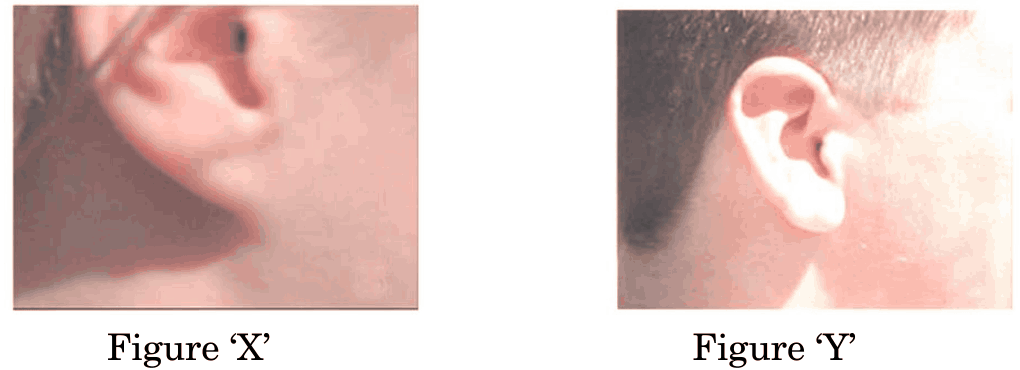
(a) A man with attached earlobes marries a woman having free earlobes. 50% of their children have free earlobes and 50% have attached earlobes. Explain the inheritance of this trait and write the trait combinations of the progeny.
(b) Write the gene combinations of the father and the mother in the above case.
Solution
Let F = gene for free earlobe (dominant) and f = attached earlobe (recessive).
(a) The father has attached earlobes, so he must be ff (a recessive trait shows only when both copies are recessive); all his sperms carry f. Since half the children are attached (ff), the mother must also carry f: she is Ff (free).
| F (mother) | f (mother) | |
|---|---|---|
| f (father) | Ff — free | ff — attached |
Progeny: Ff (free earlobes) : ff (attached earlobes) = 1 : 1, i.e. 50% each.
(b) Father: ff; Mother: Ff.
List two differences between dominant traits and recessive traits. What percentage of pea plants in the F2 generation were with yellow seeds in Mendel’s cross between the pea plants having yellow (YY) and green coloured (yy) seeds?
Solution
| Dominant trait | Recessive trait |
|---|---|
| Expressed even when only one copy of its gene is present (YY or Yy) | Expressed only when both copies are recessive (yy) |
| Appears in the F1 generation | Hidden in F1; reappears in F2 |
YY × yy → F1 all Yy (yellow). F1 × F1 (Yy × Yy) → YY : Yy : yy = 1 : 2 : 1. Yellow (YY + Yy) = 3 out of 4 = 75%.
Mendel crossed pure tall pea plants (TT) with pure short pea plants (tt) and obtained F1 progeny. When the plants of F1 progeny were self-pollinated, plants of F2 progeny were obtained. (a) What did the plants of F1 progeny look like? Give their gene combination. (b) Why could the gene for shortness not be expressed in plants of F1 progeny? (c) Write the ratio of the plants obtained in F2 progeny and state the conclusion that can be drawn from this experiment.
How do Mendel’s experiments show that the traits are inherited independently? Explain.
How did Mendel explain that it is possible that a trait is inherited but not expressed in an organism?
How do Mendel’s experiment show that traits are inherited independently?
4 marks: case-based / source-based
The most obvious outcome of the reproductive process is the generation of individuals of similar design, but in sexual reproduction they may not be exactly alike. The resemblances as well as differences are marked. The rules of heredity determine the process by which traits and characteristics are reliably inherited. Many experiments have been done to study the rules of inheritance.
(i) Why an offspring of human being is not a true copy of his parents in sexual reproduction? 1
(ii) While performing experiments on inheritance in plants, what is the difference between F1 and F2 generation? 1
(iii) (A) Why do we say that variations are useful for the survival of a species over time? 2
OR
(iii) (B) Study Mendel’s cross between two plants with a pair of contrasting characters: RRYY (Round Yellow) × rryy (Wrinkled Green). He observed 4 types of combinations in F2 generation. Which of these were new combinations? Why do new features which are not present in the parents, appear in F2 generation? 2
Solution
(i) In sexual reproduction the offspring gets half its DNA (genes) from the father and half from the mother. This creates new combinations of genes, so the child shows variations and is not an exact copy of either parent.
(ii) F1 is the first generation obtained by crossing the two parents; F2 is the second generation obtained by self-pollinating (crossing) the F1 plants.
(iii) (A) Variations give some individuals features that help them survive if the environment changes. E.g. if water temperature rises, heat-resistant variants of bacteria survive while others die. So variations ensure that at least some individuals survive, and the species continues over time.
OR (iii) (B) F2 had round yellow, round green, wrinkled yellow and wrinkled green seeds (9 : 3 : 3 : 1). The new combinations were round green and wrinkled yellow. They appear because the traits of seed shape and seed colour are inherited independently of each other, so the genes recombine in new ways in the F2 generation.
The mechanism by which the sex of an individual is determined is called sex-determination. In human beings, sex of a newborn is genetically determined, whereas in some others it is not. There are 46 (23 pairs) chromosomes in human beings. Out of these, 44 (22 pairs) control the body characters and 2 (one pair) are known as sex chromosomes. The sex chromosomes are of two types — X chromosome and Y chromosome. At the time of fertilisation, depending upon which type of male gamete fuses with the female gamete, the sex of the newborn child is decided.
(a) Why is a pair of sex chromosomes in human beings called a mismatched pair in terms of type and size? ½+½
(b) Out of male or female, which of them has a perfect pair of sex chromosomes? In case of a perfect pair, will the gametes produced be of the same kind or of a different kind? 1
(c) (i) Name two animals whose sex is not genetically determined. Explain the process of their sex determination. 1+1
OR
(c) (ii) With the help of a flowchart only, show how sex is genetically determined in human beings. 1+1
Solution
(a) In males the two sex chromosomes are of different types — one X and one Y — and of different sizes: X is normal-sized while Y is short.
(b) The female (XX) has a perfect pair. All her gametes (eggs) are of the same kind — each carries an X chromosome.
(c) (i) Some reptiles: the temperature at which the fertilised eggs are kept determines whether the developing animal will be male or female. Snails: individuals can change sex, so sex is not genetically determined.
OR (c) (ii)
| Parents | Mother (44 + XX) | × | Father (44 + XY) |
|---|---|---|---|
| Gametes | Egg: 22 + X (all) | Sperm: 22 + X or 22 + Y | |
| Zygote | Egg + X-sperm → 44 + XX → girl Egg + Y-sperm → 44 + XY → boy | ||
The sex of the child depends on which sperm (X or Y) fertilises the egg, i.e. on the father.
5 marks: long answer
(a) What are homologous structures? Give an example. (b) ‘‘The sex of a newborn child is a matter of chance and none of the parents may be considered responsible for it.’’ Justify this statement with the help of a flow chart showing sex-determination in human beings.
Solution
(a) (Evolution — not in the 2026-27 syllabus.) Homologous structures are organs with the same basic structure and origin but different functions, e.g. the forelimbs of a frog, lizard, bird and human.
(b) The mother (XX) gives an X chromosome in every egg; the father (XY) produces two kinds of sperms in equal numbers — half with X and half with Y. Which sperm fertilises the egg is purely a matter of chance:
| Parents | Mother 44 + XX | Father 44 + XY |
|---|---|---|
| Gametes | 22 + X (all eggs) | 22 + X or 22 + Y (50 : 50) |
| Children | egg + X sperm → 44 + XX (girl) · egg + Y sperm → 44 + XY (boy) — 50% chance each | |
So neither parent can be held responsible for the sex of the child.
(a) List two visible traits of garden pea that Mendel considered in his experiments. How do Mendel’s experiments show that traits may be dominant or recessive? (b) With the help of a flow diagram, how would you establish that in human beings the sex of a newborn is purely a matter of chance and none of the parents may be considered responsible for a particular sex of a newborn child?
Solution
(a) Traits: height of plant (tall/short), colour of seed (yellow/green) — also seed shape and flower colour.
Mendel crossed pure tall (TT) with pure short (tt) plants. All F1 plants were tall — only one trait was expressed, so tallness is dominant. When F1 plants were self-pollinated, F2 had tall and short plants in the ratio 3 : 1. The short trait reappeared, showing that it was present but hidden in F1 — it is recessive.
(b)
| Parents | Mother 44 + XX | Father 44 + XY |
|---|---|---|
| Gametes | 22 + X (all eggs) | 22 + X or 22 + Y (in equal numbers) |
| Offspring | egg + X-sperm → 44 + XX (girl) · egg + Y-sperm → 44 + XY (boy) | |
Which type of sperm fuses with the egg is purely a matter of chance (50 : 50), so neither parent can be held responsible for the sex of the child.
Get every solution for all chapters
- Every board question of every chapter, each fully solved the way the board gives marks
- 17 complete board papers, each followed by its solutions
- Weightage and most-asked topics for every chapter
- Instant PDF download, colour and black & white print copies
Revising the chapter first? Complete Science Notes for Class 10 (NCERT 2026-27) →
What you get in the pack
- Questions from 126 CBSE papers, 2016 to 2026: every set code available
- Complete: 2405 different questions and parts from all set codes, 13 chapters and 17 full papers
- Part A: all 13 chapters, questions sorted chapter-wise and by marks
- Year-wise weightage table and most-asked topics for every chapter
- Part B: 17 full board papers, each followed by its complete solutions, for timed practice
- Answers written to the CBSE marking-scheme points, with labelled diagrams drawn in full
- Questions on topics out of the board syllabus flagged
All chapters in this pack
- PYQ Ch 1 Chemical Reactions and Equations
- PYQ Ch 2 Acids, Bases and Salts
- PYQ Ch 3 Metals and Non-metals
- PYQ Ch 4 Carbon and its Compounds
- PYQ Ch 5 Life Processes
- PYQ Ch 6 Control and Coordination
- PYQ Ch 7 How do Organisms Reproduce
- PYQ Ch 8 Heredity
- PYQ Ch 9 Light Reflection and Refraction
- PYQ Ch 10 The Human Eye and the Colourful World
- PYQ Ch 11 Electricity
- PYQ Ch 12 Magnetic Effects of Electric Current
- PYQ Ch 13 Our Environment
- Board Paper 2026 Set 31-2-1 with Solutions
- Board Paper 2026 Set 31-3-1 with Solutions
- Board Paper 2025 Set 31-1-1 with Solutions
- Board Paper 2025 Set 31-2-1 with Solutions
- Board Paper 2024 Set 31-4-1 with Solutions
- Board Paper 2024 Set 31-5-1 with Solutions
- Board Paper 2023 Set 31-2-1 with Solutions
- Board Paper 2023 Set 31-4-1 with Solutions
- Board Paper 2022 Term 2 Set 31-1-1 with Solutions
- Board Paper 2022 Term 2 Set 31-3-1 with Solutions
- Board Paper 2020 Set 31-2-1 with Solutions
- Board Paper 2020 Set 31-4-1 with Solutions
- Board Paper 2019 Set 31-2-1 with Solutions
- Board Paper 2019 Set 31-4-1 with Solutions
- Board Paper 2018 Set 31-1 with Solutions
- Board Paper 2017 Set 3 with Solutions
- Board Paper 2016 Set 31-1 with Solutions