
CBSE Class 10 Science Question Paper 2020 (31/2/1) with Solutions
The complete CBSE Class 10 Science board paper of 2020, Q.P. code 31/2/1: all 30 questions exactly as set, with marks. 20 solutions are free below. The Class 10 Science PYQ Book: Solved Board Papers 2016-2026 (CBSE) solves all 17 papers in full and sorts every question chapter-wise.
Subject expert: Khushbu Gupta, B.Sc., M.Sc. Physics, B.Ed. · 8+ years teaching


Free: NCERT solutions for Class 10 Science →
Question paper
Jump to: Question paperSolutions
2020 · Q.P. Code 31/2/1
Maximum marks: 80
Section A · 1 mark each
Covalent compounds have low melting and boiling point. Why?
How many metals are present in second period of periodic table?
not in 2026-27 syllabusAnswer question numbers 3(a) to 3(d) on the basis of your understanding of the following paragraph and the related studied concepts.
Geothermal energy is the energy produced by the heat of molten rocks formed in the deeper hot regions of the earth’s crust. This energy is harnessed to generate electricity. When water is made to flow deep underground in the rocks it returns as steam (or hot water, which is later converted to steam) to drive a turbine on an electric power generator. In India, exploration and study of geothermal fields started in 1970. The Geological Survey in India has identified 350 geothermal energy locations in the country. The most promising of these is in Puga valley of Ladakh. The estimated potential for geothermal energy in India is about 10000 MW. There are seven geothermal provinces in India namely the Himalayas, Sohna, West coast, Cambay, Son-Narmada-Tapi; Godavari and Mahanadi. Most power stations in India produce Alternating Current (A.C).
(a) What are geothermal energy hot-spots? 1
(b) Name two countries, other than India, where power plants based on geothermal energy are operational. 1
(c) Name the phenomenon that explains the working of an electric generator. 1
(d) State an important advantage of using AC over DC. 1
Answer question numbers 4(a) to 4(d) on the basis of your understanding of the following information and related studied concepts.
Thyroid gland is a bilobed structure situated in our neck region. It secretes a hormone called thyroxine. Iodine is necessary for the thyroid gland to make thyroxine. Thyroxine regulates carbohydrate, protein and fat metabolism in the body. It promotes growth of body tissues also. When there is an excess of thyroxine in the body, a person suffers from hyperthyroidism and if this gland is underactive it results in hypothyroidism. Hyperthyroidism is diagnosed by blood tests that measure the levels of thyroxine and Thyroid Stimulating Hormone (TSH). Hypothyroidism is caused due to the deficiency of iodine in our diet resulting in a disease called goitre. Iodised salt can be included in our diet to control it.
(a) Where is thyroid gland situated in our body? 1
(b) State the function of thyroxine in human body. 1
(c) What is hyperthyroidism? 1
(d) How can we control hypothyroidism? 1
(a) Consider the following reasons for the reddish appearance of the sun at the sunrise or the sunset: A. Light from the sun near the horizon passes through thinner layers of air. B. Light from the sun covers larger distance of the earth’s atmosphere before reaching our eyes. C. Near the horizon, most of the blue light and shorter wavelengths are scattered away by the particles. D. Light from the sun near the horizon passes through thicker layers of air. The correct reasons are
(b) Person suffering from cataract has
The maximum resistance which can be made using four resistors each of 2 Ω is
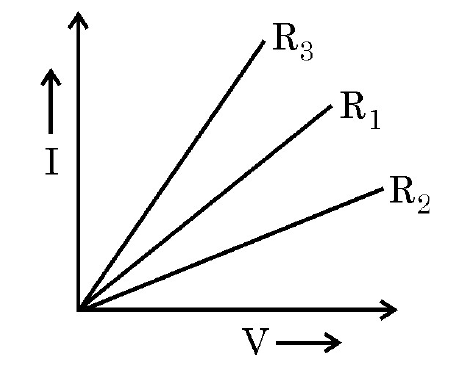
A student plots V-I graphs for three samples of nichrome wire with resistances R1, R2 and R3. Choose from the following the statement that holds true for this graph.
(a) Which of the following are water intensive crops?
(b) The most poisonous product formed by incomplete combustion of fossil fuels is
Bandharas and Tals are age old water harvesting concepts / structures found in
Identify ‘x’, ‘y’ and ‘z’ in the following reaction: 2KClO3(x) —(y)→ 2KCl(x) + O2(z)
A visually challenged student, has to perform a lab test to detect the presence of acid in a given solution. The acid-base indicator preferred by him will be:
(a) On the basis of electronic configuration of 95X, the group number and period of the element ‘X’ is:
(b) An element ‘X’ with atomic number 11 forms a compound with element ‘Y’ with atomic number 8. The formula of the compound formed is
Assertion (A): Ethanoic acid is also known as glacial acetic acid.
Reason (R): The melting point of pure ethanoic acid is 290 K and hence it often freezes during winters in cold climates.
Assertion (A): The metals and alloys are good conductors of electricity.
Reason (R): Bronze is an alloy of copper and tin and it is not a good conductor of electricity.
Section B · Short answer (3 marks)
A compound ‘A’ is used in the manufacture of cement. When dissolved in water, it evolves a large amount of heat and forms compound ‘B’. (i) Identify A and B. (ii) Write chemical equation for the reaction of A with water. (iii) List two types of reaction in which this reaction may be classified.
(a) Give reasons for the following: (i) Only one half of water molecule is shown in the formula of Plaster of Paris. (ii) Sodium hydrogen carbonate is used as an antacid. (iii) On strong heating, blue coloured copper sulphate crystals turn white.
(b) (i) Draw a labelled diagram to show the preparation of hydrogen chloride gas in laboratory. (ii) Test the gas evolved first with dry and then with wet litmus paper. In which of the two cases, does the litmus paper show change in colour? (iii) State the reason of exhibiting acidic character by dry HCl gas / HCl solution.
From the elements 3919A, 2814B, 168C and 4018D identify: (a) the most electro positive element. (b) a noble gas. (c) a metalloid. (d) an element which will gain 2 electrons to attain nearest noble gas configuration. (e) formula of compound formed between A and C. (f) elements belonging to same period.
not in 2026-27 syllabus(a) (a) Construct a terrestrial food chain comprising four trophic levels. (b) What will happen if we kill all the organisms in one trophic level? (c) Calculate the amount of energy available to the organisms at the fourth trophic level if the energy available to the organisms at the second trophic level is 2000 J.
(b) (a) Complete the following table:
| Oxygen | Ozone | |
|---|---|---|
| Formula | (i) ____ | (ii) ____ |
| Benefits to biotic component | (iii) ____ | (iv) ____ |
(b) How is ozone formed at the higher levels of atmosphere?
Complete the following flow chart as per the given instructions:
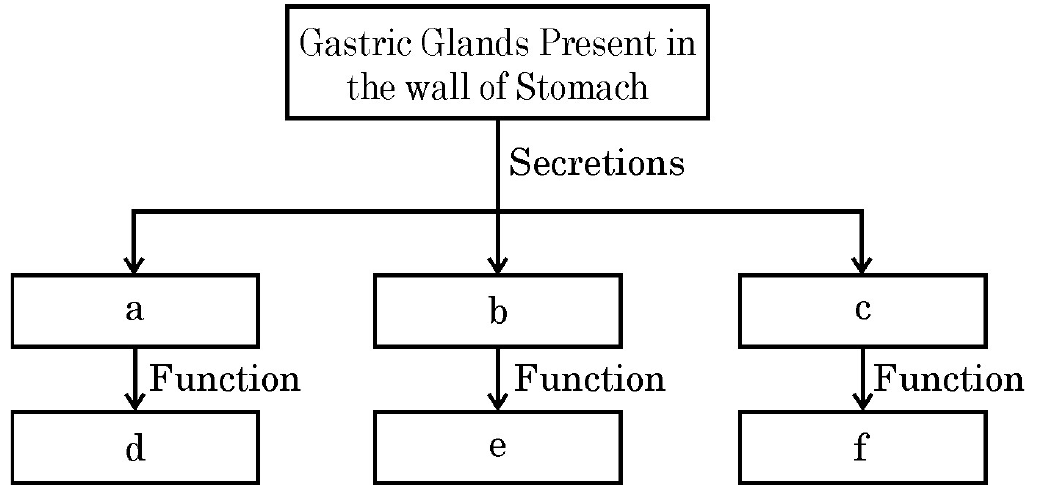
Explain giving an example how the following provide evidences in favour of evolution in organisms. (i) Homologous organs (ii) Fossils
not in 2026-27 syllabusWhat are chromosomes? Explain how in sexually reproducing organisms the number of chromosomes in the progeny is maintained.
What happens after refraction, when: (i) a ray of light parallel to the principal axis passes through a concave lens? (ii) a ray of light falls on a convex lens while passing through its principal focus? (iii) a ray of light passes through the optical centre of a convex lens?
Two coils of insulated copper wire are wound over a non-conducting cylinder as shown. Coil 1 has comparative large number of turns. State your observations, when (i) Key K is closed. (ii) Key K is opened. Give reason for each of your observations.
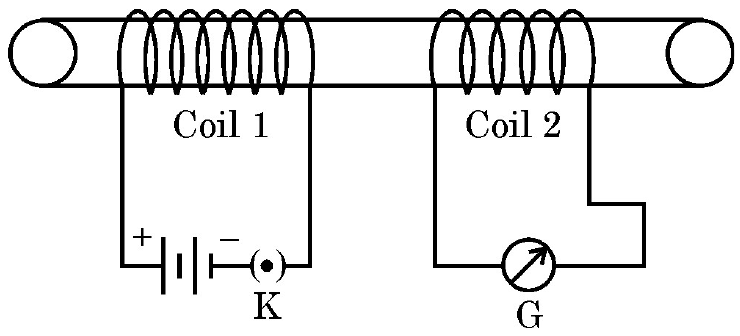 not in 2026-27 syllabus
(a) (a) List two causes of hypermetropia. (b) Draw ray diagrams showing (i) a hypermetropic eye and (ii) its correction using suitable optical device.
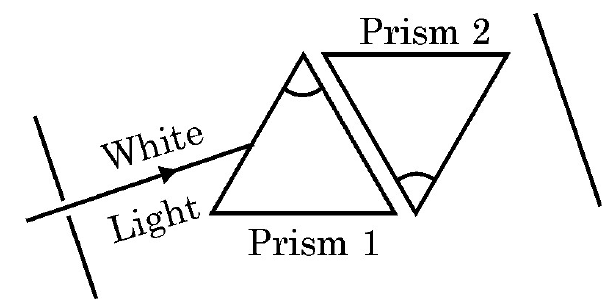
(b) (a) State the relation between colour of scattered light and size of the scattering particle. (b) The apparent position of an object, when seen through the hot air, fluctuates or wavers. State the basic cause of this observation. (c) Complete the path of white light when it passes through two identical prisms placed as shown:
Section C · Long answer (5 marks)
(a) (a) How is the method of extraction of metals high up in the reactivity series different from that for metals in the middle? Why cannot the same process be applied for them? Name and explain the process of extraction of sodium.
(b) Draw a labelled diagram of electrolytic refining of copper.
(b) What happens when (Write the balanced equation involved) – (i) Copper is heated in air? (ii) Aluminium oxide is reacted with hydrochloric acid? (iii) Potassium reacts with water? (iv) Cinnabar is heated in air? (v) Aluminium oxide reacts with sodium hydroxide?
(a) What is a homologous series? Explain with an example.
(b) Define the following terms giving one example of each. (i) Esterification (ii) Addition reaction
(a) Describe the structure and function of the basic filtering unit of kidney.
(b) List two factors on which reabsorption of water from urine depends?
(a) (a) List three different categories of contraception methods.
(b) Why has Government of India prohibited prenatal sex determination by law? State its benefits in the long run.
(c) Unsafe sexual act can lead to various infections. Name two bacterial and two viral infections caused due to unsafe sex.
(b) (a) In the female reproductive system of human beings, state the functions of (i) ovary (ii) oviduct
(b) Mention the changes which the uterus undergoes, when (i) it has to receive a zygote. (ii) no fertilization takes place.
(c) State the function of placenta.
(a) Find the ratio of resistances of two copper rods X and Y of lengths 30 cm and 10 cm respectively and having radii 2 cm and 1 cm respectively.
(b) A current of 500 mA flows in a series circuit containing an electric lamp and a conductor of 10 Ω when connected to 6 V battery. Find the resistance of the electric lamp.
(a) (a) A concave mirror of focal length 10 cm can produce a magnified real as well as virtual image of an object placed in front of it. Draw ray diagrams to justify this statement.
(b) An object is placed perpendicular to the principal axis of a convex mirror of focal length 10 cm. The distance of the object from the pole of the mirror is 10 cm. Find the position of the image formed.
(b) (a) Define the following terms: (i) Power of a lens (ii) Principal focus of a concave mirror
(b) Write the relationship among the object distance (u), image distance (v) and the focal length (f) of a (i) Spherical lens (ii) Spherical mirror
(c) An object is placed at a distance of 10 cm from optical centre of a convex lens of focal length 15 cm. Draw a labelled ray diagram to show the formation of image in this case.
Solutions: CBSE 2020 · 31/2/1
The forces of attraction between the molecules of covalent compounds are weak, so little energy is needed to separate them.
(a) Regions inside the earth where molten rocks (magma) pushed upward are trapped; the ground water in contact with them is heated and converted into steam.
(b) New Zealand and the United States of America.
(c) Electromagnetic induction.
(d) AC can be transmitted over long distances without much loss of energy.
Answer: (b) B, C and D
Near the horizon, sunlight travels a longer distance through thicker layers of air; most of the blue light is scattered away, so the light reaching us is mainly red. A is wrong.
Answer: (c) 8 Ω
Maximum resistance is obtained in series: 2 + 2 + 2 + 2 = 8 Ω. (Minimum, in parallel: 2/4 = 0.5 Ω.)
Answer: (c) Sugarcane and rice
Answer: (b) Maharashtra
Answer: (b) Clove oil
Clove oil is an olfactory indicator — its smell changes (is lost) in a basic solution, so it can be used without seeing colours. The others change colour.
Answer: (b) X2Y
X (2, 8, 1) loses 1 electron → X+; Y (2, 6) gains 2 → Y2−. Two X+ balance one Y2−: X2Y (sodium oxide, Na2O).
Answer: (c)
A is true. R is false: bronze is an alloy of copper and tin, but it does conduct electricity (alloys have somewhat lower conductivity than pure metals, but they are still conductors).
(i) In Plaster of Paris, two formula units of CaSO4 share one molecule of water: (CaSO4)2·H2O, written as CaSO4·½H2O.
(ii) Sodium hydrogencarbonate is a mild, non-corrosive base; it neutralises the excess acid in the stomach and gives relief.
(iii) The blue crystals (CuSO4·5H2O) lose their water of crystallisation on heating and form white anhydrous copper sulphate: CuSO4·5H2O → CuSO4 + 5H2O.
A (19): 2, 8, 8, 1 (potassium); B (14): 2, 8, 4 (silicon); C (8): 2, 6 (oxygen); D (18): 2, 8, 8 (argon).
(a) A (b) D (c) B (d) C (e) A2C (K2O) (f) B and D (both have three shells — period 3).
(a) (i) O2 (ii) O3 (iii) Oxygen is needed for respiration (release of energy from food) by most organisms. (iv) Ozone in the upper atmosphere shields the earth from harmful UV radiation of the Sun, which can cause skin cancer and damage organisms.
(b) High-energy UV radiation splits some oxygen molecules into free oxygen atoms, which then combine with oxygen molecules:
O + O2 → O3
(i) Homologous organs have the same basic structure (and origin) but perform different functions, e.g. the forelimbs of frogs, lizards, birds and humans. This shows that these animals evolved from a common ancestor.
(ii) Fossils are preserved traces of organisms that lived long ago. Comparing fossils of different ages shows how organisms changed over time; e.g. Archaeopteryx has features of both reptiles and birds, suggesting that birds evolved from reptiles.
(i) It diverges and appears to come from the principal focus F1 on the same side of the lens.
(ii) It emerges parallel to the principal axis.
(iii) It passes through without any deviation.
(a) (1) The focal length of the eye lens is too long. (2) The eyeball has become too small.
(b) (i) 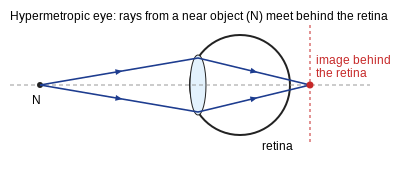
(ii) Correction with a convex lens of suitable power:
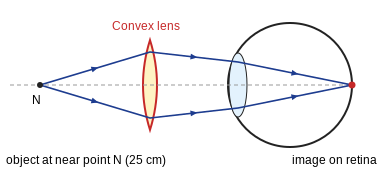
(a) Metals in the middle (Zn, Fe, Pb) are obtained by converting their ores to oxides (roasting/calcination) and then reducing the oxides with carbon. Metals high up (Na, Mg, Ca, Al) are obtained by electrolytic reduction of their molten chlorides (or oxides).
The same process cannot be used because these metals have a greater affinity for oxygen than carbon, so carbon cannot reduce their oxides.
Extraction of sodium — electrolysis of molten sodium chloride: the metal is deposited at the cathode and chlorine is liberated at the anode.
At anode: 2Cl− → Cl2 + 2e−
(b) 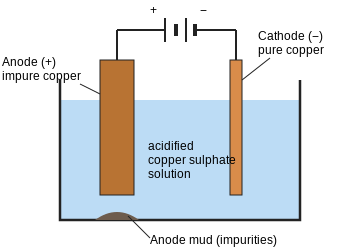
(a) A homologous series is a series of carbon compounds having the same functional group and similar chemical properties, in which successive members differ by a –CH2– unit (14 u). Example — alkanes: CH4, C2H6, C3H8, C4H10; each differs from the next by CH2; their physical properties (melting and boiling points) change gradually with molecular mass, but chemical properties are similar.
(b) (i) Esterification: the reaction of a carboxylic acid with an alcohol in the presence of an acid catalyst to form a sweet-smelling ester:
(ii) Addition reaction: a reaction in which atoms are added to an unsaturated compound across the double/triple bond, giving a saturated compound — e.g. hydrogenation of oils with a nickel catalyst:
(a) (1) Mechanical barriers — condoms, so sperm cannot reach the egg. (2) Hormonal (chemical) methods — oral pills that change hormonal balance so eggs are not released. (3) Surgical methods — vasectomy and tubectomy. (Also intra-uterine devices such as the copper-T.)
(b) Prenatal sex determination was being misused for female foeticide (selective abortion of girl children), which reduced the female-to-male sex ratio sharply in some areas. Banning it helps to maintain a healthy, balanced sex ratio in the society in the long run.
(c) Bacterial: gonorrhoea, syphilis. Viral: warts, HIV-AIDS.
(a) R = ρl/A = ρl/(πr2). Both are copper (same ρ):
RX : RY = 3 : 4.
(b) I = 500 mA = 0.5 A; V = 6 V.
Rlamp = 12 − 10 = 2 Ω
(a) (i) Power of a lens is its ability to converge or diverge light rays; it is the reciprocal of its focal length in metres, P = 1/f (unit: dioptre). (ii) Principal focus of a concave mirror is the point on the principal axis at which rays parallel to the principal axis meet after reflection.
(b) (i) Lens: 1/v − 1/u = 1/f. (ii) Mirror: 1/v + 1/u = 1/f.
(c) The object is within the focal length (u = 10 cm < f = 15 cm), so the image is virtual, erect and enlarged, on the same side as the object (1/v = 1/15 − 1/10 ⇒ v = −30 cm, m = 3):
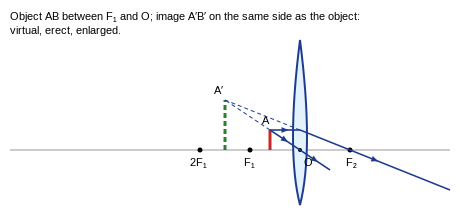
Get every solution for all 17 papers
- Every board question of every chapter, each fully solved the way the board gives marks
- 17 complete board papers, each followed by its solutions
- Weightage and most-asked topics for every chapter
- Instant PDF download, colour and black & white print copies
Revising the chapter first? Complete Science Notes for Class 10 (NCERT 2026-27) →
What you get in the pack
- Questions from 126 CBSE papers, 2016 to 2026: every set code available
- Complete: 2405 different questions and parts from all set codes, 13 chapters and 17 full papers
- Part A: all 13 chapters, questions sorted chapter-wise and by marks
- Year-wise weightage table and most-asked topics for every chapter
- Part B: 17 full board papers, each followed by its complete solutions, for timed practice
- Answers written to the CBSE marking-scheme points, with labelled diagrams drawn in full
- Questions on topics out of the board syllabus flagged
All chapters in this pack
- PYQ Ch 1 Chemical Reactions and Equations
- PYQ Ch 2 Acids, Bases and Salts
- PYQ Ch 3 Metals and Non-metals
- PYQ Ch 4 Carbon and its Compounds
- PYQ Ch 5 Life Processes
- PYQ Ch 6 Control and Coordination
- PYQ Ch 7 How do Organisms Reproduce
- PYQ Ch 8 Heredity
- PYQ Ch 9 Light Reflection and Refraction
- PYQ Ch 10 The Human Eye and the Colourful World
- PYQ Ch 11 Electricity
- PYQ Ch 12 Magnetic Effects of Electric Current
- PYQ Ch 13 Our Environment
- Board Paper 2026 Set 31-2-1 with Solutions
- Board Paper 2026 Set 31-3-1 with Solutions
- Board Paper 2025 Set 31-1-1 with Solutions
- Board Paper 2025 Set 31-2-1 with Solutions
- Board Paper 2024 Set 31-4-1 with Solutions
- Board Paper 2024 Set 31-5-1 with Solutions
- Board Paper 2023 Set 31-2-1 with Solutions
- Board Paper 2023 Set 31-4-1 with Solutions
- Board Paper 2022 Term 2 Set 31-1-1 with Solutions
- Board Paper 2022 Term 2 Set 31-3-1 with Solutions
- Board Paper 2020 Set 31-2-1 with Solutions
- Board Paper 2020 Set 31-4-1 with Solutions
- Board Paper 2019 Set 31-2-1 with Solutions
- Board Paper 2019 Set 31-4-1 with Solutions
- Board Paper 2018 Set 31-1 with Solutions
- Board Paper 2017 Set 3 with Solutions
- Board Paper 2016 Set 31-1 with Solutions