
Life Processes: Class 10 PYQs 2018–2026 with solutions
All 60 CBSE board questions asked from Life Processes in 13 board papers, with the year, set and marks of each. 32 are solved free below. The Class 10 Science PYQ Book: Solved Board Papers 2016-2026 (CBSE) has every solution, all chapters and 17 full board papers.
Subject expert: Khushbu Gupta, B.Sc., M.Sc. Physics, B.Ed. · 8+ years teaching


Free: NCERT solutions for Class 10 Science →
Life Processes: board weightage
Board weightage 2018–2026
| Year | 2016 | 2017 | 2018 | 2019 | 2020 | 2022 | 2023 | 2024 | 2025 | 2026 |
|---|---|---|---|---|---|---|---|---|---|---|
| Questions | – | – | 3 | 7 | 6 | – | 13 | 10 | 10 | 11 |
| Marks | – | – | 12 | 18 | 16 | – | 24 | 25 | 23 | 20 |
Most asked topics
60 questions from 13 papers. Repeated questions are shown once with every year they were asked.
Jump to: 1 mark2 marks3 marks4 marks5 marks
1 mark: MCQ and Assertion–Reason
The carbohydrates, which are not used immediately in plants, are stored in the form of ‘a’, which serves as an internal energy reserve. What does ‘a’ stand for?
Solution
Answer: (A) Starch
Plants store unused carbohydrate (glucose made in photosynthesis) as starch, which serves as the internal energy reserve. (Animals store it as glycogen.)
The following events occur during the process of photosynthesis. Choose the option that indicates the correct events.
(i) Oxidation of carbon dioxide to carbohydrates
(ii) Conversion of light energy into chemical energy
(iii) Absorption of light energy by chlorophyll
(iv) Conversion of hydrogen and oxygen into water
Solution
Answer: (B) (ii) and (iii)
The three events of photosynthesis are: absorption of light energy by chlorophyll; conversion of light energy to chemical energy and splitting of water into hydrogen and oxygen; and reduction (not oxidation) of carbon dioxide to carbohydrates. Water is split, not formed. So only (ii) and (iii) are correct.
Assertion (A): Blood plasma transports carbon dioxide in dissolved form, while oxygen is transported by respiratory pigments.
Reason (R): Carbon dioxide is more soluble in water than in oxygen.
Solution
Answer: (A) (the board also accepted (C) because of the wording of R)
Both statements are true. Carbon dioxide is more soluble in water than oxygen is, so it is mostly carried dissolved in plasma, whereas oxygen, being less soluble, needs the respiratory pigment haemoglobin. R explains A.
Pravin was given a list of characteristics associated with the process of anaerobic respiration in humans, in the table given below:

Which of the above characteristics is/are related to the above process?
Solution
Answer: (B) (i) and (iii)
In humans, anaerobic respiration takes place in muscle cells during heavy exercise, when oxygen is in short supply. Pyruvate is converted into lactic acid, a 3-carbon molecule. It does not need oxygen, so (ii) is wrong.
Observe the figure given below and identify the incorrect step for the activity set-up:
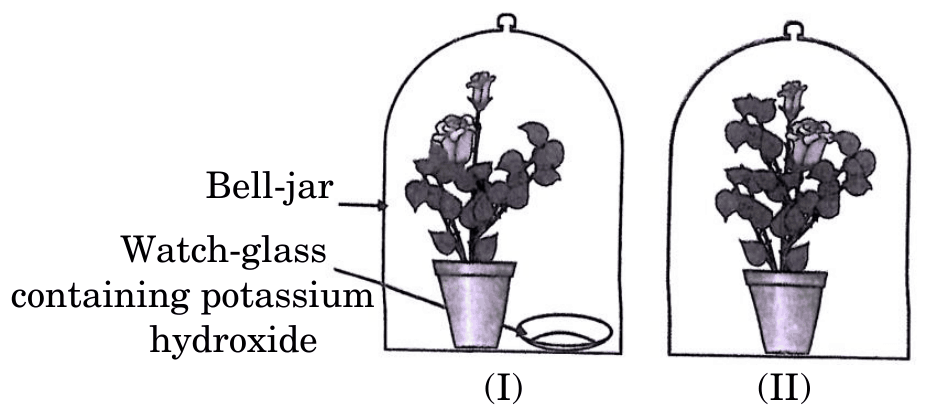
Solution
Answer: (B)
This activity shows that CO2 is needed for photosynthesis (KOH absorbs CO2 in jar I). The bell-jars must be made of glass (transparent) so that sunlight reaches the plants; wooden jars would block light, so step (B) is incorrect. The other steps are correct: de-starching in the dark, sealing with vaseline so that air cannot enter, and keeping in sunlight before the iodine test.
Assertion (A): The basic filtration unit in the kidneys, like in the lungs, is a cluster of very thin-walled blood capillaries.
Reason (R): Each capillary cluster in the kidney is associated with the cup-shaped end of a coiled tube called Bowman’s capsule.
Solution
Answer: (B)
Both are true. The filtration unit is a cluster of thin-walled capillaries (glomerulus), and each cluster sits in the cup-shaped Bowman's capsule. But R only describes the structure; it does not explain why the filtration unit is a cluster of thin-walled capillaries.
Secretion of less saliva in mouth will effect the conversion of:
Solution
Answer: (C)
Saliva contains salivary amylase, which breaks down starch into simple sugar. Less saliva means less starch digestion in the mouth.
The breakdown of glucose has taken the following pathway: Glucose →(a) Pyruvate + Energy →(b) Lactic acid + Energy. The sites ‘a’ and ‘b’ respectively are:
Solution
Answer: (D)
Glucose → pyruvate takes place in the cytoplasm of all cells. Pyruvate → lactic acid happens in muscle cells when there is a lack of oxygen (e.g. during vigorous exercise, causing cramps).
The opening and closing of stomata is regulated by:
Solution
Answer: (D)
When water flows into the guard cells they swell and the pore opens; when they lose water they shrink and the pore closes.
One-cell thick blood vessels are known as:
Solution
Answer: (B) Capillaries
Capillaries are the smallest blood vessels; their walls are one cell thick, which allows exchange of materials between the blood and the surrounding cells. (Alveoli are air sacs, not blood vessels.)
Assertion (A): Animals will not get energy if they eat (consume) coal as food.
Reason (R): Specific enzymes are needed for the breakdown of a particular food.
Solution
Answer: (A)
Both are true and R explains A: animals do not have enzymes that can break down coal, so they cannot obtain energy from it.
In human beings, when the process of digestion is completed, the (i) proteins, (ii) carbohydrates, and (iii) fats are respectively finally converted into:
Solution
Answer: (B)
In the small intestine, proteins are finally digested to amino acids, complex carbohydrates to glucose, and fats to fatty acids and glycerol.
Assertion (A): In the human heart ventricles have thicker muscular walls than atria.
Reason (R): Ventricles have to pump the blood into various organs.
The process in which transport of soluble products of photosynthesis takes place in plants is known as:
Sphincter muscles are present at the exit of:
In the following diagram, identify the cells through which massive amounts of gaseous exchange takes place for photosynthesis:
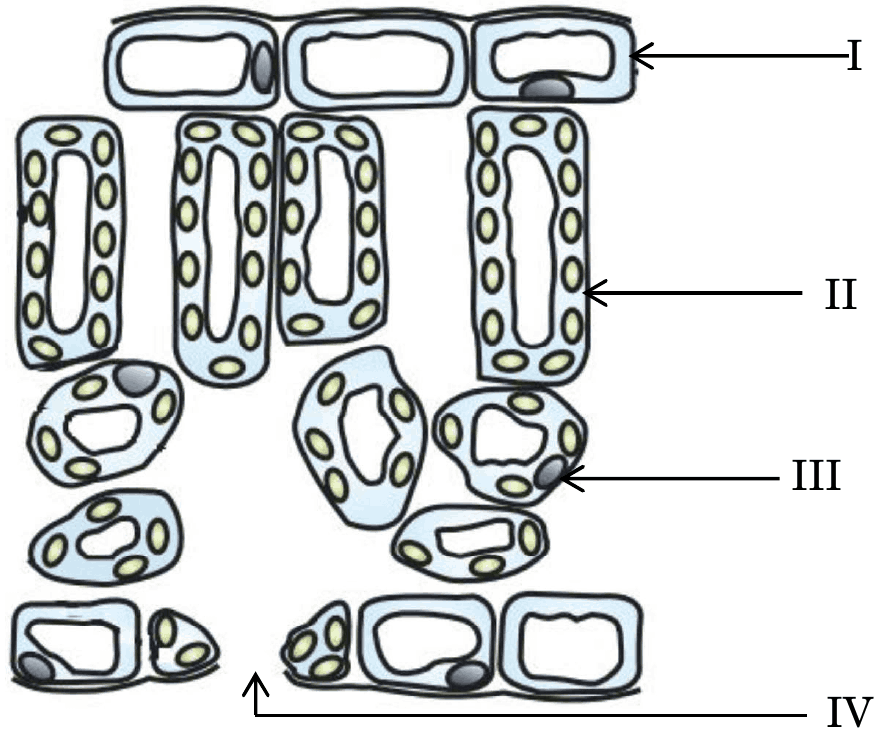
During vigorous exercise, the occurrence of cramps in the outer muscles of an athlete is due to the conversion of pyruvate to:
Observe the following diagram and identify the process and its significance from the following options:
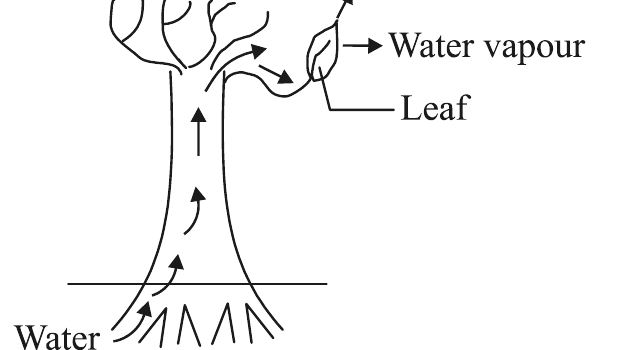
Opening and closing of stomata is due to:
Assertion (A): The inner walls of the small intestine have finger like projections called villi which are rich in blood.
Reason (R): These villi have a large surface area to help the small intestine in completing the digestion of food.
Which one of the following statements is correct about the human circulatory system?
Anaerobic process
Most of the digestion and absorption of the food takes place in the
2 marks: very short answer
What kind of respiration provides more energy and why?
Solution
Aerobic respiration (in the presence of oxygen) provides much more energy than anaerobic respiration.
Reason: in aerobic respiration glucose is broken down completely into carbon dioxide and water in the mitochondria, so almost all the energy stored in it is released. In anaerobic respiration glucose is broken down only partly (into ethanol + CO2 or lactic acid), so much less energy is released.
Separation of right side and left side of the heart is useful to keep oxygenated and deoxygenated blood from mixing. Various organisms have different types of heart.
(I) Fill in the blanks (i) to (iii) correctly according to the type of organisms and their evolution in terms of blood circulation:
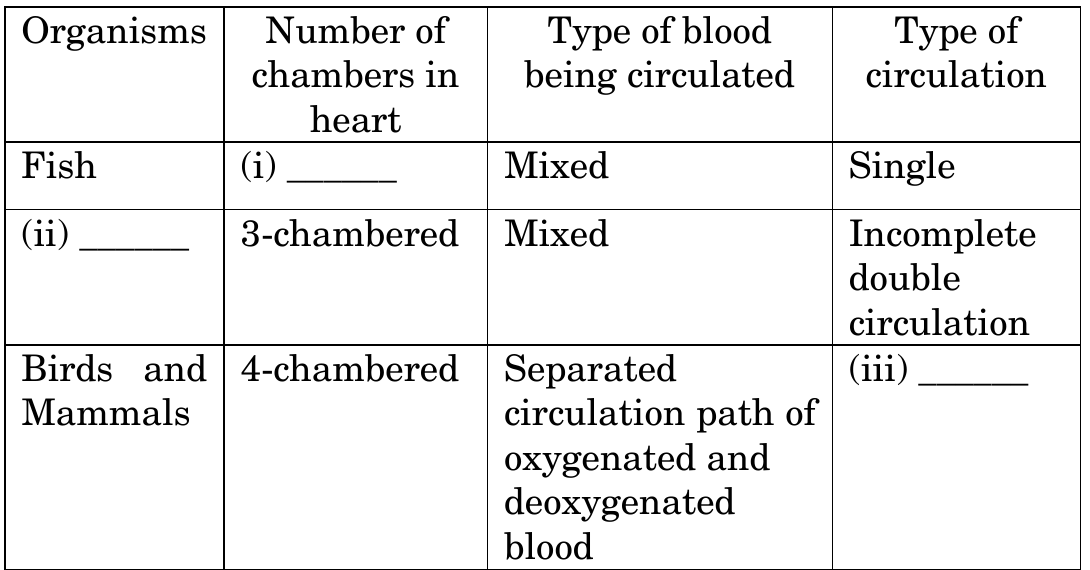
(II) Which type of circulation is most efficient?
Solution
(I) (i) Two-chambered heart (fish)
(ii) Amphibians (and many reptiles)
(iii) Double circulation
(II) Double circulation (four-chambered heart of birds and mammals) is the most efficient. Blood passes through the heart twice in one complete cycle, and oxygenated and deoxygenated blood do not mix. This gives a highly efficient supply of oxygen, which birds and mammals need for their high energy use and to maintain body temperature.
Besides minimising the loss of blood, why is it essential to plug any leak in a blood vessel? Name the component of blood which helps in this process and state how this component perform this function.
Solution
A leak would cause a loss of pressure in the circulatory system, which would reduce the efficiency of the pumping system. So the leak must be plugged.
Component: platelets. Platelets circulate in the blood and plug leaks by helping the blood to clot at the point of injury.
(i) The transport system in plants is relatively slower than in animals. Give reasons.
(ii) State the role of phloem in the transport of materials in plants.
Solution
(i) Plants do not move, and they have a large proportion of dead cells in many tissues. So plants have low energy needs and can manage with a relatively slow transport system.
(ii) Phloem carries out translocation: it transports the soluble products of photosynthesis (sucrose) from the leaves to other parts of the plant, and also amino acids and other substances to the storage organs (roots, fruits, seeds) and growing parts. Translocation uses energy from ATP.
We need to water the soil in plants on a regular basis. But it ultimately reaches the leaves of the plant. Explain how this takes place.
Solution
Water is absorbed by the roots and carried up through the xylem, a continuous system of water-conducting channels from root to leaf.
• Root pressure: root cells actively take up ions, creating a concentration difference; water moves into the roots and is pushed up as a column.
• Transpiration pull: loss of water vapour from the leaves through stomata creates a suction that pulls water up from the roots to the leaves. This is the main driving force during the day.
Name the type of nutrition exhibited by Amoeba. Explain how food is taken in and digested by this organism.
Solution
Holozoic (heterotrophic) nutrition.
Amoeba takes in food using temporary finger-like extensions of the cell surface (pseudopodia), which fuse over the food particle to form a food vacuole. Inside the food vacuole, complex substances are broken down into simpler ones, which diffuse into the cytoplasm. The undigested material moves to the surface of the cell and is thrown out.
Sometimes while running, the athletes suffer from muscle cramps. Why? How is the respiration in this case different from aerobic respiration?
Solution
During fast running the muscles need energy faster than oxygen can be supplied. They respire anaerobically, converting pyruvate into lactic acid; its build-up causes cramps.
Difference: this respiration takes place without oxygen, in the cytoplasm of muscle cells; glucose is broken down only partly to lactic acid and much less energy is released. Aerobic respiration uses oxygen, takes place in the mitochondria, breaks glucose completely into CO2 and water, and releases much more energy.
Write the other name given to lymph. State its two functions.
Solution
Lymph is also called tissue fluid.
Functions: (1) it carries digested and absorbed fat from the intestine; (2) it drains excess fluid from the spaces between cells back into the blood. (It also contains lymphocytes that help fight infection.)
(a) Why is it important to prevent oxygenated and deoxygenated blood from mixing in birds and mammals?
(b) Which animals can tolerate some mixing of the oxygenated and deoxygenated blood streams? On what factor does the body temperature of these animals depend?
Write one specific function each of the following organs in relation with excretion in human beings: (i) Renal Artery (ii) Urethra (iii) Glomerulus (iv) Tubular part of nephron
Two green plants are kept separately in oxygen free containers, one in the dark and other in sunlight. It was observed that plant kept in dark could not survive longer. Give reason for this observation.
List four precautions which a student should observe while preparing a temporary mount of a leaf peel to show stomata in his school laboratory.
Write four sequential steps of the procedure of the experiment ‘‘Preparing a temporary mount of a leaf peel to show stomata.’’
In the experimental set-up to show that ‘‘the germinating seeds give out carbon dioxide’’, answer the following questions: (i) Why do we keep the conical flask airtight? (ii) Name the substance kept in the small test tube inside the conical flask. Write its role. (iii) Why does water rise in the delivery tube?
List the steps of preparation of temporary mount of a leaf peel to observe stomata.
3 marks: short answer
Complete the pathways given below, showing the breakdown of glucose.
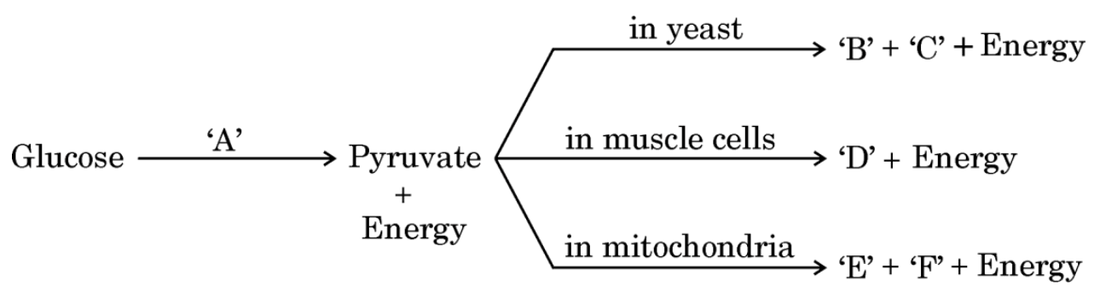
Identify ‘A’, ‘B’, ‘C’, ‘D’, ‘E’ and ‘F’.
Solution
A – Cytoplasm (glucose, a 6-carbon molecule, breaks into pyruvate, a 3-carbon molecule)
B – Ethanol and C – Carbon dioxide (anaerobic respiration / fermentation in yeast)
D – Lactic acid (in muscle cells when oxygen is in short supply)
E – Carbon dioxide and F – Water (aerobic respiration in mitochondria; most energy released)
Pyruvate →(yeast, no O2) Ethanol + CO2 + energy
Pyruvate →(muscle, lack of O2) Lactic acid + energy
Pyruvate →(mitochondria, O2) CO2 + H2O + energy
In xylem tissue, vessels and tracheids of the roots, stems and leaves are interconnected to form a continuous system of water-conducting channels reaching all parts of the plant. Explain how this is achieved.
Solution
Water moves up through this continuous system of xylem channels in two ways:
1. Root pressure: cells of the root in contact with the soil actively take up ions. This creates a difference in ion concentration between the root and the soil, so water moves into the root from the soil. This makes a steady column of water that is pushed upwards.
2. Transpiration pull: water evaporates from the leaves through the stomata (transpiration). The water lost is replaced by water from the xylem vessels of the leaf. This creates a suction that pulls water up from the xylem cells of the roots through the continuous column.
Root pressure is important at night; during the day, transpiration pull is the major driving force for the movement of water in the xylem.
(i) What is the first step in the breakdown of glucose during aerobic and anaerobic respiration? Where does it take place?
(ii) ATP is called the energy currency of the cell. Why?
(iii) What is meant by residual volume of air in a breathing cycle?
Solution
(i) The first step is the breakdown of glucose (a 6-carbon molecule) into pyruvate (a 3-carbon molecule), with release of a little energy. It takes place in the cytoplasm.
(ii) The energy released during respiration is used to make ATP. Whenever a cell needs energy (for muscle contraction, protein synthesis, nerve impulses), ATP is broken down and releases a fixed amount of energy. Like money, ATP is "earned" in respiration and "spent" in all activities, so it is called the energy currency.
(iii) Residual volume is the volume of air that always remains in the lungs even after we breathe out. It allows sufficient time for oxygen to be absorbed and carbon dioxide to be released.
Write in sequence the steps for experimental verification of the fact that sunlight is essential for photosynthesis.
Solution
1. Keep a potted plant in a dark room for about three days so that its leaves become starch-free (de-starching).
2. Cover a part of one leaf on both sides with strips of black paper (with clips).
3. Keep the plant in bright sunlight for a few hours.
4. Pluck the leaf and remove the black paper.
5. Boil the leaf in water, then in alcohol on a water bath to remove the chlorophyll; wash it with water.
6. Put a few drops of iodine solution on the leaf.
Observation: the part exposed to light turns blue-black; the covered part does not.
Conclusion: starch is made only in the part that received light, so sunlight is essential for photosynthesis.
(i) How does Paramecium obtain its food?
(ii) List the role of each of the following in our digestive system: (a) Hydrochloric acid (b) Trypsin (c) Muscular walls of stomach (d) Salivary amylase
Solution
(i) Paramecium is unicellular with a definite shape; food is taken in at a specific spot. Cilia, which cover the entire surface of the cell, move the food to that spot, from where it is taken in.
(ii) (a) Hydrochloric acid creates an acidic medium for the action of pepsin (and kills germs).
(b) Trypsin (pancreatic juice) digests proteins.
(c) Muscular walls of the stomach mix the food thoroughly with digestive juices (churning).
(d) Salivary amylase breaks down starch into simple sugar.
(i) What is double circulation?
(ii) Why is the separation of the right side and the left side of the heart useful? How does it help birds and mammals?
Solution
(i) Double circulation: blood passes through the heart twice during each complete cycle — once to the lungs (pulmonary circulation) and once to the rest of the body (systemic circulation).
(ii) The separation keeps oxygenated and deoxygenated blood from mixing, giving a highly efficient supply of oxygen to the body. Birds and mammals have high energy needs because they constantly use energy to maintain their body temperature; this efficient supply meets that need.
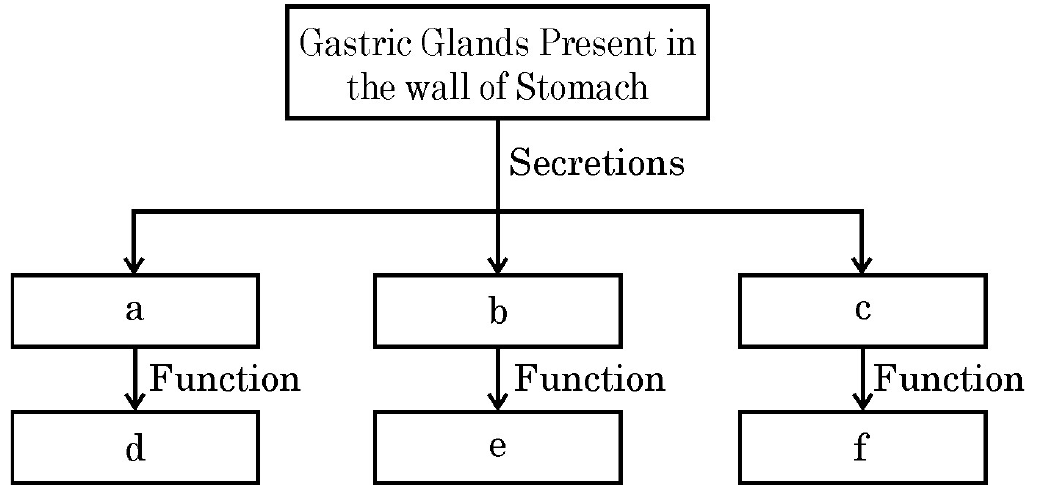
Complete the following flow chart as per the given instructions:
List in tabular form three distinguishing features between autotrophic nutrition and heterotrophic nutrition.
What is transpiration? List its two functions.
(a) What is translocation? Why is it essential for plants? (b) Where do the substances in plants reach as a result of translocation?
(a) Write the function of the following in the human alimentary canal: (i) Saliva (ii) HCl in stomach (iii) Bile juice (iv) Villi
(b) Write one function each of the following enzymes: (i) Pepsin (ii) Lipase
4 marks: case-based / source-based
Read the following passage and answer the questions that follow:
Not all plants carry out photosynthesis by the same mechanism. In most plants, it depends directly on gaseous carbon dioxide that diffuses into the leaf. However, some plants can store carbon dioxide in the vacuole of the leaf cells as part of a complex carbon compound. This compound is transported to the chloroplast and releases carbon dioxide when required for photosynthesis. This special mechanism is believed to have evolved as an adaptation in such plants which do not open stomata during the daytime to conserve water for survival in dry conditions (desert conditions).
Attempt either (a) or (b):
(a) (i) Which process in these plants is minimised to help the plants survive in dry conditions? (ii) Which part of the leaf is responsible for exchange of gases during photosynthesis?
OR
(b) (i) List the events that occur during the process of photosynthesis. (ii) When are such desert plants likely to take in carbon dioxide from the environment, unlike other plants? (iii) Draw a labelled diagram of stomata with open stomatal pore.
Solution
(a) (i) Transpiration (loss of water through stomata) is minimised by keeping the stomata closed during the day.
(ii) The stomata — tiny pores on the surface of the leaf — are where gases are exchanged during photosynthesis.
OR (b) (i) Events of photosynthesis: (1) absorption of light energy by chlorophyll; (2) conversion of light energy into chemical energy and splitting of water molecules into hydrogen and oxygen; (3) reduction of carbon dioxide to carbohydrates.
(ii) At night, when they open their stomata; the CO2 taken in is stored and used during the day.
(iii) 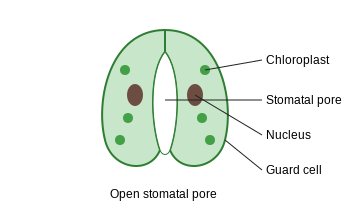
The maintenance functions of all living organisms must go on even when they are not doing anything particular. Even when we are just sitting in a class or even asleep, this maintenance job has to go on. These maintenance processes require energy to prevent damage and break-down of cells and tissues, which is obtained by the individual organism from the food prepared by the autotrophs, called producers.
(a) Name and define the process by which green plants prepare food. 1
(b) Write chemical equation involved in the above process. 1
(c) (i) State in proper sequence the events that occur in synthesis of food by desert plants. 2
OR
(c) (ii) Explain giving reasons what happens to the rate at which the green plants will prepare food (I) during cloudy weather, and (II) when stomata get blocked due to dust. 2
Solution
(a) Photosynthesis — the process by which green plants take in carbon dioxide and water and convert them into carbohydrates (glucose) in the presence of sunlight and chlorophyll, releasing oxygen.
(b)
(c) (i) Desert plants open their stomata only at night: (1) at night they take in CO2 and store it as an intermediate (acid) compound; (2) during the day chlorophyll absorbs light energy; (3) light energy is converted to chemical energy and water is split into hydrogen and oxygen; (4) the stored CO2 is released and reduced to carbohydrates using this energy.
OR (c) (ii) (I) In cloudy weather less sunlight is available, so less light energy is absorbed by chlorophyll and the rate of photosynthesis decreases.
(II) Blocked stomata reduce the intake of carbon dioxide (and gas exchange), so the rate of photosynthesis decreases.
Kidneys are vital organs for survival. Several factors like infections, injury or restricted blood flow to kidneys reduce the activity of kidneys. This leads to accumulation of poisonous wastes in the body, which can even lead to death. In case of kidney failure, an artificial kidney can be used. An artificial kidney is a device to remove waste products from the blood through dialysis.
(a) (i) Name the artery that brings oxygenated blood to the kidney. (ii) Name the cluster the thin-walled blood capillaries present in the Bowman’s capsule. 1
(b) In human excretory system name the organ which stores urine. Is this organ under hormonal control or nervous control? 1
(c) (i) List two major steps involved in the formation of urine and state in brief their functions. 2
OR
(c) (ii) In which part of the nephron does selective reabsorption take place? List the factors which the amount of water reabsorbed depends on. 2
5 marks: long answer
(i) “The length of the small intestine in various animals depends on the food they eat.” Justify the statement.
(ii) Discuss the role of the pancreas and bile juice in the digestion of food in human beings.
(iii) How is the small intestine designed to absorb digested food?
Solution
(i) Herbivores eating grass need a longer small intestine to allow the cellulose to be digested. Carnivores like tigers have a shorter small intestine because meat is easier to digest.
(ii) Bile juice (from the liver): the food coming from the stomach is acidic, and bile makes it alkaline so that pancreatic enzymes can act; bile salts break large fat globules into smaller ones (emulsification), increasing the efficiency of enzyme action.
Pancreas: secretes pancreatic juice containing trypsin for digesting proteins and lipase for breaking down emulsified fats (and amylase for starch).
(iii) The inner lining of the small intestine has numerous finger-like projections called villi, which greatly increase the surface area for absorption. The villi are richly supplied with blood vessels, which take the absorbed food to every cell of the body.
(i) State the role of rings of cartilage present in the throat.
(ii) Discuss the role of the ribs and diaphragm when air is taken in during the breathing cycle.
(iii) Why do we get muscle cramps during heavy exercise? Explain.
Solution
(i) Rings of cartilage in the throat (trachea) ensure that the air passage does not collapse, so air can flow freely.
(ii) When we breathe in, the ribs are lifted (move up and out) and the diaphragm flattens (contracts). The chest cavity becomes larger, the pressure inside falls, and air is sucked into the lungs and fills the expanded alveoli.
(iii) During heavy exercise our muscles need more energy than the oxygen supply can support. The muscle cells then carry out anaerobic respiration, in which pyruvate is converted into lactic acid. The build-up of lactic acid in the muscles causes cramps.
Design an experiment to demonstrate that carbon dioxide is essential for photosynthesis. Write the observation and conclusion of the experiment.
Solution
Experiment:
1. Take two healthy potted plants of nearly the same size. Keep them in a dark room for three days so that all the starch in their leaves is used up (de-starching).
2. Place each plant on a separate glass plate. Put a watch-glass containing potassium hydroxide (KOH) beside one plant — KOH absorbs carbon dioxide.
3. Cover both plants with separate glass bell-jars and seal the bottom of the jars with vaseline so that the set-up is air-tight.
4. Keep both plants in sunlight for about two hours.
5. Pluck a leaf from each plant, boil it in alcohol (to remove chlorophyll) and test it with iodine solution.
Observation: the leaf of the plant without KOH turns blue-black (starch present); the leaf of the plant with KOH does not turn blue-black (no starch).
Conclusion: the plant with KOH did not get carbon dioxide and could not make starch, so carbon dioxide is essential for photosynthesis.
(i) In the experimental set-up shown above in diagram (I) atmospheric air is being passed into lime water with a syringe while in diagram (II) air is being exhaled into lime water. The time taken for the lime water to turn milky in both the test tubes is different. Give reason.
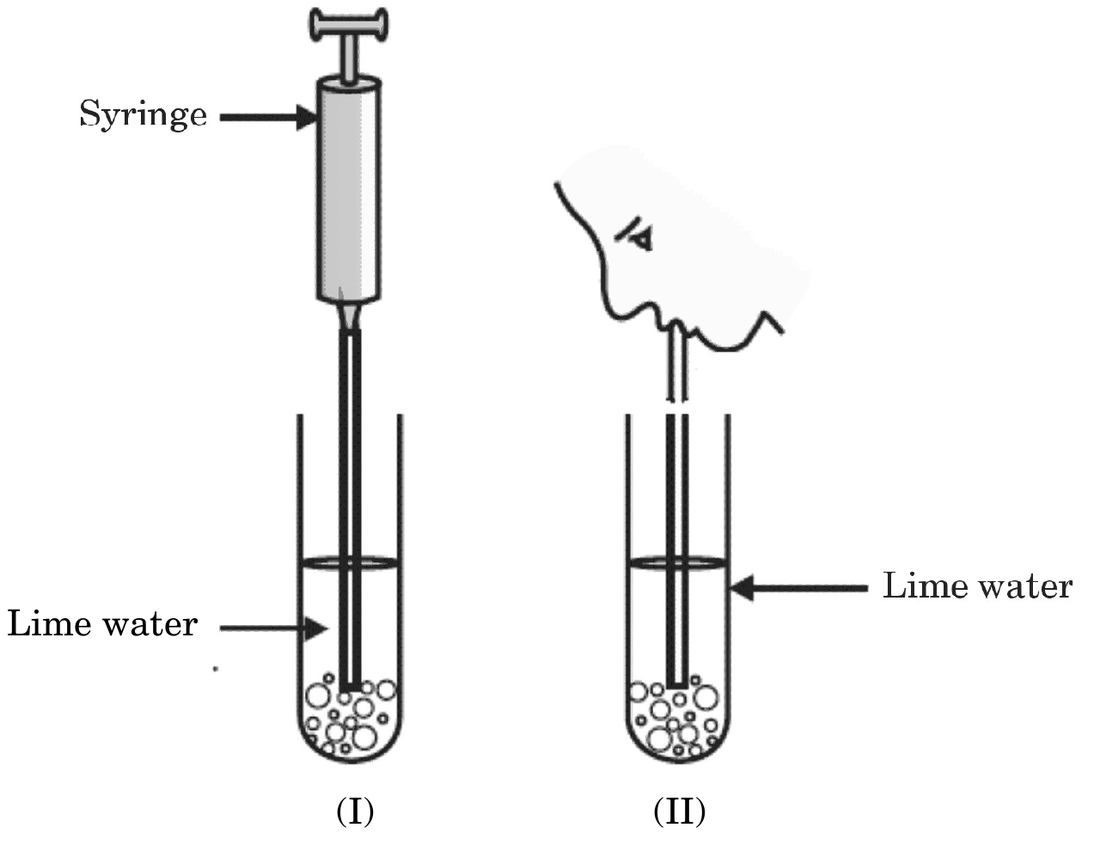
(ii) Draw the diagram of an open stomatal pore and label (I) Guard cells, and (II) Chloroplast on it. Mention two functions performed by stomata.
Solution
(i) Lime water turns milky faster in tube (II). Exhaled air contains much more carbon dioxide (produced in respiration) than atmospheric air, and CO2 turns lime water milky (Ca(OH)2 + CO2 → CaCO3 + H2O).
(ii)
Functions of stomata: (1) exchange of gases (CO2 in and O2 out for photosynthesis, and the reverse for respiration); (2) transpiration — loss of water vapour, which helps in the upward movement of water and in cooling.
(a) Describe the structure and function of the basic filtering unit of kidney.
(b) List two factors on which reabsorption of water from urine depends?
(a) Why is nutrition necessary for the human body? (b) What causes movement of food inside the alimentary canal? (c) Why is small intestine in herbivores longer than in carnivores? (d) What will happen if mucus is not secreted by the gastric glands?
(a) Mention any two components of blood. (b) Trace the movement of oxygenated blood in the body. (c) Write the function of valves present in between atria and ventricles. (d) Write one structural difference between the composition of artery and veins.
(a) Define excretion. (b) Name the basic filtration unit present in the kidney. (c) Draw excretory system in human beings and label the following organs of excretory system which perform following functions: (i) form urine. (ii) is a long tube which collects urine from kidney. (iii) store urine until it is passed out.
Get every solution for all chapters
- Every board question of every chapter, each fully solved the way the board gives marks
- 17 complete board papers, each followed by its solutions
- Weightage and most-asked topics for every chapter
- Instant PDF download, colour and black & white print copies
Revising the chapter first? Complete Science Notes for Class 10 (NCERT 2026-27) →
What you get in the pack
- Questions from 126 CBSE papers, 2016 to 2026: every set code available
- Complete: 2405 different questions and parts from all set codes, 13 chapters and 17 full papers
- Part A: all 13 chapters, questions sorted chapter-wise and by marks
- Year-wise weightage table and most-asked topics for every chapter
- Part B: 17 full board papers, each followed by its complete solutions, for timed practice
- Answers written to the CBSE marking-scheme points, with labelled diagrams drawn in full
- Questions on topics out of the board syllabus flagged
All chapters in this pack
- PYQ Ch 1 Chemical Reactions and Equations
- PYQ Ch 2 Acids, Bases and Salts
- PYQ Ch 3 Metals and Non-metals
- PYQ Ch 4 Carbon and its Compounds
- PYQ Ch 5 Life Processes
- PYQ Ch 6 Control and Coordination
- PYQ Ch 7 How do Organisms Reproduce
- PYQ Ch 8 Heredity
- PYQ Ch 9 Light Reflection and Refraction
- PYQ Ch 10 The Human Eye and the Colourful World
- PYQ Ch 11 Electricity
- PYQ Ch 12 Magnetic Effects of Electric Current
- PYQ Ch 13 Our Environment
- Board Paper 2026 Set 31-2-1 with Solutions
- Board Paper 2026 Set 31-3-1 with Solutions
- Board Paper 2025 Set 31-1-1 with Solutions
- Board Paper 2025 Set 31-2-1 with Solutions
- Board Paper 2024 Set 31-4-1 with Solutions
- Board Paper 2024 Set 31-5-1 with Solutions
- Board Paper 2023 Set 31-2-1 with Solutions
- Board Paper 2023 Set 31-4-1 with Solutions
- Board Paper 2022 Term 2 Set 31-1-1 with Solutions
- Board Paper 2022 Term 2 Set 31-3-1 with Solutions
- Board Paper 2020 Set 31-2-1 with Solutions
- Board Paper 2020 Set 31-4-1 with Solutions
- Board Paper 2019 Set 31-2-1 with Solutions
- Board Paper 2019 Set 31-4-1 with Solutions
- Board Paper 2018 Set 31-1 with Solutions
- Board Paper 2017 Set 3 with Solutions
- Board Paper 2016 Set 31-1 with Solutions