
CBSE Class 10 Science Question Paper 2023 (31/2/1) with Solutions
The complete CBSE Class 10 Science board paper of 2023, Q.P. code 31/2/1: all 39 questions exactly as set, with marks. 23 solutions are free below. The Class 10 Science PYQ Book: Solved Board Papers 2016-2026 (CBSE) solves all 17 papers in full and sorts every question chapter-wise.
Subject expert: Khushbu Gupta, B.Sc., M.Sc. Physics, B.Ed. · 8+ years teaching


Free: NCERT solutions for Class 10 Science →
Question paper
Jump to: Question paperSolutions
2023 · Q.P. Code 31/2/1
Maximum marks: 80
Section A · Multiple choice and Assertion–Reason
Which of the following is an example of endothermic process?
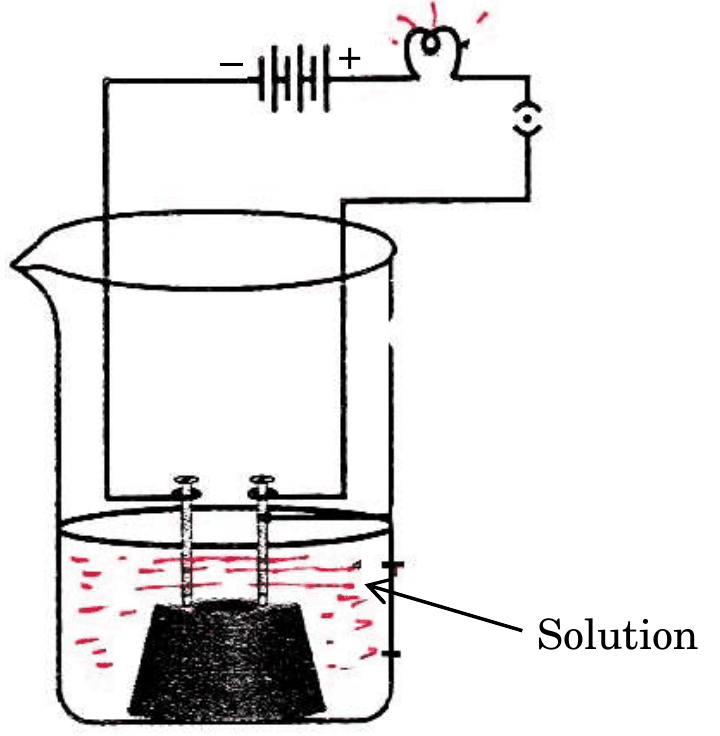
In the given experimental set-up, if the experiment is carried out separately with each of the following solutions the cases in which the bulb will glow is/are: (i) Dilute hydrochloric acid (ii) Dilute sulphuric acid (iii) Glucose solution (iv) Alcohol
In order to balance the following chemical equation, the values of the coefficients x and y respectively are: x Pb(NO3)2 →(heat) 2PbO + y NO2 + O2
When zinc reacts with sodium hydroxide, the product formed is:
Among the following, the metal with lowest density is:
The number of electrons in the outermost shell of the atom of a non-metal can be:
The total number of electrons shared in the formation of an ethyne molecule is:
Sphincter muscles are present at the exit of:
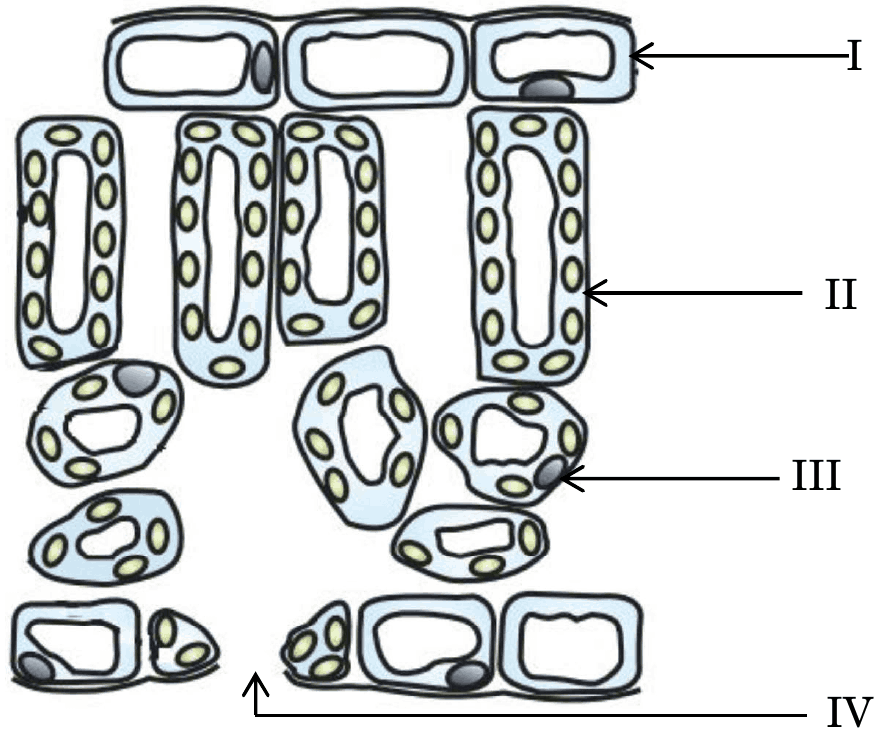
In the following diagram, identify the cells through which massive amounts of gaseous exchange takes place for photosynthesis:
During vigorous exercise, the occurrence of cramps in the outer muscles of an athlete is due to the conversion of pyruvate to:
Plants which bear unisexual flowers are:
When an ‘X’ bearing sperm fertilises the egg, the resulting zygote has the following combination of chromosomes:
An object is placed in front of a convex mirror at infinity. According to the New Cartesian Sign Convention, the sign of the focal length and the sign of the image distance in this case are respectively:
For verifying Ohm’s law, we design an electric circuit diagram in which we show the arrangement of different circuit components. We find that with respect to the resistor, the:
In a resistive circuit if the current is increased to two times, the percentage change in the amount of heat dissipated in the circuit would be:
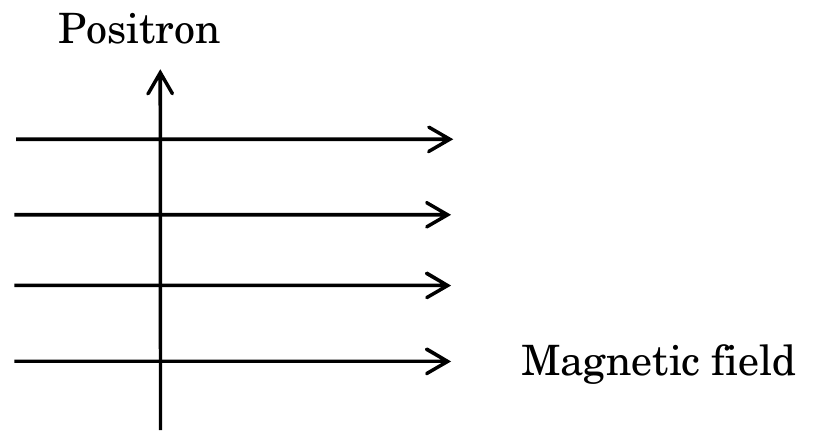
A positron enters a uniform magnetic field at right angles to it as shown. The direction of force experienced by the positron will be:
Assertion (A): Sodium oxide is an amphoteric oxide.
Reason (R): Metal oxides which react with both acids as well as bases are known as amphoteric oxides.
Assertion (A): When a bacterium divides into two, and the resultant two bacteria divide again, the four bacteria produced would be almost similar.
Reason (R): DNA copying involves small inaccuracies in the reproduction process.
Assertion (A): A person suffering from myopia cannot see the distant objects clearly.
Reason (R): A converging lens is used for the correction of myopic eye as it can form real as well as virtual images of the objects placed in front of it.
Assertion (A): Magnetic field lines do not intersect each other.
Reason (R): Magnetic field lines are imaginary lines, the tangent to which at any point gives the direction of the field at that point.
Section B · Very short answer (2 marks)
(a) What is observed when aqueous solutions of potassium iodide and lead nitrate are mixed together? Name the type of reaction and write the chemical equation for the reaction that occurs.
(b) When copper powder is heated in a watch glass, a black substance is formed. (i) Why is this black substance formed? Name it. (ii) How can this black substance be reversed to its original form?
(a) Why is it important to prevent oxygenated and deoxygenated blood from mixing in birds and mammals?
(b) Which animals can tolerate some mixing of the oxygenated and deoxygenated blood streams? On what factor does the body temperature of these animals depend?
Mendel crossed a pure tall pea plant (TT) with a pure short pea plant (tt) and obtained all tall plants in F1 generation. (a) What is the gene combination present in the plants of F1 generation? (b) Give reason why only tall plants are observed in F1 progeny. (c) What will be the ratio of the plants obtained in the F2 generation when F1 plants are self-pollinated?
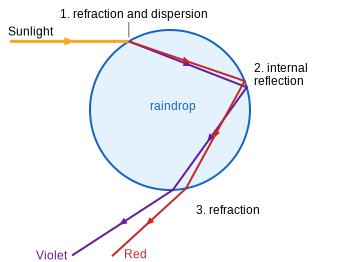
(a) When and where does a rainbow appear in the sky? Draw a labelled ray diagram to show its formation.
(b) What is scattering of light? Why does the clear sky appear blue?
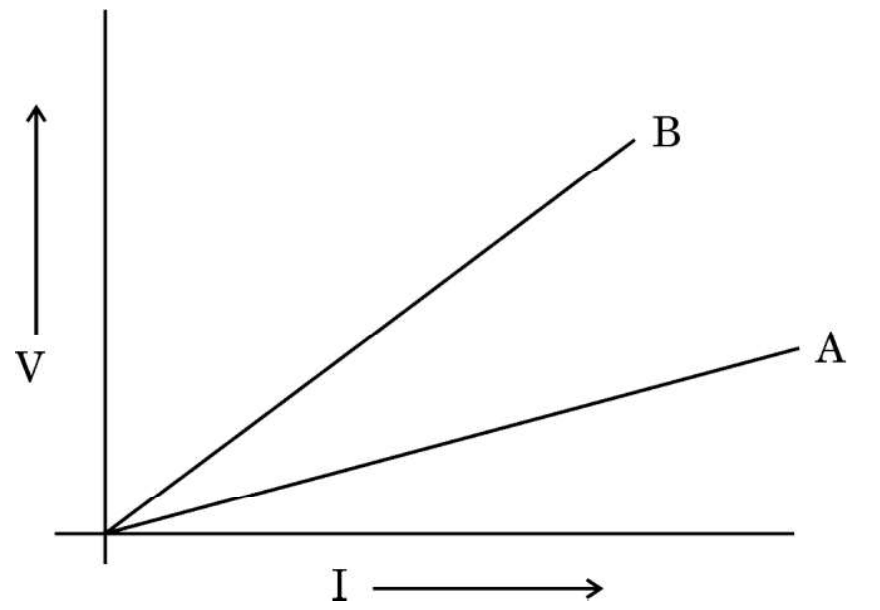
V – I graph for two conducting wires A and B are as shown. If both wires are of the same length and same diameter, which of the two is made of a material of high resistivity? Give reasons to justify your answer.
We do not clean ponds or lakes but an aquarium needs to be cleaned regularly. Why?
Section C · Short answer (3 marks)
Silver chloride kept in a china dish turns grey in sunlight. (a) Write the colour of silver chloride when it was kept in the china dish. (b) Name the type of chemical reaction taking place and write the chemical equation for the reaction. (c) State one use of the reaction. Name one more chemical which can be used for the same purpose.
With the help of suitable chemical equations, list the two main differences between roasting and calcination. How is metal reduced from the product obtained after roasting/calcination of the ore? Write the chemical equation for the reaction involved.
(a) (i) What is the first step in the breakdown of glucose during aerobic and anaerobic respiration? Where does it take place?
(ii) ATP is called the energy currency of the cell. Why?
(iii) What is meant by residual volume of air in a breathing cycle?
(b) Write in sequence the steps for experimental verification of the fact that sunlight is essential for photosynthesis.
Name the hormone released and the gland which secretes it in human beings during scary situations. How does the body respond to enable it to deal with the situation?
(a) A student has focussed the image of an object of height 3 cm on a white screen using a concave mirror of focal length 12 cm. If the distance of the object from the mirror is 18 cm, find the values of the following: (i) Distance of the image from the mirror (ii) Height of the image
(b) Define power of a lens. The focal length of a lens is −10 cm. Write the nature of the lens and find its power. If an object is placed at a distance of 20 cm from the optical centre of this lens, according to the New Cartesian Sign Convention, what will be the sign of magnification in this case?
Explain the meaning of overloading of an electrical circuit. List two possible causes due to which overloading may occur in household circuits. Write one preventive measure that should be taken to avoid overloading of domestic circuits.
Explain how some harmful chemicals enter our bodies through the food chain. Why is the concentration of these harmful chemicals found to be maximum in human beings?
Section D · Long answer (5 marks)
(a) An acid ‘X’ and an alcohol ‘Y’ react with each other in the presence of an acid catalyst to form a sweet smelling substance ‘Z’. Identify ‘X’, ‘Y’ and ‘Z’. Write the chemical equation for the reaction involved and name it. The substance ‘Z’ on treatment with sodium hydroxide produces back the alcohol ‘Y’ and sodium ethanoate. Write the chemical equation for the reaction involved and name it, giving justification for the name.
(b) (i) Name the simplest saturated hydrocarbon. Draw its electron dot structure. Which type of bonds exist in this compound?
(ii) Name any two mixtures of the carbon compound used as a fuel in daily life, of which the above mentioned compound is an important component.
(iii) In which homologous series of carbon compounds can this compound be placed? Write the general formula of the series.
(iv) Which type of flame is produced on burning it?
(a) (i) List three points of difference between nervous and hormonal mechanisms for control and coordination in animals.
(ii) How are auxins related with the bending of plant shoot towards unidirectional light? Explain.
(b) (i) Name the disorder which a person is likely to suffer from due to the following: (I) Over-secretion of growth hormone (II) Deficiency of oestrogen in females (III) Less secretion of thyroxine. Also name the gland that secretes each of the hormones mentioned above.
(ii) How is the timing and amount of hormone released regulated? Explain with the help of an example.
(a) An object is placed in front of a convex lens of focal length f. If the distance of the object from the lens is 2f, draw a ray diagram to show the formation of the image. Write the value of magnification in this case.
(b) A student has focussed the image of a candle flame on a white screen using a convex lens. The situation is as given below: Length of the flame = 2 cm; Focal length of the lens = 12 cm; Distance of the flame from the lens = 16 cm. If the flame is perpendicular to the principal axis of the lens, calculate the values of the following: (i) Distance of the image from the lens (ii) Length of the image formed
Section E · Case-based (4 marks)
The teacher while conducting practicals in the laboratory divided the students into three groups and gave them various solutions to find out their pH and classify them into acidic, basic and neutral solutions. Group A – Lemon juice, vinegar, colourless aerated drink; Group B – Tomato juice, coffee, ginger juice; Group C – Sodium hydroxide, sodium chloride, lime water.
(a) For the solutions provided, which group is/are likely to have pH value (i) less than 7, and (ii) greater than 7? 1
(b) List two ways of determining pH of a solution. 1
(c) Explain, why the sour substances such as lemon juice are effective in cleaning the tarnished copper vessels. 2
OR
(c) “pH has great importance in our daily life.” Justify this statement by giving two examples. 2
All the reproductive methods of living organisms are broadly categorized into two types: 1. Asexual reproduction, and 2. Sexual reproduction. Asexual reproduction involves the participation of a single parent without the formation of gametes, fertilisation and transfer of genetic material. This method is a common means of rapidly increasing offsprings under favourable conditions.
(a) Name the type of fission that occurs in Leishmania and Plasmodium. 1
(b) Write one advantage of sexual mode of reproduction over asexual reproduction. 1
(c) Give reasons why: (i) Colonies of yeast fail to multiply in water but multiply in sugar solution. (ii) Rhizopus individuals do not grow on a dry slice of bread. 2
OR
(c) Name the filamentous structures a student could identify when he collected water from a pond that appeared dark green. How do these organisms multiply? Explain. 2
Consider the following electrical circuit diagram in which nine identical resistors of 3 Ω each are connected as shown. If the reading of the ammeter A1 is 1 ampere, answer the following questions:
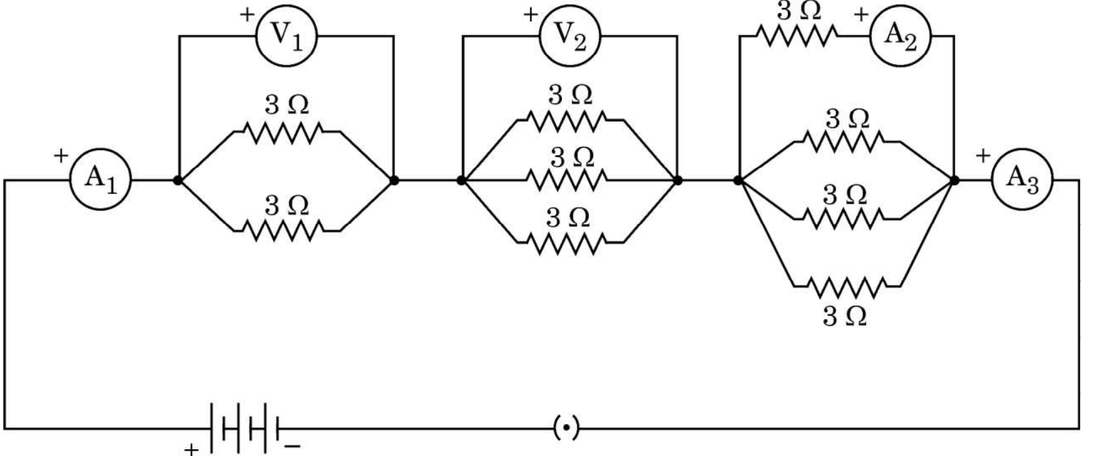
(a) What is the relationship between the readings of A1 and A3? Give reasons for your answer. 1
(b) What is the relationship between the readings of A2 and A3? 1
(c) Determine the reading of the voltmeter V1. 2
OR
(c) Find the total resistance of the circuit. 2
Solutions: CBSE 2023 · 31/2/1
Answer: (c)
When ammonium chloride dissolves in water, heat is absorbed and the solution becomes cold — an endothermic process. The other three release heat (exothermic).
Answer: (a) 2, 4
Answer: (a) Lithium
Lithium is the lightest metal (density about 0.53 g/cm3), lighter even than water.
Answer: (c) 10
Ethyne, H–C≡C–H: the triple bond shares 3 pairs (6 electrons) and the two C–H bonds share 2 pairs (4 electrons): 6 + 4 = 10.
Answer: (b) IV
IV marks the stomatal pore between guard cells in the lower epidermis of the leaf. Massive gas exchange for photosynthesis takes place through stomata.
Answer: (d) Watermelon and Papaya
Their flowers have either stamens or pistil. Mustard and Hibiscus have bisexual flowers.
Answer: (d) +, +
The focus of a convex mirror lies behind the mirror (positive), and the image of an object at infinity is formed at the focus behind the mirror, so v is also positive.
Answer: (b) 300%
H = I2Rt. Doubling I makes H four times: H′ = 4H. Change = (4H − H)/H × 100 = 300%.
Answer: (d)
A is false: sodium oxide is a basic oxide (it reacts with water to give NaOH). R is true; examples of amphoteric oxides are aluminium oxide and zinc oxide.
Answer: (c)
A is true. R is false: myopia is corrected with a concave (diverging) lens, not a converging lens.
A yellow precipitate of lead iodide is formed.
Type: double displacement (precipitation) reaction.
(a) Birds and mammals have high energy needs because they constantly use energy to maintain their body temperature. Keeping the two kinds of blood separate gives a highly efficient supply of oxygen to the body.
(b) Amphibians and many reptiles (with three-chambered hearts). Their body temperature depends on the temperature of the environment.
A rainbow appears after a rain shower, in the sky opposite to the Sun (the Sun is behind the observer). Water droplets act like tiny prisms: they refract and disperse sunlight, reflect it internally and refract it again.
Wire B. The slope of a V–I graph (V/I) gives the resistance. B has the steeper slope, so its resistance is greater. Since R = ρl/A and both wires have the same length and area, the wire with greater resistance has greater resistivity.
(a) White.
(b) Photolytic decomposition (decomposition by light):
(c) Used in black and white photography. Silver bromide (AgBr) is also used: 2AgBr → 2Ag + Br2.
(i) The first step is the breakdown of glucose (a 6-carbon molecule) into pyruvate (a 3-carbon molecule), with release of a little energy. It takes place in the cytoplasm.
(ii) The energy released during respiration is used to make ATP. Whenever a cell needs energy (for muscle contraction, protein synthesis, nerve impulses), ATP is broken down and releases a fixed amount of energy. Like money, ATP is "earned" in respiration and "spent" in all activities, so it is called the energy currency.
(iii) Residual volume is the volume of air that always remains in the lungs even after we breathe out. It allows sufficient time for oxygen to be absorbed and carbon dioxide to be released.
Hormone: adrenaline; gland: adrenal glands.
Adrenaline is secreted directly into the blood and carried to different parts of the body, including the heart:
• the heart beats faster, supplying more oxygen to the muscles;
• blood to the digestive system and skin is reduced (small arteries there contract), and is diverted to the skeletal muscles;
• the breathing rate increases (contractions of the diaphragm and rib muscles).
All these prepare the body to deal with the situation (fight or flight).
Power of a lens is the degree of convergence or divergence of light rays it produces; it is the reciprocal of its focal length in metres: P = 1/f (unit: dioptre, D).
Negative focal length ⇒ concave (diverging) lens.
A concave lens always forms a virtual, erect image, so the magnification is positive (+) (and less than 1).
Pesticides and other chemicals sprayed on crops are washed into the soil and water bodies. Plants absorb them along with water and minerals, and aquatic plants and animals take them up from water. In this way they enter the food chain, and we take them in through our food (grains, vegetables, fish).
These chemicals are non-biodegradable, so they are not broken down or excreted; they accumulate at each trophic level (biological magnification). Human beings occupy the top trophic level in many food chains, so the maximum concentration accumulates in our bodies.
(i) Methane, CH4. Carbon shares one electron pair with each of the four hydrogen atoms:
••
H •• C •• H
••
H
It has four single covalent bonds (C–H).
(ii) Natural gas / CNG and biogas.
(iii) Alkanes; general formula CnH2n+2.
(iv) A clean blue (non-sooty) flame, as it is a saturated hydrocarbon.
(i) (I) Over-secretion of growth hormone → gigantism (abnormally tall); gland: pituitary.
(II) Deficiency of oestrogen → improper development of female sex organs and secondary sexual characters, and irregularities of the menstrual cycle; gland: ovary.
(III) Less thyroxine → goitre (swollen neck) and slowed metabolism; gland: thyroid. (Iodine is needed to make thyroxine.)
(ii) By a feedback mechanism. Example: when the blood sugar level rises, the cells of the pancreas detect it and secrete more insulin; as the sugar level falls, insulin secretion is reduced.
(a) (i) pH less than 7: Groups A and B (all acidic). (ii) pH greater than 7: Group C — sodium hydroxide and lime water are basic (sodium chloride is neutral, pH 7).
(b) Using universal indicator / pH paper, and using a pH meter.
(c) Tarnished copper vessels have a greenish coating of basic copper carbonate (formed by reaction with moist CO2 in air). Sour substances such as lemon juice contain acids (citric acid) which react with and neutralise this basic coating, dissolving it, so the vessel becomes shiny again.
OR (c) Any two:
• Digestion: the stomach produces HCl; excess acid causes pain (acidity), which is relieved by antacids (mild bases) that raise the pH.
• Tooth decay starts when the pH in the mouth falls below 5.5; toothpastes, which are basic, neutralise the excess acid.
• Our body works within a narrow pH range of 7.0–7.8; plants need soil of suitable pH; bee stings (acid) are treated with baking soda (base).
The three groups are joined in series: group 1 has two 3 Ω in parallel (1.5 Ω), group 2 has three 3 Ω in parallel (1 Ω), and group 3 has four 3 Ω in parallel (one of them in series with A2), i.e. 0.75 Ω.
(a) A1 = A3 (= 1 A). Both are in the main line, in series with all the groups, and the same current flows through every part of a series circuit.
(b) The 1 A divides equally among the four identical 3 Ω branches of group 3, and A2 is in one of them: A2 = A3/4 = 0.25 A.
(c) V1 is across group 1 (1.5 Ω):
OR (c)
Get every solution for all 17 papers
- Every board question of every chapter, each fully solved the way the board gives marks
- 17 complete board papers, each followed by its solutions
- Weightage and most-asked topics for every chapter
- Instant PDF download, colour and black & white print copies
Revising the chapter first? Complete Science Notes for Class 10 (NCERT 2026-27) →
What you get in the pack
- Questions from 126 CBSE papers, 2016 to 2026: every set code available
- Complete: 2405 different questions and parts from all set codes, 13 chapters and 17 full papers
- Part A: all 13 chapters, questions sorted chapter-wise and by marks
- Year-wise weightage table and most-asked topics for every chapter
- Part B: 17 full board papers, each followed by its complete solutions, for timed practice
- Answers written to the CBSE marking-scheme points, with labelled diagrams drawn in full
- Questions on topics out of the board syllabus flagged
All chapters in this pack
- PYQ Ch 1 Chemical Reactions and Equations
- PYQ Ch 2 Acids, Bases and Salts
- PYQ Ch 3 Metals and Non-metals
- PYQ Ch 4 Carbon and its Compounds
- PYQ Ch 5 Life Processes
- PYQ Ch 6 Control and Coordination
- PYQ Ch 7 How do Organisms Reproduce
- PYQ Ch 8 Heredity
- PYQ Ch 9 Light Reflection and Refraction
- PYQ Ch 10 The Human Eye and the Colourful World
- PYQ Ch 11 Electricity
- PYQ Ch 12 Magnetic Effects of Electric Current
- PYQ Ch 13 Our Environment
- Board Paper 2026 Set 31-2-1 with Solutions
- Board Paper 2026 Set 31-3-1 with Solutions
- Board Paper 2025 Set 31-1-1 with Solutions
- Board Paper 2025 Set 31-2-1 with Solutions
- Board Paper 2024 Set 31-4-1 with Solutions
- Board Paper 2024 Set 31-5-1 with Solutions
- Board Paper 2023 Set 31-2-1 with Solutions
- Board Paper 2023 Set 31-4-1 with Solutions
- Board Paper 2022 Term 2 Set 31-1-1 with Solutions
- Board Paper 2022 Term 2 Set 31-3-1 with Solutions
- Board Paper 2020 Set 31-2-1 with Solutions
- Board Paper 2020 Set 31-4-1 with Solutions
- Board Paper 2019 Set 31-2-1 with Solutions
- Board Paper 2019 Set 31-4-1 with Solutions
- Board Paper 2018 Set 31-1 with Solutions
- Board Paper 2017 Set 3 with Solutions
- Board Paper 2016 Set 31-1 with Solutions