
CBSE Class 10 Science Question Paper 2020 (31/4/1) with Solutions
The complete CBSE Class 10 Science board paper of 2020, Q.P. code 31/4/1: all 30 questions exactly as set, with marks. 20 solutions are free below. The Class 10 Science PYQ Book: Solved Board Papers 2016-2026 (CBSE) solves all 17 papers in full and sorts every question chapter-wise.
Subject expert: Khushbu Gupta, B.Sc., M.Sc. Physics, B.Ed. · 8+ years teaching


Free: NCERT solutions for Class 10 Science →
Question paper
Jump to: Question paperSolutions
2020 · Q.P. Code 31/4/1
Maximum marks: 80
Section A · 1 mark each
Write the number of valence electrons present in a nitrogen atom 147N.
Define the term induced electric current.
not in 2026-27 syllabusAnswer question numbers 3(a) – 3(d) on the basis of your understanding of the following paragraph and the related studied concepts:
Around the year 1800, only 30 elements were known. Dobereiner in 1817 and Newlands in 1866 tried to arrange the then known elements and framed laws which were rejected by the scientists. Even after the rejection of the proposed laws, many scientists continued to search for a pattern that correlated the properties of elements with their atomic masses. The main credit for classifying elements goes to Mendeleev for his most important contribution to the early development of a Periodic table of elements wherein he arranged the elements on the basis of their fundamental property, the atomic mass and also on the similarity of chemical properties. The formulae of their hydrides and oxides were treated as basic criteria for the classification of the elements. However, Mendeleev’s classification also had some limitations as it could not assign the position to isotopes. He also left some gaps in the periodic table.
3(a) State Mendeleev’s Periodic Law. 1
3(b) Why did Mendeleev leave some gaps in the Periodic table? 1
3(c) If the letter ‘R’ was used to represent any of the elements in the group, then the hydride and oxide of carbon would respectively be represented as (i) RH4, RO (ii) RH4, RO2 (iii) RH2, RO2 (iv) RH2, RO 1
3(d) Isotopes are (i) Atoms of an element with similar chemical properties but different atomic masses. (ii) Atoms of different elements with similar chemical properties but different atomic masses. (iii) Atoms of an element with different chemical properties but same atomic masses. (iv) Atoms of different elements with different chemical properties but same atomic masses. 1
Answer question numbers 4(a) – 4(d) on the basis of your understanding of the following paragraph and the related studied concepts:
India today is facing the problem of overuse of resources, contamination of water and soil and lack of methods of processing the waste. The time has come for the world to say goodbye to “single-use plastics”. Steps must be undertaken to develop environment-friendly substitutes, effective plastic waste collection and methods of its disposal. Indore treated 15 lakh metric tonnes of waste in just 3 years, through biomining and bioremediation techniques. Bioremediation involves introducing microbes into a landfill to naturally ‘break’ it down and biomining involves using trommel machines to sift through the waste to separate the ‘soil’ and the waste component. The city managed to chip away 15 lakh metric tonnes of waste at a cost of around ₹ 10 crore. A similar experiment was successfully carried out in Ahmedabad also.
4(a) State two methods of effective plastic waste collection in your school. 1
4(b) Name any two uses of “single-use plastic” in daily life. 1
4(c) If we discontinue the use of plastic, how can an environment-friendly substitute be provided? 1
4(d) Do you think microbes will work similarly in landfill sites as they work in the laboratory? Justify your answer. 1
Which one of the following statements is correct about the human circulatory system?
(a) Anaerobic process
(b) Most of the digestion and absorption of the food takes place in the
Fertilisation is the process of
(a) If a person has five resistors each of value 1/5 Ω, then the maximum resistance he can obtain by connecting them is
(b) The resistance of a resistor is reduced to half of its initial value. In doing so, if other parameters of the circuit remain unchanged, the heating effects in the resistor will become
Fleming’s Right-hand rule gives
(a) Which one of the following statements is not true about nuclear energy generation in a nuclear reactor?
(b) The biggest source of energy on Earth’s surface is
Food web is constituted by
Choose the incorrect statement from the following:
Assertion (A): Following is a balanced chemical equation for the action of steam on iron: 3Fe + 4H2O → Fe3O4 + 4H2
Reason (R): The law of conservation of mass holds good for a chemical equation.
Assertion (A): The sex of a child in human beings will be determined by the type of chromosome he/she inherits from the father.
Reason (R): A child who inherits ‘X’ chromosome from his father would be a girl (XX), while a child who inherits a ‘Y’ chromosome from the father would be a boy (XY).
Section B · Short answer (3 marks)
(a) Lead nitrate solution is added to a test tube containing potassium iodide solution. (a) Write the name and colour of the compound precipitated. (b) Write the balanced chemical equation for the reaction involved. (c) Name the type of this reaction justifying your answer.
(b) What happens when food materials containing fats and oils are left for a long time? List two observable changes and suggest three ways by which this phenomenon can be prevented.
(a) List three differentiating features between the processes of galvanisation and alloying.
(b) Compare in tabular form the reactivities of the following metals with cold and hot water: (a) Sodium (b) Calcium (c) Magnesium
Carbon, a member of group 14, forms a large number of carbon compounds estimated to be about three million. Why is this property not exhibited by other elements of this group? Explain.
A cheetah, on seeing a prey, moves towards him at a very high speed. What causes the movement of his muscles? How does the chemistry of cellular components of muscles change during this event?
Define geotropism. Draw a labelled diagram of a plant showing geotropic movements of its parts.
(a) Define the term evolution. ‘‘Evolution cannot be equated with progress.’’ Justify this statement.
not in 2026-27 syllabus(b) ‘‘During the course of evolution, organs or features may be adapted for new functions.’’ Explain this fact by choosing an appropriate example.
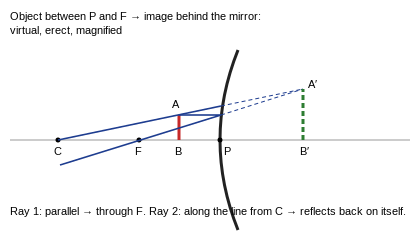
not in 2026-27 syllabusA concave mirror is used for image formation for different positions of an object. What inferences can be drawn about the following when an object is placed at a distance of 10 cm from the pole of a concave mirror of focal length 15 cm? (a) Position of the image (b) Size of the image (c) Nature of the image. Draw a labelled ray diagram to justify your inferences.
The refractive index of a medium ‘x’ with respect to a medium ‘y’ is 2/3 and the refractive index of medium ‘y’ with respect to medium ‘z’ is 4/3. Find the refractive index of medium ‘z’ with respect to medium ‘x’. If the speed of light in medium ‘x’ is 3 × 10⁸ m s−1, calculate the speed of light in medium ‘y’.
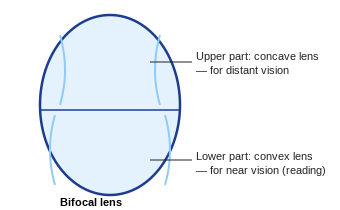
A person may suffer from both myopia and hypermetropia defects. (a) What is this condition called? (b) When does it happen? (c) Name the type of lens often required by the persons suffering from this defect. Draw labelled diagram of such lenses.
How will you use two identical glass prisms so that a narrow beam of white light incident on one prism emerges out of the second prism as white light? Draw and label the ray diagram.
Section C · Long answer (5 marks)
(a) A cloth strip dipped in onion juice is used for testing a liquid ‘X’. The liquid ‘X’ changes its odour. Which type of an indicator is onion juice? The liquid ‘X’ turns blue litmus red. List the observations the liquid ‘X’ will show on reacting with the following: (a) Zinc granules (b) Solid sodium carbonate. Write the chemical equations for the reactions involved.
(b) Define water of crystallisation. Give the chemical formula for two compounds as examples. How can it be proved that the water of crystallisation makes a difference in the state and colour of the compounds?
(a) (i) Write two properties of gold which make it the most suitable metal for ornaments. (ii) Name two metals which are the best conductors of heat. (iii) Name two metals which melt when you keep them on your palm.
(b) Explain the formation of ionic compound CaO with electron-dot structure. Atomic numbers of calcium and oxygen are 20 and 8 respectively.
(a) Why is nutrition necessary for the human body? (b) What causes movement of food inside the alimentary canal? (c) Why is small intestine in herbivores longer than in carnivores? (d) What will happen if mucus is not secreted by the gastric glands?
(a) Draw a neat diagram showing fertilisation in a flower and label (a) Pollen tube, (b) Male germ cell and (c) Female germ cell, on it. Explain the process of fertilisation in a flower. What happens to the (i) ovary and (ii) ovule after fertilisation?
(b) (a) What is puberty? (b) Describe in brief the functions of the following parts in the human male reproductive system: (i) Testes (ii) Seminal vesicle (iii) Vas deferens (iv) Urethra (c) Why are testes located outside the abdominal cavity? (d) State how sperms move towards the female germ cell.
(a) Draw a schematic diagram of a circuit consisting of a battery of 3 cells of 2 V each, a combination of three resistors of 10 Ω, 20 Ω and 30 Ω connected in parallel, a plug key and an ammeter, all connected in series. Use this circuit to find the value of the following: (a) Current through each resistor (b) Total current in the circuit (c) Total effective resistance of the circuit
(b) Two identical resistors, each of resistance 15 Ω, are connected in (i) series, and (ii) parallel, in turn to a battery of 6 V. Calculate the ratio of the power consumed in the combination of resistors in each case.
(a) State Fleming’s Left-hand rule. (b) List three characteristic features of the electric current used in our homes. (c) What is a fuse? Why is it called a safety device? (d) Why is it necessary to earth metallic electric appliances?
Solutions: CBSE 2020 · 31/4/1
Nitrogen (atomic number 7): 2, 5 — it has 5 valence electrons.
3(a) Mendeleev's Periodic Law: the properties of elements are a periodic function of their atomic masses.
3(b) He left gaps for elements that were not yet discovered, and predicted their properties (e.g. eka-aluminium, later gallium).
3(c) (ii) RH4, RO2 — carbon forms CH4 and CO2.
3(d) (i)
Answer: (C)
Valves in the heart (and veins) ensure that blood flows only in one direction. (Blood also carries CO2; the heart has four chambers; the two kinds of blood do not mix.)
Answer: (A) small intestine
Answer: (A) 1 Ω
Maximum resistance — all in series: 5 × 1/5 = 1 Ω.
Answer: (C)
Fleming's right-hand rule gives only the direction of the induced current.
Answer: (B) Solar radiations
Answer: (D)
(A), (B) and (C) are statements from NCERT: ozone (O3) is a deadly poison at ground level, and in the upper atmosphere it shields the Earth from UV radiation. Ozone is formed by the action of UV radiation on oxygen; the statement that it "gets decomposed by UV" is taken as incorrect here. (Ozone is depleted mainly by CFCs.)
Answer: (a)
Both are true and R explains A: the mother always gives an X, so the father's chromosome (X or Y) decides the sex.
The fats and oils get oxidised and become rancid (rancidity).
Observable changes: (1) the smell changes (bad, unpleasant smell); (2) the taste changes.
Prevention: (1) add antioxidants to food; (2) store food in air-tight containers; (3) flush packets with nitrogen (as in chips packets); also keep food in a refrigerator.
| Metal | Cold water | Hot water |
|---|---|---|
| Sodium | Reacts violently; the hydrogen catches fire (highly exothermic) | Reacts violently |
| Calcium | Reacts less violently; starts floating; hydrogen does not catch fire | Reacts |
| Magnesium | Does not react | Reacts; starts floating due to bubbles of hydrogen |
2Na + 2H2O → 2NaOH + H2; Ca + 2H2O → Ca(OH)2 + H2; Mg + 2H2O → Mg(OH)2 + H2. Reactivity: Na > Ca > Mg.
On seeing the prey, the information reaches the brain, which sends nerve impulses through motor nerves to the leg muscles. (In this emergency, adrenaline is also released, which speeds up the heart and sends more blood to the muscles.)
When a nerve impulse reaches the muscle cells, special proteins in them change their shape and arrangement; this makes the muscle cells shorten (contract), and the legs move. The muscles also respire rapidly to release energy; when oxygen falls short they respire anaerobically and form lactic acid.
Evolution is the sequence of gradual changes in organisms over millions of years, by which new species arise from earlier ones.
It cannot be equated with progress: evolution only produces more diverse forms, adapted to their environment; it is not "better" designs replacing older ones. Older forms continue to exist alongside the new (e.g. bacteria, the simplest organisms, still thrive), and humans are not the pinnacle of evolution but just one more species.
The object (10 cm) is between P and F (15 cm).
m = −v/u = −30/(−10) = +3
(a) Behind the mirror, 30 cm from the pole. (b) Enlarged (3 times). (c) Virtual and erect.
(a) Presbyopia.
(b) Usually with increasing age: the ciliary muscles weaken and the eye lens loses its flexibility, so the power of accommodation decreases.
(c) Bifocal lenses: the upper part is a concave lens (for distant vision) and the lower part a convex lens (for near vision).
Onion juice is an olfactory indicator. Olfactory indicators change their smell in acidic or basic medium. Since X turns blue litmus red, X is an acid — e.g. dilute hydrochloric acid.
(a) With zinc granules: bubbles of hydrogen gas, which burns with a pop sound.
(b) With solid sodium carbonate: brisk effervescence of carbon dioxide, which turns lime water milky.
Ca(OH)2 + CO2 → CaCO3 + H2O
(a) (i) Gold is (1) highly malleable and ductile and (2) lustrous and does not corrode (unreactive), so it keeps its shine. (ii) Silver and copper. (iii) Gallium and caesium (very low melting points).
(b) Ca (2, 8, 8, 2) loses its 2 valence electrons; O (2, 6) gains them:
:Ö: + 2e− → [:Ö:]2− (2,8)
Ca: + ·Ö· → Ca2+[:Ö:]2− (CaO)
Both ions get a stable octet, and the oppositely charged ions are held by strong electrostatic forces — an ionic compound.
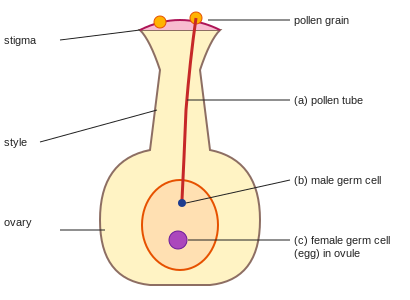
After pollination, the pollen grain on the stigma germinates and a pollen tube grows out of it, through the style, to reach the ovule in the ovary. The tube carries the male germ cell, which fuses with the female germ cell (egg) in the ovule. This fusion is fertilisation, and it forms the zygote, which develops into the embryo.
(i) The ovary grows rapidly and ripens to form the fruit. (ii) The ovule develops a tough coat and becomes the seed.
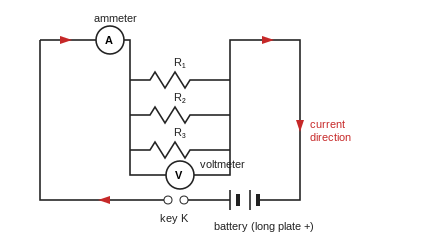
(R1 = 10 Ω, R2 = 20 Ω, R3 = 30 Ω; the voltmeter is not needed here.) Battery: V = 3 × 2 = 6 V; each parallel resistor gets the full 6 V.
(b) I = 0.6 + 0.3 + 0.2 = 1.1 A
(c) 1/R = 1/10 + 1/20 + 1/30 = (6 + 3 + 2)/60 = 11/60 ⇒ R = 60/11 ≈ 5.45 Ω
(Check: V/I = 6/1.1 ≈ 5.45 Ω.)
(a) Stretch the thumb, forefinger and middle finger of the left hand so that they are mutually perpendicular. If the forefinger points in the direction of the magnetic field and the middle finger in the direction of current, the thumb gives the direction of the force (motion) on the conductor.
(b) (1) It is alternating current (AC); (2) the potential difference between live and neutral wires is 220 V; (3) its frequency is 50 Hz (direction reverses every 1/100 s). (Separate circuits of 15 A and 5 A rating are used.)
(c) A fuse is a wire of low melting point connected in series with the circuit. When the current exceeds the safe limit (overloading or short-circuit), the fuse wire heats up and melts, breaking the circuit. It thus protects the circuit and appliances from damage — a safety device.
(d) Earthing provides a low-resistance path to the ground for any current leaking to the metal body of an appliance. The body stays at earth potential, so a person touching it does not get a severe electric shock.
Get every solution for all 17 papers
- Every board question of every chapter, each fully solved the way the board gives marks
- 17 complete board papers, each followed by its solutions
- Weightage and most-asked topics for every chapter
- Instant PDF download, colour and black & white print copies
Revising the chapter first? Complete Science Notes for Class 10 (NCERT 2026-27) →
What you get in the pack
- Questions from 126 CBSE papers, 2016 to 2026: every set code available
- Complete: 2405 different questions and parts from all set codes, 13 chapters and 17 full papers
- Part A: all 13 chapters, questions sorted chapter-wise and by marks
- Year-wise weightage table and most-asked topics for every chapter
- Part B: 17 full board papers, each followed by its complete solutions, for timed practice
- Answers written to the CBSE marking-scheme points, with labelled diagrams drawn in full
- Questions on topics out of the board syllabus flagged
All chapters in this pack
- PYQ Ch 1 Chemical Reactions and Equations
- PYQ Ch 2 Acids, Bases and Salts
- PYQ Ch 3 Metals and Non-metals
- PYQ Ch 4 Carbon and its Compounds
- PYQ Ch 5 Life Processes
- PYQ Ch 6 Control and Coordination
- PYQ Ch 7 How do Organisms Reproduce
- PYQ Ch 8 Heredity
- PYQ Ch 9 Light Reflection and Refraction
- PYQ Ch 10 The Human Eye and the Colourful World
- PYQ Ch 11 Electricity
- PYQ Ch 12 Magnetic Effects of Electric Current
- PYQ Ch 13 Our Environment
- Board Paper 2026 Set 31-2-1 with Solutions
- Board Paper 2026 Set 31-3-1 with Solutions
- Board Paper 2025 Set 31-1-1 with Solutions
- Board Paper 2025 Set 31-2-1 with Solutions
- Board Paper 2024 Set 31-4-1 with Solutions
- Board Paper 2024 Set 31-5-1 with Solutions
- Board Paper 2023 Set 31-2-1 with Solutions
- Board Paper 2023 Set 31-4-1 with Solutions
- Board Paper 2022 Term 2 Set 31-1-1 with Solutions
- Board Paper 2022 Term 2 Set 31-3-1 with Solutions
- Board Paper 2020 Set 31-2-1 with Solutions
- Board Paper 2020 Set 31-4-1 with Solutions
- Board Paper 2019 Set 31-2-1 with Solutions
- Board Paper 2019 Set 31-4-1 with Solutions
- Board Paper 2018 Set 31-1 with Solutions
- Board Paper 2017 Set 3 with Solutions
- Board Paper 2016 Set 31-1 with Solutions