
Control and Coordination: Class 10 PYQs 2018–2026 with solutions
All 32 CBSE board questions asked from Control and Coordination in 13 board papers, with the year, set and marks of each. 17 are solved free below. The Class 10 Science PYQ Book: Solved Board Papers 2016-2026 (CBSE) has every solution, all chapters and 17 full board papers.
Subject expert: Khushbu Gupta, B.Sc., M.Sc. Physics, B.Ed. · 8+ years teaching


Free: NCERT solutions for Class 10 Science →
Control and Coordination: board weightage
Board weightage 2018–2026
| Year | 2016 | 2017 | 2018 | 2019 | 2020 | 2022 | 2023 | 2024 | 2025 | 2026 |
|---|---|---|---|---|---|---|---|---|---|---|
| Questions | – | – | 2 | 3 | 3 | – | 6 | 6 | 5 | 7 |
| Marks | – | – | 5 | 13 | 10 | – | 18 | 16 | 10 | 12 |
Most asked topics
32 questions from 13 papers. Repeated questions are shown once with every year they were asked.
Jump to: 1 mark2 marks3 marks4 marks5 marks
1 mark: MCQ and Assertion–Reason
Identify the type of tropic movement that is responsible for the movement of the pollen tube towards an ovule from the following options.
Solution
Answer: (C) Chemotropism
The pollen tube grows towards the ovule in response to chemicals released by the ovule; growth in response to a chemical stimulus is chemotropism.
Walking in a straight line and riding a bicycle are activities which are possible due to coordination of which part of the brain?
| Part of the brain | Name of the area | |
|---|---|---|
| (A) | Fore-brain | Cerebrum |
| (B) | Mid-brain | Cerebellum |
| (C) | Hind-brain | Cerebellum |
| (D) | Hind-brain | Medulla |
Solution
Answer: (C) Hind-brain — cerebellum
The cerebellum, part of the hind-brain, gives precision to voluntary actions and maintains posture and balance, which are needed for walking straight or riding a bicycle.
In a synapse, the chemical signal is transmitted from:
Solution
Answer: (D)
At the end of the axon, the electrical impulse sets off the release of chemicals. These cross the synapse (the gap) and start a similar impulse in the dendrite of the next neuron.
The growth of tendrils in grapes plants is due to:
Solution
Answer: (D)
When a tendril touches a support, the part in contact with the support does not grow as fast as the part away from it. Faster growth on the far side makes the tendril coil around the support.
The plant hormone whose concentration stimulates the cells to grow longer on the side of the shoot which is away from light is:
Solution
Answer: (D) Auxins
When light comes from one side, auxin diffuses towards the shady side of the shoot. It makes cells on that side grow longer, so the shoot bends towards light (phototropism). Adrenaline is an animal hormone.
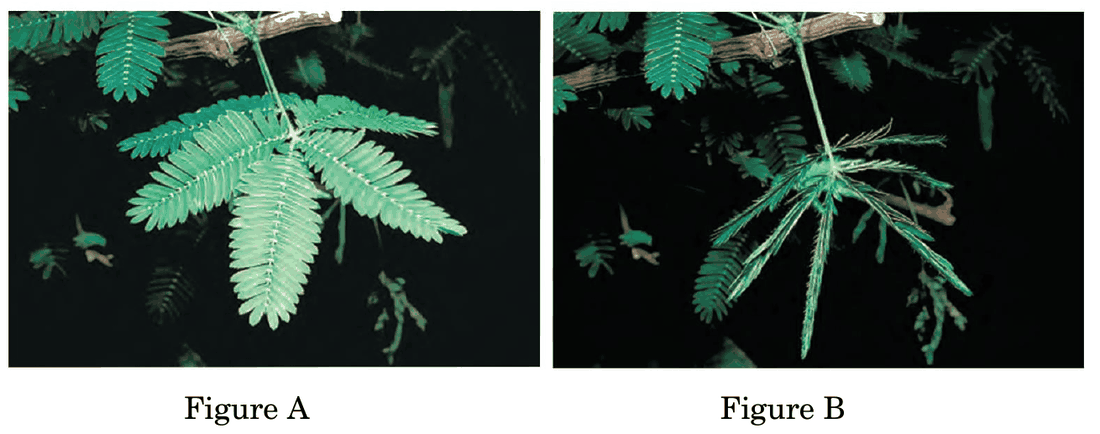
Observe the given figures A and B. When chhui-mui (sensitive) plant is touched, its leaves fold. This is due to:
A plant growth inhibitor hormone which causes wilting of leaves is called:
The correct sequence of events when someone’s hand touches a hot object unconsciously:
Sense organ in which olfactory receptors are present is:
In plants the role of cytokinin is:
2 marks: very short answer
“The timing and the amount of hormone secreted by a gland are regulated in the human body.” Justify this statement with the help of an example.
Solution
The timing and amount of hormone secreted are regulated by a feedback mechanism.
Example (insulin): when the blood sugar level rises (after a meal), cells of the pancreas detect it and secrete more insulin. Insulin lowers blood sugar. As the sugar level falls, insulin secretion is reduced. Too much or too little hormone is harmful, so the body keeps adjusting the amount.
Electrical impulse is an excellent means to transmit information in the animal body, but there are some limitations to the use of electrical impulses. State any two limitations.
Solution
1. Electrical impulses reach only those cells that are connected by nervous tissue, not every cell of the body.
2. Once a cell generates and transmits an impulse, it needs some time to reset its mechanism before it can send a new impulse, so cells cannot continually create and transmit impulses.
(This is why animals also use chemical communication — hormones.)
Name the parts of hind-brain of the human brain. Which part of the hind-brain controls involuntary actions such as blood pressure and salivation?
Solution
The hind-brain has three parts: pons, cerebellum and medulla (medulla oblongata).
The medulla controls involuntary actions such as blood pressure, salivation and vomiting.
Name the part of brain which is responsible for the following actions: (i) Maintaining posture and balance (ii) Beating of heart (iii) Thinking (iv) Blood pressure
Where are auxins synthesized in a plant? Which organ of the plant shows: (i) Positive phototropism (ii) Negative geotropism (iii) Positive hydrotropism
(a) Name one gustatory receptor and one olfactory receptor present in human beings. (b) Write a and b in the given flow chart of neuron through which information travels as an electrical impulse: Dendrite → a → b → End point of Neuron
3 marks: short answer
Plants have neither a nervous system nor muscles, even then they respond to stimuli. For example, the leaves of chhui-mui (touch-me-not) plant when touched begin to fold up and droop.
(a) How is the information communicated in ‘‘touch-me-not’’ plants?
(b) What enables the plant cells to bring out the observable response?
(c) Differentiate the movement mentioned above from the movement of tendrils in a pea plant.
Solution
(a) The plant cells use electrical-chemical means to convey the information of touch from cell to cell (there is no specialised tissue for conduction).
(b) To move, the plant cells change their shape by changing the amount of water in them, which results in swelling or shrinking and hence folding of the leaves.
(c)
| Touch-me-not leaves | Pea tendrils |
|---|---|
| Movement is quick and does not involve growth | Movement is slow and is due to growth (unequal growth on the two sides) |
| Not directional with respect to the stimulus (nastic) | Directional — the tendril coils around the support (thigmotropism) |
(a) Define hormone.
(b) “Hormones should be secreted in precise quantities. We have a feedback mechanism through which this is done.” With the help of an example justify the statement.
Solution
(a) A hormone is a chemical messenger secreted by an endocrine gland directly into the blood, which carries it to target cells or organs where it regulates their activity.
(b) The timing and amount of hormone released are regulated by a feedback mechanism. Example: when the blood sugar level rises, it is detected by the cells of the pancreas, which respond by producing more insulin. Insulin lowers the blood sugar. As the sugar level falls, insulin secretion is reduced. Too much or too little of a hormone is harmful (e.g. too little insulin causes diabetes), so precise control is needed.
Taking the example of any two animal hormones along with their gland of secretion, explain how these hormones help (i) in growth and development and (ii) regulate metabolism, in the body.
Solution
(i) Growth hormone, secreted by the pituitary gland, regulates growth and development of the body. Its deficiency in childhood causes dwarfism; excess causes gigantism.
(ii) Thyroxin, secreted by the thyroid gland, regulates carbohydrate, protein and fat metabolism to provide the best balance for growth. Iodine is needed to make thyroxin. (Insulin from the pancreas, which regulates blood sugar, is another example.)
Name the hormone released and the gland which secretes it in human beings during scary situations. How does the body respond to enable it to deal with the situation?
Solution
Hormone: adrenaline; gland: adrenal glands.
Adrenaline is secreted directly into the blood and carried to different parts of the body, including the heart:
• the heart beats faster, supplying more oxygen to the muscles;
• blood to the digestive system and skin is reduced (small arteries there contract), and is diverted to the skeletal muscles;
• the breathing rate increases (contractions of the diaphragm and rib muscles).
All these prepare the body to deal with the situation (fight or flight).
A cheetah, on seeing a prey, moves towards him at a very high speed. What causes the movement of his muscles? How does the chemistry of cellular components of muscles change during this event?
Define geotropism. Draw a labelled diagram of a plant showing geotropic movements of its parts.
(a) Plants do not have any nervous system but yet, if we touch a sensitive plant, some observable changes take place in its leaves. Explain how could this plant respond to the external stimuli and how it is communicated. (b) Name the hormone that needs to be administered to (i) increase the height of a dwarf plant. (ii) cause rapid cell division in fruits and seeds.
Name the hormones secreted by the following endocrine glands and specify one function of each: (a) Thyroid (b) Pituitary (c) Pancreas
4 marks: case-based / source-based
Read the following passage and answer the questions that follow:
A middle-aged person is facing some cognitive changes in himself. His early symptoms included mild forgetfulness. For example, forgetting where he left his mobile or failing to find words to complete his sentences. He was facing problems in driving a car, climbing up and down the stairs, inserting a plug into an outlet. He slowly developed a sad mood and anxiety.
(a) What are voluntary actions? 1
(b) Which part of the brain is responsible for precision of voluntary actions? 1
(c) (i) Explain the role of the medulla. 2
OR
(c) (ii) How do the animal muscles move? 2
Solution
(a) Voluntary actions are actions done consciously, according to our will, e.g. writing, talking, picking up a pen. They are controlled by the fore-brain (cerebrum).
(b) The cerebellum (part of the hind-brain) is responsible for precision of voluntary actions and maintaining posture and balance.
(c) (i) The medulla (in the hind-brain) controls many involuntary actions such as blood pressure, salivation and vomiting. It connects the brain to the spinal cord.
OR (c) (ii) Muscle cells contain special proteins. When a nerve impulse reaches a muscle, these proteins change their shape and arrangement in the cell. This makes the muscle cells shorter (contraction), and the muscle moves the part of the body; when they return to their original form the muscle relaxes.
Answer question numbers 4(a) to 4(d) on the basis of your understanding of the following information and related studied concepts.
Thyroid gland is a bilobed structure situated in our neck region. It secretes a hormone called thyroxine. Iodine is necessary for the thyroid gland to make thyroxine. Thyroxine regulates carbohydrate, protein and fat metabolism in the body. It promotes growth of body tissues also. When there is an excess of thyroxine in the body, a person suffers from hyperthyroidism and if this gland is underactive it results in hypothyroidism. Hyperthyroidism is diagnosed by blood tests that measure the levels of thyroxine and Thyroid Stimulating Hormone (TSH). Hypothyroidism is caused due to the deficiency of iodine in our diet resulting in a disease called goitre. Iodised salt can be included in our diet to control it.
(a) Where is thyroid gland situated in our body? 1
(b) State the function of thyroxine in human body. 1
(c) What is hyperthyroidism? 1
(d) How can we control hypothyroidism? 1
Solution
(a) In the neck region.
(b) Thyroxine regulates carbohydrate, protein and fat metabolism in the body to provide the best balance for growth.
(c) The condition caused by an excess of thyroxine in the body (an overactive thyroid gland).
(d) By including iodised salt in the diet (iodine is needed to make thyroxine).
5 marks: long answer
(i) Define a reflex arc. Why have reflex arcs evolved in animals? Trace the sequence of events which occur, when you suddenly touch a hot object.
(ii) Name the part of nervous system which helps in communication between the central nervous system and other parts of the body. What are the two components of this system?
Solution
(i) A reflex arc is the pathway followed by nerve impulses in a reflex action: from the receptor, through the sensory nerve, to the spinal cord, and back through the motor nerve to the effector.
Reflex arcs have evolved because the thinking process of the brain is too slow in an emergency; the connection in the spinal cord allows a very quick response without waiting for the brain.
Sequence on touching a hot object: receptors in the skin detect the heat → sensory neuron carries the impulse to the spinal cord → relay neuron in the spinal cord → motor neuron → effector (muscles of the arm) contracts → the hand is pulled away. (The information also reaches the brain later.)
(ii) The peripheral nervous system. Its two components: cranial nerves arising from the brain and spinal nerves arising from the spinal cord.
(i) Leaves of chhui-mui plant begin to fold up and droop in response to a stimulus. Name the stimulus and write the cause for such a rapid movement. Is there any growth involved in the movement?
(ii) Define geotropism in plants. What is meant by positive and negative geotropism? Give one example of each type.
Solution
(i) Stimulus: touch. Cause: the information of touch is passed from cell to cell by electrical-chemical means, and the plant cells change shape by changing the amount of water in them (swelling or shrinking), so the leaves fold. No growth is involved — it is a quick movement.
(ii) Geotropism is the directional growth movement of a plant part in response to gravity.
Positive geotropism: growth towards gravity — e.g. roots grow downward.
Negative geotropism: growth away from gravity — e.g. shoots grow upward.
(i) List three points of difference between nervous and hormonal mechanisms for control and coordination in animals.
(ii) How are auxins related with the bending of plant shoot towards unidirectional light? Explain.
Solution
(i)
| Nervous mechanism | Hormonal mechanism |
|---|---|
| Information travels as electrical impulses along nerve fibres | Information travels as chemical messengers (hormones) through the blood |
| Very fast response | Slow response |
| Reaches only cells connected by nervous tissue | Can reach all cells of the body |
| Effect is short-lived | Effect is generally long-lasting |
(ii) Auxin is synthesised at the tip of the shoot. When light falls from one side, auxin diffuses towards the shady side of the shoot. This higher concentration of auxin makes the cells on the shady side grow longer, so that side grows faster and the shoot bends towards the light (phototropism).
(i) Name the disorder which a person is likely to suffer from due to the following: (I) Over-secretion of growth hormone (II) Deficiency of oestrogen in females (III) Less secretion of thyroxine. Also name the gland that secretes each of the hormones mentioned above.
(ii) How is the timing and amount of hormone released regulated? Explain with the help of an example.
(a) Why is the use of iodised salt advisable? Name the disease caused due to deficiency of iodine in our diet and state its one symptom. (b) How do nerve impulses travel in the body? Explain.
What is hydrotropism? Design an experiment to demonstrate this phenomenon.
Get every solution for all chapters
- Every board question of every chapter, each fully solved the way the board gives marks
- 17 complete board papers, each followed by its solutions
- Weightage and most-asked topics for every chapter
- Instant PDF download, colour and black & white print copies
Revising the chapter first? Complete Science Notes for Class 10 (NCERT 2026-27) →
What you get in the pack
- Questions from 126 CBSE papers, 2016 to 2026: every set code available
- Complete: 2405 different questions and parts from all set codes, 13 chapters and 17 full papers
- Part A: all 13 chapters, questions sorted chapter-wise and by marks
- Year-wise weightage table and most-asked topics for every chapter
- Part B: 17 full board papers, each followed by its complete solutions, for timed practice
- Answers written to the CBSE marking-scheme points, with labelled diagrams drawn in full
- Questions on topics out of the board syllabus flagged
All chapters in this pack
- PYQ Ch 1 Chemical Reactions and Equations
- PYQ Ch 2 Acids, Bases and Salts
- PYQ Ch 3 Metals and Non-metals
- PYQ Ch 4 Carbon and its Compounds
- PYQ Ch 5 Life Processes
- PYQ Ch 6 Control and Coordination
- PYQ Ch 7 How do Organisms Reproduce
- PYQ Ch 8 Heredity
- PYQ Ch 9 Light Reflection and Refraction
- PYQ Ch 10 The Human Eye and the Colourful World
- PYQ Ch 11 Electricity
- PYQ Ch 12 Magnetic Effects of Electric Current
- PYQ Ch 13 Our Environment
- Board Paper 2026 Set 31-2-1 with Solutions
- Board Paper 2026 Set 31-3-1 with Solutions
- Board Paper 2025 Set 31-1-1 with Solutions
- Board Paper 2025 Set 31-2-1 with Solutions
- Board Paper 2024 Set 31-4-1 with Solutions
- Board Paper 2024 Set 31-5-1 with Solutions
- Board Paper 2023 Set 31-2-1 with Solutions
- Board Paper 2023 Set 31-4-1 with Solutions
- Board Paper 2022 Term 2 Set 31-1-1 with Solutions
- Board Paper 2022 Term 2 Set 31-3-1 with Solutions
- Board Paper 2020 Set 31-2-1 with Solutions
- Board Paper 2020 Set 31-4-1 with Solutions
- Board Paper 2019 Set 31-2-1 with Solutions
- Board Paper 2019 Set 31-4-1 with Solutions
- Board Paper 2018 Set 31-1 with Solutions
- Board Paper 2017 Set 3 with Solutions
- Board Paper 2016 Set 31-1 with Solutions