
Carbon and its Compounds: Class 10 PYQs 2016–2026 with solutions
All 58 CBSE board questions asked from Carbon and its Compounds in 17 board papers, with the year, set and marks of each. 31 are solved free below. The Class 10 Science PYQ Book: Solved Board Papers 2016-2026 (CBSE) has every solution, all chapters and 17 full board papers.
Subject expert: Khushbu Gupta, B.Sc., M.Sc. Physics, B.Ed. · 8+ years teaching


Free: NCERT solutions for Class 10 Science →
Carbon and its Compounds: board weightage
Board weightage 2016–2026
| Year | 2016 | 2017 | 2018 | 2019 | 2020 | 2022 | 2023 | 2024 | 2025 | 2026 |
|---|---|---|---|---|---|---|---|---|---|---|
| Questions | 8 | 8 | 2 | 6 | 4 | 6 | 6 | 6 | 5 | 7 |
| Marks | 17 | 17 | 5 | 19 | 10 | 16 | 22 | 13 | 22 | 23 |
Most asked topics
58 questions from 17 papers. Repeated questions are shown once with every year they were asked.
Jump to: 1 mark2 marks3 marks4 marks5 marks
1 mark: MCQ and Assertion–Reason
Assertion (A): Carbon compounds can form chains, branched and ring structures.
Reason (R): Carbon exhibits the property of catenation.
Solution
Answer: (A)
Both are true. Catenation — the ability of carbon to form bonds with other carbon atoms — gives long chains, branched chains and rings. R explains A.
Consider the structures ‘X’ and ‘Y’ given below:
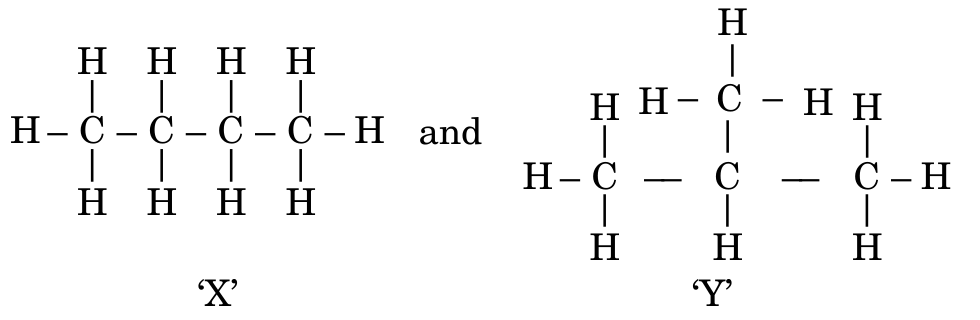
Which of the following statements are correct?
(i) ‘X’ and ‘Y’ are homologues.
(ii) ‘X’ and ‘Y’ have the same structural formula, but different molecular formula.
(iii) ‘X’ and ‘Y’ have the same molecular formula, but different structural formula.
(iv) ‘X’ and ‘Y’ are structural isomers.
Solution
Answer: (D) (iii) and (iv)
Both X (a straight chain) and Y (a branched chain) have 4 C and 10 H atoms: C4H10 (butane). Same molecular formula but different structures, so they are structural isomers, not homologues (homologues differ by –CH2–).
Assertion (A): There are large number of compounds with many carbon atoms linked to each other.
Reason (R): Carbon-Carbon bond is very strong and stable.
Solution
Answer: (A)
Both are true and R explains A. Because the C–C bond is very strong and stable, carbon can link with other carbon atoms to form long chains, branched chains and rings (catenation), giving a very large number of compounds.
The number of single and double bonds present in a molecule of benzene (C6H6) respectively, are:
Solution
Answer: (B) 9 and 3
Benzene has 6 C–H single bonds and a ring of 6 carbon atoms with alternate single and double bonds (3 C–C single, 3 C=C double). Single bonds = 6 + 3 = 9; double bonds = 3.
Assertion (A): Some vegetable oils are healthy.
Reason (R): Vegetable oils generally have long unsaturated carbon chains.
Solution
Answer: (A)
Both are true and R explains A: oils containing unsaturated fatty acids are considered healthier for cooking than animal fats, which contain saturated fatty acids.
The total number of electrons shared in the formation of an ethyne molecule is:
Solution
Answer: (c) 10
Ethyne, H–C≡C–H: the triple bond shares 3 pairs (6 electrons) and the two C–H bonds share 2 pairs (4 electrons): 6 + 4 = 10.
The electron dot structure of chlorine molecule is:
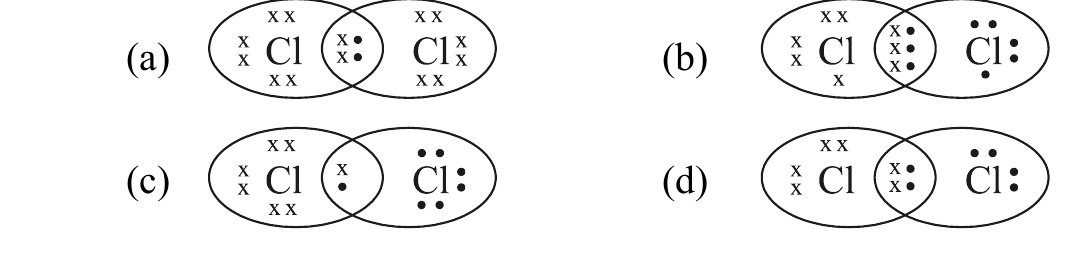
Solution
Answer: (c)
Each chlorine atom (2, 8, 7) has 7 valence electrons and needs one more. The two atoms share one pair of electrons (one × from one atom and one • from the other) — a single covalent bond — and each keeps three lone pairs. Only (c) shows one shared pair with 6 unshared electrons on each Cl. (a) and (d) show two shared pairs; (b) shows three.
Covalent compounds have low melting and boiling point. Why?
Solution
The forces of attraction between the molecules of covalent compounds are weak, so little energy is needed to separate them.
Assertion (A): Ethanoic acid is also known as glacial acetic acid.
Reason (R): The melting point of pure ethanoic acid is 290 K and hence it often freezes during winters in cold climates.
Solution
Answer: (a)
Both are true and R explains A: pure ethanoic acid freezes in cold weather, looking like a glacier.
Write the molecular formula of the 2nd and 3rd member of the homologous series where the first member is ethyne.
While studying the saponification reaction, what do you observe when you mix an equal amount of colourless vegetable oil and 20% aqueous solution of NaOH in a beaker?
When you add a few drops of acetic acid to a test-tube containing sodium bicarbonate powder, which one of the following is your observation?
A student requires hard water for an experiment in his laboratory which is not available in the neighbouring area. In the laboratory there are some salts, which when dissolved in distilled water can convert it into hard water. Select from the following groups of salts, a group, each salt of which when dissolved in distilled water will make it hard.
Write the name and structure of an alcohol with three carbon atoms in its molecule.
A student puts a drop of reaction mixture of a saponification reaction first on a blue litmus paper and then on a red litmus paper. He may observe that:
For preparing soap in the laboratory we require an oil and a base. Which of the following combinations of an oil and a base would be best suited for the preparation of soap?
In the neighbourhood of your school, hard water required for an experiment is not available. Select from the following groups of salts available in your school, a group each member of which, if dissolved in distilled water, will make it hard:
2 marks: very short answer
(a) Select from the following the members of same homologous series:
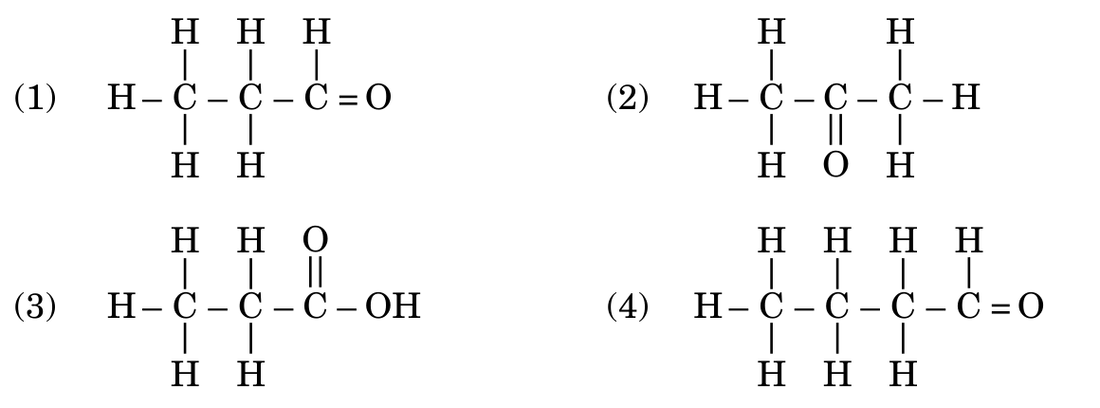
(b) What happens to (i) the melting point, and (ii) the solubility of compounds as the molecular mass of the compounds in a homologous series increases?
Solution
(a) (1) and (4). (1) is propanal, CH3CH2CHO, and (4) is butanal, CH3CH2CH2CHO. Both have the aldehyde group (–CHO) and differ by one –CH2– unit. (2) is a ketone (propanone) and (3) a carboxylic acid (propanoic acid).
(b) (i) The melting point increases with increasing molecular mass.
(ii) The solubility in a particular solvent (such as water) shows a regular gradation — it decreases with increasing molecular mass.
Distinguish between a saturated and an unsaturated hydrocarbon by flame test. List the products of combustion reaction of a saturated hydrocarbon.
Solution
• A saturated hydrocarbon burns with a clean blue flame (no soot).
• An unsaturated hydrocarbon burns with a yellow, sooty (smoky) flame.
Products of combustion of a saturated hydrocarbon: carbon dioxide, water, heat and light (e.g. CH4 + 2O2 → CO2 + 2H2O + heat and light).
The melting and boiling points of carbon compounds are generally low and they are largely non-conductors of electricity. State two conclusions based on these two properties.
Solution
1. Low melting and boiling points show that the forces of attraction between their molecules are not very strong.
2. Being non-conductors shows that the bonding in them does not give rise to ions.
Together these show that carbon compounds are formed by covalent bonds (sharing of electrons).
(a) Write the molecular formula of the following carbon compounds: (i) Methane (ii) Propane
(b) Carbon compounds have low melting and boiling points. Why?
Solution
(a) (i) Methane: CH4 (ii) Propane: C3H8
(b) Carbon compounds are covalent: they are made of molecules, and the forces of attraction between the molecules are weak. Little energy is needed to separate the molecules, so their melting and boiling points are low.
Draw the electron dot structure of the following: (a) Cyclohexane (b) Butane
Solution
Each carbon shares its four valence electrons; every C–C and C–H bond is one shared pair (••).
(a) Cyclohexane, C6H12: six carbon atoms in a ring, each carbon bonded to two other carbons and two hydrogens.
••••
H••C••C••H
H •• •• H
H••C C••H
H •• •• H
H••C••C••H
••••
H H
(b) Butane, C4H10: CH3–CH2–CH2–CH3
•• •• •• ••
H••C••C••C••C••H
•• •• •• ••
H H H H
Butane has 13 shared pairs (3 C–C + 10 C–H); cyclohexane has 18 (6 C–C + 12 C–H).
Write the molecular formula of ethene and draw its electron dot structure.
Solution
Ethene: C2H4 (CH2=CH2). The two carbon atoms share two pairs of electrons (a double bond), and each carbon shares one pair with each of two hydrogen atoms:
•• ••
C::C
•• ••
H H
i.e. H₂C::CH₂ — 6 shared pairs in all (4 C–H, 2 in C=C).
What is observed when a pinch of sodium hydrogen carbonate is added to 2 mL of acetic acid taken in a test tube? Write chemical equation for the reaction involved in this case.
What happens when 5% alkaline potassium permanganate solution is added drop by drop to warm propyl alcohol (propanol) taken in a test tube? Explain with the help of a chemical equation.
A compound ‘X’ on heating with excess conc. sulphuric acid at 443 K gives an unsaturated compound ‘Y’. ‘X’ also reacts with sodium metal to evolve a colourless gas ‘Z’. Identify ‘X’, ‘Y’ and ‘Z’. Write the equation of the chemical reaction of formation of ‘Y’ and also write the role of sulphuric acid in the reaction.
Mention the essential material (chemicals) to prepare soap in the laboratory. Describe in brief the test of determining the nature (acidic/alkaline) of the reaction mixture of saponification reaction.
A student adds a spoon full of powdered sodium hydrogen carbonate to a flask containing ethanoic acid. List two main observations, he must note in his note book, about the reaction that takes place. Also write chemical equation for the reaction.
3 marks: short answer
Why is the conversion of ethanol to ethanoic acid an oxidation reaction? Name the oxidising agent used in this conversion. Write chemical equation for this oxidation reaction. How is this reaction different from the reaction in which ethanol burns in the presence of oxygen?
Solution
It is oxidation because oxygen is added to ethanol (and hydrogen is removed): CH3CH2OH becomes CH3COOH.
Oxidising agent: alkaline potassium permanganate (or acidified potassium dichromate).
Difference: this is a controlled (partial) oxidation that gives ethanoic acid. When ethanol burns in oxygen it undergoes complete oxidation (combustion), giving carbon dioxide, water, heat and light: C2H5OH + 3O2 → 2CO2 + 3H2O.
Draw two different possible structures of a saturated hydrocarbon having four carbon atoms in its molecule. What are these two structures of the hydrocarbon having same molecular formula called? Write the molecular formula and the common name of this compound. Also write the molecular formula of its alkyne.
Solution
X: n-butane CH3–CH2–CH2–CH3 (straight chain); Y: isobutane CH3–CH(CH3)–CH3 (branched chain).
Compounds with the same molecular formula but different structures are called structural isomers.
Molecular formula: C4H10; common name: butane.
Its alkyne (butyne, CnH2n−2): C4H6.
(i) Write the molecular formula of benzene and draw its structure. (ii) Write the number of single and double covalent bonds present in a molecule of benzene. (iii) Which compounds are called alkynes?
Solution
(i) C6H6: a ring of six carbon atoms with alternate single and double bonds, each carbon bonded to one hydrogen.
(ii) Single bonds: 9 (6 C–H + 3 C–C); double bonds: 3 (C=C).
(iii) Alkynes are unsaturated hydrocarbons containing at least one carbon–carbon triple bond; general formula CnH2n−2 (e.g. ethyne, HC≡CH).
State the reason why (i) carbon compounds have low melting and boiling points. (ii) carbon compounds do not conduct electricity. (iii) carbon can form only covalent compounds.
Solution
(i) Carbon compounds are made of molecules held by weak intermolecular forces, which need little energy to overcome.
(ii) The bonding in them (sharing of electrons) does not give rise to ions, so there are no charged particles to carry current.
(iii) Carbon has 4 valence electrons. Losing 4 (to form C4+) needs too much energy, and gaining 4 (to form C4−) is difficult because 6 protons cannot hold 10 electrons. So carbon shares electrons and forms only covalent bonds.
What is a homologous series? Find the difference in molecular mass between the two consecutive members of a homologous series. State how in a homologous series of carbon compounds the following properties vary with increase in molecular mass: (i) Melting and boiling points (ii) Chemical properties
Solution
A homologous series is a series of carbon compounds having the same functional group, in which successive members differ by a –CH2– unit.
Difference in molecular mass between consecutive members = mass of CH2 = 12 + 2 × 1 = 14 u.
(i) Melting and boiling points increase with increasing molecular mass.
(ii) Chemical properties remain similar, because they are determined by the functional group, which is the same.
Carbon, a member of group 14, forms a large number of carbon compounds estimated to be about three million. Why is this property not exhibited by other elements of this group? Explain.
Solution
Carbon forms so many compounds because of:
(1) Catenation — carbon can link with other carbon atoms to form long chains, branched chains and rings, because the C–C bond is very strong and stable; (2) Tetravalency — it can bond with four atoms of carbon or other elements (H, O, N, S, Cl), and the bonds are strong because carbon atoms are small.
Other group 14 elements (Si, Ge, Sn, Pb) have larger atoms, so their bonds with each other are weaker and less stable. Silicon forms chains of only up to about seven or eight atoms, and these compounds are very reactive. So they cannot form a large number of compounds.
What is a homologous series of carbon compounds? Give an example and list its three characteristics.
(a) Why are most carbon compounds poor conductors of electricity? (b) Write the name and structure of a saturated compound in which the carbon atoms are arranged in a ring. Give the number of single bonds present in this compound.
Distinguish between esterification and saponification reactions with the help of the chemical equations for each. State one use of each (i) esters, and (ii) saponification process.
Write the structural formula of ethanol. What happens when it is heated with excess of conc. H2SO4 at 443 K? Write the chemical equation for the reaction stating the role of conc. H2SO4 in this reaction.
Write chemical equation of the reaction of ethanoic acid with the following: (a) Sodium; (b) Sodium hydroxide; (c) Ethanol. Write the name of one main product of each reaction.
An aldehyde as well as a ketone can be represented by the same molecular formula, say C3H6O. Write their structures and name them. State the relation between the two in the language of science.
4 marks: case-based / source-based
Carbon is a versatile element that forms the basis of all living organisms and many of the things we use. A large variety of compounds is formed because of its tetravalency. Compounds of carbon are formed with oxygen, hydrogen, nitrogen, sulphur, chlorine and many other elements.
(a) What are hydrocarbons? 1
(b) List two properties by virtue of which carbon can form a large number of compounds. 1
(c) (i) Write the formula of the functional group present in (1) aldehydes, and (2) ketones. Write chemical equation for the reaction that occurs between ethanoic acid and ethanol in the presence of a catalyst. 2
OR
(c) (ii) What are structural isomers? Write the structures of two isomers of butane (C4H10). 2
Solution
(a) Hydrocarbons are compounds made up of only carbon and hydrogen, e.g. methane CH4.
(b) (1) Catenation — carbon links with other carbon atoms to form long chains, branches and rings. (2) Tetravalency — with valency 4, carbon bonds with four other atoms (carbon or other elements).
(c) (i) Aldehyde: –CHO; ketone: –CO– (C=O within the chain).
OR (c) (ii) Structural isomers are compounds with the same molecular formula but different structural arrangements of atoms.
Isomers of C4H10: n-butane CH3–CH2–CH2–CH3 (straight chain) and isobutane (2-methylpropane) CH3–CH(CH3)–CH3 (branched chain).
5 marks: long answer
A carbon compound ‘P’ of molecular formula C2H6O is found to be neutral when tested with red and blue litmus. A gas that burns with a pop sound is produced when sodium metal reacts with compound ‘P’.
(i) Identify the compound ‘P’.
(ii) The carbon compound ‘P’ is heated with conc. H2SO4 at 443 K to produce compound ‘Q’. (I) Write the chemical equation for the reaction. (II) What is the role of conc. H2SO4 in this reaction?
(iii) What is likely to be observed on heating compound ‘P’ with ethanoic acid with an acid as a catalyst? Write the chemical equation for the reaction. 1+2+2
Solution
(i) P is ethanol, C2H5OH. It is neutral to litmus and reacts with sodium to give hydrogen (the gas that burns with a pop):
2Na + 2CH3CH2OH → 2CH3CH2ONa + H2
(ii) (I)
(iii) A sweet-smelling substance, the ester ethyl ethanoate, is formed (esterification):
(i) Write the structural formula of benzene.
(ii) State the reason why carbon can neither form C4+ cation nor C4– anion.
(iii) What type of bond is formed between carbon and hydrogen?
(iv) How is ethanol converted to ethanoic acid?
(v) Complete the following chemical equation: CH3COOC2H5 + NaOH → 5×1
Solution
(i) Benzene, C6H6: a ring of six carbon atoms with alternate single and double bonds, each carbon carrying one hydrogen.
(ii) Carbon has 4 valence electrons. To form C4+ it would have to lose 4 electrons, which needs a very large amount of energy. To form C4− it would have to gain 4 electrons, and a nucleus of 6 protons cannot hold 10 electrons. So carbon shares its electrons and forms covalent bonds.
(iii) A covalent bond (single covalent bond, formed by sharing a pair of electrons).
(iv) By oxidation using an oxidising agent such as alkaline potassium permanganate or acidified potassium dichromate:
CH3CH2OH →(alkaline KMnO4 + heat / acidified K2Cr2O7) CH3COOH
(v)
(i) What is homologous series? Which two of the following organic compounds belong to the same homologous series? C2H4, C4H10, C3H4, C4H8
(ii) Write the product(s) in the following reactions: (I) CH3–CH2–OH + CH3COOH →(Acid) (II) C2H5OH + O2 →(Burning)
(iii) Why does micelle formation take place when soap is added to water? 2+2+1
Solution
(i) A homologous series is a series of carbon compounds that have the same functional group and similar chemical properties, in which successive members differ by a –CH2– unit (14 u in mass).
C2H4 and C4H8 belong to the same series — the alkenes (CnH2n).
(ii) (I) Ester and water (esterification):
(II) Carbon dioxide and water, with heat and light (combustion):
(iii) A soap molecule has an ionic (hydrophilic) end that dissolves in water and a long hydrocarbon (hydrophobic) tail that dissolves in oil. In water, the tails keep away from water and cluster together inside, while the ionic ends face the water. This cluster is a micelle; oily dirt collects in its centre and is washed away.
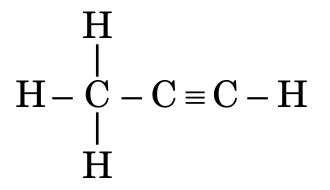
(i) Name the following compounds:
(I) 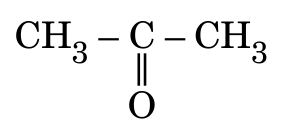 (II)
(ii) Name the reaction which is commonly used in the conversion of vegetable oils to fats.
(iii) Why is the melting point of C4H10 higher than C3H8?
(iv) What happens when a piece of sodium is dropped into ethanol?
(v) Write the products in the following reaction: CH3COOC2H5 + NaOH → 5×1
Solution
(i) (I) CH3–CO–CH3: propanone (a ketone; common name acetone). (II) CH3–C≡CH: propyne.
(ii) Hydrogenation — adding hydrogen to vegetable oils in the presence of a nickel or palladium catalyst.
(iii) Both belong to the same homologous series (alkanes). As the molecular mass (number of carbon atoms) increases, the melting and boiling points increase. C4H10 has a higher molecular mass than C3H8, so its melting point is higher.
(iv) Sodium reacts with ethanol, giving off bubbles of hydrogen gas (effervescence) and forming sodium ethoxide: 2Na + 2CH3CH2OH → 2CH3CH2ONa + H2.
(v)
(i) Draw two isomeric structures of Butene (C4H8).
(ii) Name the following compounds:
(I) 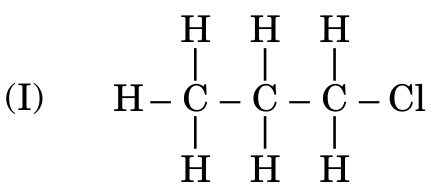 (II)
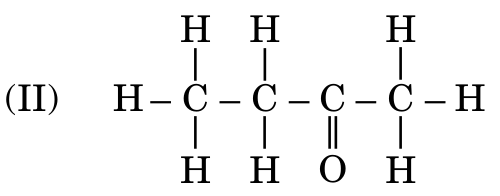
(iii) Write the chemical equations for the following reactions. Mention one essential condition each for these reactions to take place. (I) Ethanol undergoes complete oxidation (II) Propene undergoes hydrogenation (III) Ethanoic acid reacts with ethanol
Solution
(i) Two isomers of butene (same formula C4H8, different position of the double bond):
But-2-ene: CH3–CH=CH–CH3
(ii) (I) CH3CH2CH2Cl — chloropropane (1-chloropropane). (II) CH3CH2COCH3 — butanone.
(iii) (I) Complete oxidation (combustion) — condition: burning in excess air/oxygen:
(II) Hydrogenation — condition: nickel (or palladium) catalyst:
(III) Esterification — condition: an acid catalyst (conc. H2SO4) and warming:
(i) A carbon compound X is a good solvent. On reaction with sodium, X forms two products Y and Z. Z is used to convert vegetable oil into vegetable ghee. Identify and name X, Y and Z. Also write the equation of reaction of X with sodium to justify your answer.
(ii) Write chemical equation to show what happens when ethanol: (I) burns in oxygen/air. (II) is heated at 443 K in excess conc. H2SO4. (III) reacts with acidified potassium dichromate.
Solution
(i) X = ethanol (C2H5OH, a good solvent); Y = sodium ethoxide (C2H5ONa); Z = hydrogen (used in hydrogenation of oils to ghee).
(ii) (I)
(II) Dehydration to ethene:
(III) Oxidation to ethanoic acid (orange dichromate turns green):
(i) A compound ‘X’ having two carbon atoms in its molecule turns blue litmus red and 5 – 8% solution of ‘X’ in water is widely used as a preservative. Identify the compound ‘X’ and write its structure.
(ii) Compare its pH nature with a mineral acid.
(iii) ‘X’ on reacting with alcohols produces sweet smelling compounds, used in making perfumes. Name the reaction and write its chemical equation.
(iv) When sodium carbonate is added to ‘X’, a colourless gas is produced which turns lime water milky. Write the chemical equation for the reaction giving the name of the salt produced.
Solution
(i) X = ethanoic acid (acetic acid), CH3COOH. Its 5–8% solution in water is vinegar, used as a preservative in pickles.
Structure: CH3–C(=O)–OH, i.e. H3C–C(=O)–O–H.
(ii) Ethanoic acid is a weak acid; it ionises only partly, so its pH is higher (less acidic) than that of a mineral acid like HCl of the same concentration.
(iii) Esterification:
(iv)
(i) Differentiate between saturated and unsaturated hydrocarbons by giving one example each, with a structural formula.
(ii) Write the method of converting an unsaturated hydrocarbon into a saturated hydrocarbon. Name the industry where this reaction is commonly used.
(iii) Write the name and structure of a hydrocarbon having double bond and four carbon atoms in its one molecule.
Solution
(i)
| Saturated hydrocarbons | Unsaturated hydrocarbons |
|---|---|
| Carbon atoms are joined only by single bonds | Have at least one double or triple bond between carbon atoms |
| Burn with a clean blue flame; less reactive | Burn with a yellow sooty flame; more reactive (addition reactions) |
| Example: ethane, H3C–CH3 | Example: ethene, H2C=CH2 |
(ii) By hydrogenation — adding hydrogen in the presence of a catalyst such as nickel or palladium: CH2=CH2 + H2 →(Ni) CH3–CH3. It is used in the vanaspati ghee industry (hydrogenation of vegetable oils).
(iii) Butene (but-1-ene), C4H8: CH2=CH–CH2–CH3.
An acid ‘X’ and an alcohol ‘Y’ react with each other in the presence of an acid catalyst to form a sweet smelling substance ‘Z’. Identify ‘X’, ‘Y’ and ‘Z’. Write the chemical equation for the reaction involved and name it. The substance ‘Z’ on treatment with sodium hydroxide produces back the alcohol ‘Y’ and sodium ethanoate. Write the chemical equation for the reaction involved and name it, giving justification for the name.
Solution
X = ethanoic acid (CH3COOH); Y = ethanol (C2H5OH); Z = ethyl ethanoate, an ester (CH3COOC2H5). (Sodium ethanoate is formed in the second reaction, so the acid must be ethanoic acid.)
Esterification:
Saponification:
It is called saponification ("soap-making") because the same reaction — breaking an ester with an alkali to give an alcohol and the sodium salt of the acid — is used to make soap from fats and oils.
(i) Name the simplest saturated hydrocarbon. Draw its electron dot structure. Which type of bonds exist in this compound?
(ii) Name any two mixtures of the carbon compound used as a fuel in daily life, of which the above mentioned compound is an important component.
(iii) In which homologous series of carbon compounds can this compound be placed? Write the general formula of the series.
(iv) Which type of flame is produced on burning it?
(i) Draw the structure of the following compounds: (a) Butanoic acid (b) Chloropentane
(ii) How are structure (i) and structure (ii) given below related to one another? Give reason to justify your answer.
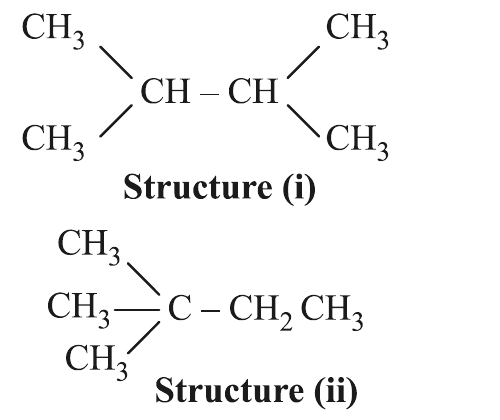
Draw one more possible structure for above case.
(iii) Differentiate between saturated and unsaturated carbon compounds on the basis of their general formula.
(i) What happens when a small piece of sodium is dropped in ethanol? Write the equation for this reaction.
(ii) Why is glacial acetic acid called so?
(iii) What happens when ethanol is heated at 443 K in the presence of conc. H2SO4? Write the role of conc. H2SO4 in this case.
(iv) Write an equation showing saponification.
(a) What is a homologous series? Explain with an example.
(b) Define the following terms giving one example of each. (i) Esterification (ii) Addition reaction
(a) Distinguish between esterification and saponification reactions with the help of chemical equations for each. (b) With a labelled diagram describe in brief an activity to show the formation of an ester.
What is the difference between soaps and detergents? State in brief the cleansing action of soaps in removing an oily spot from a fabric. Why are soaps not very effective when a fabric is washed in hard water? How is this problem resolved?
Why certain compounds are called hydrocarbons? Write the general formula for homologous series of alkanes, alkenes and alkynes and also draw the structure of the first member of each series. Write the name of the reaction that converts alkenes into alkanes and also write a chemical equation to show the necessary conditions for the reaction to occur.
A carbon compound P on heating with excess conc. H2SO4 forms another carbon compound Q which on addition of hydrogen in the presence of nickel catalyst forms a saturated carbon compound R. One molecule of R on combustion forms two molecules of carbon dioxide and three molecules of water. Identify P, Q and R and write chemical equations for the reactions involved.
Get every solution for all chapters
- Every board question of every chapter, each fully solved the way the board gives marks
- 17 complete board papers, each followed by its solutions
- Weightage and most-asked topics for every chapter
- Instant PDF download, colour and black & white print copies
Revising the chapter first? Complete Science Notes for Class 10 (NCERT 2026-27) →
What you get in the pack
- Questions from 126 CBSE papers, 2016 to 2026: every set code available
- Complete: 2405 different questions and parts from all set codes, 13 chapters and 17 full papers
- Part A: all 13 chapters, questions sorted chapter-wise and by marks
- Year-wise weightage table and most-asked topics for every chapter
- Part B: 17 full board papers, each followed by its complete solutions, for timed practice
- Answers written to the CBSE marking-scheme points, with labelled diagrams drawn in full
- Questions on topics out of the board syllabus flagged
All chapters in this pack
- PYQ Ch 1 Chemical Reactions and Equations
- PYQ Ch 2 Acids, Bases and Salts
- PYQ Ch 3 Metals and Non-metals
- PYQ Ch 4 Carbon and its Compounds
- PYQ Ch 5 Life Processes
- PYQ Ch 6 Control and Coordination
- PYQ Ch 7 How do Organisms Reproduce
- PYQ Ch 8 Heredity
- PYQ Ch 9 Light Reflection and Refraction
- PYQ Ch 10 The Human Eye and the Colourful World
- PYQ Ch 11 Electricity
- PYQ Ch 12 Magnetic Effects of Electric Current
- PYQ Ch 13 Our Environment
- Board Paper 2026 Set 31-2-1 with Solutions
- Board Paper 2026 Set 31-3-1 with Solutions
- Board Paper 2025 Set 31-1-1 with Solutions
- Board Paper 2025 Set 31-2-1 with Solutions
- Board Paper 2024 Set 31-4-1 with Solutions
- Board Paper 2024 Set 31-5-1 with Solutions
- Board Paper 2023 Set 31-2-1 with Solutions
- Board Paper 2023 Set 31-4-1 with Solutions
- Board Paper 2022 Term 2 Set 31-1-1 with Solutions
- Board Paper 2022 Term 2 Set 31-3-1 with Solutions
- Board Paper 2020 Set 31-2-1 with Solutions
- Board Paper 2020 Set 31-4-1 with Solutions
- Board Paper 2019 Set 31-2-1 with Solutions
- Board Paper 2019 Set 31-4-1 with Solutions
- Board Paper 2018 Set 31-1 with Solutions
- Board Paper 2017 Set 3 with Solutions
- Board Paper 2016 Set 31-1 with Solutions