
CBSE Class 10 Science Question Paper 2019 (31/2/1) with Solutions
The complete CBSE Class 10 Science board paper of 2019, Q.P. code 31/2/1: all 27 questions exactly as set, with marks. 19 solutions are free below. The Class 10 Science PYQ Book: Solved Board Papers 2016-2026 (CBSE) solves all 17 papers in full and sorts every question chapter-wise.
Subject expert: Khushbu Gupta, B.Sc., M.Sc. Physics, B.Ed. · 8+ years teaching


Free: NCERT solutions for Class 10 Science →
Question paper
Jump to: Question paperSolutions
2019 · Q.P. Code 31/2/1
Maximum marks: 80
Section A · 1 mark each
Name two industries based on forest produce.
not in 2026-27 syllabusWhy are the heating elements of electric toasters and electric irons made of an alloy rather than a pure metal?
Section B · 2 marks each
Write the molecular formula of ethene and draw its electron dot structure.
(a) Give reasons: (a) Platinum, gold and silver are used to make jewellery. (b) Metals like sodium and potassium are stored under oil.
(b) Silver articles become black when kept in open for some time, whereas copper vessels lose their shiny brown surfaces and gain a green coat when kept in open. Name the substances present in air with which these metals react and write the name of the products formed.
The absolute refractive index of Ruby is 1.7. Find the speed of light in Ruby. The speed of light in vacuum is 3 × 10⁸ m/s.
Section C · 3 marks each
On heating blue coloured powder of copper (II) nitrate in a boiling tube, black copper oxide, O2 and a brown gas X is formed. (a) Identify the type of reaction and the gas X. (b) Write balanced chemical equation of the reaction. (c) Write the pH range of aqueous solution of the gas X.
(a) (a) While diluting an acid, why is it recommended that the acid should be added to water and not water to the acid? (b) Dry hydrogen chloride gas does not change the colour of dry litmus paper. Why?
(b) How is sodium hydroxide manufactured in industries? Name the process. In this process a gas X is formed as by-product. This gas reacts with lime water to give a compound Y, which is used as a bleaching agent in the chemical industry. Identify X and Y and write the chemical equation of the reactions involved.
What are amphoteric oxides? Give an example. Write balanced chemical equations to justify your answer.
What is a homologous series of carbon compounds? Give an example and list its three characteristics.
List in tabular form three distinguishing features between autotrophic nutrition and heterotrophic nutrition.
(a) What is transpiration? List its two functions.
(b) (a) What is translocation? Why is it essential for plants? (b) Where do the substances in plants reach as a result of translocation?
What is carpel? Write the function of its various parts.
(a) A student holding a mirror in his hand, directed the reflecting surface of the mirror towards the Sun. He then directed the reflected light on to a sheet of paper held close to the mirror. (a) What should he do to burn the paper? (b) Which type of mirror does he have? (c) Will he be able to determine the approximate value of focal length of this mirror from this activity? Give reason and draw ray diagram to justify your answer in this case.
(b) A 10 cm tall object is placed perpendicular to the principal axis of a convex lens of focal length 12 cm. The distance of the object from the lens is 18 cm. Find the nature, position and size of the image formed.
What are solar cells? Explain the structure of solar panel. List two principal advantages associated with solar cells.
not in 2026-27 syllabusWrite the essential function performed by ozone at the higher levels of the Earth’s atmosphere? How is it produced? Name the synthetic chemicals mainly responsible for the drop of amount of ozone in the atmosphere. How can the use of these chemicals be reduced?
Section D · 5 marks each
(a) (a) List any three observations which posed a challenge to Mendeleev’s Periodic Law. (b) How does the metallic character of elements vary on moving from (i) left to right in a period, (ii) from top to bottom in a group of the Modern Periodic Table? Give reason for your answer.
not in 2026-27 syllabus(b) The electrons in the atoms of four elements A, B, C and D are distributed in three shells having 1, 3, 5 and 7 electrons respectively in their outermost shells. Write the group numbers in which these elements are placed in the Modern Periodic Table. Write the electronic configuration of the atoms of B and D and the molecular formula of the compound formed when B and D combine.
not in 2026-27 syllabus(a) (a) Why is the use of iodised salt advisable? Name the disease caused due to deficiency of iodine in our diet and state its one symptom. (b) How do nerve impulses travel in the body? Explain.
(b) What is hydrotropism? Design an experiment to demonstrate this phenomenon.
(a) What are homologous structures? Give an example. (b) ‘‘The sex of a newborn child is a matter of chance and none of the parents may be considered responsible for it.’’ Justify this statement with the help of a flow chart showing sex-determination in human beings.
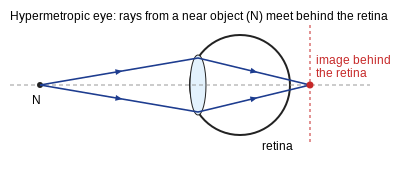
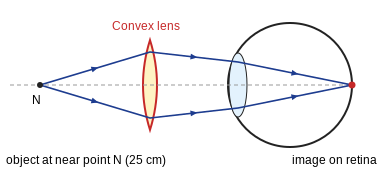
When do we consider a person to be myopic or hypermetropic? List two causes of hypermetropia. Explain using ray diagrams how the defect associated with hypermetropic eye can be corrected.
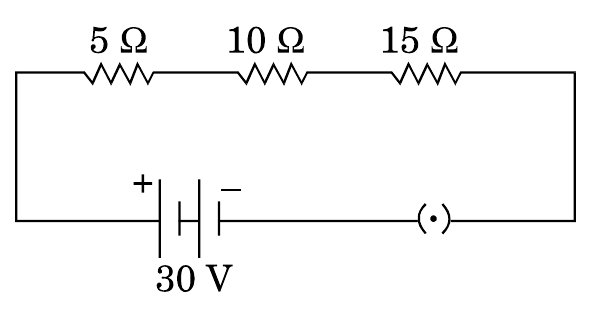
(a) (a) How will you infer with the help of an experiment that the same current flows through every part of a circuit containing three resistors in series connected to a battery? (b) Consider the given circuit and find the current flowing in the circuit and potential difference across the 15 Ω resistor when the circuit is closed.
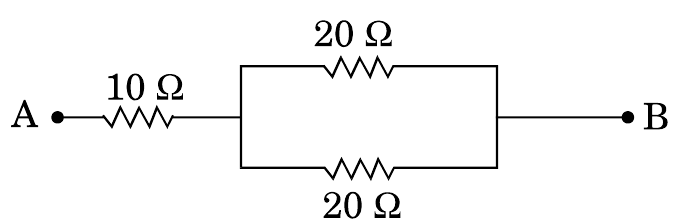
(b) (a) Three resistors R1, R2 and R3 are connected in parallel and the combination is connected to a battery, ammeter, voltmeter and key. Draw suitable circuit diagram and obtain an expression for the equivalent resistance of the combination of the resistors. (b) Calculate the equivalent resistance of the following network:
Draw the pattern of magnetic field lines produced around a current carrying straight conductor passing perpendicularly through a horizontal cardboard. State and apply right-hand thumb rule to mark the direction of the field lines. How will the strength of the magnetic field change when the point where magnetic field is to be determined is moved away from the straight conductor? Give reason to justify your answer.
Section E · Practical-based (2 marks each)
(a) A teacher provided acetic acid, water, lemon juice, aqueous solution of sodium hydrogen carbonate and sodium hydroxide to students in the school laboratory to determine the pH values of these substances using pH papers. One of the students reported the pH values of the given substances as 3, 12, 4, 8 and 14 respectively. Which one of these values is not correct? Write its correct value stating the reason.
(b) What would a student report nearly after 30 minutes of placing duly cleaned strips of aluminium, copper, iron and zinc in freshly prepared iron sulphate solution taken in four beakers?
What is observed when a pinch of sodium hydrogen carbonate is added to 2 mL of acetic acid taken in a test tube? Write chemical equation for the reaction involved in this case.
(a) List in proper sequence four steps of obtaining germinating dicot seeds.
(b) After examining a prepared slide under the high power of a compound microscope, a student concludes that the given slide shows the various stages of binary fission in a unicellular organism. Write two observations on the basis of which such a conclusion may be drawn.
List four precautions which a student should observe while preparing a temporary mount of a leaf peel to show stomata in his school laboratory.
(a) Draw the path of a ray of light when it enters one of the faces of a glass slab at an angle of nearly 45°. Label on it (i) angle of refraction, (ii) angle of emergence and (iii) lateral displacement.
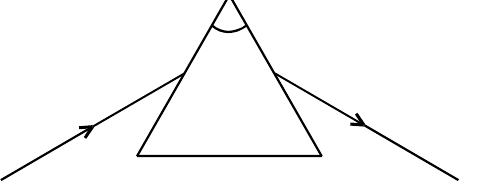
(b) A student traces the path of a ray of light through a glass prism as shown in the diagram, but leaves it incomplete and unlabelled. Redraw and complete the diagram. Also label on it ∠i, ∠e, ∠r and ∠D.
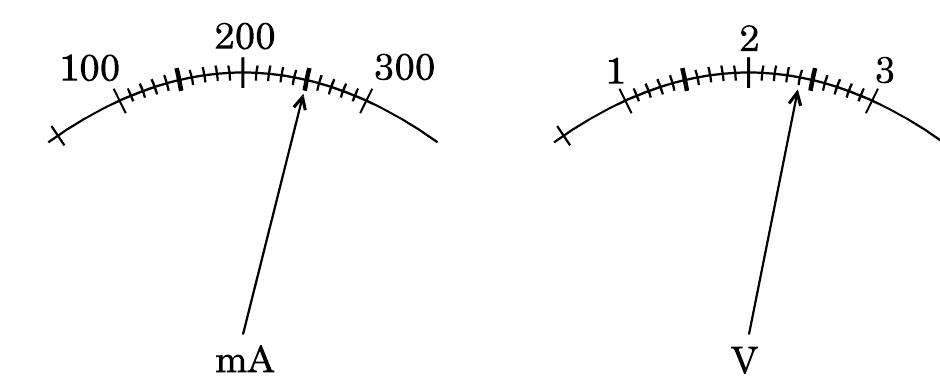
The current flowing through a resistor connected in a circuit and the potential difference developed across its ends are as shown in the diagram by milliammeter and voltmeter readings respectively: (a) What are the least counts of these meters? (b) What is the resistance of the resistor?
Solutions: CBSE 2019 · 31/2/1
Paper industry and timber / furniture industry (also lac, sports equipment, plywood).
Ethene: C2H4 (CH2=CH2). The two carbon atoms share two pairs of electrons (a double bond), and each carbon shares one pair with each of two hydrogen atoms:
•• ••
C::C
•• ••
H H
i.e. H₂C::CH₂ — 6 shared pairs in all (4 C–H, 2 in C=C).
• Silver reacts with sulphur (compounds such as H2S) in the air to form a black coating of silver sulphide (Ag2S).
• Copper reacts with moist carbon dioxide (and oxygen, water) in the air to form a green coating of basic copper carbonate (CuCO3·Cu(OH)2).
(a) Thermal decomposition reaction; X = nitrogen dioxide (NO2).
(b)
(c) NO2 is the oxide of a non-metal; its solution in water is acidic — pH less than 7.
By passing electricity through an aqueous solution of sodium chloride (brine) — the chlor-alkali process:
X = chlorine; Y = bleaching powder (calcium oxychloride):
A homologous series is a series of carbon compounds having the same functional group, in which successive members differ by a –CH2– unit.
Example: alcohols — CH3OH, C2H5OH, C3H7OH, C4H9OH.
Characteristics: (1) all members have the same general formula and functional group; (2) successive members differ by CH2, i.e. by 14 u in molecular mass; (3) they show similar chemical properties, while physical properties (melting point, boiling point, solubility) change gradually with molecular mass.
Transpiration is the loss of water in the form of vapour from the aerial parts of the plant, mainly through the stomata of leaves.
Functions: (1) it creates a suction (transpiration pull) that helps in the absorption and upward movement of water and dissolved minerals from roots to leaves; (2) it helps in temperature regulation (cooling) of the plant.
The carpel (pistil) is the female reproductive part of a flower, present in its centre. Its parts:
• Stigma — the sticky top that receives pollen grains.
• Style — the long tube through which the pollen tube grows to reach the ovary.
• Ovary — the swollen base that contains ovules; each ovule has an egg cell. After fertilisation the ovary becomes the fruit and the ovules become seeds.
f = +12 cm, u = −18 cm, h = +10 cm.
m = v/u = 36/(−18) = −2 ⇒ h′ = −2 × 10 = −20 cm
The image is real and inverted, formed 36 cm on the other side of the lens, and 20 cm tall (magnified twice).
Function: the ozone layer shields the Earth's surface from harmful ultraviolet radiation of the Sun (which causes skin cancer).
Production: UV radiation splits O2 into free oxygen atoms, which combine with O2: O2 →(UV) O + O; O + O2 → O3.
Chemicals responsible: chlorofluorocarbons (CFCs), used as refrigerants and in fire extinguishers.
Reduction: use CFC-free refrigerators and air conditioners and alternative chemicals; in 1987 UNEP got an agreement to freeze CFC production at 1986 levels.
Groups: A — 1; B — 13; C — 15; D — 17.
B: 2, 8, 3 (aluminium); D: 2, 8, 7 (chlorine).
B has valency 3 and D valency 1, so the compound is BD3 (AlCl3).
Hydrotropism is the directional growth movement of a plant part (root) in response to water; roots grow towards water (positive hydrotropism).
Experiment:
1. Take a rectangular glass trough and fill it with dry soil.
2. Sow a few germinating seeds (e.g. gram) in the middle.
3. Place a small porous clay pot (or a funnel) filled with water at one side of the trough, buried in the soil, so that the soil near it stays moist.
4. Water only through the pot for a few days.
5. Then carefully remove the soil and observe the roots.
Observation: the roots have bent and grown towards the pot (the source of water) instead of growing straight down. Conclusion: roots are positively hydrotropic.
A person is myopic (near-sighted) when he can see nearby objects clearly but not distant objects — the far point is nearer than infinity, and the image of a distant object forms in front of the retina.
A person is hypermetropic (far-sighted) when he can see distant objects clearly but not nearby objects — the near point is farther than 25 cm, and the image of a near object forms behind the retina.
Causes of hypermetropia: (1) the focal length of the eye lens is too long; (2) the eyeball has become too small.
Correction: a convex lens of suitable power provides the extra focusing power so that the image of a near object is formed on the retina.
(a) 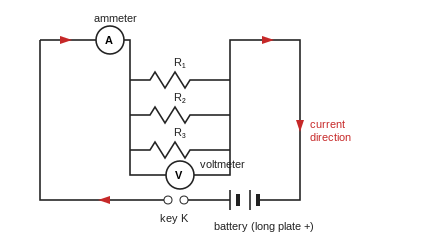
In parallel, the potential difference V across each resistor is the same, and the total current I divides: I = I1 + I2 + I3. By Ohm's law, I1 = V/R1, I2 = V/R2, I3 = V/R3, and I = V/Rp:
(b) 20 Ω ∥ 20 Ω = 10 Ω; in series with 10 Ω:
The value 12 for water is incorrect. Pure water is neutral, so its pH is 7. (Acetic acid 3 and lemon juice 4 are acidic; NaHCO3 8 is weakly basic; NaOH 14 is strongly basic.)
Brisk effervescence — a colourless, odourless gas (CO2) is given off, which turns lime water milky.
(1) The nucleus of the cell is seen elongating and then dividing into two. (2) The cytoplasm divides (a constriction appears in the middle), forming two daughter cells of nearly equal size (e.g. in Amoeba).
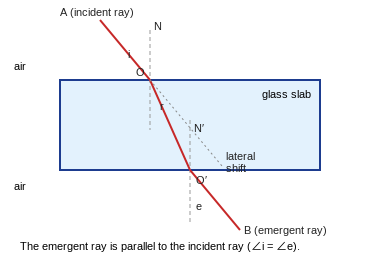
r = angle of refraction (inside the slab, with the normal); e = angle of emergence; the perpendicular distance between the incident ray produced and the emergent ray is the lateral displacement.
(a) Milliammeter: 100 mA divided into 10 divisions → least count 10 mA. Voltmeter: 1 V divided into 10 divisions → least count 0.1 V.
(b) Readings: I = 250 mA = 0.25 A; V = 2.5 V.
Get every solution for all 17 papers
- Every board question of every chapter, each fully solved the way the board gives marks
- 17 complete board papers, each followed by its solutions
- Weightage and most-asked topics for every chapter
- Instant PDF download, colour and black & white print copies
Revising the chapter first? Complete Science Notes for Class 10 (NCERT 2026-27) →
What you get in the pack
- Questions from 126 CBSE papers, 2016 to 2026: every set code available
- Complete: 2405 different questions and parts from all set codes, 13 chapters and 17 full papers
- Part A: all 13 chapters, questions sorted chapter-wise and by marks
- Year-wise weightage table and most-asked topics for every chapter
- Part B: 17 full board papers, each followed by its complete solutions, for timed practice
- Answers written to the CBSE marking-scheme points, with labelled diagrams drawn in full
- Questions on topics out of the board syllabus flagged
All chapters in this pack
- PYQ Ch 1 Chemical Reactions and Equations
- PYQ Ch 2 Acids, Bases and Salts
- PYQ Ch 3 Metals and Non-metals
- PYQ Ch 4 Carbon and its Compounds
- PYQ Ch 5 Life Processes
- PYQ Ch 6 Control and Coordination
- PYQ Ch 7 How do Organisms Reproduce
- PYQ Ch 8 Heredity
- PYQ Ch 9 Light Reflection and Refraction
- PYQ Ch 10 The Human Eye and the Colourful World
- PYQ Ch 11 Electricity
- PYQ Ch 12 Magnetic Effects of Electric Current
- PYQ Ch 13 Our Environment
- Board Paper 2026 Set 31-2-1 with Solutions
- Board Paper 2026 Set 31-3-1 with Solutions
- Board Paper 2025 Set 31-1-1 with Solutions
- Board Paper 2025 Set 31-2-1 with Solutions
- Board Paper 2024 Set 31-4-1 with Solutions
- Board Paper 2024 Set 31-5-1 with Solutions
- Board Paper 2023 Set 31-2-1 with Solutions
- Board Paper 2023 Set 31-4-1 with Solutions
- Board Paper 2022 Term 2 Set 31-1-1 with Solutions
- Board Paper 2022 Term 2 Set 31-3-1 with Solutions
- Board Paper 2020 Set 31-2-1 with Solutions
- Board Paper 2020 Set 31-4-1 with Solutions
- Board Paper 2019 Set 31-2-1 with Solutions
- Board Paper 2019 Set 31-4-1 with Solutions
- Board Paper 2018 Set 31-1 with Solutions
- Board Paper 2017 Set 3 with Solutions
- Board Paper 2016 Set 31-1 with Solutions