
Electricity: Class 10 PYQs 2018–2026 with solutions
All 54 CBSE board questions asked from Electricity in 15 board papers, with the year, set and marks of each. 28 are solved free below. The Class 10 Science PYQ Book: Solved Board Papers 2016-2026 (CBSE) has every solution, all chapters and 17 full board papers.
Subject expert: Khushbu Gupta, B.Sc., M.Sc. Physics, B.Ed. · 8+ years teaching


Free: NCERT solutions for Class 10 Science →
Electricity: board weightage
Board weightage 2018–2026
| Year | 2016 | 2017 | 2018 | 2019 | 2020 | 2022 | 2023 | 2024 | 2025 | 2026 |
|---|---|---|---|---|---|---|---|---|---|---|
| Questions | – | – | 4 | 8 | 7 | 6 | 7 | 8 | 9 | 5 |
| Marks | – | – | 11 | 26 | 19 | 17 | 15 | 21 | 18 | 14 |
Most asked topics
54 questions from 15 papers. Repeated questions are shown once with every year they were asked.
Jump to: 1 mark2 marks3 marks4 marks5 marks
1 mark: MCQ and Assertion–Reason
The correct way to connect an ammeter and a voltmeter in an electric circuit is:
Solution
Answer: (C)
An ammeter measures the current through a component, so it is joined in series. A voltmeter measures the potential difference across a component, so it is joined in parallel across it.
An electric bulb is connected to a power supply of 220 V. If the current drawn by the bulb from the supply is 500 mA, the power of the bulb is:
Solution
Answer: (B) 110 W
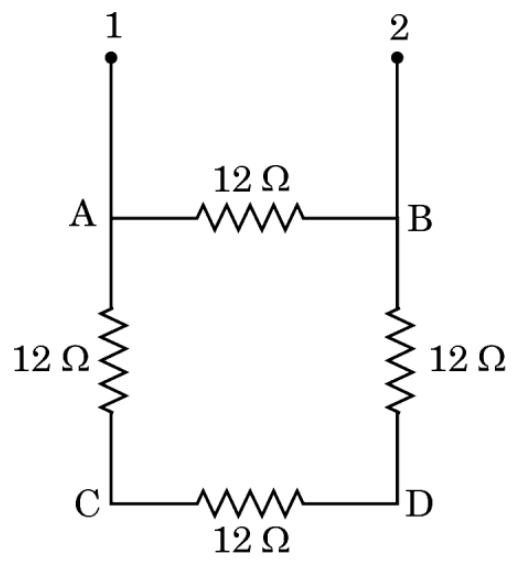
Four identical resistors of 12 Ω each are connected in series to form a square ABCD as shown in the figure. The resistance of the network between the two points 1 and 2 is:
Solution
Answer: (C) 9 Ω
Between A and B there are two paths: AB directly (12 Ω) and A–C–D–B (12 + 12 + 12 = 36 Ω), in parallel:
Assertion (A): Nichrome is an alloy which is commonly used in electrical heating devices such as electric irons, toasters, etc.
Reason (R): The resistivity of nichrome is high and its resistance decreases with increase in temperature.
Solution
Answer: (C)
A is true. R is false: nichrome has high resistivity, but its resistance does not decrease with temperature (for metals and alloys it increases). Alloys are used because they have high resistivity and do not oxidise readily at high temperatures.
Consider the following combinations of resistors:
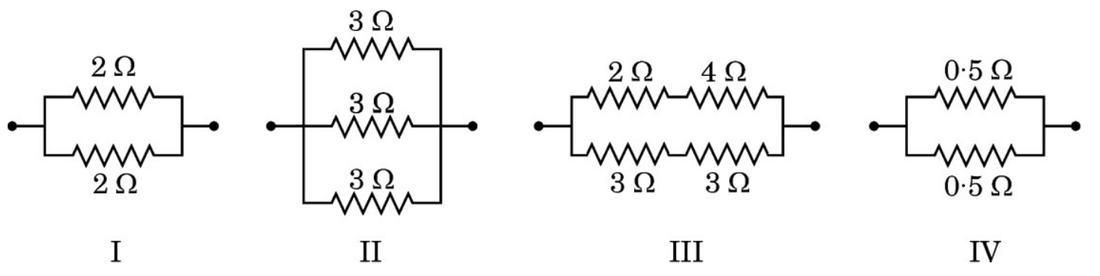
The combinations having equivalent resistance 1 Ω is/are:
Solution
Answer: (C) I and II
I: 2 Ω ∥ 2 Ω = 1 Ω. II: three 3 Ω in parallel = 3/3 = 1 Ω. III: (2 + 4) ∥ (3 + 3) = 6 ∥ 6 = 3 Ω. IV: 0.5 ∥ 0.5 = 0.25 Ω.
An electric iron of resistance 20 Ω draws a current of 5 A. The heat developed in the iron in 30 seconds is:
Solution
Answer: (A) 15000 J
Assertion (A): Electrons move from lower potential to higher potential in a conductor.
Reason (R): A dry cell maintains electric potential difference across the ends of a conductor.
Solution
Answer: (B)
Both are true (conventional current flows from higher to lower potential, so electrons move from lower to higher). R explains why charges keep flowing, but not the direction in which electrons move.
For verifying Ohm’s law, we design an electric circuit diagram in which we show the arrangement of different circuit components. We find that with respect to the resistor, the:
Solution
Answer: (b)
The ammeter measures the current through the resistor (series); the voltmeter measures the potential difference across it (parallel).
In a resistive circuit if the current is increased to two times, the percentage change in the amount of heat dissipated in the circuit would be:
Solution
Answer: (b) 300%
H = I2Rt. Doubling I makes H four times: H′ = 4H. Change = (4H − H)/H × 100 = 300%.
Two LED bulbs of 12 W and 6 W are connected in series. If the current through 12 W bulb is 0.06 A the current through 6 W bulb will be:
The resistance of a resistor is reduced to half of its initial value. If other parameters of the electrical circuit remain unaltered, the amount of heat produced in the resistor will become:
The maximum resistance which can be made using four resistors each of 2 Ω is
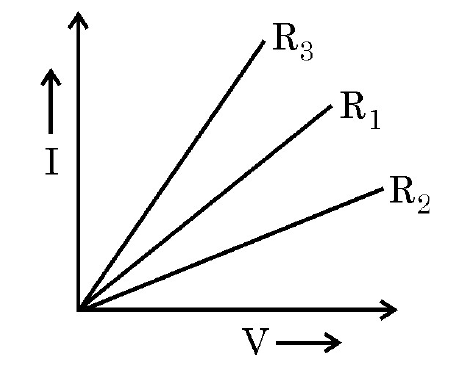
A student plots V-I graphs for three samples of nichrome wire with resistances R1, R2 and R3. Choose from the following the statement that holds true for this graph.
If a person has five resistors each of value 1/5 Ω, then the maximum resistance he can obtain by connecting them is
The resistance of a resistor is reduced to half of its initial value. In doing so, if other parameters of the circuit remain unchanged, the heating effects in the resistor will become
Why are the heating elements of electric toasters and electric irons made of an alloy rather than a pure metal?
Define resistance. Give its S.I. unit.
2 marks: very short answer
A wire of resistance R is cut into three equal parts. If these three parts are then joined in parallel, calculate the total resistance of the combination so formed.
Solution
Resistance is proportional to length, so each part has resistance R/3.
Rp = R/9
Define electric power. When do we say that the power consumed in an electric circuit is 1 watt?
Solution
Electric power is the rate at which electrical energy is consumed (or dissipated) in a circuit: P = VI = I2R = V2/R. Its SI unit is the watt (W).
The power consumed is 1 watt when a current of 1 ampere flows through a device operating at a potential difference of 1 volt (1 W = 1 V × 1 A).
An electric kettle is rated 750 W; 220 V. Can this kettle be used in a circuit which has a fuse of current rating 3 A? Give reason for your answer.
Solution
No. The kettle draws about 3.4 A, which is more than the 3 A rating of the fuse. The fuse wire would melt and break the circuit as soon as the kettle is switched on.
Two wires A and B of same material, having same lengths and diameters 0.2 mm and 0.3 mm respectively, are connected one by one in a circuit. Which one of these two wires will offer more resistance to the flow of current in the circuit? Justify your answer.
Solution
Wire A (diameter 0.2 mm). For the same material and length, R = ρl/A, so R ∝ 1/A, and A = πd2/4 ∝ d2. The thinner wire has the smaller area, so the larger resistance:
An electric source can supply a charge of 500 coulomb. If the current drawn by a device is 25 mA, find the time in which the electric source will be discharged completely.
Solution
The source will be fully discharged in 20000 s (about 5 hours 33 minutes).
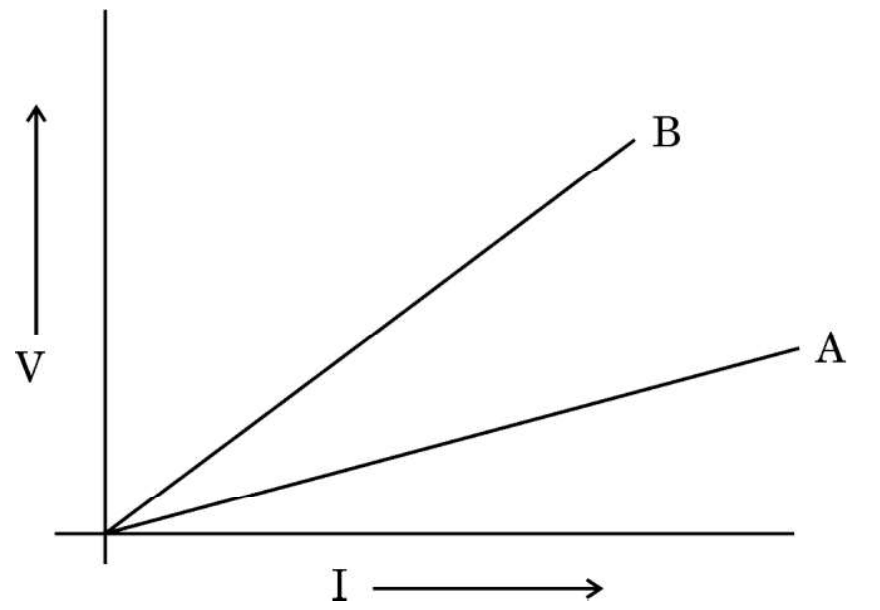
V – I graph for two conducting wires A and B are as shown. If both wires are of the same length and same diameter, which of the two is made of a material of high resistivity? Give reasons to justify your answer.
Solution
Wire B. The slope of a V–I graph (V/I) gives the resistance. B has the steeper slope, so its resistance is greater. Since R = ρl/A and both wires have the same length and area, the wire with greater resistance has greater resistivity.
An electric heater rated 1100 W operates at 220 V. Calculate (i) its resistance, and (ii) the current drawn by it.
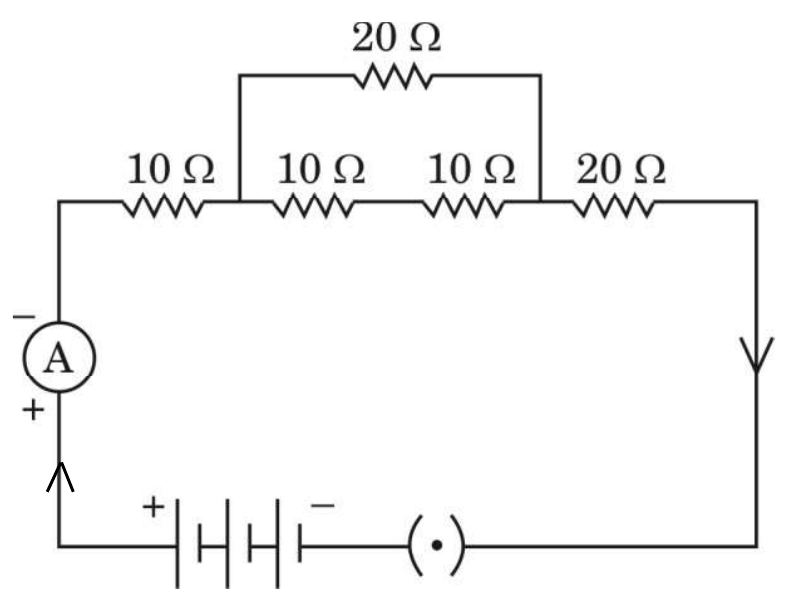
Calculate the equivalent resistance of the following electric circuit:
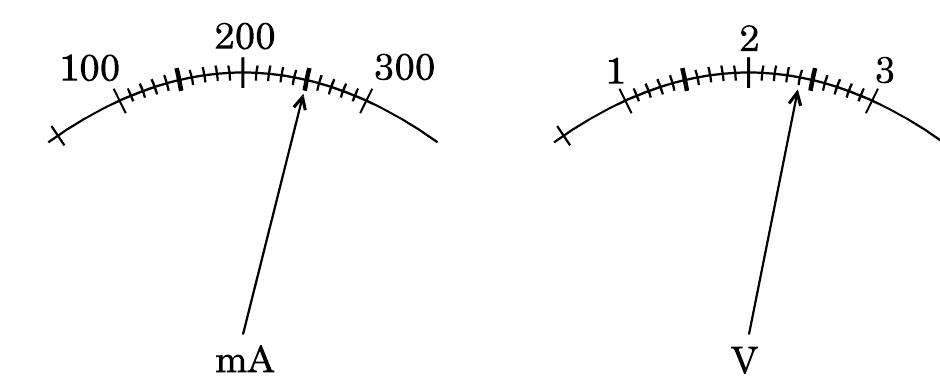
The current flowing through a resistor connected in a circuit and the potential difference developed across its ends are as shown in the diagram by milliammeter and voltmeter readings respectively: (a) What are the least counts of these meters? (b) What is the resistance of the resistor?
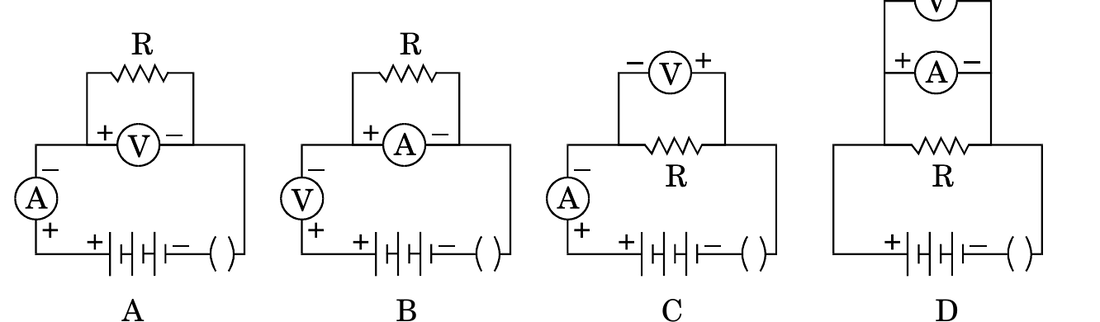
Which one of the following is the correct set-up for studying the dependence of the current on the potential difference across a resistor and why?
The values of current (I) flowing through a given resistor of resistance (R), for the corresponding values of potential difference (V) across the resistor are as given below:
| V (volts) | 0.5 | 1.0 | 1.5 | 2.0 | 2.5 | 3.0 | 4.0 | 5.0 |
|---|---|---|---|---|---|---|---|---|
| I (amperes) | 0.1 | 0.2 | 0.3 | 0.4 | 0.5 | 0.6 | 0.8 | 1.0 |
Plot a graph between current (I) and potential difference (V) and determine the resistance (R) of the resistor.
3 marks: short answer
The values of current I flowing in a given resistor for the corresponding values of potential difference V applied across the ends of resistor are given below in the table:
| I (amperes) | 0.4 | 0.8 | 1.2 | 1.6 | 2.0 |
|---|---|---|---|---|---|
| V (volts) | 1.2 | 2.4 | 3.6 | 4.8 | 6.0 |
Plot a graph between V and I and calculate the resistance of that resistor.
Solution
Plot I on the x-axis and V on the y-axis. The points lie on a straight line through the origin (V ∝ I, Ohm's law).
Resistance = slope of the V–I graph:
(Each pair also gives V/I = 3 Ω.)
(a) Name a device which is used to: (i) Maintain a constant potential difference in a circuit. (ii) Change the electric current in an electric circuit.
(b) When the potential difference between the terminals of an electric heater is 110 V, a current of 5 A flows through it. What will be the value of current flowing through it when the potential difference is increased to 220 V?
Solution
(a) (i) A cell or battery. (ii) A rheostat (variable resistance).
(b)
At 220 V: I = V/R = 220 V / 22 Ω = 10 A
(The resistance stays the same, so doubling the potential difference doubles the current.)
Consider the given electric circuit:
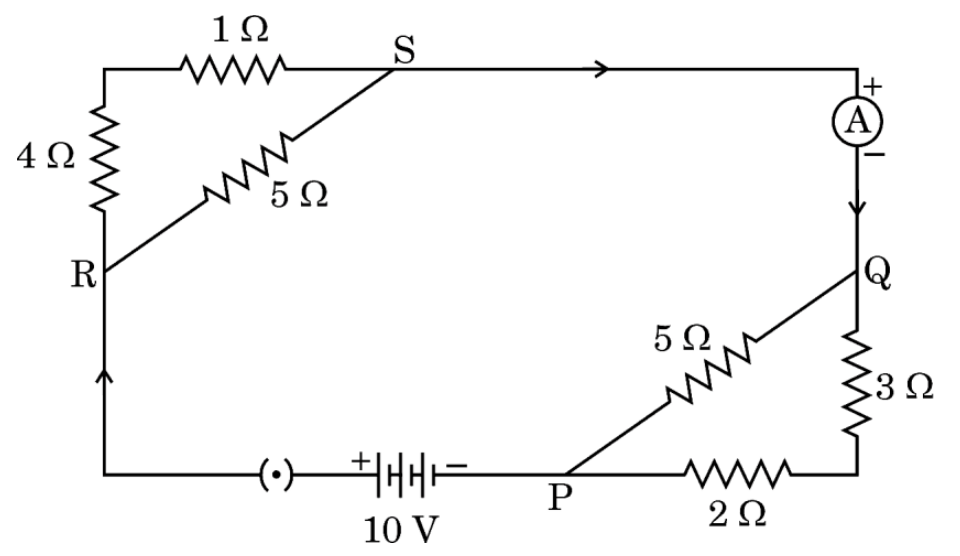
Calculate the following: (a) Total resistance of the circuit (b) The electric current drawn from the battery (c) Potential difference between points P and Q
Solution
Between R and S: the 4 Ω and 1 Ω are in series (4 + 1 = 5 Ω), and this is in parallel with the 5 Ω:
Between Q and P: the 3 Ω and 2 Ω are in series (5 Ω), in parallel with the 5 Ω: R2 = 2.5 Ω.
(a) R1 and R2 are in series with the battery: R = 2.5 + 2.5 = 5 Ω.
(b)
(c)
Consider the following electric circuit:
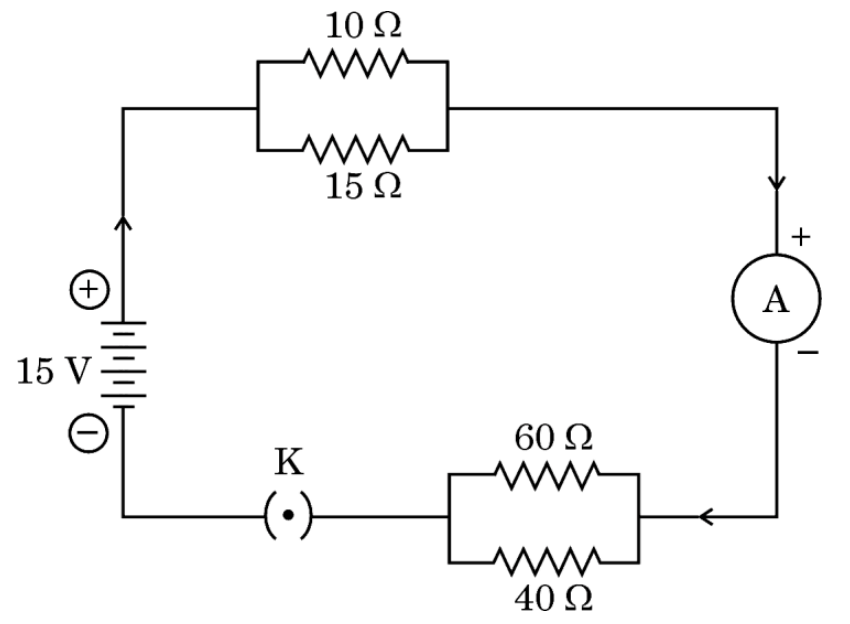
Calculate the values of the following: (a) The total resistance of the circuit (b) The total current drawn from the source (c) Potential difference across the parallel combination of 10 Ω and 15 Ω resistors
Solution
(a) 10 Ω ∥ 15 Ω:
60 Ω ∥ 40 Ω:
These two combinations are in series: R = 6 + 24 = 30 Ω.
(b)
(c)
(a) Write the relationship between resistivity and resistance of a cylindrical conductor of length l and area of cross-section A. Hence derive the SI unit of resistivity.
(b) Why are alloys used in electrical heating devices?
Solution
(a) The resistance R is directly proportional to length l and inversely proportional to area A:
SI unit of ρ = (Ω × m2) / m = Ω m (ohm metre)
(b) Alloys have a higher resistivity than their constituent metals, so they produce more heat, and they do not oxidise (burn) readily at high temperatures. So alloys like nichrome are used in heaters, irons and toasters.
Three resistors of 2 Ω, 3 Ω and 6 Ω are connected in (i) series, and (ii) parallel. Draw the arrangements of the resistors and find the equivalent resistance of each arrangement.
Solution
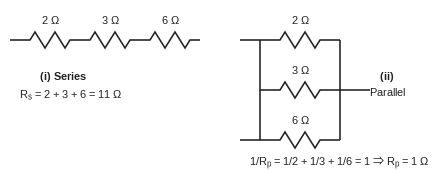
(i) Series:
(ii) Parallel:
(a) Three resistors R1, R2 and R3 are connected in parallel and the combination is connected to a battery, an ammeter, a voltmeter and a key. Draw suitable circuit diagram to show the arrangement of these circuit components along with the direction of current flowing.
(b) Calculate the equivalent resistance of the following network:
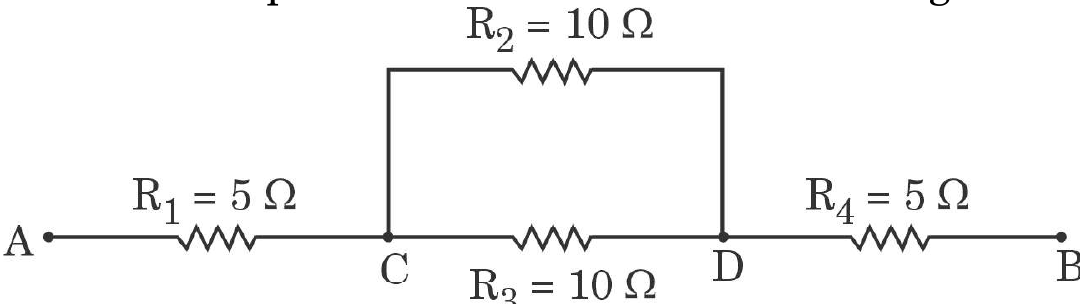
(i) Define Electric Power and write its SI unit. ½+½
(ii) Two bulbs rated 100 W; 220 V and 60 W; 220 V are connected in parallel to an electric mains of 220 V. Find the current drawn by the bulbs from the mains. 2
(i) State Joule’s law of heating. Express it mathematically when an appliance of resistance R is connected to a source of voltage V and the current I flows through the appliance for a time t. (ii) A 5 Ω resistor is connected across a battery of 6 volts. Calculate the energy that dissipates as heat in 10 s.
Show how would you join three resistors, each of resistance 9 Ω so that the equivalent resistance of the combination is (i) 13.5 Ω (ii) 6 Ω?
(a) Write Joule’s law of heating. (b) Two lamps, one rated 100 W; 220 V, and the other 60 W; 220 V, are connected in parallel to electric mains supply. Find the current drawn by two bulbs from the line, if the supply voltage is 220 V.
(a) List the factors on which the resistance of a conductor in the shape of a wire depends. (b) Why are metals good conductors of electricity whereas glass is a bad conductor of electricity? Give reason. (c) Why are alloys commonly used in electrical heating devices? Give reason.
4 marks: case-based / source-based
Read the following passage and answer the questions that follow:
Swati, a class 10 student, observes that when she passes close to the refrigerator in her kitchen, she feels the heat, although the things kept inside the refrigerator are cool.
(a) Describe the cause of heating in the above-mentioned case. 1
(b) A current I flows through a resistor of resistance R when the potential difference across it is V. Applying Ohm’s law, write the formula for amount of heat produced by the resistor in time t. 1
(c) (i) Write any two practical applications of heating effect of electric current. 2
OR
(c) (ii) Define the commercial unit of electric energy and express it in Joules (J). 2
Solution
(a) Only a part of the electrical energy supplied to the refrigerator is used for useful work (cooling); the rest is unavoidably converted into heat (heating effect of current in its coils and motor), which raises the temperature of the appliance and its surroundings. The heat removed from inside is also released outside.
(b) Work done = VIt; using V = IR:
(c) (i) Any two: electric iron, electric heater, toaster, oven, kettle, electric bulb (filament glows), electric fuse.
OR (c) (ii) The commercial unit of electric energy is the kilowatt hour (kWh): the energy used when 1 kW of power is used for 1 hour.
Study the following circuit:
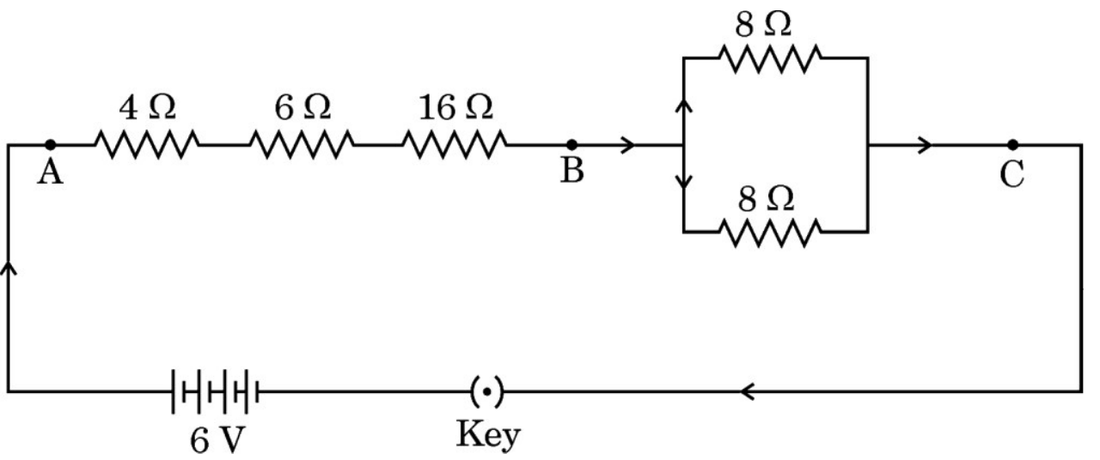
(a) Find the value of total resistance between the points A and B. 1
(b) Find the resistance between the points B and C. 1
(c) (i) Calculate the current drawn from the battery, when the key is closed. 2
OR
(c) (ii) In the above circuit, the 16 Ω resistor or the parallel combination of two resistors of 8 Ω, which one of the two will have more potential difference across its two ends? Justify your answer. 2
Solution
(a) 4 Ω, 6 Ω and 16 Ω are in series: RAB = 4 + 6 + 16 = 26 Ω.
(b) Two 8 Ω in parallel: RBC = (8 × 8)/(8 + 8) = 4 Ω.
(c) (i) Total resistance = 26 + 4 = 30 Ω.
OR (c) (ii) The same current (0.2 A) flows through the 16 Ω resistor and through the parallel combination (4 Ω).
So the 16 Ω resistor has the larger potential difference: for the same current, V = IR is larger for the larger resistance.
Consider the following electrical circuit diagram in which nine identical resistors of 3 Ω each are connected as shown. If the reading of the ammeter A1 is 1 ampere, answer the following questions:
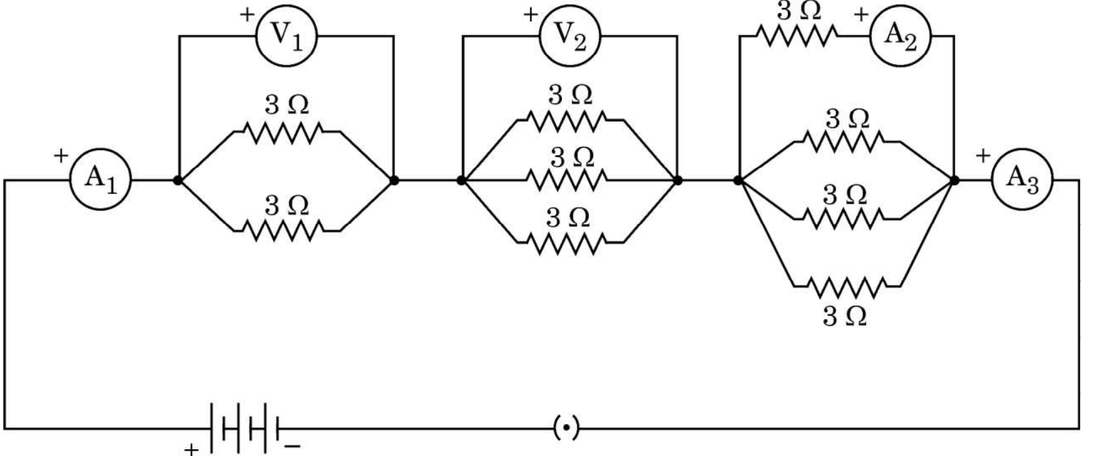
(a) What is the relationship between the readings of A1 and A3? Give reasons for your answer. 1
(b) What is the relationship between the readings of A2 and A3? 1
(c) Determine the reading of the voltmeter V1. 2
OR
(c) Find the total resistance of the circuit. 2
Study the following electric circuit in which the resistors are arranged in three arms A, B and C:
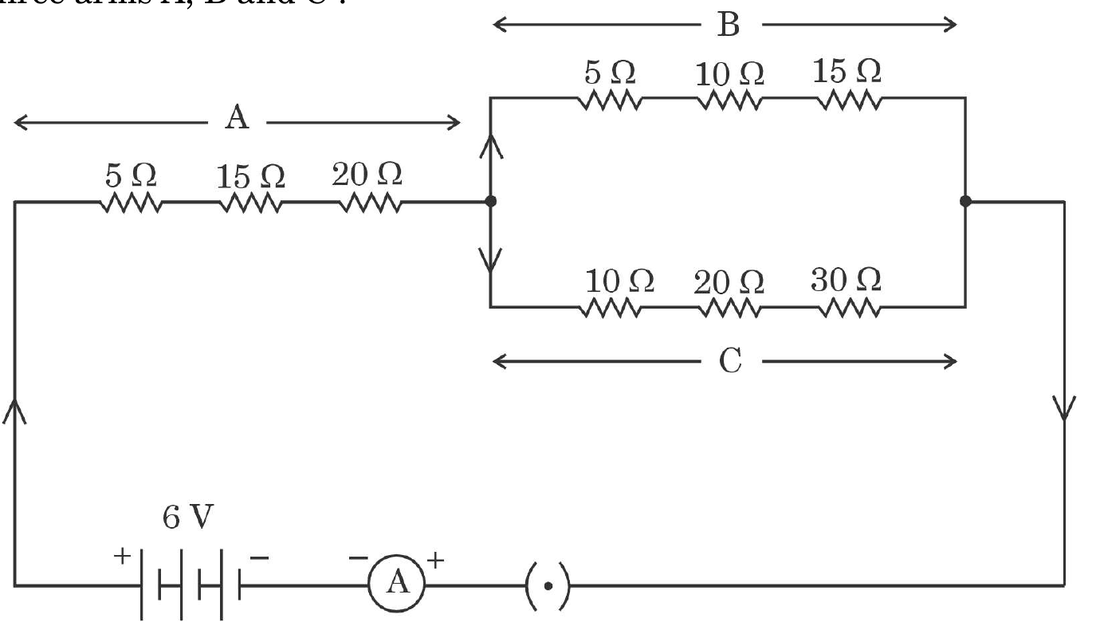
(a) Find the equivalent resistance of arm A. 1
(b) Calculate the equivalent resistance of the parallel combination of the arms B and C. 1
(c) (i) Determine the current that flows through the ammeter. 2
OR
(c) (ii) Determine the current that flows in the ammeter when the arm B is withdrawn from the circuit. 2
5 marks: long answer
(i) The potential difference across the two ends of a circuit component is decreased to one-third of its initial value, while its resistance remains constant. What change will be observed in the current flowing through it? Name and state the law which helps us to answer this question.
(ii) Draw a schematic diagram of a circuit consisting of a battery of four 1.5 V cells, a 5 Ω resistor, a 10 Ω resistor and a 15 Ω resistor and a plug key, all connected in series. Now find (I) the electric current passing through the circuit, and (II) potential difference across the 10 Ω resistor when the plug key is closed.
Solution
(i) The current also becomes one-third of its initial value. Ohm's law: the potential difference V across a conductor is directly proportional to the current I through it, provided its temperature remains the same: V = IR, i.e. I = V/R.
(ii) 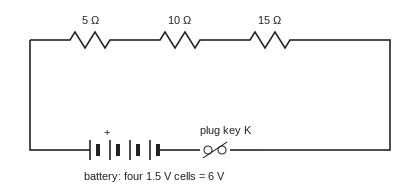
Battery voltage V = 4 × 1.5 = 6 V; total resistance R = 5 + 10 + 15 = 30 Ω.
(II) V10 = I × 10 Ω = 0.2 × 10 = 2 V
(i) When is the potential difference between two points said to be 1 volt?
(ii) A copper wire has a diameter of 0.2 mm and resistivity of 1.6 × 10⁻⁸ Ω m. What will be the length of this wire to make its resistance 14 Ω? How much does the resistance change, if the diameter of the wire is doubled?
Solution
(i) The potential difference between two points is 1 volt when 1 joule of work is done to move a charge of 1 coulomb from one point to the other (1 V = 1 J/C).
(ii) d = 0.2 mm ⇒ r = 0.1 mm = 1 × 10⁻⁴ m.
R = ρl/A ⇒ l = RA/ρ = 14 × (22/7) × 10−8 / (1.6 × 10⁻⁸) = 44/1.6 = 27.5 m
If the diameter is doubled, the area becomes 4 times (A ∝ d2), so the resistance becomes one-fourth: 14/4 = 3.5 Ω.
(i) How is electric current related to the potential difference across the terminals of a conductor? Draw a labelled circuit diagram to verify this relationship.
(ii) Why should an ammeter have low resistance?
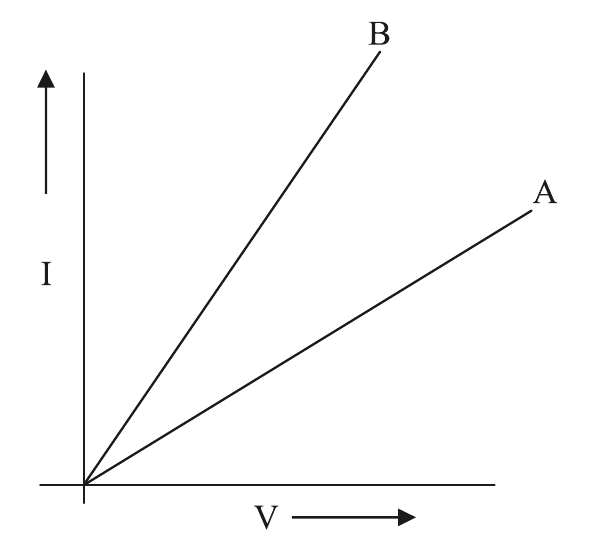
(iii) Two V - I graphs A and B for series and parallel combinations of two resistors are as shown. Giving reason state which graph shows (a) series, (b) parallel combination of the resistors.
Solution
(i) Ohm's law: the current through a conductor is directly proportional to the potential difference across its ends, provided its temperature remains the same: V ∝ I, i.e. V = IR.
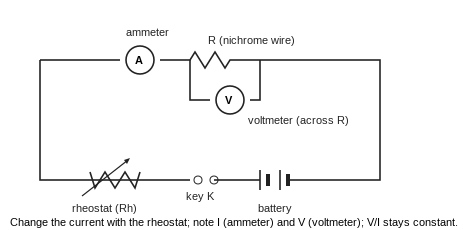
(ii) An ammeter is connected in series; a low resistance ensures that it does not change the current it is measuring (negligible potential drop across it).
(iii) The graph is drawn with I on the y-axis and V on the x-axis, so the slope = I/V = 1/R. A steeper slope means a smaller resistance.
(a) A (smaller slope, larger resistance) shows the series combination.
(b) B (steeper slope, smaller resistance) shows the parallel combination — parallel resistance is less than the smallest individual resistance.
(a) Find the ratio of resistances of two copper rods X and Y of lengths 30 cm and 10 cm respectively and having radii 2 cm and 1 cm respectively.
(b) A current of 500 mA flows in a series circuit containing an electric lamp and a conductor of 10 Ω when connected to 6 V battery. Find the resistance of the electric lamp.
Solution
(a) R = ρl/A = ρl/(πr2). Both are copper (same ρ):
RX : RY = 3 : 4.
(b) I = 500 mA = 0.5 A; V = 6 V.
Rlamp = 12 − 10 = 2 Ω
Draw a schematic diagram of a circuit consisting of a battery of 3 cells of 2 V each, a combination of three resistors of 10 Ω, 20 Ω and 30 Ω connected in parallel, a plug key and an ammeter, all connected in series. Use this circuit to find the value of the following: (a) Current through each resistor (b) Total current in the circuit (c) Total effective resistance of the circuit
Solution
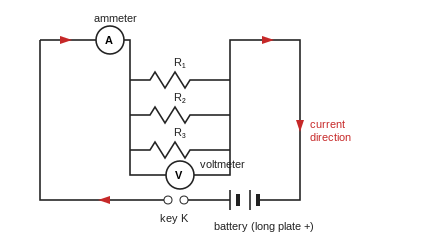
(R1 = 10 Ω, R2 = 20 Ω, R3 = 30 Ω; the voltmeter is not needed here.) Battery: V = 3 × 2 = 6 V; each parallel resistor gets the full 6 V.
(b) I = 0.6 + 0.3 + 0.2 = 1.1 A
(c) 1/R = 1/10 + 1/20 + 1/30 = (6 + 3 + 2)/60 = 11/60 ⇒ R = 60/11 ≈ 5.45 Ω
(Check: V/I = 6/1.1 ≈ 5.45 Ω.)
Two identical resistors, each of resistance 15 Ω, are connected in (i) series, and (ii) parallel, in turn to a battery of 6 V. Calculate the ratio of the power consumed in the combination of resistors in each case.
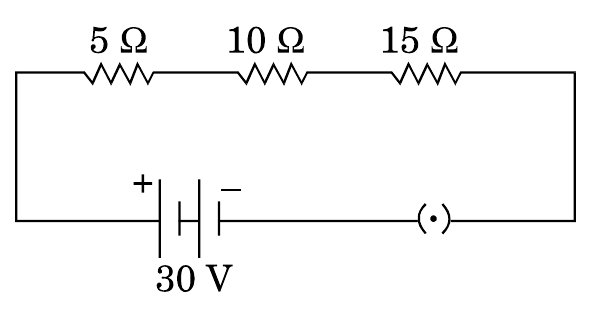
(a) How will you infer with the help of an experiment that the same current flows through every part of a circuit containing three resistors in series connected to a battery? (b) Consider the given circuit and find the current flowing in the circuit and potential difference across the 15 Ω resistor when the circuit is closed.
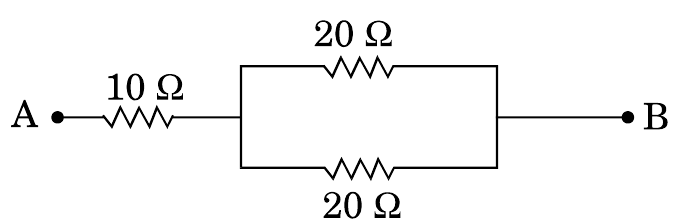
(a) Three resistors R1, R2 and R3 are connected in parallel and the combination is connected to a battery, ammeter, voltmeter and key. Draw suitable circuit diagram and obtain an expression for the equivalent resistance of the combination of the resistors. (b) Calculate the equivalent resistance of the following network:
(a) Define electric power. An electrical device of resistance R is connected across a source of voltage V and draws a current I. Derive an expression for power in terms of current and resistance. (b) Two electric bulbs rated 100 W; 220 V and 60 W; 220 V are connected in parallel to an electric mains of 220 V. Find the current drawn by the bulbs from the mains.
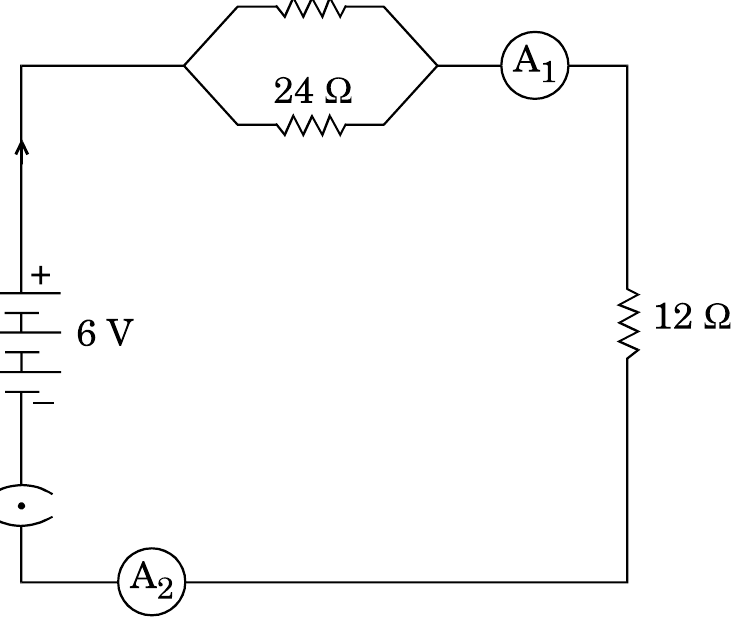
(a) How will you infer with the help of an experiment that the same current flows through every part of the circuit containing three resistors R1, R2 and R3 in series connected to a battery of V volts? (b) Study the following circuit and find out: (i) Current in 12 Ω resistor. (ii) Difference in the readings of A1 and A2, if any.
Get every solution for all chapters
- Every board question of every chapter, each fully solved the way the board gives marks
- 17 complete board papers, each followed by its solutions
- Weightage and most-asked topics for every chapter
- Instant PDF download, colour and black & white print copies
Revising the chapter first? Complete Science Notes for Class 10 (NCERT 2026-27) →
What you get in the pack
- Questions from 126 CBSE papers, 2016 to 2026: every set code available
- Complete: 2405 different questions and parts from all set codes, 13 chapters and 17 full papers
- Part A: all 13 chapters, questions sorted chapter-wise and by marks
- Year-wise weightage table and most-asked topics for every chapter
- Part B: 17 full board papers, each followed by its complete solutions, for timed practice
- Answers written to the CBSE marking-scheme points, with labelled diagrams drawn in full
- Questions on topics out of the board syllabus flagged
All chapters in this pack
- PYQ Ch 1 Chemical Reactions and Equations
- PYQ Ch 2 Acids, Bases and Salts
- PYQ Ch 3 Metals and Non-metals
- PYQ Ch 4 Carbon and its Compounds
- PYQ Ch 5 Life Processes
- PYQ Ch 6 Control and Coordination
- PYQ Ch 7 How do Organisms Reproduce
- PYQ Ch 8 Heredity
- PYQ Ch 9 Light Reflection and Refraction
- PYQ Ch 10 The Human Eye and the Colourful World
- PYQ Ch 11 Electricity
- PYQ Ch 12 Magnetic Effects of Electric Current
- PYQ Ch 13 Our Environment
- Board Paper 2026 Set 31-2-1 with Solutions
- Board Paper 2026 Set 31-3-1 with Solutions
- Board Paper 2025 Set 31-1-1 with Solutions
- Board Paper 2025 Set 31-2-1 with Solutions
- Board Paper 2024 Set 31-4-1 with Solutions
- Board Paper 2024 Set 31-5-1 with Solutions
- Board Paper 2023 Set 31-2-1 with Solutions
- Board Paper 2023 Set 31-4-1 with Solutions
- Board Paper 2022 Term 2 Set 31-1-1 with Solutions
- Board Paper 2022 Term 2 Set 31-3-1 with Solutions
- Board Paper 2020 Set 31-2-1 with Solutions
- Board Paper 2020 Set 31-4-1 with Solutions
- Board Paper 2019 Set 31-2-1 with Solutions
- Board Paper 2019 Set 31-4-1 with Solutions
- Board Paper 2018 Set 31-1 with Solutions
- Board Paper 2017 Set 3 with Solutions
- Board Paper 2016 Set 31-1 with Solutions