
CBSE Class 10 Science Question Paper 2025 (31/1/1) with Solutions
The complete CBSE Class 10 Science board paper of 2025, Q.P. code 31/1/1: all 39 questions exactly as set, with marks. 23 solutions are free below. The Class 10 Science PYQ Book: Solved Board Papers 2016-2026 (CBSE) solves all 17 papers in full and sorts every question chapter-wise.
Subject expert: Khushbu Gupta, B.Sc., M.Sc. Physics, B.Ed. · 8+ years teaching


Free: NCERT solutions for Class 10 Science →
Question paper
Jump to: Question paperSolutions
2025 · Q.P. Code 31/1/1
Maximum marks: 80
Section A · Multiple choice and Assertion–Reason
Electrolysis of water is a decomposition reaction. The mass ratio (MH : MO) of hydrogen and oxygen gases liberated at the electrodes during electrolysis of water is:
The products formed when Aluminium and Magnesium are burnt in the presence of air respectively are:
The following table shows the pH values of four solutions A, B, C and D on a pH scale:
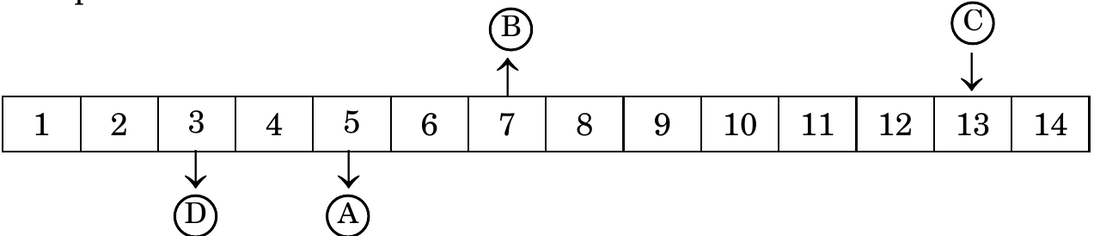
The solutions A, B, C and D respectively are of a
Consider the following reactions: (i) Dilute hydrochloric acid reacts with sodium hydroxide. (ii) Magnesium oxide reacts with dilute hydrochloric acid. (iii) Carbon dioxide reacts with sodium hydroxide. It is found that in each case:
Reaction between two elements A and B, forms a compound C. A loses electrons and B gains electrons. Which one of the following properties will not be shown by compound C?
The metals obtained from their molten chlorides by the process of electrolytic reduction are:
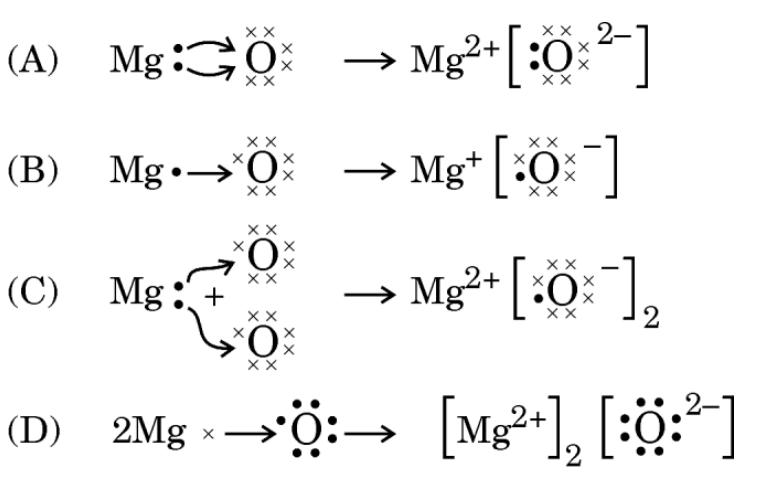
The formation of magnesium oxide is correctly shown in option:
Secretion of less saliva in mouth will effect the conversion of:
The plant hormone whose concentration stimulates the cells to grow longer on the side of the shoot which is away from light is:
The correct/true statement(s) for a bisexual flower is/are: (i) They possess both stamen and pistil. (ii) They possess either stamen or pistil. (iii) They exhibit either self-pollination or cross-pollination. (iv) They cannot produce fruits on their own.
If pea plants with round and green seeds (RRyy) are crossed with pea plants having wrinkled and yellow seeds (rrYY), the seeds developed by the plants of F1 generation will be:
The breakdown of glucose has taken the following pathway: Glucose →(a) Pyruvate + Energy →(b) Lactic acid + Energy. The sites ‘a’ and ‘b’ respectively are:
Mirror ‘X’ is used to concentrate sunlight in solar furnace and Mirror ‘Y’ is fitted on the side of the vehicle to see the traffic behind the driver. Which of the following statements are true for the two mirrors? (i) The image formed by mirror ‘X’ is real, diminished and at its focus. (ii) The image formed by mirror ‘Y’ is virtual, diminished and erect. (iii) The image formed by mirror ‘X’ is virtual, diminished and erect. (iv) The image formed by mirror ‘Y’ is real, diminished and at its focus.
An old person is suffering from an eye defect caused by weakening of ciliary muscles and diminishing flexibility of the eye lens. If the defect of vision is ‘a’ which can be corrected by lens ‘b’, then ‘a’ and ‘b’ respectively are:
Which of the following groups do not constitute a food chain? (i) Wolf, rabbit, grass, lion (ii) Plankton, man, grasshopper, fish (iii) Hawk, grass, snake, grasshopper, frog (iv) Grass, snake, wolf, tiger
The percentage of solar energy which is not converted into food energy by the leaves of green plants in a terrestrial ecosystem is about:
Assertion (A): Decomposition reactions are generally endothermic reactions.
Reason (R): Decomposition of organic matter into compost is an exothermic process.
Assertion (A): A human child bears all the basic features of human beings.
Reason (R): It looks exactly like its parents, showing very little variations.
Assertion (A): No two magnetic field lines are found to cross each other.
Reason (R): The compass needle cannot point towards two directions at the point of intersection of two magnetic field lines.
Assertion (A): The amount of ozone in the atmosphere began to drop sharply in the 1980s.
Reason (R): The oxygen atoms combine with molecular oxygen to form ozone.
Section B · Very short answer (2 marks)
A student performs the following experiment in his school laboratory.
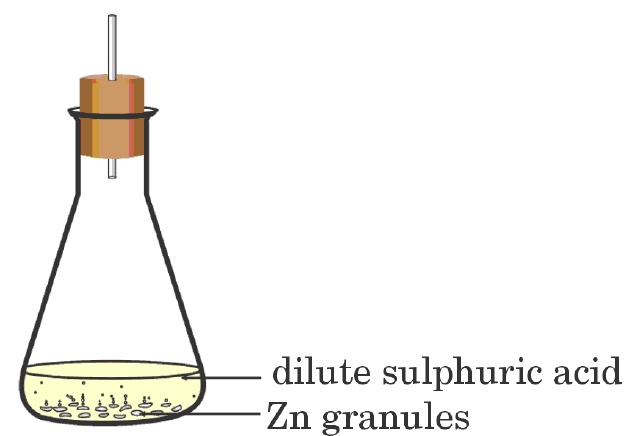
List two observations to justify that in this experiment a chemical change has taken place.
Draw labelled diagrams to show different stages of budding in Hydra.
(a) Besides minimising the loss of blood, why is it essential to plug any leak in a blood vessel? Name the component of blood which helps in this process and state how this component perform this function.
(b) (i) The transport system in plants is relatively slower than in animals. Give reasons.
(ii) State the role of phloem in the transport of materials in plants.
An object is placed at a distance of 60 cm from a concave lens of focal length 30 cm. Use lens formula to find the position of the image formed in this case.
(a) A wire of resistance R is cut into three equal parts. If these three parts are then joined in parallel, calculate the total resistance of the combination so formed.
(b) Define electric power. When do we say that the power consumed in an electric circuit is 1 watt?
‘‘Excessive use of chemicals and pesticides in agriculture adversely effect the environment.’’ Justify this statement.
Section C · Short answer (3 marks)
(a) ‘‘Displacement reactions also play a key role in extracting metals in the middle of the reactivity series.’’ Justify this statement with two examples.
(b) Why can metals high up in the reactivity series not be obtained by reduction of their oxides by carbon?
(a) With the help of an activity, explain the conditions under which iron articles get rusted.
(b) (i) Name two metals which react violently with cold water. List any three observations which a student notes when these metal are dropped in a beaker containing water.
(ii) Write a test to identify the gas evolved (if any) during the reaction of these metals with water.
Plants have neither a nervous system nor muscles, even then they respond to stimuli. For example, the leaves of chhui-mui (touch-me-not) plant when touched begin to fold up and droop.
(a) How is the information communicated in ‘‘touch-me-not’’ plants?
(b) What enables the plant cells to bring out the observable response?
(c) Differentiate the movement mentioned above from the movement of tendrils in a pea plant.
(a) What are chromosomes?
(b) Explain in brief how stability of DNA content of a species is ensured in sexually reproducing organisms?
Draw ray diagrams to show the nature, position and relative size of the image formed by a convex mirror when the object is placed (i) at infinity and (ii) between infinity and pole P of the mirror.
Consider the following electric circuit:
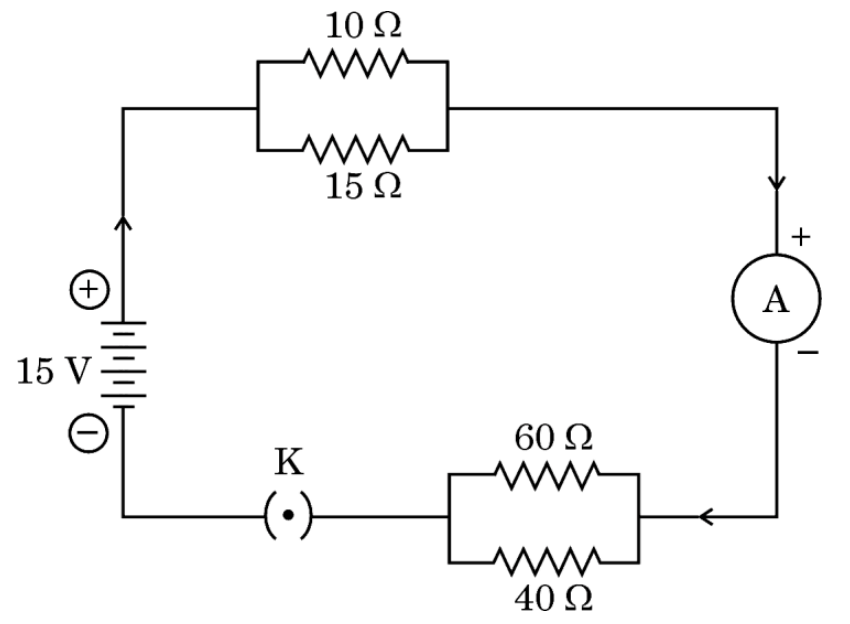
Calculate the values of the following: (a) The total resistance of the circuit (b) The total current drawn from the source (c) Potential difference across the parallel combination of 10 Ω and 15 Ω resistors
(a) Write the relationship between resistivity and resistance of a cylindrical conductor of length l and area of cross-section A. Hence derive the SI unit of resistivity.
(b) Why are alloys used in electrical heating devices?
Section D · Long answer (5 marks)
(a) (i) Draw two isomeric structures of Butene (C4H8).
(ii) Name the following compounds:
(I) 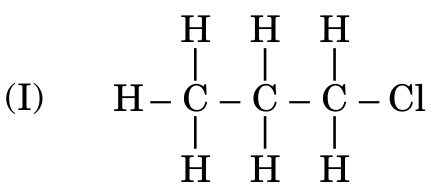 (II)
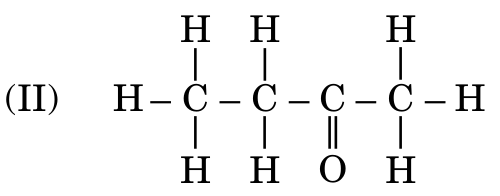
(iii) Write the chemical equations for the following reactions. Mention one essential condition each for these reactions to take place. (I) Ethanol undergoes complete oxidation (II) Propene undergoes hydrogenation (III) Ethanoic acid reacts with ethanol
(b) (i) A carbon compound X is a good solvent. On reaction with sodium, X forms two products Y and Z. Z is used to convert vegetable oil into vegetable ghee. Identify and name X, Y and Z. Also write the equation of reaction of X with sodium to justify your answer.
(ii) Write chemical equation to show what happens when ethanol: (I) burns in oxygen/air. (II) is heated at 443 K in excess conc. H2SO4. (III) reacts with acidified potassium dichromate.
(a) (i) Write the functions of the following parts of human female reproductive system: (I) Ovary (II) Fallopian tube (III) Uterus
(ii) State briefly two contraceptive methods used by human males.
(b) (i) Differentiate between self-pollination and cross-pollination.
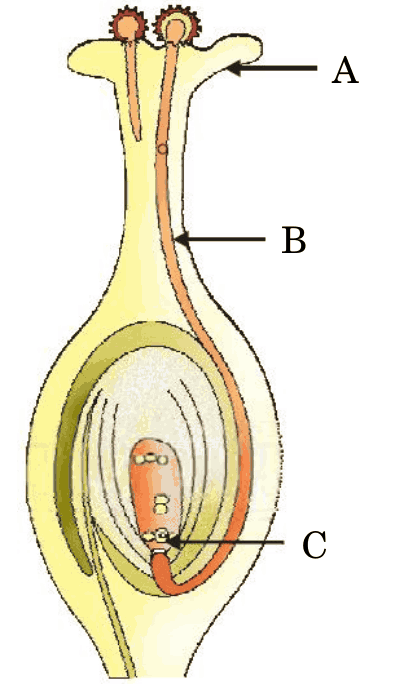
(ii) Identify A, B and C in the diagram given below and write one function of each.
(a) (i) The power of a lens ‘X’ is – 2·5 D. Name the lens and determine its focal length in cm. For which eye defect of vision will an optician prescribe this type of lens as a corrective lens?
(ii) ‘‘The value of magnification ‘m’ for a lens is – 2.’’ Using new Cartesian Sign Convention and considering that an object is placed at a distance of 20 cm from the optical centre of this lens, state: (I) the nature of the image formed; (II) size of the image compared to the size of the object; (III) position of the image, and (IV) sign of the height of the image.
(iii) The numerical values of the focal lengths of two lenses A and B are 10 cm and 20 cm respectively. Which one of the two will show higher degree of convergence/divergence? Give reason to justify your answer.
(b) (i) Draw a ray diagram to show the refraction of a ray of light through a rectangular glass slab when it falls obliquely from air into glass.
(ii) State Snell’s law of refraction of light.
(iii) Differentiate between the virtual images formed by a convex lens and a concave lens on the basis of: (I) object distance, and (II) magnification.
Section E · Case-based (4 marks)
Seawater contains many salts dissolved in it. Common salt is separated from these salts. Deposits of solid salt are also found in several parts of the world. These large crystals are often brown due to impurities. This is called rock salt and is mined like coal. The common salt is an important raw material for chemicals of daily use.
(a) Write balanced chemical equations to show the products formed during electrolysis of brine. 1
(b) List two uses of any one product obtained during electrolysis of brine. 1
(c) (i) A mild non-corrosive basic salt ‘A’, used for faster cooking, is strongly heated to produce a compound ‘B’, that is used for removing permanent hardness of water. Identify A and B and also write the equation for the reaction that occurs when A is heated. 2
OR
(c) (ii) Define water of crystallisation. Give two examples of salts that have water of crystallisation. 2
The maintenance functions of all living organisms must go on even when they are not doing anything particular. Even when we are just sitting in a class or even asleep, this maintenance job has to go on. These maintenance processes require energy to prevent damage and break-down of cells and tissues, which is obtained by the individual organism from the food prepared by the autotrophs, called producers.
(a) Name and define the process by which green plants prepare food. 1
(b) Write chemical equation involved in the above process. 1
(c) (i) State in proper sequence the events that occur in synthesis of food by desert plants. 2
OR
(c) (ii) Explain giving reasons what happens to the rate at which the green plants will prepare food (I) during cloudy weather, and (II) when stomata get blocked due to dust. 2
In our homes, we receive the supply of electric power through a main supply also called mains, either supported through overhead electric poles or by underground cables. In our country the potential difference between the two wires (live wire and neutral wire) of this supply is 220 V.
(a) Write the colours of the insulation covers of the line wires through which supply comes to our homes. 1
(b) What should be the current rating of the electric circuit (220 V) so that an electric iron of 1 kW power rating can be operated? 1
(c) (i) What is the function of the earth wire? State the advantage of the earth wire in domestic electric appliances such as electric iron. 2
OR
(c) (ii) List two precautions to be taken to avoid electrical accidents. State how these precautions prevent possible damage to the circuit/appliance. 2
Solutions: CBSE 2025 · 31/1/1
Answer: (D) 1 : 8
2H2O → 2H2 + O2. Mass of 2H2 = 2 × 2 = 4 u; mass of O2 = 32 u. Ratio 4 : 32 = 1 : 8. (By volume the ratio is 2 : 1 — do not confuse the two.)
Answer: (D)
A: pH 5 — weak acid; B: pH 7 — neutral; C: pH 13 — strong base; D: pH 3 — strong acid. (The lower the pH below 7, the stronger the acid; the higher above 7, the stronger the base.)
Answer: (C)
C is an ionic compound. Its ions are held by strong electrostatic forces, which is why it has a high melting point. It is generally soluble in water and conducts electricity when molten or dissolved.
Answer: (A)
Mg (2, 8, 2) transfers its two valence electrons to one O atom (2, 6), forming Mg2+ and O2−: Mg2+[:O:]2−. (B) shows only one electron transferred, (C) shows two oxygen atoms, and (D) shows two Mg atoms — all wrong.
Answer: (D) Auxins
When light comes from one side, auxin diffuses towards the shady side of the shoot. It makes cells on that side grow longer, so the shoot bends towards light (phototropism). Adrenaline is an animal hormone.
Answer: (C)
RRyy gives gametes Ry; rrYY gives gametes rY. All F1 plants are RrYy. Round (R) and yellow (Y) are dominant, so all are round and yellow.
Answer: (A) (i) and (ii)
X is a concave mirror: sunlight (object at infinity) forms a real, highly diminished image at its focus, concentrating heat. Y is a convex mirror: it always gives a virtual, erect, diminished image and a wider field of view.
Answer: (D) (ii) and (iv)
(i) grass → rabbit → wolf → lion and (iii) grass → grasshopper → frog → snake → hawk are food chains. In (ii) the grasshopper does not eat plankton and fish do not eat grasshoppers in this order, and in (iv) a snake does not eat grass, so these do not form food chains.
Answer: (B)
Both are true. Most decomposition reactions need energy (heat, light or electricity) to break the reactant, so they are endothermic. Composting releases heat. But R is an exception and does not explain A.
Answer: (A)
Both are true and R explains A. If two field lines crossed, the field at that point would have two directions, so a compass needle would have to point in two directions at once, which is impossible.
Zinc granules react with dilute sulphuric acid: Zn + H2SO4 → ZnSO4 + H2.
1. Evolution of a gas — bubbles of hydrogen are seen around the zinc granules.
2. Change (rise) in temperature — the flask becomes warm.
(Also, the zinc granules slowly get smaller.)
A leak would cause a loss of pressure in the circulatory system, which would reduce the efficiency of the pumping system. So the leak must be plugged.
Component: platelets. Platelets circulate in the blood and plug leaks by helping the blood to clot at the point of injury.
For a concave lens f is negative: f = −30 cm; u = −60 cm.
1/v = 1/f + 1/u = 1/(−30) + 1/(−60) = (−2 − 1)/60 = −3/60 = −1/20
v = −20 cm
The image is formed 20 cm from the lens on the same side as the object; it is virtual and erect.
Electric power is the rate at which electrical energy is consumed (or dissipated) in a circuit: P = VI = I2R = V2/R. Its SI unit is the watt (W).
The power consumed is 1 watt when a current of 1 ampere flows through a device operating at a potential difference of 1 volt (1 W = 1 V × 1 A).
(a) Highly reactive metals such as aluminium are used as reducing agents: they displace metals of lower reactivity from their oxides. These reactions are highly exothermic, so the metals are produced in the molten state.
Fe2O3(s) + 2Al(s) → 2Fe(l) + Al2O3(s) + heat (thermit reaction)
(b) Metals high up in the reactivity series (Na, Ca, Mg, Al) have a greater affinity for oxygen than carbon, so carbon cannot remove oxygen from their oxides. They are obtained by electrolytic reduction instead.
(i) Sodium and potassium. Observations: (1) the metal reacts violently, moving on the surface of water with a hissing sound; (2) a gas is evolved and it catches fire; (3) a lot of heat is produced (the reaction is highly exothermic); the solution formed turns red litmus blue (NaOH/KOH).
2Na + 2H2O → 2NaOH + H2 + heat
(ii) Collect the gas and bring a burning matchstick/splinter near it. It burns with a pop sound, showing that the gas is hydrogen.
(a) Chromosomes are thread-like structures in the nucleus of a cell that carry the information for inheritance of features from parents to the next generation in the form of DNA molecules.
(b) In sexually reproducing organisms, special lineages of cells in the reproductive organs form germ cells (gametes) that contain only half the number of chromosomes and half the DNA of the non-reproductive cells. When a male and a female gamete fuse during fertilisation, the zygote gets the normal number of chromosomes again. So the DNA content remains constant from generation to generation.
(a) 10 Ω ∥ 15 Ω:
60 Ω ∥ 40 Ω:
These two combinations are in series: R = 6 + 24 = 30 Ω.
(b)
(c)
(i) Two isomers of butene (same formula C4H8, different position of the double bond):
But-2-ene: CH3–CH=CH–CH3
(ii) (I) CH3CH2CH2Cl — chloropropane (1-chloropropane). (II) CH3CH2COCH3 — butanone.
(iii) (I) Complete oxidation (combustion) — condition: burning in excess air/oxygen:
(II) Hydrogenation — condition: nickel (or palladium) catalyst:
(III) Esterification — condition: an acid catalyst (conc. H2SO4) and warming:
(i) (I) Ovary — produces the female germ cells (eggs); one egg is released every month. It also produces hormones (oestrogen, progesterone).
(II) Fallopian tube (oviduct) — carries the egg from the ovary to the uterus; it is the site of fertilisation.
(III) Uterus — the embryo (zygote) is implanted in its thick lining and develops into a foetus; it gets nutrition from the mother's blood through the placenta.
(ii) (1) Condom (mechanical barrier) — stops sperms from reaching the egg; it also protects against sexually transmitted diseases.
(2) Vasectomy (surgical) — the vas deferens is blocked or cut, so sperms cannot be transferred.
(i) Negative power means a concave (diverging) lens.
(ii) (I) m is negative, so the image is real and inverted (the lens is convex).
(II) |m| = 2, so the image is twice the size of the object (magnified).
(III) u = −20 cm; m = v/u ⇒ v = m × u = (−2)(−20) = +40 cm: the image is 40 cm from the lens on the other side.
(IV) The height of the image is negative (it is below the principal axis).
(iii) Lens A. Power P = 1/f; the lens with the shorter focal length has the greater power: PA = 1/0.10 = 10 D, PB = 1/0.20 = 5 D. A lens of greater power bends light more, so it converges or diverges light to a higher degree.
(a)
(b) Any one product, two uses, e.g. chlorine: water treatment / swimming pools, making PVC, disinfectants, CFCs, pesticides, bleaching powder. Sodium hydroxide: soaps and detergents, paper making, artificial fibres, degreasing metals. Hydrogen: fuels, margarine, ammonia for fertilisers.
(c) (i) A = sodium hydrogencarbonate (baking soda), NaHCO3; B = sodium carbonate, Na2CO3 (recrystallised as washing soda, which removes permanent hardness).
OR (c) (ii) Water of crystallisation is the fixed number of water molecules present in one formula unit of a salt (chemically part of its crystal). Examples: copper sulphate pentahydrate CuSO4·5H2O; washing soda Na2CO3·10H2O; gypsum CaSO4·2H2O.
(a) Live wire (positive) — red insulation; neutral wire (negative) — black insulation. (The earth wire has green insulation.)
(b)
(c) (i) The earth wire connects the metal body of the appliance to a metal plate deep in the earth. It provides a low-resistance conducting path for current. If the live wire touches the metal body of an iron due to faulty insulation, the leaking current flows to the earth, the potential of the body stays at that of the earth, and the user does not get a severe electric shock.
OR (c) (ii) (1) Use an electric fuse / MCB of proper rating in the circuit: it melts or trips when the current becomes too large (overloading or short-circuit), breaking the circuit and protecting the wiring and appliances. (2) Avoid overloading — do not connect too many appliances to a single socket, so that excessive current does not flow and overheat the wires. (Also: earth all metal-bodied appliances.)
Get every solution for all 17 papers
- Every board question of every chapter, each fully solved the way the board gives marks
- 17 complete board papers, each followed by its solutions
- Weightage and most-asked topics for every chapter
- Instant PDF download, colour and black & white print copies
Revising the chapter first? Complete Science Notes for Class 10 (NCERT 2026-27) →
What you get in the pack
- Questions from 126 CBSE papers, 2016 to 2026: every set code available
- Complete: 2405 different questions and parts from all set codes, 13 chapters and 17 full papers
- Part A: all 13 chapters, questions sorted chapter-wise and by marks
- Year-wise weightage table and most-asked topics for every chapter
- Part B: 17 full board papers, each followed by its complete solutions, for timed practice
- Answers written to the CBSE marking-scheme points, with labelled diagrams drawn in full
- Questions on topics out of the board syllabus flagged
All chapters in this pack
- PYQ Ch 1 Chemical Reactions and Equations
- PYQ Ch 2 Acids, Bases and Salts
- PYQ Ch 3 Metals and Non-metals
- PYQ Ch 4 Carbon and its Compounds
- PYQ Ch 5 Life Processes
- PYQ Ch 6 Control and Coordination
- PYQ Ch 7 How do Organisms Reproduce
- PYQ Ch 8 Heredity
- PYQ Ch 9 Light Reflection and Refraction
- PYQ Ch 10 The Human Eye and the Colourful World
- PYQ Ch 11 Electricity
- PYQ Ch 12 Magnetic Effects of Electric Current
- PYQ Ch 13 Our Environment
- Board Paper 2026 Set 31-2-1 with Solutions
- Board Paper 2026 Set 31-3-1 with Solutions
- Board Paper 2025 Set 31-1-1 with Solutions
- Board Paper 2025 Set 31-2-1 with Solutions
- Board Paper 2024 Set 31-4-1 with Solutions
- Board Paper 2024 Set 31-5-1 with Solutions
- Board Paper 2023 Set 31-2-1 with Solutions
- Board Paper 2023 Set 31-4-1 with Solutions
- Board Paper 2022 Term 2 Set 31-1-1 with Solutions
- Board Paper 2022 Term 2 Set 31-3-1 with Solutions
- Board Paper 2020 Set 31-2-1 with Solutions
- Board Paper 2020 Set 31-4-1 with Solutions
- Board Paper 2019 Set 31-2-1 with Solutions
- Board Paper 2019 Set 31-4-1 with Solutions
- Board Paper 2018 Set 31-1 with Solutions
- Board Paper 2017 Set 3 with Solutions
- Board Paper 2016 Set 31-1 with Solutions