
Light – Reflection and Refraction: Class 10 PYQs 2016–2026 with solutions
All 61 CBSE board questions asked from Light – Reflection and Refraction in 15 board papers, with the year, set and marks of each. 33 are solved free below. The Class 10 Science PYQ Book: Solved Board Papers 2016-2026 (CBSE) has every solution, all chapters and 17 full board papers.

Free: NCERT solutions for Class 10 Science →
Light – Reflection and Refraction: board weightage
Board weightage 2016–2026
| Year | 2016 | 2017 | 2018 | 2019 | 2020 | 2022 | 2023 | 2024 | 2025 | 2026 |
|---|---|---|---|---|---|---|---|---|---|---|
| Questions | 8 | 8 | 4 | 7 | 5 | – | 8 | 6 | 10 | 5 |
| Marks | 20 | 20 | 10 | 16 | 19 | – | 25 | 18 | 25 | 12 |
Most asked topics
61 questions from 15 papers. Repeated questions are shown once with every year they were asked.
Jump to: 1 mark2 marks3 marks4 marks5 marks
1 mark: MCQ and Assertion–Reason
From the following options choose the one which gives negative magnification greater than one:
Solution
Answer: (A)
Negative magnification means the image is real and inverted; magnitude greater than 1 means it is enlarged. Only a concave mirror gives a real, inverted, enlarged image (object between F and C, or at F). A convex mirror always gives a virtual, erect, diminished image (m positive, less than 1).
Mirror ‘X’ is used to concentrate sunlight in solar furnace and Mirror ‘Y’ is fitted on the side of the vehicle to see the traffic behind the driver. Which of the following statements are true for the two mirrors? (i) The image formed by mirror ‘X’ is real, diminished and at its focus. (ii) The image formed by mirror ‘Y’ is virtual, diminished and erect. (iii) The image formed by mirror ‘X’ is virtual, diminished and erect. (iv) The image formed by mirror ‘Y’ is real, diminished and at its focus.
Solution
Answer: (A) (i) and (ii)
X is a concave mirror: sunlight (object at infinity) forms a real, highly diminished image at its focus, concentrating heat. Y is a convex mirror: it always gives a virtual, erect, diminished image and a wider field of view.
If the absolute refractive indices of two media X and Y are 6/5 and 4/3 respectively, then the refractive index of Y with respect to X will be:
Solution
Answer: (A) 10/9
An object is placed at a distance of 30 cm from the pole of a concave mirror. If its real and inverted image is formed at 60 cm in front of the mirror, the focal length of the mirror is:
Solution
Answer: (B) −20 cm
u = −30 cm, v = −60 cm (real image in front of the mirror).
Absolute refractive index of glass and water is 3/2 and 4/3 respectively. If the speed of light in glass is 2 × 10⁸ m/s, the speed of light in water is:
Solution
Answer: (A)
vw = c / nw = 3 × 10⁸ ÷ 4/3 = 9/4 × 108 m/s
How will the image formed by a convex lens be affected, if the upper half of the lens is wrapped with a black paper?
Solution
Answer: (C)
Rays from every point of the object still pass through the uncovered lower half, so the full image is formed at the same place and size; only fewer rays reach it, so it is less bright.
An object is placed in front of a convex mirror at infinity. According to the New Cartesian Sign Convention, the sign of the focal length and the sign of the image distance in this case are respectively:
Solution
Answer: (d) +, +
The focus of a convex mirror lies behind the mirror (positive), and the image of an object at infinity is formed at the focus behind the mirror, so v is also positive.
A student very cautiously traces the path of a ray through a glass slab for different values of the angle of incidence (∠i). He then measures the corresponding values of the angle of refraction (∠r) and the angle of emergence (∠e) for every value of the angle of incidence. On analysing these measurements of angles, his conclusion would be
Study the given ray diagrams and select the correct statement from the following:
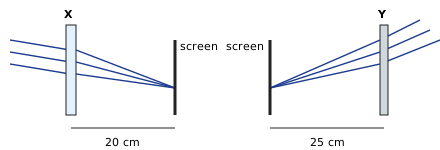
A student obtains a blurred image of a distant object on a screen using a convex lens. To obtain a distinct image on the screen he should move the lens
To determine the approximate value of the focal length of a given concave mirror, you focus the image of a distant object formed by the mirror on a screen. The image obtained on the screen, as compared to the object is always:
Suppose you have focused on a screen the image of candle flame placed at the farthest end of the laboratory table using a convex lens. If your teacher suggests you to focus the parallel rays of the sun, reaching your laboratory table, on the same screen, what you are expected to do is to move the:
In your laboratory you trace the path of light rays through a glass slab for different values of angle of incidence (∠i) and in each case measure the values of the corresponding angle of refraction (∠r) and angle of emergence (∠e). On the basis of your observations your correct conclusion is:
2 marks: very short answer
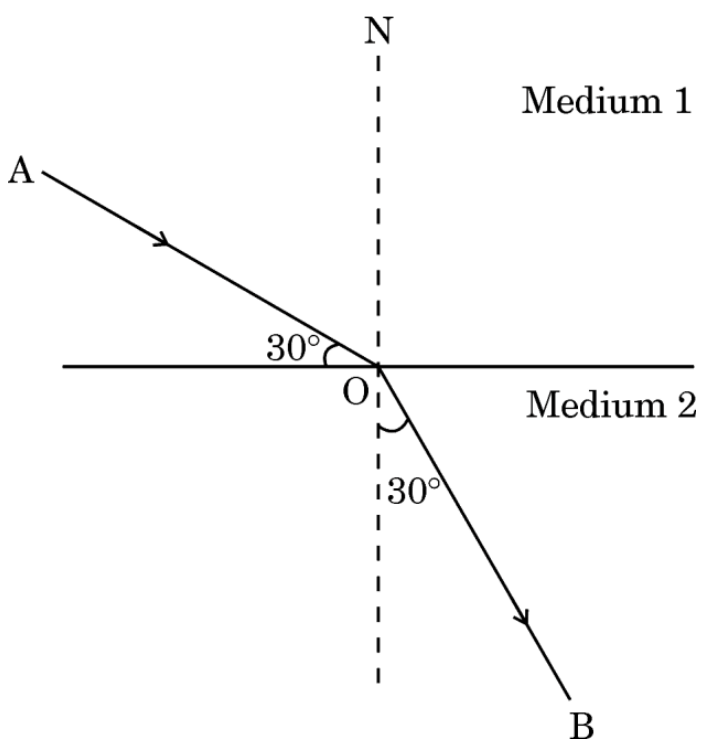
With the help of the given ray diagram, calculate the refractive index of Medium 2 with respect to Medium 1. (Given that √3 = 1·732)
Solution
The angles are measured from the normal ON.
Ray AO makes 30° with the surface, so the angle of incidence i = 90° − 30° = 60°.
The refracted ray OB makes 30° with the normal, so r = 30°.
Medium 2 is optically denser than medium 1 (the ray bends towards the normal).
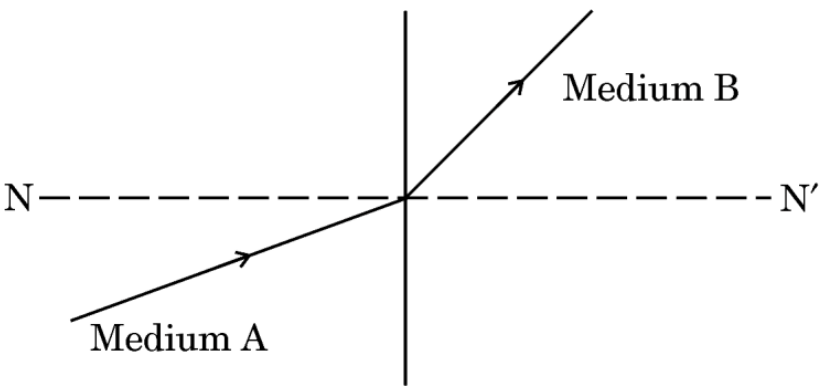
A ray of light enters into medium B from medium A as shown in the given figure:
(a) Which one of these two media is optically denser than the other medium? Justify your answer.
(b) If the speed of light in medium A is vA and in medium B is vB, then what is the refractive index of medium B with respect to medium A?
Solution
(a) NN′ is the normal. The refracted ray in medium B bends away from the normal (angle of refraction > angle of incidence). Light bends away from the normal when it goes from a denser to a rarer medium, so medium A is optically denser.
(b)
An object is placed at a distance of 60 cm from a concave lens of focal length 30 cm. Use lens formula to find the position of the image formed in this case.
Solution
For a concave lens f is negative: f = −30 cm; u = −60 cm.
1/v = 1/f + 1/u = 1/(−30) + 1/(−60) = (−2 − 1)/60 = −3/60 = −1/20
v = −20 cm
The image is formed 20 cm from the lens on the same side as the object; it is virtual and erect.
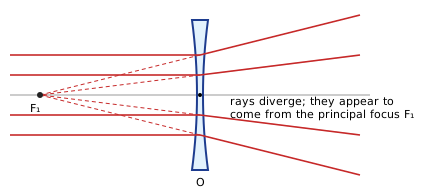
Out of the two lenses, one concave and the other convex, state which one will diverge a parallel beam of light falling on it. Draw a ray diagram to show the principal focus of the lens.
Solution
The concave lens diverges a parallel beam of light. After refraction, the rays appear to diverge from a point on the principal axis on the same side as the incident light — the principal focus F1.
A ray of light after refraction from a convex lens emerges parallel to its principal axis. (i) Draw a labelled ray diagram to show it. (ii) In this case, the incident ray before refraction from the lens passes through a point on its principal axis. Name the point.
Solution
(i) 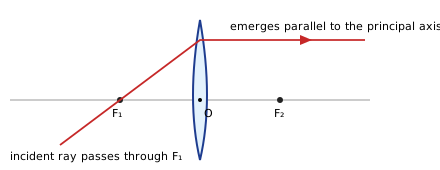
(ii) The incident ray passes through the principal focus F1 (the first focus) of the convex lens.
The heat produced at a point due to concentration of sunlight by a convex lens burns a paper. (a) Explain why it happens. (b) Name the term (in the context of the lens used) given to the point at which the paper starts burning. What does the bright spot formed on the paper represent?
Solution
(a) A convex lens converges the parallel rays of sunlight to a point. The light energy (heat) of all the rays is concentrated at that point, which becomes very hot and the paper catches fire.
(b) The point is the principal focus of the lens. The bright spot is the real image of the Sun.
The absolute refractive index of Ruby is 1.7. Find the speed of light in Ruby. The speed of light in vacuum is 3 × 10⁸ m/s.
Solution
Draw the path of a ray of light when it enters one of the faces of a glass slab at an angle of nearly 45°. Label on it (i) angle of refraction, (ii) angle of emergence and (iii) lateral displacement.
Solution
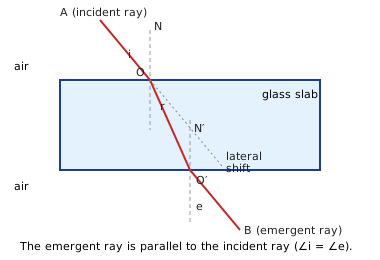
r = angle of refraction (inside the slab, with the normal); e = angle of emergence; the perpendicular distance between the incident ray produced and the emergent ray is the lateral displacement.
State laws of reflection of light.
Solution
(1) The angle of incidence is equal to the angle of reflection.
(2) The incident ray, the normal to the mirror at the point of incidence and the reflected ray all lie in the same plane.
Define absolute refractive index and express it mathematically.
Study the following ray diagram and list two mistakes committed by the student while tracing it. Rectify these mistakes by drawing the correct ray diagram to show the real position and size of the image corresponding to the position of the object AB.
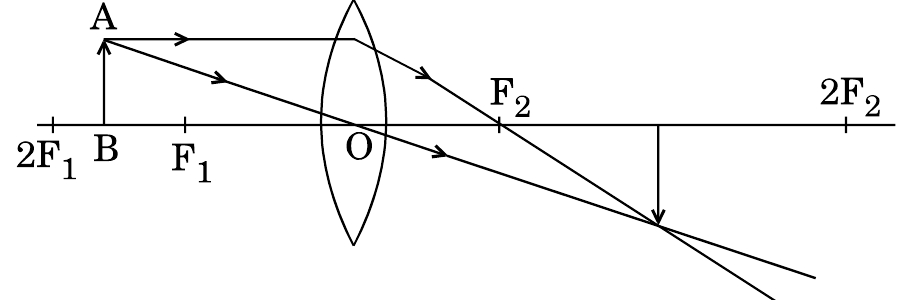
If the image formed by a spherical mirror for all positions of the object placed in front of it is always erect and diminished, what type of mirror is it? Draw a labelled ray diagram to support your answer.
An object of height 4.0 cm is placed at a distance of 30 cm from the optical centre ‘O’ of a convex lens of focal length 20 cm. Draw a ray diagram to find the position and size of the image formed. Mark optical centre ‘O’ and principal focus ‘F’ on the diagram. Also find the approximate ratio of size of the image to the size of the object.
An object is placed at a distance of 15 cm from a concave lens of focal length 30 cm. List four characteristic (nature, position, etc.) of the image formed by the lens.
A student focuses the image of a candle flame, placed at about 2 m from a convex lens of focal length 10 cm, on a screen. After that he moves gradually the flame towards the lens and each time focuses its image on the screen. (A) In which direction does he move the lens to focus the flame on the screen? (B) What happens to the size of the image of the flame formed on the screen? (C) What difference is seen in the intensity (brightness) of the image of the flame on the screen? (D) What is seen on the screen when the flame is very close (at about 5 cm) to the lens?
Name the type of mirrors used in the design of solar furnaces. Explain how high temperature is achieved by this device.
An object of height 2.5 cm is placed at a distance of 15 cm from the optical centre O of a convex lens of focal length 10 cm. Draw a ray diagram to find the position and size of the image formed. Mark optical centre O, principal focus F and height of the image on the diagram.
3 marks: short answer
(a) Write the expression for the magnification produced by a lens in terms of object distance and image distance.
(b) A 4 cm tall object is placed perpendicular to the principal axis of a convex lens of focal length 20 cm. Calculate the size of the image formed, if the distance of the object from the lens is 10 cm.
Solution
(a) m = v / u (image distance ÷ object distance); also m = h′/h.
(b) Given h = +4 cm, f = +20 cm, u = −10 cm.
v = −20 cm
m = v/u = (−20)/(−10) = +2
h′ = m × h = 2 × 4 = 8 cm
The image is 8 cm tall, virtual and erect, 20 cm from the lens on the same side as the object (the object is within the focal length).
Draw ray diagrams to show the nature, position and relative size of the image formed by a convex mirror when the object is placed (i) at infinity and (ii) between infinity and pole P of the mirror.
Solution
(i) Object at infinity: image at the focus F behind the mirror — virtual, erect and highly diminished (point-sized).
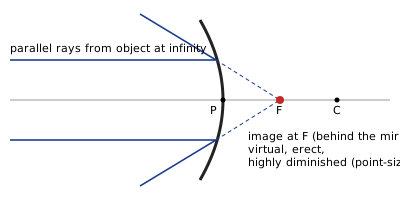
(ii) Object between infinity and the pole: image between P and F behind the mirror — virtual, erect and diminished.
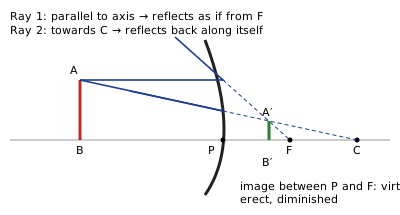
A convex lens forms an 8.0 cm long image of a 2.0 cm long object which is kept at a distance of 6.0 cm from the optical centre of the lens. If the object and the image are on the same side of the lens, find (i) the nature of the image, (ii) the position of the image, and (iii) the focal length of the lens.
Solution
(i) The image is on the same side as the object, so it is virtual and erect (and enlarged, 4 times).
(ii) m = h′/h = +8.0/2.0 = +4 (positive because erect). u = −6.0 cm.
(iii)
A student has focussed the image of an object of height 3 cm on a white screen using a concave mirror of focal length 12 cm. If the distance of the object from the mirror is 18 cm, find the values of the following: (i) Distance of the image from the mirror (ii) Height of the image
Solution
f = −12 cm, u = −18 cm, h = +3 cm.
(i) v = −36 cm (36 cm in front of the mirror, real image)
m = −v/u = −(−36)/(−18) = −2
(ii) h′ = m × h = −2 × 3 = −6 cm
The image is 6 cm tall, real and inverted.
Define power of a lens. The focal length of a lens is −10 cm. Write the nature of the lens and find its power. If an object is placed at a distance of 20 cm from the optical centre of this lens, according to the New Cartesian Sign Convention, what will be the sign of magnification in this case?
Solution
Power of a lens is the degree of convergence or divergence of light rays it produces; it is the reciprocal of its focal length in metres: P = 1/f (unit: dioptre, D).
Negative focal length ⇒ concave (diverging) lens.
A concave lens always forms a virtual, erect image, so the magnification is positive (+) (and less than 1).
Define the following terms in the context of a diverging mirror: (i) Principal focus (ii) Focal length. Draw a labelled ray diagram to illustrate your answer.
Solution
A diverging mirror is a convex mirror.
(i) Principal focus: the point on the principal axis (behind the mirror) from which rays parallel to the principal axis appear to diverge after reflection.
(ii) Focal length: the distance between the pole P and the principal focus F.
An object of height 10 cm is placed 25 cm away from the optical centre of a converging lens of focal length 15 cm. Calculate the image-distance and height of the image formed.
Solution
f = +15 cm, u = −25 cm, h = +10 cm.
m = v/u = 37.5/(−25) = −1.5
h′ = m × h = −1.5 × 10 = −15 cm
The image is 37.5 cm on the other side of the lens, 15 cm tall, real and inverted.
The power of a lens is +4 D. Find the focal length of this lens. An object is placed at a distance of 50 cm from the optical centre of this lens. State the nature and magnification of the image formed by the lens and also draw a ray diagram to justify your answer.
Solution
u = −50 cm = 2f, so the object is at 2F1: 1/v = 1/25 − 1/50 = 1/50 ⇒ v = +50 cm (at 2F2).
The image is real, inverted and of the same size; m = v/u = 50/(−50) = −1.
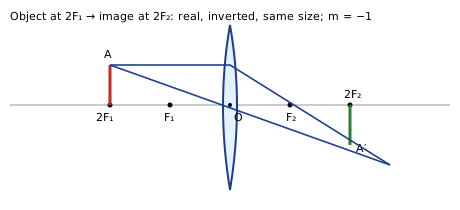
What happens after refraction, when: (i) a ray of light parallel to the principal axis passes through a concave lens? (ii) a ray of light falls on a convex lens while passing through its principal focus? (iii) a ray of light passes through the optical centre of a convex lens?
Solution
(i) It diverges and appears to come from the principal focus F1 on the same side of the lens.
(ii) It emerges parallel to the principal axis.
(iii) It passes through without any deviation.
A concave mirror is used for image formation for different positions of an object. What inferences can be drawn about the following when an object is placed at a distance of 10 cm from the pole of a concave mirror of focal length 15 cm? (a) Position of the image (b) Size of the image (c) Nature of the image. Draw a labelled ray diagram to justify your inferences.
The refractive index of a medium ‘x’ with respect to a medium ‘y’ is 2/3 and the refractive index of medium ‘y’ with respect to medium ‘z’ is 4/3. Find the refractive index of medium ‘z’ with respect to medium ‘x’. If the speed of light in medium ‘x’ is 3 × 10⁸ m s−1, calculate the speed of light in medium ‘y’.
A student holding a mirror in his hand, directed the reflecting surface of the mirror towards the Sun. He then directed the reflected light on to a sheet of paper held close to the mirror. (a) What should he do to burn the paper? (b) Which type of mirror does he have? (c) Will he be able to determine the approximate value of focal length of this mirror from this activity? Give reason and draw ray diagram to justify your answer in this case.
A 10 cm tall object is placed perpendicular to the principal axis of a convex lens of focal length 12 cm. The distance of the object from the lens is 18 cm. Find the nature, position and size of the image formed.
State the laws of refraction of light. Explain the term ‘absolute refractive index of a medium’ and write an expression to relate it with the speed of light in vacuum.
What is meant by power of a lens? Write its SI unit. A student uses a lens of focal length 40 cm and another of –20 cm. Write the nature and power of each lens.
“A lens can form a magnified erect image as well as magnified inverted image of an object placed in front of it”. State the nature of this lens and draw ray diagrams to justify the above statement. Mark the positions of O, F and 2F in the diagram.
The image of an object formed by a mirror is real, inverted and is of magnification –1. If the image is at a distance of 40 cm from the mirror, where is the object placed? Where would the image be if the object is moved 20 cm towards the mirror? State reason and also draw ray diagram for the new position of the object to justify your answer.
4 marks: case-based / source-based
The variation of image distance (v) with the object distance (u) for a convex lens is given in the following observation table. Analyse it and answer the questions given below:
| S. No. | 1 | 2 | 3 | 4 | 5 | 6 |
|---|---|---|---|---|---|---|
| u (cm) | −150 | −75 | −50 | −37.5 | −30 | −15 |
| v (cm) | +30 | +37.5 | +50 | +75 | +150 | +37.5 |
(a) Without calculation, find out the focal length of the given convex lens. Justify your answer. 1
(b) Which one of the observations given in the table is not correct and why? 1
(c) (i) Find out the value of magnification for u = –30 cm. Write the nature of the image formed. Give reason for your answer. 2
OR
(c) (ii) Analyse the data given in the table above and draw the labelled ray diagram for u = –30 cm and v = 150 cm. 2
Solution
(a) In observation 3, u = −50 cm and v = +50 cm: the object and image distances are equal. This happens only when the object is at 2F1, so 2f = 50 cm and f = 25 cm.
(b) Observation 6 is wrong. u = −15 cm is less than the focal length (25 cm), so the object is between F1 and the lens. The image must then be virtual, on the same side as the object, so v must be negative. (In fact, 1/v = 1/25 − 1/15 gives v = −37.5 cm.)
(c) (i)
OR (c) (ii) Object between F1 (25 cm) and 2F1 (50 cm); image beyond 2F2, real, inverted, enlarged:
A highly polished surface such as a mirror reflects most of the light falling on it. In our daily life we use two types of mirrors plane and spherical. The reflecting surface of a spherical mirrors may be curved inwards or outwards. In concave mirrors, reflection takes place from the inner surface, while in convex mirrors reflection takes place from the outer surface.
(a) Define the principal axis of a concave mirror. 1
(b) A ray of light is incident on a concave mirror, parallel to its principal axis. If this ray after reflection from the mirror passes through the principal axis from a point at a distance of 10 cm from the pole of the mirror, find the radius of curvature of the mirror. 1
(c) (i) An object is placed at a distance of 10 cm from the pole of a convex mirror of focal length 15 cm. Find the position of the image. 2
OR
(c) (ii) A mirror forms a virtual, erect and diminished image of an object. Identify the type of this mirror. Draw a ray diagram to show the image formation in this case. 2
Solution
(a) The principal axis is the straight line passing through the pole and the centre of curvature of the mirror.
(b) A ray parallel to the axis passes through the principal focus after reflection, so f = 10 cm and R = 2f = 20 cm.
(c) (i) Convex mirror: f = +15 cm, u = −10 cm.
v = +6 cm
The image is 6 cm behind the mirror (virtual and erect).
OR (c) (ii) A convex mirror (it always forms a virtual, erect, diminished image):
The ability of a medium to refract light is expressed in terms of its optical density. Optical density has a definite connotation. It is not the same as mass density. On comparing two media, the one with the large refractive index is optically denser medium than the other. The other medium with a lower refractive index is optically rarer. Also the speed of light through a given medium is inversely proportional to its optical density.
(i) Determine the speed of light in diamond if the refractive index of diamond with respect to vacuum is 2.42. Speed of light in vacuum is 3 × 10⁸ m/s. 1
(ii) Refractive indices of glass, water and carbon disulphide are 1.5, 1.33 and 1.62 respectively. If a ray of light is incident in these media at the same angle (say θ), then write the increasing order of the angle of refraction in these media. 1
(iii) (A) The speed of light in glass is 2 × 10⁸ m/s and in water is 2.25 × 10⁸ m/s. (a) Which one of the two is optically denser and why? (b) A ray of light is incident normally at the water-glass interface when it enters a thick glass container filled with water. What will happen to the path of the ray after entering the glass? Give reason. 2
OR
(iii) (B) The absolute refractive indices of water and glass are 4/3 and 3/2 respectively. If the speed of light in glass is 2 × 10⁸ m/s, find the speed of light in (i) vacuum and (ii) water. 2
5 marks: long answer
(i) The power of a lens ‘X’ is – 2·5 D. Name the lens and determine its focal length in cm. For which eye defect of vision will an optician prescribe this type of lens as a corrective lens?
(ii) ‘‘The value of magnification ‘m’ for a lens is – 2.’’ Using new Cartesian Sign Convention and considering that an object is placed at a distance of 20 cm from the optical centre of this lens, state: (I) the nature of the image formed; (II) size of the image compared to the size of the object; (III) position of the image, and (IV) sign of the height of the image.
(iii) The numerical values of the focal lengths of two lenses A and B are 10 cm and 20 cm respectively. Which one of the two will show higher degree of convergence/divergence? Give reason to justify your answer.
Solution
(i) Negative power means a concave (diverging) lens.
(ii) (I) m is negative, so the image is real and inverted (the lens is convex).
(II) |m| = 2, so the image is twice the size of the object (magnified).
(III) u = −20 cm; m = v/u ⇒ v = m × u = (−2)(−20) = +40 cm: the image is 40 cm from the lens on the other side.
(IV) The height of the image is negative (it is below the principal axis).
(iii) Lens A. Power P = 1/f; the lens with the shorter focal length has the greater power: PA = 1/0.10 = 10 D, PB = 1/0.20 = 5 D. A lens of greater power bends light more, so it converges or diverges light to a higher degree.
(i) Draw a ray diagram to show the refraction of a ray of light through a rectangular glass slab when it falls obliquely from air into glass.
(ii) State Snell’s law of refraction of light.
(iii) Differentiate between the virtual images formed by a convex lens and a concave lens on the basis of: (I) object distance, and (II) magnification.
Solution
(i)
At the first surface the ray bends towards the normal (air to glass); at the second surface it bends away from the normal (glass to air). The emergent ray is parallel to the incident ray but shifted sideways (lateral shift).
(ii) Snell's law: the ratio of the sine of the angle of incidence to the sine of the angle of refraction is a constant for a given pair of media and a given colour of light: sin i / sin r = constant (= n21, the refractive index of medium 2 with respect to medium 1).
(iii)
| Convex lens | Concave lens | |
|---|---|---|
| (I) Object distance | Virtual image only when the object is between F1 and the optical centre (u less than f) | Virtual image for every position of the object |
| (II) Magnification | Enlarged: m is positive and greater than 1 | Diminished: m is positive and less than 1 |
The variation of image distance (v) with object distance (u) for a convex lens is given in the following observation table. Analyse it and answer the questions that follow:
| S. No. | 1 | 2 | 3 | 4 | 5 | 6 |
|---|---|---|---|---|---|---|
| u (cm) | −150 | −75 | −50 | −37.5 | −30 | −15 |
| v (cm) | +30 | +37.5 | +50 | +75 | +150 | +37.5 |
(i) Without calculation, find the focal length of the convex lens. Justify your answer.
(ii) Which observation is not correct? Why? Draw ray diagram to find the position of the image formed for this position of the object.
(iii) Find the approximate value of magnification for u = −30 cm.
Solution
(i) In observation 3, u = −50 cm and v = +50 cm (equal). This happens when the object is at 2F1, so 2f = 50 cm, i.e. f = 25 cm.
(ii) Observation 6 is not correct. u = −15 cm is less than f, so the object lies between F1 and the optical centre. The image must be virtual, on the same side as the object (v negative), not +37.5 cm. (Correct value: 1/v = 1/25 − 1/15 ⇒ v = −37.5 cm.)
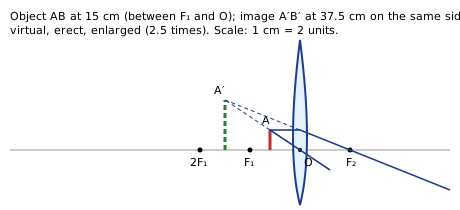
(iii)
(i) Define principal axis of a lens. Draw a ray diagram to show what happens when a ray of light parallel to the principal axis of a concave lens passes through it.
(ii) The focal length of a concave lens is 20 cm. At what distance from the lens should a 5 cm tall object be placed so that its image is formed at a distance of 15 cm from the lens? Also calculate the size of the image formed.
Solution
(i) The principal axis of a lens is the imaginary straight line passing through the two centres of curvature of its spherical surfaces. A ray parallel to the principal axis, after refraction through a concave lens, diverges and appears to come from the principal focus F1 on the same side:
(ii) Concave lens: f = −20 cm; the image is virtual, on the object's side: v = −15 cm; h = 5 cm.
u = −60 cm
m = v/u = (−15)/(−60) = 0.25 ⇒ h′ = 0.25 × 5 = 1.25 cm
The object must be placed 60 cm from the lens; the image is 1.25 cm tall, virtual and erect.
(a) An object is placed in front of a convex lens of focal length f. If the distance of the object from the lens is 2f, draw a ray diagram to show the formation of the image. Write the value of magnification in this case.
(b) A student has focussed the image of a candle flame on a white screen using a convex lens. The situation is as given below: Length of the flame = 2 cm; Focal length of the lens = 12 cm; Distance of the flame from the lens = 16 cm. If the flame is perpendicular to the principal axis of the lens, calculate the values of the following: (i) Distance of the image from the lens (ii) Length of the image formed
Solution
(a) The image is formed at 2F2: real, inverted and of the same size. m = −1.
(b) f = +12 cm, u = −16 cm, h = +2 cm.
(i) v = +48 cm (on the other side of the lens, on the screen)
m = v/u = 48/(−16) = −3
(ii) h′ = m × h = −3 × 2 = −6 cm
The image is 6 cm long, real and inverted.
(a) A concave mirror of focal length 10 cm can produce a magnified real as well as virtual image of an object placed in front of it. Draw ray diagrams to justify this statement.
(b) An object is placed perpendicular to the principal axis of a convex mirror of focal length 10 cm. The distance of the object from the pole of the mirror is 10 cm. Find the position of the image formed.
Solution
(a) Magnified real image: object between F and C (between 10 cm and 20 cm from the mirror) — the image is formed beyond C, real, inverted and magnified.
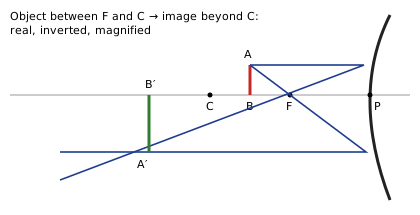
Magnified virtual image: object between P and F (less than 10 cm from the mirror) — the image is formed behind the mirror, virtual, erect and magnified.
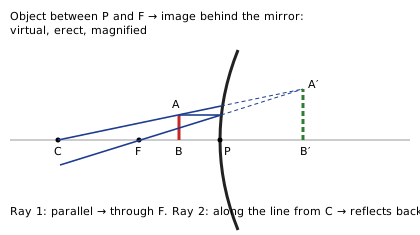
(b) Convex mirror: f = +10 cm, u = −10 cm.
v = +5 cm
The image is 5 cm behind the mirror; it is virtual, erect and diminished (m = −v/u = 0.5).
(a) Define the following terms: (i) Power of a lens (ii) Principal focus of a concave mirror
(b) Write the relationship among the object distance (u), image distance (v) and the focal length (f) of a (i) Spherical lens (ii) Spherical mirror
(c) An object is placed at a distance of 10 cm from optical centre of a convex lens of focal length 15 cm. Draw a labelled ray diagram to show the formation of image in this case.
Analyse the following observation table showing variation of image distance (v) with object distance (u) in case of a convex lens and answer the questions that follow without doing any calculations:
| S. No. | 1 | 2 | 3 | 4 | 5 | 6 |
|---|---|---|---|---|---|---|
| u (cm) | −100 | −60 | −40 | −30 | −25 | −15 |
| v (cm) | +25 | +30 | +40 | +60 | +100 | +120 |
(a) What is the focal length of the convex lens? Give reason to justify your answer. (b) Write the serial number of the observation which is not correct. On what basis have you arrived at this conclusion? (c) Select an appropriate scale and draw a ray diagram for the observation at S. No. 2. Also find the approximate value of magnification.
(a) If the image formed by a mirror for all position of the object placed in front of it is always diminished, erect and virtual, state the type of the mirror and also draw a ray diagram to justify your answer. Write one use such mirrors are put to and why. (b) Define the radius of curvature of spherical mirrors. Find the nature and focal length of a spherical mirror whose radius of curvature is +24 cm.
It is desired to obtain an erect image of an object, using concave mirror of focal length of 12 cm. (i) What should be the range of distance of an object placed in front of the mirror? (ii) Will the image be smaller or larger than the object. Draw ray diagram to show the formation of image in this case. (iii) Where will the image of this object be, if it is placed 24 cm in front of the mirror? Draw ray diagram for this situation also to justify your answer. Show the positions of pole, principal focus and the centre of curvature in the above ray diagrams.
(a) Define optical centre of a spherical lens. (b) A divergent lens has a focal length of 20 cm. At what distance should an object of height 4 cm from the optical centre of the lens be placed so that its image is formed 10 cm away from the lens. Find the size of the image also. (c) Draw a ray diagram to show the formation of image in above situation.
Get every solution for all chapters
- Every board question of every chapter, each fully solved the way the board gives marks
- 17 complete board papers, each followed by its solutions
- Weightage and most-asked topics for every chapter
- Instant PDF download, colour and black & white print copies
Revising the chapter first? Complete Science Notes for Class 10 (NCERT 2026-27) →
What you get in the pack
- 10 years of CBSE Class 10 Science board papers: 2016 to 2026 (17 papers)
- All 13 chapters and 17 board papers complete
- Part A: all 13 chapters, questions sorted chapter-wise and by marks
- Year-wise weightage table and most-asked topics for every chapter
- Part B: each full board paper followed by its complete solutions, for timed practice
- Answers written to the CBSE marking-scheme points, with labelled diagrams drawn to scale
- Questions on deleted topics flagged; only the 2026-27 syllabus in Part A
All chapters in this pack
- PYQ Ch 1 Chemical Reactions and Equations
- PYQ Ch 2 Acids, Bases and Salts
- PYQ Ch 3 Metals and Non-metals
- PYQ Ch 4 Carbon and its Compounds
- PYQ Ch 5 Life Processes
- PYQ Ch 6 Control and Coordination
- PYQ Ch 7 How do Organisms Reproduce
- PYQ Ch 8 Heredity
- PYQ Ch 9 Light Reflection and Refraction
- PYQ Ch 10 The Human Eye and the Colourful World
- PYQ Ch 11 Electricity
- PYQ Ch 12 Magnetic Effects of Electric Current
- PYQ Ch 13 Our Environment
- Board Paper 2026 Set 31-2-1 with Solutions
- Board Paper 2026 Set 31-3-1 with Solutions
- Board Paper 2025 Set 31-1-1 with Solutions
- Board Paper 2025 Set 31-2-1 with Solutions
- Board Paper 2024 Set 31-4-1 with Solutions
- Board Paper 2024 Set 31-5-1 with Solutions
- Board Paper 2023 Set 31-2-1 with Solutions
- Board Paper 2023 Set 31-4-1 with Solutions
- Board Paper 2022 Term 2 Set 31-1-1 with Solutions
- Board Paper 2022 Term 2 Set 31-3-1 with Solutions
- Board Paper 2020 Set 31-2-1 with Solutions
- Board Paper 2020 Set 31-4-1 with Solutions
- Board Paper 2019 Set 31-2-1 with Solutions
- Board Paper 2019 Set 31-4-1 with Solutions
- Board Paper 2018 Set 31-1 with Solutions
- Board Paper 2017 Set 3 with Solutions
- Board Paper 2016 Set 31-1 with Solutions