
CBSE Class 10 Science Question Paper 2025 (31/2/1) with Solutions
The complete CBSE Class 10 Science board paper of 2025, Q.P. code 31/2/1: all 39 questions exactly as set, with marks. 23 solutions are free below. The Class 10 Science PYQ Book: Solved Board Papers 2016-2026 (CBSE) solves all 17 papers in full and sorts every question chapter-wise.
Subject expert: Khushbu Gupta, B.Sc., M.Sc. Physics, B.Ed. · 8+ years teaching


Free: NCERT solutions for Class 10 Science →
Question paper
Jump to: Question paperSolutions
2025 · Q.P. Code 31/2/1
Maximum marks: 80
Section A · Multiple choice and Assertion–Reason
The correct balanced chemical equation showing exothermic reaction in which natural gas burns in air is:
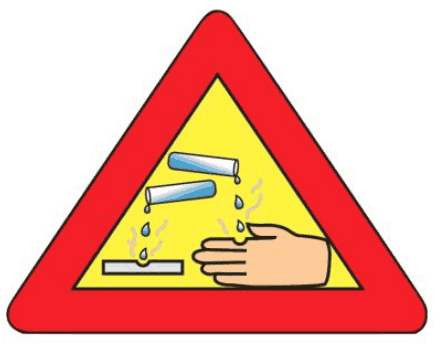
The warning sign shown in the given figure must invariably be displayed/pasted on the containers which contain hydroxide of:
The body of human beings works within the pH range of:
Aluminium powder is used in thermit welding because:
Two metals zinc and tin are dissolved separately in definite proportions in molten copper (the primary metal) to obtain two different alloys respectively known as:
The opening and closing of stomata is regulated by:
One-cell thick blood vessels are known as:
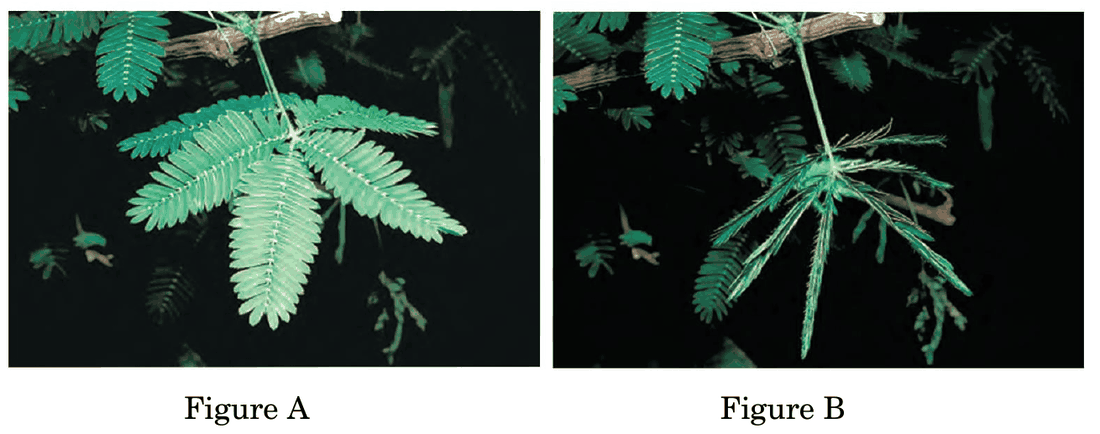
Observe the given figures A and B. When chhui-mui (sensitive) plant is touched, its leaves fold. This is due to:
Bryophyllum produces new plant through:
The number of chromosomes in a cell division is halved. This kind of cell division is observed in:
If the absolute refractive indices of two media X and Y are 6/5 and 4/3 respectively, then the refractive index of Y with respect to X will be:
An object is placed at a distance of 30 cm from the pole of a concave mirror. If its real and inverted image is formed at 60 cm in front of the mirror, the focal length of the mirror is:
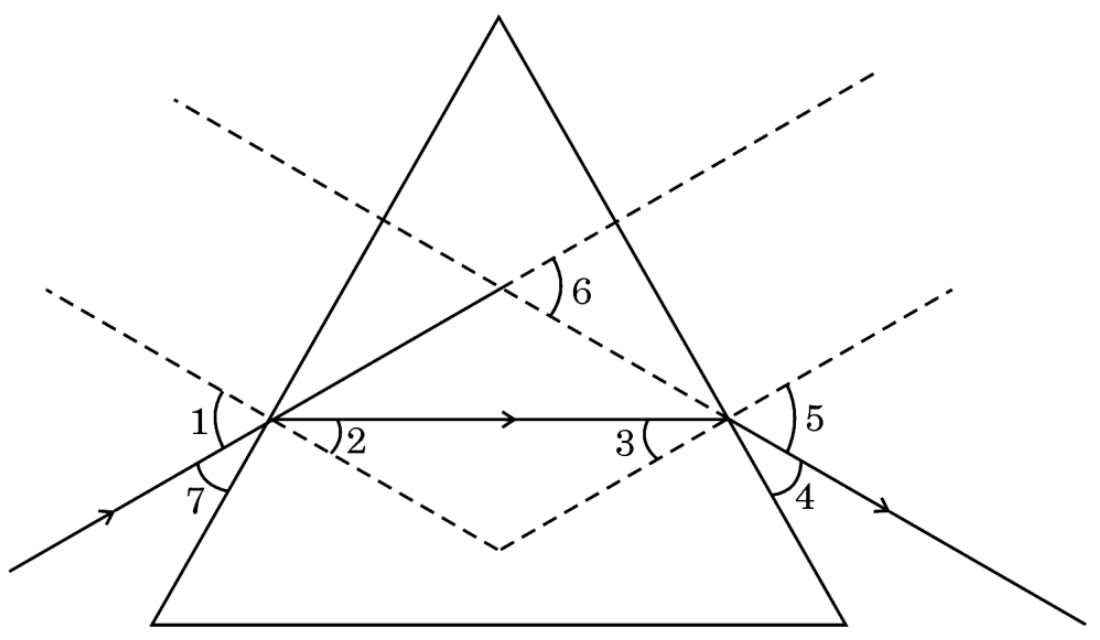
In the given figure the angle of incidence and the angle of deviation respectively are:
An electric bulb is connected to a power supply of 220 V. If the current drawn by the bulb from the supply is 500 mA, the power of the bulb is:
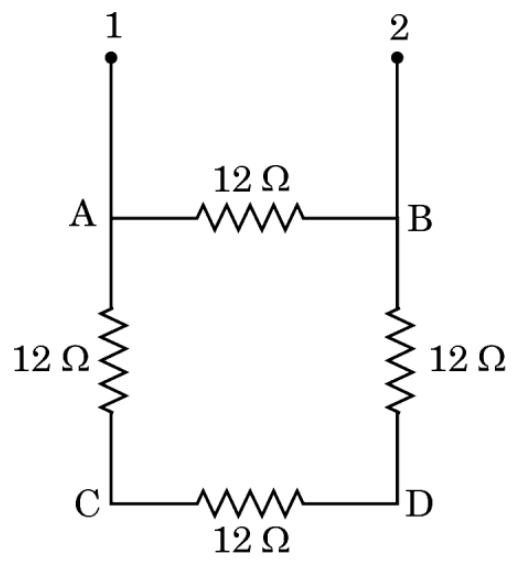
Four identical resistors of 12 Ω each are connected in series to form a square ABCD as shown in the figure. The resistance of the network between the two points 1 and 2 is:
Identify from the following a group containing all non-biodegradable substances.
Assertion (A): The metals high up in the reactivity series cannot be obtained from their compounds by heating with carbon.
Reason (R): Displacement reactions can also be used to obtain metal.
Assertion (A): A mango seed will germinate to form a mango tree.
Reason (R): Heredity determines the process by which traits and characteristics are reliably inherited from parents to offspring.
Assertion (A): Nichrome is an alloy which is commonly used in electrical heating devices such as electric irons, toasters, etc.
Reason (R): The resistivity of nichrome is high and its resistance decreases with increase in temperature.
Assertion (A): Animals will not get energy if they eat (consume) coal as food.
Reason (R): Specific enzymes are needed for the breakdown of a particular food.
Section B · Very short answer (2 marks)
(a) In common practice silver is recovered from silver nitrate solution by the use of copper metal. Name the type of reaction that takes place in this process and give the chemical equation of the reaction involved.
(b) Name the method used for refining silver.
(a) Select from the following the members of same homologous series:
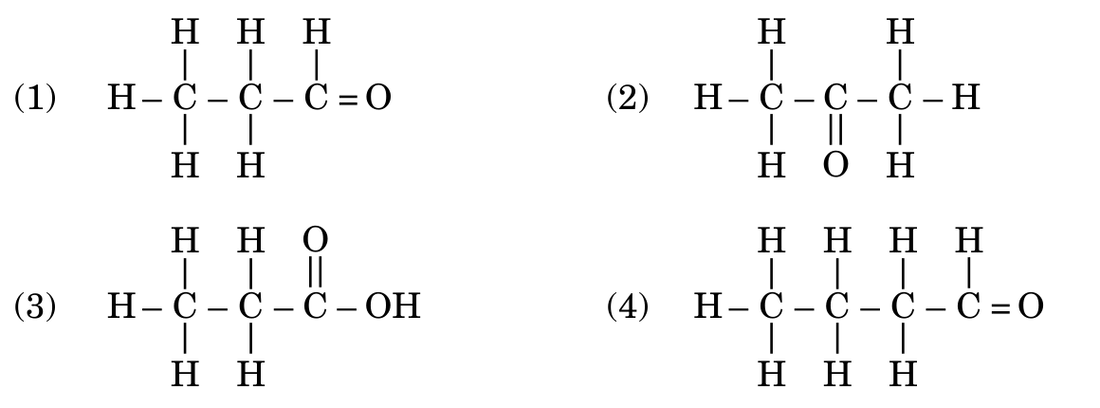
(b) What happens to (i) the melting point, and (ii) the solubility of compounds as the molecular mass of the compounds in a homologous series increases?
Name the parts of hind-brain of the human brain. Which part of the hind-brain controls involuntary actions such as blood pressure and salivation?
(a) Write one function each of the following, in a seed: (i) Seed coat (ii) Cotyledon (iii) Radicle (iv) Plumule
(b) Write the main steps to culture yeast in the laboratory.
(a) Out of the two lenses, one concave and the other convex, state which one will diverge a parallel beam of light falling on it. Draw a ray diagram to show the principal focus of the lens.
(b) A ray of light after refraction from a convex lens emerges parallel to its principal axis. (i) Draw a labelled ray diagram to show it. (ii) In this case, the incident ray before refraction from the lens passes through a point on its principal axis. Name the point.
An electric kettle is rated 750 W; 220 V. Can this kettle be used in a circuit which has a fuse of current rating 3 A? Give reason for your answer.
Section C · Short answer (3 marks)
(a) (i) Define the term decomposition reaction. Write one chemical equation each for decomposition reaction where energy is supplied in the form of heat, light or electricity.
(ii) Decomposition of vegetable matter into compost is considered an exothermic reaction. Why?
(b) Why are decomposition reactions called the opposite of combination reactions? Write one chemical equation each for these two types of reactions mentioning the name of the reactant(s) and the product(s) involved in the reactions.
Write the electron-dot structures of (i) sodium, and (ii) oxygen. Using these structures, show the formation of sodium oxide. Mark the anion and cation present in this compound. (At. No. – Sodium = 11 and Oxygen = 8)
(a) Define hormone.
(b) “Hormones should be secreted in precise quantities. We have a feedback mechanism through which this is done.” With the help of an example justify the statement.
The lowest part of the ear called earlobe, is closely attached to the side of the head in some of us (Figure ‘X’), and not in others, called free earlobe (Figure ‘Y’). Attached and free earlobes are two variants found in human populations. The gene for free earlobe is dominant over attached earlobes.
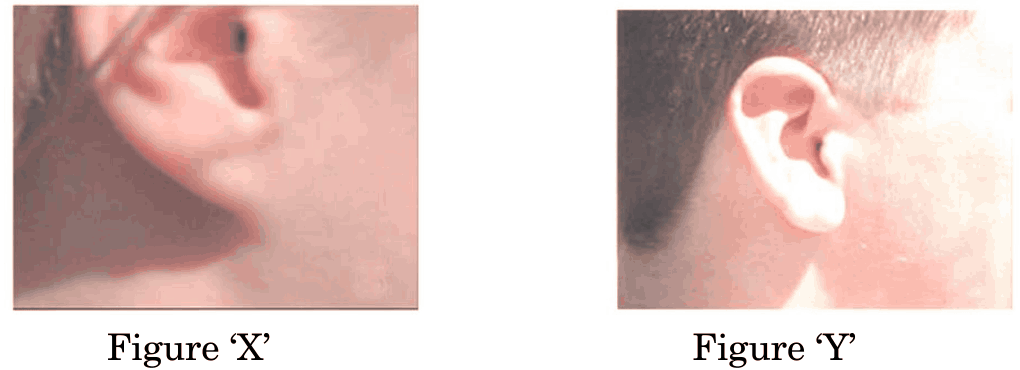
(a) A man with attached earlobes marries a woman having free earlobes. 50% of their children have free earlobes and 50% have attached earlobes. Explain the inheritance of this trait and write the trait combinations of the progeny.
(b) Write the gene combinations of the father and the mother in the above case.
A convex lens forms an 8.0 cm long image of a 2.0 cm long object which is kept at a distance of 6.0 cm from the optical centre of the lens. If the object and the image are on the same side of the lens, find (i) the nature of the image, (ii) the position of the image, and (iii) the focal length of the lens.
Three resistors of 2 Ω, 3 Ω and 6 Ω are connected in (i) series, and (ii) parallel. Draw the arrangements of the resistors and find the equivalent resistance of each arrangement.
Write the essential function performed by ozone at the higher levels of the atmosphere. How is it formed in the upper atmosphere? Write the name of the group of chemicals mainly responsible for the depletion of ozone layer.
Section D · Long answer (5 marks)
(a) (i) A compound ‘X’ having two carbon atoms in its molecule turns blue litmus red and 5 – 8% solution of ‘X’ in water is widely used as a preservative. Identify the compound ‘X’ and write its structure.
(ii) Compare its pH nature with a mineral acid.
(iii) ‘X’ on reacting with alcohols produces sweet smelling compounds, used in making perfumes. Name the reaction and write its chemical equation.
(iv) When sodium carbonate is added to ‘X’, a colourless gas is produced which turns lime water milky. Write the chemical equation for the reaction giving the name of the salt produced.
(b) (i) Differentiate between saturated and unsaturated hydrocarbons by giving one example each, with a structural formula.
(ii) Write the method of converting an unsaturated hydrocarbon into a saturated hydrocarbon. Name the industry where this reaction is commonly used.
(iii) Write the name and structure of a hydrocarbon having double bond and four carbon atoms in its one molecule.
(a) (i) “The length of the small intestine in various animals depends on the food they eat.” Justify the statement.
(ii) Discuss the role of the pancreas and bile juice in the digestion of food in human beings.
(iii) How is the small intestine designed to absorb digested food?
(b) (i) State the role of rings of cartilage present in the throat.
(ii) Discuss the role of the ribs and diaphragm when air is taken in during the breathing cycle.
(iii) Why do we get muscle cramps during heavy exercise? Explain.
(a) The given figure shows the current passing through the straight conductor XY.
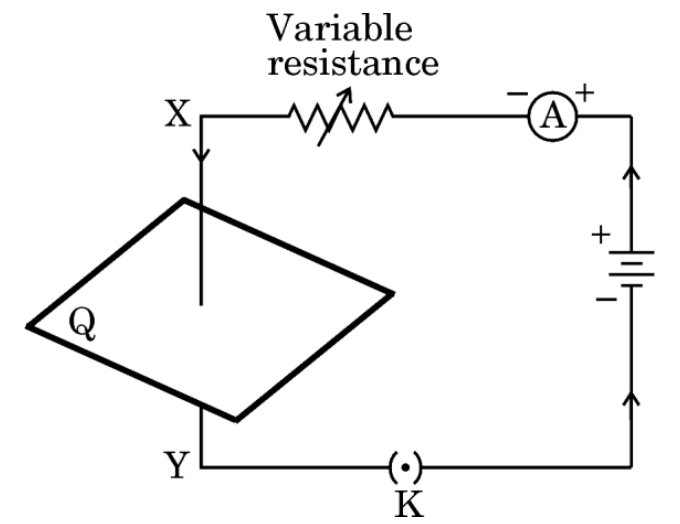
(i) Copy the diagram and draw the magnetic field lines when current flows from conductor X to Y.
(ii) Name and state the rule used in determining the direction of the magnetic field lines in the situation given above.
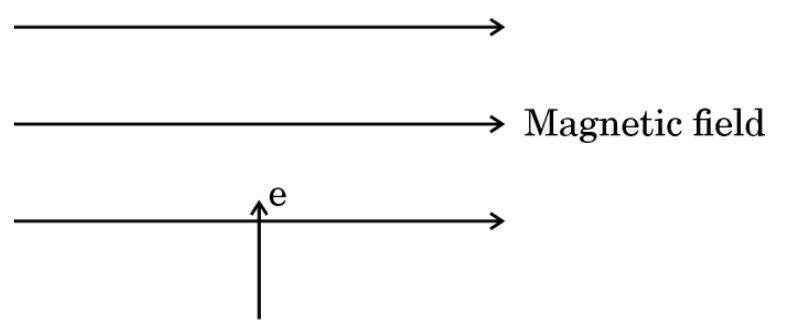
(iii) State Fleming’s left hand rule. Using this rule, determine the direction of force applied on an electron entering a uniform magnetic field as shown in the figure.
(b) (i) Define the term solenoid. Draw the pattern of the magnetic field lines in and around a current carrying straight solenoid. Mark on the pattern the (i) direction of current, (ii) direction of field lines near the ends of the solenoid, and (iii) region where the magnetic field is uniform.
(ii) How would you make an electromagnet using a current carrying solenoid?
Section E · Case-based (4 marks)
Acid-base indicators can be used to distinguish between an acid and a base. Universal indicator, a mixture of several indicators, shows different colours at different concentrations of acids and bases, thereby indicating their pH on the pH scale of 0 – 14. The pH of a solution is measured by pH paper, which is a paper impregnated with a universal indicator.

(a) Solution P is a strong acid while solution Q is a strong base. On the pH scale, where would you place the solutions P and Q? 1
(b) A solution has a pH of 7. Name a compound you would use to (i) increase its pH, and (ii) decrease its pH. 1
(c) (i) When the pH of a solution is decreased from 4 to 2, what effect does it produce on its hydronium ion concentration? State the colour change shown by the pH paper. 2
OR
(c) (ii) A person is feeling pain and irritation in the stomach due to indigestion. What could be the pH of the fluid in the stomach? Write the common name of the medicines people use for remedy. Give the chemical name of ‘‘milk of magnesia’’ often used for this purpose. 2
When a girl is born, the ovaries already contain thousands of immature eggs. On reaching puberty, some of these start maturing. One matured egg is released every month by one of the ovaries. The two oviducts unite into an elastic bag-like structure known as uterus.
(a) Write the site of fertilization in human female. 1
(b) How does the uterus prepare itself to receive and nurture the growing embryo? Explain. 1
(c) (i) What happens when the egg is not fertilized? 2
OR
(c) (ii) How does the developing embryo get nutrition from the mother’s blood? Explain. 2
A person allowed a narrow beam of white light from the sun to enter a dark room through a small aperture and placed a glass prism in its path in such a manner that the beam falls on the face AB of the prism as shown in the figure. A screen S is placed on the other side of the prism, facing AC. On turning the prism slowly, a beautiful band of colours is obtained on the screen. It is the spectrum of sunlight.
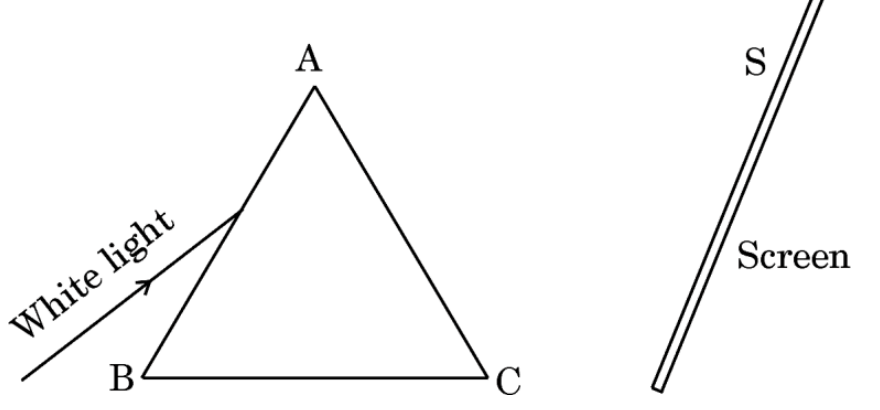
(a) Name the phenomenon due to which a prism splits the incident white light into a band of colours. 1
(b) State the reason of getting a band of seven colours in the above case. 1
(c) (i) Explain with the help of a labelled ray diagram, an experimental arrangement to show the recombination of the spectrum of white light. 2
OR
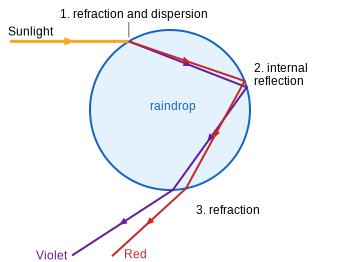
(c) (ii) Draw a labelled ray diagram to show the formation of a rainbow. 2
Solutions: CBSE 2025 · 31/2/1
Answer: (D)
Methane (natural gas) burns: CH4 + 2O2 → CO2 + 2H2O + energy. Check: C 1 = 1; H 4 = 4; O 4 = 2 + 2. (A) and (B) are not balanced, and (C) does not show the energy released (exothermic).
Answer: (C) 7.0 to 7.8
Our body works within a narrow pH range of 7.0 to 7.8; living organisms can survive only in a narrow range of pH change.
Answer: (C) Brass and Bronze
Brass = copper + zinc; bronze = copper + tin. (Solder = lead + tin.)
Answer: (B) Capillaries
Capillaries are the smallest blood vessels; their walls are one cell thick, which allows exchange of materials between the blood and the surrounding cells. (Alveoli are air sacs, not blood vessels.)
Answer: (B)
Buds produced in the notches along the leaf margin of Bryophyllum fall on the soil and grow into new plants (vegetative propagation).
Answer: (A) 10/9
Answer: (D) 1 and 6
The angle of incidence is between the incident ray and the normal (angle 1, not angle 7 which is with the surface). The angle of deviation is between the extended incident ray and the emergent ray (angle 6).
Answer: (C) 9 Ω
Between A and B there are two paths: AB directly (12 Ω) and A–C–D–B (12 + 12 + 12 = 36 Ω), in parallel:
Answer: (B)
Both are true. A is true because these metals have more affinity for oxygen than carbon (they are obtained by electrolysis). R is also true (e.g. thermit reaction for metals in the middle of the series), but it does not explain A.
Answer: (C)
A is true. R is false: nichrome has high resistivity, but its resistance does not decrease with temperature (for metals and alloys it increases). Alloys are used because they have high resistivity and do not oxidise readily at high temperatures.
(a) Displacement reaction — copper is more reactive than silver and displaces it:
(b) Electrolytic refining (impure silver as anode, a thin strip of pure silver as cathode, a silver salt solution as electrolyte).
The hind-brain has three parts: pons, cerebellum and medulla (medulla oblongata).
The medulla controls involuntary actions such as blood pressure, salivation and vomiting.
1. Dissolve about 10 g of sugar in 100 mL of water.
2. Take 20 mL of this solution in a test tube and add a pinch of yeast granules.
3. Put a cotton plug on the tube and keep it in a warm place.
4. After 1 or 2 hours, put a small drop of the yeast culture on a slide, cover it with a cover slip and observe it under a microscope. Yeast cells are seen reproducing by budding.
(i) 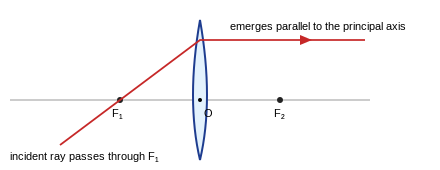
(ii) The incident ray passes through the principal focus F1 (the first focus) of the convex lens.
(i) A decomposition reaction is one in which a single reactant breaks down to give two or more simpler products.
Light (photolytic): 2AgCl(s) →(sunlight) 2Ag(s) + Cl2(g)
Electricity (electrolytic): 2H2O(l) →(electric current) 2H2(g) + O2(g)
(ii) During the decomposition of vegetable matter into compost, heat is released (the compost pile becomes warm), so it is an exothermic process.
(i) Sodium (2, 8, 1) has 1 valence electron: Na•
(ii) Oxygen (2, 6) has 6 valence electrons: :Ö: (six dots around O)
Formation of sodium oxide — each of two sodium atoms transfers its one electron to the oxygen atom:
i.e. 2Na+ + O2− → Na2O
Cation: Na+ (sodium ion). Anion: O2− (oxide ion).
Let F = gene for free earlobe (dominant) and f = attached earlobe (recessive).
(a) The father has attached earlobes, so he must be ff (a recessive trait shows only when both copies are recessive); all his sperms carry f. Since half the children are attached (ff), the mother must also carry f: she is Ff (free).
| F (mother) | f (mother) | |
|---|---|---|
| f (father) | Ff — free | ff — attached |
Progeny: Ff (free earlobes) : ff (attached earlobes) = 1 : 1, i.e. 50% each.
(b) Father: ff; Mother: Ff.
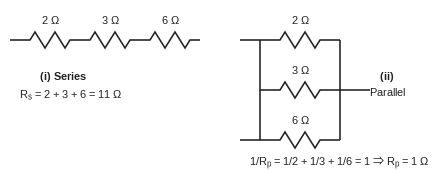
(i) Series:
(ii) Parallel:
(i) X = ethanoic acid (acetic acid), CH3COOH. Its 5–8% solution in water is vinegar, used as a preservative in pickles.
Structure: CH3–C(=O)–OH, i.e. H3C–C(=O)–O–H.
(ii) Ethanoic acid is a weak acid; it ionises only partly, so its pH is higher (less acidic) than that of a mineral acid like HCl of the same concentration.
(iii) Esterification:
(iv)
(i) Herbivores eating grass need a longer small intestine to allow the cellulose to be digested. Carnivores like tigers have a shorter small intestine because meat is easier to digest.
(ii) Bile juice (from the liver): the food coming from the stomach is acidic, and bile makes it alkaline so that pancreatic enzymes can act; bile salts break large fat globules into smaller ones (emulsification), increasing the efficiency of enzyme action.
Pancreas: secretes pancreatic juice containing trypsin for digesting proteins and lipase for breaking down emulsified fats (and amylase for starch).
(iii) The inner lining of the small intestine has numerous finger-like projections called villi, which greatly increase the surface area for absorption. The villi are richly supplied with blood vessels, which take the absorbed food to every cell of the body.
(i) The field lines on the cardboard are concentric circles centred on the wire. With the current flowing downward (X to Y), they are clockwise when seen from above.
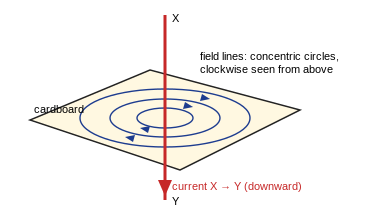
(ii) Right-hand thumb rule: imagine holding the current-carrying straight conductor in your right hand so that the thumb points in the direction of current; the fingers wrapped around the conductor give the direction of the magnetic field lines.
(iii) Fleming's left-hand rule: stretch the thumb, forefinger and middle finger of the left hand so that they are mutually perpendicular. If the forefinger points along the magnetic field and the middle finger along the current, the thumb points in the direction of the force on the conductor.
The electron moves upward, so the current is downward; the field is to the right. Hence the force on the electron is perpendicular to the plane of the paper, coming out of the page (towards the reader).
(a) P (strong acid) near the lower end, at about pH 0–2; Q (strong base) near the upper end, at about pH 12–14.
(b) (i) To increase pH, add a base, e.g. sodium hydroxide. (ii) To decrease pH, add an acid, e.g. hydrochloric acid.
(c) (i) Lower pH means more acidic: the hydronium ion concentration increases (100 times, as pH falls by 2 units). The pH paper changes from orange/yellow to red.
OR (c) (ii) The stomach produces too much acid, so the pH of the fluid is low — about 1 to 2 (less than 7). People take antacids (mild bases) to neutralise the excess acid. Milk of magnesia is magnesium hydroxide, Mg(OH)2.
(a) Dispersion of white light.
(b) The different colours of light bend through different angles with respect to the incident ray as they pass through the prism (each colour travels at a different speed in glass). Red bends the least and violet the most, so the colours separate into a band.
(c) (i) Newton's experiment: place a second identical prism in an inverted position next to the first. The spectrum formed by the first prism enters the second prism, which bends all the colours back by the same amounts. The colours recombine and a beam of white light emerges from the second prism.
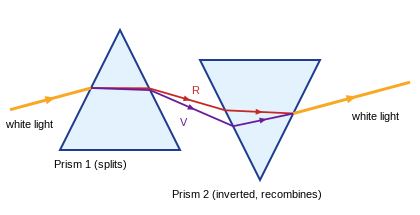
OR (c) (ii) Sunlight entering a raindrop is refracted and dispersed, internally reflected, and refracted again as it comes out, forming the spectrum we see as a rainbow (opposite the Sun):
Get every solution for all 17 papers
- Every board question of every chapter, each fully solved the way the board gives marks
- 17 complete board papers, each followed by its solutions
- Weightage and most-asked topics for every chapter
- Instant PDF download, colour and black & white print copies
Revising the chapter first? Complete Science Notes for Class 10 (NCERT 2026-27) →
What you get in the pack
- Questions from 126 CBSE papers, 2016 to 2026: every set code available
- Complete: 2405 different questions and parts from all set codes, 13 chapters and 17 full papers
- Part A: all 13 chapters, questions sorted chapter-wise and by marks
- Year-wise weightage table and most-asked topics for every chapter
- Part B: 17 full board papers, each followed by its complete solutions, for timed practice
- Answers written to the CBSE marking-scheme points, with labelled diagrams drawn in full
- Questions on topics out of the board syllabus flagged
All chapters in this pack
- PYQ Ch 1 Chemical Reactions and Equations
- PYQ Ch 2 Acids, Bases and Salts
- PYQ Ch 3 Metals and Non-metals
- PYQ Ch 4 Carbon and its Compounds
- PYQ Ch 5 Life Processes
- PYQ Ch 6 Control and Coordination
- PYQ Ch 7 How do Organisms Reproduce
- PYQ Ch 8 Heredity
- PYQ Ch 9 Light Reflection and Refraction
- PYQ Ch 10 The Human Eye and the Colourful World
- PYQ Ch 11 Electricity
- PYQ Ch 12 Magnetic Effects of Electric Current
- PYQ Ch 13 Our Environment
- Board Paper 2026 Set 31-2-1 with Solutions
- Board Paper 2026 Set 31-3-1 with Solutions
- Board Paper 2025 Set 31-1-1 with Solutions
- Board Paper 2025 Set 31-2-1 with Solutions
- Board Paper 2024 Set 31-4-1 with Solutions
- Board Paper 2024 Set 31-5-1 with Solutions
- Board Paper 2023 Set 31-2-1 with Solutions
- Board Paper 2023 Set 31-4-1 with Solutions
- Board Paper 2022 Term 2 Set 31-1-1 with Solutions
- Board Paper 2022 Term 2 Set 31-3-1 with Solutions
- Board Paper 2020 Set 31-2-1 with Solutions
- Board Paper 2020 Set 31-4-1 with Solutions
- Board Paper 2019 Set 31-2-1 with Solutions
- Board Paper 2019 Set 31-4-1 with Solutions
- Board Paper 2018 Set 31-1 with Solutions
- Board Paper 2017 Set 3 with Solutions
- Board Paper 2016 Set 31-1 with Solutions