
How do Organisms Reproduce?: Class 10 PYQs 2016–2026 with solutions
All 63 CBSE board questions asked from How do Organisms Reproduce? in 17 board papers, with the year, set and marks of each. 33 are solved free below. The Class 10 Science PYQ Book: Solved Board Papers 2016-2026 (CBSE) has every solution, all chapters and 17 full board papers.
Subject expert: Khushbu Gupta, B.Sc., M.Sc. Physics, B.Ed. · 8+ years teaching


Free: NCERT solutions for Class 10 Science →
How do Organisms Reproduce?: board weightage
Board weightage 2016–2026
| Year | 2016 | 2017 | 2018 | 2019 | 2020 | 2022 | 2023 | 2024 | 2025 | 2026 |
|---|---|---|---|---|---|---|---|---|---|---|
| Questions | 7 | 6 | 4 | 6 | 6 | 6 | 5 | 8 | 10 | 5 |
| Marks | 18 | 17 | 12 | 19 | 24 | 15 | 12 | 16 | 26 | 21 |
Most asked topics
63 questions from 17 papers. Repeated questions are shown once with every year they were asked.
Jump to: 1 mark2 marks3 marks4 marks5 marks
1 mark: MCQ and Assertion–Reason
Spirogyra, despite being a multi-cellular organism, still shows a simple reproductive method. Select the correct option with regard to reproduction in Spirogyra:
Solution
Answer: (C)
Spirogyra reproduces by fragmentation: the filament simply breaks into smaller pieces and each piece grows into a new individual. This is asexual reproduction.
The correct/true statement(s) for a bisexual flower is/are: (i) They possess both stamen and pistil. (ii) They possess either stamen or pistil. (iii) They exhibit either self-pollination or cross-pollination. (iv) They cannot produce fruits on their own.
Solution
Answer: (C) (i) and (iii)
A bisexual flower (e.g. Hibiscus, mustard) has both stamens and pistil. It can be self-pollinated or cross-pollinated, and it can produce fruit. A flower with only stamens or only pistil is unisexual.
Bryophyllum produces new plant through:
Solution
Answer: (B)
Buds produced in the notches along the leaf margin of Bryophyllum fall on the soil and grow into new plants (vegetative propagation).
The number of chromosomes in a cell division is halved. This kind of cell division is observed in:
Solution
Answer: (C)
Germ cells (sperm in the testes and eggs in the ovaries) are formed by a special division (meiosis) in which the chromosome number is halved. Other body cells keep the full number.
The plants that can be raised by the method of vegetative propagation are:
Solution
Answer: (A)
Sugarcane, roses and grapes are grown by vegetative methods (layering, grafting, cuttings). Mustard and papaya are grown from seeds.
The part of seed which is a source of food during germination of seed is:
Solution
Answer: (A) Cotyledon
Cotyledons store food for the developing embryo; the radicle becomes the root and the plumule the shoot.
The incorrect statement about placenta is:
Solution
Answer: (C)
The placenta has villi on the embryo's side that provide a large surface area for glucose and oxygen to pass from the mother to the embryo.
Select from the following the conditions responsible for the rapid spread of bread mould on a slice of bread: (i) Formation of large number of spores (ii) Presence of moisture and nutrients in bread (iii) Low temperature (iv) Presence of hyphae
Solution
Answer: (A) (i) and (ii)
Bread mould (Rhizopus) produces a very large number of spores by spore formation; in moist, nutrient-rich bread they germinate quickly. Low temperature slows its growth.
Plants which bear unisexual flowers are:
Assertion (A): When a bacterium divides into two, and the resultant two bacteria divide again, the four bacteria produced would be almost similar.
Reason (R): DNA copying involves small inaccuracies in the reproduction process.
The number of chromosomes in parents and offsprings of a particular species undergoing sexual reproduction remain constant due to:
Fertilisation is the process of
To perform an experiment to identify the different parts of an embryo of a dicot seed, first of all you require a dicot seed. Select dicot seeds from the following group: Wheat, Gram, Maize, Pea, Barley, Ground-nut
What happens when a mature Spirogyra filament attains considerable length?
A student while observing an embryo of a pea seed in the laboratory listed various parts of the embryo as given below: Testa, Tegmen, Radicle, Plumule, Micropyle, Cotyledon. On examining the list the teacher remarked that only three parts are correct. Select three correct parts from the above list:
2 marks: very short answer
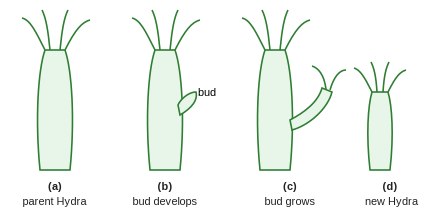
Draw labelled diagrams to show different stages of budding in Hydra.
Solution
In Hydra, a bud develops as an outgrowth due to repeated cell division at one specific site. The bud grows into a tiny individual with tentacles and, when fully mature, detaches from the parent to become a new independent individual.
Write one function each of the following, in a seed: (i) Seed coat (ii) Cotyledon (iii) Radicle (iv) Plumule
Solution
(i) Seed coat — protects the embryo inside the seed.
(ii) Cotyledon — stores food for the embryo, used during germination.
(iii) Radicle — develops into the root.
(iv) Plumule — develops into the shoot.
Write the main steps to culture yeast in the laboratory.
Solution
1. Dissolve about 10 g of sugar in 100 mL of water.
2. Take 20 mL of this solution in a test tube and add a pinch of yeast granules.
3. Put a cotton plug on the tube and keep it in a warm place.
4. After 1 or 2 hours, put a small drop of the yeast culture on a slide, cover it with a cover slip and observe it under a microscope. Yeast cells are seen reproducing by budding.
Some unicellular organisms such as Plasmodium and Leishmania differ in the manner in which they reproduce. Name and explain the reproductive process taking place in them.
Solution
• Plasmodium reproduces by multiple fission: the nucleus divides repeatedly and the cell divides into many daughter cells at the same time.
• Leishmania reproduces by binary fission: the cell splits into two, and the division takes place in a definite plane (longitudinally) with respect to its whip-like structure (flagellum) at one end.
(a) Which of the following flowers will have higher possibility of self-pollination? Mustard, Papaya, Watermelon, Hibiscus
(b) List the two reproductive parts of a bisexual flower.
Solution
(a) Mustard and Hibiscus — they have bisexual flowers (both stamens and pistil), so pollen can reach the stigma of the same flower. Papaya and watermelon have unisexual flowers.
(b) Stamen (male part) and pistil (carpel) (female part).
Which one of the two multicellular organisms — Spirogyra and Planaria — reproduces by regeneration and why? Give an example of any other organism which can also reproduce by the same process.
Solution
Planaria. It has the ability to regenerate: if its body is cut into pieces, each piece grows into a complete organism, because it has specialised cells that can multiply and form all the different kinds of cells and tissues. (Spirogyra reproduces by fragmentation — its filament simply breaks into pieces.)
Another example: Hydra.
Suggest any two contraceptive methods to control the size of human population and explain them.
Solution
Any two:
• Mechanical barrier — condoms (on the penis) or similar coverings; sperm cannot reach the egg.
• Hormonal (oral pills) — change the hormonal balance of the body so that eggs are not released.
• Intra-uterine devices — loop or copper-T placed in the uterus to prevent pregnancy.
• Surgical methods — vasectomy (vas deferens blocked, sperm transfer prevented) or tubectomy (fallopian tube blocked, egg cannot reach the uterus).
Name the part/organ of the human female reproductive system (a) where contraceptive devices such as loop or copper-T are placed to prevent pregnancy. (b) which is blocked to prevent the transfer of eggs. (c) where formation of germ cells as ova takes place. (d) from where the embryo gets nutrition from the mother’s blood.
Solution
(a) Uterus (b) Fallopian tube (oviduct) (c) Ovary (d) Placenta
List in proper sequence four steps of obtaining germinating dicot seeds.
After examining a prepared slide under the high power of a compound microscope, a student concludes that the given slide shows the various stages of binary fission in a unicellular organism. Write two observations on the basis of which such a conclusion may be drawn.
List two observations on the basis of which it may be concluded that the given slide shows binary fission in Amoeba.
Name the process by which an amoeba reproduces. Draw the various stages of its reproduction in a proper sequence.
A student is viewing under a microscope a permanent slide showing various stages of asexual reproduction by budding in yeast. Draw diagrams of what he observes. (in proper sequence)
Draw in sequence (showing the four stages), the process of binary fission in Amoeba.
A student is observing a permanent slide showing sequentially the different stages of asexual reproduction taking place in yeast. Name this process and draw diagrams, of what he observes, in a proper sequence.
3 marks: short answer
(a) What are chromosomes?
(b) Explain in brief how stability of DNA content of a species is ensured in sexually reproducing organisms?
Solution
(a) Chromosomes are thread-like structures in the nucleus of a cell that carry the information for inheritance of features from parents to the next generation in the form of DNA molecules.
(b) In sexually reproducing organisms, special lineages of cells in the reproductive organs form germ cells (gametes) that contain only half the number of chromosomes and half the DNA of the non-reproductive cells. When a male and a female gamete fuse during fertilisation, the zygote gets the normal number of chromosomes again. So the DNA content remains constant from generation to generation.
Explain with the help of a labelled diagram, the process of reproduction in Hydra by budding. Name the cells used for reproduction in this process.
Solution
In Hydra, a bud develops as an outgrowth due to repeated cell division at one specific site. The bud develops into a tiny individual with tentacles and, when fully mature, detaches from the parent and becomes a new independent individual.
Hydra uses regenerative cells for reproduction in the process of budding.
List two roles of each of the following in human reproductive system: (i) Seminal vesicles and prostate gland (ii) Oviduct (iii) Testis
Solution
(i) Seminal vesicles and prostate gland: (1) add their secretions so that the sperms are in a fluid, which makes their transport easier; (2) the fluid provides nutrition to the sperms.
(ii) Oviduct (fallopian tube): (1) carries the egg from the ovary to the uterus; (2) it is the site of fertilisation.
(iii) Testis: (1) produces sperms (male germ cells); (2) secretes the hormone testosterone, which regulates sperm formation and brings about changes in boys at puberty.
(a) Mention one function each of the following organs in human male reproductive system: (i) Testis (ii) Scrotum (iii) Vas deferens (iv) Prostate gland
(b) Name the type of germ cell which (i) is motile, and (ii) stores food.
Solution
(a) (i) Testis — produces sperms (and the hormone testosterone).
(ii) Scrotum — keeps the testes outside the abdominal cavity, at a temperature lower than body temperature, which sperm formation needs.
(iii) Vas deferens — carries sperms from the testes towards the urethra.
(iv) Prostate gland — adds its secretion to the sperms, so they are in a fluid; this makes their transport easier and provides nutrition.
(b) (i) Motile germ cell: male germ cell (sperm). (ii) Germ cell that stores food: female germ cell (egg/ovum).
What are chromosomes? Explain how in sexually reproducing organisms the number of chromosomes in the progeny is maintained.
Solution
Chromosomes are thread-like structures in the nucleus of a cell; they carry the information for inheritance of features from parents to the next generation in the form of DNA.
In sexually reproducing organisms, special cells in the reproductive organs form germ cells (gametes) that have half the number of chromosomes of other body cells. When a male and a female gamete fuse in fertilisation, the zygote gets the full number again (half from each parent). In this way the number of chromosomes (and the amount of DNA) stays the same from generation to generation.
What is carpel? Write the function of its various parts.
Solution
The carpel (pistil) is the female reproductive part of a flower, present in its centre. Its parts:
• Stigma — the sticky top that receives pollen grains.
• Style — the long tube through which the pollen tube grows to reach the ovary.
• Ovary — the swollen base that contains ovules; each ovule has an egg cell. After fertilisation the ovary becomes the fruit and the ovules become seeds.
Write one main difference between asexual and sexual mode of reproduction. Which species is likely to have comparatively better chances of survival – the one reproducing asexually or the one reproducing sexually? Give reason to justify your answer.
Solution
Difference: asexual reproduction involves a single parent and no gametes; sexual reproduction involves two parents and the fusion of male and female gametes.
The species reproducing sexually has better chances of survival. Sexual reproduction combines DNA from two parents, producing more variations. If the environment changes, some variants are likely to survive, so the species continues.
List the two types of reproduction. Which one of the two is responsible for bringing in more variations in its progeny and how?
What is vegetative propagation? State two advantages and two disadvantages of this method.
List three techniques that have been developed to prevent pregnancy. Which one of these techniques is not meant for males? How does the use of these techniques have a direct impact on the health and prosperity of a family?
Define reproduction. How does it help in providing stability to the population of species?
Explain the term ‘‘Regeneration’’ as used in relation to reproduction of organisms. Describe briefly how regeneration is carried out in multicellular organisms like Hydra.
(a) List two reasons for the appearance of variations among the progeny formed by sexual reproduction.
(b) 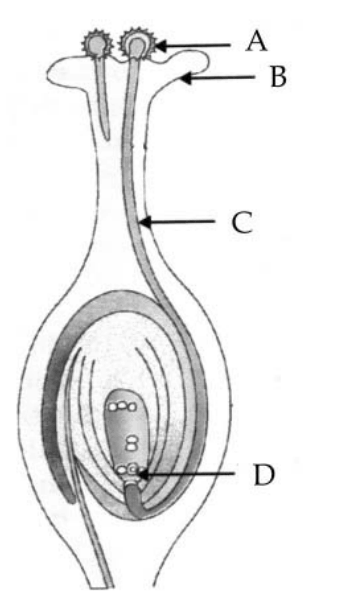 (i) Name the part marked A in the diagram. (ii) How does A reaches part B? (iii) State the importance of the part C. (iv) What happens to the part marked D after fertilisation is over?
4 marks: case-based / source-based
When a girl is born, the ovaries already contain thousands of immature eggs. On reaching puberty, some of these start maturing. One matured egg is released every month by one of the ovaries. The two oviducts unite into an elastic bag-like structure known as uterus.
(a) Write the site of fertilization in human female. 1
(b) How does the uterus prepare itself to receive and nurture the growing embryo? Explain. 1
(c) (i) What happens when the egg is not fertilized? 2
OR
(c) (ii) How does the developing embryo get nutrition from the mother’s blood? Explain. 2
Solution
(a) The oviduct (fallopian tube).
(b) Every month the lining of the uterus becomes thick and spongy and is richly supplied with blood, ready to receive and nourish the embryo if fertilisation takes place.
(c) (i) If the egg is not fertilised, it lives for about one day. The thick, blood-rich lining of the uterus is no longer needed, so it slowly breaks down and comes out through the vagina as blood and mucus. This is menstruation; it occurs roughly every month and usually lasts about 2 to 8 days.
OR (c) (ii) Through the placenta, a disc-like special tissue embedded in the uterine wall. It has villi on the embryo's side, and on the mother's side there are blood spaces surrounding the villi. This gives a large surface area for glucose and oxygen to pass from the mother's blood to the embryo. Wastes from the embryo are removed into the mother's blood through the placenta.
Pollination is an important process in sexual reproduction of plants. It is an essential process that facilitates fertilisation in plants. Pollinating agents can be wind, water, insects and birds. Several changes take place in the flower after the fertilization has taken place.
(a) Write the main difference between self-pollination and cross-pollination. 1
(b) Name the part of the flower which attracts insects for pollination. What happens to this part after fertilisation? 1
(c) (i) Define fertilisation. What is the fate of ovules and the ovary in a flower after fertilisation? 2
OR
(c) (ii) In a germinating seed, which parts are known as future shoot and future root? Mention the function of cotyledon. 2
Solution
(a) In self-pollination pollen is transferred to the stigma of the same flower (or another flower of the same plant); in cross-pollination pollen is transferred to the stigma of a flower on a different plant of the same species.
(b) The brightly coloured petals attract insects. After fertilisation the petals (and sepals) wither and fall off.
(c) (i) Fertilisation is the fusion of the male germ cell with the female germ cell (egg) to form a zygote. After fertilisation the ovules develop into seeds and the ovary grows and ripens into a fruit.
OR (c) (ii) Plumule is the future shoot and radicle is the future root. The cotyledon stores food for the developing embryo during germination.
All the reproductive methods of living organisms are broadly categorized into two types: 1. Asexual reproduction, and 2. Sexual reproduction. Asexual reproduction involves the participation of a single parent without the formation of gametes, fertilisation and transfer of genetic material. This method is a common means of rapidly increasing offsprings under favourable conditions.
(a) Name the type of fission that occurs in Leishmania and Plasmodium. 1
(b) Write one advantage of sexual mode of reproduction over asexual reproduction. 1
(c) Give reasons why: (i) Colonies of yeast fail to multiply in water but multiply in sugar solution. (ii) Rhizopus individuals do not grow on a dry slice of bread. 2
OR
(c) Name the filamentous structures a student could identify when he collected water from a pond that appeared dark green. How do these organisms multiply? Explain. 2
The modes by which various organisms reproduce depend on the body design of the organisms. In asexual reproduction, a single individual parent produces offsprings without the involvement of gametes. This method is a common means of increasing the offsprings rapidly under favourable conditions. Asexual reproduction occurs mostly in unicellular organisms, some plants and certain simple multicellular animals.
(a) State the name of the organism in which binary fission takes place in a definite orientation. Also name the disease caused by this organism. 1
(b) List any two advantages of producing plants through vegetative propagation. 1
(c) (i) Explain the process of budding in Hydra. 2
OR
(c) (ii) What happens when (I) a Spirogyra filament matures and attains a considerable length, and (II) a sporangia in Rhizopus bursts on maturation? 2
5 marks: long answer
(i) Name an organ that helps in the formation of male germ cells in humans and also mention the condition that favours the formation of male germ cells.
(ii) In male reproductive system, write the pathway followed to deliver male germ cells to the site of fertilisation.
(iii) Mention the main physical feature of the male germ cell that helps it move towards the female germ cell. 2+2+1
Solution
(i) Testes form the male germ cells (sperms). They lie outside the abdominal cavity in the scrotum because sperm formation needs a temperature lower than the normal body temperature.
(ii) Testes → vas deferens → (joins a tube from the urinary bladder) → urethra → out of the body (through the penis) into the vagina. On the way, the seminal vesicles and prostate gland add their secretions so that the sperms are in a fluid, which makes their transport easier and provides nutrition.
(iii) The sperm has a long tail that helps it swim towards the female germ cell (egg).
Radha has three children. She does not want to have more children. Radha visits a nearby hospital, to know the methods to prevent pregnancy.
(i) Mention the name of any two ways other than the surgical methods, following which Radha can avoid unwanted pregnancies.
(ii) Name the surgical methods to prevent pregnancy.
(iii) Give one example each of sexually transmitted diseases caused by bacteria and virus. 2+2+1
Solution
(i) Any two non-surgical methods:
• Mechanical barrier — condom, so that sperm does not reach the egg.
• Oral pills (hormonal) — change the hormonal balance so that eggs are not released.
• Copper-T / loop placed in the uterus.
(ii) Surgical methods: vasectomy in males (vas deferens is blocked so sperm transfer is prevented) and tubectomy in females (fallopian tube is blocked so the egg cannot reach the uterus).
(iii) Bacterial STD: gonorrhoea or syphilis. Viral STD: HIV-AIDS or warts.
Observe the given diagram and answer the questions that follow:
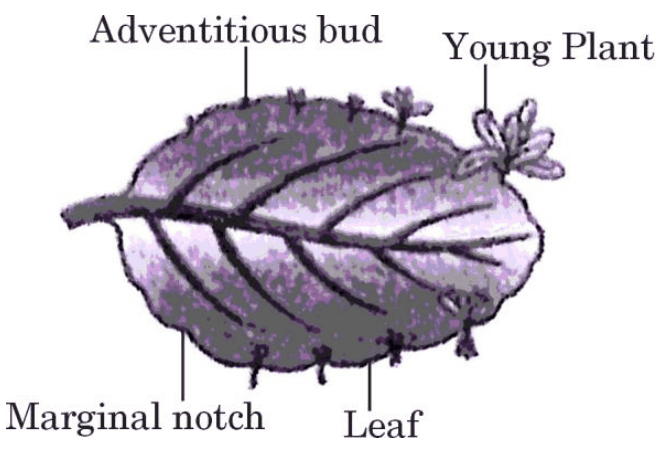
(i) Give the name of the structure and type of reproduction shown in the above diagram.
(ii) State one advantage and one disadvantage of the above mentioned method of reproduction.
(iii) Give reason: Asexual reproduction lacks genetic variation.
(iv) Why have higher organisms resorted to sexual reproduction in spite of its complexity?
Solution
(i) It is a leaf of Bryophyllum with buds in the notches along its margin. When the leaf falls on wet soil, these buds grow into new plants. This is vegetative propagation, a type of asexual reproduction.
(ii) Advantage: new plants are produced quickly and are exactly like the parent, so desirable characters are kept. Disadvantage: there is no variation, so all the plants are equally affected by a disease or a change in the environment.
(iii) Only one parent is involved and there is no fusion of gametes. The DNA of the parent is simply copied, so the offspring are almost identical to the parent; only small variations arise from errors in DNA copying.
(iv) Sexual reproduction combines DNA from two different individuals. This creates new combinations of variations in every generation. Variation helps a species survive when the environment changes and is the basis of evolution, so higher organisms use sexual reproduction despite its complexity.
Observe the given diagram and answer the questions that follow:
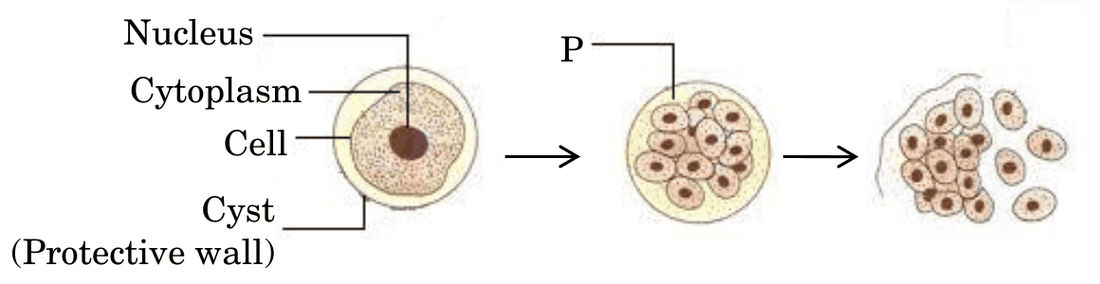
(i) Give the name and type of reproduction shown in the above diagram.
(ii) Comment on the processes taking place in stage P.
(iii) Name an organism which reproduces by the above mentioned method.
(iv) Name the method that can be used to raise plants that have lost their capacity to produce seeds. List any two advantages of growing plants by such a method.
Solution
(i) Multiple fission — a type of asexual reproduction.
(ii) In stage P the cell is enclosed in a protective wall (cyst). Inside it the nucleus divides repeatedly to form many nuclei; a little cytoplasm collects around each, forming many daughter cells. When the cyst breaks, the daughter cells are released.
(iii) Plasmodium (the malarial parasite).
(iv) Vegetative propagation (by layering, grafting or cutting), as in banana, orange, rose and jasmine. Advantages: (1) the plants bear flowers and fruits earlier than plants grown from seed; (2) all the new plants are genetically similar to the parent, so they keep its desirable characters.
(i) Write the functions of the following parts of human female reproductive system: (I) Ovary (II) Fallopian tube (III) Uterus
(ii) State briefly two contraceptive methods used by human males.
Solution
(i) (I) Ovary — produces the female germ cells (eggs); one egg is released every month. It also produces hormones (oestrogen, progesterone).
(II) Fallopian tube (oviduct) — carries the egg from the ovary to the uterus; it is the site of fertilisation.
(III) Uterus — the embryo (zygote) is implanted in its thick lining and develops into a foetus; it gets nutrition from the mother's blood through the placenta.
(ii) (1) Condom (mechanical barrier) — stops sperms from reaching the egg; it also protects against sexually transmitted diseases.
(2) Vasectomy (surgical) — the vas deferens is blocked or cut, so sperms cannot be transferred.
(i) Differentiate between self-pollination and cross-pollination.
(ii) Identify A, B and C in the diagram given below and write one function of each.
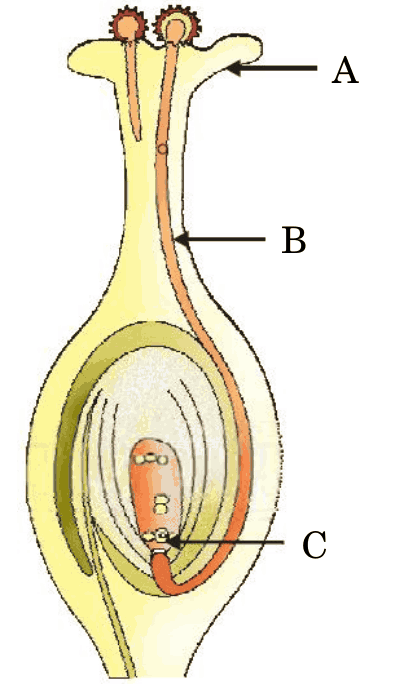
Solution
(i)
| Self-pollination | Cross-pollination |
|---|---|
| Transfer of pollen from the stamen (anther) to the stigma of the same flower (or another flower of the same plant) | Transfer of pollen from the stamen of one flower to the stigma of a flower on another plant of the same species |
| No outside agent is usually needed | Needs agents such as wind, water, insects or birds |
(ii) A — Stigma: receives the pollen grains and provides a suitable surface for them to germinate.
B — Pollen tube: grows from the pollen grain through the style and carries the male germ cell to the ovule.
C — Female germ cell (egg cell) in the ovule: fuses with the male germ cell to form the zygote.
(i) Name and explain the two modes of asexual reproduction observed in hydra.
(ii) What is vegetative propagation? List two advantages of using this technique.
Solution
(i) (1) Budding: a bud develops as an outgrowth due to repeated cell division at one specific site; it grows into a tiny individual with tentacles and, when mature, detaches from the parent as a new independent individual.
(2) Regeneration: if the body of Hydra is cut into many pieces, each piece grows into a complete organism. Specialised cells in the pieces proliferate and make large numbers of cells, which change into various cell types and tissues in an organised sequence (development).
(ii) Vegetative propagation is the production of new plants from vegetative parts such as roots, stems and leaves (by layering, grafting, cuttings), e.g. sugarcane, rose, grapes.
Advantages: (1) plants bear flowers and fruits earlier than plants grown from seeds; (2) all plants produced are genetically similar to the parent, so desirable characters are kept; (3) plants that have lost the capacity to produce seeds (banana, orange, rose, jasmine) can be propagated.
(a) List three different categories of contraception methods.
(b) Why has Government of India prohibited prenatal sex determination by law? State its benefits in the long run.
(c) Unsafe sexual act can lead to various infections. Name two bacterial and two viral infections caused due to unsafe sex.
Solution
(a) (1) Mechanical barriers — condoms, so sperm cannot reach the egg. (2) Hormonal (chemical) methods — oral pills that change hormonal balance so eggs are not released. (3) Surgical methods — vasectomy and tubectomy. (Also intra-uterine devices such as the copper-T.)
(b) Prenatal sex determination was being misused for female foeticide (selective abortion of girl children), which reduced the female-to-male sex ratio sharply in some areas. Banning it helps to maintain a healthy, balanced sex ratio in the society in the long run.
(c) Bacterial: gonorrhoea, syphilis. Viral: warts, HIV-AIDS.
(a) In the female reproductive system of human beings, state the functions of (i) ovary (ii) oviduct
(b) Mention the changes which the uterus undergoes, when (i) it has to receive a zygote. (ii) no fertilization takes place.
(c) State the function of placenta.
Draw a neat diagram showing fertilisation in a flower and label (a) Pollen tube, (b) Male germ cell and (c) Female germ cell, on it. Explain the process of fertilisation in a flower. What happens to the (i) ovary and (ii) ovule after fertilisation?
(a) What is puberty? (b) Describe in brief the functions of the following parts in the human male reproductive system: (i) Testes (ii) Seminal vesicle (iii) Vas deferens (iv) Urethra (c) Why are testes located outside the abdominal cavity? (d) State how sperms move towards the female germ cell.
(a) Define vegetative propagation. List its two methods. (b) Why is this mode practised for growing some types of plants? (c) Explain the process of budding in Hydra with the help of labelled diagrams.
What is contraception? List its four different methods. State four reasons for adopting contraceptive methods.
(a) Write the function of following parts in human female reproductive system: (i) Ovary (ii) Oviduct (iii) Uterus (b) Describe in brief the structure and function of placenta.
(a) Write the functions of each of the following parts in a human female reproductive system: (i) Ovary (ii) Uterus (iii) Fallopian tube (b) Write the structure and functions of placenta in a human female.
What is placenta? Describe its structure. State its functions in case of a pregnant human female.
Get every solution for all chapters
- Every board question of every chapter, each fully solved the way the board gives marks
- 17 complete board papers, each followed by its solutions
- Weightage and most-asked topics for every chapter
- Instant PDF download, colour and black & white print copies
Revising the chapter first? Complete Science Notes for Class 10 (NCERT 2026-27) →
What you get in the pack
- Questions from 126 CBSE papers, 2016 to 2026: every set code available
- Complete: 2405 different questions and parts from all set codes, 13 chapters and 17 full papers
- Part A: all 13 chapters, questions sorted chapter-wise and by marks
- Year-wise weightage table and most-asked topics for every chapter
- Part B: 17 full board papers, each followed by its complete solutions, for timed practice
- Answers written to the CBSE marking-scheme points, with labelled diagrams drawn in full
- Questions on topics out of the board syllabus flagged
All chapters in this pack
- PYQ Ch 1 Chemical Reactions and Equations
- PYQ Ch 2 Acids, Bases and Salts
- PYQ Ch 3 Metals and Non-metals
- PYQ Ch 4 Carbon and its Compounds
- PYQ Ch 5 Life Processes
- PYQ Ch 6 Control and Coordination
- PYQ Ch 7 How do Organisms Reproduce
- PYQ Ch 8 Heredity
- PYQ Ch 9 Light Reflection and Refraction
- PYQ Ch 10 The Human Eye and the Colourful World
- PYQ Ch 11 Electricity
- PYQ Ch 12 Magnetic Effects of Electric Current
- PYQ Ch 13 Our Environment
- Board Paper 2026 Set 31-2-1 with Solutions
- Board Paper 2026 Set 31-3-1 with Solutions
- Board Paper 2025 Set 31-1-1 with Solutions
- Board Paper 2025 Set 31-2-1 with Solutions
- Board Paper 2024 Set 31-4-1 with Solutions
- Board Paper 2024 Set 31-5-1 with Solutions
- Board Paper 2023 Set 31-2-1 with Solutions
- Board Paper 2023 Set 31-4-1 with Solutions
- Board Paper 2022 Term 2 Set 31-1-1 with Solutions
- Board Paper 2022 Term 2 Set 31-3-1 with Solutions
- Board Paper 2020 Set 31-2-1 with Solutions
- Board Paper 2020 Set 31-4-1 with Solutions
- Board Paper 2019 Set 31-2-1 with Solutions
- Board Paper 2019 Set 31-4-1 with Solutions
- Board Paper 2018 Set 31-1 with Solutions
- Board Paper 2017 Set 3 with Solutions
- Board Paper 2016 Set 31-1 with Solutions