
Metals and Non-metals: Class 10 PYQs 2017–2026 with solutions
All 45 CBSE board questions asked from Metals and Non-metals in 14 board papers, with the year, set and marks of each. 24 are solved free below. The Class 10 Science PYQ Book: Solved Board Papers 2016-2026 (CBSE) has every solution, all chapters and 17 full board papers.
Subject expert: Khushbu Gupta, B.Sc., M.Sc. Physics, B.Ed. · 8+ years teaching


Free: NCERT solutions for Class 10 Science →
Metals and Non-metals: board weightage
Board weightage 2017–2026
| Year | 2016 | 2017 | 2018 | 2019 | 2020 | 2022 | 2023 | 2024 | 2025 | 2026 |
|---|---|---|---|---|---|---|---|---|---|---|
| Questions | – | 1 | 2 | 5 | 8 | – | 5 | 5 | 12 | 7 |
| Marks | – | 3 | 7 | 12 | 24 | – | 10 | 10 | 21 | 16 |
Most asked topics
45 questions from 14 papers. Repeated questions are shown once with every year they were asked.
Jump to: 1 mark2 marks3 marks4 marks5 marks
1 mark: MCQ and Assertion–Reason
When Mg metal is treated with hot water, it starts floating on the surface of the water. The reason for its different behaviour is:
Solution
Answer: (B)
Mg + 2H2O → Mg(OH)2 + H2. Bubbles of hydrogen stick to the surface of the metal and make it float.
The reaction of calcium with cold water is:
Solution
Answer: (C)
Ca + 2H2O → Ca(OH)2 + H2. Calcium reacts less violently than sodium; the heat evolved is not enough for the hydrogen to catch fire. (Calcium starts floating as hydrogen bubbles stick to it.)
The products formed when Aluminium and Magnesium are burnt in the presence of air respectively are:
Solution
Answer: (B) Al2O3 and MgO
4Al + 3O2 → 2Al2O3 (Al3+, O2−) and 2Mg + O2 → 2MgO (Mg2+, O2−).
Reaction between two elements A and B, forms a compound C. A loses electrons and B gains electrons. Which one of the following properties will not be shown by compound C?
Solution
Answer: (C)
C is an ionic compound. Its ions are held by strong electrostatic forces, which is why it has a high melting point. It is generally soluble in water and conducts electricity when molten or dissolved.
The metals obtained from their molten chlorides by the process of electrolytic reduction are:
Solution
Answer: (B) Calcium and magnesium
Metals high in the reactivity series (Na, K, Ca, Mg, Al) cannot be obtained by reduction with carbon; they are obtained by electrolysis of their molten chlorides (aluminium from its oxide). Gold and silver occur free; iron is obtained by carbon reduction.
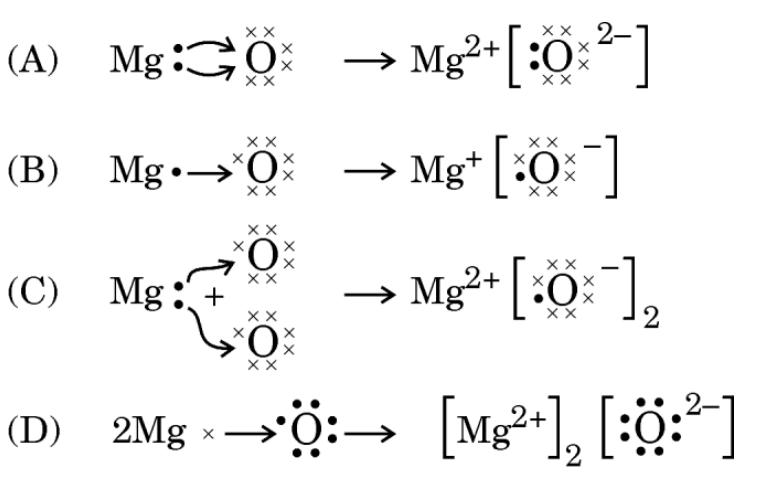
The formation of magnesium oxide is correctly shown in option:
Solution
Answer: (A)
Mg (2, 8, 2) transfers its two valence electrons to one O atom (2, 6), forming Mg2+ and O2−: Mg2+[:O:]2−. (B) shows only one electron transferred, (C) shows two oxygen atoms, and (D) shows two Mg atoms — all wrong.
Aluminium powder is used in thermit welding because:
Solution
Answer: (B)
Fe2O3 + 2Al → 2Fe + Al2O3 + heat. The reaction is so exothermic that the iron produced is molten; this molten iron is used to join railway tracks or cracked machine parts. Aluminium does not react with iron itself.
Two metals zinc and tin are dissolved separately in definite proportions in molten copper (the primary metal) to obtain two different alloys respectively known as:
Solution
Answer: (C) Brass and Bronze
Brass = copper + zinc; bronze = copper + tin. (Solder = lead + tin.)
Assertion (A): The metals high up in the reactivity series cannot be obtained from their compounds by heating with carbon.
Reason (R): Displacement reactions can also be used to obtain metal.
Solution
Answer: (B)
Both are true. A is true because these metals have more affinity for oxygen than carbon (they are obtained by electrolysis). R is also true (e.g. thermit reaction for metals in the middle of the series), but it does not explain A.
The metals which are found in both free state as well as combined state are:
Assertion (A): The extraction of metals from their sulphide ores cannot take place without roasting of the ore.
Reason (R): Roasting converts sulphide ores directly into metals.
A metal ‘X’ is used in thermit process. When ‘X’ is heated with oxygen, it gives an oxide ‘Y’, which is amphoteric in nature. ‘X’ and ‘Y’ respectively are:
Among the following, the metal with lowest density is:
The number of electrons in the outermost shell of the atom of a non-metal can be:
Assertion (A): Sodium oxide is an amphoteric oxide.
Reason (R): Metal oxides which react with both acids as well as bases are known as amphoteric oxides.
An element ‘X’ with atomic number 11 forms a compound with element ‘Y’ with atomic number 8. The formula of the compound formed is
Assertion (A): The metals and alloys are good conductors of electricity.
Reason (R): Bronze is an alloy of copper and tin and it is not a good conductor of electricity.
Write the number of valence electrons present in a nitrogen atom 147N.
2 marks: very short answer
Read the following passage and answer the questions that follow:
One student was comparing the reactivity of different metals for his science project. He added iron filings in four test tubes A, B, C and D containing aqueous solutions of ZnSO4, CuSO4, FeSO4 and Al2(SO4)3.
(i) In which of the test tubes will he observe the reaction to be the most vigorous and why?
(ii) Write a balanced equation for the reaction involved. 1+1
Solution
(i) Test tube B (CuSO4). Iron is more reactive than copper, so it displaces copper from copper sulphate solution. Iron is less reactive than zinc and aluminium, so nothing happens in A and D; in C the metal and the salt are the same (iron), so there is no reaction. The blue solution turns pale green and a reddish-brown copper coating appears.
(ii) Fe(s) + CuSO4(aq) → FeSO4(aq) + Cu(s)
Show the formation of the following ionic compounds by transfer of electrons between the combining atoms: (i) Sodium oxide (Na2O) (ii) Magnesium chloride (MgCl2) (Given: Atomic number: Na = 11, Mg = 12, O = 8, Cl = 17) 1+1
Solution
(i) Na: 2, 8, 1 — each sodium atom loses 1 electron. O: 2, 6 — needs 2 electrons. So two sodium atoms give one electron each to one oxygen atom.
O (2,6) + 2e− → O2− (2,8)
2Na+ + O2− → Na2O
(ii) Mg: 2, 8, 2 — loses 2 electrons. Cl: 2, 8, 7 — each needs 1 electron. So one magnesium atom gives one electron to each of two chlorine atoms.
2Cl (2,8,7) + 2e− → 2Cl− (2,8,8)
Mg2+ + 2Cl− → MgCl2
(a) In common practice silver is recovered from silver nitrate solution by the use of copper metal. Name the type of reaction that takes place in this process and give the chemical equation of the reaction involved.
(b) Name the method used for refining silver.
Solution
(a) Displacement reaction — copper is more reactive than silver and displaces it:
(b) Electrolytic refining (impure silver as anode, a thin strip of pure silver as cathode, a silver salt solution as electrolyte).
Give reasons: (a) Platinum, gold and silver are used to make jewellery. (b) Metals like sodium and potassium are stored under oil.
Solution
(a) These metals are lustrous (shiny), highly malleable and ductile, and least reactive — they do not corrode or tarnish easily.
(b) Sodium and potassium are so reactive that they react vigorously with oxygen and moisture of air and catch fire if kept in the open. Kerosene (oil) prevents contact with air and water.
What would a student report nearly after 30 minutes of placing duly cleaned strips of aluminium, copper, iron and zinc in freshly prepared iron sulphate solution taken in four beakers?
(a) Arrange the following metals in the increasing order of their reactivities: Copper, Zinc, Aluminium and Iron. (b) List two observations you would record in your notebook 30 minutes after adding iron filings to copper sulphate solution.
A student added few pieces of aluminium metal to two test tubes A and B containing aqueous solutions of iron sulphate and copper sulphate. In the second part of her experiment, she added iron metal to another test tubes C and D containing aqueous solutions of aluminium sulphate and copper sulphate. In which test tube or test tubes will she observe colour change? On the basis of this experiment, state which one is the most reactive metal and why.
3 marks: short answer
(i) Write one example each of one metal that is so soft that it can be cut with a knife, and one non-metal that is a good conductor of electricity.
(ii) Using the electronic configuration, explain how Mg atom combines with oxygen to form magnesium oxide by transfer of electrons. [Atomic number: Mg = 12, O = 8] 1+2
Solution
(i) Soft metal: sodium (or potassium). Non-metal conductor: graphite (a form of carbon).
(ii) Mg (12): 2, 8, 2 — it loses its 2 valence electrons to get the stable configuration 2, 8 and becomes Mg2+.
O (8): 2, 6 — it gains these 2 electrons to get 2, 8 and becomes O2−.
O (2,6) + 2e− → O2− (2,8)
Mg2+ + O2− → Mg2+O2− (MgO)
The oppositely charged ions are held by strong electrostatic attraction, forming the ionic compound magnesium oxide.
Give reasons:
(i) Metal sulphides and carbonates should be converted to their metal oxides in the process of extraction of metals.
(ii) Aluminium oxide is considered as an amphoteric oxide.
(iii) Metals like Na, K, Ca and Mg are never found in their free state in nature. 3×1
Solution
(i) It is easier to obtain a metal from its oxide (by reduction, e.g. with carbon) than from its sulphide or carbonate. So sulphide ores are roasted and carbonate ores are calcined to convert them into oxides first.
(ii) Aluminium oxide reacts with both acids and bases to give salt and water:
Al2O3 + 6HCl → 2AlCl3 + 3H2O
Al2O3 + 2NaOH → 2NaAlO2 + H2O
So it shows both acidic and basic behaviour — it is amphoteric.
(iii) These metals are very reactive (high in the reactivity series). They react readily with oxygen, water and other elements, so they are always found combined as compounds, never free.
(a) ‘‘Displacement reactions also play a key role in extracting metals in the middle of the reactivity series.’’ Justify this statement with two examples.
(b) Why can metals high up in the reactivity series not be obtained by reduction of their oxides by carbon?
Solution
(a) Highly reactive metals such as aluminium are used as reducing agents: they displace metals of lower reactivity from their oxides. These reactions are highly exothermic, so the metals are produced in the molten state.
Fe2O3(s) + 2Al(s) → 2Fe(l) + Al2O3(s) + heat (thermit reaction)
(b) Metals high up in the reactivity series (Na, Ca, Mg, Al) have a greater affinity for oxygen than carbon, so carbon cannot remove oxygen from their oxides. They are obtained by electrolytic reduction instead.
With the help of an activity, explain the conditions under which iron articles get rusted.
Solution
Activity: take three test tubes and put clean iron nails in each.
• Tube A: nails in ordinary water (exposed to both air and water).
• Tube B: nails in boiled distilled water with a layer of oil on top (boiling removes dissolved air; oil stops air from dissolving again) — no air.
• Tube C: nails in dry air with anhydrous calcium chloride (absorbs moisture) — no water.
Leave for a few days.
Observation: only the nails in tube A rust (reddish-brown coating); nails in B and C do not.
Conclusion: iron rusts only when both air (oxygen) and water (moisture) are present.
(i) Name two metals which react violently with cold water. List any three observations which a student notes when these metal are dropped in a beaker containing water.
(ii) Write a test to identify the gas evolved (if any) during the reaction of these metals with water.
Solution
(i) Sodium and potassium. Observations: (1) the metal reacts violently, moving on the surface of water with a hissing sound; (2) a gas is evolved and it catches fire; (3) a lot of heat is produced (the reaction is highly exothermic); the solution formed turns red litmus blue (NaOH/KOH).
2Na + 2H2O → 2NaOH + H2 + heat
(ii) Collect the gas and bring a burning matchstick/splinter near it. It burns with a pop sound, showing that the gas is hydrogen.
Write the electron-dot structures of (i) sodium, and (ii) oxygen. Using these structures, show the formation of sodium oxide. Mark the anion and cation present in this compound. (At. No. – Sodium = 11 and Oxygen = 8)
Solution
(i) Sodium (2, 8, 1) has 1 valence electron: Na•
(ii) Oxygen (2, 6) has 6 valence electrons: :Ö: (six dots around O)
Formation of sodium oxide — each of two sodium atoms transfers its one electron to the oxygen atom:
i.e. 2Na+ + O2− → Na2O
Cation: Na+ (sodium ion). Anion: O2− (oxide ion).
Name the ore of mercury and state the form in which it is found in nature. Write the chemical equations along with the condition required for the reactions involved in the extraction of mercury from its ore.
Solution
The ore is cinnabar, HgS — mercury is found as its sulphide.
(1) Roasting — heating in air converts it into mercuric oxide:
(2) Further heating reduces the oxide to mercury:
With the help of suitable chemical equations, list the two main differences between roasting and calcination. How is metal reduced from the product obtained after roasting/calcination of the ore? Write the chemical equation for the reaction involved.
List three differentiating features between the processes of galvanisation and alloying.
Compare in tabular form the reactivities of the following metals with cold and hot water: (a) Sodium (b) Calcium (c) Magnesium
What are amphoteric oxides? Give an example. Write balanced chemical equations to justify your answer.
How is the method of extraction of metals high up in the reactivity series different from that for metals in the middle? Why can the same process not be applied for them? Name the process used for the extraction of these metals.
Write the electronic configuration of two elements X and Y whose atomic numbers are 20 and 17 respectively. Write the molecular formula of the compound formed when element X reacts with element Y. Draw electron-dot structure of the product and also state the nature of the bond formed between both the elements.
4 marks: case-based / source-based
Read the following passage and answer the questions that follow:
An electrochemical process is used for refining metals by selectively dissolving and depositing them through electrolysis. Electrolytic refining is used for metals like Copper, Zinc, Tin, Nickel, Silver and Gold.
(a) Define anode mud. 1
(b) In electrolytic refining of copper, name the anode and the cathode. 1
(c) (i) With the help of chemical equations, show the extraction of copper from its ore Cu2S. 2
OR
(c) (ii) Draw a neat and labelled diagram showing electrolytic refining of copper. 2
Solution
(a) Anode mud is the insoluble impurities that settle down at the bottom of the tank, below the anode, during electrolytic refining. (Soluble impurities go into the solution.)
(b) Anode: a thick block of impure copper. Cathode: a thin strip of pure copper. (Electrolyte: acidified copper sulphate solution.)
(c) (i) Cu2S is heated in air (roasting); part of it changes to oxide, which then reacts with the remaining sulphide:
2Cu2O + Cu2S →(heat) 6Cu + SO2
OR (c) (ii) 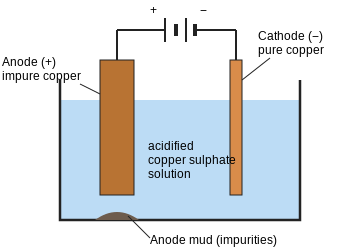
On passing current, pure copper from the solution deposits on the cathode, and an equal amount of copper from the impure anode dissolves into the solution.
Three metal samples of magnesium, aluminium and iron were taken and rubbed with sand paper. These samples were then put separately in test tubes containing dilute hydrochloric acid. Thermometers were also suspended in each test tube so that their bulbs dipped in the acid. The rate of formation of bubbles was observed. The above activity was repeated with dilute nitric acid and the observations were recorded.
(a) When activity was done with dilute hydrochloric acid, then in which one of the test tubes was the rate of formation of bubbles the fastest and the thermometer showed the highest temperature? 1
(b) Which metal did not react with dilute hydrochloric acid? Give reason. 1
(c) (i) Why is hydrogen gas not evolved when a metal reacts with dilute nitric acid? Name the ultimate products formed in the reaction. 2
OR
(c) (ii) Name the type of reaction on the basis of which reactivity of metals is decided. You have two metals X and Y. How would you decide which is more reactive than the other? 2
Solution
(a) In the test tube containing magnesium — it is the most reactive of the three.
(b) None — all three metals (Mg, Al, Fe) react with dilute HCl and give hydrogen, because all of them are more reactive than hydrogen (above hydrogen in the reactivity series). (Copper, silver or gold would not react, as they are below hydrogen.)
(c) (i) Nitric acid is a strong oxidising agent. It oxidises the hydrogen produced to water and is itself reduced to oxides of nitrogen. Ultimate products: water and oxides of nitrogen (N2O, NO or NO2), along with the metal nitrate. (Only Mg and Mn give H2 with very dilute HNO3.)
OR (c) (ii) Displacement reactions. Put a piece of metal X in a solution of a salt of Y. If X displaces Y from its salt solution (Y gets deposited), X is more reactive than Y; if there is no reaction, Y is more reactive. E.g. Fe + CuSO4 → FeSO4 + Cu shows iron is more reactive than copper.
The melting points and boiling points of some ionic compounds are given below:
| Compound | Melting point (K) | Boiling point (K) |
|---|---|---|
| NaCl | 1074 | 1686 |
| LiCl | 887 | 1600 |
| CaCl2 | 1045 | 1900 |
| CaO | 2850 | 3120 |
| MgCl2 | 981 | 1685 |
These compounds are termed ionic because they are formed by the transfer of electrons from a metal to a non-metal. The electron transfer in such compounds is controlled by the electronic configuration of the elements involved. Every element tends to attain a completely filled valence shell of its nearest noble gas or a stable octet.
(i) Show the electron transfer in the formation of magnesium chloride. 1
(ii) List two properties of ionic compounds other than their high melting and boiling points. 1
(iii) (A) While forming an ionic compound say sodium chloride how does sodium atom attain its stable configuration? 2
OR
(iii) (B) Give reasons: (i) Why do ionic compounds in the solid state not conduct electricity? (ii) What happens at the cathode when electricity is passed through an aqueous solution of sodium chloride? 2
5 marks: long answer
(a) How is the method of extraction of metals high up in the reactivity series different from that for metals in the middle? Why cannot the same process be applied for them? Name and explain the process of extraction of sodium.
(b) Draw a labelled diagram of electrolytic refining of copper.
Solution
(a) Metals in the middle (Zn, Fe, Pb) are obtained by converting their ores to oxides (roasting/calcination) and then reducing the oxides with carbon. Metals high up (Na, Mg, Ca, Al) are obtained by electrolytic reduction of their molten chlorides (or oxides).
The same process cannot be used because these metals have a greater affinity for oxygen than carbon, so carbon cannot reduce their oxides.
Extraction of sodium — electrolysis of molten sodium chloride: the metal is deposited at the cathode and chlorine is liberated at the anode.
At anode: 2Cl− → Cl2 + 2e−
(b)
What happens when (Write the balanced equation involved) – (i) Copper is heated in air? (ii) Aluminium oxide is reacted with hydrochloric acid? (iii) Potassium reacts with water? (iv) Cinnabar is heated in air? (v) Aluminium oxide reacts with sodium hydroxide?
Solution
(i) A black coating of copper(II) oxide forms: 2Cu + O2 → 2CuO
(ii) Salt and water are formed (Al2O3 behaves as a base): Al2O3 + 6HCl → 2AlCl3 + 3H2O
(iii) Violent reaction; hydrogen catches fire: 2K + 2H2O → 2KOH + H2 + heat
(iv) Cinnabar (HgS) is converted to mercuric oxide (roasting): 2HgS + 3O2 → 2HgO + 2SO2; further heating gives mercury: 2HgO → 2Hg + O2.
(v) Sodium aluminate and water are formed (Al2O3 behaves as an acid — it is amphoteric): Al2O3 + 2NaOH → 2NaAlO2 + H2O
(a) (i) Write two properties of gold which make it the most suitable metal for ornaments. (ii) Name two metals which are the best conductors of heat. (iii) Name two metals which melt when you keep them on your palm.
(b) Explain the formation of ionic compound CaO with electron-dot structure. Atomic numbers of calcium and oxygen are 20 and 8 respectively.
(a) Write the steps involved in the extraction of pure metals in the middle of the activity series from their carbonate ores. (b) How is copper extracted from its sulphide ore? Explain the various steps supported by chemical equations. Draw labelled diagram for the electrolytic refining of copper.
Get every solution for all chapters
- Every board question of every chapter, each fully solved the way the board gives marks
- 17 complete board papers, each followed by its solutions
- Weightage and most-asked topics for every chapter
- Instant PDF download, colour and black & white print copies
Revising the chapter first? Complete Science Notes for Class 10 (NCERT 2026-27) →
What you get in the pack
- Questions from 126 CBSE papers, 2016 to 2026: every set code available
- Complete: 2405 different questions and parts from all set codes, 13 chapters and 17 full papers
- Part A: all 13 chapters, questions sorted chapter-wise and by marks
- Year-wise weightage table and most-asked topics for every chapter
- Part B: 17 full board papers, each followed by its complete solutions, for timed practice
- Answers written to the CBSE marking-scheme points, with labelled diagrams drawn in full
- Questions on topics out of the board syllabus flagged
All chapters in this pack
- PYQ Ch 1 Chemical Reactions and Equations
- PYQ Ch 2 Acids, Bases and Salts
- PYQ Ch 3 Metals and Non-metals
- PYQ Ch 4 Carbon and its Compounds
- PYQ Ch 5 Life Processes
- PYQ Ch 6 Control and Coordination
- PYQ Ch 7 How do Organisms Reproduce
- PYQ Ch 8 Heredity
- PYQ Ch 9 Light Reflection and Refraction
- PYQ Ch 10 The Human Eye and the Colourful World
- PYQ Ch 11 Electricity
- PYQ Ch 12 Magnetic Effects of Electric Current
- PYQ Ch 13 Our Environment
- Board Paper 2026 Set 31-2-1 with Solutions
- Board Paper 2026 Set 31-3-1 with Solutions
- Board Paper 2025 Set 31-1-1 with Solutions
- Board Paper 2025 Set 31-2-1 with Solutions
- Board Paper 2024 Set 31-4-1 with Solutions
- Board Paper 2024 Set 31-5-1 with Solutions
- Board Paper 2023 Set 31-2-1 with Solutions
- Board Paper 2023 Set 31-4-1 with Solutions
- Board Paper 2022 Term 2 Set 31-1-1 with Solutions
- Board Paper 2022 Term 2 Set 31-3-1 with Solutions
- Board Paper 2020 Set 31-2-1 with Solutions
- Board Paper 2020 Set 31-4-1 with Solutions
- Board Paper 2019 Set 31-2-1 with Solutions
- Board Paper 2019 Set 31-4-1 with Solutions
- Board Paper 2018 Set 31-1 with Solutions
- Board Paper 2017 Set 3 with Solutions
- Board Paper 2016 Set 31-1 with Solutions