
Acids, Bases and Salts: Class 10 PYQs 2018–2026 with solutions
All 46 CBSE board questions asked from Acids, Bases and Salts in 13 board papers, with the year, set and marks of each. 24 are solved free below. The Class 10 Science PYQ Book: Solved Board Papers 2016-2026 (CBSE) has every solution, all chapters and 17 full board papers.
Subject expert: Khushbu Gupta, B.Sc., M.Sc. Physics, B.Ed. · 8+ years teaching


Free: NCERT solutions for Class 10 Science →
Acids, Bases and Salts: board weightage
Board weightage 2018–2026
| Year | 2016 | 2017 | 2018 | 2019 | 2020 | 2022 | 2023 | 2024 | 2025 | 2026 |
|---|---|---|---|---|---|---|---|---|---|---|
| Questions | – | – | 2 | 5 | 5 | – | 10 | 9 | 6 | 9 |
| Marks | – | – | 6 | 13 | 17 | – | 17 | 21 | 12 | 16 |
Most asked topics
46 questions from 13 papers. Repeated questions are shown once with every year they were asked.
Jump to: 1 mark2 marks3 marks4 marks5 marks
1 mark: MCQ and Assertion–Reason
A metal carbonate reacts with a solution X which forms a salt, water and a gas Y. What are X and Y?
Solution
Answer: (C)
Metal carbonate + acid → salt + water + carbon dioxide. E.g. Na2CO3 + 2HCl → 2NaCl + H2O + CO2. So X is hydrochloric acid and Y is carbon dioxide.
The pH of the gastric juices released during digestion is:
Solution
Answer: (A) Less than 7
The stomach produces hydrochloric acid, so gastric juice is acidic (pH about 1.5–2).
Baking powder is a mixture of:
Solution
Answer: (C)
Baking powder = baking soda (sodium hydrogencarbonate, NaHCO3) + a mild edible acid such as tartaric acid. On heating or wetting, CO2 is released and makes the dough rise; the acid removes the bitter taste of sodium carbonate.
To a small amount of copper oxide in a beaker, when we add dilute hydrochloric acid slowly with stirring, the change in the colour of the solution is due to the formation of:
Solution
Answer: (C)
CuO + 2HCl → CuCl2 + H2O. Copper(II) chloride makes the solution blue-green. (A metal oxide reacts with an acid to give salt and water.)
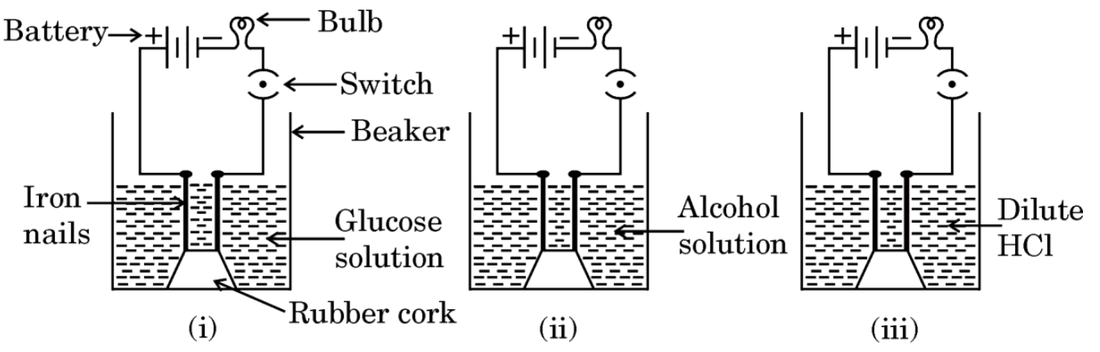
In which case/cases will the bulb glow considering that all other connections of electric circuit are complete and working?
Solution
Answer: (D) Case (iii) only
Dilute HCl produces H+ (H3O+) and Cl− ions in water, which carry current, so the bulb glows. Glucose and alcohol do not form ions in solution, so they do not conduct electricity.
When zinc reacts with NaOH, the product formed is:
Solution
Answer: (C) Na2ZnO2
2NaOH + Zn → Na2ZnO2 (sodium zincate) + H2.
The following table shows the pH values of four solutions A, B, C and D on a pH scale:
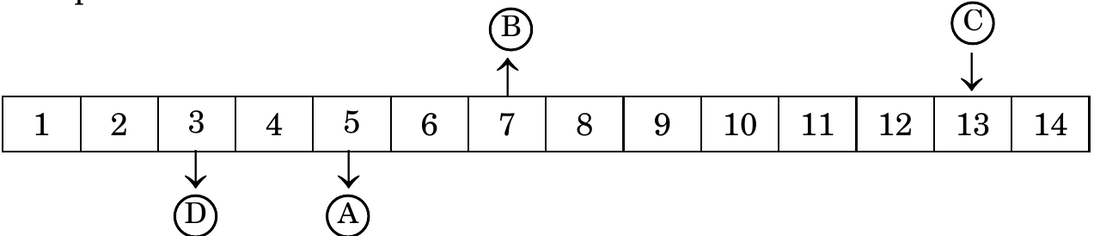
The solutions A, B, C and D respectively are of a
Solution
Answer: (D)
A: pH 5 — weak acid; B: pH 7 — neutral; C: pH 13 — strong base; D: pH 3 — strong acid. (The lower the pH below 7, the stronger the acid; the higher above 7, the stronger the base.)
Consider the following reactions: (i) Dilute hydrochloric acid reacts with sodium hydroxide. (ii) Magnesium oxide reacts with dilute hydrochloric acid. (iii) Carbon dioxide reacts with sodium hydroxide. It is found that in each case:
Solution
Answer: (A)
(i) HCl + NaOH → NaCl + H2O (neutralisation); (ii) MgO + 2HCl → MgCl2 + H2O (metal oxide + acid); (iii) 2NaOH + CO2 → Na2CO3 + H2O (non-metal oxide + base). In each case salt and water form. (Na2CO3 is a basic salt, so (B) is wrong.)
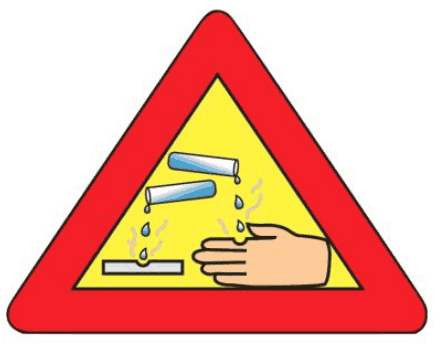
The warning sign shown in the given figure must invariably be displayed/pasted on the containers which contain hydroxide of:
Solution
Answer: (C) Sodium
The sign means "corrosive". Sodium hydroxide is a strong alkali that burns the skin and corrodes materials, so its containers must carry this sign.
The body of human beings works within the pH range of:
Solution
Answer: (C) 7.0 to 7.8
Our body works within a narrow pH range of 7.0 to 7.8; living organisms can survive only in a narrow range of pH change.
An aqueous solution of a salt turns blue litmus to red. The salt could be the one obtained by the reaction of:
Solution
Answer: (D)
The salt solution is acidic. A salt of a strong acid and a weak base is acidic: HCl + NH4OH → NH4Cl + H2O (pH below 7). (A) and (B) give neutral salts; (C) gives a basic salt.
Four solutions, namely glucose, alcohol, hydrochloric acid and sulphuric acid filled in four separate beakers are connected one by one in an electric circuit with a bulb. The solutions in which the bulb will glow when current is passed are:
The salt present in tooth enamel is:
An aqueous solution of sodium chloride is prepared in distilled water. The pH of this solution is:
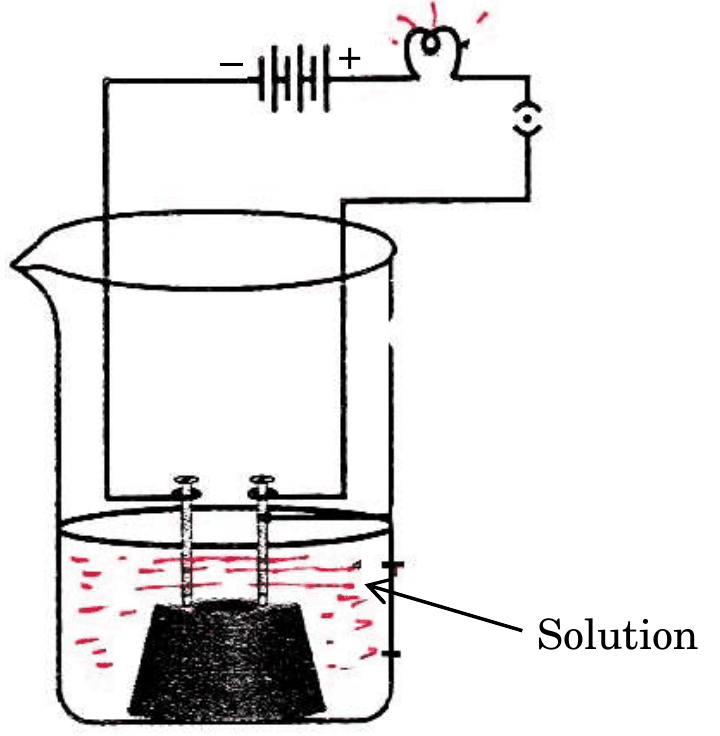
In the given experimental set-up, if the experiment is carried out separately with each of the following solutions the cases in which the bulb will glow is/are: (i) Dilute hydrochloric acid (ii) Dilute sulphuric acid (iii) Glucose solution (iv) Alcohol
When zinc reacts with sodium hydroxide, the product formed is:
When Sodium bicarbonate reacts with dilute hydrochloric acid, the gas evolved is:
Acid present in tomato is:
Sodium hydroxide is termed an alkali while Ferric hydroxide is not because:
The name of the salt used to remove permanent hardness of water is:
A visually challenged student, has to perform a lab test to detect the presence of acid in a given solution. The acid-base indicator preferred by him will be:
2 marks: very short answer
1 gram of solid sodium chloride was taken in a clean and dry test tube and concentrated sulphuric acid was added to it. (i) Name the gas evolved in the reaction. (ii) What will be observed when this gas is tested with (I) dry, and (II) wet blue litmus paper? Write your conclusion about the nature (acidic/basic) of this gas.
Solution
(i) Hydrogen chloride (HCl) gas: NaCl + H2SO4 → NaHSO4 + HCl.
(ii) (I) Dry blue litmus: no change in colour. (II) Wet blue litmus: turns red.
Conclusion: HCl gas is acidic, but it shows acidic behaviour only in the presence of water, which allows it to form H+ ions.
Some metals react with acids to produce salt and hydrogen gas. Illustrate it with an example. How will you test the presence of this gas?
Solution
Example: zinc granules react with dilute sulphuric acid:
Test: bring a burning candle or matchstick near the gas (or a soap bubble filled with it). It burns with a pop sound, which confirms hydrogen.
A student took a small amount of copper oxide in a conical flask and added dilute hydrochloric acid to it with constant stirring. He observed a change in colour of the solution. (i) Write the name of the compound formed and its colour. (ii) Write a balanced chemical equation for the reaction involved.
Solution
(i) Copper(II) chloride; the solution becomes blue-green.
(ii)
The industrial process used for the manufacture of caustic soda involves electrolysis of an aqueous solution of compound ‘X’. In this process, two gases ‘Y’ and ‘Z’ are liberated. ‘Y’ is liberated at cathode and ‘Z’, which is liberated at anode, on treatment with dry slaked lime forms a compound ‘B’. Name X, Y, Z and B.
A teacher provided acetic acid, water, lemon juice, aqueous solution of sodium hydrogen carbonate and sodium hydroxide to students in the school laboratory to determine the pH values of these substances using pH papers. One of the students reported the pH values of the given substances as 3, 12, 4, 8 and 14 respectively. Which one of these values is not correct? Write its correct value stating the reason.
A solution ‘X’ gives orange colour when a drop of it falls on pH paper, while another solution ‘Y’ gives bluish colour when a drop of it falls on pH paper. What is the nature of both the solutions? Determine the pH of solutions ‘X’ and ‘Y’.
3 marks: short answer
Give reasons:
(i) For dilution of an acid, acid is added into water and not water into acid.
(ii) Dry HCl gas does not turn blue litmus red whereas dilute hydrochloric acid does.
(iii) Blue colour of Copper(II) sulphate crystals turns white on heating. 3×1
Solution
(i) Mixing an acid with water is highly exothermic. If water is added to concentrated acid, the heat generated may make the mixture splash out and cause burns, and the glass container may break. Adding acid slowly to water (with stirring) lets the large volume of water absorb the heat safely.
(ii) Acids show acidic behaviour only in the presence of water, when they produce H+ ions (H3O+). Dry HCl gas does not form H+ ions, so it does not change the colour of litmus; in water, HCl dissociates and the H+ ions turn blue litmus red.
(iii) Blue copper sulphate crystals contain water of crystallisation (CuSO4·5H2O). On heating they lose this water and become white anhydrous copper sulphate: CuSO4·5H2O → CuSO4 + 5H2O.
Write the preparation of the following compounds with balanced chemical equation: (i) NaOH by chlor-alkali process (ii) Baking Soda (iii) Plaster of Paris 3×1
Solution
(i) Electricity is passed through brine (aqueous NaCl); NaOH forms near the cathode, chlorine at the anode and hydrogen at the cathode:
(ii) Baking soda is made from sodium chloride:
(iii) Plaster of Paris is made by heating gypsum at 373 K:
Write the common name and the chemical name of the compound CaSO4·½H2O. Write the method of its preparation. Give chemical equation for the reaction, when water reacts with CaSO4·½H2O.
Solution
Common name: Plaster of Paris. Chemical name: calcium sulphate hemihydrate.
Preparation: gypsum is heated at 373 K; it loses water molecules:
With water: it changes back to gypsum, a hard solid mass:
(i) Suggest a safe procedure of diluting a strong concentrated acid.
(ii) Name the salt formed when sulphuric acid is added to sodium hydroxide and write its pH.
(iii) Dry HCl gas does not change the colour of dry blue litmus paper. Why?
Solution
(i) Add the concentrated acid slowly to water (never water to acid), with constant stirring, in a glass container. The process is highly exothermic; this way the heat is absorbed by the large amount of water.
(ii) Sodium sulphate: H2SO4 + 2NaOH → Na2SO4 + 2H2O. It is a salt of a strong acid and a strong base, so its pH is 7.
(iii) Dry HCl gas does not dissociate to give H+ ions; acids show acidic behaviour only in the presence of water.
Give reasons for the following: (i) Only one half of water molecule is shown in the formula of Plaster of Paris. (ii) Sodium hydrogen carbonate is used as an antacid. (iii) On strong heating, blue coloured copper sulphate crystals turn white.
Solution
(i) In Plaster of Paris, two formula units of CaSO4 share one molecule of water: (CaSO4)2·H2O, written as CaSO4·½H2O.
(ii) Sodium hydrogencarbonate is a mild, non-corrosive base; it neutralises the excess acid in the stomach and gives relief.
(iii) The blue crystals (CuSO4·5H2O) lose their water of crystallisation on heating and form white anhydrous copper sulphate: CuSO4·5H2O → CuSO4 + 5H2O.
(i) Draw a labelled diagram to show the preparation of hydrogen chloride gas in laboratory. (ii) Test the gas evolved first with dry and then with wet litmus paper. In which of the two cases, does the litmus paper show change in colour? (iii) State the reason of exhibiting acidic character by dry HCl gas / HCl solution.
Solution
(i) Solid sodium chloride is heated with concentrated sulphuric acid:
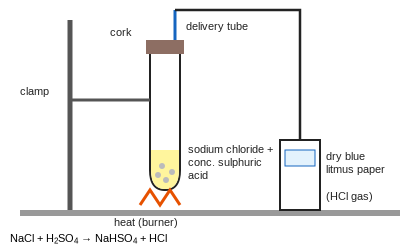
(ii) With wet blue litmus paper — it turns red. Dry litmus paper shows no change.
(iii) HCl shows acidic character only in the presence of water, when it produces H+ (H3O+) ions: HCl + H2O → H3O+ + Cl−. Dry HCl gas does not form these ions, so it does not act as an acid.
(a) While diluting an acid, why is it recommended that the acid should be added to water and not water to the acid? (b) Dry hydrogen chloride gas does not change the colour of dry litmus paper. Why?
How is sodium hydroxide manufactured in industries? Name the process. In this process a gas X is formed as by-product. This gas reacts with lime water to give a compound Y, which is used as a bleaching agent in the chemical industry. Identify X and Y and write the chemical equation of the reactions involved.
A white powder is used by doctors to support fractured bones. (a) Write the name and chemical formula of the powder. (b) How is this powder prepared? (c) When this white powder is mixed with water, a hard solid mass is obtained. Write a balanced chemical equation for the change. (d) Give one more use of this white powder.
2 mL of sodium hydroxide solution is added to a few pieces of granulated zinc metal taken in a test tube. When the contents are warmed, a gas evolves which is bubbled through a soap solution before testing. Write the equation of the chemical reaction involved and the test to detect the gas. Name the gas which will be evolved when the same metal reacts with dilute solution of a strong acid.
The pH of a salt used to make tasty and crispy pakoras is 14. Identify the salt and write a chemical equation for its formation. List its two uses.
4 marks: case-based / source-based
Read the following passage and answer the questions that follow:
In the given diagram, when electricity is passed through an aqueous solution of a common salt, a substance ‘Z’ is produced, along with the evolution of gases ‘X’ and ‘Y’. When a burning matchstick is brought near the gas ‘Y’, it burns with a pop sound, whereas ‘X’ is used for disinfecting drinking water. When ‘X’ is passed through slaked lime, an insoluble substance ‘A’ is produced.
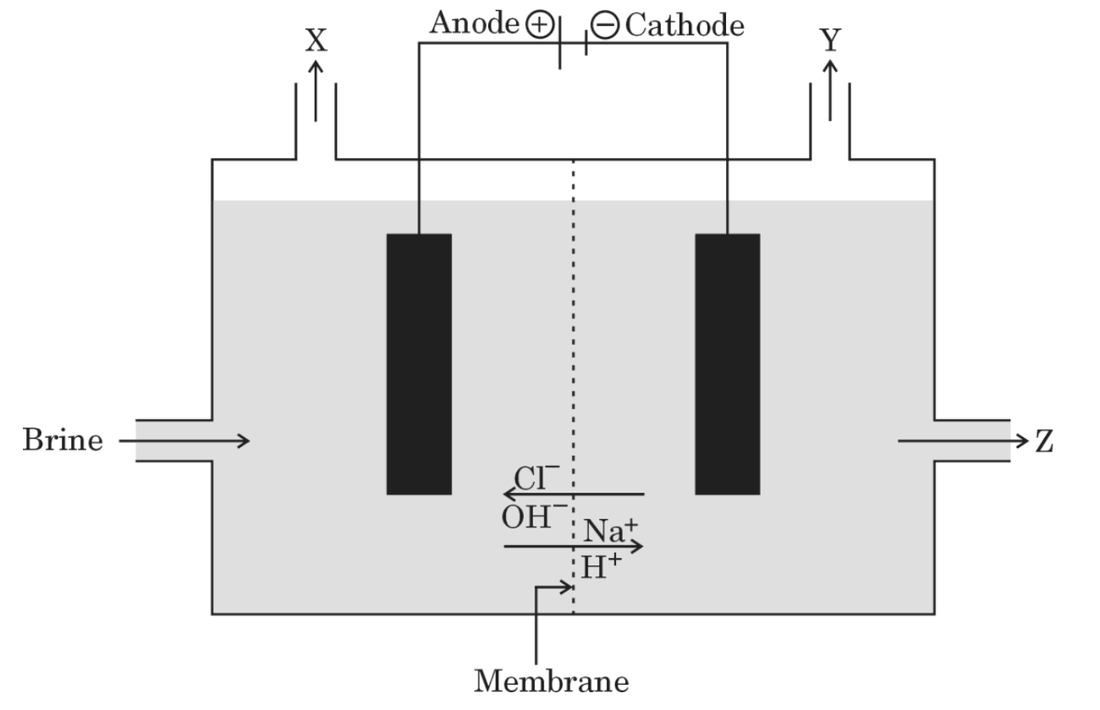
(a) Write the names of the gases ‘X’ and ‘Y’. 1
(b) Write the balanced chemical equation for the formation of substance ‘Z’. 1
(c) (i) What happens: (I) If a drop of red litmus solution is added to the aqueous solution of substance ‘Z’? (II) If CO2 gas is passed through ammoniacal solution of aqueous NaCl? 2
OR
(c) (ii) Identify the substance ‘A’ and write the balanced chemical equation of the reaction which takes place in its preparation. 2
Solution
(a) X = chlorine (given off at the anode; used to disinfect water). Y = hydrogen (given off at the cathode; burns with a pop sound).
(b) Z is sodium hydroxide:
(c) (i) (I) NaOH is a base, so red litmus turns blue.
(II) Sodium hydrogencarbonate (baking soda) is formed: NaCl + H2O + CO2 + NH3 → NH4Cl + NaHCO3
OR (c) (ii) A = bleaching powder (calcium oxychloride, CaOCl2):
Seawater contains many salts dissolved in it. Common salt is separated from these salts. Deposits of solid salt are also found in several parts of the world. These large crystals are often brown due to impurities. This is called rock salt and is mined like coal. The common salt is an important raw material for chemicals of daily use.
(a) Write balanced chemical equations to show the products formed during electrolysis of brine. 1
(b) List two uses of any one product obtained during electrolysis of brine. 1
(c) (i) A mild non-corrosive basic salt ‘A’, used for faster cooking, is strongly heated to produce a compound ‘B’, that is used for removing permanent hardness of water. Identify A and B and also write the equation for the reaction that occurs when A is heated. 2
OR
(c) (ii) Define water of crystallisation. Give two examples of salts that have water of crystallisation. 2
Solution
(a)
(b) Any one product, two uses, e.g. chlorine: water treatment / swimming pools, making PVC, disinfectants, CFCs, pesticides, bleaching powder. Sodium hydroxide: soaps and detergents, paper making, artificial fibres, degreasing metals. Hydrogen: fuels, margarine, ammonia for fertilisers.
(c) (i) A = sodium hydrogencarbonate (baking soda), NaHCO3; B = sodium carbonate, Na2CO3 (recrystallised as washing soda, which removes permanent hardness).
OR (c) (ii) Water of crystallisation is the fixed number of water molecules present in one formula unit of a salt (chemically part of its crystal). Examples: copper sulphate pentahydrate CuSO4·5H2O; washing soda Na2CO3·10H2O; gypsum CaSO4·2H2O.
Acid-base indicators can be used to distinguish between an acid and a base. Universal indicator, a mixture of several indicators, shows different colours at different concentrations of acids and bases, thereby indicating their pH on the pH scale of 0 – 14. The pH of a solution is measured by pH paper, which is a paper impregnated with a universal indicator.

(a) Solution P is a strong acid while solution Q is a strong base. On the pH scale, where would you place the solutions P and Q? 1
(b) A solution has a pH of 7. Name a compound you would use to (i) increase its pH, and (ii) decrease its pH. 1
(c) (i) When the pH of a solution is decreased from 4 to 2, what effect does it produce on its hydronium ion concentration? State the colour change shown by the pH paper. 2
OR
(c) (ii) A person is feeling pain and irritation in the stomach due to indigestion. What could be the pH of the fluid in the stomach? Write the common name of the medicines people use for remedy. Give the chemical name of ‘‘milk of magnesia’’ often used for this purpose. 2
The teacher while conducting practicals in the laboratory divided the students into three groups and gave them various solutions to find out their pH and classify them into acidic, basic and neutral solutions. Group A – Lemon juice, vinegar, colourless aerated drink; Group B – Tomato juice, coffee, ginger juice; Group C – Sodium hydroxide, sodium chloride, lime water.
(a) For the solutions provided, which group is/are likely to have pH value (i) less than 7, and (ii) greater than 7? 1
(b) List two ways of determining pH of a solution. 1
(c) Explain, why the sour substances such as lemon juice are effective in cleaning the tarnished copper vessels. 2
OR
(c) “pH has great importance in our daily life.” Justify this statement by giving two examples. 2
5 marks: long answer
A few crystals of ferrous sulphate were taken in a dry boiling tube and heated. Tiny water droplets were observed in the tube after some time. (i) From where did these water droplets appear? Explain. (ii) What colour change will be observed during heating? (iii) How many molecules of water are attached per molecule of FeSO4 crystal? Write the molecular formula of crystalline forms of (I) Copper sulphate, and (II) Sodium carbonate. (iv) State how is Plaster of Paris obtained from gypsum. Write two uses of Plaster of Paris.
Solution
(i) From the water of crystallisation. Ferrous sulphate crystals contain water molecules as part of their crystal structure; on heating this water evaporates and condenses as droplets on the cooler, upper part of the tube.
(ii) The green crystals turn white (anhydrous ferrous sulphate); on strong heating they change further to brownish ferric oxide.
(iii) 7 molecules: FeSO4·7H2O. (I) Copper sulphate: CuSO4·5H2O. (II) Sodium carbonate (washing soda): Na2CO3·10H2O.
(iv) Gypsum is heated at 373 K; it loses water and becomes Plaster of Paris:
Uses: (1) supporting fractured bones in the right position; (2) making toys, materials for decoration and making surfaces smooth.
An acid ‘X’ present in tamarind when mixed with ‘Y’, produces a mixture ‘Z’. ‘Z’ on addition to a dough when heated makes cakes soft and spongy. ‘Y’ is prepared from common salt and helps in faster cooking. (i) Write the common names of ‘X’, ‘Y’ and ‘Z’, and the chemical formula of ‘Y’. (ii) How is ‘Y’ prepared and how does it help in making cakes soft and spongy? Illustrate the reaction with suitable chemical equation. (iii) Write the name and chemical formula of a mild base other than ‘Y’ used as an antacid.
Solution
(i) X = tartaric acid; Y = baking soda, NaHCO3 (sodium hydrogencarbonate); Z = baking powder.
(ii) Preparation of Y from common salt:
When baking powder is mixed with water/heated, the acid reacts with baking soda and carbon dioxide is released; the CO2 bubbles make the dough rise, so the cake becomes soft and spongy:
(On heating alone: 2NaHCO3 → Na2CO3 + H2O + CO2; the tartaric acid neutralises the bitter-tasting sodium carbonate.)
(iii) Magnesium hydroxide, Mg(OH)2 (milk of magnesia).
A cloth strip dipped in onion juice is used for testing a liquid ‘X’. The liquid ‘X’ changes its odour. Which type of an indicator is onion juice? The liquid ‘X’ turns blue litmus red. List the observations the liquid ‘X’ will show on reacting with the following: (a) Zinc granules (b) Solid sodium carbonate. Write the chemical equations for the reactions involved.
Define water of crystallisation. Give the chemical formula for two compounds as examples. How can it be proved that the water of crystallisation makes a difference in the state and colour of the compounds?
Get every solution for all chapters
- Every board question of every chapter, each fully solved the way the board gives marks
- 17 complete board papers, each followed by its solutions
- Weightage and most-asked topics for every chapter
- Instant PDF download, colour and black & white print copies
Revising the chapter first? Complete Science Notes for Class 10 (NCERT 2026-27) →
What you get in the pack
- Questions from 126 CBSE papers, 2016 to 2026: every set code available
- Complete: 2405 different questions and parts from all set codes, 13 chapters and 17 full papers
- Part A: all 13 chapters, questions sorted chapter-wise and by marks
- Year-wise weightage table and most-asked topics for every chapter
- Part B: 17 full board papers, each followed by its complete solutions, for timed practice
- Answers written to the CBSE marking-scheme points, with labelled diagrams drawn in full
- Questions on topics out of the board syllabus flagged
All chapters in this pack
- PYQ Ch 1 Chemical Reactions and Equations
- PYQ Ch 2 Acids, Bases and Salts
- PYQ Ch 3 Metals and Non-metals
- PYQ Ch 4 Carbon and its Compounds
- PYQ Ch 5 Life Processes
- PYQ Ch 6 Control and Coordination
- PYQ Ch 7 How do Organisms Reproduce
- PYQ Ch 8 Heredity
- PYQ Ch 9 Light Reflection and Refraction
- PYQ Ch 10 The Human Eye and the Colourful World
- PYQ Ch 11 Electricity
- PYQ Ch 12 Magnetic Effects of Electric Current
- PYQ Ch 13 Our Environment
- Board Paper 2026 Set 31-2-1 with Solutions
- Board Paper 2026 Set 31-3-1 with Solutions
- Board Paper 2025 Set 31-1-1 with Solutions
- Board Paper 2025 Set 31-2-1 with Solutions
- Board Paper 2024 Set 31-4-1 with Solutions
- Board Paper 2024 Set 31-5-1 with Solutions
- Board Paper 2023 Set 31-2-1 with Solutions
- Board Paper 2023 Set 31-4-1 with Solutions
- Board Paper 2022 Term 2 Set 31-1-1 with Solutions
- Board Paper 2022 Term 2 Set 31-3-1 with Solutions
- Board Paper 2020 Set 31-2-1 with Solutions
- Board Paper 2020 Set 31-4-1 with Solutions
- Board Paper 2019 Set 31-2-1 with Solutions
- Board Paper 2019 Set 31-4-1 with Solutions
- Board Paper 2018 Set 31-1 with Solutions
- Board Paper 2017 Set 3 with Solutions
- Board Paper 2016 Set 31-1 with Solutions