
Our Environment: Class 10 PYQs 2016–2026 with solutions
All 42 CBSE board questions asked from Our Environment in 17 board papers, with the year, set and marks of each. 22 are solved free below. The Class 10 Science PYQ Book: Solved Board Papers 2016-2026 (CBSE) has every solution, all chapters and 17 full board papers.
Subject expert: Khushbu Gupta, B.Sc., M.Sc. Physics, B.Ed. · 8+ years teaching


Free: NCERT solutions for Class 10 Science →
Our Environment: board weightage
Board weightage 2016–2026
| Year | 2016 | 2017 | 2018 | 2019 | 2020 | 2022 | 2023 | 2024 | 2025 | 2026 |
|---|---|---|---|---|---|---|---|---|---|---|
| Questions | 2 | 1 | 1 | 3 | 5 | 6 | 4 | 6 | 6 | 8 |
| Marks | 4 | 1 | 3 | 9 | 12 | 14 | 10 | 10 | 9 | 10 |
Most asked topics
42 questions from 17 papers. Repeated questions are shown once with every year they were asked.
Jump to: 1 mark2 marks3 marks4 marks
1 mark: MCQ and Assertion–Reason
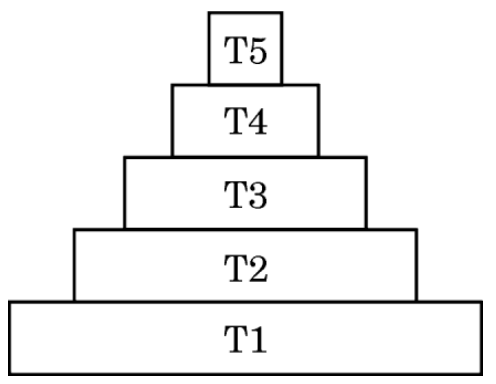
In the given figure, identify the trophic level having maximum concentration of harmful chemicals.
Solution
Answer: (B) T5
Harmful non-biodegradable chemicals (like pesticides) accumulate at every step of the food chain. This is biological magnification, so their concentration is maximum at the top trophic level, T5.
Which of the following limits the number of trophic levels in a food chain?
Solution
Answer: (C) Decrease in energy at higher levels
Only about 10% of the energy is passed on from one trophic level to the next (10 per cent law). After 3–4 levels too little energy is left to support another level, so food chains are short.
Assertion (A): There are generally a greater number of individuals at the lower trophic levels of an ecosystem.
Reason (R): The greatest number is of the producers.
Solution
Answer: (B)
Both statements are true. The reason for A is the loss of energy at each level (less energy can support fewer individuals higher up); R only states that producers are most numerous and does not explain why. So R is not the correct explanation of A.
Organisms of a higher trophic level which feed on several types of organisms belonging to a lower trophic level form the:
Solution
Answer: (A) Food web
When an organism feeds on several types of organisms, many food chains get interlinked, forming a branching network called a food web.
In accumulation of toxic substances at higher trophic levels of an ecosystem through the food chain, which of the following organisms is affected the most?
Solution
Answer: (B) Human beings
Because of biological magnification, the concentration of non-biodegradable chemicals is highest at the top trophic level. Human beings occupy the top level in most food chains (plants → small fish → large fish → humans).
Assertion (A): Natural replenishment of soil will not take place in absence of microbes.
Reason (R): Microbes, comprising of bacteria and fungi, break down dead remains and waste products of organisms, and they go into the soil.
Solution
Answer: (A)
Both are true. Decomposers (bacteria and fungi) break down complex organic substances of dead remains into simple inorganic substances that return to the soil. Without them the soil would not be replenished. R explains A.
Which of the following groups do not constitute a food chain? (i) Wolf, rabbit, grass, lion (ii) Plankton, man, grasshopper, fish (iii) Hawk, grass, snake, grasshopper, frog (iv) Grass, snake, wolf, tiger
Solution
Answer: (D) (ii) and (iv)
(i) grass → rabbit → wolf → lion and (iii) grass → grasshopper → frog → snake → hawk are food chains. In (ii) the grasshopper does not eat plankton and fish do not eat grasshoppers in this order, and in (iv) a snake does not eat grass, so these do not form food chains.
The percentage of solar energy which is not converted into food energy by the leaves of green plants in a terrestrial ecosystem is about:
Solution
Answer: (D) 99%
Green plants capture only about 1% of the sunlight falling on their leaves and convert it into food energy. So about 99% is not converted.
Assertion (A): The amount of ozone in the atmosphere began to drop sharply in the 1980s.
Reason (R): The oxygen atoms combine with molecular oxygen to form ozone.
Solution
Answer: (B)
Both are true. The drop in ozone was linked to synthetic chemicals like CFCs, not to the way ozone is formed (O + O2 → O3). So R does not explain A.
Identify from the following a group containing all non-biodegradable substances.
Some wastes are given below: (i) Garden waste (ii) Ball point pen refills (iii) Empty medicine bottles made of glass (iv) Peels of fruits and vegetables (v) Old cotton shirt. The non-biodegradable wastes among these are:
Assertion (A): Oxygen is essential for all aerobic forms of life.
Reason (R): Free oxygen atoms combine with molecular oxygen to form ozone.
Which one of the following is not a natural ecosystem?
Assertion (A): Ozone layer protects the surface of the Earth from harmful UV radiations.
Reason (R): Chlorofluorocarbons (CFCs) are responsible for depletion of ozone layer.
Food web is constituted by
Choose the incorrect statement from the following:
In the following food chain, 20,000 J of energy was available to the plants. How much energy would be available to man in this chain? Plants → Sheep → Man
The depletion of ozone layer is a cause of concern. Why?
2 marks: very short answer
Suggest one best way to dispose of the following wastes:
(i) Kitchen waste (ii) Metallic waste (iii) Plastic bottles (iv) Sanitary waste
Solution
(i) Kitchen waste — composting (it is biodegradable; turns into manure).
(ii) Metallic waste — recycling (melt and reuse the metal).
(iii) Plastic bottles — recycling / reuse.
(iv) Sanitary waste — incineration (burning at high temperature in an incinerator).
(i) Chlorofluorocarbons (CFCs) have been linked to depletion of ozone layer. In 1987, the United Nations Environment Programme (UNEP) succeeded in making an agreement. State this agreement.
(ii) What is the role of ozone in our atmosphere?
Solution
(i) In 1987, UNEP succeeded in forging an agreement to freeze CFC production at 1986 levels (it is now mandatory for all manufacturing companies to make CFC-free refrigerators).
(ii) The ozone layer in the upper atmosphere shields the surface of the Earth from ultraviolet (UV) radiation from the Sun. UV radiation is highly damaging to organisms and can cause skin cancer in human beings.
‘‘Excessive use of chemicals and pesticides in agriculture adversely effect the environment.’’ Justify this statement.
Solution
• Many pesticides are non-biodegradable. They are washed into the soil and water bodies and are taken up by plants and aquatic organisms.
• They enter the food chain and accumulate at each trophic level (biological magnification), so organisms at the top, including humans, get the highest concentration.
• They also kill useful organisms (decomposers, pollinators) and pollute soil and water, harming the balance of the ecosystem.
We do not clean ponds or lakes but an aquarium needs to be cleaned regularly. Why?
Solution
Ponds and lakes are natural, self-sustaining ecosystems: decomposers (bacteria and fungi) break down dead organisms and wastes, and nutrients are recycled. An aquarium is an artificial ecosystem with few or no decomposers and an incomplete food chain, so wastes and leftover food accumulate and the water gets dirty unless it is cleaned.
Use of several pesticides which results in excessive accumulation of pesticides in rivers or ponds, is a matter of deep concern. Justify this statement.
Solution
Pesticides are washed into rivers and ponds. They are non-biodegradable, so they are taken up by aquatic plants and animals and enter the food chain. At each trophic level their concentration increases (biological magnification), so fish and finally humans at the top get the highest concentrations, causing health problems. They also kill useful aquatic organisms and disturb the ecosystem.
What is ozone? How is it formed in the upper layers of the Earth’s atmosphere? How does ozone affect our ecosystem?
(i) List two human-made ecosystems. 1
(ii) “We do not clean a pond in the same manner as we do in an aquarium.” Give reason to justify this statement. 1
Kulhads (disposable cups made of clay) and disposable paper cups both are used as an alternative for disposable plastic cups. Which one of these two can be considered as a better alternative to plastic cups and why?
Human beings are most adversely affected by the Biological Magnification. State the reason. Why can ordinary washing of the edibles (fruits and vegetables) not reduce the effect of biological magnification?
3 marks: short answer
Write the essential function performed by ozone at the higher levels of the atmosphere. How is it formed in the upper atmosphere? Write the name of the group of chemicals mainly responsible for the depletion of ozone layer.
Solution
Function: the ozone layer shields the surface of the Earth from harmful ultraviolet (UV) radiation of the Sun, which can cause skin cancer and damage organisms.
Formation: high-energy UV radiation splits some oxygen molecules (O2) into free oxygen atoms (O). These atoms combine with molecular oxygen to form ozone:
O + O2 → O3 (ozone)
Chemicals responsible for depletion: chlorofluorocarbons (CFCs), used as refrigerants and in fire extinguishers.
Study the picture given below showing three food chains (a), (b) and (c) and answer the following questions:
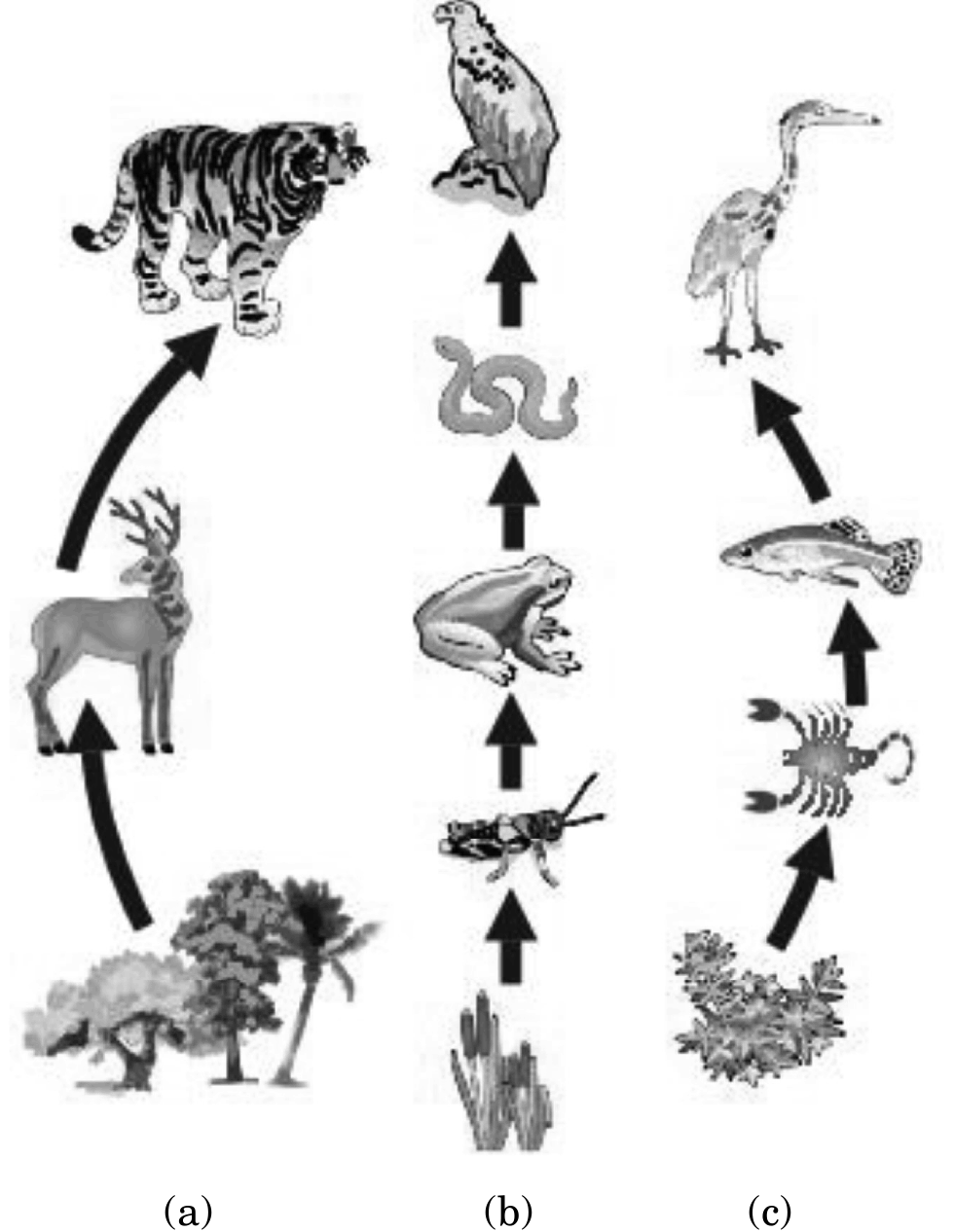
(i) Name the type of ecosystems that exist in food chains (b) and (c).
(ii) The first trophic level in all food chains are producers. Why? What percentage of solar energy do these producers capture for their use?
(iii) Why are the arrows shown in the diagram in one direction only and not vice versa? Justify.
Solution
(i) (b) grass → grasshopper → frog → snake → eagle: a terrestrial (grassland) ecosystem. (c) water plants → small animals → fish → bird: an aquatic (pond) ecosystem.
(ii) Producers (green plants) are the only organisms that can make food from inorganic substances using sunlight (photosynthesis); all other organisms depend on them directly or indirectly. They capture about 1% of the solar energy falling on their leaves.
(iii) The flow of energy is unidirectional. The energy captured by autotrophs does not revert to the Sun, and energy passed on to herbivores does not come back to the plants; it moves progressively through the trophic levels and is no longer available to the previous level. So the arrows point one way only.
Differentiate between food chain and food web. In a food chain consisting of deer, grass and tiger, if the population of deer decreases, what will happen to the population of organisms belonging to the first and third trophic levels?
Solution
| Food chain | Food web |
|---|---|
| A single linear series of organisms feeding on one another | A network of many interconnected food chains |
| Each organism has one source of food at the level below | An organism can feed on several types of organisms |
Food chain: grass (first trophic level) → deer (second) → tiger (third).
If deer decrease: grass will increase (fewer animals eat it), and tigers will decrease (less food is available).
Explain how some harmful chemicals enter our bodies through the food chain. Why is the concentration of these harmful chemicals found to be maximum in human beings?
Solution
Pesticides and other chemicals sprayed on crops are washed into the soil and water bodies. Plants absorb them along with water and minerals, and aquatic plants and animals take them up from water. In this way they enter the food chain, and we take them in through our food (grains, vegetables, fish).
These chemicals are non-biodegradable, so they are not broken down or excreted; they accumulate at each trophic level (biological magnification). Human beings occupy the top trophic level in many food chains, so the maximum concentration accumulates in our bodies.
Write one difference between biodegradable and non-biodegradable wastes. List two impacts of each type of the accumulated waste on environment if not disposed off properly.
Solution
Difference: biodegradable wastes (peels, paper, cotton) are broken down by microorganisms (bacteria, fungi); non-biodegradable wastes (plastics, glass, DDT) cannot be broken down by biological processes.
Impacts of accumulated biodegradable waste: (1) foul smell as it rots; (2) breeding of flies and mosquitoes that spread diseases.
Impacts of non-biodegradable waste: (1) pollutes soil and water and blocks drains; (2) harmful chemicals enter food chains and accumulate (biological magnification); animals that swallow plastic may die.
(a) Name the group of organisms which form in the first trophic level of all food chains. Why are they called so?
(b) Why are the human beings most adversely affected by bio-magnification?
(c) State one ill-effect of the absence of decomposers from a natural ecosystem.
Solution
(a) Producers (green plants and blue-green algae). They are called so because they produce food (sugar and starch) from inorganic substances using sunlight energy, in the presence of chlorophyll.
(b) Human beings occupy the top trophic level in many food chains. Non-biodegradable chemicals accumulate progressively at each level, so the maximum concentration builds up in humans.
(c) Without decomposers, dead plants and animals and wastes would not be broken down; they would pile up, and nutrients would not be returned to the soil, so the soil would not be replenished.
What are human-made ecosystems? Give an example. Can a human-made ecosystem become a self-sustaining ecosystem? Give reason to justify your answer.
Solution
Human-made (artificial) ecosystems are ecosystems created and maintained by human beings, e.g. a crop field, garden, park or aquarium.
No, they cannot normally become self-sustaining. They have limited biodiversity, incomplete food chains and few decomposers, so nutrients are not fully recycled and wastes are not removed; they need constant human care (watering, adding nutrients, cleaning, removing weeds and pests).
(a) Construct a terrestrial food chain comprising four trophic levels. (b) What will happen if we kill all the organisms in one trophic level? (c) Calculate the amount of energy available to the organisms at the fourth trophic level if the energy available to the organisms at the second trophic level is 2000 J.
(a) Complete the following table:
| Oxygen | Ozone | |
|---|---|---|
| Formula | (i) ____ | (ii) ____ |
| Benefits to biotic component | (iii) ____ | (iv) ____ |
(b) How is ozone formed at the higher levels of atmosphere?
Write the essential function performed by ozone at the higher levels of the Earth’s atmosphere? How is it produced? Name the synthetic chemicals mainly responsible for the drop of amount of ozone in the atmosphere. How can the use of these chemicals be reduced?
(a) Natural water bodies are not regularly cleaned whereas an aquarium needs regular cleaning. Why? (b) What are decomposers? What will be the consequence if the decomposers are completely eradicated from an ecosystem? Give justification in support of your answer.
How is ozone formed in the upper atmosphere? State its importance. What is responsible for its depletion? Write one harmful effect of ozone depletion.
Students in a school listened to the news read in the morning assembly that the mountain of garbage in Delhi, suddenly exploded and various vehicles got buried under it. Several people were also injured and there was traffic jam all around. In the brain storming session the teacher also discussed this issue and asked the students to find out a solution to the problem of garbage. Finally they arrived at two main points – one is self management of the garbage we produce and the second is to generate less garbage at individual level. (a) Suggest two measures to manage the garbage we produce. (b) As an individual, what can we do to generate the least garbage? Give two points. (c) List two values the teacher instilled in his students in this episode.
The activities of man had adverse effects on all forms of living organisms in the biosphere. Unlimited exploitation of nature by man disturbed the delicate ecological balance between the living and non-living components of the biosphere. The unfavourable conditions created by man himself threatened the survival not only of himself but also of the entire living organisms on the mother earth. One of your classmates is an active member of Eco club of your school which is creating environmental awareness amongst the school students, spreading the same in the society and also working hard for preventing environmental degradation of the surroundings. (a) Why is it necessary to conserve our environment? (b) State the importance of green and blue dust-bins in the safe disposal of the household waste. (c) List two values exhibited by your classmate who is an active member of Eco-club of your school.
4 marks: case-based / source-based
Answer question numbers 4(a) – 4(d) on the basis of your understanding of the following paragraph and the related studied concepts:
India today is facing the problem of overuse of resources, contamination of water and soil and lack of methods of processing the waste. The time has come for the world to say goodbye to “single-use plastics”. Steps must be undertaken to develop environment-friendly substitutes, effective plastic waste collection and methods of its disposal. Indore treated 15 lakh metric tonnes of waste in just 3 years, through biomining and bioremediation techniques. Bioremediation involves introducing microbes into a landfill to naturally ‘break’ it down and biomining involves using trommel machines to sift through the waste to separate the ‘soil’ and the waste component. The city managed to chip away 15 lakh metric tonnes of waste at a cost of around ₹ 10 crore. A similar experiment was successfully carried out in Ahmedabad also.
4(a) State two methods of effective plastic waste collection in your school. 1
4(b) Name any two uses of “single-use plastic” in daily life. 1
4(c) If we discontinue the use of plastic, how can an environment-friendly substitute be provided? 1
4(d) Do you think microbes will work similarly in landfill sites as they work in the laboratory? Justify your answer. 1
Solution
4(a) (1) Keep separate (colour-coded) bins for plastic waste in every class and corridor. (2) Run a plastic collection drive / give plastic to recyclers through an eco-club.
4(b) Polythene carry bags, disposable cups and plates, straws, water bottles (any two).
4(c) Use cloth or jute bags, paper or leaf plates, steel or glass bottles and cups (biodegradable / reusable materials).
4(d) No, not exactly. In the laboratory the conditions (temperature, moisture, oxygen, pH) are controlled and ideal. In a landfill they vary and the waste is mixed, often with toxic substances, so the microbes work more slowly and less efficiently.
Get every solution for all chapters
- Every board question of every chapter, each fully solved the way the board gives marks
- 17 complete board papers, each followed by its solutions
- Weightage and most-asked topics for every chapter
- Instant PDF download, colour and black & white print copies
Revising the chapter first? Complete Science Notes for Class 10 (NCERT 2026-27) →
What you get in the pack
- Questions from 126 CBSE papers, 2016 to 2026: every set code available
- Complete: 2405 different questions and parts from all set codes, 13 chapters and 17 full papers
- Part A: all 13 chapters, questions sorted chapter-wise and by marks
- Year-wise weightage table and most-asked topics for every chapter
- Part B: 17 full board papers, each followed by its complete solutions, for timed practice
- Answers written to the CBSE marking-scheme points, with labelled diagrams drawn in full
- Questions on topics out of the board syllabus flagged
All chapters in this pack
- PYQ Ch 1 Chemical Reactions and Equations
- PYQ Ch 2 Acids, Bases and Salts
- PYQ Ch 3 Metals and Non-metals
- PYQ Ch 4 Carbon and its Compounds
- PYQ Ch 5 Life Processes
- PYQ Ch 6 Control and Coordination
- PYQ Ch 7 How do Organisms Reproduce
- PYQ Ch 8 Heredity
- PYQ Ch 9 Light Reflection and Refraction
- PYQ Ch 10 The Human Eye and the Colourful World
- PYQ Ch 11 Electricity
- PYQ Ch 12 Magnetic Effects of Electric Current
- PYQ Ch 13 Our Environment
- Board Paper 2026 Set 31-2-1 with Solutions
- Board Paper 2026 Set 31-3-1 with Solutions
- Board Paper 2025 Set 31-1-1 with Solutions
- Board Paper 2025 Set 31-2-1 with Solutions
- Board Paper 2024 Set 31-4-1 with Solutions
- Board Paper 2024 Set 31-5-1 with Solutions
- Board Paper 2023 Set 31-2-1 with Solutions
- Board Paper 2023 Set 31-4-1 with Solutions
- Board Paper 2022 Term 2 Set 31-1-1 with Solutions
- Board Paper 2022 Term 2 Set 31-3-1 with Solutions
- Board Paper 2020 Set 31-2-1 with Solutions
- Board Paper 2020 Set 31-4-1 with Solutions
- Board Paper 2019 Set 31-2-1 with Solutions
- Board Paper 2019 Set 31-4-1 with Solutions
- Board Paper 2018 Set 31-1 with Solutions
- Board Paper 2017 Set 3 with Solutions
- Board Paper 2016 Set 31-1 with Solutions