
Magnetic Effects of Electric Current: Class 10 PYQs 2019–2026 with solutions
All 31 CBSE board questions asked from Magnetic Effects of Electric Current in 13 board papers, with the year, set and marks of each. 17 are solved free below. The Class 10 Science PYQ Book: Solved Board Papers 2016-2026 (CBSE) has every solution, all chapters and 17 full board papers.
Subject expert: Khushbu Gupta, B.Sc., M.Sc. Physics, B.Ed. · 8+ years teaching


Free: NCERT solutions for Class 10 Science →
Magnetic Effects of Electric Current: board weightage
Board weightage 2019–2026
| Year | 2016 | 2017 | 2018 | 2019 | 2020 | 2022 | 2023 | 2024 | 2025 | 2026 |
|---|---|---|---|---|---|---|---|---|---|---|
| Questions | – | – | – | 2 | 1 | 4 | 8 | 6 | 4 | 6 |
| Marks | – | – | – | 7 | 5 | 11 | 14 | 10 | 15 | 22 |
Most asked topics
31 questions from 13 papers. Repeated questions are shown once with every year they were asked.
Jump to: 1 mark2 marks3 marks4 marks5 marks
1 mark: MCQ and Assertion–Reason
Assertion (A): Direction of force exerted on a current-carrying conductor placed in a magnetic field remains same if the directions of both magnetic field and current flowing through the conductor are reversed.
Reason (R): The direction of force exerted on a current-carrying conductor placed in an external magnetic field can be determined by using magnetic compass.
Solution
Answer: (C)
A is true: reversing either the current or the field reverses the force, so reversing both leaves it unchanged. R is false: the direction of the force is found using Fleming's left-hand rule, not a compass.
Assertion (A): The needle of a compass, kept in an external magnetic field, always aligns itself in the North-South direction of the Earth.
Reason (R): The behaviour of the needle of the compass is similar to the behaviour of a freely suspended bar magnet.
Solution
Answer: (D)
A is false: in an external magnetic field (e.g. near a bar magnet) the needle aligns along that field, not necessarily north–south. R is true: a compass needle is a small bar magnet free to rotate.
Assertion (A): No two magnetic field lines are found to cross each other.
Reason (R): The compass needle cannot point towards two directions at the point of intersection of two magnetic field lines.
Solution
Answer: (A)
Both are true and R explains A. If two field lines crossed, the field at that point would have two directions, so a compass needle would have to point in two directions at once, which is impossible.
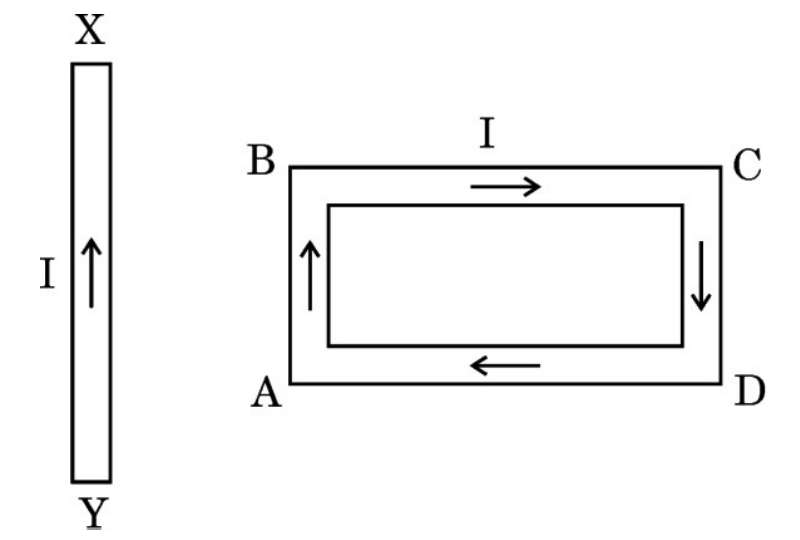
A rectangular loop ABCD carrying a current I is situated near a straight conductor XY, such that the conductor is parallel to the side AB of the loop and is in the plane of the loop. If a steady current I is established in the conductor as shown, the conductor XY will
Solution
Answer: (B)
The current in side AB (A to B, upward) is in the same direction as the current in XY. The magnetic field of AB exerts a force on XY (Fleming's left-hand rule) that pulls XY towards AB — parallel currents in the same direction attract. Side CD is farther away, so its opposite (repulsive) effect is weaker.
Assertion (A): Magnetic field lines never intersect each other.
Reason (R): If they intersect, then at the point of intersection, the compass needle would point towards two directions, which is not possible.
Solution
Answer: (A)
Both are true and R explains A: the field has a single direction at every point.
The current carrying device which produces a magnetic field similar to that of a bar magnet is:
Solution
Answer: (C) A solenoid
One end of a current-carrying solenoid behaves like a north pole and the other like a south pole.
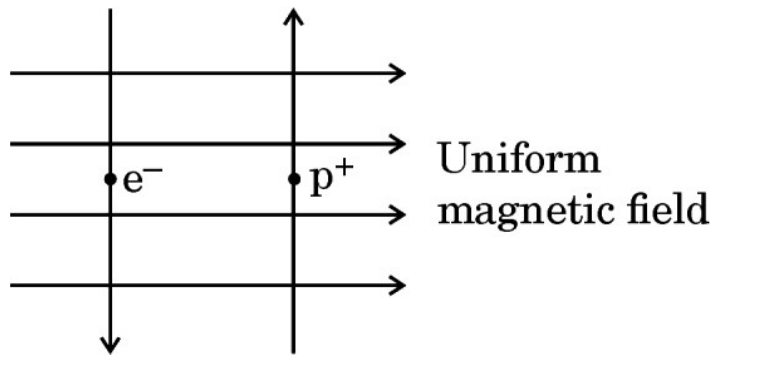
A uniform magnetic field exists in the plane of paper as shown in the diagram. In this field, an electron (e−) and a positron (p+) enter as shown. The electron and positron experience forces:
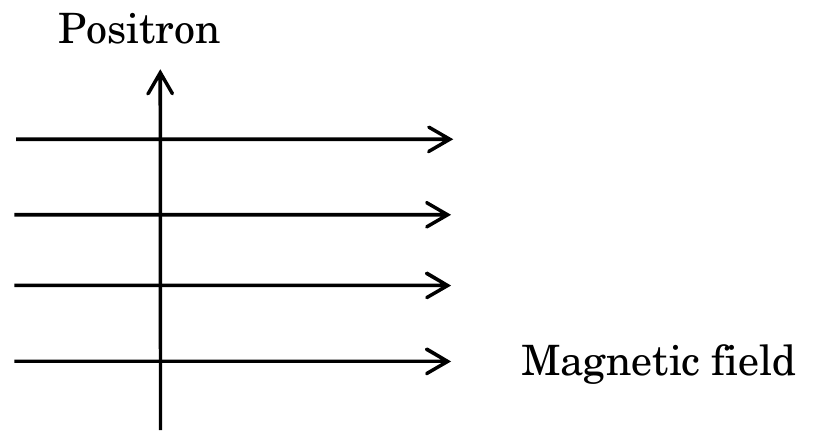
A positron enters a uniform magnetic field at right angles to it as shown. The direction of force experienced by the positron will be:
Assertion (A): Magnetic field lines do not intersect each other.
Reason (R): Magnetic field lines are imaginary lines, the tangent to which at any point gives the direction of the field at that point.
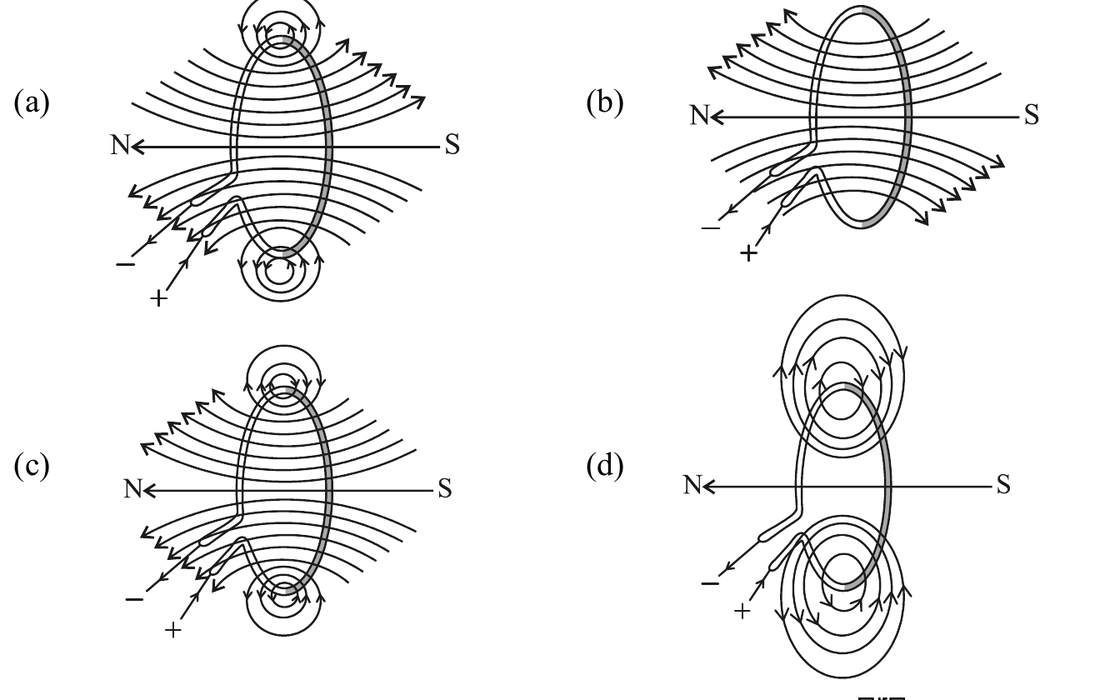
The correct pattern of magnetic field lines of the field produced by a current carrying circular loop is:
An alpha particle enters a uniform magnetic field as shown. The direction of force experienced by the alpha particle is:
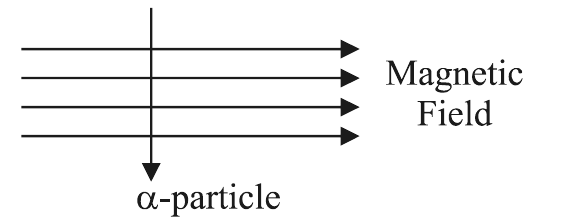
Assertion (A): A current carrying straight conductor experiences a force when placed perpendicular to the direction of magnetic field.
Reason (R): The net charge on a current carrying conductor is always zero.
2 marks: very short answer
(i) Name and state the rule to determine the direction of force experienced by a current carrying straight conductor placed in a uniform magnetic field which is perpendicular to it. (ii) An alpha particle while passing through a magnetic field gets projected towards north. In which direction will an electron project when it passes through the same magnetic field?
Solution
(i) Fleming's left-hand rule: stretch the thumb, forefinger and middle finger of the left hand so that they are mutually perpendicular. If the forefinger points in the direction of the magnetic field and the middle finger in the direction of current, the thumb points in the direction of the force on the conductor.
(ii) An electron carries a negative charge, opposite to the positive alpha particle; moving the same way, it is equivalent to a current in the opposite direction. So it is deflected in the opposite direction — towards the south.
(i) What is a solenoid? (ii) Draw the pattern of magnetic field lines of the magnetic field produced by a solenoid through which a steady current flows.
Solution
(i) A solenoid is a coil of many circular turns of insulated copper wire wrapped closely in the shape of a cylinder.
(ii) 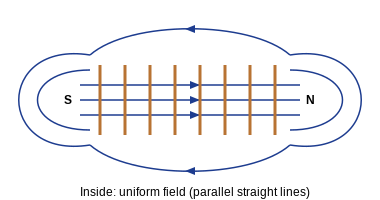
The pattern is like that of a bar magnet; inside, the field lines are parallel straight lines (uniform field).
Draw magnetic field lines around a bar magnet.
3 marks: short answer
A student fixes a sheet of white paper on a drawing board. He places a bar magnet in the centre of it. He sprinkles some iron filings uniformly around the bar magnet. Then he taps the drawing board gently and observes that the iron filings arrange themselves in a particular pattern. (a) Why do iron filings arrange in a particular pattern? (b) What does the crowding of iron filings at the ends of the magnet indicate? (c) What do the lines, along which the iron filings align, represent? (d) If the student places a cardboard horizontally in a current carrying solenoid and repeats the above activity, in what pattern would the iron filings arrange? State the conclusion drawn about the magnetic field based on the observed pattern of the lines.
Solution
(a) The magnet exerts a force on the iron filings; they become small magnets and align themselves along the magnetic field around the magnet.
(b) The crowding shows that the magnetic field is strongest at the poles.
(c) They represent the magnetic field lines.
(d) Inside the solenoid the filings arrange in parallel straight lines; outside, the pattern is like that of a bar magnet. Conclusion: the magnetic field inside a solenoid is the same at all points (uniform).
(a) What happens when a bundle of wires of soft iron is placed inside the coil of a solenoid carrying a steady current? Name the device obtained. Why is it called so?
(b) Draw the magnetic field lines inside a current carrying solenoid. What does this pattern of magnetic field lines indicate?
Solution
(a) The soft iron gets strongly magnetised by the field inside the solenoid. The device is an electromagnet. It is called so because it is a magnet produced by an electric current; it behaves as a magnet only while current flows through the coil.
(b)
The field lines inside the solenoid are parallel straight lines, which shows that the magnetic field is the same at all points (uniform) inside it.
Explain the meaning of overloading of an electrical circuit. List two possible causes due to which overloading may occur in household circuits. Write one preventive measure that should be taken to avoid overloading of domestic circuits.
Solution
Overloading occurs when the current drawn from the circuit becomes more than the safe limit for which the wires are designed; the wires heat up and may cause a fire.
Causes: (1) connecting too many appliances to a single socket; (2) an accidental hike in the supply voltage (also, a short-circuit when live and neutral wires touch).
Prevention: use an electric fuse / MCB of proper rating in the circuit, and do not connect too many appliances to one socket.
(i) Why is an alternating current (A.C.) considered to be advantageous over direct current (D.C.) for the long distance transmission of electric power?
(ii) How is the type of current used in household supply different from the one given by a battery of dry cells?
(iii) How does an electric fuse prevent the electric circuit and the appliances from a possible damage due to short circuiting or overloading.
For the current carrying solenoid as shown, draw magnetic field lines and give reason to explain that out of the three points A, B and C, at which point the field strength is maximum and at which point it is minimum?
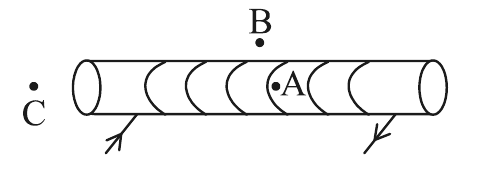
What is a Solenoid? Draw the pattern of the magnetic field lines around a current carrying solenoid. Mark on the pattern the region where the magnetic field is uniform.
4 marks: case-based / source-based
In our homes, we receive the supply of electric power through a main supply also called mains, either supported through overhead electric poles or by underground cables. In our country the potential difference between the two wires (live wire and neutral wire) of this supply is 220 V.
(a) Write the colours of the insulation covers of the line wires through which supply comes to our homes. 1
(b) What should be the current rating of the electric circuit (220 V) so that an electric iron of 1 kW power rating can be operated? 1
(c) (i) What is the function of the earth wire? State the advantage of the earth wire in domestic electric appliances such as electric iron. 2
OR
(c) (ii) List two precautions to be taken to avoid electrical accidents. State how these precautions prevent possible damage to the circuit/appliance. 2
Solution
(a) Live wire (positive) — red insulation; neutral wire (negative) — black insulation. (The earth wire has green insulation.)
(b)
(c) (i) The earth wire connects the metal body of the appliance to a metal plate deep in the earth. It provides a low-resistance conducting path for current. If the live wire touches the metal body of an iron due to faulty insulation, the leaking current flows to the earth, the potential of the body stays at that of the earth, and the user does not get a severe electric shock.
OR (c) (ii) (1) Use an electric fuse / MCB of proper rating in the circuit: it melts or trips when the current becomes too large (overloading or short-circuit), breaking the circuit and protecting the wiring and appliances. (2) Avoid overloading — do not connect too many appliances to a single socket, so that excessive current does not flow and overheat the wires. (Also: earth all metal-bodied appliances.)
A student fixes a sheet of white paper on a drawing board using some adhesive materials. She places a bar magnet in the centre of it and sprinkles some iron filings uniformly around the bar magnet using a salt-sprinkler. On tapping the board gently, she observes that the iron filings have arranged themselves in a particular pattern.
(a) Draw a diagram to show this pattern of iron filings. 1
(b) Draw the magnetic field lines of a bar magnet showing the poles of the bar magnet as well as the direction of the magnetic field lines. 1
(c) (i) How is the direction of magnetic field at a point determined using the field lines? Why do two magnetic field lines not cross each other? 2
OR
(c) (ii) How are the magnetic field lines of a bar magnet drawn using a small compass needle? Draw one magnetic field line each on both sides of the magnet. 2
Solution
(a) and (b) The iron filings arrange themselves along curved lines from one end of the magnet to the other, crowded near the poles. The field lines (closed curves) go from the N pole to the S pole outside the magnet:
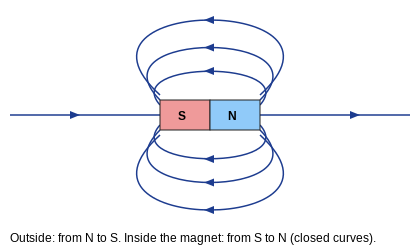
(c) (i) The direction of the field at a point is given by the tangent to the field line at that point (the direction in which the north pole of a compass needle points). Two field lines never cross, because at the point of intersection the compass needle would have to point in two directions at once, which is not possible.
OR (c) (ii) Place a small compass near the N pole of the magnet and mark the positions of its two ends with dots. Move the compass so that its south end is at the dot where the north end was, and mark the new position of the north end. Repeat until the S pole of the magnet is reached. Join the dots with a smooth curve — this is one field line. Repeat from other starting points to draw more lines (one on each side of the magnet, as in the diagram above).
5 marks: long answer
(i) State the rule which gives the direction of force acting on a current-carrying conductor placed in a magnetic field.
(ii) What is a fuse? Why is it called a safety device?
(iii) Why are electrical appliances with metallic bodies connected to the mains through a three-pin plug, whereas an electric bulb is connected with a two-pin plug?
(iv) 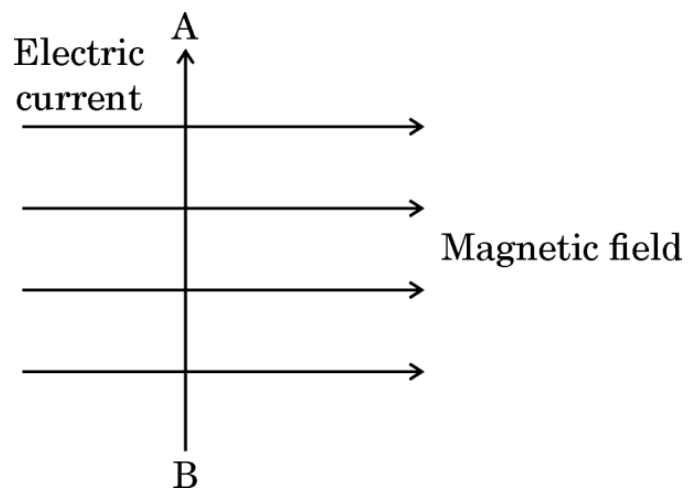
What will be the direction of force experienced by the conductor AB due to the magnetic field, when current flows in the direction shown? Name the law you applied to find the direction.
Solution
(i) Fleming's left-hand rule: stretch the thumb, forefinger and middle finger of the left hand so that they are mutually perpendicular. If the forefinger points in the direction of the magnetic field and the middle finger in the direction of current, the thumb points in the direction of the force (motion) on the conductor.
(ii) A fuse is a short piece of wire of low melting point connected in series with the circuit. When too much current flows (overloading or short-circuit), the wire heats up and melts, breaking the circuit. It protects the circuit and appliances from damage, so it is called a safety device.
(iii) In a three-pin plug the third pin connects the metal body of the appliance to the earth wire. If the live wire touches the metal body, current flows to the earth through this low-resistance path and the user does not get a severe shock. A bulb has no metal body that a person touches, so it does not need earthing and a two-pin plug is enough.
(iv) Current flows from B to A (upwards) and the field is from left to right. By Fleming's left-hand rule the force on AB is perpendicular to the plane of the paper, directed into the page.
(i) Draw the pattern of magnetic field lines through and around a current-carrying circular loop.
(ii) State the rule to find out the direction of the magnetic field inside and around the circular loop.
(iii) Give reasons: (I) Why should a burnt-out fuse be replaced by another fuse of identical rating only, in an electric circuit? (II) Why is soft iron-core used in making an electromagnet?
Solution
(i) The field lines are concentric circles near each point of the wire; near the centre of the loop they become almost straight and parallel, all in the same direction.
(ii) Right-hand thumb rule: imagine holding the current-carrying wire in the right hand with the thumb pointing in the direction of current; the curled fingers give the direction of the magnetic field lines around it. (Applied to each part of the loop, it shows that inside the loop all the lines point in the same direction.)
(iii) (I) A fuse of the same rating melts at the safe current limit. A fuse of higher rating would not melt during overloading and would not protect the circuit; a fuse of lower rating would melt even with normal current and the appliance would not work.
(II) Soft iron gets strongly magnetised when current flows in the coil and loses its magnetism as soon as the current is switched off. So the electromagnet can be switched on and off.
(i) What is a solenoid? Draw a diagram showing the magnetic field pattern due to a current-carrying solenoid (inside and outside).
(ii) Name any two factors on which the magnitude of the magnetic field due to a current-carrying solenoid depends.
(iii) A current-carrying solenoid is stretched and converted into a straight wire carrying current. Draw a diagram showing the magnetic field pattern around it and mark the direction of the magnetic field.
Solution
(i) A solenoid is a coil of many circular turns of insulated copper wire wrapped closely in the shape of a cylinder. Its field is like that of a bar magnet; inside, the field lines are parallel straight lines, showing a uniform field.
(ii) (1) The number of turns in the solenoid; (2) the strength of the current in it. (Also the nature of the core material.)
(iii) Around a straight current-carrying wire, the field lines are concentric circles centred on the wire. By the right-hand thumb rule, for current flowing upward the field is anticlockwise when seen from above.
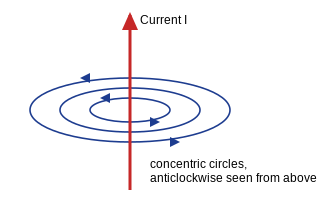
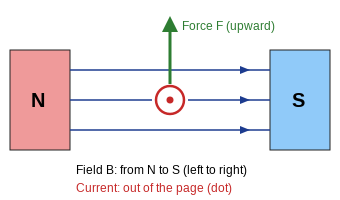
(i) With the help of a diagram, show that a current-carrying conductor placed in an external magnetic field, experiences a force. Indicate the direction of the field, current and force clearly.
(ii) The diagram given below shows an electron moving in a uniform magnetic field.
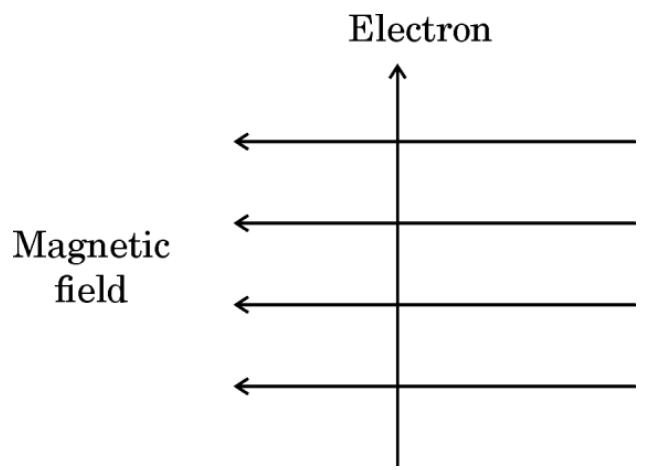
(I) What will be the direction of the force acting on the electron? (II) What will happen to the direction of the force acting on the electron, if the direction of the magnetic field as well as the direction of motion of the electron, both are reversed?
Solution
(i) A conductor carrying current, placed between the poles of a magnet (perpendicular to the field), is pushed sideways — this is the force on a current-carrying conductor. With the field from N to S (left to right) and the current coming out of the page, Fleming's left-hand rule gives an upward force. Reversing either the current or the field reverses the force.
(ii) (I) The electron moves upward, so the conventional current is downward (opposite to the electron's motion). The field is towards the left. By Fleming's left-hand rule (forefinger left, middle finger down), the thumb — the force — points into the plane of the paper.
(II) Reversing both the field and the direction of motion leaves the force in the same direction (into the paper); reversing only one of them would reverse it.
The given figure shows the current passing through the straight conductor XY.
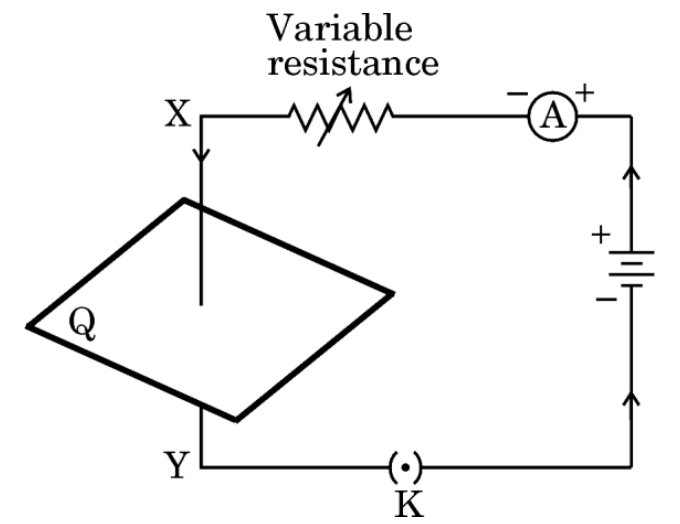
(i) Copy the diagram and draw the magnetic field lines when current flows from conductor X to Y.
(ii) Name and state the rule used in determining the direction of the magnetic field lines in the situation given above.
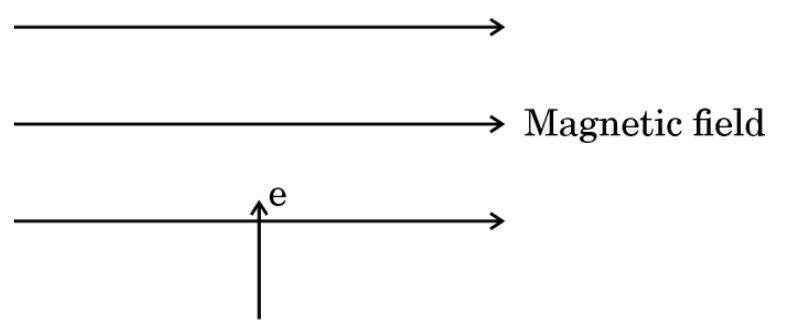
(iii) State Fleming’s left hand rule. Using this rule, determine the direction of force applied on an electron entering a uniform magnetic field as shown in the figure.
(i) Define the term solenoid. Draw the pattern of the magnetic field lines in and around a current carrying straight solenoid. Mark on the pattern the (i) direction of current, (ii) direction of field lines near the ends of the solenoid, and (iii) region where the magnetic field is uniform.
(ii) How would you make an electromagnet using a current carrying solenoid?
(a) State Fleming’s Left-hand rule. (b) List three characteristic features of the electric current used in our homes. (c) What is a fuse? Why is it called a safety device? (d) Why is it necessary to earth metallic electric appliances?
Draw the pattern of magnetic field lines produced around a current carrying straight conductor passing perpendicularly through a horizontal cardboard. State and apply right-hand thumb rule to mark the direction of the field lines. How will the strength of the magnetic field change when the point where magnetic field is to be determined is moved away from the straight conductor? Give reason to justify your answer.
Get every solution for all chapters
- Every board question of every chapter, each fully solved the way the board gives marks
- 17 complete board papers, each followed by its solutions
- Weightage and most-asked topics for every chapter
- Instant PDF download, colour and black & white print copies
Revising the chapter first? Complete Science Notes for Class 10 (NCERT 2026-27) →
What you get in the pack
- Questions from 126 CBSE papers, 2016 to 2026: every set code available
- Complete: 2405 different questions and parts from all set codes, 13 chapters and 17 full papers
- Part A: all 13 chapters, questions sorted chapter-wise and by marks
- Year-wise weightage table and most-asked topics for every chapter
- Part B: 17 full board papers, each followed by its complete solutions, for timed practice
- Answers written to the CBSE marking-scheme points, with labelled diagrams drawn in full
- Questions on topics out of the board syllabus flagged
All chapters in this pack
- PYQ Ch 1 Chemical Reactions and Equations
- PYQ Ch 2 Acids, Bases and Salts
- PYQ Ch 3 Metals and Non-metals
- PYQ Ch 4 Carbon and its Compounds
- PYQ Ch 5 Life Processes
- PYQ Ch 6 Control and Coordination
- PYQ Ch 7 How do Organisms Reproduce
- PYQ Ch 8 Heredity
- PYQ Ch 9 Light Reflection and Refraction
- PYQ Ch 10 The Human Eye and the Colourful World
- PYQ Ch 11 Electricity
- PYQ Ch 12 Magnetic Effects of Electric Current
- PYQ Ch 13 Our Environment
- Board Paper 2026 Set 31-2-1 with Solutions
- Board Paper 2026 Set 31-3-1 with Solutions
- Board Paper 2025 Set 31-1-1 with Solutions
- Board Paper 2025 Set 31-2-1 with Solutions
- Board Paper 2024 Set 31-4-1 with Solutions
- Board Paper 2024 Set 31-5-1 with Solutions
- Board Paper 2023 Set 31-2-1 with Solutions
- Board Paper 2023 Set 31-4-1 with Solutions
- Board Paper 2022 Term 2 Set 31-1-1 with Solutions
- Board Paper 2022 Term 2 Set 31-3-1 with Solutions
- Board Paper 2020 Set 31-2-1 with Solutions
- Board Paper 2020 Set 31-4-1 with Solutions
- Board Paper 2019 Set 31-2-1 with Solutions
- Board Paper 2019 Set 31-4-1 with Solutions
- Board Paper 2018 Set 31-1 with Solutions
- Board Paper 2017 Set 3 with Solutions
- Board Paper 2016 Set 31-1 with Solutions