
The Human Eye and the Colourful World: Class 10 PYQs 2016–2026 with solutions
All 43 CBSE board questions asked from The Human Eye and the Colourful World in 15 board papers, with the year, set and marks of each. 23 are solved free below. The Class 10 Science PYQ Book: Solved Board Papers 2016-2026 (CBSE) has every solution, all chapters and 17 full board papers.
Subject expert: Khushbu Gupta, B.Sc., M.Sc. Physics, B.Ed. · 8+ years teaching


Free: NCERT solutions for Class 10 Science →
The Human Eye and the Colourful World: board weightage
Board weightage 2016–2026
| Year | 2016 | 2017 | 2018 | 2019 | 2020 | 2022 | 2023 | 2024 | 2025 | 2026 |
|---|---|---|---|---|---|---|---|---|---|---|
| Questions | 3 | 3 | 2 | 6 | 6 | – | 5 | 7 | 3 | 8 |
| Marks | 9 | 9 | 10 | 20 | 14 | – | 9 | 14 | 6 | 16 |
Most asked topics
43 questions from 15 papers. Repeated questions are shown once with every year they were asked.
Jump to: 1 mark2 marks3 marks4 marks5 marks
1 mark: MCQ and Assertion–Reason
A thin beam of white light falls on a face of a glass prism and a spectrum is obtained on a screen. Which of the following options is the correct sequence of colours from top to bottom on the screen?
Solution
Answer: (B)
Red bends the least and violet bends the most, so on the screen (prism with base downward) red is at the top and violet at the bottom: VIBGYOR read from bottom — red, orange, yellow, green, blue, indigo, violet from the top.
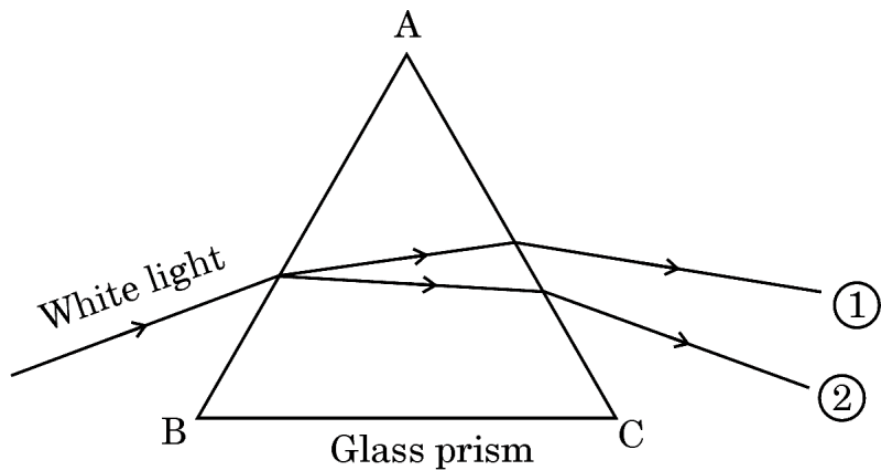
Observe the given ray diagram showing refraction through a prism and choose the correct option for colour of rays 1 and 2:
Solution
Answer: (C) Ray 1 Red, Ray 2 Violet
Red light bends the least and violet bends the most. Ray 1 is deviated less (towards the top), so it is red; ray 2 is deviated more, so it is violet.
An old person is suffering from an eye defect caused by weakening of ciliary muscles and diminishing flexibility of the eye lens. If the defect of vision is ‘a’ which can be corrected by lens ‘b’, then ‘a’ and ‘b’ respectively are:
Solution
Answer: (B)
With age, the ciliary muscles weaken and the lens becomes less flexible, so the power of accommodation decreases — this is presbyopia. Such people often have both myopia and hypermetropia and need bifocal lenses (upper part concave for distance, lower part convex for reading).
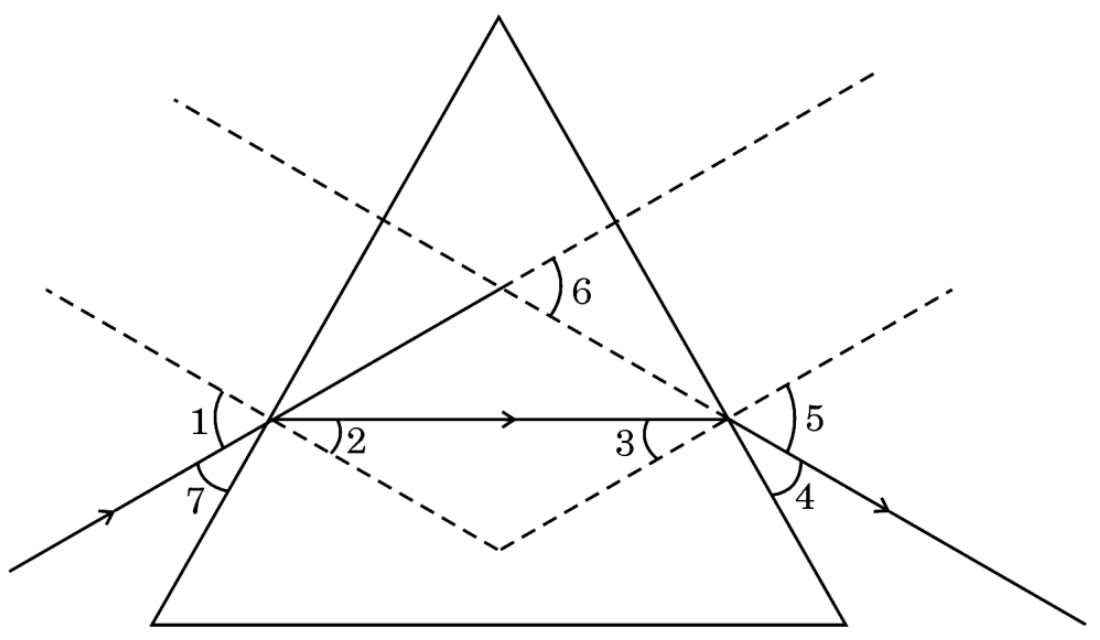
In the given figure the angle of incidence and the angle of deviation respectively are:
Solution
Answer: (D) 1 and 6
The angle of incidence is between the incident ray and the normal (angle 1, not angle 7 which is with the surface). The angle of deviation is between the extended incident ray and the emergent ray (angle 6).
When a beam of white light passes through a region having very fine dust particles, the colour of light mainly scattered in that region is:
Solution
Answer: (C) Blue
Very fine particles scatter mainly the shorter wavelengths (blue end of the spectrum).
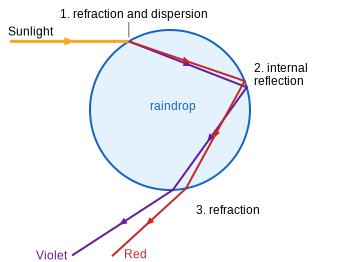
The phenomena of light involved in the formation of rainbow are:
Solution
Answer: (B)
Raindrops refract and disperse sunlight, reflect it internally, and refract it again as it comes out.
The colour of light for which the refractive index of glass is minimum, is:
Assertion (A): A person suffering from myopia cannot see the distant objects clearly.
Reason (R): A converging lens is used for the correction of myopic eye as it can form real as well as virtual images of the objects placed in front of it.
Consider the following reasons for the reddish appearance of the sun at the sunrise or the sunset: A. Light from the sun near the horizon passes through thinner layers of air. B. Light from the sun covers larger distance of the earth’s atmosphere before reaching our eyes. C. Near the horizon, most of the blue light and shorter wavelengths are scattered away by the particles. D. Light from the sun near the horizon passes through thicker layers of air. The correct reasons are
Person suffering from cataract has
Study the following ray diagram (the ray enters through the right face of the prism):
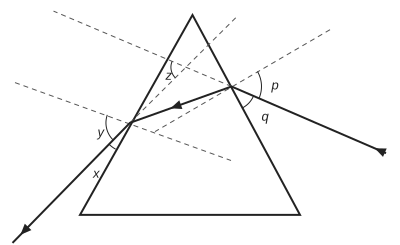
In this diagram, the angle of incidence, the angle of emergence and the angle of deviation respectively have been represented by
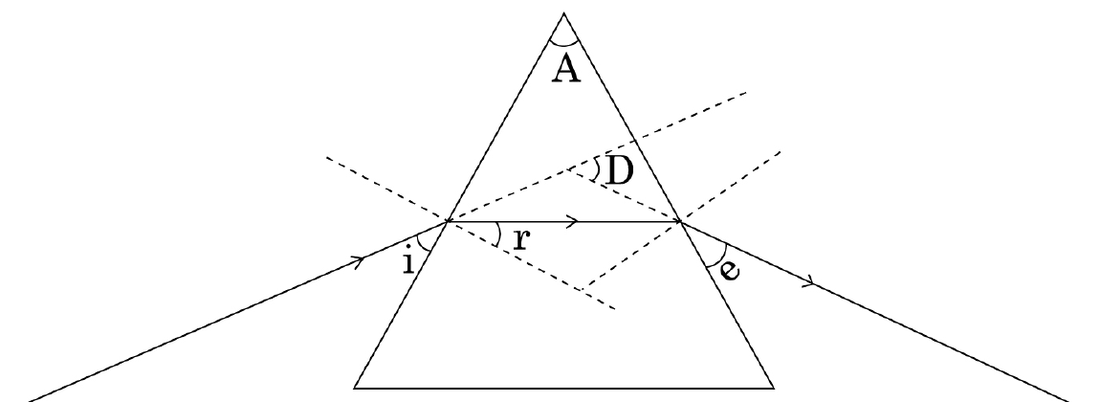
In the following ray diagram the correctly marked angle are:
2 marks: very short answer
How does the focal length of eye lens change as the distance of the object from the eyes is altered? Explain.
Solution
The ciliary muscles change the curvature of the eye lens (power of accommodation):
• When the object is far, the ciliary muscles relax, the lens becomes thin and its focal length increases.
• When the object is near, the ciliary muscles contract, the lens becomes thick and its focal length decreases.
In both cases the image is formed on the retina.
Why is the concave lens used as a corrective lens for a myopic eye?
Solution
In myopia (near-sightedness) the image of a distant object is formed in front of the retina (eyeball too long or lens too curved). A concave (diverging) lens of suitable power spreads the rays out a little before they enter the eye, so the eye lens now brings them to focus on the retina. In effect, the lens makes rays from far away appear to come from the far point of the myopic eye.
What happens when light is scattered from (i) very fine particles and (ii) very large size particles of medium? Justify your answer in each case.
Solution
(i) Very fine particles (such as air molecules) scatter mainly light of shorter wavelengths — the blue end of the spectrum. That is why the clear sky appears blue.
(ii) Large particles (larger than the wavelength of light, such as water droplets in clouds) scatter all wavelengths almost equally, so the scattered light appears white. That is why clouds look white.
Justification: the colour of scattered light depends on the size of the scattering particles.
With the help of a ray diagram, explain any phenomenon of formation of spectrum in nature.
Solution
Rainbow: a rainbow is a natural spectrum seen in the sky after a rain shower, in the direction opposite to the Sun. Tiny water droplets in the air act like small prisms. Sunlight entering a droplet is refracted and dispersed into its colours, then internally reflected at the back of the droplet, and refracted again as it comes out. The different colours emerge at different angles and reach the observer's eye as a band of colours.
A person suffering from presbyopia needs bifocal lens. If he needs two lens of power −4.0 dioptre and +2.0 dioptre, which one of these two lenses is for the correction of distant vision and what is its focal length?
Solution
Distant vision (myopia) is corrected by a concave lens — the lens of power −4.0 D (upper part of the bifocal).
When and where does a rainbow appear in the sky? Draw a labelled ray diagram to show its formation.
Solution
A rainbow appears after a rain shower, in the sky opposite to the Sun (the Sun is behind the observer). Water droplets act like tiny prisms: they refract and disperse sunlight, reflect it internally and refract it again.
What is scattering of light? Why does the clear sky appear blue?
Observe the following diagram and answer the questions following it:
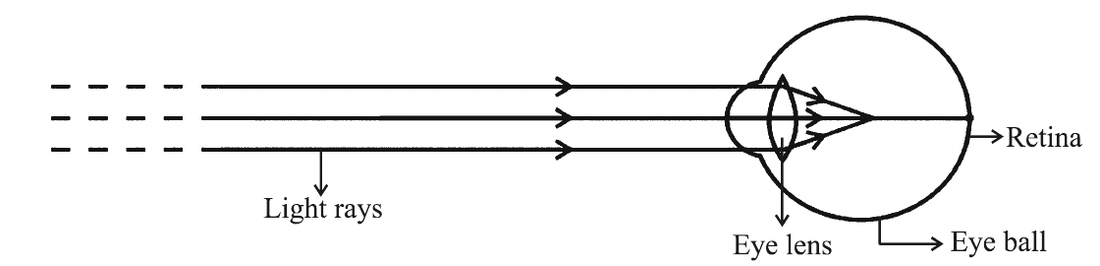
(i) Identify the defect of vision shown. (ii) List its two causes. (iii) Name the type of lens used for the correction of this defect.
The colour of clear sky from the earth appears blue but from the space it appears black. Why?
A student traces the path of a ray of light through a glass prism as shown in the diagram, but leaves it incomplete and unlabelled. Redraw and complete the diagram. Also label on it ∠i, ∠e, ∠r and ∠D.
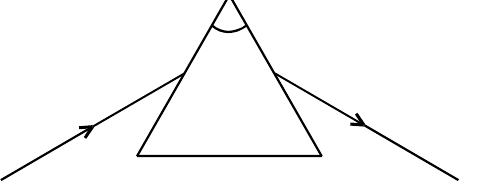
A student has to trace the path of a ray of light through a glass prism. List four precautions he should observe for better results.
3 marks: short answer
What is scattering of light? How is scattering of light different from reflection of light? Explain.
Solution
Scattering: when light falls on very small particles of a medium (dust, smoke, air molecules), it is thrown off (spread) in different directions. This is scattering of light. Example: the path of a beam of light becomes visible in a dusty room (Tyndall effect).
Difference from reflection:
• In reflection, light bounces back from a surface in a fixed direction obeying the laws of reflection; in scattering it spreads in all directions.
• Reflection does not depend on the size of particles; the colour of scattered light depends on the size of the particles — very fine particles scatter mainly blue light (blue sky), larger particles scatter all colours (white clouds).
Study the given diagram and answer the questions that follow:
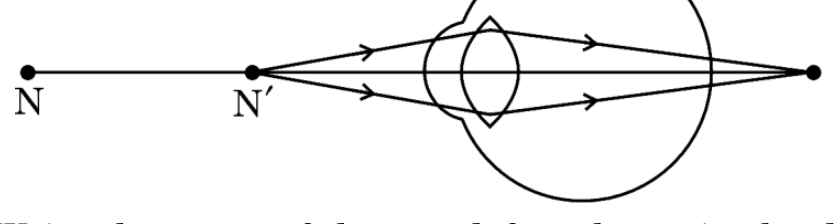
(a) Write the name of the eye defect shown in the diagram. Where is the image formed in this eye defect with respect to the retina of the eye?
(b) List two causes of this eye defect.
(c) With the help of a diagram, show how this eye defect of vision is corrected.
Solution
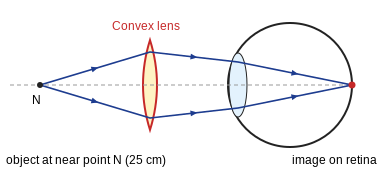
(a) Hypermetropia (far-sightedness). Rays from a nearby object meet behind the retina, so near objects look blurred.
(b) Causes: (1) the focal length of the eye lens is too long; (2) the eyeball has become too small.
(c) It is corrected with a convex (converging) lens of suitable power. The lens gives the extra focusing power needed, so the image of a near object is formed on the retina:
Define the term power of accommodation of human eye. What happens to the image distance in the eye when we increase the distance of an object from the eye? Name and explain the role of the part of human eye responsible for it in this case.
Solution
Power of accommodation: the ability of the eye lens to adjust its focal length so that both near and distant objects are seen clearly.
The image distance stays the same — the image is always formed on the retina (the distance between the eye lens and the retina is fixed).
This is done by the ciliary muscles. When the object is moved farther away, the ciliary muscles relax, the lens becomes thinner and its focal length increases, so the image still falls on the retina.
Study the diagram given below and answer the questions that follow:
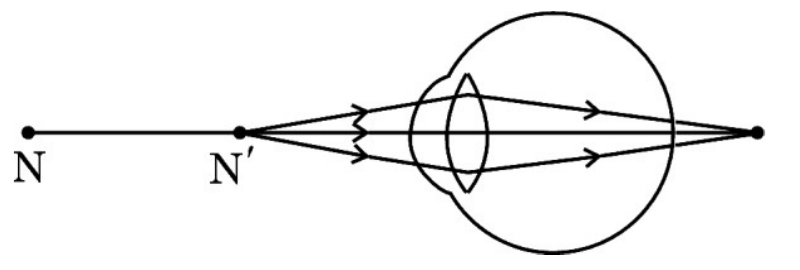
(i) Name the defect of vision depicted in this diagram stating the part of the eye responsible for this condition. (ii) List two causes of this defect. (iii) Name the type of lens used to correct this defect and state its role in this case.
Solution
(i) Hypermetropia (far-sightedness): the rays from a near object meet behind the retina. The part responsible is the eye lens (and the eyeball).
(ii) (1) The focal length of the eye lens is too long. (2) The eyeball has become too small.
(iii) A convex (converging) lens of suitable power. It provides the additional focusing power so that the image of a near object is formed on the retina.
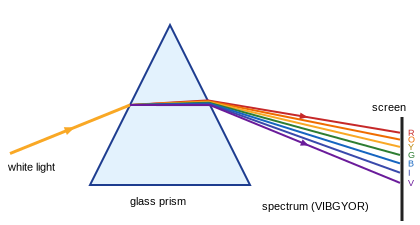
What is dispersion of white light? State its cause. Draw a diagram to show dispersion of a beam of white light by a glass prism.
Solution
Dispersion is the splitting of white light into its seven component colours (the spectrum).
Cause: different colours of light bend through different angles with respect to the incident ray as they pass through the prism (glass has a different refractive index for each colour). Red bends the least and violet the most.
(a) List two causes of hypermetropia. (b) Draw ray diagrams showing (i) a hypermetropic eye and (ii) its correction using suitable optical device.
Solution
(a) (1) The focal length of the eye lens is too long. (2) The eyeball has become too small.
(b) (i) 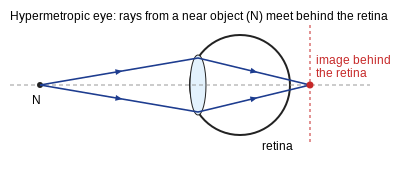
(ii) Correction with a convex lens of suitable power:
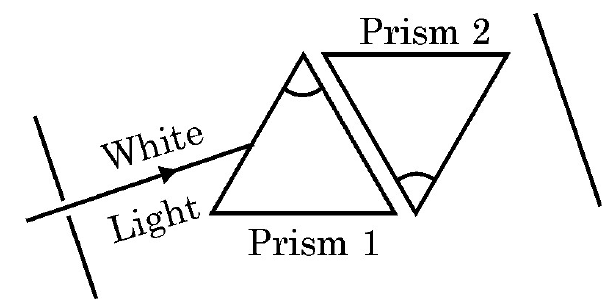
(a) State the relation between colour of scattered light and size of the scattering particle. (b) The apparent position of an object, when seen through the hot air, fluctuates or wavers. State the basic cause of this observation. (c) Complete the path of white light when it passes through two identical prisms placed as shown:
Solution
(a) Very fine particles scatter mainly blue light (shorter wavelengths); larger particles scatter light of longer wavelengths too, and very large particles scatter all colours equally (so the scattered light looks white).
(b) Atmospheric refraction: hot air above a fire is optically rarer than the cooler air above it, and its refractive index keeps changing, so the light from the object is refracted by varying amounts and its apparent position fluctuates.
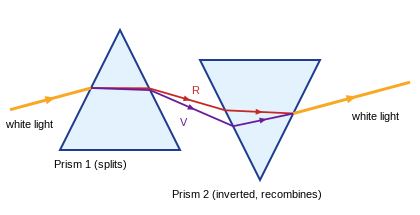
(c) The first prism disperses white light into a spectrum; the second, inverted prism bends all colours back so they recombine, and white light emerges, parallel to the incident beam:
A person may suffer from both myopia and hypermetropia defects. (a) What is this condition called? (b) When does it happen? (c) Name the type of lens often required by the persons suffering from this defect. Draw labelled diagram of such lenses.
How will you use two identical glass prisms so that a narrow beam of white light incident on one prism emerges out of the second prism as white light? Draw and label the ray diagram.
What is the cause of dispersion of white light through a glass prism? Draw a ray diagram to show the path of light when two identical glass prisms are arranged together in inverted position with respect to each other and a narrow beam of white light is allowed to fall obliquely on one of the faces of the prisms.
What is scattering of light? Use this phenomenon to explain why (i) the Sun appears reddish at sun-rise, and (ii) the clear sky appears blue.
What is “dispersion of white light”? Draw a labelled diagram to illustrate the recombination of the spectrum of white light. Why it is essential that the two prisms used for the purpose should be identical and placed in an inverted position with respect to each other?
Describe an activity to show that the colours of white light splitted by a glass prism can be recombined to get white light by another identical glass prism. Also draw ray diagram to show the recombination of the spectrum of white light.
4 marks: case-based / source-based
A person allowed a narrow beam of white light from the sun to enter a dark room through a small aperture and placed a glass prism in its path in such a manner that the beam falls on the face AB of the prism as shown in the figure. A screen S is placed on the other side of the prism, facing AC. On turning the prism slowly, a beautiful band of colours is obtained on the screen. It is the spectrum of sunlight.
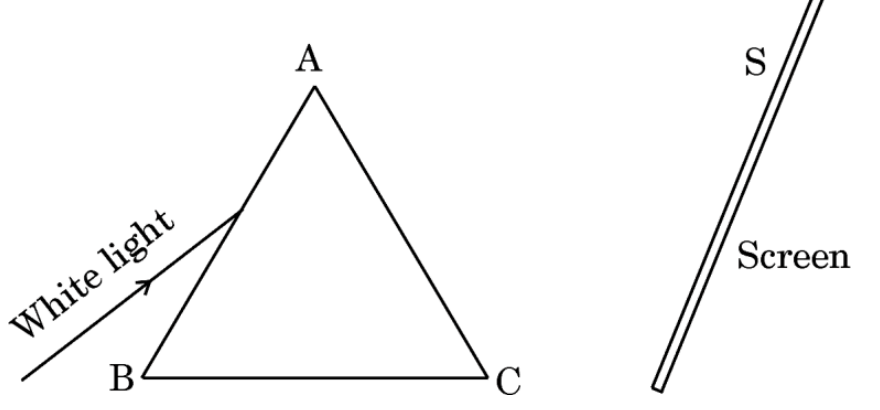
(a) Name the phenomenon due to which a prism splits the incident white light into a band of colours. 1
(b) State the reason of getting a band of seven colours in the above case. 1
(c) (i) Explain with the help of a labelled ray diagram, an experimental arrangement to show the recombination of the spectrum of white light. 2
OR
(c) (ii) Draw a labelled ray diagram to show the formation of a rainbow. 2
Solution
(a) Dispersion of white light.
(b) The different colours of light bend through different angles with respect to the incident ray as they pass through the prism (each colour travels at a different speed in glass). Red bends the least and violet the most, so the colours separate into a band.
(c) (i) Newton's experiment: place a second identical prism in an inverted position next to the first. The spectrum formed by the first prism enters the second prism, which bends all the colours back by the same amounts. The colours recombine and a beam of white light emerges from the second prism.
OR (c) (ii) Sunlight entering a raindrop is refracted and dispersed, internally reflected, and refracted again as it comes out, forming the spectrum we see as a rainbow (opposite the Sun):
5 marks: long answer
When do we consider a person to be myopic or hypermetropic? List two causes of hypermetropia. Explain using ray diagrams how the defect associated with hypermetropic eye can be corrected.
Solution
A person is myopic (near-sighted) when he can see nearby objects clearly but not distant objects — the far point is nearer than infinity, and the image of a distant object forms in front of the retina.
A person is hypermetropic (far-sighted) when he can see distant objects clearly but not nearby objects — the near point is farther than 25 cm, and the image of a near object forms behind the retina.
Causes of hypermetropia: (1) the focal length of the eye lens is too long; (2) the eyeball has become too small.
Correction: a convex lens of suitable power provides the extra focusing power so that the image of a near object is formed on the retina.
A person is unable to see objects distinctly placed within 50 cm from his eyes. (a) Name the defect of vision the person is suffering from and list its two possible causes. (b) Draw a ray diagram to show the defect in the above case. (c) Mention the type of lens used by him for the correction of the defect and calculate its power. Assume that the near point for the normal eye is 25 cm. (d) Draw a labelled diagram for the correction of the defect in the above case.
Solution
(a) Hypermetropia (far-sightedness) — his near point is 50 cm instead of 25 cm. Causes: (1) the focal length of the eye lens is too long; (2) the eyeball has become too small.
(b)
(c) A convex lens. It must form a virtual image at 50 cm (his near point) of an object at 25 cm: u = −25 cm, v = −50 cm.
P = 1/f = +2 D
(d)
(a) A student is unable to see clearly the words written on the black board placed at a distance of approximately 3 m from him. Name the defect of vision the boy is suffering from. State the possible causes of this defect and explain the method of correcting it. (b) Why do stars twinkle? Explain.
Solution
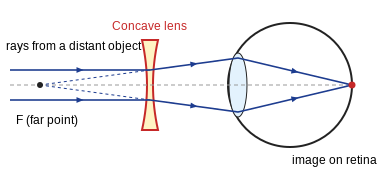
(a) Myopia (near-sightedness). Causes: (1) excessive curvature of the eye lens; (2) elongation of the eyeball. The image of a distant object forms in front of the retina.
Correction: a concave lens of suitable power diverges the rays slightly, so the image forms on the retina.
(b) Starlight is refracted repeatedly as it passes through layers of air of changing refractive index (atmospheric refraction). Since the physical conditions keep changing, the apparent position of the star fluctuates and the amount of light entering the eye keeps changing — the star appears brighter at one moment and fainter at the next, so it twinkles. (Stars are very distant point sources, so the effect is noticeable.)
(a) Write the function of each of the following parts of human eye: (i) Cornea (ii) Iris (iii) Crystalline lens (iv) Ciliary muscles (b) Why does the sun appear reddish early in the morning? Will this phenomenon be observed by an astronaut on the Moon? Give reason to justify your answer.
(a) A student suffering from myopia is not able to see distinctly the object placed beyond 5 m. List two possible reasons due to which this defect of vision may have arisen. With the help of ray diagrams explain: (i) Why the student is unable to see distinctly the objects placed beyond 5 m from his eyes. (ii) The type of the corrective lens used to restore proper vision and how this defect is corrected by the use of this lens. (b) If, in this case, the numerical value of the focal length of the corrective lens is 5 m, find the power of the lens as per the new Cartesian sign convention.
What is atmospheric refraction? Use this phenomenon to explain the following natural events. (a) Twinkling of stars (b) Advanced sun-rise and delayed sun-set. Draw diagrams to illustrate your answers.
Get every solution for all chapters
- Every board question of every chapter, each fully solved the way the board gives marks
- 17 complete board papers, each followed by its solutions
- Weightage and most-asked topics for every chapter
- Instant PDF download, colour and black & white print copies
Revising the chapter first? Complete Science Notes for Class 10 (NCERT 2026-27) →
What you get in the pack
- Questions from 126 CBSE papers, 2016 to 2026: every set code available
- Complete: 2405 different questions and parts from all set codes, 13 chapters and 17 full papers
- Part A: all 13 chapters, questions sorted chapter-wise and by marks
- Year-wise weightage table and most-asked topics for every chapter
- Part B: 17 full board papers, each followed by its complete solutions, for timed practice
- Answers written to the CBSE marking-scheme points, with labelled diagrams drawn in full
- Questions on topics out of the board syllabus flagged
All chapters in this pack
- PYQ Ch 1 Chemical Reactions and Equations
- PYQ Ch 2 Acids, Bases and Salts
- PYQ Ch 3 Metals and Non-metals
- PYQ Ch 4 Carbon and its Compounds
- PYQ Ch 5 Life Processes
- PYQ Ch 6 Control and Coordination
- PYQ Ch 7 How do Organisms Reproduce
- PYQ Ch 8 Heredity
- PYQ Ch 9 Light Reflection and Refraction
- PYQ Ch 10 The Human Eye and the Colourful World
- PYQ Ch 11 Electricity
- PYQ Ch 12 Magnetic Effects of Electric Current
- PYQ Ch 13 Our Environment
- Board Paper 2026 Set 31-2-1 with Solutions
- Board Paper 2026 Set 31-3-1 with Solutions
- Board Paper 2025 Set 31-1-1 with Solutions
- Board Paper 2025 Set 31-2-1 with Solutions
- Board Paper 2024 Set 31-4-1 with Solutions
- Board Paper 2024 Set 31-5-1 with Solutions
- Board Paper 2023 Set 31-2-1 with Solutions
- Board Paper 2023 Set 31-4-1 with Solutions
- Board Paper 2022 Term 2 Set 31-1-1 with Solutions
- Board Paper 2022 Term 2 Set 31-3-1 with Solutions
- Board Paper 2020 Set 31-2-1 with Solutions
- Board Paper 2020 Set 31-4-1 with Solutions
- Board Paper 2019 Set 31-2-1 with Solutions
- Board Paper 2019 Set 31-4-1 with Solutions
- Board Paper 2018 Set 31-1 with Solutions
- Board Paper 2017 Set 3 with Solutions
- Board Paper 2016 Set 31-1 with Solutions