
Chemical Reactions and Equations: Class 10 PYQs 2018–2026 with solutions
All 42 CBSE board questions asked from Chemical Reactions and Equations in 13 board papers, with the year, set and marks of each. 22 are solved free below. The Class 10 Science PYQ Book: Solved Board Papers 2016-2026 (CBSE) has every solution, all chapters and 17 full board papers.
Subject expert: Khushbu Gupta, B.Sc., M.Sc. Physics, B.Ed. · 8+ years teaching


Free: NCERT solutions for Class 10 Science →
Chemical Reactions and Equations: board weightage
Board weightage 2018–2026
| Year | 2016 | 2017 | 2018 | 2019 | 2020 | 2022 | 2023 | 2024 | 2025 | 2026 |
|---|---|---|---|---|---|---|---|---|---|---|
| Questions | – | – | 2 | 5 | 5 | – | 9 | 8 | 6 | 7 |
| Marks | – | – | 5 | 13 | 11 | – | 15 | 20 | 11 | 11 |
Most asked topics
42 questions from 13 papers. Repeated questions are shown once with every year they were asked.
Jump to: 1 mark2 marks3 marks5 marks
1 mark: MCQ and Assertion–Reason
Which of the following are combination reactions?
(i) 2KClO3 → 2KCl + 3O2
(ii) MgO + H2O → Mg(OH)2
(iii) 4Al + 3O2 → 2Al2O3
(iv) Zn + FeSO4 → ZnSO4 + Fe
Solution
Answer: (D) (ii) and (iii)
In a combination reaction two or more reactants form a single product: (ii) MgO + H2O → Mg(OH)2 and (iii) 4Al + 3O2 → 2Al2O3. (i) is decomposition and (iv) is displacement.
When ferrous sulphate crystals are heated in a test tube, we observe that:
Solution
Answer: (C)
2FeSO4 → Fe2O3 + SO2 + SO3 (thermal decomposition). The green crystals lose water and change colour, and SO2/SO3 gases with the smell of burning sulphur are given off.
A student notices that her silver jewellery turned dull and had a grey-black coating over it after wearing for a few months. What results in the change in colour of the silver metal?
Solution
Answer: (B)
Silver corrodes: it reacts with sulphur compounds in the air to form a black coating of silver sulphide. (Rusting is the corrosion of iron only.)
Which of the following is an example of a displacement reaction?
Solution
Answer: (B)
A reactive metal displaces hydrogen from the acid, e.g. Zn + H2SO4 → ZnSO4 + H2. (A) is combustion, (C) is decomposition and (D) is combination.
In the following equation: x KI + H2O2 → I2 + y KOH, x and y respectively are:
Solution
Answer: (A) 2, 2
I2 on the right needs 2 iodine atoms, so x = 2. Then 2 K atoms need y = 2. Check O: 2 on each side; H: 2 on each side.
Electrolysis of water is a decomposition reaction. The mass ratio (MH : MO) of hydrogen and oxygen gases liberated at the electrodes during electrolysis of water is:
Solution
Answer: (D) 1 : 8
2H2O → 2H2 + O2. Mass of 2H2 = 2 × 2 = 4 u; mass of O2 = 32 u. Ratio 4 : 32 = 1 : 8. (By volume the ratio is 2 : 1 — do not confuse the two.)
Assertion (A): Decomposition reactions are generally endothermic reactions.
Reason (R): Decomposition of organic matter into compost is an exothermic process.
Solution
Answer: (B)
Both are true. Most decomposition reactions need energy (heat, light or electricity) to break the reactant, so they are endothermic. Composting releases heat. But R is an exception and does not explain A.
The correct balanced chemical equation showing exothermic reaction in which natural gas burns in air is:
Solution
Answer: (D)
Methane (natural gas) burns: CH4 + 2O2 → CO2 + 2H2O + energy. Check: C 1 = 1; H 4 = 4; O 4 = 2 + 2. (A) and (B) are not balanced, and (C) does not show the energy released (exothermic).
Zn + 2CH3COOH → (CH3COO)2Zn + H2. The above reaction is a:
Solution
Answer: (B) Displacement reaction
Zinc, being more reactive, displaces hydrogen from ethanoic acid, forming zinc ethanoate and hydrogen gas.
To balance the following chemical equation, the values of the coefficients x, y and z must be respectively: x Zn(NO3)2 → y ZnO + z NO2 + O2
Which of the following is a redox reaction, but not a combination reaction?
Which of the following is an example of endothermic process?
In order to balance the following chemical equation, the values of the coefficients x and y respectively are: x Pb(NO3)2 →(heat) 2PbO + y NO2 + O2
When aqueous solutions of potassium iodide and lead nitrate are mixed, an insoluble substance separates out. The chemical equation for the reaction involved is:
A metal ribbon ‘X’ burns in oxygen with a dazzling white flame forming a white ash ‘Y’. The correct description of X, Y and the type of reaction is:
Assertion (A): Reaction of Quicklime with water is an exothermic reaction.
Reason (R): Quicklime reacts vigorously with water releasing a large amount of heat.
Identify ‘x’, ‘y’ and ‘z’ in the following reaction: 2KClO3(x) —(y)→ 2KCl(x) + O2(z)
Assertion (A): Following is a balanced chemical equation for the action of steam on iron: 3Fe + 4H2O → Fe3O4 + 4H2
Reason (R): The law of conservation of mass holds good for a chemical equation.
2 marks: very short answer
A student performs the following experiment in his school laboratory.
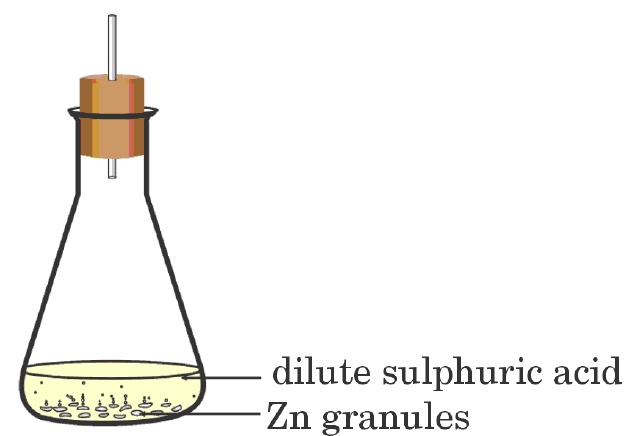
List two observations to justify that in this experiment a chemical change has taken place.
Solution
Zinc granules react with dilute sulphuric acid: Zn + H2SO4 → ZnSO4 + H2.
1. Evolution of a gas — bubbles of hydrogen are seen around the zinc granules.
2. Change (rise) in temperature — the flask becomes warm.
(Also, the zinc granules slowly get smaller.)
Copper powder is taken in a china dish and heated over a burner. Name the product formed and state its colour. Write the chemical equation for the reaction involved.
Solution
Product: copper(II) oxide, which is black (the surface of the brown copper powder turns black).
Write chemical equation for the chemical reaction which occurs when the aqueous solutions of barium chloride and sodium sulphate react together. Write the symbols of the ions present in the compound precipitated in the reaction.
Solution
A white precipitate of barium sulphate forms (double displacement / precipitation reaction). Ions present in it: Ba2+ and SO42−.
What is observed when aqueous solutions of potassium iodide and lead nitrate are mixed together? Name the type of reaction and write the chemical equation for the reaction that occurs.
Solution
A yellow precipitate of lead iodide is formed.
Type: double displacement (precipitation) reaction.
When copper powder is heated in a watch glass, a black substance is formed. (i) Why is this black substance formed? Name it. (ii) How can this black substance be reversed to its original form?
Silver articles become black when kept in open for some time, whereas copper vessels lose their shiny brown surfaces and gain a green coat when kept in open. Name the substances present in air with which these metals react and write the name of the products formed.
A student mixes sodium sulphate powder in barium chloride powder. What change would the student observe on mixing the two powders? Justify your answer and explain how he can obtain the desired change.
What is observed when a solution of sodium sulphate is added to a solution of barium chloride taken in a test tube? Write equation for the chemical reaction involved and name the type of reaction in this case.
3 marks: short answer
Seema took a small amount of copper powder in a china dish and heated it. What changes will she observe on heating? When H2 gas is passed over this heated substance, what visible changes will be seen in it? Give the chemical equations of the reactions involved, along with the names and colours of the products in each case.
Solution
On heating: the brown copper powder becomes coated with a black substance, copper(II) oxide, because copper combines with oxygen of air (oxidation).
On passing hydrogen over the hot black substance: the black coating turns brown again as copper is formed, and drops of water appear (CuO is reduced).
2 g of green coloured crystals of ferrous sulphate are heated in a dry boiling tube. Name the type of chemical reaction taking place. Write the balanced chemical equation for the reaction. Is this an exothermic or an endothermic reaction?
Solution
Type: thermal decomposition reaction (one reactant breaks down into simpler products on heating). The green crystals first lose their water of crystallisation, then decompose; a smell of burning sulphur is noticed.
(ferrous sulphate → ferric oxide + sulphur dioxide + sulphur trioxide)
It is an endothermic reaction, because heat has to be supplied continuously for the decomposition.
(i) Define the term decomposition reaction. Write one chemical equation each for decomposition reaction where energy is supplied in the form of heat, light or electricity.
(ii) Decomposition of vegetable matter into compost is considered an exothermic reaction. Why?
Solution
(i) A decomposition reaction is one in which a single reactant breaks down to give two or more simpler products.
Light (photolytic): 2AgCl(s) →(sunlight) 2Ag(s) + Cl2(g)
Electricity (electrolytic): 2H2O(l) →(electric current) 2H2(g) + O2(g)
(ii) During the decomposition of vegetable matter into compost, heat is released (the compost pile becomes warm), so it is an exothermic process.
Why are decomposition reactions called the opposite of combination reactions? Write one chemical equation each for these two types of reactions mentioning the name of the reactant(s) and the product(s) involved in the reactions.
Solution
In a combination reaction two or more reactants combine to form a single product; in a decomposition reaction a single reactant breaks down into two or more products. So one is the reverse of the other.
(calcium oxide / quick lime + water → calcium hydroxide / slaked lime)
(calcium carbonate / limestone → calcium oxide + carbon dioxide)
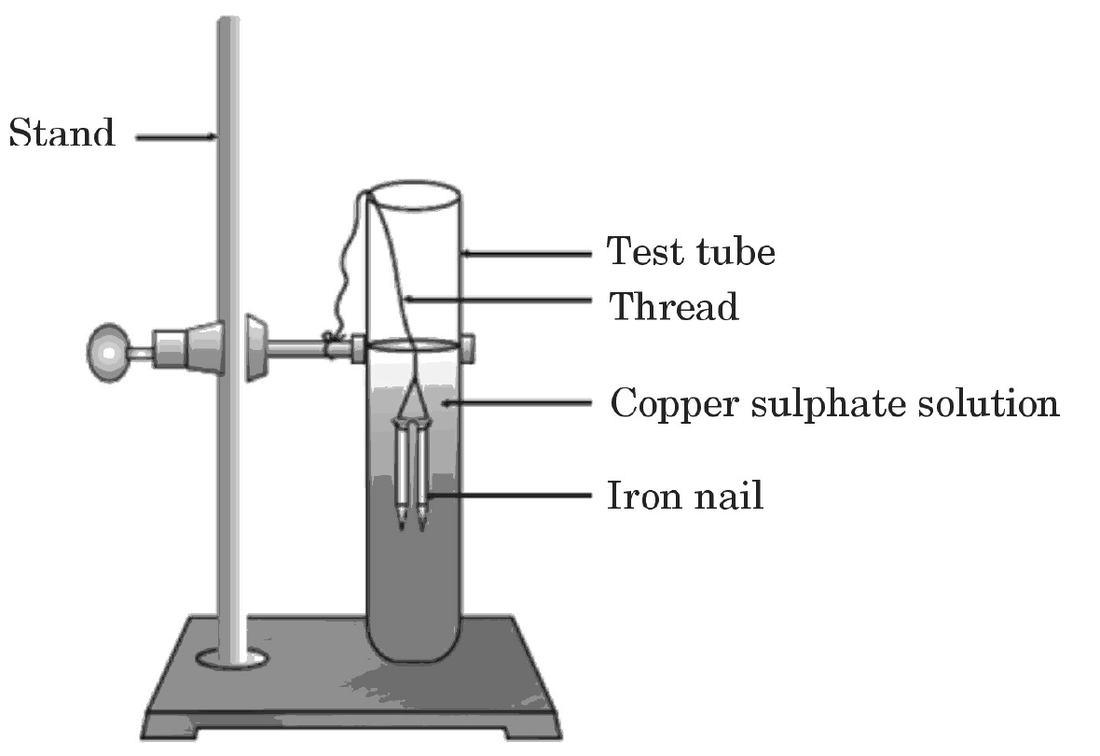
Study the experimental set-up shown in the diagram and write chemical equation for the chemical reaction involved. Name and define the type of reaction. List two other metals which can be used in place of iron to show the same type of reaction with copper sulphate solution.
Solution
The iron nail gets a brownish coating of copper, and the blue solution fades to pale green.
Displacement reaction: a reaction in which a more reactive element displaces a less reactive element from its compound (solution).
Other metals: zinc and aluminium (or magnesium) — all are more reactive than copper.
Silver chloride kept in a china dish turns grey in sunlight. (a) Write the colour of silver chloride when it was kept in the china dish. (b) Name the type of chemical reaction taking place and write the chemical equation for the reaction. (c) State one use of the reaction. Name one more chemical which can be used for the same purpose.
Solution
(a) White.
(b) Photolytic decomposition (decomposition by light):
(c) Used in black and white photography. Silver bromide (AgBr) is also used: 2AgBr → 2Ag + Br2.
(i) While electrolysing water before passing the current some drops of an acid are added. Why? Name the gases liberated at cathode and anode. Write the relationship between the volume of gas collected at anode and the volume of gas collected at cathode.
(ii) What is observed when silver chloride is exposed to sunlight? Give the type of reaction involved.
Solution
(i) Pure water is a poor conductor; a few drops of dilute acid make it conduct electricity.
Cathode: hydrogen; anode: oxygen.
Volume of gas at anode : volume at cathode = 1 : 2 (2H2O → 2H2 + O2).
(ii) White silver chloride turns grey (silver is formed): 2AgCl →(sunlight) 2Ag + Cl2. It is a photolytic decomposition reaction.
A compound ‘A’ is used in the manufacture of cement. When dissolved in water, it evolves a large amount of heat and forms compound ‘B’. (i) Identify A and B. (ii) Write chemical equation for the reaction of A with water. (iii) List two types of reaction in which this reaction may be classified.
Lead nitrate solution is added to a test tube containing potassium iodide solution. (a) Write the name and colour of the compound precipitated. (b) Write the balanced chemical equation for the reaction involved. (c) Name the type of this reaction justifying your answer.
What happens when food materials containing fats and oils are left for a long time? List two observable changes and suggest three ways by which this phenomenon can be prevented.
On heating blue coloured powder of copper (II) nitrate in a boiling tube, black copper oxide, O2 and a brown gas X is formed. (a) Identify the type of reaction and the gas X. (b) Write balanced chemical equation of the reaction. (c) Write the pH range of aqueous solution of the gas X.
(a) Classify the following reactions into different types: (i) AgNO3(aq) + NaCl(aq) → AgCl(s) + NaNO3(aq) (ii) CaO(s) + H2O(l) → Ca(OH)2(aq) (iii) 2KClO3(s) → 2KCl(s) + 3O2(g) (iv) Zn + CuSO4 → ZnSO4 + Cu
(b) Translate the following statement into a balanced chemical equation: ‘‘Barium chloride reacts with aluminium sulphate to give aluminium chloride and barium sulphate.’’
When potassium iodide solution is added to a solution of lead (II) nitrate in a test tube, a precipitate is formed. (a) What is the colour of this precipitate? Name the compound precipitated. (b) Write the balanced chemical equation for this reaction. (c) List two types of reactions in which this reaction can be placed.
Decomposition reactions require energy either in the form of heat or light or electricity for breaking down the reactants. Write one equation each for decomposition reactions where energy is supplied in the form of heat, light and electricity.
5 marks: long answer
What is a chemical reaction? Describe one activity each to show that a chemical change has occurred in which (i) change of colour, and (ii) change in temperature has taken place.
Solution
A chemical reaction is a process in which one or more substances (reactants) change into new substances (products) with different properties. It is indicated by a change in state, colour, temperature, evolution of gas, or formation of a precipitate.
(i) Change of colour: put an iron nail into copper sulphate solution in a test tube. After about 20 minutes the blue colour of the solution fades to pale green, and a brownish coating appears on the nail.
(ii) Change in temperature: take a small amount of quick lime in a beaker and slowly add water. The beaker becomes hot (the reaction is exothermic).
(Also: zinc granules with dilute sulphuric acid — the flask becomes warm.)
(i) Define a decomposition reaction. How can we say that (I) electrolysis of water, and (II) blackening of silver bromide when exposed to sunlight, are decomposition reactions? Mention the type of energy involved in each case.
(ii) The type of reactions in which (I) calcium oxide is formed, and (II) calcium hydroxide is formed are opposite reactions to each other. Justify this statement with the help of chemical equations.
Solution
(i) A decomposition reaction is one in which a single reactant breaks down to give two or more simpler products.
(I) Water (single reactant) breaks into hydrogen and oxygen — electrical energy: 2H2O(l) → 2H2(g) + O2(g).
(II) Silver bromide (single reactant) breaks into silver (grey/black) and bromine — light energy: 2AgBr(s) →(sunlight) 2Ag(s) + Br2(g).
(ii) Calcium oxide is formed by decomposition, and calcium hydroxide by combination:
CaO(s) + H2O(l) → Ca(OH)2(aq) (two reactants → one product)
In decomposition one substance breaks into simpler ones; in combination substances join to form one — so they are opposite types of reactions.
Get every solution for all chapters
- Every board question of every chapter, each fully solved the way the board gives marks
- 17 complete board papers, each followed by its solutions
- Weightage and most-asked topics for every chapter
- Instant PDF download, colour and black & white print copies
Revising the chapter first? Complete Science Notes for Class 10 (NCERT 2026-27) →
What you get in the pack
- Questions from 126 CBSE papers, 2016 to 2026: every set code available
- Complete: 2405 different questions and parts from all set codes, 13 chapters and 17 full papers
- Part A: all 13 chapters, questions sorted chapter-wise and by marks
- Year-wise weightage table and most-asked topics for every chapter
- Part B: 17 full board papers, each followed by its complete solutions, for timed practice
- Answers written to the CBSE marking-scheme points, with labelled diagrams drawn in full
- Questions on topics out of the board syllabus flagged
All chapters in this pack
- PYQ Ch 1 Chemical Reactions and Equations
- PYQ Ch 2 Acids, Bases and Salts
- PYQ Ch 3 Metals and Non-metals
- PYQ Ch 4 Carbon and its Compounds
- PYQ Ch 5 Life Processes
- PYQ Ch 6 Control and Coordination
- PYQ Ch 7 How do Organisms Reproduce
- PYQ Ch 8 Heredity
- PYQ Ch 9 Light Reflection and Refraction
- PYQ Ch 10 The Human Eye and the Colourful World
- PYQ Ch 11 Electricity
- PYQ Ch 12 Magnetic Effects of Electric Current
- PYQ Ch 13 Our Environment
- Board Paper 2026 Set 31-2-1 with Solutions
- Board Paper 2026 Set 31-3-1 with Solutions
- Board Paper 2025 Set 31-1-1 with Solutions
- Board Paper 2025 Set 31-2-1 with Solutions
- Board Paper 2024 Set 31-4-1 with Solutions
- Board Paper 2024 Set 31-5-1 with Solutions
- Board Paper 2023 Set 31-2-1 with Solutions
- Board Paper 2023 Set 31-4-1 with Solutions
- Board Paper 2022 Term 2 Set 31-1-1 with Solutions
- Board Paper 2022 Term 2 Set 31-3-1 with Solutions
- Board Paper 2020 Set 31-2-1 with Solutions
- Board Paper 2020 Set 31-4-1 with Solutions
- Board Paper 2019 Set 31-2-1 with Solutions
- Board Paper 2019 Set 31-4-1 with Solutions
- Board Paper 2018 Set 31-1 with Solutions
- Board Paper 2017 Set 3 with Solutions
- Board Paper 2016 Set 31-1 with Solutions