
CBSE Class 10 Science Question Paper 2026 (31/2/1) with Solutions
The complete CBSE Class 10 Science board paper of 2026, Q.P. code 31/2/1: all 39 questions exactly as set, with marks. 23 solutions are free below. The Class 10 Science PYQ Book: Solved Board Papers 2016-2026 (CBSE) solves all 17 papers in full and sorts every question chapter-wise.
Subject expert: Khushbu Gupta, B.Sc., M.Sc. Physics, B.Ed. · 8+ years teaching


Free: NCERT solutions for Class 10 Science →
Question paper
Jump to: Question paperSolutions
2026 · Q.P. Code 31/2/1
Maximum marks: 80
Section A · Biology
The genotype of green stemmed tomato plant is denoted by ‘GG’ and that of purple stemmed tomato plant as ‘gg’. Hybrid of a cross between these two were self-pollinated to obtain F2 progeny. What will be the ratio of GG, Gg and gg in this F2 progeny?
Identify the type of tropic movement that is responsible for the movement of the pollen tube towards an ovule from the following options.
Spirogyra, despite being a multi-cellular organism, still shows a simple reproductive method. Select the correct option with regard to reproduction in Spirogyra:
The carbohydrates, which are not used immediately in plants, are stored in the form of ‘a’, which serves as an internal energy reserve. What does ‘a’ stand for?
The following events occur during the process of photosynthesis. Choose the option that indicates the correct events.
(i) Oxidation of carbon dioxide to carbohydrates
(ii) Conversion of light energy into chemical energy
(iii) Absorption of light energy by chlorophyll
(iv) Conversion of hydrogen and oxygen into water
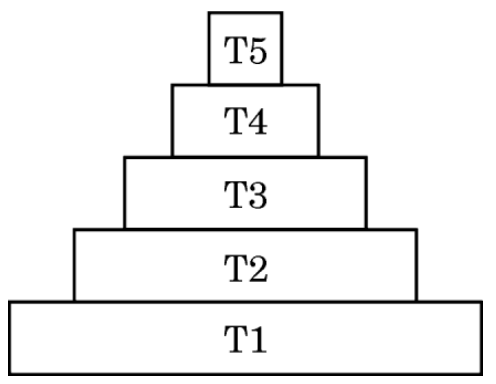
In the given figure, identify the trophic level having maximum concentration of harmful chemicals.
Which of the following limits the number of trophic levels in a food chain?
Assertion (A): Blood plasma transports carbon dioxide in dissolved form, while oxygen is transported by respiratory pigments.
Reason (R): Carbon dioxide is more soluble in water than in oxygen.
Assertion (A): There are generally a greater number of individuals at the lower trophic levels of an ecosystem.
Reason (R): The greatest number is of the producers.
(a) “The timing and the amount of hormone secreted by a gland are regulated in the human body.” Justify this statement with the help of an example.
(b) Electrical impulse is an excellent means to transmit information in the animal body, but there are some limitations to the use of electrical impulses. State any two limitations.
“Variation is useful for the survival of species over time.” Explain this statement with the help of an example.
Suggest one best way to dispose of the following wastes:
(i) Kitchen waste (ii) Metallic waste (iii) Plastic bottles (iv) Sanitary waste
Complete the pathways given below, showing the breakdown of glucose.
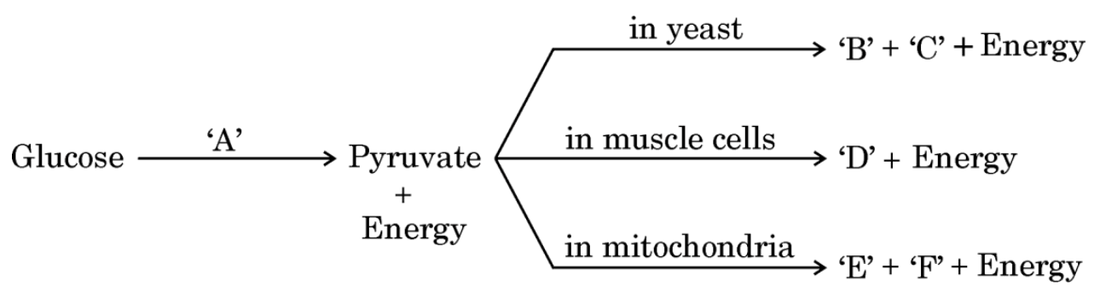
Identify ‘A’, ‘B’, ‘C’, ‘D’, ‘E’ and ‘F’.
(a) Giving two examples, justify the statement that the sex of the offspring in all animals is not always genetically determined.
(b) Differentiate between the sex chromosomes of male and female human beings.
Read the following passage and answer the questions that follow:
A middle-aged person is facing some cognitive changes in himself. His early symptoms included mild forgetfulness. For example, forgetting where he left his mobile or failing to find words to complete his sentences. He was facing problems in driving a car, climbing up and down the stairs, inserting a plug into an outlet. He slowly developed a sad mood and anxiety.
(a) What are voluntary actions? 1
(b) Which part of the brain is responsible for precision of voluntary actions? 1
(c) (i) Explain the role of the medulla. 2
OR
(c) (ii) How do the animal muscles move? 2
(a) (i) Name an organ that helps in the formation of male germ cells in humans and also mention the condition that favours the formation of male germ cells.
(ii) In male reproductive system, write the pathway followed to deliver male germ cells to the site of fertilisation.
(iii) Mention the main physical feature of the male germ cell that helps it move towards the female germ cell. 2+2+1
(b) Radha has three children. She does not want to have more children. Radha visits a nearby hospital, to know the methods to prevent pregnancy.
(i) Mention the name of any two ways other than the surgical methods, following which Radha can avoid unwanted pregnancies.
(ii) Name the surgical methods to prevent pregnancy.
(iii) Give one example each of sexually transmitted diseases caused by bacteria and virus. 2+2+1
Section B · Chemistry
Which of the following are combination reactions?
(i) 2KClO3 → 2KCl + 3O2
(ii) MgO + H2O → Mg(OH)2
(iii) 4Al + 3O2 → 2Al2O3
(iv) Zn + FeSO4 → ZnSO4 + Fe
A metal carbonate reacts with a solution X which forms a salt, water and a gas Y. What are X and Y?
When ferrous sulphate crystals are heated in a test tube, we observe that:
When Mg metal is treated with hot water, it starts floating on the surface of the water. The reason for its different behaviour is:
The pH of the gastric juices released during digestion is:
Baking powder is a mixture of:
A student notices that her silver jewellery turned dull and had a grey-black coating over it after wearing for a few months. What results in the change in colour of the silver metal?
Assertion (A): Carbon compounds can form chains, branched and ring structures.
Reason (R): Carbon exhibits the property of catenation.
Read the following passage and answer the questions that follow:
One student was comparing the reactivity of different metals for his science project. He added iron filings in four test tubes A, B, C and D containing aqueous solutions of ZnSO4, CuSO4, FeSO4 and Al2(SO4)3.
(i) In which of the test tubes will he observe the reaction to be the most vigorous and why?
(ii) Write a balanced equation for the reaction involved. 1+1
(a) (i) Write one example each of one metal that is so soft that it can be cut with a knife, and one non-metal that is a good conductor of electricity.
(ii) Using the electronic configuration, explain how Mg atom combines with oxygen to form magnesium oxide by transfer of electrons. [Atomic number: Mg = 12, O = 8] 1+2
(b) Give reasons:
(i) Metal sulphides and carbonates should be converted to their metal oxides in the process of extraction of metals.
(ii) Aluminium oxide is considered as an amphoteric oxide.
(iii) Metals like Na, K, Ca and Mg are never found in their free state in nature. 3×1
Seema took a small amount of copper powder in a china dish and heated it. What changes will she observe on heating? When H2 gas is passed over this heated substance, what visible changes will be seen in it? Give the chemical equations of the reactions involved, along with the names and colours of the products in each case.
Read the following passage and answer the questions that follow:
In the given diagram, when electricity is passed through an aqueous solution of a common salt, a substance ‘Z’ is produced, along with the evolution of gases ‘X’ and ‘Y’. When a burning matchstick is brought near the gas ‘Y’, it burns with a pop sound, whereas ‘X’ is used for disinfecting drinking water. When ‘X’ is passed through slaked lime, an insoluble substance ‘A’ is produced.
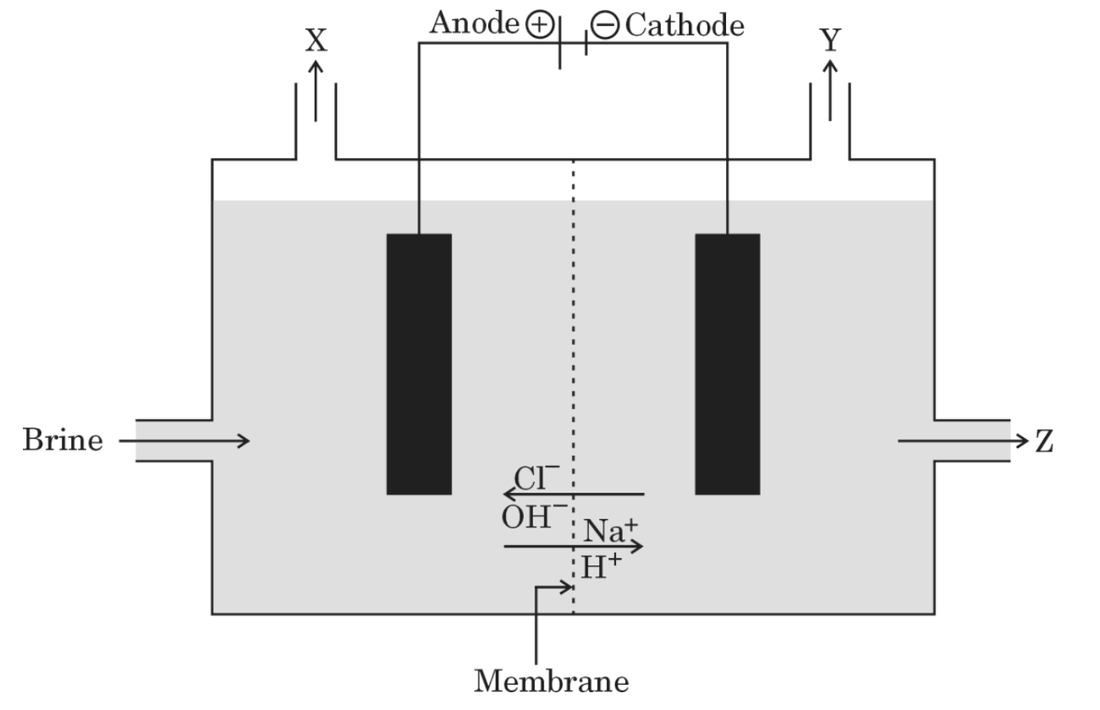
(a) Write the names of the gases ‘X’ and ‘Y’. 1
(b) Write the balanced chemical equation for the formation of substance ‘Z’. 1
(c) (i) What happens: (I) If a drop of red litmus solution is added to the aqueous solution of substance ‘Z’? (II) If CO2 gas is passed through ammoniacal solution of aqueous NaCl? 2
OR
(c) (ii) Identify the substance ‘A’ and write the balanced chemical equation of the reaction which takes place in its preparation. 2
(a) A carbon compound ‘P’ of molecular formula C2H6O is found to be neutral when tested with red and blue litmus. A gas that burns with a pop sound is produced when sodium metal reacts with compound ‘P’.
(i) Identify the compound ‘P’.
(ii) The carbon compound ‘P’ is heated with conc. H2SO4 at 443 K to produce compound ‘Q’. (I) Write the chemical equation for the reaction. (II) What is the role of conc. H2SO4 in this reaction?
(iii) What is likely to be observed on heating compound ‘P’ with ethanoic acid with an acid as a catalyst? Write the chemical equation for the reaction. 1+2+2
(b) (i) Write the structural formula of benzene.
(ii) State the reason why carbon can neither form C4+ cation nor C4– anion.
(iii) What type of bond is formed between carbon and hydrogen?
(iv) How is ethanol converted to ethanoic acid?
(v) Complete the following chemical equation: CH3COOC2H5 + NaOH → 5×1
Section C · Physics
From the following options choose the one which gives negative magnification greater than one:
A thin beam of white light falls on a face of a glass prism and a spectrum is obtained on a screen. Which of the following options is the correct sequence of colours from top to bottom on the screen?
Assertion (A): Direction of force exerted on a current-carrying conductor placed in a magnetic field remains same if the directions of both magnetic field and current flowing through the conductor are reversed.
Reason (R): The direction of force exerted on a current-carrying conductor placed in an external magnetic field can be determined by using magnetic compass.
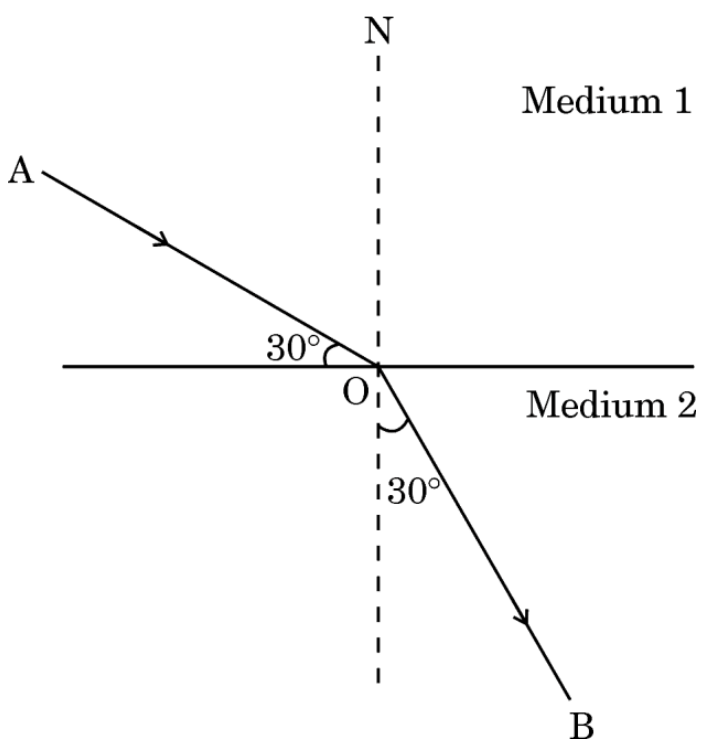
With the help of the given ray diagram, calculate the refractive index of Medium 2 with respect to Medium 1. (Given that √3 = 1·732)
(a) How does the focal length of eye lens change as the distance of the object from the eyes is altered? Explain.
(b) Why is the concave lens used as a corrective lens for a myopic eye?
(a) Write the expression for the magnification produced by a lens in terms of object distance and image distance.
(b) A 4 cm tall object is placed perpendicular to the principal axis of a convex lens of focal length 20 cm. Calculate the size of the image formed, if the distance of the object from the lens is 10 cm.
What is scattering of light? How is scattering of light different from reflection of light? Explain.
The values of current I flowing in a given resistor for the corresponding values of potential difference V applied across the ends of resistor are given below in the table:
| I (amperes) | 0.4 | 0.8 | 1.2 | 1.6 | 2.0 |
|---|---|---|---|---|---|
| V (volts) | 1.2 | 2.4 | 3.6 | 4.8 | 6.0 |
Plot a graph between V and I and calculate the resistance of that resistor.
Read the following passage and answer the questions that follow:
Swati, a class 10 student, observes that when she passes close to the refrigerator in her kitchen, she feels the heat, although the things kept inside the refrigerator are cool.
(a) Describe the cause of heating in the above-mentioned case. 1
(b) A current I flows through a resistor of resistance R when the potential difference across it is V. Applying Ohm’s law, write the formula for amount of heat produced by the resistor in time t. 1
(c) (i) Write any two practical applications of heating effect of electric current. 2
OR
(c) (ii) Define the commercial unit of electric energy and express it in Joules (J). 2
(a) (i) State the rule which gives the direction of force acting on a current-carrying conductor placed in a magnetic field.
(ii) What is a fuse? Why is it called a safety device?
(iii) Why are electrical appliances with metallic bodies connected to the mains through a three-pin plug, whereas an electric bulb is connected with a two-pin plug?
(iv) 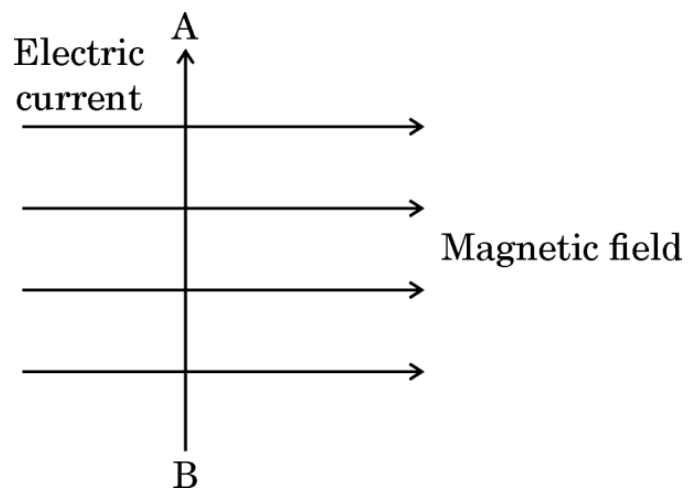
What will be the direction of force experienced by the conductor AB due to the magnetic field, when current flows in the direction shown? Name the law you applied to find the direction.
(b) (i) Draw the pattern of magnetic field lines through and around a current-carrying circular loop.
(ii) State the rule to find out the direction of the magnetic field inside and around the circular loop.
(iii) Give reasons: (I) Why should a burnt-out fuse be replaced by another fuse of identical rating only, in an electric circuit? (II) Why is soft iron-core used in making an electromagnet?
Solutions: CBSE 2026 · 31/2/1
Answer: (D) 1 : 2 : 1
GG × gg → F1 all Gg. Selfing Gg × Gg gives gametes G and g from each parent:
| G | g | |
|---|---|---|
| G | GG | Gg |
| g | Gg | gg |
GG : Gg : gg = 1 : 2 : 1 (genotypic ratio). The phenotypic ratio is 3 green : 1 purple.
Answer: (C)
Spirogyra reproduces by fragmentation: the filament simply breaks into smaller pieces and each piece grows into a new individual. This is asexual reproduction.
Answer: (B) (ii) and (iii)
The three events of photosynthesis are: absorption of light energy by chlorophyll; conversion of light energy to chemical energy and splitting of water into hydrogen and oxygen; and reduction (not oxidation) of carbon dioxide to carbohydrates. Water is split, not formed. So only (ii) and (iii) are correct.
Answer: (C) Decrease in energy at higher levels
Only about 10% of the energy is passed on from one trophic level to the next (10 per cent law). After 3–4 levels too little energy is left to support another level, so food chains are short.
Answer: (B)
Both statements are true. The reason for A is the loss of energy at each level (less energy can support fewer individuals higher up); R only states that producers are most numerous and does not explain why. So R is not the correct explanation of A.
1. Electrical impulses reach only those cells that are connected by nervous tissue, not every cell of the body.
2. Once a cell generates and transmits an impulse, it needs some time to reset its mechanism before it can send a new impulse, so cells cannot continually create and transmit impulses.
(This is why animals also use chemical communication — hormones.)
(i) Kitchen waste — composting (it is biodegradable; turns into manure).
(ii) Metallic waste — recycling (melt and reuse the metal).
(iii) Plastic bottles — recycling / reuse.
(iv) Sanitary waste — incineration (burning at high temperature in an incinerator).
(a) In some animals sex is decided by non-genetic factors:
• In some reptiles, the temperature at which fertilised eggs are kept decides whether the young will be male or female.
• Some animals such as snails can change sex during their life.
So sex is not always genetically determined.
(b)
| Female | Male |
|---|---|
| Has a perfect pair of sex chromosomes, both called X (XX) | Has a mismatched pair: one normal-sized X and one short Y (XY) |
| All eggs carry an X chromosome | Half the sperms carry X and half carry Y; so the father's sperm decides the sex of the child |
(i) Testes form the male germ cells (sperms). They lie outside the abdominal cavity in the scrotum because sperm formation needs a temperature lower than the normal body temperature.
(ii) Testes → vas deferens → (joins a tube from the urinary bladder) → urethra → out of the body (through the penis) into the vagina. On the way, the seminal vesicles and prostate gland add their secretions so that the sperms are in a fluid, which makes their transport easier and provides nutrition.
(iii) The sperm has a long tail that helps it swim towards the female germ cell (egg).
Answer: (D) (ii) and (iii)
In a combination reaction two or more reactants form a single product: (ii) MgO + H2O → Mg(OH)2 and (iii) 4Al + 3O2 → 2Al2O3. (i) is decomposition and (iv) is displacement.
Answer: (C)
2FeSO4 → Fe2O3 + SO2 + SO3 (thermal decomposition). The green crystals lose water and change colour, and SO2/SO3 gases with the smell of burning sulphur are given off.
Answer: (A) Less than 7
The stomach produces hydrochloric acid, so gastric juice is acidic (pH about 1.5–2).
Answer: (B)
Silver corrodes: it reacts with sulphur compounds in the air to form a black coating of silver sulphide. (Rusting is the corrosion of iron only.)
(i) Test tube B (CuSO4). Iron is more reactive than copper, so it displaces copper from copper sulphate solution. Iron is less reactive than zinc and aluminium, so nothing happens in A and D; in C the metal and the salt are the same (iron), so there is no reaction. The blue solution turns pale green and a reddish-brown copper coating appears.
(ii) Fe(s) + CuSO4(aq) → FeSO4(aq) + Cu(s)
(i) It is easier to obtain a metal from its oxide (by reduction, e.g. with carbon) than from its sulphide or carbonate. So sulphide ores are roasted and carbonate ores are calcined to convert them into oxides first.
(ii) Aluminium oxide reacts with both acids and bases to give salt and water:
Al2O3 + 6HCl → 2AlCl3 + 3H2O
Al2O3 + 2NaOH → 2NaAlO2 + H2O
So it shows both acidic and basic behaviour — it is amphoteric.
(iii) These metals are very reactive (high in the reactivity series). They react readily with oxygen, water and other elements, so they are always found combined as compounds, never free.
(a) X = chlorine (given off at the anode; used to disinfect water). Y = hydrogen (given off at the cathode; burns with a pop sound).
(b) Z is sodium hydroxide:
(c) (i) (I) NaOH is a base, so red litmus turns blue.
(II) Sodium hydrogencarbonate (baking soda) is formed: NaCl + H2O + CO2 + NH3 → NH4Cl + NaHCO3
OR (c) (ii) A = bleaching powder (calcium oxychloride, CaOCl2):
(i) Benzene, C6H6: a ring of six carbon atoms with alternate single and double bonds, each carbon carrying one hydrogen.
(ii) Carbon has 4 valence electrons. To form C4+ it would have to lose 4 electrons, which needs a very large amount of energy. To form C4− it would have to gain 4 electrons, and a nucleus of 6 protons cannot hold 10 electrons. So carbon shares its electrons and forms covalent bonds.
(iii) A covalent bond (single covalent bond, formed by sharing a pair of electrons).
(iv) By oxidation using an oxidising agent such as alkaline potassium permanganate or acidified potassium dichromate:
CH3CH2OH →(alkaline KMnO4 + heat / acidified K2Cr2O7) CH3COOH
(v)
Answer: (B)
Red bends the least and violet bends the most, so on the screen (prism with base downward) red is at the top and violet at the bottom: VIBGYOR read from bottom — red, orange, yellow, green, blue, indigo, violet from the top.
The angles are measured from the normal ON.
Ray AO makes 30° with the surface, so the angle of incidence i = 90° − 30° = 60°.
The refracted ray OB makes 30° with the normal, so r = 30°.
Medium 2 is optically denser than medium 1 (the ray bends towards the normal).
In myopia (near-sightedness) the image of a distant object is formed in front of the retina (eyeball too long or lens too curved). A concave (diverging) lens of suitable power spreads the rays out a little before they enter the eye, so the eye lens now brings them to focus on the retina. In effect, the lens makes rays from far away appear to come from the far point of the myopic eye.
Scattering: when light falls on very small particles of a medium (dust, smoke, air molecules), it is thrown off (spread) in different directions. This is scattering of light. Example: the path of a beam of light becomes visible in a dusty room (Tyndall effect).
Difference from reflection:
• In reflection, light bounces back from a surface in a fixed direction obeying the laws of reflection; in scattering it spreads in all directions.
• Reflection does not depend on the size of particles; the colour of scattered light depends on the size of the particles — very fine particles scatter mainly blue light (blue sky), larger particles scatter all colours (white clouds).
(a) Only a part of the electrical energy supplied to the refrigerator is used for useful work (cooling); the rest is unavoidably converted into heat (heating effect of current in its coils and motor), which raises the temperature of the appliance and its surroundings. The heat removed from inside is also released outside.
(b) Work done = VIt; using V = IR:
(c) (i) Any two: electric iron, electric heater, toaster, oven, kettle, electric bulb (filament glows), electric fuse.
OR (c) (ii) The commercial unit of electric energy is the kilowatt hour (kWh): the energy used when 1 kW of power is used for 1 hour.
(i) The field lines are concentric circles near each point of the wire; near the centre of the loop they become almost straight and parallel, all in the same direction.
(ii) Right-hand thumb rule: imagine holding the current-carrying wire in the right hand with the thumb pointing in the direction of current; the curled fingers give the direction of the magnetic field lines around it. (Applied to each part of the loop, it shows that inside the loop all the lines point in the same direction.)
(iii) (I) A fuse of the same rating melts at the safe current limit. A fuse of higher rating would not melt during overloading and would not protect the circuit; a fuse of lower rating would melt even with normal current and the appliance would not work.
(II) Soft iron gets strongly magnetised when current flows in the coil and loses its magnetism as soon as the current is switched off. So the electromagnet can be switched on and off.
Get every solution for all 17 papers
- Every board question of every chapter, each fully solved the way the board gives marks
- 17 complete board papers, each followed by its solutions
- Weightage and most-asked topics for every chapter
- Instant PDF download, colour and black & white print copies
Revising the chapter first? Complete Science Notes for Class 10 (NCERT 2026-27) →
What you get in the pack
- Questions from 126 CBSE papers, 2016 to 2026: every set code available
- Complete: 2405 different questions and parts from all set codes, 13 chapters and 17 full papers
- Part A: all 13 chapters, questions sorted chapter-wise and by marks
- Year-wise weightage table and most-asked topics for every chapter
- Part B: 17 full board papers, each followed by its complete solutions, for timed practice
- Answers written to the CBSE marking-scheme points, with labelled diagrams drawn in full
- Questions on topics out of the board syllabus flagged
All chapters in this pack
- PYQ Ch 1 Chemical Reactions and Equations
- PYQ Ch 2 Acids, Bases and Salts
- PYQ Ch 3 Metals and Non-metals
- PYQ Ch 4 Carbon and its Compounds
- PYQ Ch 5 Life Processes
- PYQ Ch 6 Control and Coordination
- PYQ Ch 7 How do Organisms Reproduce
- PYQ Ch 8 Heredity
- PYQ Ch 9 Light Reflection and Refraction
- PYQ Ch 10 The Human Eye and the Colourful World
- PYQ Ch 11 Electricity
- PYQ Ch 12 Magnetic Effects of Electric Current
- PYQ Ch 13 Our Environment
- Board Paper 2026 Set 31-2-1 with Solutions
- Board Paper 2026 Set 31-3-1 with Solutions
- Board Paper 2025 Set 31-1-1 with Solutions
- Board Paper 2025 Set 31-2-1 with Solutions
- Board Paper 2024 Set 31-4-1 with Solutions
- Board Paper 2024 Set 31-5-1 with Solutions
- Board Paper 2023 Set 31-2-1 with Solutions
- Board Paper 2023 Set 31-4-1 with Solutions
- Board Paper 2022 Term 2 Set 31-1-1 with Solutions
- Board Paper 2022 Term 2 Set 31-3-1 with Solutions
- Board Paper 2020 Set 31-2-1 with Solutions
- Board Paper 2020 Set 31-4-1 with Solutions
- Board Paper 2019 Set 31-2-1 with Solutions
- Board Paper 2019 Set 31-4-1 with Solutions
- Board Paper 2018 Set 31-1 with Solutions
- Board Paper 2017 Set 3 with Solutions
- Board Paper 2016 Set 31-1 with Solutions