
CBSE Class 10 Science Question Paper 2024 (31/5/1) with Solutions
The complete CBSE Class 10 Science board paper of 2024, Q.P. code 31/5/1: all 39 questions exactly as set, with marks. 23 solutions are free below. The Class 10 Science PYQ Book: Solved Board Papers 2016-2026 (CBSE) solves all 17 papers in full and sorts every question chapter-wise.
Subject expert: Khushbu Gupta, B.Sc., M.Sc. Physics, B.Ed. · 8+ years teaching


Free: NCERT solutions for Class 10 Science →
Question paper
Jump to: Question paperSolutions
2024 · Q.P. Code 31/5/1
Maximum marks: 80
Section A · Multiple choice and Assertion–Reason
To balance the following chemical equation, the values of the coefficients x, y and z must be respectively: x Zn(NO3)2 → y ZnO + z NO2 + O2
Which of the following is a redox reaction, but not a combination reaction?
The salt present in tooth enamel is:
An aqueous solution of sodium chloride is prepared in distilled water. The pH of this solution is:
A metal ‘X’ is used in thermit process. When ‘X’ is heated with oxygen, it gives an oxide ‘Y’, which is amphoteric in nature. ‘X’ and ‘Y’ respectively are:
The process in which transport of soluble products of photosynthesis takes place in plants is known as:
The correct sequence of events when someone’s hand touches a hot object unconsciously:
Sense organ in which olfactory receptors are present is:
The incorrect statement about placenta is:
Select from the following the conditions responsible for the rapid spread of bread mould on a slice of bread: (i) Formation of large number of spores (ii) Presence of moisture and nutrients in bread (iii) Low temperature (iv) Presence of hyphae
How will the image formed by a convex lens be affected, if the upper half of the lens is wrapped with a black paper?
The phenomena of light involved in the formation of rainbow are:
The colour of light for which the refractive index of glass is minimum, is:
The current carrying device which produces a magnetic field similar to that of a bar magnet is:
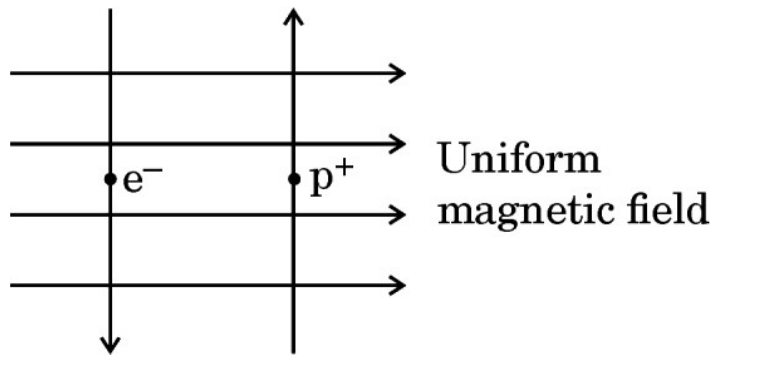
A uniform magnetic field exists in the plane of paper as shown in the diagram. In this field, an electron (e−) and a positron (p+) enter as shown. The electron and positron experience forces:
Which one of the following is not a natural ecosystem?
Assertion (A): Some vegetable oils are healthy.
Reason (R): Vegetable oils generally have long unsaturated carbon chains.
Assertion (A): Sex of the children will be determined by what they inherit from their mother.
Reason (R): Women have XX sex chromosomes.
Assertion (A): Electrons move from lower potential to higher potential in a conductor.
Reason (R): A dry cell maintains electric potential difference across the ends of a conductor.
Assertion (A): Ozone layer protects the surface of the Earth from harmful UV radiations.
Reason (R): Chlorofluorocarbons (CFCs) are responsible for depletion of ozone layer.
Section B · Very short answer (2 marks)
(a) Copper powder is taken in a china dish and heated over a burner. Name the product formed and state its colour. Write the chemical equation for the reaction involved.
(b) Write chemical equation for the chemical reaction which occurs when the aqueous solutions of barium chloride and sodium sulphate react together. Write the symbols of the ions present in the compound precipitated in the reaction.
The melting and boiling points of carbon compounds are generally low and they are largely non-conductors of electricity. State two conclusions based on these two properties.
(a) Sometimes while running, the athletes suffer from muscle cramps. Why? How is the respiration in this case different from aerobic respiration?
(b) Write the other name given to lymph. State its two functions.
Some unicellular organisms such as Plasmodium and Leishmania differ in the manner in which they reproduce. Name and explain the reproductive process taking place in them.
The heat produced at a point due to concentration of sunlight by a convex lens burns a paper. (a) Explain why it happens. (b) Name the term (in the context of the lens used) given to the point at which the paper starts burning. What does the bright spot formed on the paper represent?
An electric source can supply a charge of 500 coulomb. If the current drawn by a device is 25 mA, find the time in which the electric source will be discharged completely.
Section C · Short answer (3 marks)
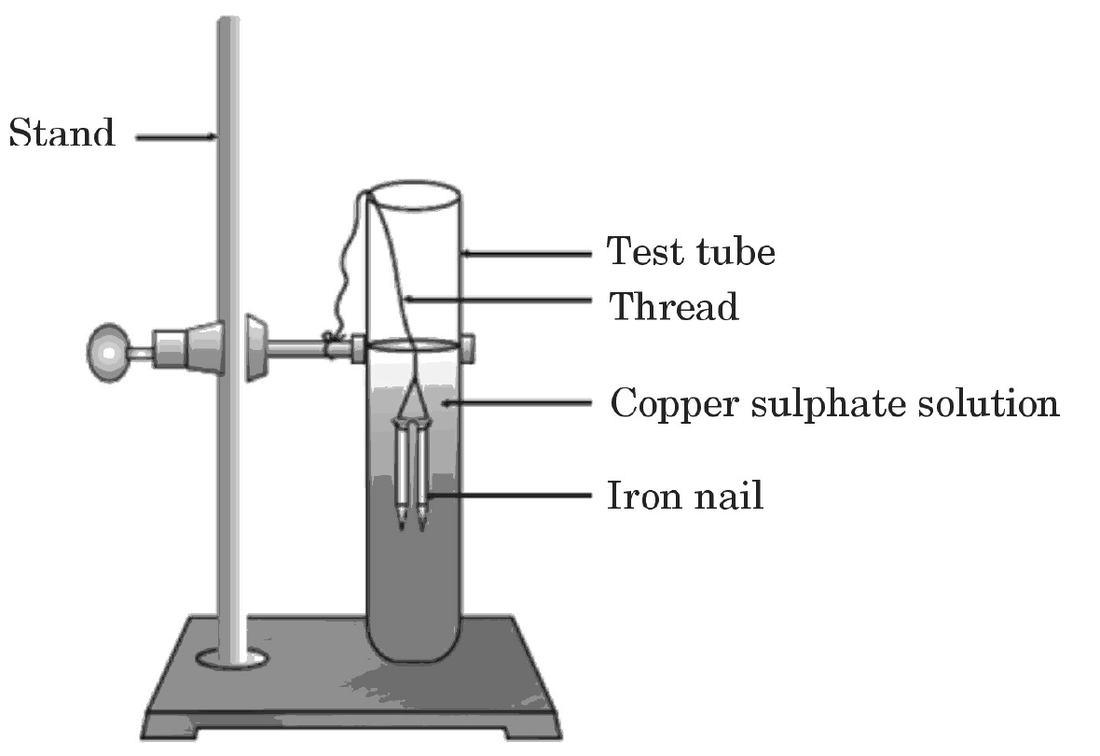
Study the experimental set-up shown in the diagram and write chemical equation for the chemical reaction involved. Name and define the type of reaction. List two other metals which can be used in place of iron to show the same type of reaction with copper sulphate solution.
Name the ore of mercury and state the form in which it is found in nature. Write the chemical equations along with the condition required for the reactions involved in the extraction of mercury from its ore.
Taking the example of any two animal hormones along with their gland of secretion, explain how these hormones help (i) in growth and development and (ii) regulate metabolism, in the body.
Mendel crossed pure tall pea plants (TT) with pure short pea plants (tt) and obtained F1 progeny. When the plants of F1 progeny were self-pollinated, plants of F2 progeny were obtained. (a) What did the plants of F1 progeny look like? Give their gene combination. (b) Why could the gene for shortness not be expressed in plants of F1 progeny? (c) Write the ratio of the plants obtained in F2 progeny and state the conclusion that can be drawn from this experiment.
(a) Study the diagram given below and answer the questions that follow:
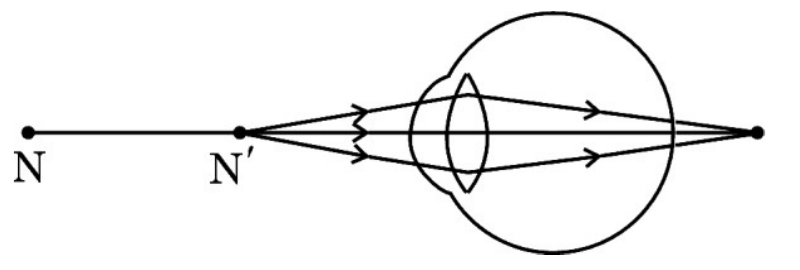
(i) Name the defect of vision depicted in this diagram stating the part of the eye responsible for this condition. (ii) List two causes of this defect. (iii) Name the type of lens used to correct this defect and state its role in this case.
(b) What is dispersion of white light? State its cause. Draw a diagram to show dispersion of a beam of white light by a glass prism.
(a) What happens when a bundle of wires of soft iron is placed inside the coil of a solenoid carrying a steady current? Name the device obtained. Why is it called so?
(b) Draw the magnetic field lines inside a current carrying solenoid. What does this pattern of magnetic field lines indicate?
Differentiate between food chain and food web. In a food chain consisting of deer, grass and tiger, if the population of deer decreases, what will happen to the population of organisms belonging to the first and third trophic levels?
Section D · Long answer (5 marks)
(a) A few crystals of ferrous sulphate were taken in a dry boiling tube and heated. Tiny water droplets were observed in the tube after some time. (i) From where did these water droplets appear? Explain. (ii) What colour change will be observed during heating? (iii) How many molecules of water are attached per molecule of FeSO4 crystal? Write the molecular formula of crystalline forms of (I) Copper sulphate, and (II) Sodium carbonate. (iv) State how is Plaster of Paris obtained from gypsum. Write two uses of Plaster of Paris.
(b) An acid ‘X’ present in tamarind when mixed with ‘Y’, produces a mixture ‘Z’. ‘Z’ on addition to a dough when heated makes cakes soft and spongy. ‘Y’ is prepared from common salt and helps in faster cooking. (i) Write the common names of ‘X’, ‘Y’ and ‘Z’, and the chemical formula of ‘Y’. (ii) How is ‘Y’ prepared and how does it help in making cakes soft and spongy? Illustrate the reaction with suitable chemical equation. (iii) Write the name and chemical formula of a mild base other than ‘Y’ used as an antacid.
(a) Design an experiment to demonstrate that carbon dioxide is essential for photosynthesis. Write the observation and conclusion of the experiment.
(b) (i) In the experimental set-up shown above in diagram (I) atmospheric air is being passed into lime water with a syringe while in diagram (II) air is being exhaled into lime water. The time taken for the lime water to turn milky in both the test tubes is different. Give reason.
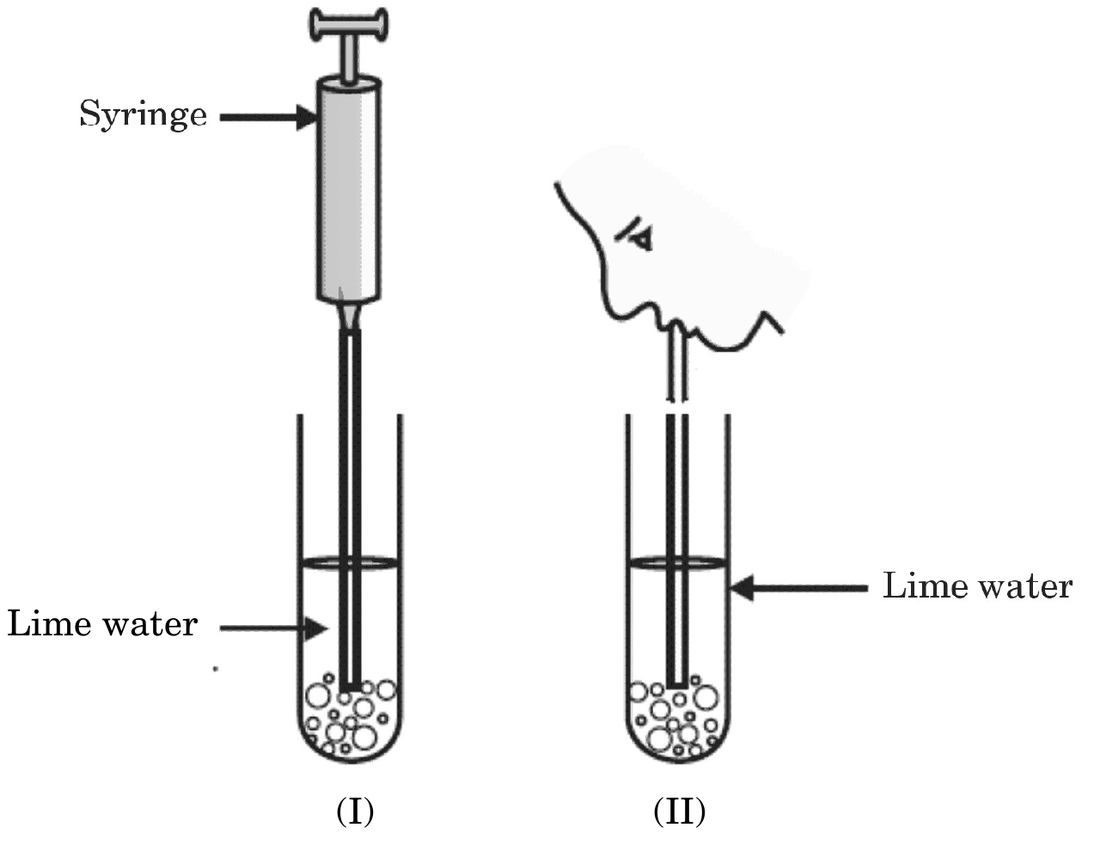
(ii) Draw the diagram of an open stomatal pore and label (I) Guard cells, and (II) Chloroplast on it. Mention two functions performed by stomata.
(a) (i) The potential difference across the two ends of a circuit component is decreased to one-third of its initial value, while its resistance remains constant. What change will be observed in the current flowing through it? Name and state the law which helps us to answer this question.
(ii) Draw a schematic diagram of a circuit consisting of a battery of four 1.5 V cells, a 5 Ω resistor, a 10 Ω resistor and a 15 Ω resistor and a plug key, all connected in series. Now find (I) the electric current passing through the circuit, and (II) potential difference across the 10 Ω resistor when the plug key is closed.
(b) (i) When is the potential difference between two points said to be 1 volt?
(ii) A copper wire has a diameter of 0.2 mm and resistivity of 1.6 × 10⁻⁸ Ω m. What will be the length of this wire to make its resistance 14 Ω? How much does the resistance change, if the diameter of the wire is doubled?
Section E · Case-based (4 marks)
Carbon is a versatile element that forms the basis of all living organisms and many of the things we use. A large variety of compounds is formed because of its tetravalency. Compounds of carbon are formed with oxygen, hydrogen, nitrogen, sulphur, chlorine and many other elements.
(a) What are hydrocarbons? 1
(b) List two properties by virtue of which carbon can form a large number of compounds. 1
(c) (i) Write the formula of the functional group present in (1) aldehydes, and (2) ketones. Write chemical equation for the reaction that occurs between ethanoic acid and ethanol in the presence of a catalyst. 2
OR
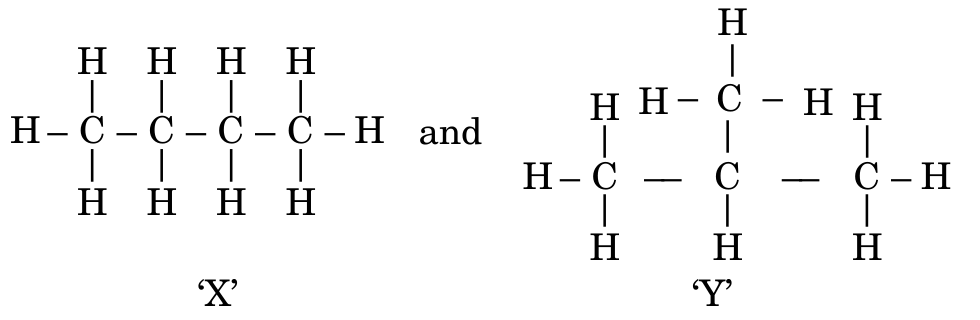
(c) (ii) What are structural isomers? Write the structures of two isomers of butane (C4H10). 2
Pollination is an important process in sexual reproduction of plants. It is an essential process that facilitates fertilisation in plants. Pollinating agents can be wind, water, insects and birds. Several changes take place in the flower after the fertilization has taken place.
(a) Write the main difference between self-pollination and cross-pollination. 1
(b) Name the part of the flower which attracts insects for pollination. What happens to this part after fertilisation? 1
(c) (i) Define fertilisation. What is the fate of ovules and the ovary in a flower after fertilisation? 2
OR
(c) (ii) In a germinating seed, which parts are known as future shoot and future root? Mention the function of cotyledon. 2
A highly polished surface such as a mirror reflects most of the light falling on it. In our daily life we use two types of mirrors plane and spherical. The reflecting surface of a spherical mirrors may be curved inwards or outwards. In concave mirrors, reflection takes place from the inner surface, while in convex mirrors reflection takes place from the outer surface.
(a) Define the principal axis of a concave mirror. 1
(b) A ray of light is incident on a concave mirror, parallel to its principal axis. If this ray after reflection from the mirror passes through the principal axis from a point at a distance of 10 cm from the pole of the mirror, find the radius of curvature of the mirror. 1
(c) (i) An object is placed at a distance of 10 cm from the pole of a convex mirror of focal length 15 cm. Find the position of the image. 2
OR
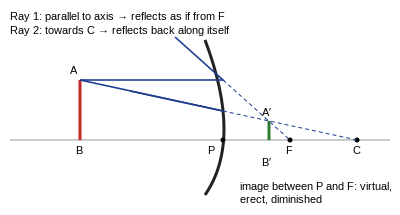
(c) (ii) A mirror forms a virtual, erect and diminished image of an object. Identify the type of this mirror. Draw a ray diagram to show the image formation in this case. 2
Solutions: CBSE 2024 · 31/5/1
Answer: (C) 2, 2, 4
Check: Zn 2 = 2; N 4 = 4; O 12 = 2 + 8 + 2.
Answer: (A) Calcium phosphate
Tooth enamel is made of calcium phosphate, the hardest substance in the body; it starts corroding when the pH in the mouth falls below 5.5.
Answer: (B) Al, Al2O3
Aluminium is used in the thermit process; 4Al + 3O2 → 2Al2O3, and aluminium oxide reacts with both acids and bases (amphoteric).
Answer: (C)
In a reflex arc the impulse goes from the receptor along the sensory neuron to a relay neuron in the spinal cord, then along the motor neuron to the effector muscle.
Answer: (C)
The placenta has villi on the embryo's side that provide a large surface area for glucose and oxygen to pass from the mother to the embryo.
Answer: (C)
Rays from every point of the object still pass through the uncovered lower half, so the full image is formed at the same place and size; only fewer rays reach it, so it is less bright.
Answer: (A) Red
Red light bends the least in glass, so glass has the lowest refractive index for red (it travels fastest in glass).
Answer: (A)
The field is to the right. The electron moves downward, so its current is upward; the positron moves upward, so its current is also upward. With the field to the right and current upward, Fleming's left-hand rule gives a force into the plane of the paper for both.
Answer: (A)
Both are true and R explains A: oils containing unsaturated fatty acids are considered healthier for cooking than animal fats, which contain saturated fatty acids.
Answer: (B)
Both are true (conventional current flows from higher to lower potential, so electrons move from lower to higher). R explains why charges keep flowing, but not the direction in which electrons move.
Product: copper(II) oxide, which is black (the surface of the brown copper powder turns black).
1. Low melting and boiling points show that the forces of attraction between their molecules are not very strong.
2. Being non-conductors shows that the bonding in them does not give rise to ions.
Together these show that carbon compounds are formed by covalent bonds (sharing of electrons).
Lymph is also called tissue fluid.
Functions: (1) it carries digested and absorbed fat from the intestine; (2) it drains excess fluid from the spaces between cells back into the blood. (It also contains lymphocytes that help fight infection.)
(a) A convex lens converges the parallel rays of sunlight to a point. The light energy (heat) of all the rays is concentrated at that point, which becomes very hot and the paper catches fire.
(b) The point is the principal focus of the lens. The bright spot is the real image of the Sun.
The iron nail gets a brownish coating of copper, and the blue solution fades to pale green.
Displacement reaction: a reaction in which a more reactive element displaces a less reactive element from its compound (solution).
Other metals: zinc and aluminium (or magnesium) — all are more reactive than copper.
(i) Growth hormone, secreted by the pituitary gland, regulates growth and development of the body. Its deficiency in childhood causes dwarfism; excess causes gigantism.
(ii) Thyroxin, secreted by the thyroid gland, regulates carbohydrate, protein and fat metabolism to provide the best balance for growth. Iodine is needed to make thyroxin. (Insulin from the pancreas, which regulates blood sugar, is another example.)
(i) Hypermetropia (far-sightedness): the rays from a near object meet behind the retina. The part responsible is the eye lens (and the eyeball).
(ii) (1) The focal length of the eye lens is too long. (2) The eyeball has become too small.
(iii) A convex (converging) lens of suitable power. It provides the additional focusing power so that the image of a near object is formed on the retina.
(a) The soft iron gets strongly magnetised by the field inside the solenoid. The device is an electromagnet. It is called so because it is a magnet produced by an electric current; it behaves as a magnet only while current flows through the coil.
(b) 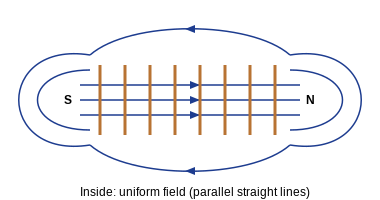
The field lines inside the solenoid are parallel straight lines, which shows that the magnetic field is the same at all points (uniform) inside it.
(i) From the water of crystallisation. Ferrous sulphate crystals contain water molecules as part of their crystal structure; on heating this water evaporates and condenses as droplets on the cooler, upper part of the tube.
(ii) The green crystals turn white (anhydrous ferrous sulphate); on strong heating they change further to brownish ferric oxide.
(iii) 7 molecules: FeSO4·7H2O. (I) Copper sulphate: CuSO4·5H2O. (II) Sodium carbonate (washing soda): Na2CO3·10H2O.
(iv) Gypsum is heated at 373 K; it loses water and becomes Plaster of Paris:
Uses: (1) supporting fractured bones in the right position; (2) making toys, materials for decoration and making surfaces smooth.
Experiment:
1. Take two healthy potted plants of nearly the same size. Keep them in a dark room for three days so that all the starch in their leaves is used up (de-starching).
2. Place each plant on a separate glass plate. Put a watch-glass containing potassium hydroxide (KOH) beside one plant — KOH absorbs carbon dioxide.
3. Cover both plants with separate glass bell-jars and seal the bottom of the jars with vaseline so that the set-up is air-tight.
4. Keep both plants in sunlight for about two hours.
5. Pluck a leaf from each plant, boil it in alcohol (to remove chlorophyll) and test it with iodine solution.
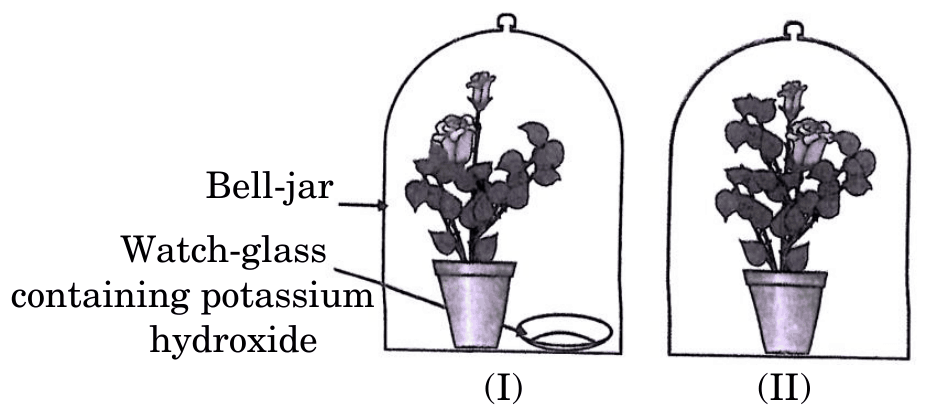
Observation: the leaf of the plant without KOH turns blue-black (starch present); the leaf of the plant with KOH does not turn blue-black (no starch).
Conclusion: the plant with KOH did not get carbon dioxide and could not make starch, so carbon dioxide is essential for photosynthesis.
(i) The current also becomes one-third of its initial value. Ohm's law: the potential difference V across a conductor is directly proportional to the current I through it, provided its temperature remains the same: V = IR, i.e. I = V/R.
(ii) 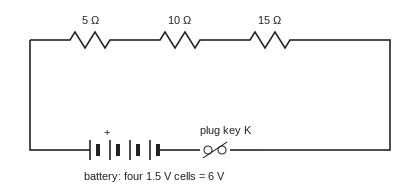
Battery voltage V = 4 × 1.5 = 6 V; total resistance R = 5 + 10 + 15 = 30 Ω.
(II) V10 = I × 10 Ω = 0.2 × 10 = 2 V
(a) Hydrocarbons are compounds made up of only carbon and hydrogen, e.g. methane CH4.
(b) (1) Catenation — carbon links with other carbon atoms to form long chains, branches and rings. (2) Tetravalency — with valency 4, carbon bonds with four other atoms (carbon or other elements).
(c) (i) Aldehyde: –CHO; ketone: –CO– (C=O within the chain).
OR (c) (ii) Structural isomers are compounds with the same molecular formula but different structural arrangements of atoms.
Isomers of C4H10: n-butane CH3–CH2–CH2–CH3 (straight chain) and isobutane (2-methylpropane) CH3–CH(CH3)–CH3 (branched chain).
(a) The principal axis is the straight line passing through the pole and the centre of curvature of the mirror.
(b) A ray parallel to the axis passes through the principal focus after reflection, so f = 10 cm and R = 2f = 20 cm.
(c) (i) Convex mirror: f = +15 cm, u = −10 cm.
v = +6 cm
The image is 6 cm behind the mirror (virtual and erect).
OR (c) (ii) A convex mirror (it always forms a virtual, erect, diminished image):
Get every solution for all 17 papers
- Every board question of every chapter, each fully solved the way the board gives marks
- 17 complete board papers, each followed by its solutions
- Weightage and most-asked topics for every chapter
- Instant PDF download, colour and black & white print copies
Revising the chapter first? Complete Science Notes for Class 10 (NCERT 2026-27) →
What you get in the pack
- Questions from 126 CBSE papers, 2016 to 2026: every set code available
- Complete: 2405 different questions and parts from all set codes, 13 chapters and 17 full papers
- Part A: all 13 chapters, questions sorted chapter-wise and by marks
- Year-wise weightage table and most-asked topics for every chapter
- Part B: 17 full board papers, each followed by its complete solutions, for timed practice
- Answers written to the CBSE marking-scheme points, with labelled diagrams drawn in full
- Questions on topics out of the board syllabus flagged
All chapters in this pack
- PYQ Ch 1 Chemical Reactions and Equations
- PYQ Ch 2 Acids, Bases and Salts
- PYQ Ch 3 Metals and Non-metals
- PYQ Ch 4 Carbon and its Compounds
- PYQ Ch 5 Life Processes
- PYQ Ch 6 Control and Coordination
- PYQ Ch 7 How do Organisms Reproduce
- PYQ Ch 8 Heredity
- PYQ Ch 9 Light Reflection and Refraction
- PYQ Ch 10 The Human Eye and the Colourful World
- PYQ Ch 11 Electricity
- PYQ Ch 12 Magnetic Effects of Electric Current
- PYQ Ch 13 Our Environment
- Board Paper 2026 Set 31-2-1 with Solutions
- Board Paper 2026 Set 31-3-1 with Solutions
- Board Paper 2025 Set 31-1-1 with Solutions
- Board Paper 2025 Set 31-2-1 with Solutions
- Board Paper 2024 Set 31-4-1 with Solutions
- Board Paper 2024 Set 31-5-1 with Solutions
- Board Paper 2023 Set 31-2-1 with Solutions
- Board Paper 2023 Set 31-4-1 with Solutions
- Board Paper 2022 Term 2 Set 31-1-1 with Solutions
- Board Paper 2022 Term 2 Set 31-3-1 with Solutions
- Board Paper 2020 Set 31-2-1 with Solutions
- Board Paper 2020 Set 31-4-1 with Solutions
- Board Paper 2019 Set 31-2-1 with Solutions
- Board Paper 2019 Set 31-4-1 with Solutions
- Board Paper 2018 Set 31-1 with Solutions
- Board Paper 2017 Set 3 with Solutions
- Board Paper 2016 Set 31-1 with Solutions