
CBSE Class 10 Science Question Paper 2024 (31/4/1) with Solutions
The complete CBSE Class 10 Science board paper of 2024, Q.P. code 31/4/1: all 39 questions exactly as set, with marks. 23 solutions are free below. The Class 10 Science PYQ Book: Solved Board Papers 2016-2026 (CBSE) solves all 17 papers in full and sorts every question chapter-wise.
Subject expert: Khushbu Gupta, B.Sc., M.Sc. Physics, B.Ed. · 8+ years teaching


Free: NCERT solutions for Class 10 Science →
Question paper
Jump to: Question paperSolutions
2024 · Q.P. Code 31/4/1
Maximum marks: 80
Section A · Multiple choice and Assertion–Reason
Zn + 2CH3COOH → (CH3COO)2Zn + H2. The above reaction is a:
An aqueous solution of a salt turns blue litmus to red. The salt could be the one obtained by the reaction of:
Four solutions, namely glucose, alcohol, hydrochloric acid and sulphuric acid filled in four separate beakers are connected one by one in an electric circuit with a bulb. The solutions in which the bulb will glow when current is passed are:
The metals which are found in both free state as well as combined state are:
The number of single and double bonds present in a molecule of benzene (C6H6) respectively, are:
In human beings, when the process of digestion is completed, the (i) proteins, (ii) carbohydrates, and (iii) fats are respectively finally converted into:
A plant growth inhibitor hormone which causes wilting of leaves is called:
The plants that can be raised by the method of vegetative propagation are:
The part of seed which is a source of food during germination of seed is:
A zygote is formed by the fusion of a male gamete and a female gamete. The number of chromosomes in the zygote of a human is:
Absolute refractive index of glass and water is 3/2 and 4/3 respectively. If the speed of light in glass is 2 × 10⁸ m/s, the speed of light in water is:
When a beam of white light passes through a region having very fine dust particles, the colour of light mainly scattered in that region is:
Consider the following combinations of resistors:
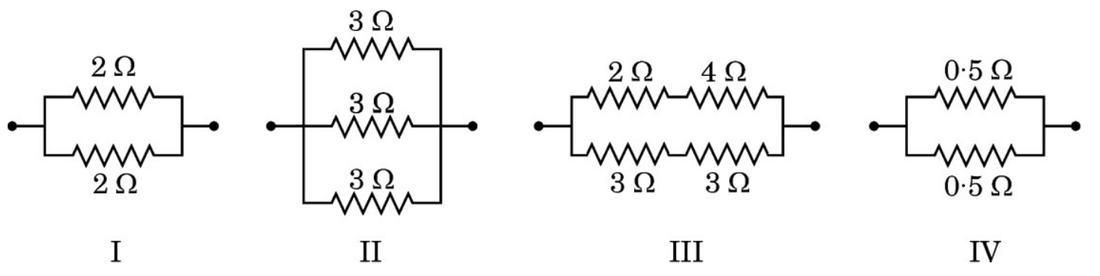
The combinations having equivalent resistance 1 Ω is/are:
An electric iron of resistance 20 Ω draws a current of 5 A. The heat developed in the iron in 30 seconds is:
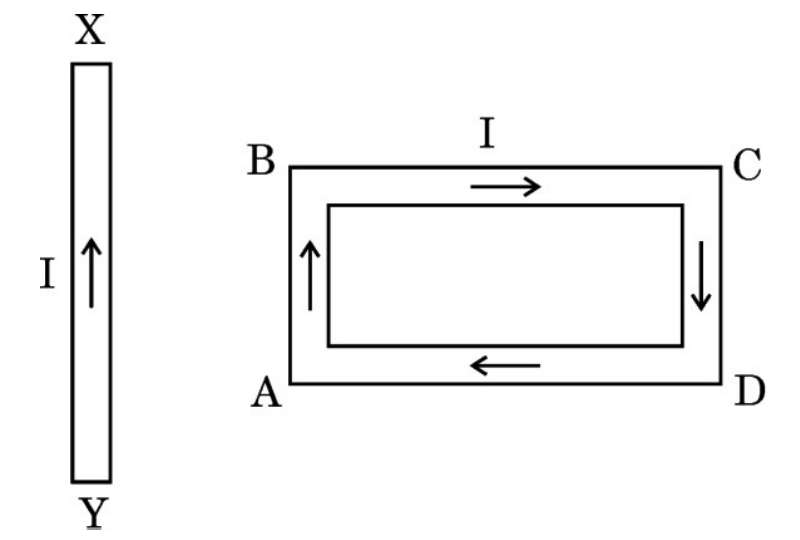
A rectangular loop ABCD carrying a current I is situated near a straight conductor XY, such that the conductor is parallel to the side AB of the loop and is in the plane of the loop. If a steady current I is established in the conductor as shown, the conductor XY will
Some wastes are given below: (i) Garden waste (ii) Ball point pen refills (iii) Empty medicine bottles made of glass (iv) Peels of fruits and vegetables (v) Old cotton shirt. The non-biodegradable wastes among these are:
Assertion (A): The extraction of metals from their sulphide ores cannot take place without roasting of the ore.
Reason (R): Roasting converts sulphide ores directly into metals.
Assertion (A): In the human heart ventricles have thicker muscular walls than atria.
Reason (R): Ventricles have to pump the blood into various organs.
Assertion (A): Magnetic field lines never intersect each other.
Reason (R): If they intersect, then at the point of intersection, the compass needle would point towards two directions, which is not possible.
Assertion (A): Oxygen is essential for all aerobic forms of life.
Reason (R): Free oxygen atoms combine with molecular oxygen to form ozone.
Section B · Very short answer (2 marks)
(a) 1 gram of solid sodium chloride was taken in a clean and dry test tube and concentrated sulphuric acid was added to it. (i) Name the gas evolved in the reaction. (ii) What will be observed when this gas is tested with (I) dry, and (II) wet blue litmus paper? Write your conclusion about the nature (acidic/basic) of this gas.
(b) Some metals react with acids to produce salt and hydrogen gas. Illustrate it with an example. How will you test the presence of this gas?
Distinguish between a saturated and an unsaturated hydrocarbon by flame test. List the products of combustion reaction of a saturated hydrocarbon.
(a) We need to water the soil in plants on a regular basis. But it ultimately reaches the leaves of the plant. Explain how this takes place.
(b) Name the type of nutrition exhibited by Amoeba. Explain how food is taken in and digested by this organism.
The survival of a species is promoted through creation of variations. Illustrate with an example.
A person suffering from presbyopia needs bifocal lens. If he needs two lens of power −4.0 dioptre and +2.0 dioptre, which one of these two lenses is for the correction of distant vision and what is its focal length?
Two wires A and B of same material, having same lengths and diameters 0.2 mm and 0.3 mm respectively, are connected one by one in a circuit. Which one of these two wires will offer more resistance to the flow of current in the circuit? Justify your answer.
Section C · Short answer (3 marks)
Write the common name and the chemical name of the compound CaSO4·½H2O. Write the method of its preparation. Give chemical equation for the reaction, when water reacts with CaSO4·½H2O.
Why is the conversion of ethanol to ethanoic acid an oxidation reaction? Name the oxidising agent used in this conversion. Write chemical equation for this oxidation reaction. How is this reaction different from the reaction in which ethanol burns in the presence of oxygen?
(a) Explain with the help of a labelled diagram, the process of reproduction in Hydra by budding. Name the cells used for reproduction in this process.
(b) List two roles of each of the following in human reproductive system: (i) Seminal vesicles and prostate gland (ii) Oviduct (iii) Testis
List two differences between dominant traits and recessive traits. What percentage of pea plants in the F2 generation were with yellow seeds in Mendel’s cross between the pea plants having yellow (YY) and green coloured (yy) seeds?
Define the term power of accommodation of human eye. What happens to the image distance in the eye when we increase the distance of an object from the eye? Name and explain the role of the part of human eye responsible for it in this case.
A student fixes a sheet of white paper on a drawing board. He places a bar magnet in the centre of it. He sprinkles some iron filings uniformly around the bar magnet. Then he taps the drawing board gently and observes that the iron filings arrange themselves in a particular pattern. (a) Why do iron filings arrange in a particular pattern? (b) What does the crowding of iron filings at the ends of the magnet indicate? (c) What do the lines, along which the iron filings align, represent? (d) If the student places a cardboard horizontally in a current carrying solenoid and repeats the above activity, in what pattern would the iron filings arrange? State the conclusion drawn about the magnetic field based on the observed pattern of the lines.
Study the picture given below showing three food chains (a), (b) and (c) and answer the following questions:
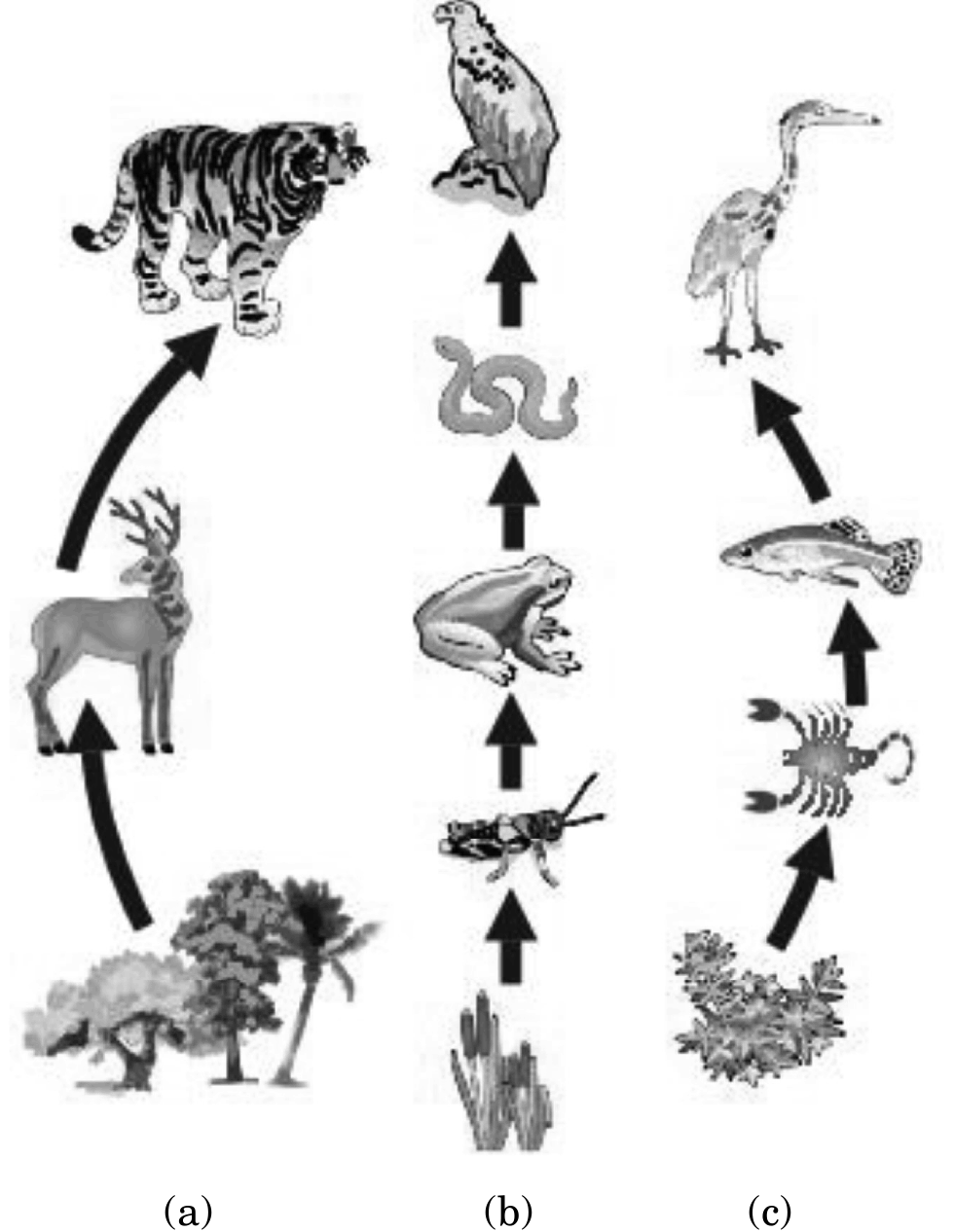
(i) Name the type of ecosystems that exist in food chains (b) and (c).
(ii) The first trophic level in all food chains are producers. Why? What percentage of solar energy do these producers capture for their use?
(iii) Why are the arrows shown in the diagram in one direction only and not vice versa? Justify.
Section D · Long answer (5 marks)
(a) What is a chemical reaction? Describe one activity each to show that a chemical change has occurred in which (i) change of colour, and (ii) change in temperature has taken place.
(b) (i) Define a decomposition reaction. How can we say that (I) electrolysis of water, and (II) blackening of silver bromide when exposed to sunlight, are decomposition reactions? Mention the type of energy involved in each case.
(ii) The type of reactions in which (I) calcium oxide is formed, and (II) calcium hydroxide is formed are opposite reactions to each other. Justify this statement with the help of chemical equations.
(a) (i) Define a reflex arc. Why have reflex arcs evolved in animals? Trace the sequence of events which occur, when you suddenly touch a hot object.
(ii) Name the part of nervous system which helps in communication between the central nervous system and other parts of the body. What are the two components of this system?
(b) (i) Leaves of chhui-mui plant begin to fold up and droop in response to a stimulus. Name the stimulus and write the cause for such a rapid movement. Is there any growth involved in the movement?
(ii) Define geotropism in plants. What is meant by positive and negative geotropism? Give one example of each type.
(a) The variation of image distance (v) with object distance (u) for a convex lens is given in the following observation table. Analyse it and answer the questions that follow:
| S. No. | 1 | 2 | 3 | 4 | 5 | 6 |
|---|---|---|---|---|---|---|
| u (cm) | −150 | −75 | −50 | −37.5 | −30 | −15 |
| v (cm) | +30 | +37.5 | +50 | +75 | +150 | +37.5 |
(i) Without calculation, find the focal length of the convex lens. Justify your answer.
(ii) Which observation is not correct? Why? Draw ray diagram to find the position of the image formed for this position of the object.
(iii) Find the approximate value of magnification for u = −30 cm.
(b) (i) Define principal axis of a lens. Draw a ray diagram to show what happens when a ray of light parallel to the principal axis of a concave lens passes through it.
(ii) The focal length of a concave lens is 20 cm. At what distance from the lens should a 5 cm tall object be placed so that its image is formed at a distance of 15 cm from the lens? Also calculate the size of the image formed.
Section E · Case-based (4 marks)
Three metal samples of magnesium, aluminium and iron were taken and rubbed with sand paper. These samples were then put separately in test tubes containing dilute hydrochloric acid. Thermometers were also suspended in each test tube so that their bulbs dipped in the acid. The rate of formation of bubbles was observed. The above activity was repeated with dilute nitric acid and the observations were recorded.
(a) When activity was done with dilute hydrochloric acid, then in which one of the test tubes was the rate of formation of bubbles the fastest and the thermometer showed the highest temperature? 1
(b) Which metal did not react with dilute hydrochloric acid? Give reason. 1
(c) (i) Why is hydrogen gas not evolved when a metal reacts with dilute nitric acid? Name the ultimate products formed in the reaction. 2
OR
(c) (ii) Name the type of reaction on the basis of which reactivity of metals is decided. You have two metals X and Y. How would you decide which is more reactive than the other? 2
Kidneys are vital organs for survival. Several factors like infections, injury or restricted blood flow to kidneys reduce the activity of kidneys. This leads to accumulation of poisonous wastes in the body, which can even lead to death. In case of kidney failure, an artificial kidney can be used. An artificial kidney is a device to remove waste products from the blood through dialysis.
(a) (i) Name the artery that brings oxygenated blood to the kidney. (ii) Name the cluster the thin-walled blood capillaries present in the Bowman’s capsule. 1
(b) In human excretory system name the organ which stores urine. Is this organ under hormonal control or nervous control? 1
(c) (i) List two major steps involved in the formation of urine and state in brief their functions. 2
OR
(c) (ii) In which part of the nephron does selective reabsorption take place? List the factors which the amount of water reabsorbed depends on. 2
Study the following circuit:
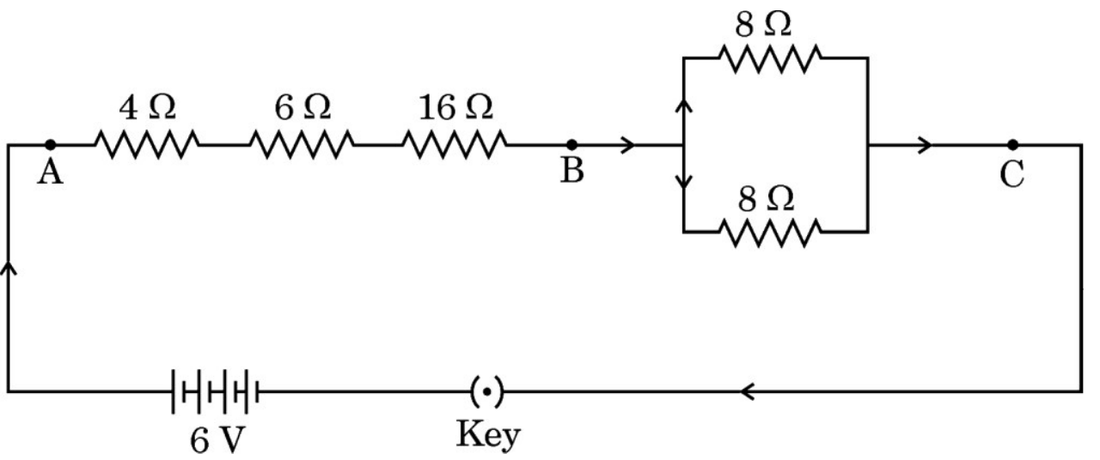
(a) Find the value of total resistance between the points A and B. 1
(b) Find the resistance between the points B and C. 1
(c) (i) Calculate the current drawn from the battery, when the key is closed. 2
OR
(c) (ii) In the above circuit, the 16 Ω resistor or the parallel combination of two resistors of 8 Ω, which one of the two will have more potential difference across its two ends? Justify your answer. 2
Solutions: CBSE 2024 · 31/4/1
Answer: (B) Displacement reaction
Zinc, being more reactive, displaces hydrogen from ethanoic acid, forming zinc ethanoate and hydrogen gas.
Answer: (D)
Acids give H+ ions in water and the ions conduct electricity. Glucose and alcohol do not ionise in water, so the bulb does not glow.
Answer: (B) 9 and 3
Benzene has 6 C–H single bonds and a ring of 6 carbon atoms with alternate single and double bonds (3 C–C single, 3 C=C double). Single bonds = 6 + 3 = 9; double bonds = 3.
Answer: (C) Abscisic acid
Abscisic acid inhibits growth; its effects include wilting of leaves. Auxin, gibberellin and cytokinin promote growth.
Answer: (A) Cotyledon
Cotyledons store food for the developing embryo; the radicle becomes the root and the plumule the shoot.
Answer: (A)
vw = c / nw = 3 × 10⁸ ÷ 4/3 = 9/4 × 108 m/s
Answer: (C) I and II
I: 2 Ω ∥ 2 Ω = 1 Ω. II: three 3 Ω in parallel = 3/3 = 1 Ω. III: (2 + 4) ∥ (3 + 3) = 6 ∥ 6 = 3 Ω. IV: 0.5 ∥ 0.5 = 0.25 Ω.
Answer: (B)
The current in side AB (A to B, upward) is in the same direction as the current in XY. The magnetic field of AB exerts a force on XY (Fleming's left-hand rule) that pulls XY towards AB — parallel currents in the same direction attract. Side CD is farther away, so its opposite (repulsive) effect is weaker.
Answer (board key): (B)
A is true: sulphide ores must be roasted (heated strongly in air) first. In general, roasting converts a sulphide into an oxide, which is then reduced. The board treated R as true (for copper, roasting Cu2S gives the metal directly through self-reduction) but not the correct explanation of A.
Answer: (A)
Both are true and R explains A: the field has a single direction at every point.
(i) Hydrogen chloride (HCl) gas: NaCl + H2SO4 → NaHSO4 + HCl.
(ii) (I) Dry blue litmus: no change in colour. (II) Wet blue litmus: turns red.
Conclusion: HCl gas is acidic, but it shows acidic behaviour only in the presence of water, which allows it to form H+ ions.
• A saturated hydrocarbon burns with a clean blue flame (no soot).
• An unsaturated hydrocarbon burns with a yellow, sooty (smoky) flame.
Products of combustion of a saturated hydrocarbon: carbon dioxide, water, heat and light (e.g. CH4 + 2O2 → CO2 + 2H2O + heat and light).
Holozoic (heterotrophic) nutrition.
Amoeba takes in food using temporary finger-like extensions of the cell surface (pseudopodia), which fuse over the food particle to form a food vacuole. Inside the food vacuole, complex substances are broken down into simpler ones, which diffuse into the cytoplasm. The undigested material moves to the surface of the cell and is thrown out.
Distant vision (myopia) is corrected by a concave lens — the lens of power −4.0 D (upper part of the bifocal).
Common name: Plaster of Paris. Chemical name: calcium sulphate hemihydrate.
Preparation: gypsum is heated at 373 K; it loses water molecules:
With water: it changes back to gypsum, a hard solid mass:
In Hydra, a bud develops as an outgrowth due to repeated cell division at one specific site. The bud develops into a tiny individual with tentacles and, when fully mature, detaches from the parent and becomes a new independent individual.
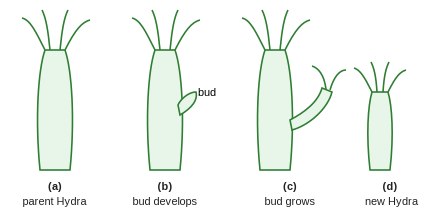
Hydra uses regenerative cells for reproduction in the process of budding.
| Dominant trait | Recessive trait |
|---|---|
| Expressed even when only one copy of its gene is present (YY or Yy) | Expressed only when both copies are recessive (yy) |
| Appears in the F1 generation | Hidden in F1; reappears in F2 |
YY × yy → F1 all Yy (yellow). F1 × F1 (Yy × Yy) → YY : Yy : yy = 1 : 2 : 1. Yellow (YY + Yy) = 3 out of 4 = 75%.
(a) The magnet exerts a force on the iron filings; they become small magnets and align themselves along the magnetic field around the magnet.
(b) The crowding shows that the magnetic field is strongest at the poles.
(c) They represent the magnetic field lines.
(d) Inside the solenoid the filings arrange in parallel straight lines; outside, the pattern is like that of a bar magnet. Conclusion: the magnetic field inside a solenoid is the same at all points (uniform).
A chemical reaction is a process in which one or more substances (reactants) change into new substances (products) with different properties. It is indicated by a change in state, colour, temperature, evolution of gas, or formation of a precipitate.
(i) Change of colour: put an iron nail into copper sulphate solution in a test tube. After about 20 minutes the blue colour of the solution fades to pale green, and a brownish coating appears on the nail.
(ii) Change in temperature: take a small amount of quick lime in a beaker and slowly add water. The beaker becomes hot (the reaction is exothermic).
(Also: zinc granules with dilute sulphuric acid — the flask becomes warm.)
(i) A reflex arc is the pathway followed by nerve impulses in a reflex action: from the receptor, through the sensory nerve, to the spinal cord, and back through the motor nerve to the effector.
Reflex arcs have evolved because the thinking process of the brain is too slow in an emergency; the connection in the spinal cord allows a very quick response without waiting for the brain.
Sequence on touching a hot object: receptors in the skin detect the heat → sensory neuron carries the impulse to the spinal cord → relay neuron in the spinal cord → motor neuron → effector (muscles of the arm) contracts → the hand is pulled away. (The information also reaches the brain later.)
(ii) The peripheral nervous system. Its two components: cranial nerves arising from the brain and spinal nerves arising from the spinal cord.
(i) In observation 3, u = −50 cm and v = +50 cm (equal). This happens when the object is at 2F1, so 2f = 50 cm, i.e. f = 25 cm.
(ii) Observation 6 is not correct. u = −15 cm is less than f, so the object lies between F1 and the optical centre. The image must be virtual, on the same side as the object (v negative), not +37.5 cm. (Correct value: 1/v = 1/25 − 1/15 ⇒ v = −37.5 cm.)
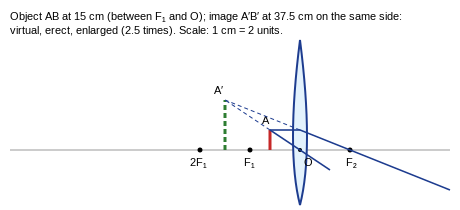
(iii)
(a) In the test tube containing magnesium — it is the most reactive of the three.
(b) None — all three metals (Mg, Al, Fe) react with dilute HCl and give hydrogen, because all of them are more reactive than hydrogen (above hydrogen in the reactivity series). (Copper, silver or gold would not react, as they are below hydrogen.)
(c) (i) Nitric acid is a strong oxidising agent. It oxidises the hydrogen produced to water and is itself reduced to oxides of nitrogen. Ultimate products: water and oxides of nitrogen (N2O, NO or NO2), along with the metal nitrate. (Only Mg and Mn give H2 with very dilute HNO3.)
OR (c) (ii) Displacement reactions. Put a piece of metal X in a solution of a salt of Y. If X displaces Y from its salt solution (Y gets deposited), X is more reactive than Y; if there is no reaction, Y is more reactive. E.g. Fe + CuSO4 → FeSO4 + Cu shows iron is more reactive than copper.
(a) 4 Ω, 6 Ω and 16 Ω are in series: RAB = 4 + 6 + 16 = 26 Ω.
(b) Two 8 Ω in parallel: RBC = (8 × 8)/(8 + 8) = 4 Ω.
(c) (i) Total resistance = 26 + 4 = 30 Ω.
OR (c) (ii) The same current (0.2 A) flows through the 16 Ω resistor and through the parallel combination (4 Ω).
So the 16 Ω resistor has the larger potential difference: for the same current, V = IR is larger for the larger resistance.
Get every solution for all 17 papers
- Every board question of every chapter, each fully solved the way the board gives marks
- 17 complete board papers, each followed by its solutions
- Weightage and most-asked topics for every chapter
- Instant PDF download, colour and black & white print copies
Revising the chapter first? Complete Science Notes for Class 10 (NCERT 2026-27) →
What you get in the pack
- Questions from 126 CBSE papers, 2016 to 2026: every set code available
- Complete: 2405 different questions and parts from all set codes, 13 chapters and 17 full papers
- Part A: all 13 chapters, questions sorted chapter-wise and by marks
- Year-wise weightage table and most-asked topics for every chapter
- Part B: 17 full board papers, each followed by its complete solutions, for timed practice
- Answers written to the CBSE marking-scheme points, with labelled diagrams drawn in full
- Questions on topics out of the board syllabus flagged
All chapters in this pack
- PYQ Ch 1 Chemical Reactions and Equations
- PYQ Ch 2 Acids, Bases and Salts
- PYQ Ch 3 Metals and Non-metals
- PYQ Ch 4 Carbon and its Compounds
- PYQ Ch 5 Life Processes
- PYQ Ch 6 Control and Coordination
- PYQ Ch 7 How do Organisms Reproduce
- PYQ Ch 8 Heredity
- PYQ Ch 9 Light Reflection and Refraction
- PYQ Ch 10 The Human Eye and the Colourful World
- PYQ Ch 11 Electricity
- PYQ Ch 12 Magnetic Effects of Electric Current
- PYQ Ch 13 Our Environment
- Board Paper 2026 Set 31-2-1 with Solutions
- Board Paper 2026 Set 31-3-1 with Solutions
- Board Paper 2025 Set 31-1-1 with Solutions
- Board Paper 2025 Set 31-2-1 with Solutions
- Board Paper 2024 Set 31-4-1 with Solutions
- Board Paper 2024 Set 31-5-1 with Solutions
- Board Paper 2023 Set 31-2-1 with Solutions
- Board Paper 2023 Set 31-4-1 with Solutions
- Board Paper 2022 Term 2 Set 31-1-1 with Solutions
- Board Paper 2022 Term 2 Set 31-3-1 with Solutions
- Board Paper 2020 Set 31-2-1 with Solutions
- Board Paper 2020 Set 31-4-1 with Solutions
- Board Paper 2019 Set 31-2-1 with Solutions
- Board Paper 2019 Set 31-4-1 with Solutions
- Board Paper 2018 Set 31-1 with Solutions
- Board Paper 2017 Set 3 with Solutions
- Board Paper 2016 Set 31-1 with Solutions