
CBSE Class 10 Science Question Paper 2023 (31/4/1) with Solutions
The complete CBSE Class 10 Science board paper of 2023, Q.P. code 31/4/1: all 39 questions exactly as set, with marks. 23 solutions are free below. The Class 10 Science PYQ Book: Solved Board Papers 2016-2026 (CBSE) solves all 17 papers in full and sorts every question chapter-wise.
Subject expert: Khushbu Gupta, B.Sc., M.Sc. Physics, B.Ed. · 8+ years teaching


Free: NCERT solutions for Class 10 Science →
Question paper
Jump to: Question paperSolutions
2023 · Q.P. Code 31/4/1
Maximum marks: 80
Section A · Multiple choice and Assertion–Reason
When Sodium bicarbonate reacts with dilute hydrochloric acid, the gas evolved is:
When aqueous solutions of potassium iodide and lead nitrate are mixed, an insoluble substance separates out. The chemical equation for the reaction involved is:
A metal ribbon ‘X’ burns in oxygen with a dazzling white flame forming a white ash ‘Y’. The correct description of X, Y and the type of reaction is:
Acid present in tomato is:
Sodium hydroxide is termed an alkali while Ferric hydroxide is not because:
The name of the salt used to remove permanent hardness of water is:
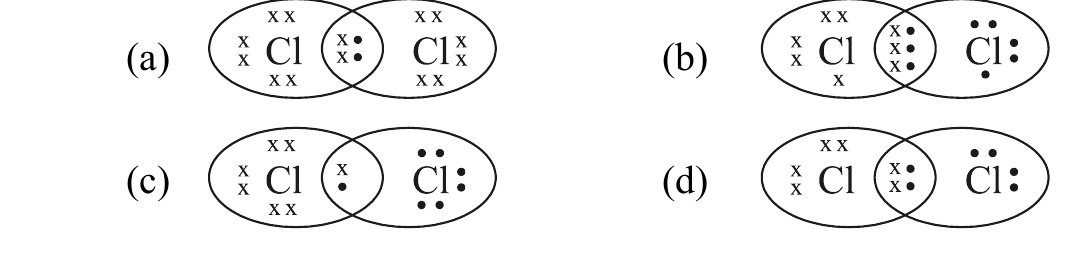
The electron dot structure of chlorine molecule is:
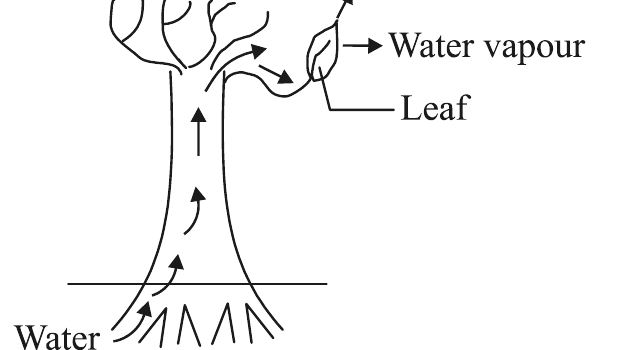
Observe the following diagram and identify the process and its significance from the following options:
Opening and closing of stomata is due to:
A cross between pea plant with white flowers (vv) and pea plant with violet flowers (VV) resulted in F2 progeny in which ratio of violet (VV) and white (vv) flowers will be:
In plants the role of cytokinin is:
The number of chromosomes in parents and offsprings of a particular species undergoing sexual reproduction remain constant due to:
Two LED bulbs of 12 W and 6 W are connected in series. If the current through 12 W bulb is 0.06 A the current through 6 W bulb will be:
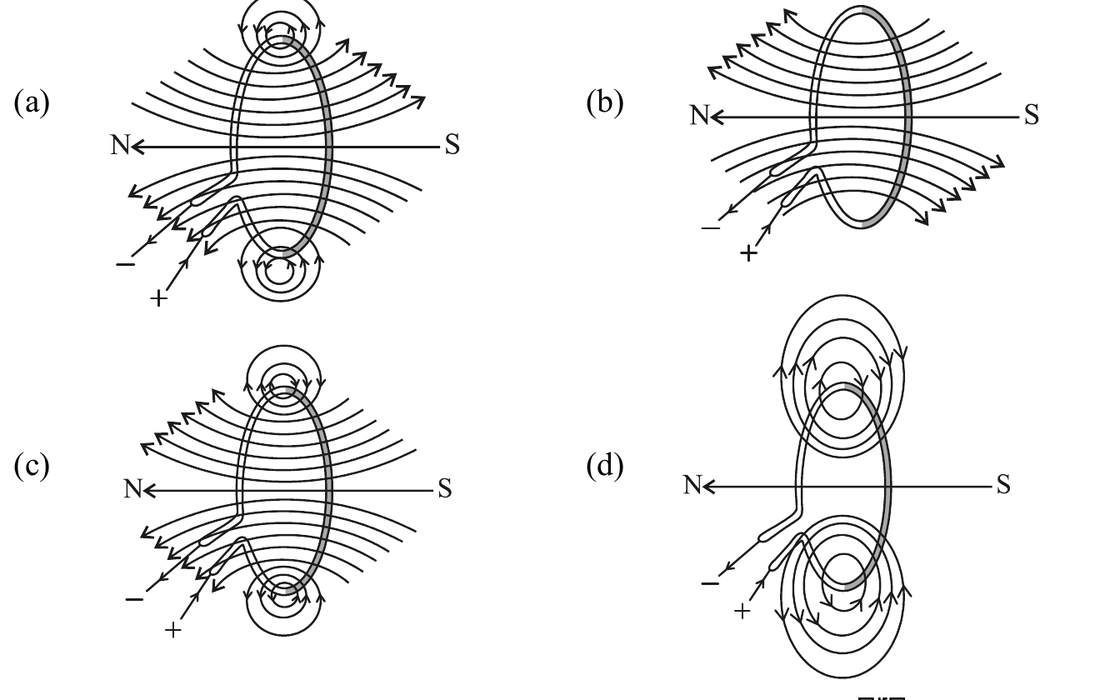
The correct pattern of magnetic field lines of the field produced by a current carrying circular loop is:
The resistance of a resistor is reduced to half of its initial value. If other parameters of the electrical circuit remain unaltered, the amount of heat produced in the resistor will become:
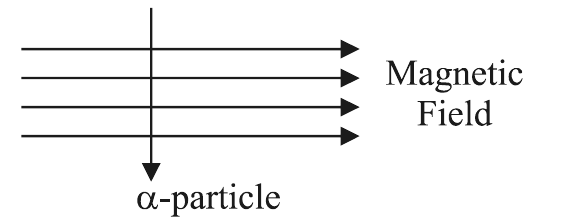
An alpha particle enters a uniform magnetic field as shown. The direction of force experienced by the alpha particle is:
Assertion (A): Reaction of Quicklime with water is an exothermic reaction.
Reason (R): Quicklime reacts vigorously with water releasing a large amount of heat.
Assertion (A): In humans, if gene (B) is responsible for black eyes and gene (b) is responsible for brown eyes, then the colour of eyes of the progeny having gene combination Bb, bb or BB will be black only.
Reason (R): The black colour of the eyes is a dominant trait.
Assertion (A): The inner walls of the small intestine have finger like projections called villi which are rich in blood.
Reason (R): These villi have a large surface area to help the small intestine in completing the digestion of food.
Assertion (A): A current carrying straight conductor experiences a force when placed perpendicular to the direction of magnetic field.
Reason (R): The net charge on a current carrying conductor is always zero.
Section B · Very short answer (2 marks)
(a) A student took a small amount of copper oxide in a conical flask and added dilute hydrochloric acid to it with constant stirring. He observed a change in colour of the solution. (i) Write the name of the compound formed and its colour. (ii) Write a balanced chemical equation for the reaction involved.
(b) The industrial process used for the manufacture of caustic soda involves electrolysis of an aqueous solution of compound ‘X’. In this process, two gases ‘Y’ and ‘Z’ are liberated. ‘Y’ is liberated at cathode and ‘Z’, which is liberated at anode, on treatment with dry slaked lime forms a compound ‘B’. Name X, Y, Z and B.
(a) Name the part of brain which is responsible for the following actions: (i) Maintaining posture and balance (ii) Beating of heart (iii) Thinking (iv) Blood pressure
(b) Where are auxins synthesized in a plant? Which organ of the plant shows: (i) Positive phototropism (ii) Negative geotropism (iii) Positive hydrotropism
Write one specific function each of the following organs in relation with excretion in human beings: (i) Renal Artery (ii) Urethra (iii) Glomerulus (iv) Tubular part of nephron
Two green plants are kept separately in oxygen free containers, one in the dark and other in sunlight. It was observed that plant kept in dark could not survive longer. Give reason for this observation.
(a) Observe the following diagram and answer the questions following it:
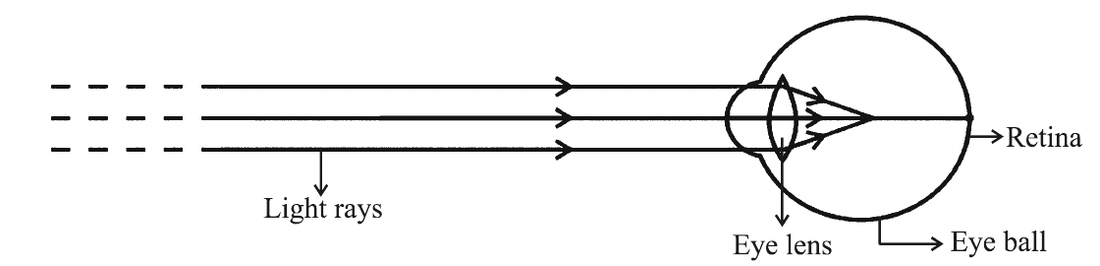
(i) Identify the defect of vision shown. (ii) List its two causes. (iii) Name the type of lens used for the correction of this defect.
(b) The colour of clear sky from the earth appears blue but from the space it appears black. Why?
Use of several pesticides which results in excessive accumulation of pesticides in rivers or ponds, is a matter of deep concern. Justify this statement.
Section C · Short answer (3 marks)
(i) While electrolysing water before passing the current some drops of an acid are added. Why? Name the gases liberated at cathode and anode. Write the relationship between the volume of gas collected at anode and the volume of gas collected at cathode.
(ii) What is observed when silver chloride is exposed to sunlight? Give the type of reaction involved.
(i) Suggest a safe procedure of diluting a strong concentrated acid.
(ii) Name the salt formed when sulphuric acid is added to sodium hydroxide and write its pH.
(iii) Dry HCl gas does not change the colour of dry blue litmus paper. Why?
(a) (i) How does Paramecium obtain its food?
(ii) List the role of each of the following in our digestive system: (a) Hydrochloric acid (b) Trypsin (c) Muscular walls of stomach (d) Salivary amylase
(b) (i) What is double circulation?
(ii) Why is the separation of the right side and the left side of the heart useful? How does it help birds and mammals?
(a) Define the following terms in the context of a diverging mirror: (i) Principal focus (ii) Focal length. Draw a labelled ray diagram to illustrate your answer.
(b) An object of height 10 cm is placed 25 cm away from the optical centre of a converging lens of focal length 15 cm. Calculate the image-distance and height of the image formed.
The power of a lens is +4 D. Find the focal length of this lens. An object is placed at a distance of 50 cm from the optical centre of this lens. State the nature and magnification of the image formed by the lens and also draw a ray diagram to justify your answer.
(a) (i) Why is an alternating current (A.C.) considered to be advantageous over direct current (D.C.) for the long distance transmission of electric power?
(ii) How is the type of current used in household supply different from the one given by a battery of dry cells?
(iii) How does an electric fuse prevent the electric circuit and the appliances from a possible damage due to short circuiting or overloading.
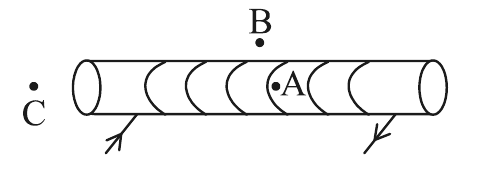
(b) For the current carrying solenoid as shown, draw magnetic field lines and give reason to explain that out of the three points A, B and C, at which point the field strength is maximum and at which point it is minimum?
Write one difference between biodegradable and non-biodegradable wastes. List two impacts of each type of the accumulated waste on environment if not disposed off properly.
Section D · Long answer (5 marks)
(a) (i) Draw the structure of the following compounds: (a) Butanoic acid (b) Chloropentane
(ii) How are structure (i) and structure (ii) given below related to one another? Give reason to justify your answer.
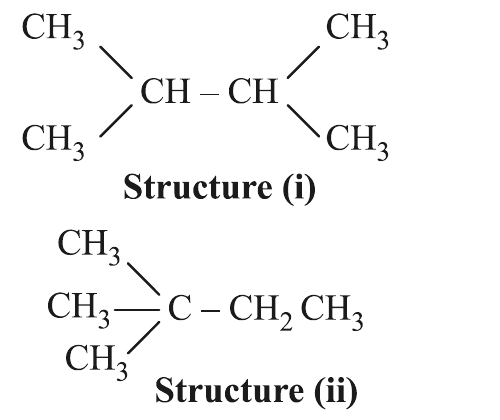
Draw one more possible structure for above case.
(iii) Differentiate between saturated and unsaturated carbon compounds on the basis of their general formula.
(b) (i) What happens when a small piece of sodium is dropped in ethanol? Write the equation for this reaction.
(ii) Why is glacial acetic acid called so?
(iii) What happens when ethanol is heated at 443 K in the presence of conc. H2SO4? Write the role of conc. H2SO4 in this case.
(iv) Write an equation showing saponification.
(i) Name and explain the two modes of asexual reproduction observed in hydra.
(ii) What is vegetative propagation? List two advantages of using this technique.
(i) How is electric current related to the potential difference across the terminals of a conductor? Draw a labelled circuit diagram to verify this relationship.
(ii) Why should an ammeter have low resistance?
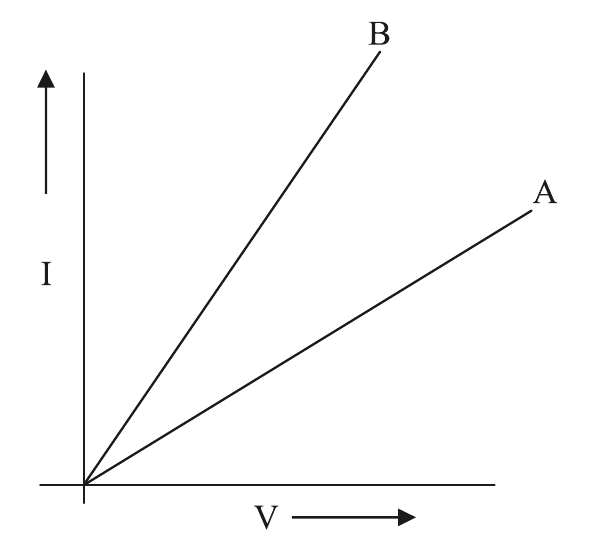
(iii) Two V - I graphs A and B for series and parallel combinations of two resistors are as shown. Giving reason state which graph shows (a) series, (b) parallel combination of the resistors.
Section E · Case-based (4 marks)
The melting points and boiling points of some ionic compounds are given below:
| Compound | Melting point (K) | Boiling point (K) |
|---|---|---|
| NaCl | 1074 | 1686 |
| LiCl | 887 | 1600 |
| CaCl2 | 1045 | 1900 |
| CaO | 2850 | 3120 |
| MgCl2 | 981 | 1685 |
These compounds are termed ionic because they are formed by the transfer of electrons from a metal to a non-metal. The electron transfer in such compounds is controlled by the electronic configuration of the elements involved. Every element tends to attain a completely filled valence shell of its nearest noble gas or a stable octet.
(i) Show the electron transfer in the formation of magnesium chloride. 1
(ii) List two properties of ionic compounds other than their high melting and boiling points. 1
(iii) (A) While forming an ionic compound say sodium chloride how does sodium atom attain its stable configuration? 2
OR
(iii) (B) Give reasons: (i) Why do ionic compounds in the solid state not conduct electricity? (ii) What happens at the cathode when electricity is passed through an aqueous solution of sodium chloride? 2
The most obvious outcome of the reproductive process is the generation of individuals of similar design, but in sexual reproduction they may not be exactly alike. The resemblances as well as differences are marked. The rules of heredity determine the process by which traits and characteristics are reliably inherited. Many experiments have been done to study the rules of inheritance.
(i) Why an offspring of human being is not a true copy of his parents in sexual reproduction? 1
(ii) While performing experiments on inheritance in plants, what is the difference between F1 and F2 generation? 1
(iii) (A) Why do we say that variations are useful for the survival of a species over time? 2
OR
(iii) (B) Study Mendel’s cross between two plants with a pair of contrasting characters: RRYY (Round Yellow) × rryy (Wrinkled Green). He observed 4 types of combinations in F2 generation. Which of these were new combinations? Why do new features which are not present in the parents, appear in F2 generation? 2
The ability of a medium to refract light is expressed in terms of its optical density. Optical density has a definite connotation. It is not the same as mass density. On comparing two media, the one with the large refractive index is optically denser medium than the other. The other medium with a lower refractive index is optically rarer. Also the speed of light through a given medium is inversely proportional to its optical density.
(i) Determine the speed of light in diamond if the refractive index of diamond with respect to vacuum is 2.42. Speed of light in vacuum is 3 × 10⁸ m/s. 1
(ii) Refractive indices of glass, water and carbon disulphide are 1.5, 1.33 and 1.62 respectively. If a ray of light is incident in these media at the same angle (say θ), then write the increasing order of the angle of refraction in these media. 1
(iii) (A) The speed of light in glass is 2 × 10⁸ m/s and in water is 2.25 × 10⁸ m/s. (a) Which one of the two is optically denser and why? (b) A ray of light is incident normally at the water-glass interface when it enters a thick glass container filled with water. What will happen to the path of the ray after entering the glass? Give reason. 2
OR
(iii) (B) The absolute refractive indices of water and glass are 4/3 and 3/2 respectively. If the speed of light in glass is 2 × 10⁸ m/s, find the speed of light in (i) vacuum and (ii) water. 2
Solutions: CBSE 2023 · 31/4/1
Answer: (c)
NaHCO3 + HCl → NaCl + H2O + CO2. Carbon dioxide turns lime water milky (Ca(OH)2 + CO2 → CaCO3 + H2O). It puts out a flame but without a pop sound (the pop test is for hydrogen).
Answer: (b)
A magnesium ribbon burns with a dazzling white flame forming white magnesium oxide: 2Mg + O2 → 2MgO — a combination reaction.
Answer: (b)
An alkali is a base that is soluble in water. All alkalis are bases, but not all bases are alkalis — ferric hydroxide is an insoluble base.
Answer: (c)
Each chlorine atom (2, 8, 7) has 7 valence electrons and needs one more. The two atoms share one pair of electrons (one × from one atom and one • from the other) — a single covalent bond — and each keeps three lone pairs. Only (c) shows one shared pair with 6 unshared electrons on each Cl. (a) and (d) show two shared pairs; (b) shows three.
Answer: (b)
Guard cells swell when water flows into them (pore opens) and shrink when they lose water (pore closes).
Answer: (a)
Cytokinins promote cell division and are present in greater concentration where cell division is rapid (fruits, seeds). Wilting is caused by abscisic acid; stem growth by gibberellins.
Answer: (b) 0.06 A
In a series circuit the same current flows through every component.
Answer: (b) two times
With the same potential difference V and time t: H = V2t/R. Halving R doubles H.
Answer: (a)
Both are true and R explains A: CaO + H2O → Ca(OH)2 + heat. A reaction that releases heat is exothermic.
Answer: (c)
A is true. R is false: villi increase the surface area for absorption of digested food, not for completing digestion.
(i) Copper(II) chloride; the solution becomes blue-green.
(ii)
(i) Cerebellum (hind-brain)
(ii) Medulla (hind-brain)
(iii) Cerebrum (fore-brain)
(iv) Medulla (hind-brain)
(i) Renal artery — brings blood containing nitrogenous wastes (and oxygen) to the kidney for filtration.
(ii) Urethra — carries urine from the urinary bladder out of the body.
(iii) Glomerulus — filters the blood (water, salts, glucose, urea pass into Bowman's capsule).
(iv) Tubular part — selective reabsorption of useful substances (glucose, amino acids, salts) and water back into the blood.
(i) Myopia (near-sightedness) — parallel rays from a distant object meet in front of the retina.
(ii) (1) Excessive curvature of the eye lens; (2) elongation of the eyeball.
(iii) A concave (diverging) lens of suitable power.
Pesticides are washed into rivers and ponds. They are non-biodegradable, so they are taken up by aquatic plants and animals and enter the food chain. At each trophic level their concentration increases (biological magnification), so fish and finally humans at the top get the highest concentrations, causing health problems. They also kill useful aquatic organisms and disturb the ecosystem.
(i) Add the concentrated acid slowly to water (never water to acid), with constant stirring, in a glass container. The process is highly exothermic; this way the heat is absorbed by the large amount of water.
(ii) Sodium sulphate: H2SO4 + 2NaOH → Na2SO4 + 2H2O. It is a salt of a strong acid and a strong base, so its pH is 7.
(iii) Dry HCl gas does not dissociate to give H+ ions; acids show acidic behaviour only in the presence of water.
(i) Double circulation: blood passes through the heart twice during each complete cycle — once to the lungs (pulmonary circulation) and once to the rest of the body (systemic circulation).
(ii) The separation keeps oxygenated and deoxygenated blood from mixing, giving a highly efficient supply of oxygen to the body. Birds and mammals have high energy needs because they constantly use energy to maintain their body temperature; this efficient supply meets that need.
f = +15 cm, u = −25 cm, h = +10 cm.
m = v/u = 37.5/(−25) = −1.5
h′ = m × h = −1.5 × 10 = −15 cm
The image is 37.5 cm on the other side of the lens, 15 cm tall, real and inverted.
(i) AC can be transmitted over long distances without much loss of energy (its voltage can easily be stepped up and down).
(ii) Household supply is AC — it reverses its direction periodically (in India every 1/100 s; frequency 50 Hz). A dry cell gives DC, which always flows in one direction.
(iii) A fuse is a wire of low melting point connected in series. When an unduly high current flows (short-circuit or overloading), the fuse wire heats up and melts, breaking the circuit and stopping the current, so the wiring and appliances are protected.
Difference: biodegradable wastes (peels, paper, cotton) are broken down by microorganisms (bacteria, fungi); non-biodegradable wastes (plastics, glass, DDT) cannot be broken down by biological processes.
Impacts of accumulated biodegradable waste: (1) foul smell as it rots; (2) breeding of flies and mosquitoes that spread diseases.
Impacts of non-biodegradable waste: (1) pollutes soil and water and blocks drains; (2) harmful chemicals enter food chains and accumulate (biological magnification); animals that swallow plastic may die.
(i) Sodium reacts, giving off bubbles of hydrogen gas and forming sodium ethoxide:
(ii) Pure ethanoic acid has a melting point of 290 K, so it often freezes during winter in cold climates, looking like ice (a glacier). Hence it is called glacial acetic acid.
(iii) Ethanol is dehydrated to form ethene: CH3CH2OH →(hot conc. H2SO4, 443 K) CH2=CH2 + H2O. Conc. H2SO4 acts as a dehydrating agent (removes water).
(iv)
(i) Ohm's law: the current through a conductor is directly proportional to the potential difference across its ends, provided its temperature remains the same: V ∝ I, i.e. V = IR.
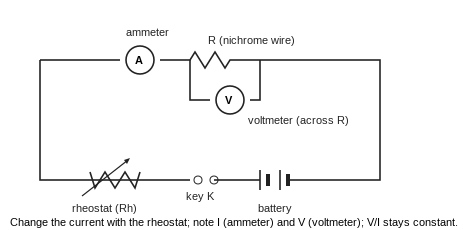
(ii) An ammeter is connected in series; a low resistance ensures that it does not change the current it is measuring (negligible potential drop across it).
(iii) The graph is drawn with I on the y-axis and V on the x-axis, so the slope = I/V = 1/R. A steeper slope means a smaller resistance.
(a) A (smaller slope, larger resistance) shows the series combination.
(b) B (steeper slope, smaller resistance) shows the parallel combination — parallel resistance is less than the smallest individual resistance.
(i) In sexual reproduction the offspring gets half its DNA (genes) from the father and half from the mother. This creates new combinations of genes, so the child shows variations and is not an exact copy of either parent.
(ii) F1 is the first generation obtained by crossing the two parents; F2 is the second generation obtained by self-pollinating (crossing) the F1 plants.
(iii) (A) Variations give some individuals features that help them survive if the environment changes. E.g. if water temperature rises, heat-resistant variants of bacteria survive while others die. So variations ensure that at least some individuals survive, and the species continues over time.
OR (iii) (B) F2 had round yellow, round green, wrinkled yellow and wrinkled green seeds (9 : 3 : 3 : 1). The new combinations were round green and wrinkled yellow. They appear because the traits of seed shape and seed colour are inherited independently of each other, so the genes recombine in new ways in the F2 generation.
Get every solution for all 17 papers
- Every board question of every chapter, each fully solved the way the board gives marks
- 17 complete board papers, each followed by its solutions
- Weightage and most-asked topics for every chapter
- Instant PDF download, colour and black & white print copies
Revising the chapter first? Complete Science Notes for Class 10 (NCERT 2026-27) →
What you get in the pack
- Questions from 126 CBSE papers, 2016 to 2026: every set code available
- Complete: 2405 different questions and parts from all set codes, 13 chapters and 17 full papers
- Part A: all 13 chapters, questions sorted chapter-wise and by marks
- Year-wise weightage table and most-asked topics for every chapter
- Part B: 17 full board papers, each followed by its complete solutions, for timed practice
- Answers written to the CBSE marking-scheme points, with labelled diagrams drawn in full
- Questions on topics out of the board syllabus flagged
All chapters in this pack
- PYQ Ch 1 Chemical Reactions and Equations
- PYQ Ch 2 Acids, Bases and Salts
- PYQ Ch 3 Metals and Non-metals
- PYQ Ch 4 Carbon and its Compounds
- PYQ Ch 5 Life Processes
- PYQ Ch 6 Control and Coordination
- PYQ Ch 7 How do Organisms Reproduce
- PYQ Ch 8 Heredity
- PYQ Ch 9 Light Reflection and Refraction
- PYQ Ch 10 The Human Eye and the Colourful World
- PYQ Ch 11 Electricity
- PYQ Ch 12 Magnetic Effects of Electric Current
- PYQ Ch 13 Our Environment
- Board Paper 2026 Set 31-2-1 with Solutions
- Board Paper 2026 Set 31-3-1 with Solutions
- Board Paper 2025 Set 31-1-1 with Solutions
- Board Paper 2025 Set 31-2-1 with Solutions
- Board Paper 2024 Set 31-4-1 with Solutions
- Board Paper 2024 Set 31-5-1 with Solutions
- Board Paper 2023 Set 31-2-1 with Solutions
- Board Paper 2023 Set 31-4-1 with Solutions
- Board Paper 2022 Term 2 Set 31-1-1 with Solutions
- Board Paper 2022 Term 2 Set 31-3-1 with Solutions
- Board Paper 2020 Set 31-2-1 with Solutions
- Board Paper 2020 Set 31-4-1 with Solutions
- Board Paper 2019 Set 31-2-1 with Solutions
- Board Paper 2019 Set 31-4-1 with Solutions
- Board Paper 2018 Set 31-1 with Solutions
- Board Paper 2017 Set 3 with Solutions
- Board Paper 2016 Set 31-1 with Solutions