
CBSE Class 10 Science Question Paper 2022 (31/3/1, Term 2) with Solutions
The complete CBSE Class 10 Science board paper of 2022, Q.P. code 31/3/1 · Term 2: all 15 questions exactly as set, with marks. 10 solutions are free below. The Class 10 Science PYQ Book: Solved Board Papers 2016-2026 (CBSE) solves all 17 papers in full and sorts every question chapter-wise.
Subject expert: Khushbu Gupta, B.Sc., M.Sc. Physics, B.Ed. · 8+ years teaching


Free: NCERT solutions for Class 10 Science →
Question paper
Jump to: Question paperSolutions
2022 · Q.P. Code 31/3/1 · Term 2
Maximum marks: 40
In 2022 CBSE held the board exam in two terms. Term 1 (Nov–Dec 2021) was an MCQ paper; this is the Term 2 written paper (40 marks, 2 hours), which covered the second half of the syllabus.
Section A · Short answer (2 marks)
(a) Kulhads (disposable cups made of clay) and disposable paper cups both are used as an alternative for disposable plastic cups. Which one of these two can be considered as a better alternative to plastic cups and why?
(b) Human beings are most adversely affected by the Biological Magnification. State the reason. Why can ordinary washing of the edibles (fruits and vegetables) not reduce the effect of biological magnification?
Draw the electron dot structure of the following: (a) Cyclohexane (b) Butane
State the criteria used by Mendeleev for creating his Periodic Table. Compare the position of isotopes of elements in the Mendeleev’s Periodic Table and in the Modern Periodic Table.
not in 2026-27 syllabus(a) An electric heater rated 1100 W operates at 220 V. Calculate (i) its resistance, and (ii) the current drawn by it.
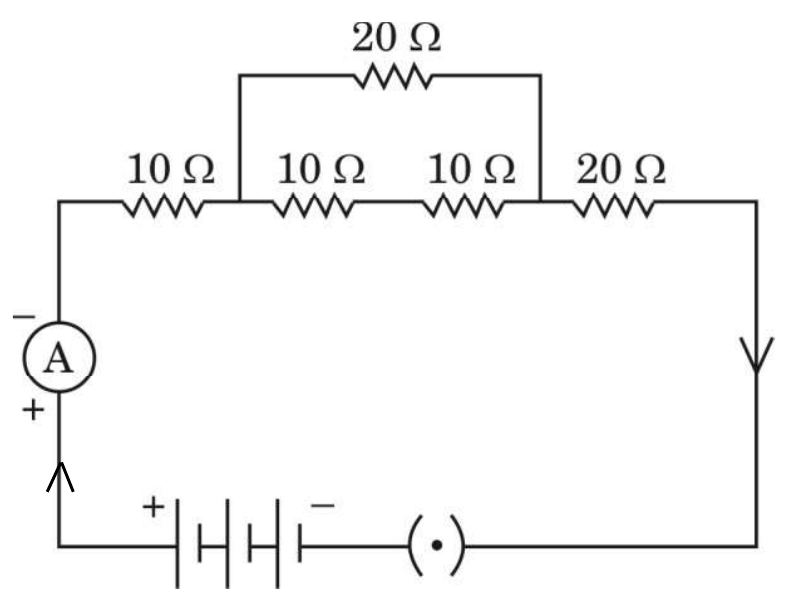
(b) Calculate the equivalent resistance of the following electric circuit:
Suggest any two contraceptive methods to control the size of human population and explain them.
(a) Mendel crossed two pea plants with visible contrasting characteristics and found that there were no half-way characteristics in the plants of F1 progeny. Explain the reason for this observation of Mendel.
(b) Justify the statement “Sex of the children will be determined by what they inherit from their father”.
Name the part/organ of the human female reproductive system (a) where contraceptive devices such as loop or copper-T are placed to prevent pregnancy. (b) which is blocked to prevent the transfer of eggs. (c) where formation of germ cells as ova takes place. (d) from where the embryo gets nutrition from the mother’s blood.
Section B · Short answer (3 marks)
What are human-made ecosystems? Give an example. Can a human-made ecosystem become a self-sustaining ecosystem? Give reason to justify your answer.
(a) State the reason why (i) carbon compounds have low melting and boiling points. (ii) carbon compounds do not conduct electricity. (iii) carbon can form only covalent compounds.
(b) What is a homologous series? Find the difference in molecular mass between the two consecutive members of a homologous series. State how in a homologous series of carbon compounds the following properties vary with increase in molecular mass: (i) Melting and boiling points (ii) Chemical properties
In the following table, some elements have been arranged in a certain pattern:
| sa (do) | re (re) | ga (mi) | ma (fa) | pa (so) | da (la) | ni (ti) |
|---|---|---|---|---|---|---|
| H | Li | Be | B | C | N | O |
| F | Na | Mg | Al | Si | P | S |
| Cl | K | Ca | Cr | Ti | Mn | Fe |
| Co and Ni | Cu | Zn | Y | In | As | Se |
| Br | Rb | Sr | Ce and La | Zr | – | – |
Identify the periodic law with which the given table is associated. List two important features and two anomalies of the above periodic law.
not in 2026-27 syllabusWhat is a Solenoid? Draw the pattern of the magnetic field lines around a current carrying solenoid. Mark on the pattern the region where the magnetic field is uniform.
(a) In the diagram given below, Coil – 1 is connected in series with a battery and a plug key while Coil – 2 is connected with a galvanometer.
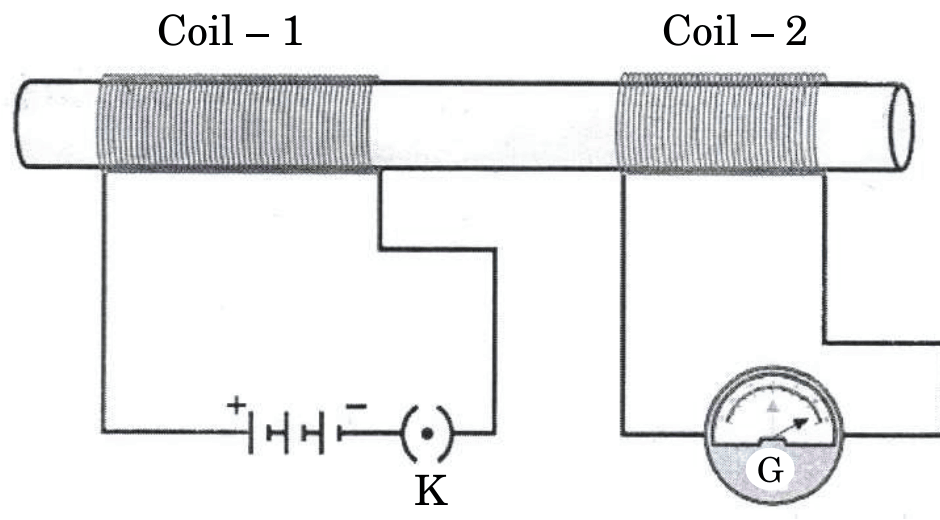
(i) Why does the galvanometer show deflection only when the key (K) is plugged in and not when a steady current starts flowing in the circuit? (ii) What is observed in the galvanometer, when the key is plugged out? (iii) State the conclusion based on the observation of this activity.
not in 2026-27 syllabus(b) In the figure given below, a simple electric motor is shown:
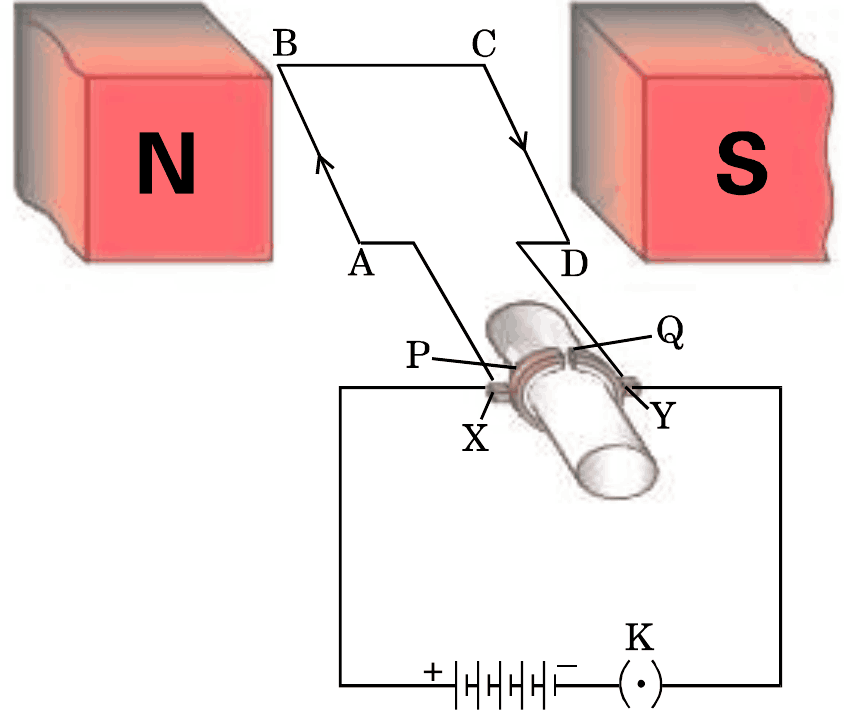
As shown in the figure, the current in the coil ABCD flows from A to B in the arm AB and C to D in the arm CD. (i) State the directions in which the arms AB and CD will experience a force. (ii) Identify the part of the electric motor that reverses the flow of current in the coil ABCD and write its name. (iii) After the reversal of flow of current in the coil ABCD, state the directions in which the arms AB and CD will experience a force. (iv) Name the rule which is applied to determine the direction of force on a current carrying conductor placed in a magnetic field.
not in 2026-27 syllabusHow do Mendel’s experiments show that the traits are inherited independently? Explain.
Section C · Case-based (4 marks)
Study the following electric circuit in which the resistors are arranged in three arms A, B and C:
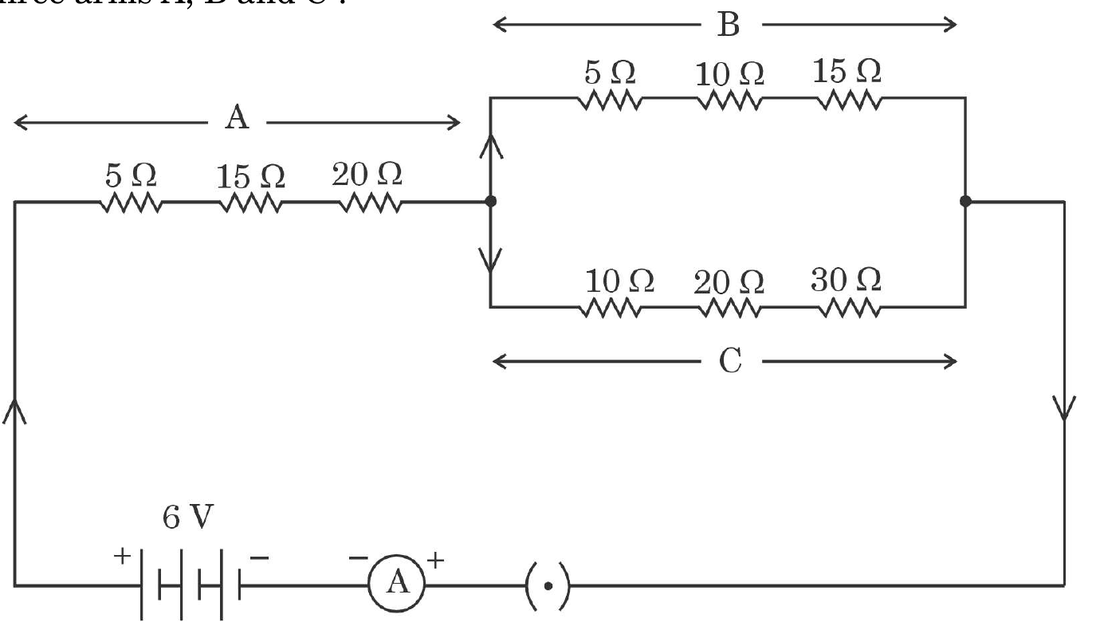
(a) Find the equivalent resistance of arm A. 1
(b) Calculate the equivalent resistance of the parallel combination of the arms B and C. 1
(c) (i) Determine the current that flows through the ammeter. 2
OR
(c) (ii) Determine the current that flows in the ammeter when the arm B is withdrawn from the circuit. 2
The modes by which various organisms reproduce depend on the body design of the organisms. In asexual reproduction, a single individual parent produces offsprings without the involvement of gametes. This method is a common means of increasing the offsprings rapidly under favourable conditions. Asexual reproduction occurs mostly in unicellular organisms, some plants and certain simple multicellular animals.
(a) State the name of the organism in which binary fission takes place in a definite orientation. Also name the disease caused by this organism. 1
(b) List any two advantages of producing plants through vegetative propagation. 1
(c) (i) Explain the process of budding in Hydra. 2
OR
(c) (ii) What happens when (I) a Spirogyra filament matures and attains a considerable length, and (II) a sporangia in Rhizopus bursts on maturation? 2
Solutions: CBSE 2022 · 31/3/1 · Term 2
Disposable paper cups are the better alternative. Paper is biodegradable and can be recycled. Making kulhads on a large scale needs the fertile top-soil, which is lost, and baking them uses fuel and causes air pollution.
Each carbon shares its four valence electrons; every C–C and C–H bond is one shared pair (••).
(a) Cyclohexane, C6H12: six carbon atoms in a ring, each carbon bonded to two other carbons and two hydrogens.
••••
H••C••C••H
H •• •• H
H••C C••H
H •• •• H
H••C••C••H
••••
H H
(b) Butane, C4H10: CH3–CH2–CH2–CH3
•• •• •• ••
H••C••C••C••C••H
•• •• •• ••
H H H H
Butane has 13 shared pairs (3 C–C + 10 C–H); cyclohexane has 18 (6 C–C + 12 C–H).
(ii) I = P/V = 1100/220 = 5 A
Any two:
• Mechanical barrier — condoms (on the penis) or similar coverings; sperm cannot reach the egg.
• Hormonal (oral pills) — change the hormonal balance of the body so that eggs are not released.
• Intra-uterine devices — loop or copper-T placed in the uterus to prevent pregnancy.
• Surgical methods — vasectomy (vas deferens blocked, sperm transfer prevented) or tubectomy (fallopian tube blocked, egg cannot reach the uterus).
A mother has a perfect pair of sex chromosomes (XX), so all her eggs carry an X chromosome. A father has XY, so half his sperms carry X and half carry Y. If an X-bearing sperm fertilises the egg, the child is XX — a girl; if a Y-bearing sperm fertilises it, the child is XY — a boy. So the sex of the child depends on the sperm, i.e. on what the child inherits from the father.
Human-made (artificial) ecosystems are ecosystems created and maintained by human beings, e.g. a crop field, garden, park or aquarium.
No, they cannot normally become self-sustaining. They have limited biodiversity, incomplete food chains and few decomposers, so nutrients are not fully recycled and wastes are not removed; they need constant human care (watering, adding nutrients, cleaning, removing weeds and pests).
A homologous series is a series of carbon compounds having the same functional group, in which successive members differ by a –CH2– unit.
Difference in molecular mass between consecutive members = mass of CH2 = 12 + 2 × 1 = 14 u.
(i) Melting and boiling points increase with increasing molecular mass.
(ii) Chemical properties remain similar, because they are determined by the functional group, which is the same.
A solenoid is a coil of many circular turns of insulated copper wire wrapped closely in the shape of a cylinder.
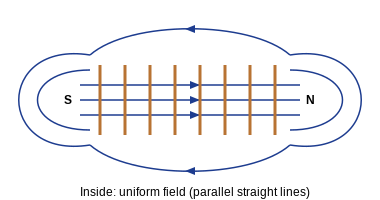
The field is uniform inside the solenoid, where the field lines are parallel straight lines. One end behaves as a north pole and the other as a south pole.
(i) With the field from N to S, by Fleming's left-hand rule arm AB is pushed downward and arm CD upward (the forces are equal and opposite, so the coil rotates anticlockwise as seen in the figure).
(ii) P and Q — the two halves of the slip ring, called the split-ring commutator.
(iii) After half a rotation the commutator reverses the current, which now flows along DCBA. Arm AB (now on the right-hand side) is pushed upward and arm CD (now on the left) is pushed downward. So the coil keeps rotating in the same direction.
(iv) Fleming's left-hand rule.
(a) Arm A (series): RA = 5 + 15 + 20 = 40 Ω.
(b) RB = 5 + 10 + 15 = 30 Ω; RC = 10 + 20 + 30 = 60 Ω.
(c) (i) Total R = 40 + 20 = 60 Ω.
OR (c) (ii) Without arm B, arms A and C are in series: R = 40 + 60 = 100 Ω.
Get every solution for all 17 papers
- Every board question of every chapter, each fully solved the way the board gives marks
- 17 complete board papers, each followed by its solutions
- Weightage and most-asked topics for every chapter
- Instant PDF download, colour and black & white print copies
Revising the chapter first? Complete Science Notes for Class 10 (NCERT 2026-27) →
What you get in the pack
- Questions from 126 CBSE papers, 2016 to 2026: every set code available
- Complete: 2405 different questions and parts from all set codes, 13 chapters and 17 full papers
- Part A: all 13 chapters, questions sorted chapter-wise and by marks
- Year-wise weightage table and most-asked topics for every chapter
- Part B: 17 full board papers, each followed by its complete solutions, for timed practice
- Answers written to the CBSE marking-scheme points, with labelled diagrams drawn in full
- Questions on topics out of the board syllabus flagged
All chapters in this pack
- PYQ Ch 1 Chemical Reactions and Equations
- PYQ Ch 2 Acids, Bases and Salts
- PYQ Ch 3 Metals and Non-metals
- PYQ Ch 4 Carbon and its Compounds
- PYQ Ch 5 Life Processes
- PYQ Ch 6 Control and Coordination
- PYQ Ch 7 How do Organisms Reproduce
- PYQ Ch 8 Heredity
- PYQ Ch 9 Light Reflection and Refraction
- PYQ Ch 10 The Human Eye and the Colourful World
- PYQ Ch 11 Electricity
- PYQ Ch 12 Magnetic Effects of Electric Current
- PYQ Ch 13 Our Environment
- Board Paper 2026 Set 31-2-1 with Solutions
- Board Paper 2026 Set 31-3-1 with Solutions
- Board Paper 2025 Set 31-1-1 with Solutions
- Board Paper 2025 Set 31-2-1 with Solutions
- Board Paper 2024 Set 31-4-1 with Solutions
- Board Paper 2024 Set 31-5-1 with Solutions
- Board Paper 2023 Set 31-2-1 with Solutions
- Board Paper 2023 Set 31-4-1 with Solutions
- Board Paper 2022 Term 2 Set 31-1-1 with Solutions
- Board Paper 2022 Term 2 Set 31-3-1 with Solutions
- Board Paper 2020 Set 31-2-1 with Solutions
- Board Paper 2020 Set 31-4-1 with Solutions
- Board Paper 2019 Set 31-2-1 with Solutions
- Board Paper 2019 Set 31-4-1 with Solutions
- Board Paper 2018 Set 31-1 with Solutions
- Board Paper 2017 Set 3 with Solutions
- Board Paper 2016 Set 31-1 with Solutions