
CBSE Class 10 Science Question Paper 2022 (31/1/1, Term 2) with Solutions
The complete CBSE Class 10 Science board paper of 2022, Q.P. code 31/1/1 · Term 2: all 15 questions exactly as set, with marks. 10 solutions are free below. The Class 10 Science PYQ Book: Solved Board Papers 2016-2026 (CBSE) solves all 17 papers in full and sorts every question chapter-wise.
Subject expert: Khushbu Gupta, B.Sc., M.Sc. Physics, B.Ed. · 8+ years teaching


Free: NCERT solutions for Class 10 Science →
Question paper
Jump to: Question paperSolutions
2022 · Q.P. Code 31/1/1 · Term 2
Maximum marks: 40
In 2022 CBSE held the board exam in two terms. Term 1 (Nov–Dec 2021) was an MCQ paper; this is the Term 2 written paper (40 marks, 2 hours), which covered the second half of the syllabus.
Section A · Short answer (2 marks)
(a) Write the molecular formula of the following carbon compounds: (i) Methane (ii) Propane
(b) Carbon compounds have low melting and boiling points. Why?
The electrons in the atoms of two elements X and Y are distributed in three shells having 1 and 7 electrons respectively in their outermost shells. (a) Write the group numbers of these elements in the Modern Periodic Table. (b) Write the molecular formula of the compound formed when X and Y combine with each other. (c) Which of the two is electropositive?
not in 2026-27 syllabus(a) Which of the following flowers will have higher possibility of self-pollination? Mustard, Papaya, Watermelon, Hibiscus
(b) List the two reproductive parts of a bisexual flower.
Which one of the two multicellular organisms — Spirogyra and Planaria — reproduces by regeneration and why? Give an example of any other organism which can also reproduce by the same process.
(a) What is variation? List two main reasons that may lead to variation in a population.
(b) (i) In a cross between violet flowered plants and white flowered plants, state the characteristics of the plants obtained in the F1 progeny. (ii) If the plants of F1 progeny are self-pollinated, then what would be observed in the plants of F2 progeny? (iii) If 100 plants are produced in F2 progeny, then how many plants will show the recessive trait?
(a) (i) Name and state the rule to determine the direction of force experienced by a current carrying straight conductor placed in a uniform magnetic field which is perpendicular to it. (ii) An alpha particle while passing through a magnetic field gets projected towards north. In which direction will an electron project when it passes through the same magnetic field?
(b) (i) What is a solenoid? (ii) Draw the pattern of magnetic field lines of the magnetic field produced by a solenoid through which a steady current flows.
(a) What is ozone? How is it formed in the upper layers of the Earth’s atmosphere? How does ozone affect our ecosystem?
(b) (i) List two human-made ecosystems. 1
(ii) “We do not clean a pond in the same manner as we do in an aquarium.” Give reason to justify this statement. 1
Section B · Short answer (3 marks)
(a) List two advantages of adopting the atomic number of an element as the basis of classification of elements in the Modern Periodic Table.
(b) Write the electronic configurations of the elements X (atomic number 13) and Y (atomic number 20).
(a) Draw two different possible structures of a saturated hydrocarbon having four carbon atoms in its molecule. What are these two structures of the hydrocarbon having same molecular formula called? Write the molecular formula and the common name of this compound. Also write the molecular formula of its alkyne.
(b) (i) Write the molecular formula of benzene and draw its structure. (ii) Write the number of single and double covalent bonds present in a molecule of benzene. (iii) Which compounds are called alkynes?
(a) Mention one function each of the following organs in human male reproductive system: (i) Testis (ii) Scrotum (iii) Vas deferens (iv) Prostate gland
(b) Name the type of germ cell which (i) is motile, and (ii) stores food.
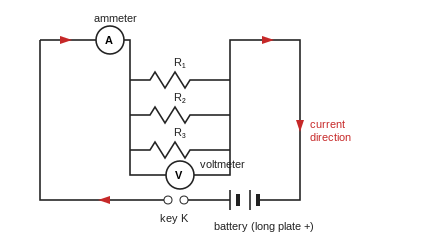
(a) Three resistors R1, R2 and R3 are connected in parallel and the combination is connected to a battery, an ammeter, a voltmeter and a key. Draw suitable circuit diagram to show the arrangement of these circuit components along with the direction of current flowing.
(b) Calculate the equivalent resistance of the following network:
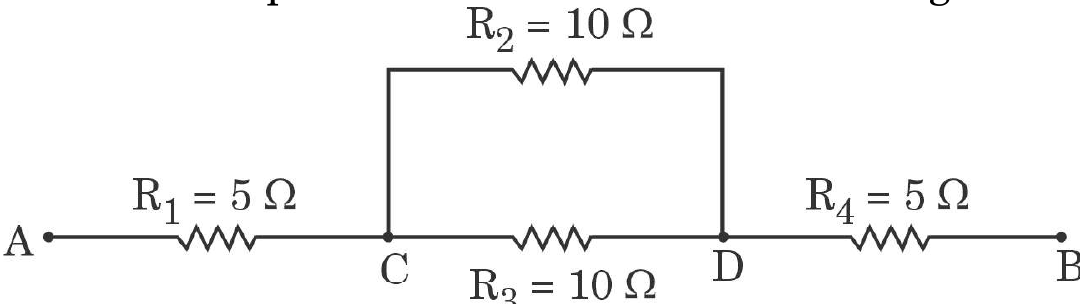
(a) (i) Define Electric Power and write its SI unit. ½+½
(ii) Two bulbs rated 100 W; 220 V and 60 W; 220 V are connected in parallel to an electric mains of 220 V. Find the current drawn by the bulbs from the mains. 2
(b) (i) State Joule’s law of heating. Express it mathematically when an appliance of resistance R is connected to a source of voltage V and the current I flows through the appliance for a time t. (ii) A 5 Ω resistor is connected across a battery of 6 volts. Calculate the energy that dissipates as heat in 10 s.
(a) Name the group of organisms which form in the first trophic level of all food chains. Why are they called so?
(b) Why are the human beings most adversely affected by bio-magnification?
(c) State one ill-effect of the absence of decomposers from a natural ecosystem.
Section C · Case-based (4 marks)
The mechanism by which the sex of an individual is determined is called sex-determination. In human beings, sex of a newborn is genetically determined, whereas in some others it is not. There are 46 (23 pairs) chromosomes in human beings. Out of these, 44 (22 pairs) control the body characters and 2 (one pair) are known as sex chromosomes. The sex chromosomes are of two types — X chromosome and Y chromosome. At the time of fertilisation, depending upon which type of male gamete fuses with the female gamete, the sex of the newborn child is decided.
(a) Why is a pair of sex chromosomes in human beings called a mismatched pair in terms of type and size? ½+½
(b) Out of male or female, which of them has a perfect pair of sex chromosomes? In case of a perfect pair, will the gametes produced be of the same kind or of a different kind? 1
(c) (i) Name two animals whose sex is not genetically determined. Explain the process of their sex determination. 1+1
OR
(c) (ii) With the help of a flowchart only, show how sex is genetically determined in human beings. 1+1
A student fixes a sheet of white paper on a drawing board using some adhesive materials. She places a bar magnet in the centre of it and sprinkles some iron filings uniformly around the bar magnet using a salt-sprinkler. On tapping the board gently, she observes that the iron filings have arranged themselves in a particular pattern.
(a) Draw a diagram to show this pattern of iron filings. 1
(b) Draw the magnetic field lines of a bar magnet showing the poles of the bar magnet as well as the direction of the magnetic field lines. 1
(c) (i) How is the direction of magnetic field at a point determined using the field lines? Why do two magnetic field lines not cross each other? 2
OR
(c) (ii) How are the magnetic field lines of a bar magnet drawn using a small compass needle? Draw one magnetic field line each on both sides of the magnet. 2
Solutions: CBSE 2022 · 31/1/1 · Term 2
(a) (i) Methane: CH4 (ii) Propane: C3H8
(b) Carbon compounds are covalent: they are made of molecules, and the forces of attraction between the molecules are weak. Little energy is needed to separate the molecules, so their melting and boiling points are low.
(a) Mustard and Hibiscus — they have bisexual flowers (both stamens and pistil), so pollen can reach the stigma of the same flower. Papaya and watermelon have unisexual flowers.
(b) Stamen (male part) and pistil (carpel) (female part).
Variation means the differences among individuals of a species (or between parents and offspring).
Reasons: (1) small inaccuracies (errors) in DNA copying during reproduction; (2) sexual reproduction, which combines DNA from two different parents and creates new combinations.
(i) Fleming's left-hand rule: stretch the thumb, forefinger and middle finger of the left hand so that they are mutually perpendicular. If the forefinger points in the direction of the magnetic field and the middle finger in the direction of current, the thumb points in the direction of the force on the conductor.
(ii) An electron carries a negative charge, opposite to the positive alpha particle; moving the same way, it is equivalent to a current in the opposite direction. So it is deflected in the opposite direction — towards the south.
Ozone (O3) is a molecule made of three oxygen atoms; it is a deadly poison at ground level.
Formation: high-energy UV radiation splits some O2 molecules into free oxygen atoms, which combine with O2: O2 →(UV) O + O; O + O2 → O3.
Effect: the ozone layer in the upper atmosphere shields the Earth from harmful UV radiation of the Sun, protecting living organisms (UV causes skin cancer and damages plants and animals).
(a) (1) It removed the anomalies of Mendeleev's table — e.g. the position of isotopes is settled (they have the same atomic number) and the order of cobalt and nickel is correct. (2) Elements with similar properties (same number of valence electrons) fall in the same group, so properties vary periodically in a regular way; the position of hydrogen and of new elements can be fixed.
(b) X (13): 2, 8, 3 (aluminium). Y (20): 2, 8, 8, 2 (calcium).
(i) C6H6: a ring of six carbon atoms with alternate single and double bonds, each carbon bonded to one hydrogen.
(ii) Single bonds: 9 (6 C–H + 3 C–C); double bonds: 3 (C=C).
(iii) Alkynes are unsaturated hydrocarbons containing at least one carbon–carbon triple bond; general formula CnH2n−2 (e.g. ethyne, HC≡CH).
(a) The ammeter is in series with the battery and key; the voltmeter is connected across the parallel combination. Current flows from the positive terminal through the circuit:
(b) R2 ∥ R3:
(i) Joule's law of heating: the heat produced in a resistor is directly proportional to (1) the square of the current, (2) the resistance and (3) the time for which the current flows.
(ii)
(a) In males the two sex chromosomes are of different types — one X and one Y — and of different sizes: X is normal-sized while Y is short.
(b) The female (XX) has a perfect pair. All her gametes (eggs) are of the same kind — each carries an X chromosome.
(c) (i) Some reptiles: the temperature at which the fertilised eggs are kept determines whether the developing animal will be male or female. Snails: individuals can change sex, so sex is not genetically determined.
OR (c) (ii)
| Parents | Mother (44 + XX) | × | Father (44 + XY) |
|---|---|---|---|
| Gametes | Egg: 22 + X (all) | Sperm: 22 + X or 22 + Y | |
| Zygote | Egg + X-sperm → 44 + XX → girl Egg + Y-sperm → 44 + XY → boy | ||
The sex of the child depends on which sperm (X or Y) fertilises the egg, i.e. on the father.
Get every solution for all 17 papers
- Every board question of every chapter, each fully solved the way the board gives marks
- 17 complete board papers, each followed by its solutions
- Weightage and most-asked topics for every chapter
- Instant PDF download, colour and black & white print copies
Revising the chapter first? Complete Science Notes for Class 10 (NCERT 2026-27) →
What you get in the pack
- Questions from 126 CBSE papers, 2016 to 2026: every set code available
- Complete: 2405 different questions and parts from all set codes, 13 chapters and 17 full papers
- Part A: all 13 chapters, questions sorted chapter-wise and by marks
- Year-wise weightage table and most-asked topics for every chapter
- Part B: 17 full board papers, each followed by its complete solutions, for timed practice
- Answers written to the CBSE marking-scheme points, with labelled diagrams drawn in full
- Questions on topics out of the board syllabus flagged
All chapters in this pack
- PYQ Ch 1 Chemical Reactions and Equations
- PYQ Ch 2 Acids, Bases and Salts
- PYQ Ch 3 Metals and Non-metals
- PYQ Ch 4 Carbon and its Compounds
- PYQ Ch 5 Life Processes
- PYQ Ch 6 Control and Coordination
- PYQ Ch 7 How do Organisms Reproduce
- PYQ Ch 8 Heredity
- PYQ Ch 9 Light Reflection and Refraction
- PYQ Ch 10 The Human Eye and the Colourful World
- PYQ Ch 11 Electricity
- PYQ Ch 12 Magnetic Effects of Electric Current
- PYQ Ch 13 Our Environment
- Board Paper 2026 Set 31-2-1 with Solutions
- Board Paper 2026 Set 31-3-1 with Solutions
- Board Paper 2025 Set 31-1-1 with Solutions
- Board Paper 2025 Set 31-2-1 with Solutions
- Board Paper 2024 Set 31-4-1 with Solutions
- Board Paper 2024 Set 31-5-1 with Solutions
- Board Paper 2023 Set 31-2-1 with Solutions
- Board Paper 2023 Set 31-4-1 with Solutions
- Board Paper 2022 Term 2 Set 31-1-1 with Solutions
- Board Paper 2022 Term 2 Set 31-3-1 with Solutions
- Board Paper 2020 Set 31-2-1 with Solutions
- Board Paper 2020 Set 31-4-1 with Solutions
- Board Paper 2019 Set 31-2-1 with Solutions
- Board Paper 2019 Set 31-4-1 with Solutions
- Board Paper 2018 Set 31-1 with Solutions
- Board Paper 2017 Set 3 with Solutions
- Board Paper 2016 Set 31-1 with Solutions