
CBSE Class 10 Science Question Paper 2019 (31/4/1) with Solutions
The complete CBSE Class 10 Science board paper of 2019, Q.P. code 31/4/1: all 27 questions exactly as set, with marks. 19 solutions are free below. The Class 10 Science PYQ Book: Solved Board Papers 2016-2026 (CBSE) solves all 17 papers in full and sorts every question chapter-wise.
Subject expert: Khushbu Gupta, B.Sc., M.Sc. Physics, B.Ed. · 8+ years teaching


Free: NCERT solutions for Class 10 Science →
Question paper
Jump to: Question paperSolutions
2019 · Q.P. Code 31/4/1
Maximum marks: 80
Section A · 1 mark each
Define resistance. Give its S.I. unit.
Name any two elements that are used in fabricating solar cells.
not in 2026-27 syllabusSection B · 2 marks each
(a) State laws of reflection of light.
(b) Define absolute refractive index and express it mathematically.
Draw magnetic field lines around a bar magnet.
What happens when 5% alkaline potassium permanganate solution is added drop by drop to warm propyl alcohol (propanol) taken in a test tube? Explain with the help of a chemical equation.
Section C · 3 marks each
What are fossils? Describe briefly two methods of determining the age of fossils.
not in 2026-27 syllabus(a) What is the cause of dispersion of white light through a glass prism? Draw a ray diagram to show the path of light when two identical glass prisms are arranged together in inverted position with respect to each other and a narrow beam of white light is allowed to fall obliquely on one of the faces of the prisms.
(b) What is scattering of light? Use this phenomenon to explain why (i) the Sun appears reddish at sun-rise, and (ii) the clear sky appears blue.
(a) (a) Classify the following reactions into different types: (i) AgNO3(aq) + NaCl(aq) → AgCl(s) + NaNO3(aq) (ii) CaO(s) + H2O(l) → Ca(OH)2(aq) (iii) 2KClO3(s) → 2KCl(s) + 3O2(g) (iv) Zn + CuSO4 → ZnSO4 + Cu
(b) Translate the following statement into a balanced chemical equation: ‘‘Barium chloride reacts with aluminium sulphate to give aluminium chloride and barium sulphate.’’
(b) When potassium iodide solution is added to a solution of lead (II) nitrate in a test tube, a precipitate is formed. (a) What is the colour of this precipitate? Name the compound precipitated. (b) Write the balanced chemical equation for this reaction. (c) List two types of reactions in which this reaction can be placed.
(a) (a) Natural water bodies are not regularly cleaned whereas an aquarium needs regular cleaning. Why? (b) What are decomposers? What will be the consequence if the decomposers are completely eradicated from an ecosystem? Give justification in support of your answer.
(b) How is ozone formed in the upper atmosphere? State its importance. What is responsible for its depletion? Write one harmful effect of ozone depletion.
A white powder is used by doctors to support fractured bones. (a) Write the name and chemical formula of the powder. (b) How is this powder prepared? (c) When this white powder is mixed with water, a hard solid mass is obtained. Write a balanced chemical equation for the change. (d) Give one more use of this white powder.
A coil of insulated copper wire is connected to a galvanometer. What would happen if a strong bar magnet is (a) pushed into the coil? (b) withdrawn from inside the coil? (c) held stationary inside the coil? Give justification for each observation.
not in 2026-27 syllabus(a) Write the function of the following in the human alimentary canal: (i) Saliva (ii) HCl in stomach (iii) Bile juice (iv) Villi
(b) Write one function each of the following enzymes: (i) Pepsin (ii) Lipase
(a) Plants do not have any nervous system but yet, if we touch a sensitive plant, some observable changes take place in its leaves. Explain how could this plant respond to the external stimuli and how it is communicated. (b) Name the hormone that needs to be administered to (i) increase the height of a dwarf plant. (ii) cause rapid cell division in fruits and seeds.
What is biodiversity? Why are forests considered as ‘‘biodiversity hot spots’’? List two factors responsible for causing deforestation.
not in 2026-27 syllabusHow is the method of extraction of metals high up in the reactivity series different from that for metals in the middle? Why can the same process not be applied for them? Name the process used for the extraction of these metals.
Section D · 5 marks each
(a) (a) Distinguish between esterification and saponification reactions with the help of chemical equations for each. (b) With a labelled diagram describe in brief an activity to show the formation of an ester.
(b) What is the difference between soaps and detergents? State in brief the cleansing action of soaps in removing an oily spot from a fabric. Why are soaps not very effective when a fabric is washed in hard water? How is this problem resolved?
A person is unable to see objects distinctly placed within 50 cm from his eyes. (a) Name the defect of vision the person is suffering from and list its two possible causes. (b) Draw a ray diagram to show the defect in the above case. (c) Mention the type of lens used by him for the correction of the defect and calculate its power. Assume that the near point for the normal eye is 25 cm. (d) Draw a labelled diagram for the correction of the defect in the above case.
(a) How is the valency of an element determined if its electronic configuration is known? Determine the valency of an element of atomic no. 9.
(b) Given below are some elements of the Modern Periodic Table. Atomic numbers of the elements are given in parentheses: A(4), B(9), C(14), D(19), E(20). (i) With the help of the electronic configuration, find out which one of the above elements will have one electron in its outermost shell. (ii) Which two elements belong to the same group? Give reasons for your answer. (iii) Which one of the above elements belonging to the fourth period has bigger atomic radius and why?
(a) (a) Define electric power. An electrical device of resistance R is connected across a source of voltage V and draws a current I. Derive an expression for power in terms of current and resistance. (b) Two electric bulbs rated 100 W; 220 V and 60 W; 220 V are connected in parallel to an electric mains of 220 V. Find the current drawn by the bulbs from the mains.
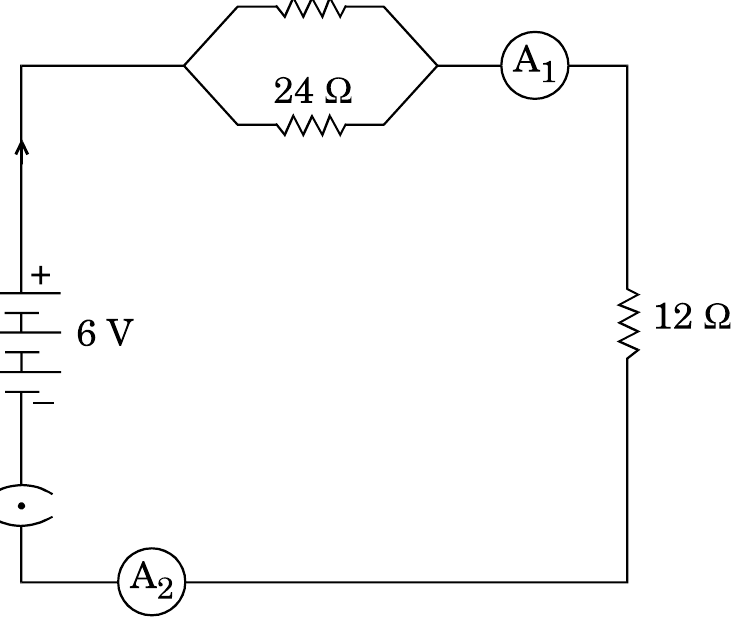
(b) (a) How will you infer with the help of an experiment that the same current flows through every part of the circuit containing three resistors R1, R2 and R3 in series connected to a battery of V volts? (b) Study the following circuit and find out: (i) Current in 12 Ω resistor. (ii) Difference in the readings of A1 and A2, if any.
(a) (a) Define vegetative propagation. List its two methods. (b) Why is this mode practised for growing some types of plants? (c) Explain the process of budding in Hydra with the help of labelled diagrams.
(b) What is contraception? List its four different methods. State four reasons for adopting contraceptive methods.
(a) List two visible traits of garden pea that Mendel considered in his experiments. How do Mendel’s experiments show that traits may be dominant or recessive? (b) With the help of a flow diagram, how would you establish that in human beings the sex of a newborn is purely a matter of chance and none of the parents may be considered responsible for a particular sex of a newborn child?
Section E · Practical-based (2 marks each)
(a) A student mixes sodium sulphate powder in barium chloride powder. What change would the student observe on mixing the two powders? Justify your answer and explain how he can obtain the desired change.
(b) (a) Arrange the following metals in the increasing order of their reactivities: Copper, Zinc, Aluminium and Iron. (b) List two observations you would record in your notebook 30 minutes after adding iron filings to copper sulphate solution.
A solution ‘X’ gives orange colour when a drop of it falls on pH paper, while another solution ‘Y’ gives bluish colour when a drop of it falls on pH paper. What is the nature of both the solutions? Determine the pH of solutions ‘X’ and ‘Y’.
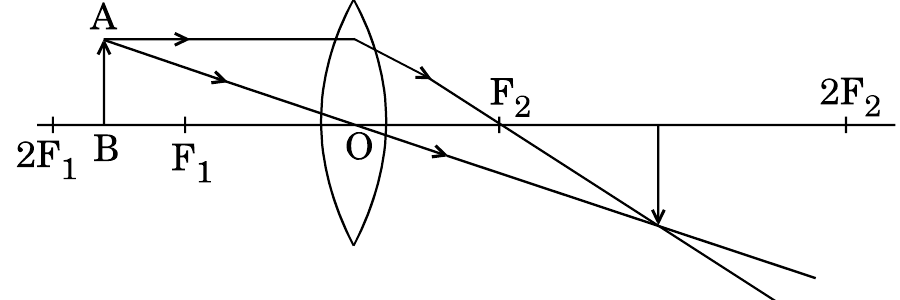
(a) Study the following ray diagram and list two mistakes committed by the student while tracing it. Rectify these mistakes by drawing the correct ray diagram to show the real position and size of the image corresponding to the position of the object AB.
(b) A student has to trace the path of a ray of light through a glass prism. List four precautions he should observe for better results.
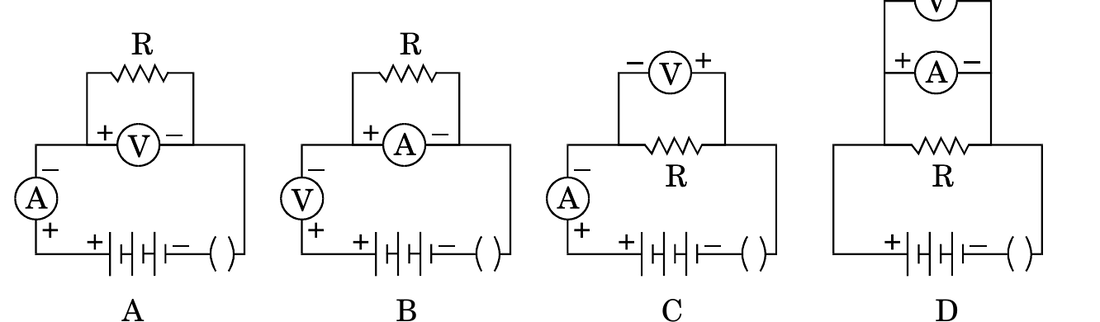
Which one of the following is the correct set-up for studying the dependence of the current on the potential difference across a resistor and why?
(a) Write four sequential steps of the procedure of the experiment ‘‘Preparing a temporary mount of a leaf peel to show stomata.’’
(b) In the experimental set-up to show that ‘‘the germinating seeds give out carbon dioxide’’, answer the following questions: (i) Why do we keep the conical flask airtight? (ii) Name the substance kept in the small test tube inside the conical flask. Write its role. (iii) Why does water rise in the delivery tube?
List two observations on the basis of which it may be concluded that the given slide shows binary fission in Amoeba.
Solutions: CBSE 2019 · 31/4/1
Resistance is the property of a conductor to oppose the flow of charges (current) through it; R = V/I. SI unit: ohm (Ω).
(1) The angle of incidence is equal to the angle of reflection.
(2) The incident ray, the normal to the mirror at the point of incidence and the reflected ray all lie in the same plane.
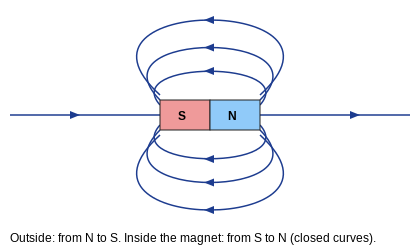
The lines come out of the north pole and go into the south pole outside the magnet, and from S to N inside it; they are closed curves, closer together near the poles, and never cross.
Fossils are the preserved traces or remains of organisms that lived long ago (e.g. impressions of leaves, bones, footprints).
Ageing fossils: (1) Relative method — in the earth's layers, fossils found closer to the surface are more recent than those found in deeper layers. (2) Fossil dating (radioactive / carbon dating) — the ratio of different isotopes of the same element (e.g. carbon-14) in the fossil material shows how old it is.
Scattering: the spreading of light in different directions by very small particles of the medium.
(i) At sunrise the Sun is near the horizon, so its light passes through thicker layers of air and a longer distance in the atmosphere. Most of the blue (shorter wavelength) light is scattered away, and the light reaching us is mainly red.
(ii) Air molecules and fine particles are smaller than the wavelength of visible light; they scatter blue light much more strongly than red. This scattered blue light reaches our eyes from all directions, so the clear sky looks blue.
(a) Yellow; lead iodide (PbI2).
(b)
(c) Double displacement reaction and precipitation reaction.
Formation: UV radiation splits O2 molecules into free oxygen atoms, which combine with O2: O2 →(UV) O + O; O + O2 → O3.
Importance: it shields the Earth from harmful UV radiation of the Sun.
Depletion: caused mainly by chlorofluorocarbons (CFCs) used in refrigerators and fire extinguishers.
Harmful effect: more UV radiation reaches the Earth, causing skin cancer (also cataract, damage to plants).
(a) The galvanometer needle deflects momentarily (say, to the right): the magnetic field linked with the coil increases, so a current is induced.
(b) The needle deflects momentarily in the opposite direction: the field linked with the coil decreases, inducing a current in the opposite direction.
(c) No deflection: the field linked with the coil does not change, so no current is induced. (Current is induced only when the magnetic field through the coil changes.)
(a) The touch is the stimulus. The plant cells use electrical-chemical means to convey the information from cell to cell. In response, the cells change their shape by changing the amount of water in them (swelling or shrinking), so the leaves fold up and droop.
(b) (i) Gibberellin (ii) Cytokinin
Metals in the middle (Zn, Fe, Pb) are extracted by converting their ores to oxides (roasting or calcination) and then reducing the oxides with carbon. Metals high up (Na, K, Ca, Mg, Al) are extracted by electrolysis of their molten chlorides (or oxide).
The same process cannot be used because these metals have a greater affinity for oxygen than carbon, so carbon cannot reduce their oxides.
Process: electrolytic reduction, e.g. sodium from molten NaCl: at the cathode Na+ + e− → Na; at the anode 2Cl− → Cl2 + 2e−.
Soaps are sodium or potassium salts of long-chain carboxylic acids; detergents are generally sodium salts of long-chain sulphonic acids or ammonium salts with chlorides/bromides. Detergents work well even in hard water; soaps do not.
Cleansing action: a soap molecule has an ionic (hydrophilic) end that dissolves in water and a long hydrocarbon (hydrophobic) tail that dissolves in oil. In water, the tails stick into the oily dirt while the ionic ends face the water, forming clusters called micelles with the oily dirt trapped in the centre. On rinsing, the micelles (with the dirt) are washed away.
Hard water: it contains calcium and magnesium salts, which react with soap to form an insoluble precipitate called scum; so a lot of soap is wasted and cleaning is poor.
Solution: use detergents, whose charged ends do not form insoluble precipitates with calcium and magnesium ions (or soften the water first, e.g. with washing soda).
(a) Valency is the number of electrons an atom loses, gains or shares to complete its octet: equal to the number of valence electrons (if 1–4), or 8 minus the number of valence electrons (if 4–8). Atomic number 9: 2, 7 → valency = 8 − 7 = 1.
(b) A: 2, 2 · B: 2, 7 · C: 2, 8, 4 · D: 2, 8, 8, 1 · E: 2, 8, 8, 2.
(i) D (2, 8, 8, 1).
(ii) A and E — both have 2 valence electrons, so both are in group 2.
(iii) D and E are in period 4; D has the bigger atomic radius. Along a period the nuclear charge increases while electrons enter the same shell, so the electrons are pulled closer and the size decreases; D has a smaller nuclear charge than E.
(a) Join R1, R2, R3 in series with the battery, a key and an ammeter. Note the ammeter reading. Change the position of the ammeter to anywhere between the resistors and note the reading each time. The reading is the same everywhere, showing that the same current flows through every part of a series circuit.
(b) The two 24 Ω resistors in parallel: 24/2 = 12 Ω; in series with 12 Ω: total R = 24 Ω.
(ii) No difference: A1 and A2 are both in the main series line, so both read 0.25 A.
Contraception is the use of methods or devices to prevent pregnancy.
Methods: (1) mechanical barriers — condoms; (2) hormonal — oral pills; (3) intra-uterine devices — loop or copper-T; (4) surgical — vasectomy and tubectomy.
Reasons: (1) to control the size of the population; (2) to keep a gap between children, which protects the mother's health; (3) to avoid unwanted pregnancies; (4) condoms also prevent the spread of sexually transmitted diseases (HIV-AIDS, gonorrhoea).
No change is observed. In the solid state the ions are not free to move, so the reaction does not take place.
To obtain the change, he should prepare aqueous solutions of both and mix them: a white precipitate of barium sulphate forms (double displacement):
X is acidic — orange on pH paper means a pH of about 3–5 (less than 7).
Y is basic — bluish on pH paper means a pH of about 8–10 (more than 7).
(1) The angle of incidence should be between 30° and 60°.
(2) The pins should be fixed vertically, at least 5 cm apart.
(3) Look at the feet of the pins (images), not the heads, while fixing them in a straight line.
(4) Draw the outline of the prism accurately and do not move the prism during the experiment; use a sharp pencil.
1. Gently fold and tear a fresh leaf to take out a thin peel from its lower surface, and put it in a watch glass containing water.
2. Put a few drops of safranin to stain it; after a minute, wash off the extra stain with water.
3. Place the peel on a clean slide and put a drop of glycerine on it.
4. Place a cover slip gently with a needle (avoiding air bubbles), and observe under the microscope.
(1) The nucleus elongates and divides into two. (2) A constriction appears in the cytoplasm, which divides to form two daughter cells of nearly equal size.
Get every solution for all 17 papers
- Every board question of every chapter, each fully solved the way the board gives marks
- 17 complete board papers, each followed by its solutions
- Weightage and most-asked topics for every chapter
- Instant PDF download, colour and black & white print copies
Revising the chapter first? Complete Science Notes for Class 10 (NCERT 2026-27) →
What you get in the pack
- Questions from 126 CBSE papers, 2016 to 2026: every set code available
- Complete: 2405 different questions and parts from all set codes, 13 chapters and 17 full papers
- Part A: all 13 chapters, questions sorted chapter-wise and by marks
- Year-wise weightage table and most-asked topics for every chapter
- Part B: 17 full board papers, each followed by its complete solutions, for timed practice
- Answers written to the CBSE marking-scheme points, with labelled diagrams drawn in full
- Questions on topics out of the board syllabus flagged
All chapters in this pack
- PYQ Ch 1 Chemical Reactions and Equations
- PYQ Ch 2 Acids, Bases and Salts
- PYQ Ch 3 Metals and Non-metals
- PYQ Ch 4 Carbon and its Compounds
- PYQ Ch 5 Life Processes
- PYQ Ch 6 Control and Coordination
- PYQ Ch 7 How do Organisms Reproduce
- PYQ Ch 8 Heredity
- PYQ Ch 9 Light Reflection and Refraction
- PYQ Ch 10 The Human Eye and the Colourful World
- PYQ Ch 11 Electricity
- PYQ Ch 12 Magnetic Effects of Electric Current
- PYQ Ch 13 Our Environment
- Board Paper 2026 Set 31-2-1 with Solutions
- Board Paper 2026 Set 31-3-1 with Solutions
- Board Paper 2025 Set 31-1-1 with Solutions
- Board Paper 2025 Set 31-2-1 with Solutions
- Board Paper 2024 Set 31-4-1 with Solutions
- Board Paper 2024 Set 31-5-1 with Solutions
- Board Paper 2023 Set 31-2-1 with Solutions
- Board Paper 2023 Set 31-4-1 with Solutions
- Board Paper 2022 Term 2 Set 31-1-1 with Solutions
- Board Paper 2022 Term 2 Set 31-3-1 with Solutions
- Board Paper 2020 Set 31-2-1 with Solutions
- Board Paper 2020 Set 31-4-1 with Solutions
- Board Paper 2019 Set 31-2-1 with Solutions
- Board Paper 2019 Set 31-4-1 with Solutions
- Board Paper 2018 Set 31-1 with Solutions
- Board Paper 2017 Set 3 with Solutions
- Board Paper 2016 Set 31-1 with Solutions