
CBSE Class 10 Science Question Paper 2017 (Set 3) with Solutions
The complete CBSE Class 10 Science board paper of 2017, Q.P. code Set 3: all 36 questions exactly as set, with marks. 18 solutions are free below. The Class 10 Science PYQ Book: Solved Board Papers 2016-2026 (CBSE) solves all 17 papers in full and sorts every question chapter-wise.
Subject expert: Khushbu Gupta, B.Sc., M.Sc. Physics, B.Ed. · 8+ years teaching


Free: NCERT solutions for Class 10 Science →
Question paper
Jump to: Question paperSolutions
2017 · Q.P. Code Set 3
Maximum marks: 90
Section A
Write the molecular formula of the 2nd and 3rd member of the homologous series where the first member is ethyne.
Why is variation important for a species?
In the following food chain, 20,000 J of energy was available to the plants. How much energy would be available to man in this chain? Plants → Sheep → Man
An object is placed at a distance of 15 cm from a concave lens of focal length 30 cm. List four characteristic (nature, position, etc.) of the image formed by the lens.
You being an environmentalist are interested in contributing towards the conservation of natural resources. List four activities that you can do on your own.
not in 2026-27 syllabusWhy are coal and petroleum categorized as natural resources? Give a reason as to why they should be used judiciously.
not in 2026-27 syllabusDistinguish between esterification and saponification reactions with the help of the chemical equations for each. State one use of each (i) esters, and (ii) saponification process.
Write the structural formula of ethanol. What happens when it is heated with excess of conc. H2SO4 at 443 K? Write the chemical equation for the reaction stating the role of conc. H2SO4 in this reaction.
What is periodicity in properties of elements with reference to the Modern Periodic Table? Why do all the elements of the same group have similar properties? How does the tendency of elements to gain electrons change as we move from left to right in a period? State the reason of this change.
not in 2026-27 syllabusWrite the electronic configuration of two elements X and Y whose atomic numbers are 20 and 17 respectively. Write the molecular formula of the compound formed when element X reacts with element Y. Draw electron-dot structure of the product and also state the nature of the bond formed between both the elements.
How did Mendel explain that it is possible that a trait is inherited but not expressed in an organism?
What is an organic evolution? It cannot be equated with progress. Explain with the help of a suitable example.
not in 2026-27 syllabusList the two types of reproduction. Which one of the two is responsible for bringing in more variations in its progeny and how?
What is vegetative propagation? State two advantages and two disadvantages of this method.
List three techniques that have been developed to prevent pregnancy. Which one of these techniques is not meant for males? How does the use of these techniques have a direct impact on the health and prosperity of a family?
“A lens can form a magnified erect image as well as magnified inverted image of an object placed in front of it”. State the nature of this lens and draw ray diagrams to justify the above statement. Mark the positions of O, F and 2F in the diagram.
What is “dispersion of white light”? Draw a labelled diagram to illustrate the recombination of the spectrum of white light. Why it is essential that the two prisms used for the purpose should be identical and placed in an inverted position with respect to each other?
(a) Water is an elixir of life, a very important natural resource. Your science teacher wants you to prepare a plan for a formative assessment activity, “How to save water, the vital natural resource”. Write any two ways that you will suggest to bring awareness in your neighbourhood, on how to save water. (b) Name and explain any one way by which the underground water table does not go down further.
not in 2026-27 syllabusWith the help of one example for each, distinguish between the acquired traits and the inherited traits. Why are the traits/experiences acquired during the entire lifetime of an individual not inherited in the next generation? Explain the reason of this fact with an example.
not in 2026-27 syllabus(a) Write the functions of each of the following parts in a human female reproductive system: (i) Ovary (ii) Uterus (iii) Fallopian tube (b) Write the structure and functions of placenta in a human female.
Why certain compounds are called hydrocarbons? Write the general formula for homologous series of alkanes, alkenes and alkynes and also draw the structure of the first member of each series. Write the name of the reaction that converts alkenes into alkanes and also write a chemical equation to show the necessary conditions for the reaction to occur.
(a) A student suffering from myopia is not able to see distinctly the object placed beyond 5 m. List two possible reasons due to which this defect of vision may have arisen. With the help of ray diagrams explain: (i) Why the student is unable to see distinctly the objects placed beyond 5 m from his eyes. (ii) The type of the corrective lens used to restore proper vision and how this defect is corrected by the use of this lens. (b) If, in this case, the numerical value of the focal length of the corrective lens is 5 m, find the power of the lens as per the new Cartesian sign convention.
Analyse the following observation table showing variation of image distance (v) with object distance (u) in case of a convex lens and answer the questions that follow without doing any calculations:
| S. No. | 1 | 2 | 3 | 4 | 5 | 6 |
|---|---|---|---|---|---|---|
| u (cm) | −100 | −60 | −40 | −30 | −25 | −15 |
| v (cm) | +25 | +30 | +40 | +60 | +100 | +120 |
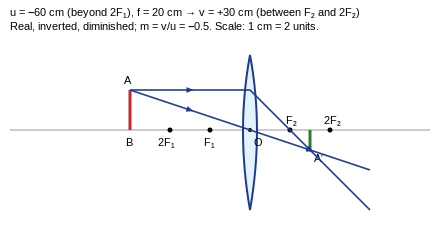
(a) What is the focal length of the convex lens? Give reason to justify your answer. (b) Write the serial number of the observation which is not correct. On what basis have you arrived at this conclusion? (c) Select an appropriate scale and draw a ray diagram for the observation at S. No. 2. Also find the approximate value of magnification.
(a) If the image formed by a mirror for all position of the object placed in front of it is always diminished, erect and virtual, state the type of the mirror and also draw a ray diagram to justify your answer. Write one use such mirrors are put to and why. (b) Define the radius of curvature of spherical mirrors. Find the nature and focal length of a spherical mirror whose radius of curvature is +24 cm.
Section B · Practical skills
Study the following ray diagram (the ray enters through the right face of the prism):
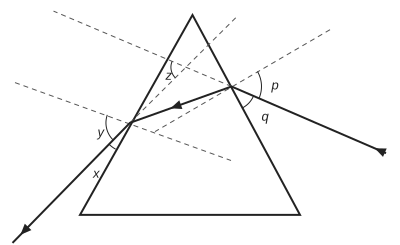
In this diagram, the angle of incidence, the angle of emergence and the angle of deviation respectively have been represented by
A student very cautiously traces the path of a ray through a glass slab for different values of the angle of incidence (∠i). He then measures the corresponding values of the angle of refraction (∠r) and the angle of emergence (∠e) for every value of the angle of incidence. On analysing these measurements of angles, his conclusion would be
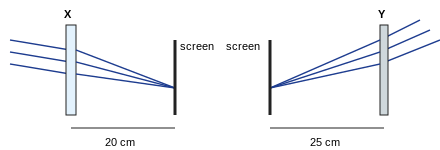
Study the given ray diagrams and select the correct statement from the following:
A student obtains a blurred image of a distant object on a screen using a convex lens. To obtain a distinct image on the screen he should move the lens
While studying the saponification reaction, what do you observe when you mix an equal amount of colourless vegetable oil and 20% aqueous solution of NaOH in a beaker?
When you add a few drops of acetic acid to a test-tube containing sodium bicarbonate powder, which one of the following is your observation?
A student requires hard water for an experiment in his laboratory which is not available in the neighbouring area. In the laboratory there are some salts, which when dissolved in distilled water can convert it into hard water. Select from the following groups of salts, a group, each salt of which when dissolved in distilled water will make it hard.
To perform an experiment to identify the different parts of an embryo of a dicot seed, first of all you require a dicot seed. Select dicot seeds from the following group: Wheat, Gram, Maize, Pea, Barley, Ground-nut
The following vegetables are kept in a basket: Potato, Tomato, Radish, Brinjal, Carrot, Bottle-gourd. Which two of these vegetables correctly represent the homologous structures?
Draw in sequence (showing the four stages), the process of binary fission in Amoeba.
A student focuses the image of a candle flame, placed at about 2 m from a convex lens of focal length 10 cm, on a screen. After that he moves gradually the flame towards the lens and each time focuses its image on the screen. (A) In which direction does he move the lens to focus the flame on the screen? (B) What happens to the size of the image of the flame formed on the screen? (C) What difference is seen in the intensity (brightness) of the image of the flame on the screen? (D) What is seen on the screen when the flame is very close (at about 5 cm) to the lens?
Mention the essential material (chemicals) to prepare soap in the laboratory. Describe in brief the test of determining the nature (acidic/alkaline) of the reaction mixture of saponification reaction.
Solutions: CBSE 2017 · Set 3
Alkynes (CnH2n−2): 2nd member — propyne, C3H4; 3rd member — butyne, C4H6.
By the 10 per cent law: sheep get 10% of 20,000 J = 2,000 J; man gets 10% of 2,000 J = 200 J.
(1) Switch off lights and fans when not in use; use energy-efficient bulbs. (2) Repair leaking taps and harvest rainwater; save water. (3) Use public transport, walk or cycle for short distances. (4) Follow the 3 Rs — reduce, reuse, recycle (e.g. use cloth bags, reuse paper).
Esterification: a carboxylic acid reacts with an alcohol in the presence of an acid catalyst to form an ester:
Saponification: an ester reacts with an alkali to give the alcohol and the sodium salt of the carboxylic acid:
Uses: (i) esters — in perfumes and as flavouring agents; (ii) saponification — in making soap.
Periodicity: the repetition of similar properties of elements after definite intervals when they are arranged in order of increasing atomic number.
Elements of a group have the same number of valence electrons, so they show similar chemical properties.
From left to right in a period, the tendency to gain electrons increases, because the nuclear charge increases and the atomic size decreases, so the nucleus attracts electrons more strongly.
Mendel crossed pure tall (TT) and pure short (tt) pea plants. All F1 plants were tall (Tt) — the short trait was not expressed. But when F1 plants were self-pollinated, about one-fourth of the F2 plants were short (tt).
He explained that each trait is controlled by a pair of factors, one from each parent. In Tt, the factor for shortness (t) is inherited but remains hidden because tallness (T) is dominant. The recessive trait is expressed only when both factors are recessive (tt).
(1) Asexual reproduction and (2) sexual reproduction.
Sexual reproduction brings in more variations: it involves two parents and the fusion of their gametes, so the offspring get a new combination of DNA (genes) from both parents; small errors in DNA copying add further variation.
Techniques: (1) mechanical barriers — condoms; (2) hormonal methods — oral pills; (3) surgical methods — vasectomy and tubectomy (also intra-uterine devices like copper-T).
Oral pills (and copper-T) are not meant for males.
Impact: fewer children and proper gaps between them protect the mother's health; a small family can give better food, health care and education to each child, so the family is healthier and more prosperous.
Dispersion is the splitting of white light into its seven constituent colours by a prism.
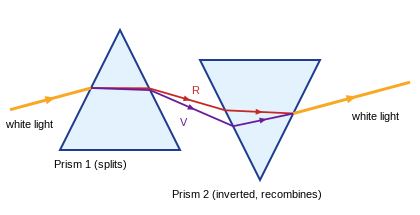
The second prism must be identical (same material and angle) so that it bends each colour by exactly the same amount as the first, and inverted so that it bends them in the opposite direction. Only then do all the colours come together again to give white light.
Acquired traits are developed during the lifetime of an individual due to its experiences or environment, e.g. a mouse losing its tail when cut, or a person learning to swim / low weight of a starving beetle. Inherited traits are passed on from parents through genes, e.g. eye colour, attached or free earlobes.
Acquired traits are not inherited because they produce changes only in the body (non-reproductive) cells, not in the DNA of the germ cells. Only changes in the DNA of germ cells can be passed on. Example: if the tails of mice are cut off in every generation, their offspring are still born with tails.
They contain only hydrogen and carbon, so they are called hydrocarbons.
| Series | General formula | First member |
|---|---|---|
| Alkanes | CnH2n+2 | Methane, CH4 (C with four single C–H bonds) |
| Alkenes | CnH2n | Ethene, H2C=CH2 |
| Alkynes | CnH2n−2 | Ethyne, HC≡CH |
Alkenes are converted to alkanes by hydrogenation (an addition reaction), in the presence of a nickel or palladium catalyst:
(a) In observation 3, u = −40 cm and v = +40 cm are equal, which happens when the object is at 2F. So 2f = 40 cm, f = 20 cm.
(b) S. No. 6. u = −15 cm is less than f (20 cm): the object is between F1 and O, so the image must be virtual and on the same side (v negative), not +120 cm.
(c) u = −60 cm, v = +30 cm; scale 1 cm = 2 units:
Answer: (C) p, y, z
Light enters through the right face (arrows point left), so the angle of incidence is p (between the incident ray and the normal at the right face); the angle of emergence is y (between the emergent ray and the normal at the left face); z is the angle of deviation. q and x are measured from the surface, not the normal.
Answer: (D)
X lets light pass through and converges parallel rays — a convex lens, focusing them 20 cm away (f = 20 cm). Y reflects parallel rays and converges them — a concave mirror, f = 25 cm.
Answer: (C)
Saponification is an exothermic reaction, so the beaker becomes warm.
Answer: (D)
Hardness is caused by calcium (and magnesium) salts.
Answer: (C)
Radish and carrot are both modified roots.
(A) As the object comes nearer, the image moves farther from the lens, so he moves the lens away from the screen (towards the flame).
(B) The image becomes larger.
(C) The image becomes less bright (the same light is spread over a larger image).
(D) No image is formed on the screen — with the flame within the focal length, the image is virtual (on the same side as the flame).
Get every solution for all 17 papers
- Every board question of every chapter, each fully solved the way the board gives marks
- 17 complete board papers, each followed by its solutions
- Weightage and most-asked topics for every chapter
- Instant PDF download, colour and black & white print copies
Revising the chapter first? Complete Science Notes for Class 10 (NCERT 2026-27) →
What you get in the pack
- Questions from 126 CBSE papers, 2016 to 2026: every set code available
- Complete: 2405 different questions and parts from all set codes, 13 chapters and 17 full papers
- Part A: all 13 chapters, questions sorted chapter-wise and by marks
- Year-wise weightage table and most-asked topics for every chapter
- Part B: 17 full board papers, each followed by its complete solutions, for timed practice
- Answers written to the CBSE marking-scheme points, with labelled diagrams drawn in full
- Questions on topics out of the board syllabus flagged
All chapters in this pack
- PYQ Ch 1 Chemical Reactions and Equations
- PYQ Ch 2 Acids, Bases and Salts
- PYQ Ch 3 Metals and Non-metals
- PYQ Ch 4 Carbon and its Compounds
- PYQ Ch 5 Life Processes
- PYQ Ch 6 Control and Coordination
- PYQ Ch 7 How do Organisms Reproduce
- PYQ Ch 8 Heredity
- PYQ Ch 9 Light Reflection and Refraction
- PYQ Ch 10 The Human Eye and the Colourful World
- PYQ Ch 11 Electricity
- PYQ Ch 12 Magnetic Effects of Electric Current
- PYQ Ch 13 Our Environment
- Board Paper 2026 Set 31-2-1 with Solutions
- Board Paper 2026 Set 31-3-1 with Solutions
- Board Paper 2025 Set 31-1-1 with Solutions
- Board Paper 2025 Set 31-2-1 with Solutions
- Board Paper 2024 Set 31-4-1 with Solutions
- Board Paper 2024 Set 31-5-1 with Solutions
- Board Paper 2023 Set 31-2-1 with Solutions
- Board Paper 2023 Set 31-4-1 with Solutions
- Board Paper 2022 Term 2 Set 31-1-1 with Solutions
- Board Paper 2022 Term 2 Set 31-3-1 with Solutions
- Board Paper 2020 Set 31-2-1 with Solutions
- Board Paper 2020 Set 31-4-1 with Solutions
- Board Paper 2019 Set 31-2-1 with Solutions
- Board Paper 2019 Set 31-4-1 with Solutions
- Board Paper 2018 Set 31-1 with Solutions
- Board Paper 2017 Set 3 with Solutions
- Board Paper 2016 Set 31-1 with Solutions