
CBSE Class 10 Science Question Paper 2016 (31/1) with Solutions
The complete CBSE Class 10 Science board paper of 2016, Q.P. code 31/1: all 36 questions exactly as set, with marks. 18 solutions are free below. The Class 10 Science PYQ Book: Solved Board Papers 2016-2026 (CBSE) solves all 17 papers in full and sorts every question chapter-wise.
Subject expert: Khushbu Gupta, B.Sc., M.Sc. Physics, B.Ed. · 8+ years teaching


Free: NCERT solutions for Class 10 Science →
Question paper
Jump to: Question paperSolutions
2016 · Q.P. Code 31/1
Maximum marks: 90
Section A
Write the name and structure of an alcohol with three carbon atoms in its molecule.
What happens when a mature Spirogyra filament attains considerable length?
The depletion of ozone layer is a cause of concern. Why?
Name the type of mirrors used in the design of solar furnaces. Explain how high temperature is achieved by this device.
What was Chipko Andolan? How did this Andolan ultimately benefit the local people and the environment?
not in 2026-27 syllabusBurning of fossil fuels results in global warming. Give reasons to justify this statement.
not in 2026-27 syllabusWrite chemical equation of the reaction of ethanoic acid with the following: (a) Sodium; (b) Sodium hydroxide; (c) Ethanol. Write the name of one main product of each reaction.
An aldehyde as well as a ketone can be represented by the same molecular formula, say C3H6O. Write their structures and name them. State the relation between the two in the language of science.
An element X belongs to 3rd period and group 16 of the Modern Periodic Table. (a) Determine the number of valence electrons and the valency of X. (b) Molecular formula of the compound when X reacts with hydrogen and write its electron dot structure. (c) Name the element X and state whether it is metallic or non-metallic.
not in 2026-27 syllabusAn element X has mass number 35 and number of neutrons 18. Write atomic number and electronic configuration of X. Also write group number, period number and valency of X.
not in 2026-27 syllabusDefine reproduction. How does it help in providing stability to the population of species?
Explain the term ‘‘Regeneration’’ as used in relation to reproduction of organisms. Describe briefly how regeneration is carried out in multicellular organisms like Hydra.
(a) List two reasons for the appearance of variations among the progeny formed by sexual reproduction.
(b) 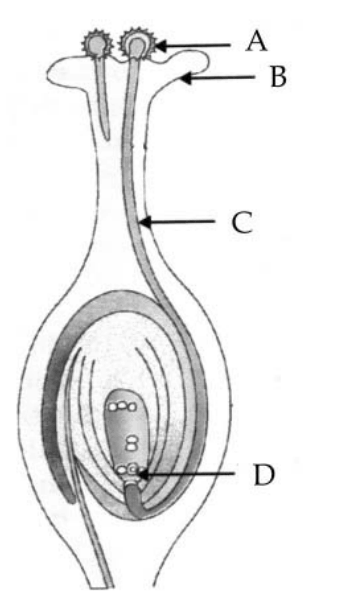 (i) Name the part marked A in the diagram. (ii) How does A reaches part B? (iii) State the importance of the part C. (iv) What happens to the part marked D after fertilisation is over?
How do Mendel’s experiment show that traits are inherited independently?
‘‘Two areas of study namely ‘evolution’ and ‘classification’ are interlinked’’. Justify this statement.
not in 2026-27 syllabusThe image of an object formed by a mirror is real, inverted and is of magnification –1. If the image is at a distance of 40 cm from the mirror, where is the object placed? Where would the image be if the object is moved 20 cm towards the mirror? State reason and also draw ray diagram for the new position of the object to justify your answer.
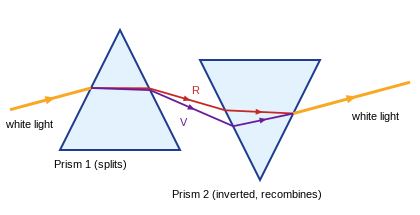
Describe an activity to show that the colours of white light splitted by a glass prism can be recombined to get white light by another identical glass prism. Also draw ray diagram to show the recombination of the spectrum of white light.
The activities of man had adverse effects on all forms of living organisms in the biosphere. Unlimited exploitation of nature by man disturbed the delicate ecological balance between the living and non-living components of the biosphere. The unfavourable conditions created by man himself threatened the survival not only of himself but also of the entire living organisms on the mother earth. One of your classmates is an active member of Eco club of your school which is creating environmental awareness amongst the school students, spreading the same in the society and also working hard for preventing environmental degradation of the surroundings. (a) Why is it necessary to conserve our environment? (b) State the importance of green and blue dust-bins in the safe disposal of the household waste. (c) List two values exhibited by your classmate who is an active member of Eco-club of your school.
A carbon compound P on heating with excess conc. H2SO4 forms another carbon compound Q which on addition of hydrogen in the presence of nickel catalyst forms a saturated carbon compound R. One molecule of R on combustion forms two molecules of carbon dioxide and three molecules of water. Identify P, Q and R and write chemical equations for the reactions involved.
What is placenta? Describe its structure. State its functions in case of a pregnant human female.
Define evolution. How does it occur? Describe how fossils provide us evidences in support of evolution.
not in 2026-27 syllabusIt is desired to obtain an erect image of an object, using concave mirror of focal length of 12 cm. (i) What should be the range of distance of an object placed in front of the mirror? (ii) Will the image be smaller or larger than the object. Draw ray diagram to show the formation of image in this case. (iii) Where will the image of this object be, if it is placed 24 cm in front of the mirror? Draw ray diagram for this situation also to justify your answer. Show the positions of pole, principal focus and the centre of curvature in the above ray diagrams.
(a) Define optical centre of a spherical lens. (b) A divergent lens has a focal length of 20 cm. At what distance should an object of height 4 cm from the optical centre of the lens be placed so that its image is formed 10 cm away from the lens. Find the size of the image also. (c) Draw a ray diagram to show the formation of image in above situation.
What is atmospheric refraction? Use this phenomenon to explain the following natural events. (a) Twinkling of stars (b) Advanced sun-rise and delayed sun-set. Draw diagrams to illustrate your answers.
Section B · Practical skills
A student puts a drop of reaction mixture of a saponification reaction first on a blue litmus paper and then on a red litmus paper. He may observe that:
For preparing soap in the laboratory we require an oil and a base. Which of the following combinations of an oil and a base would be best suited for the preparation of soap?
In the neighbourhood of your school, hard water required for an experiment is not available. Select from the following groups of salts available in your school, a group each member of which, if dissolved in distilled water, will make it hard:
A student while observing an embryo of a pea seed in the laboratory listed various parts of the embryo as given below: Testa, Tegmen, Radicle, Plumule, Micropyle, Cotyledon. On examining the list the teacher remarked that only three parts are correct. Select three correct parts from the above list:
If you are asked to select a group of two vegetables, out of the following, having homologous structures which one would you select?
To determine the approximate value of the focal length of a given concave mirror, you focus the image of a distant object formed by the mirror on a screen. The image obtained on the screen, as compared to the object is always:
Suppose you have focused on a screen the image of candle flame placed at the farthest end of the laboratory table using a convex lens. If your teacher suggests you to focus the parallel rays of the sun, reaching your laboratory table, on the same screen, what you are expected to do is to move the:
In your laboratory you trace the path of light rays through a glass slab for different values of angle of incidence (∠i) and in each case measure the values of the corresponding angle of refraction (∠r) and angle of emergence (∠e). On the basis of your observations your correct conclusion is:
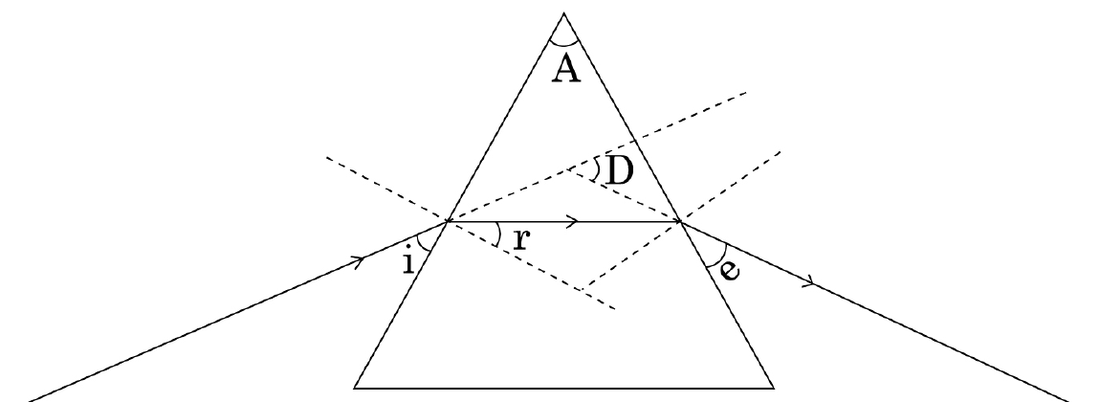
In the following ray diagram the correctly marked angle are:
A student adds a spoon full of powdered sodium hydrogen carbonate to a flask containing ethanoic acid. List two main observations, he must note in his note book, about the reaction that takes place. Also write chemical equation for the reaction.
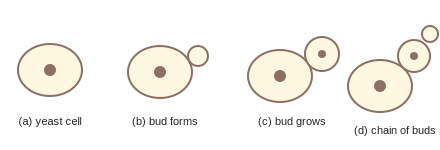
A student is observing a permanent slide showing sequentially the different stages of asexual reproduction taking place in yeast. Name this process and draw diagrams, of what he observes, in a proper sequence.
An object of height 2.5 cm is placed at a distance of 15 cm from the optical centre O of a convex lens of focal length 10 cm. Draw a ray diagram to find the position and size of the image formed. Mark optical centre O, principal focus F and height of the image on the diagram.
Solutions: CBSE 2016 · 31/1
Propanol (propan-1-ol): CH3–CH2–CH2–OH (C3H7OH).
The ozone layer shields the Earth from harmful UV radiation; its depletion lets more UV reach the Earth, causing skin cancer and harming living organisms.
The Chipko Andolan ("hug the trees" movement) began in the early 1970s in Reni village, Garhwal (Himalayas): local women hugged the trees to stop contractors from cutting them down.
Benefits: the forests were saved, so the local people kept their source of fuel, fodder, fruits and medicines; the environment benefited through prevention of soil erosion and protection of biodiversity. It also made the government recognise the importance of people's participation in managing forests.
(b) CH3COOH + NaOH → CH3COONa + H2O — sodium ethanoate (and water)
(c) CH3COOH + C2H5OH →(acid) CH3COOC2H5 + H2O — ethyl ethanoate (an ester)
(a) Group 16 → 6 valence electrons (2, 8, 6); valency = 8 − 6 = 2.
(b) H2X (H2S): X shares one electron pair with each hydrogen atom — H : X : H, with two lone pairs on X:
H:S:H
••
(c) X is sulphur, a non-metal.
Reproduction is the process by which living organisms produce new individuals of their own kind.
Reproduction involves copying of DNA, so the body design of the offspring is like that of the parents. Populations of organisms live in well-defined places (niches) using their body designs. Reproduction keeps producing individuals of the same design, replacing those that die, so the population of the species remains stable. (Small variations in DNA copying also help some individuals survive if the niche changes.)
(a) (1) Combination of DNA from two different parents (from the two gametes). (2) Small inaccuracies in DNA copying during formation of the gametes.
(b) (i) A — pollen grain.
(ii) By pollination — pollen is transferred from the anther to the stigma (B) by wind, water, insects or animals.
(iii) C is the pollen tube: it grows through the style and carries the male germ cell to the female germ cell in the ovule, so that fertilisation can take place.
(iv) D is the female germ cell (egg); after fertilisation it forms the zygote, which divides to form the embryo within the seed.
Classification groups organisms on the basis of similarities and differences in their characteristics. The more characteristics two species share, the more closely related they are, and the more recently they had a common ancestor. So classifying organisms is, in effect, tracing their evolutionary relationships — both study the same pattern of descent with modification.
Allow a narrow beam of white light (through a slit) to fall on a glass prism; a spectrum of seven colours is obtained. Now place a second, identical prism in an inverted position close to the first, so that the spectrum enters it. A beam of white light emerges from the other side of the second prism and is seen on a screen. The second prism bends each colour back by the same amount, recombining them (Newton's experiment).
R gives 2CO2 + 3H2O, so it has 2 C and 6 H: R = ethane (C2H6). Q = ethene (C2H4); P = ethanol (C2H5OH).
CH2=CH2 + H2 →(Ni) CH3–CH3
2C2H6 + 7O2 → 4CO2 + 6H2O + heat and light
Evolution is the sequence of gradual changes which take place in primitive organisms over millions of years, by which new species are produced.
How it occurs: variations arise during reproduction (errors in DNA copying, sexual reproduction). Some variations help organisms survive better in their environment; these individuals leave more offspring (natural selection). Over many generations, variations accumulate and, if populations get separated (geographical isolation, genetic drift), they may become new species.
Fossils as evidence: fossils are preserved remains of organisms that lived long ago. Fossils in deeper rock layers are older; comparing them shows how organisms changed gradually over time. Some fossils show intermediate features — e.g. Archaeopteryx has feathers like birds and teeth/tail like reptiles, suggesting birds evolved from reptiles.
(a) The optical centre is the central point of a lens; a ray of light passing through it goes undeviated.
(b) Divergent (concave) lens: f = −20 cm; the image is virtual, on the same side: v = −10 cm.
m = v/u = (−10)/(−20) = 0.5 ⇒ h′ = 0.5 × 4 = 2 cm
The object is placed 20 cm from the lens (at F1); the image is 2 cm tall, virtual and erect.
(c) 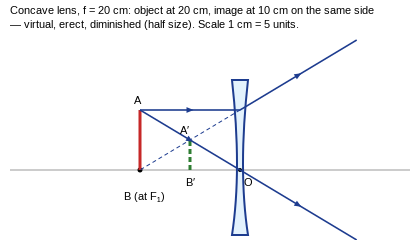
Answer: (c)
The saponification mixture contains excess sodium hydroxide (and soap), so it is basic: red litmus turns blue.
Answer: (d)
Hardness of water is caused by calcium and magnesium salts.
Answer: (a) Carrot and radish
Both are modified roots (same origin and structure). Potato is a stem, sweet potato a root — analogous, not homologous.
Answer: (a)
Parallel rays from the Sun (object at infinity) focus exactly at F, which is a little closer to the lens than the image of the candle (a nearby object). So the lens must be moved slightly towards the screen.
Answer: (d)
∠i and ∠e are wrongly marked — they are drawn from the prism surface instead of from the normal. ∠r (between refracted ray and normal), ∠A (angle of the prism) and ∠D (angle of deviation) are correctly marked.
Budding.
Get every solution for all 17 papers
- Every board question of every chapter, each fully solved the way the board gives marks
- 17 complete board papers, each followed by its solutions
- Weightage and most-asked topics for every chapter
- Instant PDF download, colour and black & white print copies
Revising the chapter first? Complete Science Notes for Class 10 (NCERT 2026-27) →
What you get in the pack
- Questions from 126 CBSE papers, 2016 to 2026: every set code available
- Complete: 2405 different questions and parts from all set codes, 13 chapters and 17 full papers
- Part A: all 13 chapters, questions sorted chapter-wise and by marks
- Year-wise weightage table and most-asked topics for every chapter
- Part B: 17 full board papers, each followed by its complete solutions, for timed practice
- Answers written to the CBSE marking-scheme points, with labelled diagrams drawn in full
- Questions on topics out of the board syllabus flagged
All chapters in this pack
- PYQ Ch 1 Chemical Reactions and Equations
- PYQ Ch 2 Acids, Bases and Salts
- PYQ Ch 3 Metals and Non-metals
- PYQ Ch 4 Carbon and its Compounds
- PYQ Ch 5 Life Processes
- PYQ Ch 6 Control and Coordination
- PYQ Ch 7 How do Organisms Reproduce
- PYQ Ch 8 Heredity
- PYQ Ch 9 Light Reflection and Refraction
- PYQ Ch 10 The Human Eye and the Colourful World
- PYQ Ch 11 Electricity
- PYQ Ch 12 Magnetic Effects of Electric Current
- PYQ Ch 13 Our Environment
- Board Paper 2026 Set 31-2-1 with Solutions
- Board Paper 2026 Set 31-3-1 with Solutions
- Board Paper 2025 Set 31-1-1 with Solutions
- Board Paper 2025 Set 31-2-1 with Solutions
- Board Paper 2024 Set 31-4-1 with Solutions
- Board Paper 2024 Set 31-5-1 with Solutions
- Board Paper 2023 Set 31-2-1 with Solutions
- Board Paper 2023 Set 31-4-1 with Solutions
- Board Paper 2022 Term 2 Set 31-1-1 with Solutions
- Board Paper 2022 Term 2 Set 31-3-1 with Solutions
- Board Paper 2020 Set 31-2-1 with Solutions
- Board Paper 2020 Set 31-4-1 with Solutions
- Board Paper 2019 Set 31-2-1 with Solutions
- Board Paper 2019 Set 31-4-1 with Solutions
- Board Paper 2018 Set 31-1 with Solutions
- Board Paper 2017 Set 3 with Solutions
- Board Paper 2016 Set 31-1 with Solutions