
Ray Optics and Optical Instruments: Class 12 PYQs 2016–2026 with solutions
All 70 CBSE board questions asked from Ray Optics and Optical Instruments in 17 board papers, with the year, set and marks of each. 36 are solved free below. The Class 12 Physics PYQ Book: Solved Board Papers 2016-2026 (CBSE) has every solution, all chapters and 19 full board papers.
Subject experts: Khushbu Gupta (B.Sc., M.Sc. Physics, B.Ed.) and Vinay Wadhwani (B.Tech Electrical Engineering)



Free: NCERT solutions for Class 12 Physics →
Ray Optics and Optical Instruments: board weightage
Board weightage 2016–2026
| Year | 2016 | 2017 | 2018 | 2019 | 2020 | 2022 | 2023 | 2024 | 2025 | 2026 |
|---|---|---|---|---|---|---|---|---|---|---|
| Questions | 2 | 4 | 3 | 7 | 11 | 7 | 9 | 10 | 8 | 9 |
| Marks | 5 | 12 | 10 | 19 | 27 | 21 | 24 | 28 | 23 | 30 |
Most asked topics
70 questions from 17 papers. Repeated questions are shown once with every year they were asked.
Jump to: 1 mark2 marks3 marks4 marks5 marks
1 mark: MCQ and Assertion–Reason
A concave lens of focal length 10 cm is cut into two identical plano-concave lenses. The focal length of each lens will be
Solution
Answer: (A) 20 cm
For the equi-concave lens, , so cm.
Each plano-concave half has one curved surface: , so cm.
A beaker is filled with water (refractive index ) upto a height H. A coin is placed at its bottom. The depth of the coin, when viewed along the near normal direction, will be
Solution
Answer: (B)
Apparent depth .
A tub is filled with a transparent liquid to a height of 30.0 cm. The apparent depth of a coin lying at the bottom of the tub is found to be 16.0 cm. The speed of light in the liquid will be
Solution
Answer: (A) m s⁻¹
, so m s⁻¹.
Assertion (A): Plane and convex mirrors cannot produce real images under any circumstance.
Reason (R): A virtual image cannot serve as an object to produce a real image.
Solution
Answer: (D) Both A and R are false.
If converging rays fall on a plane or convex mirror (a virtual object), the mirror can form a real image, so A is false. A virtual image formed by one lens or mirror can act as the object for another and produce a real image (as in a microscope), so R is also false.
Assertion (A): The magnifying power of a compound microscope is negative.
Reason (R): The final image formed is erect with respect to the object.
Solution
Answer: (C) A is true, but R is false.
The objective forms a real inverted image, which the eyepiece magnifies without inverting again, so the final image is inverted with respect to the object and the magnifying power is negative.
For a concave mirror of focal length 'f', the minimum distance between the object and its real image is
Solution
Answer: (a) zero
When the object is at the centre of curvature (2f), the real image is formed at the same place, so the distance between them is zero.
A ray of monochromatic light propagating in air, is incident on the surface of water. Which of the following will be the same for the reflected and refracted rays?
Solution
Answer: (c) Frequency
Frequency is fixed by the source and does not change on reflection or refraction; speed and wavelength change in water, and the energy is shared between the two rays.
A beam of light travels from air into a medium. Its speed and wavelength in the medium are m s⁻¹ and 230 nm respectively. The wavelength of light in air will be
Larger aperture of objective lens in an astronomical telescope
A biconvex lens of glass having refractive index 1.47 is immersed in a liquid. It becomes invisible and behaves as a plane glass plate. The refractive index of the liquid is
For a glass prism, the angle of minimum deviation will be smallest for the light of
Fill in the blank: A ray of light on passing through an equilateral glass prism, suffers a minimum deviation equal to the angle of the prism. The value of refractive index of the material of the prism is ________.
Fill in the blank: For a higher resolving power of a compound microscope, the wavelength of light used should be ________.
How does the angle of minimum deviation of a glass prism vary, if the incident violet light is replaced by red light? Give reason.
2 marks: very short answer
A ray of light in air is incident at angle i on a face of an equilateral glass prism and is refracted through the prism. As i is varied, it is observed that the ray undergoes minimum deviation, when the i is three-fourth of the angle of the prism. Calculate the speed of light in the prism.
Solution
, so at minimum deviation and .
A 5 cm long pencil is placed along the principal axis of a concave mirror of focal length 20 cm such that its nearest end is at a distance of 25 cm from the mirror. Calculate the length of the image of the pencil.
Solution
cm. Near end: cm; far end: cm.
Near end: , so cm.
Far end: , so cm.
Length of image .
A transparent solid cylindrical rod (refractive index ) is kept in air. A ray of light incident on its face travels along the surface of the rod, as shown in figure. Calculate the angle θ.
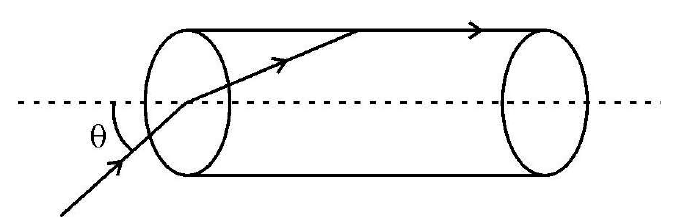
Solution
The ray inside just grazes the curved surface, so it meets that surface at the critical angle C:
The angle of refraction at the flat face is then .
Snell's law at the face:
Two concave lenses A and B, each of focal length 8.0 cm are arranged coaxially 16 cm apart as shown in figure. An object P is placed at a distance of 4.0 cm from A. Find the position and nature of the final image formed.
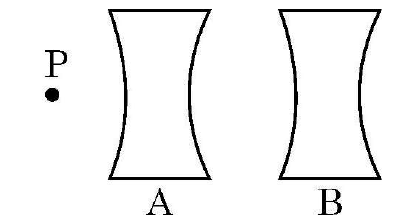
Solution
Lens A: cm, cm.
(a virtual image 8/3 cm to the left of A).
Lens B is 16 cm from A, so the object distance for B is cm.
The final image is 5.6 cm to the left of lens B (between the lenses); it is virtual and erect.
Monochromatic light of frequency Hz passes from air into a medium of refractive index 1.5. Find the wavelength of the light (i) reflected, and (ii) refracted at the interface of the two media.
Solution
(i) Reflected light stays in air: m .
(ii) In the medium the frequency is unchanged and , so .
A plano-convex lens of focal length 16 cm is made of a material of refractive index 1.4. Calculate the radius of the curved surface of the lens.
Solution
Lens maker's formula with , :
An object is placed 30 cm in front of a concave mirror of radius of curvature 40 cm. Find the (i) position of the image formed and (ii) magnification of the image.
Solution
cm, cm.
(i) , so : the image is 60 cm in front of the mirror (real).
(ii) : real, inverted, twice the size.
A convex lens (n = 1.52) has a focal length of 15.0 cm in air. Find its focal length when it is immersed in liquid of refractive index 1.65. What will be the nature of the lens?
Solution
Lens maker's formula: .
In air: .
In the liquid: .
The focal length is negative: in the denser liquid the lens behaves as a diverging (concave) lens.
Why is a reflecting telescope preferred over a refracting telescope? Justify your answer giving two reasons.
Solution
Any two:
1. A mirror has no chromatic aberration, since reflection does not depend on wavelength; a parabolic mirror also removes spherical aberration.
2. A large mirror is much lighter and cheaper to make than a large lens of the same aperture, and it can be supported over its entire back, so it does not sag.
3. A large aperture collects more light, giving a brighter image and higher resolving power.
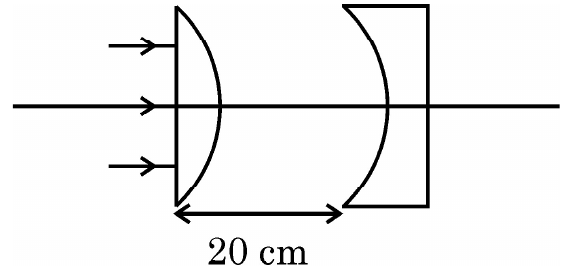
In the given figure the radius of curvature of curved face in the plano-convex and the plano-concave lens is 15 cm each. The refractive index of the material of the lenses is 1.5. Find the final position of the image formed.
Using lens maker's formula, derive the thin lens formula for a biconvex lens.
An object is kept 20 cm in front of a concave mirror of radius of curvature 60 cm. Find the nature and position of the image formed.
Calculate the radius of curvature of an equi-concave lens of refractive index 1.5, when it is kept in a medium of refractive index 1.4, to have a power of –5D?
An equilateral glass prism has a refractive index 1.6 in air. Calculate the angle of minimum deviation of the prism, when kept in a medium of refractive index .
Draw the ray diagram of an astronomical telescope showing image formation in the normal adjustment position. Write the expression for its magnifying power.
Draw a labelled ray diagram to show image formation by a compound microscope and write the expression for its resolving power.
The figure shows a ray of light falling normally on the face AB of an equilateral glass prism having refractive index 3/2, placed in water of refractive index 4/3. Will this ray suffer total internal reflection on striking the face AC? Justify your answer.
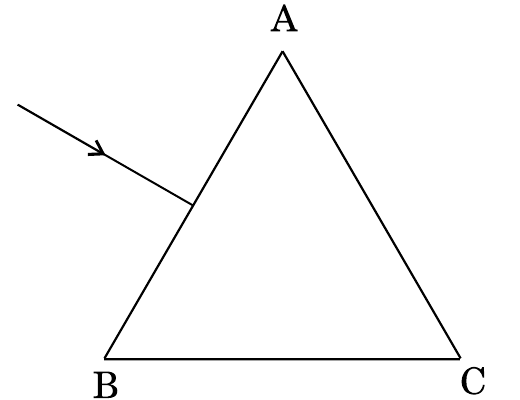
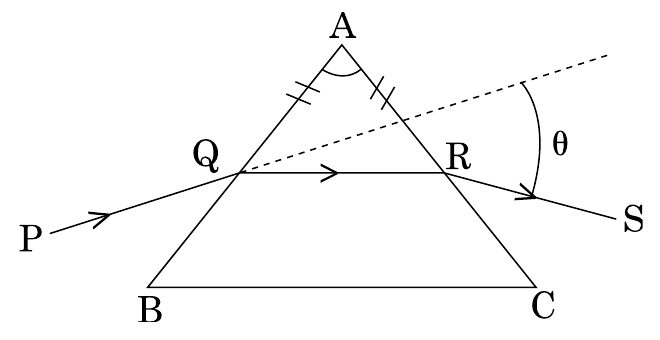
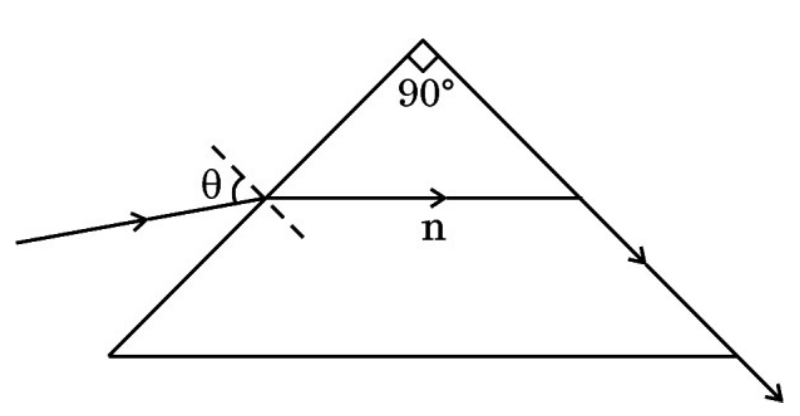
A ray PQ incident on the refracting face BA is refracted in the prism BAC as shown in the figure and emerges from the other refracting face AC as RS such that AQ = AR. If the angle of prism A = 60° and refractive index of material of prism is , calculate angle θ.
3 marks: short answer
(a) Draw the ray diagram to show the image formation by a refracting telescope and write the expression for angular magnification for the telescope in normal adjustment.
(b) Give two reasons to explain why a reflecting telescope is preferred over a refracting telescope.
Solution
(a)
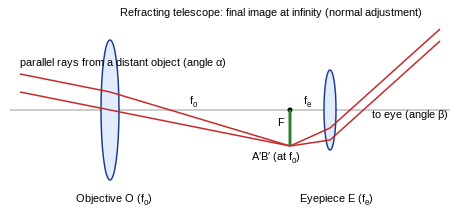
In normal adjustment (final image at infinity):
(the length of the tube is ).
(b) Any two:
1. A mirror has no chromatic aberration (no dispersion), and a parabolic mirror removes spherical aberration.
2. A large mirror is easier and cheaper to make and support (it can be supported over its whole back), whereas a large lens is heavy and sags.
3. The image is brighter, since a large aperture gathers more light.
(a) State the two conditions under which total internal reflection occurs.
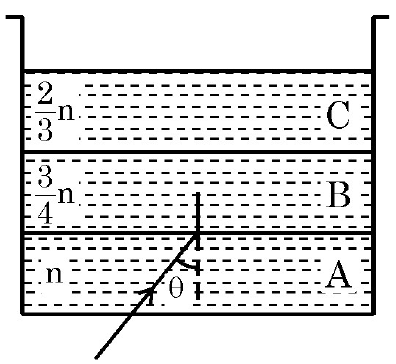
(b) A transparent container contains layers of three immiscible transparent liquids A, B and C of refractive indices n, n and n, respectively. A laser beam is incident at the interface between A and B at an angle as shown in figure. Prove that the beam does not enter region C at all for .
Solution
(a) 1. Light must travel from an optically denser medium to a rarer medium.
2. The angle of incidence must be greater than the critical angle for the pair of media.
(b) At the A–B interface (Snell's law), with refraction angle :
At the B–C interface, with refraction angle r:
From (1) and (2): , so .
For : , , and the ray grazes the B–C surface. For , would exceed 1, which is impossible: the ray is totally internally reflected at the B–C interface.
Hence for the beam does not enter region C at all.
(a) When a parallel beam of light enters water surface obliquely at some angle, what is the effect on the width of the beam?
(b) With the help of a ray diagram, show that a straw appears bent when it is partly dipped in water and explain it.
(c) Explain the transmission of optical signal through an optical fibre by a diagram.
Solution
(a) The beam bends towards the normal on entering water. The edge rays refract at points that are some distance apart, so the refracted beam is less tilted and its width increases.
(b)
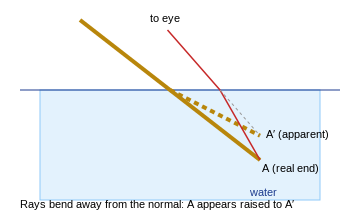
Rays from the dipped end A pass from water to air and bend away from the normal. Traced back, they seem to come from A′, above A. Every point of the dipped part appears raised, so the straw appears bent at the water surface.
(c)
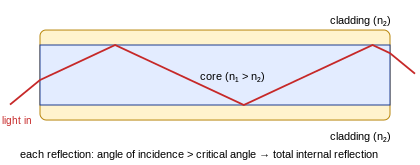
An optical fibre has a core of higher refractive index surrounded by a cladding of lower refractive index. Light entering at one end strikes the core–cladding boundary at an angle greater than the critical angle and is totally internally reflected again and again, so it travels along the fibre (even when bent) with very little loss.
Define critical angle for a given pair of media and total internal reflection. Obtain the relation between the critical angle and refractive index of the medium.
Solution
Critical angle: for light going from a denser to a rarer medium, the angle of incidence in the denser medium for which the angle of refraction is 90°.
Total internal reflection: when light goes from a denser to a rarer medium and the angle of incidence exceeds the critical angle, no light is refracted; it is entirely reflected back into the denser medium.
Relation: at the critical angle, Snell's law gives :
For the denser medium in air (, ): , i.e. .
A point source in air is kept 24 cm in front of a concave spherical glass surface ( = 1.5) and radius of curvature 60 cm. Find the nature of the image formed and its distance from the point source.
Solution
Light goes from air () to glass (). u = –24 cm. For a concave surface facing the object, the centre of curvature is on the object side: R = –60 cm.
The image is virtual, 30 cm from the surface on the same side as the source. Its distance from the point source is .
Explain with the help of a suitable diagram, the phenomenon on which an optical fibre works. Mention any two uses of optical fibres.
Solution
An optical fibre works on total internal reflection.
It has a thin glass core of higher refractive index surrounded by a cladding of lower refractive index. Light entering one end strikes the core–cladding boundary at an angle greater than the critical angle and is totally reflected; this repeats many times, so the light travels along the fibre (even if it is bent) with very little loss and emerges at the other end.
Uses (any two): transmitting telephone, internet and TV signals (optical communication); endoscopy (viewing inside the body); decorative lamps; transmitting images.
A thin equiconvex lens of radius of curvature R made of material of refractive index is kept coaxially, in contact with an equiconcave lens of the same radius of curvature and refractive index . Find: (i) the ratio of their powers, and (ii) the power of the combination and its nature.
Solution
Lens maker's formula:
Equiconvex: .
Equiconcave: .
(i)
(ii)
Since , P is negative: the combination behaves as a diverging (concave) lens.
(i) Trace the path of a ray of light PQ which is incident at an angle i on one face of a glass prism of angle A. It then emerges out from the other face at an angle e. Use the ray diagram to prove that the angle through which the ray is deviated is given by ∠δ = ∠i + ∠e – ∠A.
(ii) What will be the minimum value of δ if the ray passes symmetrically through the prism?
Solution
(i)
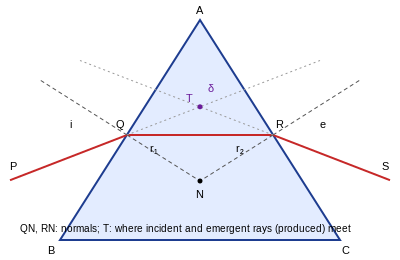
PQ is incident at Q, refracted along QR, and emerges along RS. QN and RN are the normals, meeting at N; and are the angles of refraction at the two faces.
In quadrilateral AQNR, the angles at Q and R are 90°, so ∠A + ∠QNR = 180°.
In triangle QNR, . Hence
The total deviation is the sum of the deviations at the two faces:
(ii) When the ray passes symmetrically, i = e and ; the deviation is then minimum:
(a) State the conditions for total internal reflection to take place.
(b) A tank is filled with a transparent liquid to height 'H'. A coin suspended by a thread in the liquid is gradually lowered till it touches the bottom. The apparent depth is determined corresponding to different positions of the coin. (i) Plot a graph showing variation of the apparent depth with the real depth of the coin. (ii) What is the physical significance of the slope of the graph?
Solution
(a) 1. Light must travel from an optically denser medium to an optically rarer medium.
2. The angle of incidence must be greater than the critical angle for the pair of media.
(b) (i) Apparent depth , so the graph is a straight line through the origin.
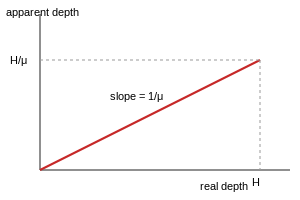
(ii) The slope (apparent depth ÷ real depth) equals ; its reciprocal gives the refractive index of the liquid.
Draw a labelled ray diagram showing the formation of an image by an astronomical refracting telescope in normal adjustment. Hence, obtain the expression for its magnifying power.
A converging lens made of glass (μ = 1.5) has its spherical faces of radii of curvature 10 cm and 20 cm. Find its focal length (a) in air, and (b) when it is immersed in a liquid of refractive index 1.25.
What is the difference in the construction of an astronomical telescope and a compound microscope? The focal lengths of the objective and eyepiece of a compound microscope are 1.25 cm and 5.0 cm, respectively. Find the position of the object relative to the objective in order to obtain an angular magnification of 30 when the final image is formed at the near point.
Draw a labelled ray diagram of an astronomical telescope in the near point adjustment position. A giant refracting telescope at an observatory has an objective lens of focal length 15 m and an eyepiece of focal length 1.0 cm. If this telescope is used to view the Moon, find the diameter of the image of the Moon formed by the objective lens. The diameter of the Moon is m, and the radius of lunar orbit is m.
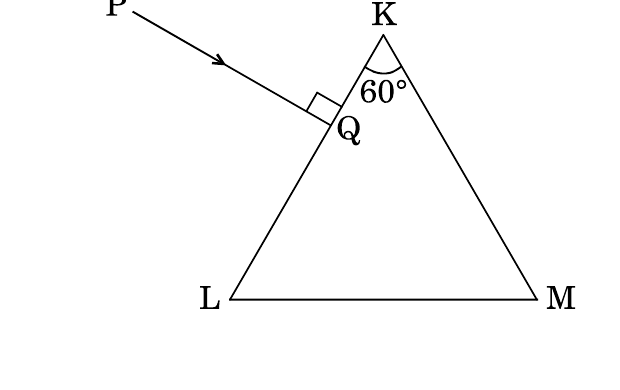
A triangular prism of refracting angle 60° is made of a transparent material of refractive index . A ray of light is incident normally on the face KL as shown in the figure. Trace the path of the ray as it passes through the prism and calculate the angle of emergence and angle of deviation.
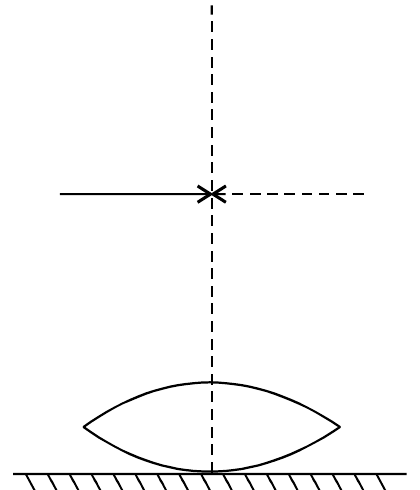
A symmetric biconvex lens of radius of curvature R and made of glass of refractive index 1.5, is placed on a layer of liquid placed on top of a plane mirror as shown in the figure. An optical needle with its tip on the principal axis of the lens is moved along the axis until its real, inverted image coincides with the needle itself. The distance of the needle from the lens is measured to be x. On removing the liquid layer and repeating the experiment, the distance is found to be y. Obtain the expression for the refractive index of the liquid in terms of x and y.
(a) Monochromatic light of wavelength 589 nm is incident from air on a water surface. If μ for water is 1.33, find the wavelength, frequency and speed of the refracted light. (b) A double convex lens is made of a glass of refractive index 1.55, with both faces of the same radius of curvature. Find the radius of curvature required, if the focal length is 20 cm.
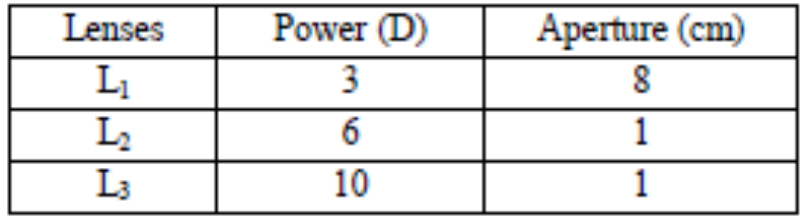
(a) Draw a ray diagram depicting the formation of the image by an astronomical telescope in normal adjustment. (b) You are given the following three lenses. Which two lenses will you use as an eyepiece and as an objective to construct an astronomical telescope? Give reason.
(i) A screen is placed at a distance of 100 cm from an object. The image of the object is formed on the screen by a convex lens for two different locations of the lens separated by 20 cm. Calculate the focal length of the lens used. (ii) A converging lens is kept coaxially in contact with a diverging lens - both the lenses being of equal focal length. What is the focal length of the combination?
4 marks: case-based / source-based
In an experiment with convex lens of focal length f, the screen is fixed at a distance D from the object. A student slowly moves the lens away from the object towards the screen and finds that she is able to form sharp image of the object for two positions of the lens. The distance between these two positions of the lens is d.
(i) The value of d is
A thin convex lens of focal length 10 cm and another thin lens of focal length 'f' are placed coaxially in contact. If the power of their combination is D, the value of 'f' is
Solution
(i) (A) . With and : gives , whose roots are . Their difference is .
(ii) (D) enlarged, reduced. In the first position (lens near the object) , so the image is enlarged; the second position interchanges u and v, giving a reduced image.
(iii) (B) 18.75 cm. cm.
(iv) (D) 65 cm. Two positions exist only if cm.
OR (A) –15 cm. D, so m = 30 cm. , so cm.
A thin lens is a transparent optical medium bounded by two surfaces, at least one of which should be spherical. Applying the formula for image formation by a single spherical surface successively at the two surfaces of a lens, one can obtain the 'lens maker formula' and then the 'lens formula'. A lens has two foci – called 'first focal point' and 'second focal point' of the lens, one on each side.
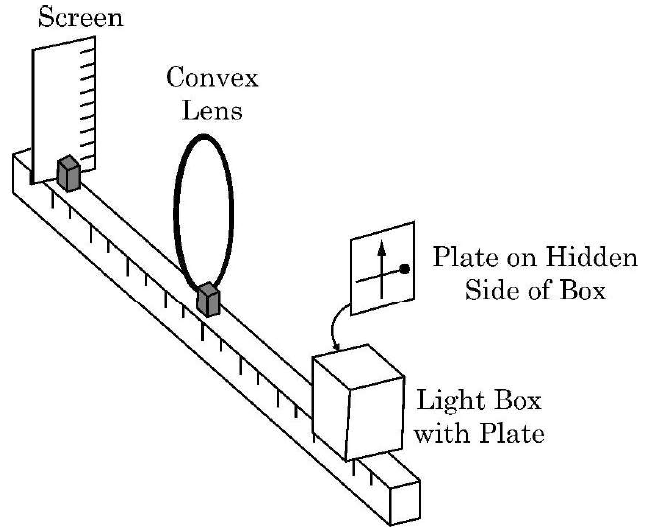
(i) Consider the arrangement shown in figure. A black vertical arrow and a horizontal thick line with a ball are painted on a glass plate. It serves as the object. When the plate is illuminated, its real image is formed on the screen. Which of the following correctly represents the image formed on the screen?
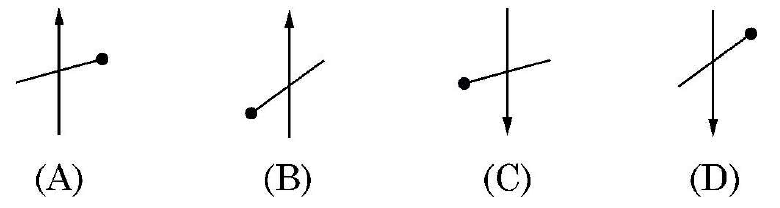
(ii) Which of the following statements is incorrect?
If an object in case (i) above is 20 cm from the lens and the screen is 50 cm away from the object, the focal length of the lens used is
Solution
(i) (C). A real image formed by a convex lens is inverted both up–down and left–right (rotated through 180°): the arrow points down and the ball appears on the left.
(ii) (A) is incorrect: a convex mirror always forms a virtual, erect image, so its magnification is always positive.
(iii) (B) 2f. Each half is plano-convex with one curved surface: , so .
OR (B) 12 cm. cm, cm: , so cm.
(iv) (C) . With and , the lens formula gives Newton's relation .
A lens is a transparent medium bounded by two surfaces, with one or both surfaces being spherical. The focal length of a lens is determined by the radii of curvature of its two surfaces and the refractive index of its medium with respect to that of the surrounding medium. The power of a lens is reciprocal of its focal length. If a number of lenses are kept in contact, the power of the combination is the algebraic sum of the powers of the individual lenses.
(i) A double-convex lens, with each face having same radius of curvature R, is made of glass of refractive index n. Its power is
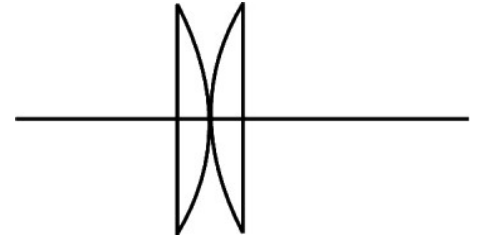
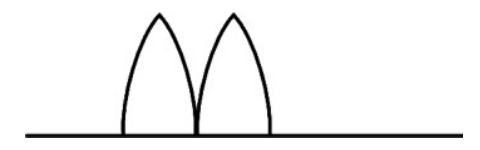
(b) Two convex lenses of focal lengths 60 cm and 20 cm are held coaxially in contact with each other. The power of the combination is
Solution
(i) (A) . .
(ii) (D) . Each half is plano-convex with one curved surface: .
(iii) (B) P. Two halves in contact: .
(iv) (a) (C) 2P. Cutting along the principal axis does not change the focal length: each half still has power P. Placed one after the other on the axis, in contact, the powers add: .
OR (b) (A) 6.6 D. D.
When a ray of light propagates from a denser medium to a rarer medium, it bends away from the normal. When the incident angle is increased, the refracted ray deviates more from the normal. For a particular angle of incidence in the denser medium, the refracted ray just grazes the interface of the two surfaces. This angle of incidence is called the critical angle for the pair of media involved.
(i) For a ray incident at the critical angle, the angle of reflection is
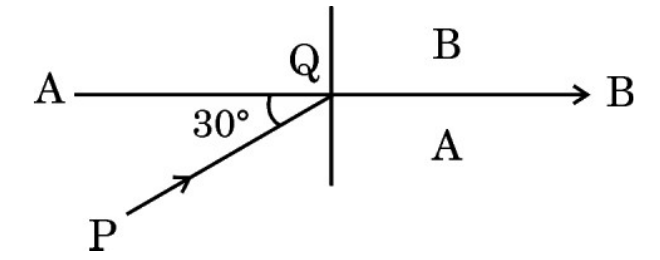
(b) Two media A and B are separated by a plane boundary. The speed of light in medium A and B is m s⁻¹ and m s⁻¹ respectively. The critical angle for a ray of light going from medium A to medium B is
Strontium titanate is a rare oxide — a natural mineral found in Siberia. It is used as a substitute for diamond because its refractive index and critical angle are 2.41 and 24.5°, respectively, which are approximately equal to the refractive index and critical angle of diamond. It has all the properties of diamond. Even an expert jeweller is unable to differentiate between diamond and strontium titanate. A ray of light is incident normally on one face of an equilateral triangular prism ABC made of strontium titanate.
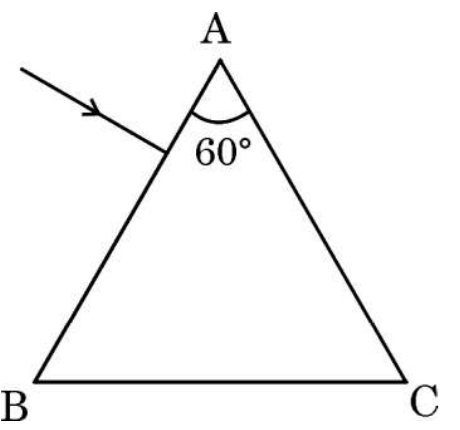
(a) Trace the path of the ray showing its passage through the prism. (1)
(b) Find the velocity of light through the prism. (1)
(c) Briefly explain two applications of total internal reflection. (2)
OR
(c) Define total internal reflection of light. Give two conditions for it. (2)
5 marks: long answer
(a) Using the relation for refraction at a curved spherical surface, derive the expression for lens maker's formula.
(b) Three lenses , and , each of focal length 40 cm, are placed coaxially. The distance between and and between and are 120 cm and 20 cm respectively. An object is kept at a distance of 80 cm to the left of lens . Find the distance of the final image formed from the object.
Solution
(a)
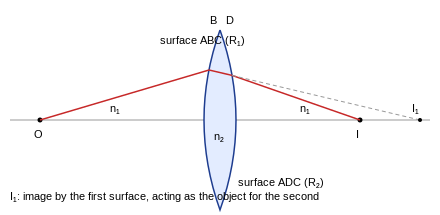
A thin lens of refractive index in a medium has surfaces of radii and . Object O on the axis.
Refraction at the first surface ABC forms image :
acts as the object for the second surface ADC, which forms the final image I (light goes from to ):
Adding (1) and (2) (the lens is thin, so distances are from the optical centre):
For an object at infinity, :
This is the lens maker's formula (in air, ).
(b) Taking each lens as converging, cm.
: cm: , so cm (to the right of ).
is 120 cm from , so this image is 40 cm to the left of : cm , so the image is at infinity (rays leave parallel).
: parallel rays focus at cm to the right of .
Distance of the final image from the object .
(a) Draw a ray diagram to show the image formation by a concave mirror when the object is kept between its focus and the centre of curvature. Using this diagram, derive the mirror formula.
(b) A concave mirror produces a two times magnified virtual image of an object kept 10 cm in front of it. Calculate the focal length of the mirror.
Solution
(a)
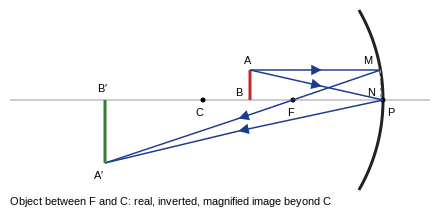
Object AB between F and C; the ray parallel to the axis reflects through F, and the ray to the pole P reflects symmetrically. They meet at A′, giving a real, inverted image A′B′ beyond C. MN is the normal from M to the axis; for a small aperture, and N ≈ P.
(approximately ):
(equal angles of incidence and reflection at P):
So , i.e. .
Using the sign convention , , :
(b) Virtual image, ; cm.
cm (behind the mirror).
cm: the focal length is 20 cm (concave).
(a) Draw a labelled ray diagram of a refracting telescope when it forms image of a distant object at infinity. Derive expression for its magnifying power.
(b) (i) In a telescope the objective has much larger aperture than the eye piece. Why? (ii) Write two advantages of reflecting telescope over refracting telescope.
Solution
(a)
Parallel rays from a distant object, making angle α with the axis, form an image A′B′ (height h) at the focus of the objective. In normal adjustment A′B′ is also at the focus of the eyepiece, so the final image is at infinity and subtends angle β at the eye.
(b) (i) A large objective collects more light from a distant (faint) object, so the image is brighter; it also gives higher resolving power (finer detail can be seen).
(ii) Any two: no chromatic aberration in a mirror; spherical aberration removed with a parabolic mirror; a large mirror is lighter, cheaper and can be supported over its back; brighter image.
(i) Define a wavefront. An incident plane wave falls on a convex lens and gets refracted through it. Draw a diagram to show the incident and refracted wavefront.
(ii) A beam of light coming from a distant source is refracted by a spherical glass ball (refractive index 1.5) of radius 15 cm. Draw the ray diagram and obtain the position of the final image formed.
Solution
(i) A wavefront is the locus of all points that oscillate in the same phase.
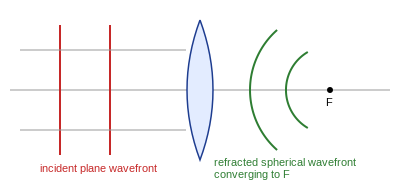
The central part of the plane wavefront travels through the thickest part of the lens and is delayed most, so the emerging wavefront is spherical and converges to the focus F.
(ii)
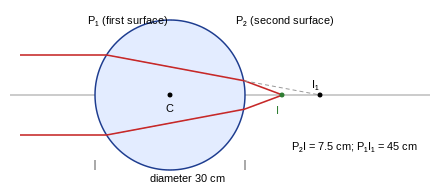
First surface (air to glass): , , , cm.
This image is 45 cm from the first surface, i.e. 15 cm beyond the second surface; it acts as a virtual object for the second surface.
Second surface (glass to air): , , cm, cm.
The final image is formed 7.5 cm beyond the second surface (22.5 cm from the centre of the ball), on the far side.
(i) A thin pencil of length (f/4) is placed coinciding with the principal axis of a mirror of focal length f. The image of the pencil is real and enlarged, just touches the pencil. Calculate the magnification produced by the mirror.
(ii) A ray of light is incident on a refracting face AB of a prism ABC at an angle of 45°. The ray emerges from face AC and the angle of deviation is 15°. The angle of prism is 30°. Show that the emergent ray is normal to the face AC from which it emerges out. Find the refraction index of the material of the prism.
Solution
(i) The image is real and enlarged, so the mirror is concave and the pencil lies between F and 2F. The image just touches the pencil, so one end is at C (2f), where object and image coincide.
The other end is at .
Magnification of this end: (real, inverted, enlarged).
(ii) : , so . The angle of emergence is zero, so the emergent ray is normal to face AC, and .
Then gives .
(i) A ray of light passes through a triangular prism. Show graphically, how the angle of deviation varies with the angle of incidence? Hence define the angle of minimum deviation.
(ii) A ray of light is incident normally on a refracting face of a prism of prism angle A and suffers a deviation of angle δ. Prove that the refractive index n of the material of the prism is given by .
(iii) The refractive index of the material of a prism is . If the refracting angle of the prism is 60°, find the (1) Angle of minimum deviation, and (2) Angle of incidence.
Solution
(i)
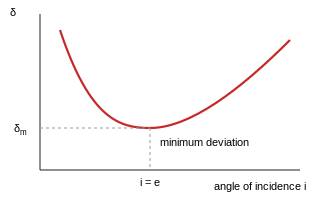
As i increases, δ first decreases, reaches a minimum value , and then increases. The angle of minimum deviation is this smallest deviation; at this position i = e, and the ray passes symmetrically through the prism.
(ii) Normal incidence on the first face: i = 0, so . Since , the angle of incidence at the second face is .
Deviation: , so .
Snell's law at the second face (glass to air): :
(iii) :
(1) .
(2) At minimum deviation .
(i) Draw a labelled ray diagram of a compound microscope showing image formation at least distance of distinct vision. Derive an expression for its magnifying power.
(ii) A telescope consists of two lenses of focal length 100 cm and 5 cm. Find the magnifying power when the final image is formed at infinity.
Solution
(i)
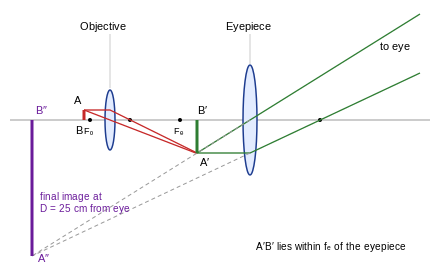
The objective (short focal length ) forms a real, inverted, magnified image A′B′ of a small object AB placed just beyond . A′B′ lies within the focal length of the eyepiece, which acts as a simple magnifier and forms the final virtual image A″B″ at the least distance of distinct vision D.
Magnifying power .
Objective: (magnitudes). Since the object is near and the image is near the eyepiece, , where L is the distance between the second focal point of the objective and the first focal point of the eyepiece (tube length).
Eyepiece, with the final image at D: .
(For the final image at infinity, .)
(ii) For a telescope in normal adjustment the lens of larger focal length is the objective:
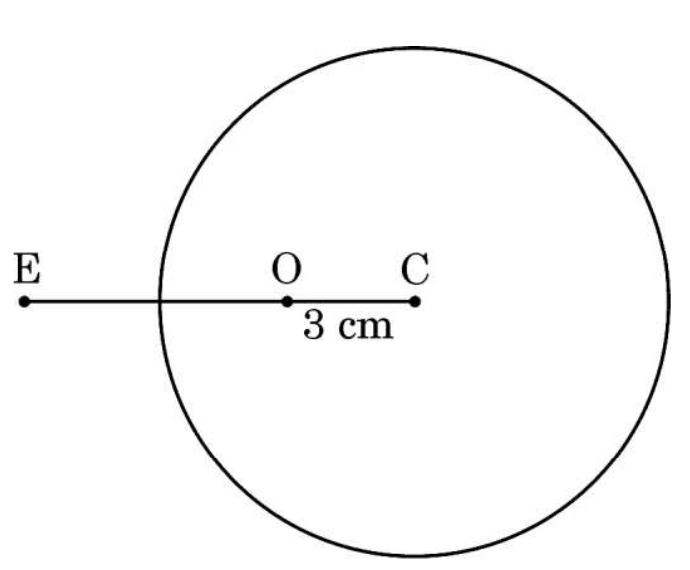
(i) A spherical surface of radius of curvature R separates two media of refractive indices and . A point object is placed in front of the surface at distance u in medium of refractive index and its image is formed by the surface at distance v, in the medium of refractive index . Derive a relation between u and v.
(ii) A solid glass sphere of radius 6.0 cm has a small air bubble trapped at a distance 3.0 cm from its centre C as shown in the figure. The refractive index of the material of the sphere is 1.5. Find the apparent position of this bubble when seen through the surface of the sphere from an outside point E in air.
Solution
(i)
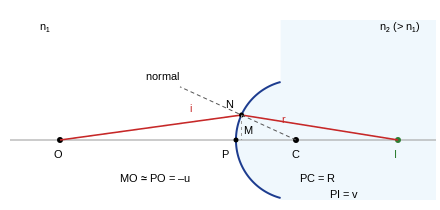
A ray from O meets the surface at N and is refracted to I. NM is perpendicular to the axis. For small angles (paraxial rays):
In triangle NOC: . In triangle NIC: .
Snell's law for small angles: :
With M ≈ P and the sign convention, OM = –u, MI = +v, MC = +R:
(ii) The bubble O is 3.0 cm from C on the side of E, so it is cm from the nearest point of the surface. Light goes from glass () to air (). Taking the direction of light (towards E) as positive: u = –3.0 cm, and C lies behind the surface, R = –6.0 cm.
: the bubble appears 2.4 cm inside the sphere from the surface (on the same side as the bubble), i.e. 3.6 cm from the centre.
(i) Draw a labelled ray diagram showing the image formation by a refracting telescope. Define its magnifying power. Write two limitations of a refracting telescope over a reflecting telescope.
(ii) The focal lengths of the objective and the eye-piece of a compound microscope are 1.0 cm and 2.5 cm respectively. Find the tube length of the microscope for obtaining a magnification of 300.
(a) Draw the ray diagram of an astronomical telescope when the final image is formed at infinity. Write the expression for the resolving power of the telescope.
(b) An astronomical telescope has an objective lens of focal length 20 m and eyepiece of focal length 1 cm. (i) Find the angular magnification of the telescope. (ii) If this telescope is used to view the Moon, find the diameter of the image formed by the objective lens. Given the diameter of the Moon is m and radius of lunar orbit is m.
(a) An object is placed in front of a concave mirror. It is observed that a virtual image is formed. Draw the ray diagram to show the image formation and hence derive the mirror equation .
(b) An object is placed 30 cm in front of a plano-convex lens with its spherical surface of radius of curvature 20 cm. If the refractive index of the material of the lens is 1.5, find the position and nature of the image formed.
(a) Derive lens maker's formula for a biconvex lens.
(b) A point object is placed at a distance of 12 cm on the principal axis of a convex lens of focal length 10 cm. A convex mirror is placed coaxially on the other side of the lens at a distance of 10 cm. If the final image coincides with the object, sketch the ray diagram and find the focal length of the convex mirror.
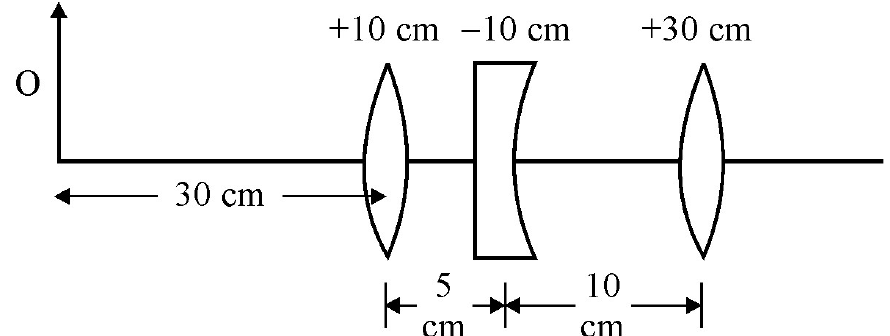
(a) Under what conditions is the phenomenon of total internal reflection of light observed? Obtain the relation between the critical angle of incidence and the refractive index of the medium. (b) Three lenses of focal lengths +10 cm, –10 cm and +30 cm are arranged coaxially as in the figure given below. Find the position of the final image formed by the combination.
(a) Draw a ray diagram to show image formation when the concave mirror produces a real, inverted and magnified image of the object. (b) Obtain the mirror formula and write the expression for the linear magnification. (c) Explain two advantages of a reflecting telescope over a refracting telescope.
(a) Draw a ray diagram to show the image formation by a combination of two thin convex lenses in contact. Obtain the expression for the power of this combination in terms of the focal lengths of the lenses. (b) A ray of light passing from air through an equilateral glass prism undergoes minimum deviation when the angle of incidence is th of the angle of prism. Calculate the speed of light in the prism.
Get every solution for all chapters
- Every board question of every chapter, each fully solved the way the board gives marks
- 19 complete board papers, each followed by its solutions
- Weightage and most-asked topics for every chapter
- Instant PDF download, colour and black & white print copies
Revising the chapter first? Complete Physics Notes for Class 12 (NCERT 2026-27, CBSE Board 2027) →
What you get in the pack
- Questions from 138 CBSE papers, 2016 to 2026: every set code available
- Complete: 2262 different questions and parts from all set codes, 14 chapters and 19 full papers
- Part A: all 14 chapters, questions sorted chapter-wise and by marks
- Year-wise weightage table and most-asked topics for every chapter
- Part B: 19 full board papers, each followed by its complete solutions
- Derivations, numericals, ray and circuit diagrams worked the way the board awards marks
- Questions on topics out of the board syllabus flagged
All chapters in this pack
- PYQ Ch 1 Electric Charges and Fields
- PYQ Ch 2 Electrostatic Potential and Capacitance
- PYQ Ch 3 Current Electricity
- PYQ Ch 4 Moving Charges and Magnetism
- PYQ Ch 5 Magnetism and Matter
- PYQ Ch 6 Electromagnetic Induction
- PYQ Ch 7 Alternating Current
- PYQ Ch 8 Electromagnetic Waves
- PYQ Ch 9 Ray Optics and Optical Instruments
- PYQ Ch 10 Wave Optics
- PYQ Ch 11 Dual Nature of Radiation and Matter
- PYQ Ch 12 Atoms
- PYQ Ch 13 Nuclei
- PYQ Ch 14 Semiconductor Electronics
- Board Paper 2026 Set 55-1-1 with Solutions
- Board Paper 2026 Set 55-1-2 with Solutions
- Board Paper 2026 Set 55-1-3 with Solutions
- Board Paper 2026 Set 55-2-1 with Solutions
- Board Paper 2025 Set 55-1-1 with Solutions
- Board Paper 2025 Set 55-2-1 with Solutions
- Board Paper 2024 Set 55-1-1 with Solutions
- Board Paper 2024 Set 55-2-1 with Solutions
- Board Paper 2023 Set 55-1-1 with Solutions
- Board Paper 2023 Set 55-2-1 with Solutions
- Board Paper 2022 Term 2 Set 55-1-1 with Solutions
- Board Paper 2022 Term 2 Set 55-2-1 with Solutions
- Board Paper 2020 Set 55-1-1 with Solutions
- Board Paper 2020 Set 55-2-1 with Solutions
- Board Paper 2019 Set 55-1-1 with Solutions
- Board Paper 2019 Set 55-2-1 with Solutions
- Board Paper 2018 Set 55-1 with Solutions
- Board Paper 2017 Set 55-1 with Solutions
- Board Paper 2016 Set 55-1 with Solutions