
Electromagnetic Waves: Class 12 PYQs 2016–2026 with solutions
All 34 CBSE board questions asked from Electromagnetic Waves in 17 board papers, with the year, set and marks of each. 18 are solved free below. The Class 12 Physics PYQ Book: Solved Board Papers 2016-2026 (CBSE) has every solution, all chapters and 19 full board papers.
Subject experts: Khushbu Gupta (B.Sc., M.Sc. Physics, B.Ed.) and Vinay Wadhwani (B.Tech Electrical Engineering)



Free: NCERT solutions for Class 12 Physics →
Electromagnetic Waves: board weightage
Board weightage 2016–2026
| Year | 2016 | 2017 | 2018 | 2019 | 2020 | 2022 | 2023 | 2024 | 2025 | 2026 |
|---|---|---|---|---|---|---|---|---|---|---|
| Questions | 1 | 2 | 2 | 4 | 5 | 3 | 5 | 4 | 4 | 4 |
| Marks | 3 | 3 | 3 | 7 | 8 | 9 | 8 | 8 | 8 | 6 |
Most asked topics
34 questions from 17 papers. Repeated questions are shown once with every year they were asked.
1 mark: MCQ and Assertion–Reason
An electromagnetic wave passes from vacuum into a dielectric medium with relative electrical permittivity and relative magnetic permeability . Then, its
Solution
Answer: (C) wavelength is halved and frequency remains unchanged.
.
Frequency is set by the source and does not change; , so the wavelength becomes half.
Electromagnetic waves used in a diagnostic tool in medicine have a wavelength range
Solution
Answer: (A) 1 nm to nm
X-rays are used as a diagnostic tool in medicine; their wavelengths lie roughly between 10 nm and nm, so the range 1 nm to nm fits.
An electromagnetic wave is propagating along x-axis. At any instant, the phase difference (in radian) between the electric field and the magnetic field associated with the wave is
Solution
Answer: (A) zero
In an EM wave and oscillate in phase (they are perpendicular in space, but reach their maxima together), with .
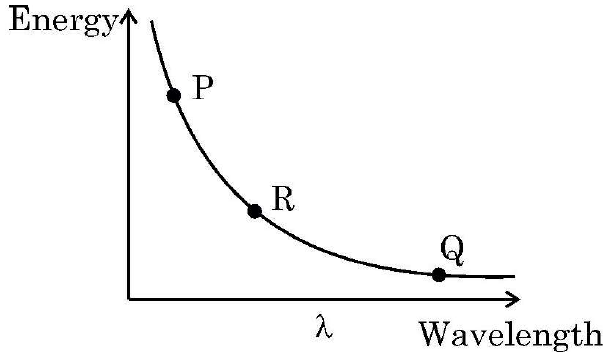
The given diagram exhibits the relationship between the wavelength of the electromagnetic waves and the energy of photon associated with them. The three points P, Q and R marked on the diagram may correspond respectively to
Solution
Answer: (A) X-rays, microwaves, UV radiation
. P has the highest energy (shortest λ): X-rays. Q has the lowest energy (longest λ): microwaves. R lies between: UV radiation.
Assertion (A): Out of Infrared and radio waves, the radio waves show more diffraction effect.
Reason (R): Radio waves have greater frequency than infrared waves.
Solution
Answer: (C) A is true, but R is false.
Radio waves have much longer wavelengths, comparable to everyday obstacles, so they diffract more. But they have a lower frequency than infrared, so R is false.
In the four regions, I, II, III and IV, the electric fields are described as: Region I: ; Region II: ; Region III: ; Region IV: . The displacement current will exist in the region
Solution
Answer: (A) I
Displacement current needs an electric field that changes with time. Only in region I does depend on t.
Electromagnetic waves with wavelength 10 nm are called
Solution
Answer: (B) Ultraviolet rays
Ultraviolet rays span roughly 400 nm down to about 1 nm, so 10 nm is in the UV region (the far-UV end).
In the process of charging of a capacitor, the current produced between the plates of the capacitor is
Solution
Answer: (c)
Between the plates there is only displacement current, .
and represent the electric and the magnetic field of an electromagnetic wave respectively. The direction of propagation of the wave is along
Write the mathematical form of Ampere-Maxwell circuital law.
Displacement current exists only when
Electromagnetic waves used as a diagnostic tool in medicine are
Which part of the electromagnetic spectrum is used in RADAR? Give its frequency range.
How are electromagnetic waves produced by accelerating charges?
Name the electromagnetic radiations used for (a) water purification, and (b) eye surgery.
Do electromagnetic waves carry energy and momentum?
2 marks: very short answer
Consider an induced magnetic field due to changing electric field and an induced electric field due to changing magnetic field. Which one is more easily observed? Justify your answer.
Solution
The induced electric field (emf) due to a changing magnetic field is far more easily observed.
The magnetic field produced by a changing electric field arises from the displacement current . Since is very small (), this current and its magnetic field are extremely small unless the electric field changes very rapidly. On the other hand, an emf is easily produced and measured (e.g. moving a magnet near a coil connected to a galvanometer).
How are infrared waves produced? Why are these waves referred to as heat waves? Give any two uses of infrared waves.
Solution
Infrared waves are produced by hot bodies and by the vibrations of atoms and molecules.
They are called heat waves because they are readily absorbed by water molecules and other molecules in most materials; this increases their thermal motion, so the material gets heated.
Uses (any two): physiotherapy (heat treatment), remote controls of TVs and other appliances, night-vision devices, drying fruits and food, and keeping the earth warm (greenhouse effect).
How are X-rays produced? Give any two uses of these.
Solution
X-rays are produced when high-speed electrons strike a metal target of high atomic number (as in an X-ray tube); they are also produced by inner-shell electron transitions in heavy atoms.
Uses (any two): diagnosing bone fractures and other medical conditions, radiotherapy for cancer, studying crystal structure, and security scanning of luggage.
Which of the following electromagnetic waves has (a) minimum wavelength, and (b) minimum frequency? Write one use of each of these two waves. Infrared waves, Microwaves, γ-rays and X-rays
Solution
(a) Minimum wavelength: γ-rays. Use: treatment of cancer / sterilising medical equipment.
(b) Minimum frequency: microwaves. Use: radar systems / microwave ovens / satellite communication.
A capacitor made of two parallel plates, each of area 'A' and separation 'd' is charged by an external dc source. Show that during charging, the displacement current inside the capacitor is the same as the current charging the capacitor.
(a) Why are infra-red waves often called heat waves? Explain. (b) What do you understand by the statement, "Electromagnetic waves transport momentum"?
Identify the electromagnetic waves whose wavelengths vary as (a) m < λ < m (b) m < λ < m. Write one use for each.
3 marks: short answer
Name the electromagnetic waves which are used for (i) detection of fractures in bones (ii) physiotherapy (iii) radar systems. Also write their wavelength range.
Solution
(i) Fractures in bones: X-rays, wavelength about 1 nm to nm (10 nm to nm).
(ii) Physiotherapy: infrared waves, wavelength about 1 mm to 700 nm.
(iii) Radar: microwaves, wavelength about 0.1 m to 1 mm.
(a) A parallel plate capacitor is charged by an ac source. Show that the sum of conduction current and the displacement current has the same value at all points of the circuit.
(b) In case (a) above, is Kirchhoff's first rule (junction rule) valid at each plate of the capacitor? Explain.
Solution
(a) In the connecting wires there is only conduction current: , and (the electric field there does not change).
Between the plates there is no conduction current (). The field there is , so the electric flux is , and
So in the wires and between the plates: the total current is the same at all points of the circuit.
(b) Yes, provided the displacement current is included. At each plate, the conduction current arriving through the wire equals the displacement current leaving through the gap, so the total current into the plate equals the total current out of it.
(a) The electric field of an electromagnetic wave propagating in north direction is oscillating in up and down direction. Describe the direction of magnetic field of the wave.
(b) Are the wave length of radio waves and microwaves longer or shorter than those detectable by human eyes?
(c) Write main use of each of the following in human life: (i) Infrared waves (ii) Gamma rays
Solution
(a) , and the direction of propagation are mutually perpendicular. With propagation north and vertical, oscillates in the east–west direction (horizontal).
(b) Longer. Radio waves (> 0.1 m) and microwaves (0.1 m to 1 mm) have wavelengths much longer than visible light (400–700 nm).
(c) (i) Infrared: physiotherapy (heating), remote controls, night vision, keeping the earth warm (greenhouse effect). (Any one.)
(ii) Gamma rays: treatment of cancer, sterilising medical equipment. (Any one.)
(a) "The wavelength of the electromagnetic wave is often correlated with the characteristic size of the system that radiates." Give two examples to justify this statement.
(b) (i) Long distance radio broadcasts use short-wave bands. Why? (ii) Optical and radio telescopes are built on the ground, but X-ray astronomy is possible only from satellites orbiting the Earth. Why?
Solution
(a) Any two:
1. Gamma rays ( m) come from nuclei, whose size is about – m.
2. Visible and UV light ( m) come from transitions of electrons in atoms (size m).
3. Radio waves (λ of metres) are radiated by antennas whose size is comparable to the wavelength (about λ/4).
(b) (i) Short radio waves are reflected by the ionosphere, so they can travel very long distances around the curved earth by repeated reflection.
(ii) The atmosphere is transparent to visible light and radio waves, but absorbs X-rays strongly. X-rays from space do not reach the ground, so X-ray telescopes must be placed above the atmosphere on satellites.
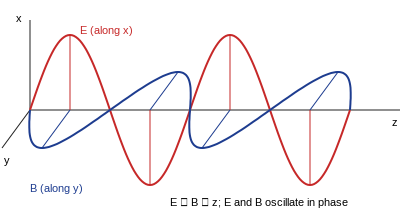
(a) On what factors does the speed of an electromagnetic wave in a medium depend? (b) How is an electromagnetic wave produced? (c) Sketch a schematic diagram depicting the electric and magnetic fields for an electromagnetic wave propagating along z-axis.
Solution
(a) It depends on the permittivity and permeability of the medium: (in vacuum ). For a given medium it also varies slightly with wavelength.
(b) An accelerated (oscillating) charge produces an oscillating electric field, which produces an oscillating magnetic field, which in turn produces an oscillating electric field, and so on. These mutually regenerating fields travel through space as an EM wave, with the frequency of the oscillating charge.
(c)
(i) Monochromatic light is incident on a surface separating two media. The frequency of the light after refraction remains unaffected but its wavelength changes. Why?
(ii) The frequency of an electromagnetic radiation is Hz. Identify the radiation and mention its two uses.
Solution
(i) Frequency is a property of the source: the charges at the surface oscillate with the frequency of the incident wave and re-radiate at the same frequency, so frequency is unchanged. The speed changes in the new medium (), and since with ν fixed, the wavelength changes.
(ii) m = 3 mm: these are microwaves.
Uses (any two): radar systems; microwave ovens; satellite and mobile communication; speed guns.
(i) Depict a plane electromagnetic wave propagating along the x-axis. Write the expressions for its oscillating electric and magnetic fields.
(ii) Write three characteristics of electromagnetic waves.
Name the electromagnetic waves which are produced by the following: (i) Radioactive decays of nucleus (ii) Welding arcs (iii) Hot bodies. Write one use each of these waves.
(a) Write the expression for the speed of light in a material medium of relative permittivity and relative magnetic permeability .
(b) Write the wavelength range and name of the electromagnetic waves which are used in (i) radar systems for aircraft navigation, and (ii) Earth satellites to observe the growth of the crops.
(a) Identify the part of the electromagnetic spectrum used in (i) radar and (ii) eye surgery. Write their frequency range. (b) Prove that the average energy density of the oscillating electric field is equal to that of the oscillating magnetic field.
How are electromagnetic waves produced? What is the source of energy of these waves? Write mathematical expressions for electric and magnetic fields of an electromagnetic wave propagating along the z-axis. Write any two important properties of electromagnetic waves.
Get every solution for all chapters
- Every board question of every chapter, each fully solved the way the board gives marks
- 19 complete board papers, each followed by its solutions
- Weightage and most-asked topics for every chapter
- Instant PDF download, colour and black & white print copies
Revising the chapter first? Complete Physics Notes for Class 12 (NCERT 2026-27, CBSE Board 2027) →
What you get in the pack
- Questions from 138 CBSE papers, 2016 to 2026: every set code available
- Complete: 2262 different questions and parts from all set codes, 14 chapters and 19 full papers
- Part A: all 14 chapters, questions sorted chapter-wise and by marks
- Year-wise weightage table and most-asked topics for every chapter
- Part B: 19 full board papers, each followed by its complete solutions
- Derivations, numericals, ray and circuit diagrams worked the way the board awards marks
- Questions on topics out of the board syllabus flagged
All chapters in this pack
- PYQ Ch 1 Electric Charges and Fields
- PYQ Ch 2 Electrostatic Potential and Capacitance
- PYQ Ch 3 Current Electricity
- PYQ Ch 4 Moving Charges and Magnetism
- PYQ Ch 5 Magnetism and Matter
- PYQ Ch 6 Electromagnetic Induction
- PYQ Ch 7 Alternating Current
- PYQ Ch 8 Electromagnetic Waves
- PYQ Ch 9 Ray Optics and Optical Instruments
- PYQ Ch 10 Wave Optics
- PYQ Ch 11 Dual Nature of Radiation and Matter
- PYQ Ch 12 Atoms
- PYQ Ch 13 Nuclei
- PYQ Ch 14 Semiconductor Electronics
- Board Paper 2026 Set 55-1-1 with Solutions
- Board Paper 2026 Set 55-1-2 with Solutions
- Board Paper 2026 Set 55-1-3 with Solutions
- Board Paper 2026 Set 55-2-1 with Solutions
- Board Paper 2025 Set 55-1-1 with Solutions
- Board Paper 2025 Set 55-2-1 with Solutions
- Board Paper 2024 Set 55-1-1 with Solutions
- Board Paper 2024 Set 55-2-1 with Solutions
- Board Paper 2023 Set 55-1-1 with Solutions
- Board Paper 2023 Set 55-2-1 with Solutions
- Board Paper 2022 Term 2 Set 55-1-1 with Solutions
- Board Paper 2022 Term 2 Set 55-2-1 with Solutions
- Board Paper 2020 Set 55-1-1 with Solutions
- Board Paper 2020 Set 55-2-1 with Solutions
- Board Paper 2019 Set 55-1-1 with Solutions
- Board Paper 2019 Set 55-2-1 with Solutions
- Board Paper 2018 Set 55-1 with Solutions
- Board Paper 2017 Set 55-1 with Solutions
- Board Paper 2016 Set 55-1 with Solutions