
CBSE Class 12 Physics Question Paper 2026 (55/2/1) with Solutions
The complete CBSE Class 12 Physics board paper of 2026, Q.P. code 55/2/1: all 33 questions exactly as set, with marks. 19 solutions are free below. The Class 12 Physics PYQ Book: Solved Board Papers 2016-2026 (CBSE) solves all 19 papers in full and sorts every question chapter-wise.
Subject experts: Khushbu Gupta (B.Sc., M.Sc. Physics, B.Ed.) and Vinay Wadhwani (B.Tech Electrical Engineering)



Free: NCERT solutions for Class 12 Physics →
Question paper
Jump to: Question paperSolutions
2026 · Q.P. Code 55/2/1
Maximum marks: 70
Section A · Multiple choice and Assertion–Reason (1 mark each)
Three point charges 2q, –2q and q are kept at the vertices of an equilateral triangle of side . The potential energy of the system is
Two metal spheres of radii and having charges and respectively kept in air, are brought in contact. Which of the following statements is not correct?
The maximum kinetic energy of the electrons emitted from a photo sensitive surface depends on
In Bohr model of hydrogen atom, for large values of n, the distance between the consecutive orbits is proportional to
A straight long wire lying along y-axis, carries a current of 1 A along –y direction. The magnetic field due to the conductor at a point (50 cm, 0, 0) will point along
Which of the following materials has positive and small value of magnetic susceptibility?
A galvanometer of resistance 27 Ω is converted into an ammeter of range (0 – 10 mA) using a resistance of 3 Ω. The galvanometer will show full scale deflection for a current of about
The magnetic flux (in Wb) linked with a coil is related to time t (in s) as . The SI units of A and B are respectively
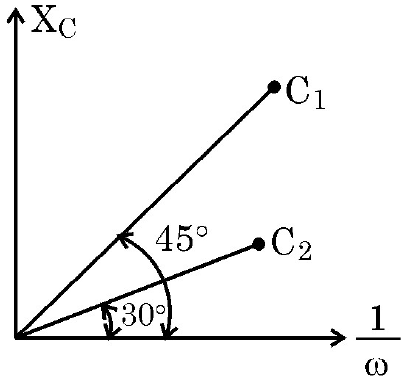
The figure shows the variation of capacitive reactance of two ideal capacitors of capacitances & with the reciprocal of angular frequency of ac source. The value of is
A magnet held vertically, with its north pole down is dropped along the axis of a closed solenoid placed vertically on a table. If the observer looks down from the top,
An electromagnetic wave is propagating along x-axis. At any instant, the phase difference (in radian) between the electric field and the magnetic field associated with the wave is
In Bohr model of hydrogen atom, the electron makes a transition from n = 5 to n = 1 state. As a result, a photon of wavelength is emitted in the process. The wavelength of the photon emitted when an electron makes a transition from energy level n = 5 to n = 2 will be
Assertion (A): On increasing the intensity of incident light of frequency on a photosensitive surface, the photocurrent increases.
Reason (R): The stopping potential for a photosensitive surface increases with increase of frequency of incident light.
Assertion (A): On forward biasing a p-n junction diode, the height of the barrier potential increases.
Reason (R): In forward biasing of a p-n junction diode, the direction of the applied voltage is in the same direction as the built-in potential.
Assertion (A): Light added to light can produce darkness.
Reason (R): When two coherent light waves interfere, there is darkness at position of destructive interference.
Assertion (A): Two electric heaters of power and are joined in series across a dc source of voltage V. The power consumed by the combination will be less than that consumed by when connected across the same source.
Reason (R): The power consumed by a electric device when connected to a dc source of voltage V is proportional to its resistance.
Section B · Very short answer (2 marks each)
Write two points of difference between intrinsic and extrinsic semiconductors.
Find ratio of the de Broglie wavelength and associated respectively with an alpha particle and a proton, (i) if they are moving with the same kinetic energy. (ii) just after they are accelerated through the same potential difference.
A ray of light in air is incident at angle i on a face of an equilateral glass prism and is refracted through the prism. As i is varied, it is observed that the ray undergoes minimum deviation, when the i is three-fourth of the angle of the prism. Calculate the speed of light in the prism.
A heating element using nichrome is connected to a 220 V supply. Initially it draws a current of 2.9 A. After some time, the current attains a steady value of 2.5 A. Find the steady temperature of the heating element if the room temperature is 27 °C. The temperature coefficient of resistance of nichrome is °C⁻¹.
(a) A 5 cm long pencil is placed along the principal axis of a concave mirror of focal length 20 cm such that its nearest end is at a distance of 25 cm from the mirror. Calculate the length of the image of the pencil.
(b) In a Young's double-slit experiment, a beam of light consisting of two wavelengths 500 nm and 600 nm is used. The interference fringes are observed at a screen placed 1.8 m away from the plane of slits (slit separation 0.3 mm). Calculate the least distance from the central maximum where the bright fringes due to both the wavelengths coincide.
Section C · Short answer (3 marks each)
(a) Consider the following nuclides: , , , . Group them into isotopes and isotones.
(b) How does the size of a nucleus depend on its mass number A? Hence prove that the density of nucleus is a constant, independent of A, for all nuclei.
(a) An electric field exists in a region of space. Draw three equipotential surfaces in the region.
(b) Two point charges –q and +q are located at points (–a, 0, 0) and (a, 0, 0) respectively. Find the electrostatic potential at point (x, 0, 0) where .
Name the electromagnetic waves which are used for (i) detection of fractures in bones (ii) physiotherapy (iii) radar systems. Also write their wavelength range.
(a) (i) Define mutual inductance of a pair of coils. Write its SI unit.
(ii) A long solenoid of radius R and length L has n turns per unit length. A circular loop of radius is placed inside at the centre of the solenoid such that its axis coincides with the axis of the solenoid. Obtain the mutual inductance of the solenoid and the loop.
(b) Two long straight parallel conductors A and B carrying steady currents and in the same direction are separated by a distance d. Deduce the expressions for the force acting on length L of conductor B due to conductor A and show it in figure. Write the expression for the force acting on length L of conductor A due to conductor B and show that it follows Newton's third law.
(a) State Bohr's second postulate and mention its significance.
(b) Prove that, in Bohr model of hydrogen atom as principal quantum number n becomes large, the energy levels get closer and closer.
(a) Explain the statement: "Current is a scalar although we represent current with an arrow".
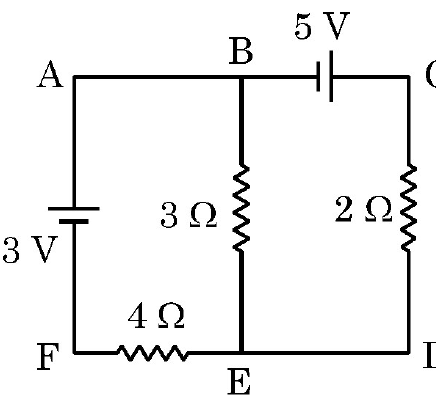
(b) Use Kirchhoff's rules to find the current through 3 Ω resistor in the circuit shown in the figure:
Derive an expression for the magnetic field B, due to a circular coil of N turns, each of radius r carrying current I, at a distance 'x' from the centre along its axis.
Section D · Case-based (4 marks each)
A p-type or n-type semiconductor can be converted into a p-n junction by doping it with suitable impurity. The motion of majority charge carriers causes diffusion current across the junction while the barrier electric field causes motion of minority carriers for drift current. In case of unbiased diode, the diffusion and drift currents are equal. This equilibrium is disturbed by the biasing batteries. Diodes, therefore, allow currents in one direction. This property of diode is used in making rectifiers.
(i) Silicon is doped with which of the following to obtain p-type semiconductor?
When we dope Ge with a pentavalent element, four of its electrons bond with four germanium neighbours but fifth electron remains weakly bound. The ionisation energy for this electron is about
In an experiment with convex lens of focal length f, the screen is fixed at a distance D from the object. A student slowly moves the lens away from the object towards the screen and finds that she is able to form sharp image of the object for two positions of the lens. The distance between these two positions of the lens is d.
(i) The value of d is
A thin convex lens of focal length 10 cm and another thin lens of focal length 'f' are placed coaxially in contact. If the power of their combination is D, the value of 'f' is
Section E · Long answer (5 marks each)
(a) What are coherent sources? Why they are necessary for observing stable interference pattern? Draw a graph showing the variation of intensity of light with the position on the screen in Young's double-slit experiment.
(b) Find the intensity of light at a point on the screen when two interfering waves of the same intensity have a path difference of (i) and (ii) .
(b) (a) Draw a labelled ray diagram of a refracting telescope when it forms image of a distant object at infinity. Derive expression for its magnifying power.
(b) (i) In a telescope the objective has much larger aperture than the eye piece. Why? (ii) Write two advantages of reflecting telescope over refracting telescope.
(a) Derive an expression for the capacitance of a parallel plate capacitor of plate area A and plate separation d with air present between the plates.
(b) Two air-filled capacitors of capacitances and are connected in parallel with a dc battery. After the capacitors are fully charged, a slab of dielectric constant K is inserted between the plates of each capacitor. How will the (i) charge on each capacitor and (ii) energy stored in the capacitor affected after the slab is introduced.
(b) (a) An electric field is established across the ends of a cylindrical conductor of length L and area of cross-section A. Discuss how electrons attain an average velocity, independent of time. Hence, obtain a relation between current in the conductor and this 'average velocity' of electrons.
(b) (i) This 'average velocity' is found be few mm/s for currents in range of a few amperes. How then is current established almost the instant a circuit is closed? (ii) Two copper wires having their radii in the ratio of 3 : 2 are connected in series across a battery. Find the ratio of the drift velocities of the electrons in the wires.
(a) A series combination of L, C and R is connected to an a.c. source. Using a phasor diagram, derive an expression for the impedance of the circuit and phase difference between V and I.
(b) Under what conditions the (i) impedance of the circuit is minimum? (ii) Wattless current flows in the circuit?
(b) (i) With the help of a labelled diagram, explain the principle, construction and working of an a.c. generator.
(ii) Deduce an expression for the induced emf in the coil of the generator.
(iii) If T is the time period of the rotation of the coil, at what values of T in a cycle, the emf generator is maximum?
Solutions: CBSE 2026 · 55/2/1
Answer: (D)
Answer: (D) Both and
: it depends on the frequency and the work function, not on the intensity.
Answer: (A) z-axis
is along . Here is along and (from the wire to the point) is along : . So points along .
Answer: (C) 1 mA
The shunt is in parallel, so : , giving and mA.
Answer: (D)
, so the slope of each line is .
Slope for ; slope for .
Answer: (A) zero
In an EM wave and oscillate in phase (they are perpendicular in space, but reach their maxima together), with .
Answer: (B) Both A and R are true, but R is not the correct explanation of A.
More intensity means more photons per second, so more electrons are emitted and the photocurrent rises (A is true). R is also true (), but it concerns frequency, not intensity, so it does not explain A.
Answer: (A) Both A and R are true and R is the correct explanation of A.
Where two coherent waves meet out of phase (path difference ), they cancel and give a dark fringe. This is why light added to light can give darkness.
| Intrinsic semiconductor | Extrinsic semiconductor |
|---|---|
| Pure semiconductor, with no impurity atoms added. | Semiconductor doped with a suitable impurity (pentavalent or trivalent). |
| . | : (n-type) or (p-type). |
| Low conductivity. | Much higher conductivity. |
| Conductivity depends only on temperature. | Conductivity depends on temperature and on the amount of doping. |
(Any two.)
, so at minimum deviation and .
cm. Near end: cm; far end: cm.
Near end: , so cm.
Far end: , so cm.
Length of image .
(a) Isotopes (same Z): and .
Isotones (same N = A – Z): (N = 118) and (N = 118).
(b) ( fm), so the volume .
If m is the mass of a nucleon, the mass of the nucleus is :
This does not contain A, so nuclear density is the same for all nuclei (about kg/m³).
(i) Fractures in bones: X-rays, wavelength about 1 nm to nm (10 nm to nm).
(ii) Physiotherapy: infrared waves, wavelength about 1 mm to 700 nm.
(iii) Radar: microwaves, wavelength about 0.1 m to 1 mm.
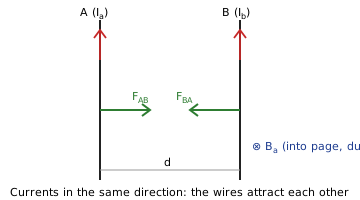
Field of A at the position of B: , perpendicular to B (into the page in the figure).
Force on length L of B: , of magnitude
directed towards A (attraction).
Similarly, the field of B at A is , and the force on length L of A is
directed towards B.
The two forces are equal in magnitude and opposite in direction, , as Newton's third law requires.
(a) Current does not obey the laws of vector addition: currents meeting at a junction add algebraically, whatever the angle between the wires. The arrow only shows the direction of flow of positive charge along the conductor. (Current density is a vector; is a scalar.)
(b) Let current I flow through the 5 V cell and the 2 Ω resistor (B → C → D → E), current upward through the 3 Ω resistor (E → B), and so through the 4 Ω resistor and the 3 V cell (E → F → A → B), by the junction rule at B.
Loop BCDEB: …(1)
Loop ABEFA: …(2)
From (1), ; substituting in (2): , so .
(through the 3 Ω resistor, from E to B).
(i) (C) Boron, a trivalent impurity, gives a p-type semiconductor.
(ii) (D) m⁻³. : m⁻³.
(iii) In forward bias the current is mainly due to diffusion of majority carriers, which none of the options states. CBSE awarded the mark to every student who attempted this part.
(iv) (C) 0.7 V.
OR (A) 0.01 eV (the fifth electron of a donor in Ge needs only about 0.01 eV to become free).
(a) Two sources are coherent if they emit waves of the same frequency with a constant (or zero) phase difference.
If the sources are incoherent, the phase difference at each point changes rapidly and randomly with time, so the positions of maxima and minima keep shifting and only an average uniform intensity is seen. With coherent sources the phase difference at each point stays fixed, giving a stable interference pattern.
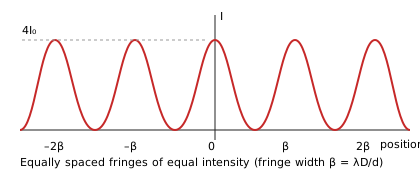
(b) For two waves of intensity : , with .
(i) : , so .
(ii) : , so .
(a)
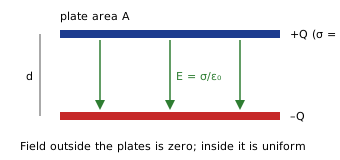
Let the plates carry charges +Q and –Q, so . Between the plates the fields of the two sheets add:
The field is uniform, so the potential difference is
(b) The battery stays connected, so V stays the same, and each capacitance becomes K times.
(i) : the charge on each capacitor becomes K times ( and ).
(ii) : the energy stored in each capacitor becomes K times.
(a) Let and the current be common to all elements. Then is in phase with i, leads i by 90°, and lags i by 90°.
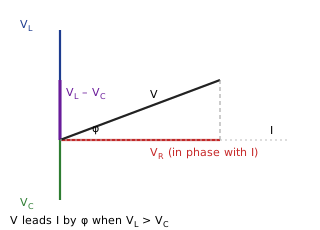
and are opposite, giving a resultant perpendicular to . The source voltage is the vector sum:
Phase difference between V and I:
(b) (i) Z is minimum (= R) when , i.e. at resonance, .
(ii) Power . The current is wattless when , i.e. : this happens when the circuit has no resistance (a purely inductive or purely capacitive circuit, R = 0).
Get every solution for all 19 papers
- Every board question of every chapter, each fully solved the way the board gives marks
- 19 complete board papers, each followed by its solutions
- Weightage and most-asked topics for every chapter
- Instant PDF download, colour and black & white print copies
Revising the chapter first? Complete Physics Notes for Class 12 (NCERT 2026-27, CBSE Board 2027) →
What you get in the pack
- Questions from 138 CBSE papers, 2016 to 2026: every set code available
- Complete: 2262 different questions and parts from all set codes, 14 chapters and 19 full papers
- Part A: all 14 chapters, questions sorted chapter-wise and by marks
- Year-wise weightage table and most-asked topics for every chapter
- Part B: 19 full board papers, each followed by its complete solutions
- Derivations, numericals, ray and circuit diagrams worked the way the board awards marks
- Questions on topics out of the board syllabus flagged
All chapters in this pack
- PYQ Ch 1 Electric Charges and Fields
- PYQ Ch 2 Electrostatic Potential and Capacitance
- PYQ Ch 3 Current Electricity
- PYQ Ch 4 Moving Charges and Magnetism
- PYQ Ch 5 Magnetism and Matter
- PYQ Ch 6 Electromagnetic Induction
- PYQ Ch 7 Alternating Current
- PYQ Ch 8 Electromagnetic Waves
- PYQ Ch 9 Ray Optics and Optical Instruments
- PYQ Ch 10 Wave Optics
- PYQ Ch 11 Dual Nature of Radiation and Matter
- PYQ Ch 12 Atoms
- PYQ Ch 13 Nuclei
- PYQ Ch 14 Semiconductor Electronics
- Board Paper 2026 Set 55-1-1 with Solutions
- Board Paper 2026 Set 55-1-2 with Solutions
- Board Paper 2026 Set 55-1-3 with Solutions
- Board Paper 2026 Set 55-2-1 with Solutions
- Board Paper 2025 Set 55-1-1 with Solutions
- Board Paper 2025 Set 55-2-1 with Solutions
- Board Paper 2024 Set 55-1-1 with Solutions
- Board Paper 2024 Set 55-2-1 with Solutions
- Board Paper 2023 Set 55-1-1 with Solutions
- Board Paper 2023 Set 55-2-1 with Solutions
- Board Paper 2022 Term 2 Set 55-1-1 with Solutions
- Board Paper 2022 Term 2 Set 55-2-1 with Solutions
- Board Paper 2020 Set 55-1-1 with Solutions
- Board Paper 2020 Set 55-2-1 with Solutions
- Board Paper 2019 Set 55-1-1 with Solutions
- Board Paper 2019 Set 55-2-1 with Solutions
- Board Paper 2018 Set 55-1 with Solutions
- Board Paper 2017 Set 55-1 with Solutions
- Board Paper 2016 Set 55-1 with Solutions