
CBSE Class 12 Physics Question Paper 2026 (55/1/1) with Solutions
The complete CBSE Class 12 Physics board paper of 2026, Q.P. code 55/1/1: all 33 questions exactly as set, with marks. 19 solutions are free below. The Class 12 Physics PYQ Book: Solved Board Papers 2016-2026 (CBSE) solves all 19 papers in full and sorts every question chapter-wise.
Subject experts: Khushbu Gupta (B.Sc., M.Sc. Physics, B.Ed.) and Vinay Wadhwani (B.Tech Electrical Engineering)



Free: NCERT solutions for Class 12 Physics →
Question paper
Jump to: Question paperSolutions
2026 · Q.P. Code 55/1/1
Maximum marks: 70
Section A · Multiple choice and Assertion–Reason (1 mark each)
In a region, the electric potential varies as , where V is in volts and x in meters. The electric field in the region is
A conducting wire connects two charged metallic spheres A and B of radii and respectively. The distance between the spheres is very large compared to their radii. The ratio of electric fields at the surfaces of spheres A and B will be
A long straight wire of circular cross-section (radius a) carries a steady current I. The current is uniformly distributed across this cross-section. The magnitude of the magnetic field produced at a point at a distance from the axis of the wire will be
The shape of the interference fringes in Young's double-slit experiment, when the distance between the slit and the screen is very large as compared to the slit-separation, is nearly
An electromagnetic wave passes from vacuum into a dielectric medium with relative electrical permittivity and relative magnetic permeability . Then, its
In a series LCR circuit, the voltage across the resistor, capacitor and inductor is 10 V each. If the capacitor is short circuited, the voltage across the inductor will be
Electromagnetic waves used in a diagnostic tool in medicine have a wavelength range
The 'distance of closest approach' of an alpha-particle is 'd' when it moves with a velocity v head-on towards the target nucleus. If the velocity of alpha particle is halved, the new 'distance of closest approach' will be
A concave lens of focal length 10 cm is cut into two identical plano-concave lenses. The focal length of each lens will be
Four independent waves are expressed as (i) (ii) (iii) (iv) . The interference between two of these waves is possible in
Two heaters rated as and are connected in series across a dc source of volt. The power consumed by the combination will be
In an unbiased p-n junction, at equilibrium, which of the following statements is true?
Assertion (A): All atoms have a net magnetic moment.
Reason (R): A current loop does not always behave as a magnetic dipole.
Assertion (A): If accelerated electrons are passed through a narrow slit, a diffraction pattern is observed.
Reason (R): Electrons behave as both particles and waves.
Assertion (A): The mass of a nucleus is less than the sum of the masses of the constituent nucleons.
Reason (R): Energy is absorbed when the nucleons are bound together to form a nucleus.
Assertion (A): In Bohr model of hydrogen atom, the energy levels are discrete and quantised.
Reason (R): In a hydrogen atom, the electrostatic force on the electron provides the necessary centripetal force to it to revolve around the nucleus.
Section B · Very short answer (2 marks each)
In a photoelectric experiment, the emitter plate is irradiated with radiation of 200 nm. The photocurrent becomes zero when the collector plate potential is V. Calculate the work function (in eV) of the emitter.
(a) A beam of light consisting of two wavelengths 400 nm and 600 nm is used to illuminate a single slit of width 1 mm. Find the least distance of the point from the central maximum where the dark fringes due to both wavelengths coincide on the screen placed 1.5 m from the slit.
(b) In a Young's double-slit experimental set-up with slit separation 0.6 mm a beam of light consisting of two wavelengths 440 nm and 660 nm is used to obtain interference pattern on a screen kept 1.5 m in front of the slits. Find the least distance of the point from the central maximum where the bright fringes due to both the wavelengths coincide.
A wire of length L is bent round into (i) a square coil having N turns and (ii) a circular coil having N turns. The coil in both cases is free to turn about a vertical axis coinciding with the plane of the coil, in a uniform, horizontal magnetic field and carry the same currents. Find the ratio of the maximum value of the torque acting on the square coil to that on the circular coil.
What is the order of magnitude of drift velocity of electrons in a conductor? Deduce the relation between the current flowing through a conductor and drift velocity of electrons in it.
Draw the plot of potential energy of a pair of nucleons as a function of their separation. Write two important conclusions that can be drawn from this plot.
Section C · Short answer (3 marks each)
(a) Using Gauss's law, deduce an expression for electric field at a point due to a uniformly charged infinite plane thin sheet.
(b) Two large thin plane sheets, each having surface charge density , are held close and parallel to each other in air. What is the net electric field at a point (i) inside and (ii) outside, the sheets?
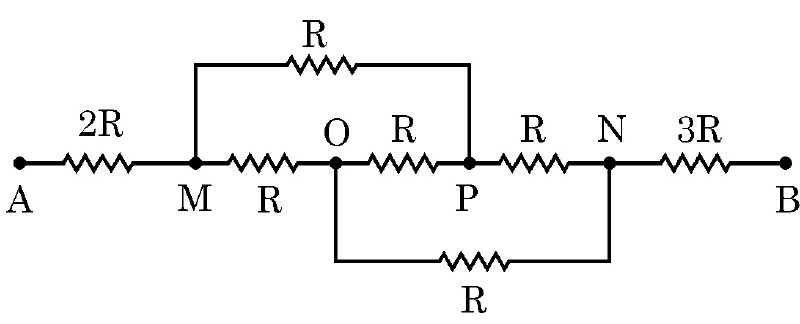
(b) (a) Obtain the condition of balance of a Wheatstone bridge.
(b) Find net resistance of the network of resistors connected between A and B, as shown in figure.
A parallel plate capacitor of capacitance C has a dielectric slab between its plates. It is charged to a potential difference V by connecting it across a battery. The battery is then disconnected. If the dielectric slab is now withdrawn from the capacitor, how will the following be affected? (a) Capacitance of the capacitor, (b) Energy stored in the capacitor, and (c) The potential difference between the plates of the capacitor. Justify your answer in each case.
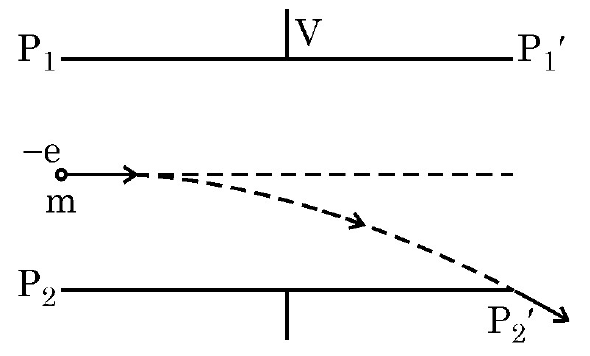
Figure shows a narrow beam of electrons entering with a velocity of m/s, symmetrically through the space between two parallel horizontal plates and kept 2 cm apart. If each plate is 3 cm long, calculate the potential difference V applied between the plates so that the beam just strikes the end .
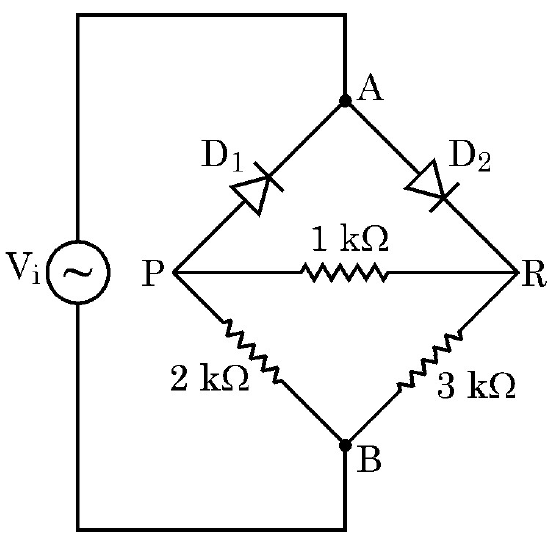
An ac voltage V is applied between points A and B in a network of two ideal diodes and three resistors as shown in figure. During the positive half-cycle of the input voltage supplied to the network, (a) Identify which of the two diodes will conduct and why?
(b) Redraw an equivalent circuit diagram to show the flow of current.
(c) Calculate the output voltage drops across the three resistors when the input voltage attains its peak value.
Briefly explain the two important processes that occur during the formation of a p-n junction.
(a) Draw the ray diagram to show the image formation by a refracting telescope and write the expression for angular magnification for the telescope in normal adjustment.
(b) Give two reasons to explain why a reflecting telescope is preferred over a refracting telescope.
(a) State the two conditions under which total internal reflection occurs.
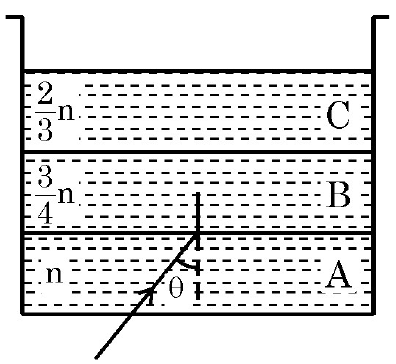
(b) A transparent container contains layers of three immiscible transparent liquids A, B and C of refractive indices n, n and n, respectively. A laser beam is incident at the interface between A and B at an angle as shown in figure. Prove that the beam does not enter region C at all for .
Section D · Case-based (4 marks each)
A galvanometer is used to detect or/and measure small currents in an electrical circuit. It essentially works on the fact that a current-carrying coil experiences a deflecting torque when placed in a magnetic field. This deflection in the coil can be measured and it is related to the current flowing in the coil, the number of turns in the coil, area of the coil and the magnetic field. A hair spring attached to the coil provides a counter torque and helps in measuring the deflection. A galvanometer can be converted to an ammeter or a voltmeter of desired range by using suitable resistances.
(I) The torque on the coil remains constant irrespective of the coil's orientation during rotation due to
A galvanometer coil has a resistance of 15 Ω and the meter shows full scale deflection for a current of 3 mA. The value of resistance required to convert it into a voltmeter of range (0 – 12 V) is
A researcher performs an experiment on photo-electric effect using two metals A and B with unknown work functions. She illuminates the surfaces of A and B with monochromatic radiation of various frequencies and records the value of corresponding stopping potentials . The graph shows the variation of stopping potential with the frequency of incident radiation for metals A and B.
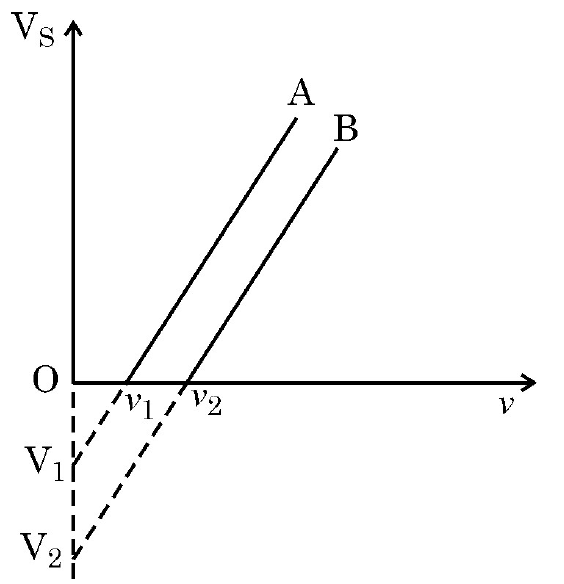
(I) From the graph, the work functions of A and B are (h is Planck's constant and e value of charge on an electron)
Let m be the slope of the graph line for metal B. If e is the value of electron charge, then Planck's constant 'h' is given by
Section E · Long answer (5 marks each)
(a) An electric dipole consists of two point charges q and –q separated by a distance 2a. Derive an expression for the electric field due to this dipole at a point distant r from the centre of the dipole on the equatorial plane. Write the expression for the electric field at a far off point, i.e. .
(b) A dipole is placed in x-y plane such that charges q and –q are located at and respectively. There exists an electric field N/C in the region. Calculate the force and torque experienced by the dipole.
(b) (a) Two cells of emf and with internal resistances and respectively, are connected in parallel by connecting their positive terminals together and negative terminals together. Deduce an expression for equivalent emf and equivalent internal resistance of the combination.
(b) A parallel combination, as stated in (a) above, of two cells of emfs E and 3E and internal resistances R each is connected across a resistance 2R. Find the current that flows through resistance 2R.
(a) Using the relation for refraction at a curved spherical surface, derive the expression for lens maker's formula.
(b) Three lenses , and , each of focal length 40 cm, are placed coaxially. The distance between and and between and are 120 cm and 20 cm respectively. An object is kept at a distance of 80 cm to the left of lens . Find the distance of the final image formed from the object.
(b) (a) Draw a ray diagram to show the image formation by a concave mirror when the object is kept between its focus and the centre of curvature. Using this diagram, derive the mirror formula.
(b) A concave mirror produces a two times magnified virtual image of an object kept 10 cm in front of it. Calculate the focal length of the mirror.
(a) State Faraday's law of electromagnetic induction.
(b) Derive an expression for the self-inductance of an air-filled long solenoid of length l and cross-sectional area A having N turns.
(c) A conducting rod of length 50 cm, with one end pivoted, is rotated with angular speed of 60 rpm in a uniform magnetic field of 4.0 mT directed perpendicular to the plane of rotation of rod. Find the emf induced in the rod.
(b) (a) Draw a labelled diagram of a step-up transformer. State the principle on which it works and obtain the ratio of secondary voltage to primary voltage in terms of number of turns and currents in the two coils.
(b) The ratio of the number of turns in the primary to the secondary of an ideal transformer is 1 : 5. If 5 kW power at 200 V is supplied to the primary, find (i) current in the primary, and (ii) output voltage.
Solutions: CBSE 2026 · 55/1/1
Answer: (C) 50 N/C along
The positive sign means the field points along (the direction in which V decreases).
Answer: (C)
Inside the wire , Ampere's law with the enclosed current gives . At :
Answer: (C) wavelength is halved and frequency remains unchanged.
.
Frequency is set by the source and does not change; , so the wavelength becomes half.
Answer: (A) 1 nm to nm
X-rays are used as a diagnostic tool in medicine; their wavelengths lie roughly between 10 nm and nm, so the range 1 nm to nm fits.
Answer: (A) 20 cm
For the equi-concave lens, , so cm.
Each plano-concave half has one curved surface: , so cm.
Answer: (D)
, , so in series .
Answer: (D) Both Assertion (A) and Reason (R) are false.
Atoms of diamagnetic substances have zero net magnetic moment (the moments of their electrons cancel), so A is false. A current loop always behaves as a magnetic dipole of moment , so R is also false.
Answer: (C) Assertion (A) is true, but Reason (R) is false.
The nucleus has a mass defect , so A is true. When nucleons combine, energy (the binding energy) is released, not absorbed, so R is false.
Einstein's equation: , so .
Stopping potential V, so eV.
Bright fringes: . For coincidence : , so , .
Order of drift velocity: about m/s (a fraction of a mm per second).
Relation: Take a conductor of cross-section A with n free electrons per unit volume, drifting with speed .
In time each electron moves , so all electrons in a length cross a section: their number is .
Charge crossing: .
(a) Take a cylindrical Gaussian surface of end-area A, cutting the sheet perpendicularly.
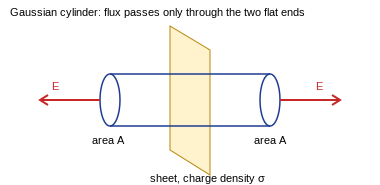
By symmetry is normal to the sheet. There is no flux through the curved surface; through each flat end the flux is EA.
Total flux ; charge enclosed . Gauss's law:
directed away from the sheet if ; it does not depend on distance.
(b) Each sheet gives .
(i) Inside: the two fields are opposite, so .
(ii) Outside: the fields add, so , directed away from the sheets.
With the battery disconnected, the charge stays constant. Let K be the dielectric constant.
(a) ; without the slab . Capacitance decreases K times.
(b) ; . Energy increases K times (work is done in pulling the slab out).
(c) . Potential difference increases K times.
(a) In the positive half-cycle A is at the higher potential. (pointing from A towards R) is forward biased and conducts; (pointing from P towards A) is reverse biased and does not conduct.
(b) Equivalent circuit ( a closed switch, open):
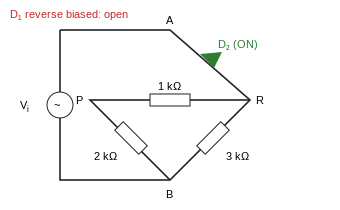
From R the current divides: through 3 kΩ directly to B, and through 1 kΩ and 2 kΩ (via P) to B.
(c) The two branches are 3 kΩ and kΩ, in parallel: kΩ. At peak V:
mA, which splits equally, 4 mA in each branch.
Drops: across 3 kΩ: ; across 1 kΩ: ; across 2 kΩ: .
(a)
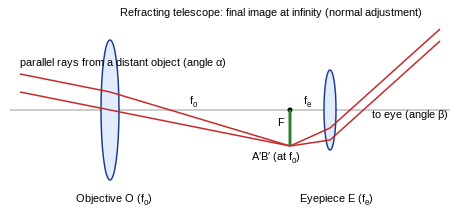
In normal adjustment (final image at infinity):
(the length of the tube is ).
(b) Any two:
1. A mirror has no chromatic aberration (no dispersion), and a parabolic mirror removes spherical aberration.
2. A large mirror is easier and cheaper to make and support (it can be supported over its whole back), whereas a large lens is heavy and sags.
3. The image is brighter, since a large aperture gathers more light.
(I) (B) radial magnetic field. In a radial field the plane of the coil is always parallel to , so and at every position.
(II) (A) increasing number of turns of the coil (answer as per the CBSE marking scheme). Current sensitivity increases with N.
(III) (D) 0.25 N m. N m.
OR (B) 3985 Ω. , in series.
(IV) (C) 0.01 Ω in parallel. Shunt , connected in parallel.
(a)
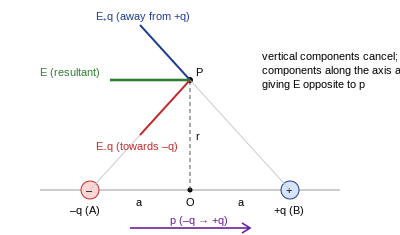
P is on the perpendicular bisector at distance r from the centre O. Distance of P from each charge , so
Their components perpendicular to the axis cancel. The components parallel to the axis add, both pointing from +q towards –q (opposite to ). If is the angle each field makes with the axis, :
With :
For a far-off point :
(b) The field is uniform, so the forces on +q and –q are and : net force .
Dipole moment (from –q to +q): . Torque:
(the dipole lies along the field, so it is in equilibrium).
(a)
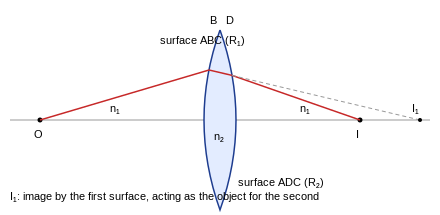
A thin lens of refractive index in a medium has surfaces of radii and . Object O on the axis.
Refraction at the first surface ABC forms image :
acts as the object for the second surface ADC, which forms the final image I (light goes from to ):
Adding (1) and (2) (the lens is thin, so distances are from the optical centre):
For an object at infinity, :
This is the lens maker's formula (in air, ).
(b) Taking each lens as converging, cm.
: cm: , so cm (to the right of ).
is 120 cm from , so this image is 40 cm to the left of : cm , so the image is at infinity (rays leave parallel).
: parallel rays focus at cm to the right of .
Distance of the final image from the object .
(a) The magnitude of the emf induced in a circuit equals the time rate of change of magnetic flux through it: (for N turns, ). The negative sign shows the induced emf opposes the change (Lenz's law).
(b) Turns per unit length . A current I gives a field inside the solenoid
Total flux linkage: .
Since :
(c) rpm rev/s rad/s; m; T.
Get every solution for all 19 papers
- Every board question of every chapter, each fully solved the way the board gives marks
- 19 complete board papers, each followed by its solutions
- Weightage and most-asked topics for every chapter
- Instant PDF download, colour and black & white print copies
Revising the chapter first? Complete Physics Notes for Class 12 (NCERT 2026-27, CBSE Board 2027) →
What you get in the pack
- Questions from 138 CBSE papers, 2016 to 2026: every set code available
- Complete: 2262 different questions and parts from all set codes, 14 chapters and 19 full papers
- Part A: all 14 chapters, questions sorted chapter-wise and by marks
- Year-wise weightage table and most-asked topics for every chapter
- Part B: 19 full board papers, each followed by its complete solutions
- Derivations, numericals, ray and circuit diagrams worked the way the board awards marks
- Questions on topics out of the board syllabus flagged
All chapters in this pack
- PYQ Ch 1 Electric Charges and Fields
- PYQ Ch 2 Electrostatic Potential and Capacitance
- PYQ Ch 3 Current Electricity
- PYQ Ch 4 Moving Charges and Magnetism
- PYQ Ch 5 Magnetism and Matter
- PYQ Ch 6 Electromagnetic Induction
- PYQ Ch 7 Alternating Current
- PYQ Ch 8 Electromagnetic Waves
- PYQ Ch 9 Ray Optics and Optical Instruments
- PYQ Ch 10 Wave Optics
- PYQ Ch 11 Dual Nature of Radiation and Matter
- PYQ Ch 12 Atoms
- PYQ Ch 13 Nuclei
- PYQ Ch 14 Semiconductor Electronics
- Board Paper 2026 Set 55-1-1 with Solutions
- Board Paper 2026 Set 55-1-2 with Solutions
- Board Paper 2026 Set 55-1-3 with Solutions
- Board Paper 2026 Set 55-2-1 with Solutions
- Board Paper 2025 Set 55-1-1 with Solutions
- Board Paper 2025 Set 55-2-1 with Solutions
- Board Paper 2024 Set 55-1-1 with Solutions
- Board Paper 2024 Set 55-2-1 with Solutions
- Board Paper 2023 Set 55-1-1 with Solutions
- Board Paper 2023 Set 55-2-1 with Solutions
- Board Paper 2022 Term 2 Set 55-1-1 with Solutions
- Board Paper 2022 Term 2 Set 55-2-1 with Solutions
- Board Paper 2020 Set 55-1-1 with Solutions
- Board Paper 2020 Set 55-2-1 with Solutions
- Board Paper 2019 Set 55-1-1 with Solutions
- Board Paper 2019 Set 55-2-1 with Solutions
- Board Paper 2018 Set 55-1 with Solutions
- Board Paper 2017 Set 55-1 with Solutions
- Board Paper 2016 Set 55-1 with Solutions