
Nuclei: Class 12 PYQs 2017–2026 with solutions
All 23 CBSE board questions asked from Nuclei in 15 board papers, with the year, set and marks of each. 13 are solved free below. The Class 12 Physics PYQ Book: Solved Board Papers 2016-2026 (CBSE) has every solution, all chapters and 19 full board papers.
Subject experts: Khushbu Gupta (B.Sc., M.Sc. Physics, B.Ed.) and Vinay Wadhwani (B.Tech Electrical Engineering)



Free: NCERT solutions for Class 12 Physics →
Nuclei: board weightage
Board weightage 2017–2026
| Year | 2016 | 2017 | 2018 | 2019 | 2020 | 2022 | 2023 | 2024 | 2025 | 2026 |
|---|---|---|---|---|---|---|---|---|---|---|
| Questions | – | 1 | 2 | 1 | 3 | 2 | 6 | 2 | 3 | 3 |
| Marks | – | 4 | 3 | 3 | 5 | 6 | 13 | 5 | 7 | 6 |
Most asked topics
23 questions from 15 papers. Repeated questions are shown once with every year they were asked.
Jump to: 1 mark2 marks3 marks4 marks
1 mark: MCQ and Assertion–Reason
Assertion (A): The mass of a nucleus is less than the sum of the masses of the constituent nucleons.
Reason (R): Energy is absorbed when the nucleons are bound together to form a nucleus.
Solution
Answer: (C) Assertion (A) is true, but Reason (R) is false.
The nucleus has a mass defect , so A is true. When nucleons combine, energy (the binding energy) is released, not absorbed, so R is false.
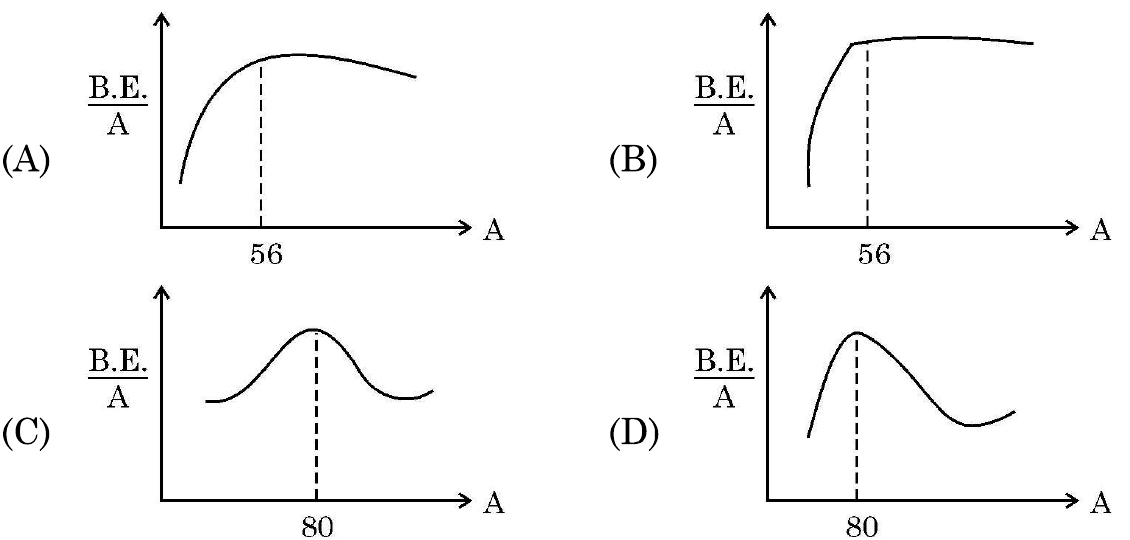
Which of the following figures correctly represent the shape of curve of binding energy per nucleon as a function of mass number?
Solution
Answer: (A)
BE/A rises steeply for light nuclei, reaches a broad maximum of about 8.75 MeV near A = 56 (iron), and then decreases slowly for heavy nuclei. Graph (A) shows exactly this shape.
The mass density of a nucleus of mass number A is
Solution
Answer: (d) independent of A
Mass ∝ A and volume ∝ , so density is independent of A.
The curve of binding energy per nucleon as a function of atomic mass number has a sharp peak for helium nucleus. This implies that helium nucleus is
Solution
Answer: (d) more stable nucleus than its neighbours
A higher binding energy per nucleon means the nucleons are more tightly bound, so He-4 is more stable than nearby nuclei.
The nuclear radius of is 3.6 fermi. Find the nuclear radius of .
When two nuclei (A ≤ 10) fuse together to form a heavier nucleus, the
Four nuclei of an element undergo fusion to form a heavier nucleus, with release of energy. Which of the two — the parent or the daughter nucleus — would have higher binding energy per nucleon?
2 marks: very short answer
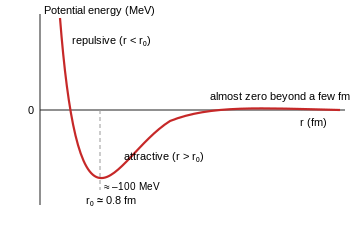
Draw the plot of potential energy of a pair of nucleons as a function of their separation. Write two important conclusions that can be drawn from this plot.
Solution
Conclusions (any two):
1. The potential energy is minimum at a separation fm.
2. For the nuclear force is attractive; for it is strongly repulsive.
3. The nuclear force is short range: it becomes negligible beyond a few femtometres.
The carbon isotope has a nuclear mass of 12.000000 u. Calculate the binding energy of its nucleus. Given = 1.007825 u; = 1.008665 u.
Solution
(about 7.7 MeV per nucleon)
Define the term, mass defect. How is it related to stability of the nucleus?
Explain the processes of nuclear fission and nuclear fusion by using the plot of binding energy per nucleon (BE/A) versus the mass number A.
3 marks: short answer
(a) Consider the following nuclides: , , , . Group them into isotopes and isotones.
(b) How does the size of a nucleus depend on its mass number A? Hence prove that the density of nucleus is a constant, independent of A, for all nuclei.
Solution
(a) Isotopes (same Z): and .
Isotones (same N = A – Z): (N = 118) and (N = 118).
(b) ( fm), so the volume .
If m is the mass of a nucleon, the mass of the nucleus is :
This does not contain A, so nuclear density is the same for all nuclei (about kg/m³).
(a) Define 'Mass defect' and 'Binding energy' of a nucleus. Describe 'Fission process' on the basis of binding energy per nucleon.
(b) A deuteron contains a proton and a neutron and has a mass of 2.013553 u. Calculate the mass defect for it in u and its energy equivalence in MeV. ( = 1.007277 u, = 1.008665 u, 1 u = 931.5 MeV/c²)
Solution
(a) Mass defect: the difference between the total mass of the nucleons and the mass of the nucleus: .
Binding energy: the energy needed to separate a nucleus into its nucleons (equal to the energy released when it forms): .
Fission: a heavy nucleus (A ≈ 235, BE/A ≈ 7.6 MeV) splits into two medium nuclei (A ≈ 120, BE/A ≈ 8.5 MeV). The products are more tightly bound, so the binding energy per nucleon increases by about 0.9 MeV. For about 235 nucleons, roughly 200 MeV is released per fission.
(b)
(a) Show the variation of binding energy per nucleon with mass number. Write the significance of the binding energy curve.
(b) Two nuclei with lower binding energy per nucleon form a nuclei with more binding energy per nucleon. (i) What type of nuclear reaction is it? (ii) Whether the total mass of nuclei increases, decreases or remains unchanged? (iii) Does the process require energy or produce energy?
Solution
(a)
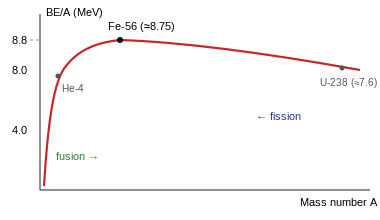
Significance (any one): it shows why light nuclei release energy by fusion and heavy nuclei by fission; nuclei near A = 56 are the most stable; BE/A is nearly constant for 30 < A < 170, showing that nuclear forces are short range and saturate.
(b) (i) Nuclear fusion.
(ii) The total mass decreases (the mass difference appears as energy).
(iii) Energy is produced (released).
(a) State any two properties of a nucleus. (b) Why is the density of a nucleus much more than that of an atom? (c) Show that the density of the nuclear matter is the same for all nuclei.
Solution
(a) Any two: the nucleus contains protons and neutrons held by a strong, short-range nuclear force; its radius ( fm); its mass is less than the sum of the masses of its nucleons (mass defect); nuclear density is the same for all nuclei.
(b) Almost the whole mass of the atom is concentrated in the nucleus, whose radius ( m) is about of the atom's radius, so its volume is about of the atom's volume. The same mass in a far smaller volume gives a far larger density.
(c) Mass of nucleus ≈ mA (m = mass of a nucleon). Volume .
This is independent of A, so all nuclei have the same density (about kg m⁻³).
Draw a diagram to show the variation of binding energy per nucleon with mass number for different nuclei and mention its two features. Why do lighter nuclei usually undergo nuclear fusion?
Solution
Features (any two):
1. BE/A is practically constant (about 8 MeV) for 30 < A < 170, because nuclear forces are short range and saturate.
2. It has a maximum of about 8.75 MeV near A = 56 (iron), the most stable nuclei.
3. It is low for light nuclei (A < 30) and falls for heavy nuclei (A > 170).
Lighter nuclei have low binding energy per nucleon. When two of them fuse, the product has a higher BE/A, i.e. it is more tightly bound; the increase in binding energy is released as energy. So fusion of light nuclei is energetically favourable.
(i) Distinguish between nuclear fission and fusion giving an example of each.
(ii) Explain the release of energy in nuclear fission and fusion on the basis of binding energy per nucleon curve.
Solution
(i)
| Fission | Fusion |
|---|---|
| A heavy nucleus splits into two lighter nuclei of comparable mass. | Two light nuclei combine to form a heavier nucleus. |
| Can occur at ordinary temperature (triggered by a neutron). | Needs extremely high temperature (about K) and pressure. |
| Example: + energy. | Example: + 3.27 MeV (as in the sun). |
(ii)
Energy is released whenever the products are more tightly bound (higher BE/A) than the reactants.
Fission: a heavy nucleus (A ≈ 235, BE/A ≈ 7.6 MeV) splits into two medium nuclei (BE/A ≈ 8.5 MeV), so about 0.9 MeV per nucleon, i.e. roughly 200 MeV per fission, is released.
Fusion: light nuclei have low BE/A; the heavier product (e.g. He) has a much higher BE/A, so energy is released.
(i) How is the size of a nucleus found experimentally? Write the relation between the radius and mass number of a nucleus.
(ii) Prove that the density of a nucleus is independent of its mass number.
Calculate the energy released in MeV in the following reaction: . Given: = 2.014102 u, = 3.016049 u, = 4.002603 u, = 1.008665 u.
(a) Depict the variation of the potential energy of a pair of nucleons with the separation between them.
(b) Imagine the fission of a into two equal fragments of nucleus. Is the fission energetically possible? Justify your answer by working out Q value of the process. Given: = 55.93494 u, = 27.98191 u.
The nucleus , initially at rest, decays into by emitting an α-particle: + energy. The binding energies per nucleon of the parent nucleus, the daughter nucleus and α-particle are 7.8 MeV, 7.835 MeV and 7.07 MeV, respectively. Assuming the daughter nucleus to be formed in the unexcited state and neglecting its share in the energy of the reaction, find the speed of the emitted α-particle. (Mass of α-particle = kg)
(a) State two distinguishing features of nuclear force. (b) Draw a plot showing the variation of potential energy of a pair of nucleons as a function of their separation. Mark the regions on the graph where the force is (i) attractive, and (ii) repulsive.
4 marks: case-based / source-based
Asha's mother read an article in the newspaper about a disaster that took place at Chernobyl. She could not understand much from the article and asked a few questions from Asha regarding the article. Asha tried to answer her mother's questions based on what she learnt in Class XII Physics.
(a) What was the installation at Chernobyl where the disaster took place? What, according to you, was the cause of this disaster? (b) Explain the process of release of energy in the installation at Chernobyl. (c) What according to you, were the values displayed by Asha and her mother?
Solution
(a) A nuclear power reactor. The disaster (1986) was caused by an uncontrolled chain reaction during a faulty safety test: the reaction ran out of control, the reactor overheated and exploded, releasing radioactive material.
(b) Nuclear fission: a slow neutron is absorbed by U-235, which splits into two medium nuclei and releases 2–3 neutrons and about 200 MeV of energy (from the mass defect, ). The released neutrons cause further fissions, a chain reaction, which in a reactor is kept steady by control rods and a moderator.
(c) Mother: curiosity and eagerness to learn. Asha: knowledge, helpfulness and patience in explaining (scientific awareness).
Get every solution for all chapters
- Every board question of every chapter, each fully solved the way the board gives marks
- 19 complete board papers, each followed by its solutions
- Weightage and most-asked topics for every chapter
- Instant PDF download, colour and black & white print copies
Revising the chapter first? Complete Physics Notes for Class 12 (NCERT 2026-27, CBSE Board 2027) →
What you get in the pack
- Questions from 138 CBSE papers, 2016 to 2026: every set code available
- Complete: 2262 different questions and parts from all set codes, 14 chapters and 19 full papers
- Part A: all 14 chapters, questions sorted chapter-wise and by marks
- Year-wise weightage table and most-asked topics for every chapter
- Part B: 19 full board papers, each followed by its complete solutions
- Derivations, numericals, ray and circuit diagrams worked the way the board awards marks
- Questions on topics out of the board syllabus flagged
All chapters in this pack
- PYQ Ch 1 Electric Charges and Fields
- PYQ Ch 2 Electrostatic Potential and Capacitance
- PYQ Ch 3 Current Electricity
- PYQ Ch 4 Moving Charges and Magnetism
- PYQ Ch 5 Magnetism and Matter
- PYQ Ch 6 Electromagnetic Induction
- PYQ Ch 7 Alternating Current
- PYQ Ch 8 Electromagnetic Waves
- PYQ Ch 9 Ray Optics and Optical Instruments
- PYQ Ch 10 Wave Optics
- PYQ Ch 11 Dual Nature of Radiation and Matter
- PYQ Ch 12 Atoms
- PYQ Ch 13 Nuclei
- PYQ Ch 14 Semiconductor Electronics
- Board Paper 2026 Set 55-1-1 with Solutions
- Board Paper 2026 Set 55-1-2 with Solutions
- Board Paper 2026 Set 55-1-3 with Solutions
- Board Paper 2026 Set 55-2-1 with Solutions
- Board Paper 2025 Set 55-1-1 with Solutions
- Board Paper 2025 Set 55-2-1 with Solutions
- Board Paper 2024 Set 55-1-1 with Solutions
- Board Paper 2024 Set 55-2-1 with Solutions
- Board Paper 2023 Set 55-1-1 with Solutions
- Board Paper 2023 Set 55-2-1 with Solutions
- Board Paper 2022 Term 2 Set 55-1-1 with Solutions
- Board Paper 2022 Term 2 Set 55-2-1 with Solutions
- Board Paper 2020 Set 55-1-1 with Solutions
- Board Paper 2020 Set 55-2-1 with Solutions
- Board Paper 2019 Set 55-1-1 with Solutions
- Board Paper 2019 Set 55-2-1 with Solutions
- Board Paper 2018 Set 55-1 with Solutions
- Board Paper 2017 Set 55-1 with Solutions
- Board Paper 2016 Set 55-1 with Solutions