
Current Electricity: Class 12 PYQs 2016–2026 with solutions
All 51 CBSE board questions asked from Current Electricity in 15 board papers, with the year, set and marks of each. 28 are solved free below. The Class 12 Physics PYQ Book: Solved Board Papers 2016-2026 (CBSE) has every solution, all chapters and 19 full board papers.
Subject experts: Khushbu Gupta (B.Sc., M.Sc. Physics, B.Ed.) and Vinay Wadhwani (B.Tech Electrical Engineering)



Free: NCERT solutions for Class 12 Physics →
Current Electricity: board weightage
Board weightage 2016–2026
| Year | 2016 | 2017 | 2018 | 2019 | 2020 | 2022 | 2023 | 2024 | 2025 | 2026 |
|---|---|---|---|---|---|---|---|---|---|---|
| Questions | 3 | 2 | 3 | 4 | 7 | – | 7 | 9 | 8 | 8 |
| Marks | 6 | 4 | 7 | 9 | 13 | – | 12 | 21 | 17 | 22 |
Most asked topics
51 questions from 15 papers. Repeated questions are shown once with every year they were asked.
Jump to: 1 mark2 marks3 marks4 marks5 marks
1 mark: MCQ and Assertion–Reason
Two heaters rated as and are connected in series across a dc source of volt. The power consumed by the combination will be
Solution
Answer: (D)
, , so in series .
Assertion (A): Two electric heaters of power and are joined in series across a dc source of voltage V. The power consumed by the combination will be less than that consumed by when connected across the same source.
Reason (R): The power consumed by a electric device when connected to a dc source of voltage V is proportional to its resistance.
Solution
Answer: (C) A is true, but R is false.
In series , which is less than (A is true). At constant V, is inversely proportional to R, so R is false.
Two wires P and Q are made of the same material. The wire Q has twice the diameter and half the length as that of wire P. If the resistance of wire P is R, the resistance of the wire Q will be
Solution
Answer: (C)
, so .
A student has three resistors, each of resistance R. To obtain a resistance of R, she should connect
Solution
Answer: (C)
Two in series give 2R; 2R in parallel with R gives .
(The others give 3R, and .)
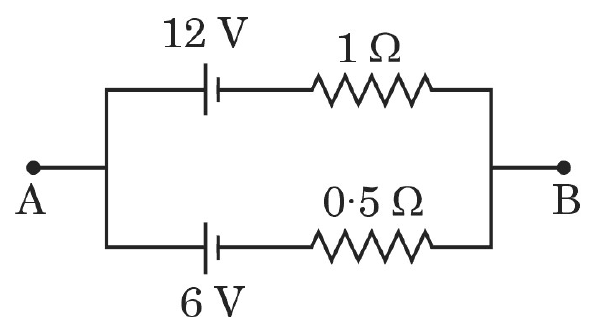
Consider the circuit shown in the figure. The potential difference between points A and B is
Solution
Answer: (B) 8 V
With nothing connected across A and B, the terminal voltage of the parallel combination equals its equivalent emf:
(Check: circulating current A, so V.)
Electrons drift with speed in a conductor with potential difference V across its ends. If V is reduced to , their drift speed will become
Solution
Answer: (A)
, so . Halving V halves the drift speed.
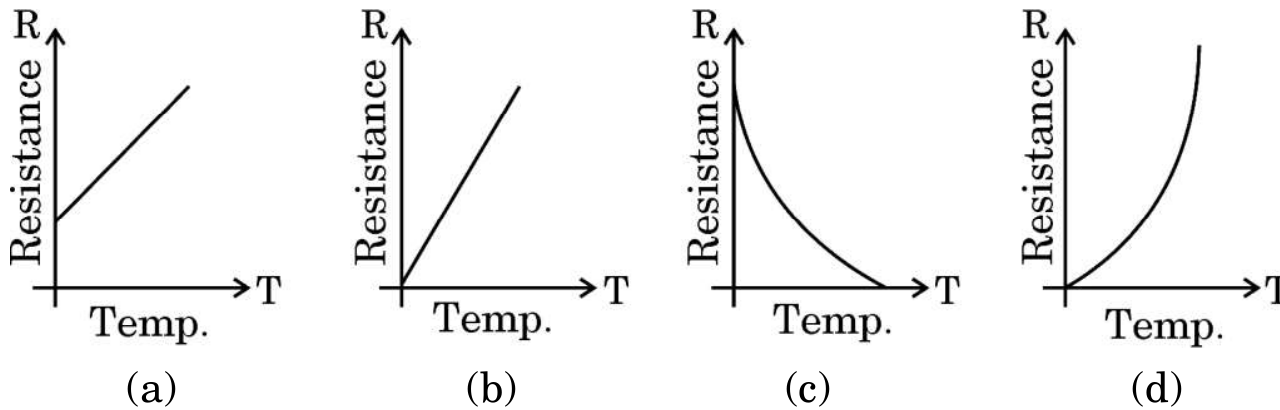
For a metallic conductor, the correct representation of variation of resistance R with temperature T is
Solution
Answer: (d)
For a metal, R increases with temperature, and the curve bends upward (R rises faster at high temperature; it is nearly linear only over a limited range), as in graph (d). (The marking scheme gives (d).)
The potential difference across a cell in an open circuit is 8 V. It falls to 4 V when a current of 4 A is drawn from it. The internal resistance of the cell is
Solution
Answer: (d) 1 Ω
Open-circuit voltage = emf = 8 V. : , so .
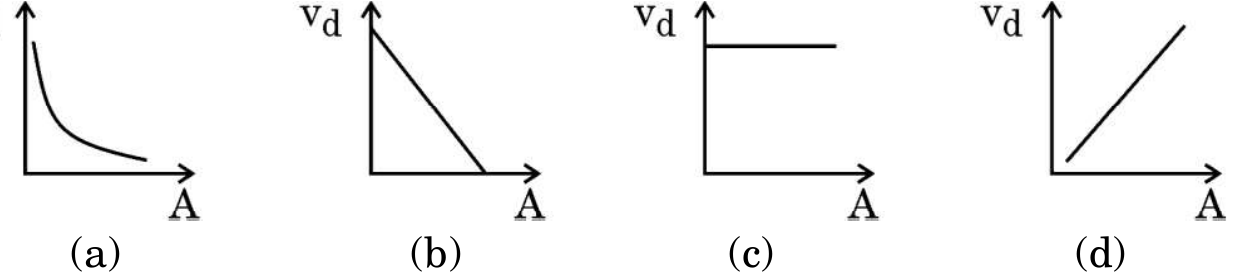
A steady current flows through a metallic wire whose area of cross-section (A) increases continuously from one end of the wire to the other. The magnitude of drift velocity () of the free electrons as a function of 'A' can be shown by
Solution
Answer: (a)
I is the same at every section and , so : a rectangular hyperbola, graph (a).
A current of 0.8 A flows in a conductor of 40 Ω for 1 minute. The heat produced in the conductor will be
A cell of emf E is connected across an external resistance R. When current 'I' is drawn from the cell, the potential difference across the electrodes of the cell drops to V. The internal resistance 'r' of the cell is
Two resistors and of 4 Ω and 6 Ω are connected in parallel across a battery. The ratio of power dissipated in them, will be
A cell of internal resistance r connected across an external resistance R can supply maximum current when
In a current carrying conductor, the ratio of the electric field and the current density at a point is called
How does the mobility of electrons in a conductor change, if the potential difference applied across the conductor is doubled, keeping the length and temperature of the conductor constant?
Nichrome and copper wires of same length and same radius are connected in series. Current I is passed through them. Which wire gets heated up more? Justify your answer.
Define mobility of a charge carrier. What is its relation with relaxation time?
2 marks: very short answer
What is the order of magnitude of drift velocity of electrons in a conductor? Deduce the relation between the current flowing through a conductor and drift velocity of electrons in it.
Solution
Order of drift velocity: about m/s (a fraction of a mm per second).
Relation: Take a conductor of cross-section A with n free electrons per unit volume, drifting with speed .
In time each electron moves , so all electrons in a length cross a section: their number is .
Charge crossing: .
A heating element using nichrome is connected to a 220 V supply. Initially it draws a current of 2.9 A. After some time, the current attains a steady value of 2.5 A. Find the steady temperature of the heating element if the room temperature is 27 °C. The temperature coefficient of resistance of nichrome is °C⁻¹.
Solution
(at 27 °C); (at ).
, so
.
A battery of emf E and internal resistance r is connected to a rheostat. When a current of 2 A is drawn from the battery, the potential difference across the rheostat is 5 V. The potential difference becomes 4 V when a current of 4 A is drawn from the battery. Calculate the value of E and r.
Solution
Terminal voltage .
First case: …(1)
Second case: …(2)
Subtracting: , so ; then .
Two wires of the same material and the same radius have their lengths in the ratio 2 : 3. They are connected in parallel to a battery which supplies a current of 15 A. Find the current through the wires.
Solution
Same material and radius: , so .
In parallel the voltage is the same, so : .
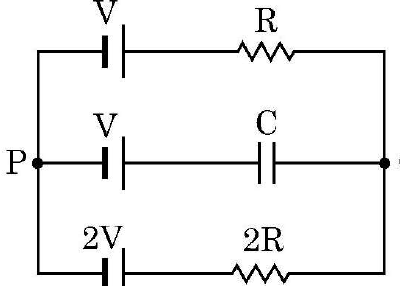
In the circuit three ideal cells of e.m.f. V, V and 2V are connected to a resistor of resistance R, a capacitor of capacitance C and another resistor of resistance 2R as shown in figure. In the steady state find (i) the potential difference between P and Q and (ii) potential difference across capacitor C.
Solution
In the steady state no current flows through the capacitor branch. A current i circulates through the top branch (V, R) and the bottom branch (2V, 2R). The two cells oppose each other in this loop:
(i) Along the top branch from P to Q (with the polarities shown):
So the potential difference between P and Q is (Q at the higher potential).
(ii) Along the middle branch: , so .
The potential difference across the capacitor is .
Find the temperature at which the resistance of a wire made of silver will be twice its resistance at 20 °C. Take 20 °C as the reference temperature and temperature coefficient of resistance of silver at 20 °C = K⁻¹.
Solution
. With :
Plot a graph showing the variation of current with voltage for the material GaAs. On the graph, mark the region where: (a) resistance is negative, and (b) Ohm's law is obeyed.
Solution
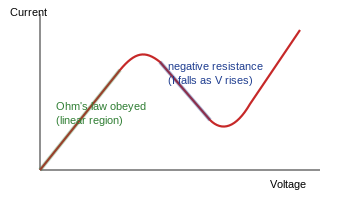
(a) Negative resistance: the part where the current decreases as the voltage increases (the falling portion after the peak).
(b) Ohm's law: the initial straight-line portion through the origin, where I ∝ V.
Define resistivity of a conductor. How does the resistivity of a conductor depend upon the following: (a) Number density of free electrons in the conductor (n) (b) Their relaxation time (τ)
Define the term 'mobility' of charge carriers in a current carrying conductor. Obtain the relation for mobility in terms of relaxation time.
Define the term 'drift velocity' of electrons in a current carrying conductor. Obtain the relationship between the current density and the drift velocity of electrons.
Two bulbs are rated and . If they are connected (i) in series and (ii) in parallel across a supply V, find the power dissipated in the two combinations in terms of and .
Two electric bulbs P and Q have their resistances in the ratio of 1 : 2. They are connected in series across a battery. Find the ratio of the power dissipation in these bulbs.
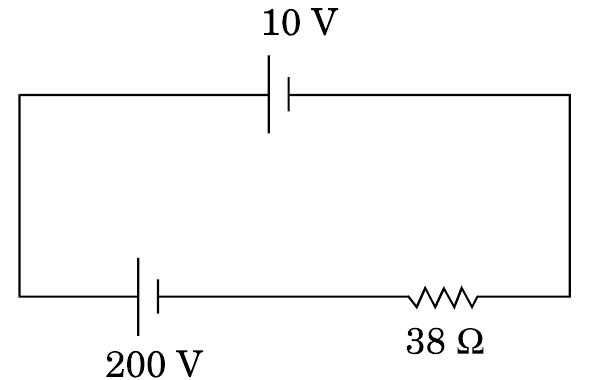
A 10 V cell of negligible internal resistance is connected in parallel across a battery of emf 200 V and internal resistance 38 Ω as shown in the figure. Find the value of current in the circuit.
When 5 V potential difference is applied across a wire of length 0.1 m, the drift speed of electrons is m/s. If the electron density in the wire is m⁻³, calculate the resistivity of the material of wire.
3 marks: short answer
(a) Obtain the condition of balance of a Wheatstone bridge.
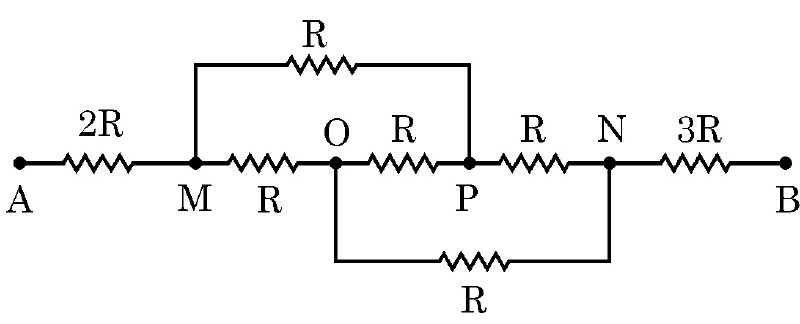
(b) Find net resistance of the network of resistors connected between A and B, as shown in figure.
Solution
(a)
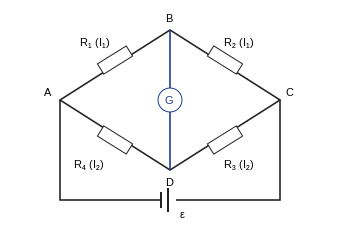
At balance no current flows through the galvanometer, so B and D are at the same potential. Then and carry the same current ; and carry .
Kirchhoff's loop rule:
Loop ABDA: …(1)
Loop BCDB: …(2)
Dividing (1) by (2):
(b) Between M and N, the resistors M–O (R), M–P (R, top), O–N (R, bottom), P–N (R) and O–P (R) form a Wheatstone bridge. Since , it is balanced and O–P carries no current.
= two paths of in parallel .
(a) Explain the statement: "Current is a scalar although we represent current with an arrow".
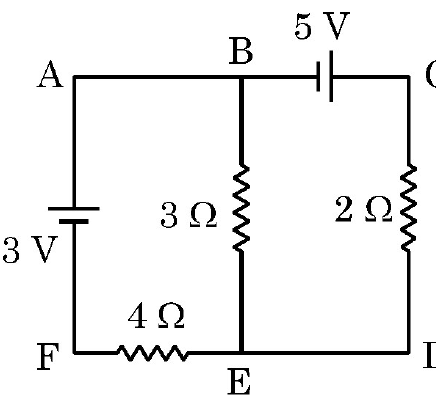
(b) Use Kirchhoff's rules to find the current through 3 Ω resistor in the circuit shown in the figure:
Solution
(a) Current does not obey the laws of vector addition: currents meeting at a junction add algebraically, whatever the angle between the wires. The arrow only shows the direction of flow of positive charge along the conductor. (Current density is a vector; is a scalar.)
(b) Let current I flow through the 5 V cell and the 2 Ω resistor (B → C → D → E), current upward through the 3 Ω resistor (E → B), and so through the 4 Ω resistor and the 3 V cell (E → F → A → B), by the junction rule at B.
Loop BCDEB: …(1)
Loop ABEFA: …(2)
From (1), ; substituting in (2): , so .
(through the 3 Ω resistor, from E to B).
Two batteries of emfs 3 V & 6 V and internal resistances 0.2 Ω & 0.4 Ω are connected in parallel. This combination is connected to a 4 Ω resistor. Find: (i) the equivalent emf of the combination (ii) the equivalent internal resistance of the combination (iii) the current drawn from the combination
Solution
(i)
(ii) (2/15 Ω)
(iii)
(i) A conductor of length l is connected across an ideal cell of emf E. Keeping the cell connected, the length of the conductor is increased to 2l by gradually stretching it. If R and R′ are initial and final values of resistance and and are initial and final values of drift velocity, find the relation between (i) R′ and R and (ii) and .
(ii) When electrons drift in a conductor from lower to higher potential, does it mean that all the 'free electrons' of the conductor are moving in the same direction?
Solution
(i) The volume stays the same: , so .
Drift velocity , where the field in the wire is . The cell's emf is the same but the length doubles, so the field halves: .
(Check: and , so .)
(ii) No. The free electrons keep moving randomly in all directions with high thermal speeds. The drift velocity is only a small average velocity superimposed on this random motion; on average the electrons drift from lower to higher potential.
(a) A cell of e.m.f. E and internal resistance r is connected with a variable external resistance R and a voltmeter showing potential drop V across R. Obtain the relationship between V, E, R and r.
(b) Draw the shape of the graph showing the variation of terminal voltage V of the cell as a function of current I drawn from it. How one can determine the e.m.f. of the cell and its internal resistance from this graph?
Solution
(a) Current ; the voltage across R is :
(b)
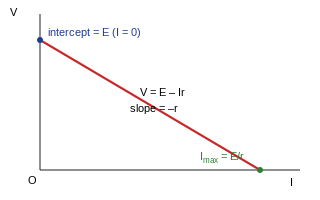
is a straight line with negative slope.
The intercept on the V-axis (I = 0) gives the emf E.
The magnitude of the slope gives the internal resistance r (equivalently, , where the line meets the I-axis).
Define 'current density'. Is it a scalar or a vector? An electric field is maintained in a metallic conductor. If n be the number of electrons (mass m, charge –e) per unit volume in the conductor and τ its relaxation time, show that the current density , where .
Solution
Current density is the current per unit area of cross-section, taken normal to the flow: . It is a vector, along the direction of flow of positive charge (SI unit A m⁻²).
Each electron is accelerated by the field, , and its average velocity between collisions is the drift velocity
In time Δt the charge crossing area A is , so
(α is the conductivity σ of the material.)
What is a Wheatstone bridge? Obtain the necessary conditions under which the Wheatstone bridge is balanced.
Solution
A Wheatstone bridge is an arrangement of four resistances in a quadrilateral ABCD, with a cell across one diagonal (A, C) and a galvanometer across the other (B, D). It is used to find an unknown resistance.
At balance the galvanometer shows no current (), so B and D are at the same potential; and carry the same current , and and carry .
Loop ABDA: …(1)
Loop BCDB: …(2)
Dividing (1) by (2):
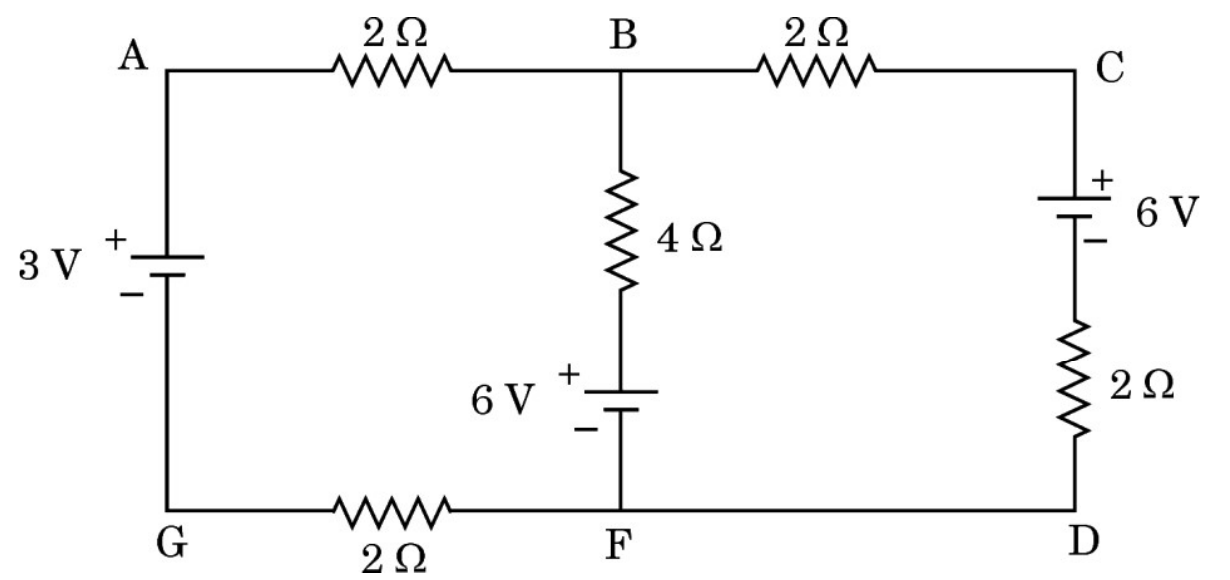
The figure shows a circuit with three ideal batteries. Find the magnitude and direction of currents in the branches AG, BF and CD.
Solution
Take the potential of F (and D, joined by a wire) as zero and let be the potential of B.
Branch BF (6 V cell, + towards B, and 4 Ω): current from F to B is .
Branch D–C–B (6 V cell, + towards C, 2 Ω in CD and 2 Ω in CB, total 4 Ω): current from D to B is .
Branch B–A–G–F (2 Ω in AB, 3 V cell with + at A, 2 Ω in GF, total 4 Ω): current from F to B along this path is .
Junction rule at B: V.
Branch BF: , from F to B.
Branch CD: , from D to C (and on from C to B).
Branch AG: A, i.e. flowing from B to A, then from A to G (and G to F).
(Check at B: 0.25 + 0.25 = 0.5 A in, 0.5 A out.)
Define current density and relaxation time. Derive an expression for resistivity of a conductor in terms of number density of charge carriers in the conductor and relaxation time.
(a) Two cells of emf and have their internal resistances and , respectively. Deduce an expression for the equivalent emf and internal resistance of their parallel combination when connected across an external resistance R. Assume that the two cells are supporting each other.
(b) In case the two cells are identical, each of emf E = 5 V and internal resistance r = 2 Ω, calculate the voltage across the external resistance R = 10 Ω.
(a) Derive the condition of balance for Wheatstone bridge. (b) Draw the circuit diagram of a meter bridge to explain how it is based on Wheatstone bridge.
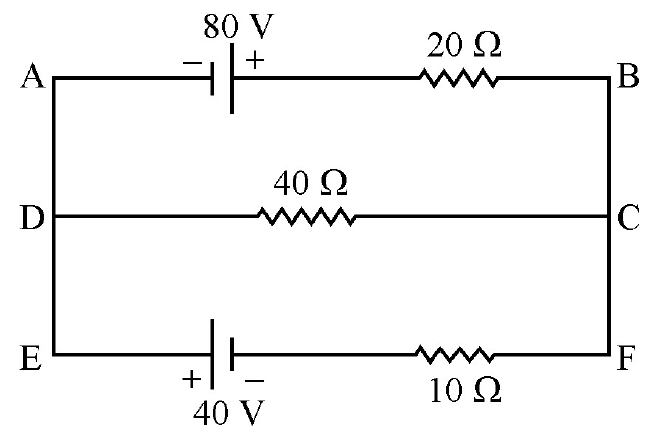
Using Kirchhoff's rules, calculate the current through the 40 Ω and 20 Ω resistors in the following circuit:
Show, on a plot, variation of resistivity of (i) a conductor, and (ii) a typical semiconductor as a function of temperature. Using the expression for the resistivity in terms of number density and relaxation time between the collisions, explain how resistivity in the case of a conductor increases while it decreases in a semiconductor, with the rise of temperature.
(a) Define the term 'conductivity' of a metallic wire. Write its SI unit. (b) Using the concept of free electrons in a conductor, derive the expression for the conductivity of a wire in terms of number density and relaxation time. Hence obtain the relation between current density and the applied electric field E.
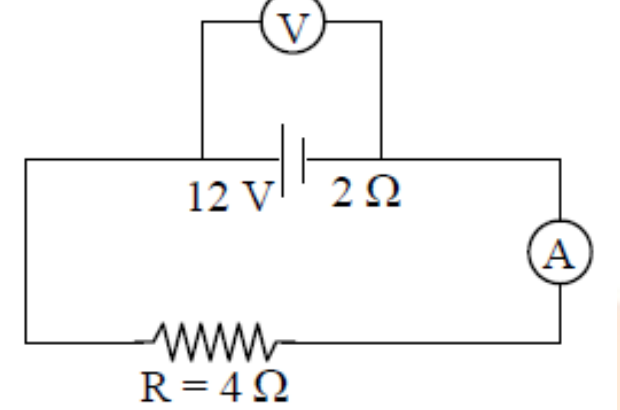
(a) The potential difference applied across a given resistor is altered so that the heat produced per second increases by a factor of 9. By what factor does the applied potential difference change? (b) In the figure shown, an ammeter A and a resistor of 4 Ω are connected to the terminals of the source. The emf of the source is 12 V having an internal resistance of 2 Ω. Calculate the voltmeter and ammeter reading.
Two identical cells of emf 1.5 V each joined in parallel supply energy to an external circuit consisting of two resistances of 7 Ω each joined in parallel. A very high resistance voltmeter reads the terminal voltage of cells to be 1.4 V. Calculate the internal resistance of each cell.
4 marks: case-based / source-based
When the terminals of a cell are connected to a conductor of resistance R, an electric current flows through the circuit. The electrolyte of the cell also offers some resistance in the path of the current, like the conductor. This resistance offered by the electrolyte is called internal resistance of the cell (r). It depends upon the nature of the electrolyte, the area of the electrodes immersed in the electrolyte and the temperature. Due to internal resistance, a part of the energy supplied by the cell is wasted in the form of heat. When no current is drawn from the cell, the potential difference between the two electrodes is known as emf of the cell (ε). With a current drawn from the cell, the potential difference between the two electrodes is termed as terminal potential difference (V).
(i) Choose the incorrect statement:
(b) Potential difference across a cell in the open circuit is 6 V. It becomes 4 V when a current of 2 A is drawn from it. The internal resistance of the cell is
Solution
(i) (B) is incorrect: internal resistance increases when the temperature of the electrolyte decreases (ions move more slowly).
(ii) (B) 2.8 V. V.
(iii) (A) ε = V₊ + V₋ > 0. The potential of the positive electrode is and that of the negative electrode is (relative to the electrolyte), so the difference is , which is positive.
(iv) (a) (D) 0.2 A. Five equal cells in parallel: V, . A.
OR (b) (A) 1.0 Ω. : , so .
The following figure shows a circuit diagram. We can find the currents through and potential differences across different resistors using Kirchhoff's rules.
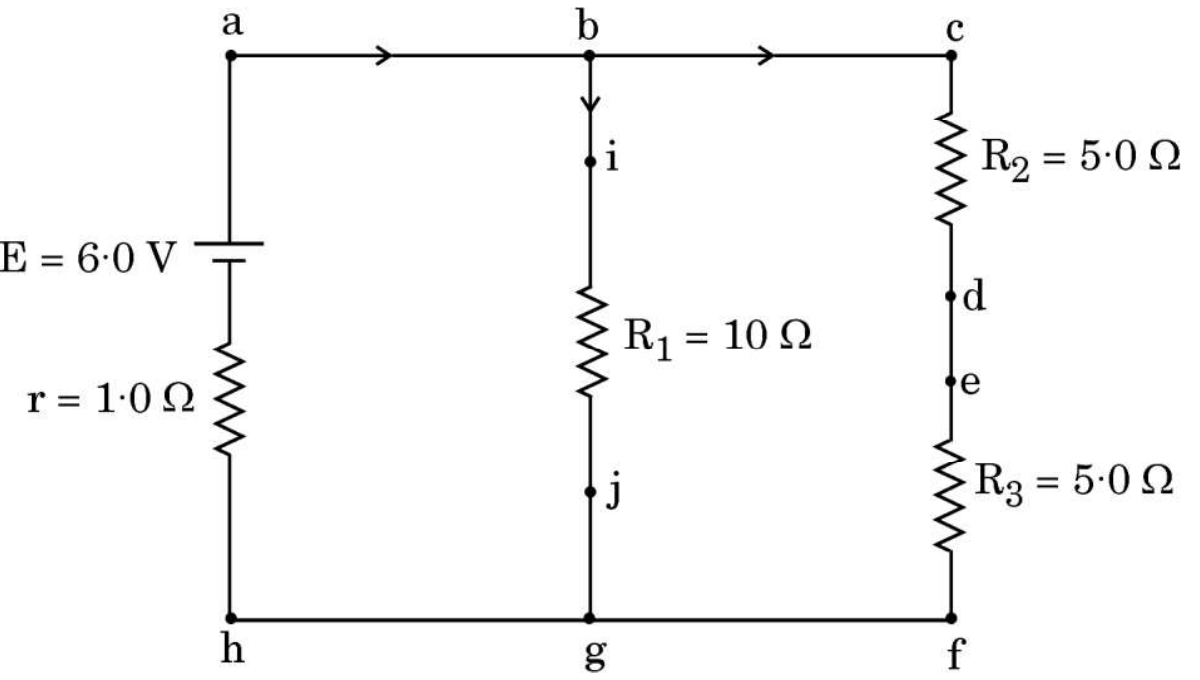
(a) Which points are at the same potential in the circuit? (1)
(b) What is the current through arm bg? (1)
(c) Find the potential difference across resistance . (2)
OR
(c) What is the power dissipated in resistance ? (2)
Solution
(a) Points joined by wires of no resistance are at the same potential: a, b and c; d and e; j, g, h and f (any two sets).
(b) in parallel with gives 5 Ω; with r = 1 Ω the total is 6 Ω.
A, which divides equally between the two 10 Ω branches.
(By Kirchhoff's rules: loop abgha: ; loop acfha: ; solving, A, A.)
Current through arm bg .
(c) Current through = 0.5 A: .
OR (c) .
5 marks: long answer
(a) Two cells of emf and with internal resistances and respectively, are connected in parallel by connecting their positive terminals together and negative terminals together. Deduce an expression for equivalent emf and equivalent internal resistance of the combination.
(b) A parallel combination, as stated in (a) above, of two cells of emfs E and 3E and internal resistances R each is connected across a resistance 2R. Find the current that flows through resistance 2R.
Solution
(a)
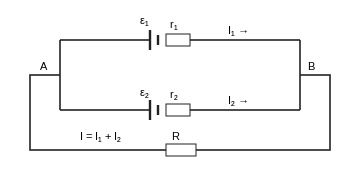
Let and leave the positive terminals; the external current is . The terminal voltage V is common:
;
Comparing with :
(b) ; .
(a) An electric field is established across the ends of a cylindrical conductor of length L and area of cross-section A. Discuss how electrons attain an average velocity, independent of time. Hence, obtain a relation between current in the conductor and this 'average velocity' of electrons.
(b) (i) This 'average velocity' is found be few mm/s for currents in range of a few amperes. How then is current established almost the instant a circuit is closed? (ii) Two copper wires having their radii in the ratio of 3 : 2 are connected in series across a battery. Find the ratio of the drift velocities of the electrons in the wires.
Solution
(a) Each free electron is accelerated by the field: . It soon collides with an ion and its velocity becomes random again. After a collision at time ago, its velocity is .
Averaging over all electrons, the average of the random velocities is zero, and the average of is the relaxation time τ:
This drift velocity is constant, independent of time, because collisions keep resetting the motion.
Current: in time Δt the electrons in a length cross a section, i.e. electrons carrying charge :
(b) (i) The current does not wait for electrons to travel from the battery. When the circuit is closed, the electric field is set up throughout the conductor almost at the speed of light, and the free electrons everywhere in the wire begin to drift at once.
(ii) In series both wires carry the same current, and n and e are the same (both copper): .
Get every solution for all chapters
- Every board question of every chapter, each fully solved the way the board gives marks
- 19 complete board papers, each followed by its solutions
- Weightage and most-asked topics for every chapter
- Instant PDF download, colour and black & white print copies
Revising the chapter first? Complete Physics Notes for Class 12 (NCERT 2026-27, CBSE Board 2027) →
What you get in the pack
- Questions from 138 CBSE papers, 2016 to 2026: every set code available
- Complete: 2262 different questions and parts from all set codes, 14 chapters and 19 full papers
- Part A: all 14 chapters, questions sorted chapter-wise and by marks
- Year-wise weightage table and most-asked topics for every chapter
- Part B: 19 full board papers, each followed by its complete solutions
- Derivations, numericals, ray and circuit diagrams worked the way the board awards marks
- Questions on topics out of the board syllabus flagged
All chapters in this pack
- PYQ Ch 1 Electric Charges and Fields
- PYQ Ch 2 Electrostatic Potential and Capacitance
- PYQ Ch 3 Current Electricity
- PYQ Ch 4 Moving Charges and Magnetism
- PYQ Ch 5 Magnetism and Matter
- PYQ Ch 6 Electromagnetic Induction
- PYQ Ch 7 Alternating Current
- PYQ Ch 8 Electromagnetic Waves
- PYQ Ch 9 Ray Optics and Optical Instruments
- PYQ Ch 10 Wave Optics
- PYQ Ch 11 Dual Nature of Radiation and Matter
- PYQ Ch 12 Atoms
- PYQ Ch 13 Nuclei
- PYQ Ch 14 Semiconductor Electronics
- Board Paper 2026 Set 55-1-1 with Solutions
- Board Paper 2026 Set 55-1-2 with Solutions
- Board Paper 2026 Set 55-1-3 with Solutions
- Board Paper 2026 Set 55-2-1 with Solutions
- Board Paper 2025 Set 55-1-1 with Solutions
- Board Paper 2025 Set 55-2-1 with Solutions
- Board Paper 2024 Set 55-1-1 with Solutions
- Board Paper 2024 Set 55-2-1 with Solutions
- Board Paper 2023 Set 55-1-1 with Solutions
- Board Paper 2023 Set 55-2-1 with Solutions
- Board Paper 2022 Term 2 Set 55-1-1 with Solutions
- Board Paper 2022 Term 2 Set 55-2-1 with Solutions
- Board Paper 2020 Set 55-1-1 with Solutions
- Board Paper 2020 Set 55-2-1 with Solutions
- Board Paper 2019 Set 55-1-1 with Solutions
- Board Paper 2019 Set 55-2-1 with Solutions
- Board Paper 2018 Set 55-1 with Solutions
- Board Paper 2017 Set 55-1 with Solutions
- Board Paper 2016 Set 55-1 with Solutions