
Electrostatic Potential and Capacitance: Class 12 PYQs 2016–2026 with solutions
All 36 CBSE board questions asked from Electrostatic Potential and Capacitance in 15 board papers, with the year, set and marks of each. 20 are solved free below. The Class 12 Physics PYQ Book: Solved Board Papers 2016-2026 (CBSE) has every solution, all chapters and 19 full board papers.
Subject experts: Khushbu Gupta (B.Sc., M.Sc. Physics, B.Ed.) and Vinay Wadhwani (B.Tech Electrical Engineering)



Free: NCERT solutions for Class 12 Physics →
Electrostatic Potential and Capacitance: board weightage
Board weightage 2016–2026
| Year | 2016 | 2017 | 2018 | 2019 | 2020 | 2022 | 2023 | 2024 | 2025 | 2026 |
|---|---|---|---|---|---|---|---|---|---|---|
| Questions | 3 | 1 | 2 | 4 | 5 | – | 6 | 3 | 5 | 7 |
| Marks | 11 | 3 | 6 | 12 | 16 | – | 16 | 11 | 23 | 15 |
Most asked topics
36 questions from 15 papers. Repeated questions are shown once with every year they were asked.
Jump to: 1 mark2 marks3 marks4 marks5 marks
1 mark: MCQ and Assertion–Reason
In a region, the electric potential varies as , where V is in volts and x in meters. The electric field in the region is
Solution
Answer: (C) 50 N/C along
The positive sign means the field points along (the direction in which V decreases).
A conducting wire connects two charged metallic spheres A and B of radii and respectively. The distance between the spheres is very large compared to their radii. The ratio of electric fields at the surfaces of spheres A and B will be
Solution
Answer: (B)
Connected spheres are at the same potential: , so .
Three point charges 2q, –2q and q are kept at the vertices of an equilateral triangle of side . The potential energy of the system is
Solution
Answer: (D)
Two metal spheres of radii and having charges and respectively kept in air, are brought in contact. Which of the following statements is not correct?
Solution
Answer: (D)
Charge is conserved and the spheres share charge until their potentials are equal. If and are the final charges, , so the common potential is , as in (C). Statement (D) is therefore wrong.
Ten capacitors, each of capacitance 1 μF, are connected in parallel to a source of 100 V. The total energy stored in the system is equal to
Solution
Answer: (D) J
F; J.
A point P lies at a distance x from the mid point of an electric dipole on its axis. The electric potential at point P is proportional to
Assertion (A): Work done in moving a charge around a closed path, in an electric field is always zero.
Reason (R): Electrostatic force is a conservative force.
An electric dipole consisting of charges +q and –q separated by a distance L is in stable equilibrium in a uniform electric field . The electrostatic potential energy of the dipole is
Draw equipotential surfaces for an electric dipole.
What is the amount of work done in moving a point charge Q around a circular arc of radius 'r' at the centre of which another point charge 'q' is located?
2 marks: very short answer
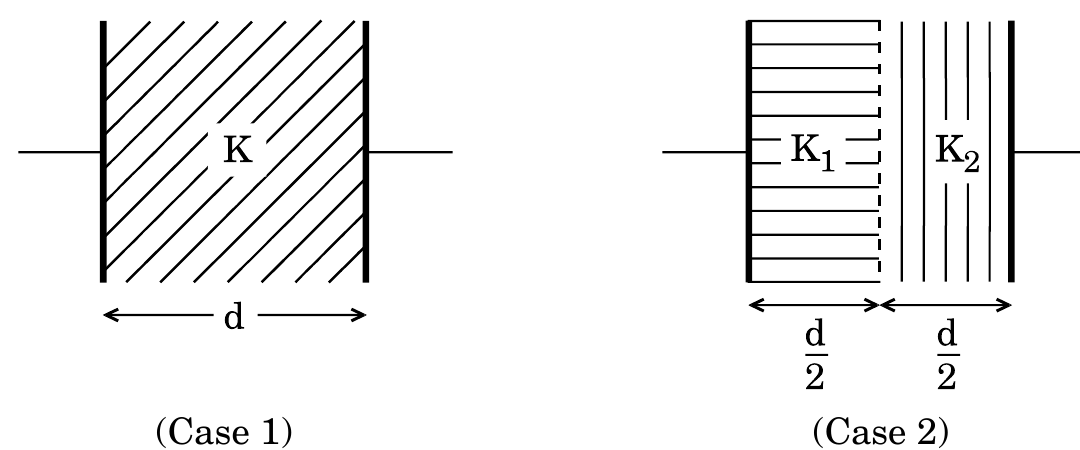
The space between the plates of a parallel plate capacitor is completely filled in two ways. In the first case, it is filled with a slab of dielectric constant K. In the second case, it is filled with two slabs of equal thickness and dielectric constants and respectively as shown in the figure. The capacitance of the capacitor is same in the two cases. Obtain the relationship between K, and .
Solution
Case 1: .
Case 2: two capacitors in series, each of thickness : and .
Setting :
3 marks: short answer
A parallel plate capacitor of capacitance C has a dielectric slab between its plates. It is charged to a potential difference V by connecting it across a battery. The battery is then disconnected. If the dielectric slab is now withdrawn from the capacitor, how will the following be affected? (a) Capacitance of the capacitor, (b) Energy stored in the capacitor, and (c) The potential difference between the plates of the capacitor. Justify your answer in each case.
Solution
With the battery disconnected, the charge stays constant. Let K be the dielectric constant.
(a) ; without the slab . Capacitance decreases K times.
(b) ; . Energy increases K times (work is done in pulling the slab out).
(c) . Potential difference increases K times.
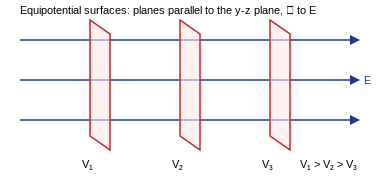
(a) An electric field exists in a region of space. Draw three equipotential surfaces in the region.
(b) Two point charges –q and +q are located at points (–a, 0, 0) and (a, 0, 0) respectively. Find the electrostatic potential at point (x, 0, 0) where .
Solution
(a) The equipotential surfaces are planes perpendicular to the field, i.e. parallel to the y-z plane, with the potential falling along +x.
(b) The point is at distance from +q and from –q:
For :
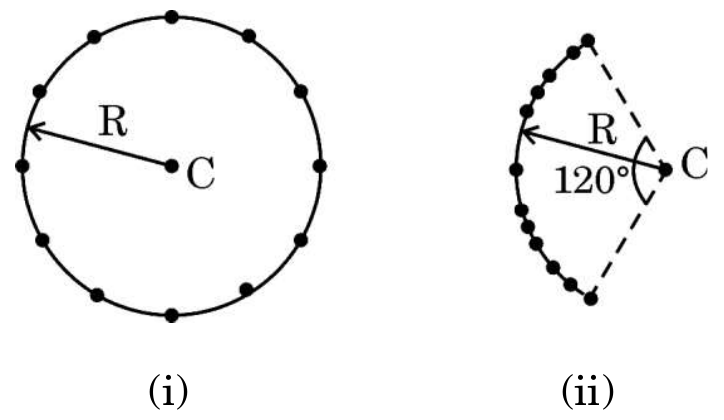
(a) Twelve negative charges of same magnitude are equally spaced and fixed on the circumference of a circle of radius R as shown in Fig. (i). Relative to potential being zero at infinity, find the electric potential and electric field at the centre C of the circle.
(b) If the charges are unequally spaced and fixed on an arc of 120° of radius R as shown in Fig. (ii), find electric potential at the centre C.
Solution
Let each charge be –q.
(a) Potential is a scalar and every charge is at distance R from C:
The field at C is zero: the charges are symmetric, so the field of each is cancelled by that of the charge diametrically opposite.
(b) Every charge is still at distance R from C, and potential does not depend on direction:
the same as in (a). (The field at C is no longer zero.)
Two charged conducting spheres of radii a and b are connected to each other by a wire. Find the ratio of the electric fields at their surfaces.
Solution
Connected spheres reach the same potential: , so .
Surface fields: , .
The field is larger at the surface of the smaller sphere (this is why charge leaks from sharp points).
A parallel plate capacitor (A) of capacitance C is charged by a battery to voltage V. The battery is disconnected and an uncharged capacitor (B) of capacitance 2C is connected across A. Find the ratio of (i) final charges on A and B. (ii) total electrostatic energy stored in A and B finally and that stored in A initially.
Solution
Initial charge . After connection the charge is shared until the potentials are equal. Total capacitance , so the common potential is .
(i) , , so .
(ii) ; .
(Two-thirds of the energy is lost as heat and radiation during the redistribution.)
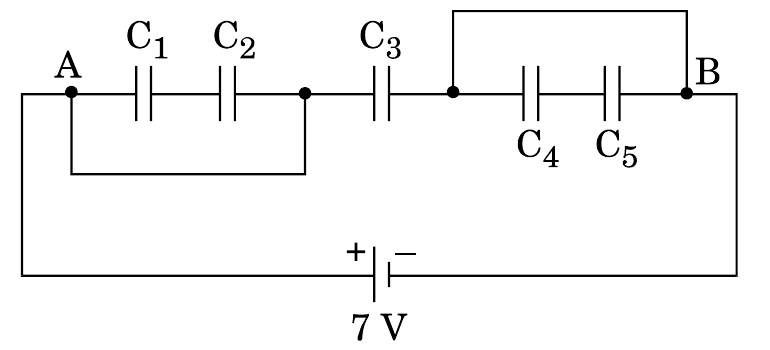
In the figure given below, find the (a) equivalent capacitance of the network between points A and B. Given: μF, μF. (b) maximum charge supplied by the battery, and (c) total energy stored in the network.
Solution
(a) The wire below and joins A directly to the right end of , so and are short-circuited. The wire above and shorts them too. Only remains between A and B:
(b) .
(c) .
(a) Draw the equipotential surfaces corresponding to a uniform electric field in the z-direction. (b) Derive an expression for the electric potential at any point along the axial line of an electric dipole.
A 200 μF parallel plate capacitor having plate separation of 5 mm is charged by a 100 V dc source. It remains connected to the source. Using an insulated handle, the distance between the plates is doubled and a dielectric slab of thickness 5 mm and dielectric constant 10 is introduced between the plates. Explain with reason, how the (i) capacitance, (ii) electric field between the plates, (iii) energy density of the capacitor will change?
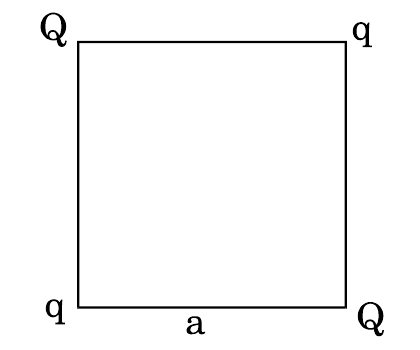
Four point charges Q, q, Q and q are placed at the corners of a square of side 'a' as shown in the figure. Find the (a) resultant electric force on a charge Q, and (b) potential energy of this system.
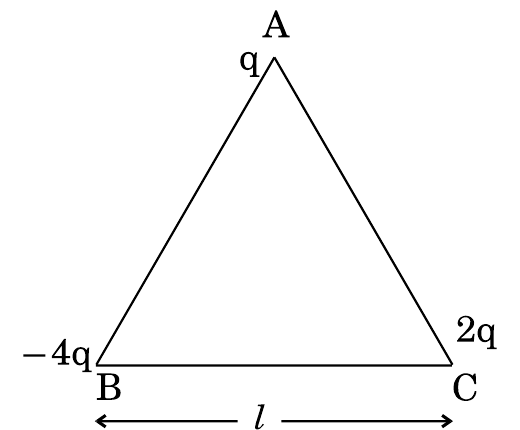
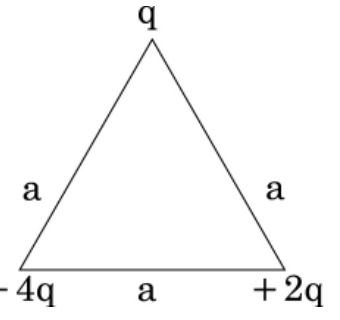
(a) Three point charges q, – 4q and 2q are placed at the vertices of an equilateral triangle ABC of side 'l' as shown in the figure. Obtain the expression for the magnitude of the resultant electric force acting on the charge q. (b) Find out the amount of the work done to separate the charges at infinite distance.
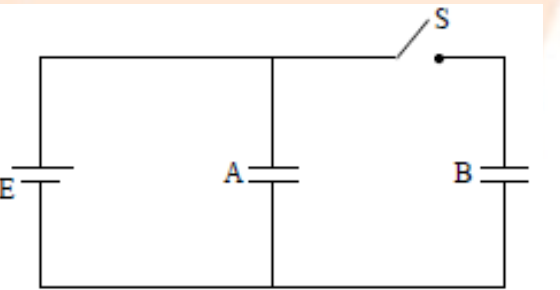
Two identical parallel plate capacitors A and B are connected to a battery of V volts with the switch S closed. The switch is now opened and the free space between the plates of the capacitors is filled with a dielectric of dielectric constant K. Find the ratio of the total electrostatic energy stored in both capacitors before and after the introduction of the dielectric.
4 marks: case-based / source-based
A circuit consisting of a capacitor C, a resistor of resistance R and an ideal battery of emf V, as shown in figure is known as RC series circuit.
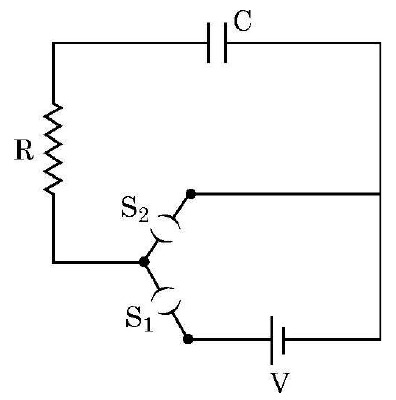
As soon as the circuit is completed by closing key (keeping open) charges begin to flow between the capacitor plates and the battery terminals. The charge on the capacitor increases and consequently the potential difference across the capacitor also increases with time. When this potential difference equals the potential difference across the battery, the capacitor is fully charged . During this process of charging, the charge q on the capacitor changes with time t as . The charging current can be obtained by differentiating it and using . Consider the case when R = 20 kΩ, C = 500 μF and V = 10 V.
(i) The final charge on the capacitor, when key is closed and is open, is
The key is closed and is open. The initial value of charging current in the resistor, is
Solution
(i) (B) 5 mC. C.
(ii) (A) Zero. With closed and the battery cut off, the capacitor discharges completely through R.
(iii) (D) [M⁰ L⁰ T A⁰]. RC is the time constant, so it has the dimensions of time.
(iv) (A) mA. . s and mA. At t = 5 s: mA.
OR (B) 0.5 mA. At t = 0: mA.
A parallel plate capacitor has two parallel plates which are separated by an insulating medium like air, mica, etc. When the plates are connected to the terminals of a battery, they get equal and opposite charges and an electric field is set up in between them. This electric field between the two plates depends upon the potential difference applied, the separation of the plates and nature of the medium between the plates.
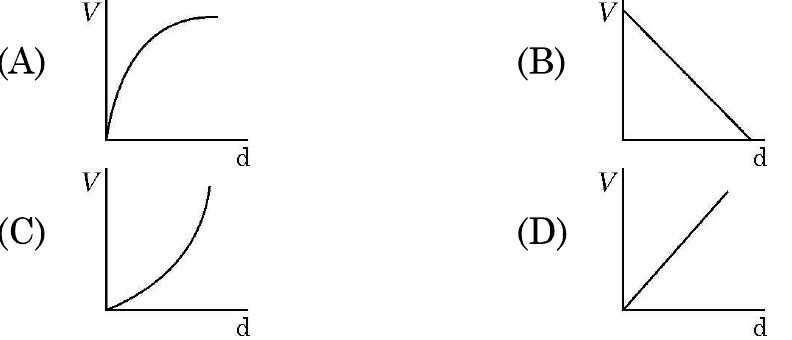
(i) The electric field between the plates of a parallel plate capacitor is E. Now the separation between the plates is doubled and simultaneously the applied potential difference between the plates is reduced to half of its initial value. The new value of the electric field between the plates will be
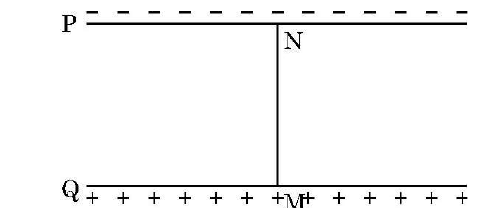
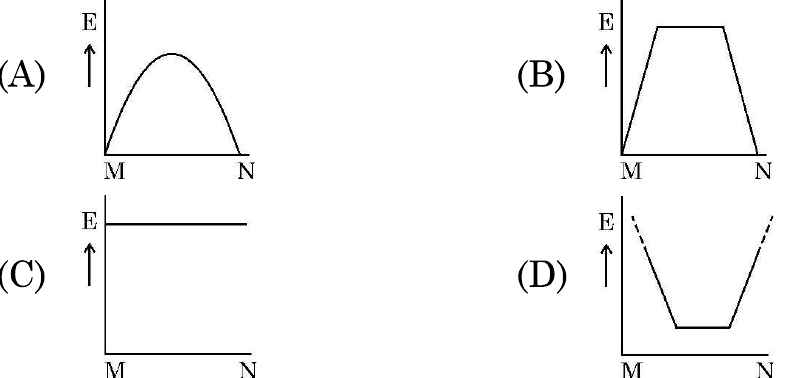
(iii) In the figure P, Q are the two parallel plates of a capacitor. Plate Q is at positive potential with respect to plate P. MN is an imaginary line drawn perpendicular to the plates. Which of the graphs shows correctly the variations of the magnitude of electric field strength E along the line MN?
(iv) Three parallel plates are placed above each other with equal displacement between neighbouring plates. The electric field between the first pair of the plates is and the electric field between the second pair of the plates is . The potential difference between the third and the first plate is
A material of dielectric constant K is filled in a parallel plate capacitor of capacitance C. The new value of its capacitance becomes
Solution
(i) (C) . , so .
(ii) (D). with E constant: V increases linearly with d, a straight line through the origin.
(iii) (C). The field between the plates of a parallel plate capacitor is uniform, so E is the same everywhere along MN.
(iv) (A) . The potential differences across the two gaps add: .
OR (C) CK. Filling the space with a dielectric multiplies the capacitance by K.
5 marks: long answer
(a) Derive an expression for the capacitance of a parallel plate capacitor of plate area A and plate separation d with air present between the plates.
(b) Two air-filled capacitors of capacitances and are connected in parallel with a dc battery. After the capacitors are fully charged, a slab of dielectric constant K is inserted between the plates of each capacitor. How will the (i) charge on each capacitor and (ii) energy stored in the capacitor affected after the slab is introduced.
Solution
(a)
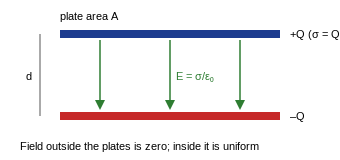
Let the plates carry charges +Q and –Q, so . Between the plates the fields of the two sheets add:
The field is uniform, so the potential difference is
(b) The battery stays connected, so V stays the same, and each capacitance becomes K times.
(i) : the charge on each capacitor becomes K times ( and ).
(ii) : the energy stored in each capacitor becomes K times.
(i) Two point charges 5 μC and –1 μC are placed at points (–3 cm, 0, 0) and (3 cm, 0, 0) respectively. An external electric field where V m is switched on in the region. Calculate the change in electrostatic energy of the system due to the electric field.
(ii) A system of two conductors is placed in air and they have net charge of +80 μC and –80 μC which causes a potential difference of 16 V between them. (1) Find the capacitance of the system. (2) If the air between the capacitor is replaced by a dielectric medium of dielectric constant 3, what will be the potential difference between the two conductors? (3) If the charges on two conductors are changed to +160 μC and –160 μC, will the capacitance of the system change? Give reason for your answer.
Solution
(i) The field corresponds to a potential (since ).
Without the field the energy is . With the field each charge also has energy :
Both charges are at m from the origin:
(ii) (1) .
(2) F, and the charge is unchanged: .
(3) No. Capacitance depends only on the size, shape and separation of the conductors and the medium between them, not on the charge. Doubling the charge doubles V, and stays 5 μF.
(i) Consider three metal spherical shells A, B and C, each of radius R. Each shell is having a concentric metal ball of radius R/10. The spherical shells A, B and C are given charges +6q, –4q, and 14q respectively. Their inner metal balls are also given charges –2q, +8q and –10q respectively. Compare the magnitude of the electric fields due to shells A, B and C at a distance 3R from their centres.
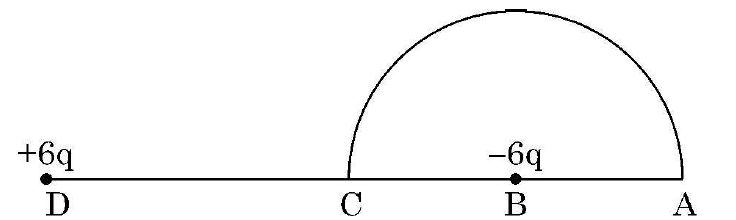
(ii) A charge –6 μC is placed at the centre B of a semicircle of radius 5 cm, as shown in the figure. An equal and opposite charge is placed at point D at a distance of 10 cm from B. A charge +5 μC is moved from point 'C' to point 'A' along the circumference. Calculate the work done on the charge.
Solution
(i) Outside all the charges (r = 3R), by Gauss's law the field depends only on the total charge enclosed, as if it were at the centre: .
A: ; B: ; C: .
All three enclose 4q, so for each: .
(ii) Charges: –6 μC at B and +6 μC at D, with BD = 10 cm. C is 5 cm from B and 5 cm from D; A is 5 cm from B and 15 cm from D.
Work done (by the external agent) in moving the charge from C to A, independent of the path:
(i) A small conducting sphere A of radius r charged to a potential V, is enclosed by a spherical conducting shell B of radius R. If A and B are connected by a thin wire, calculate the final potential on sphere A and shell B.
(ii) Write two characteristics of equipotential surfaces. A uniform electric field of 50 N C⁻¹ is set up in a region along +x axis. If the potential at the origin (0, 0) is 220 V, find the potential at a point (4 m, 3 m).
Solution
(i) Charge on A: . When A and B are joined, they form one conductor, and all the charge moves to its outer surface, the shell B.
Potential of the shell (and of A, which is now inside it and connected to it):
Final potential of both A and B .
(ii) Characteristics (any two): the potential is the same at every point of the surface; the field is everywhere perpendicular to it; no work is done in moving a charge along it; two equipotential surfaces never intersect.
The field is along +x, so only the x-coordinate matters: V.
(i) An electric dipole (dipole moment ), consisting of charges –q and q, separated by distance 2a, is placed along the x-axis, with its centre at the origin. Show that the potential V, due to this dipole, at a point x, is equal to .
(ii) Two isolated metallic spheres and of radii 1 cm and 3 cm respectively are charged such that both have the same charge density C/m². They are placed far away from each other and connected by a thin wire. Calculate the new charge on sphere .
Solution
(i) , so –q is at x = –a and +q at x = +a. At the point x on the axis:
For , , and :
(ii) Initial charges: .
C; C.
Total C. After connection the potentials are equal: , so the charge divides in the ratio of the radii (1 : 3):
(i) Obtain an expression for the electric potential due to a small dipole of dipole moment , at a point from its centre, for much larger distances compared to the size of the dipole.
(ii) Three point charges q, 2q and nq are placed at the vertices of an equilateral triangle. If the potential energy of the system is zero, find the value of n.
Solution
(i)
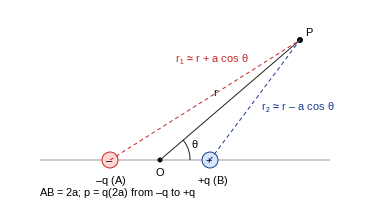
Charges –q at A and +q at B, separated by 2a; P is at distance r from the centre O, at angle θ with the dipole axis. Distances: , .
For : and , so
(On the axis, θ = 0: ; on the equatorial line, θ = 90°: V = 0.)
(ii) With side a:
(i) Consider two identical point charges located at points (0, 0) and (a, 0). (1) Is there a point on the line joining them at which the electric field is zero? (2) Is there a point on the line joining them at which the electric potential is zero? Justify your answers for each case.
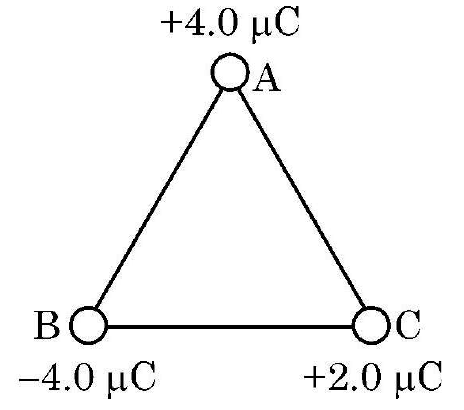
(ii) State the significance of negative value of electrostatic potential energy of a system of charges. Three charges are placed at the corners of an equilateral triangle ABC of side 2.0 m as shown in figure. Calculate the electric potential energy of the system of three charges.
(a) Find the expression for the potential energy of a system of two point charges and located at and , respectively in an external electric field .
(b) Draw equipotential surfaces due to an isolated point charge (– q) and depict the electric field lines.
(c) Three point charges + 1 μC, – 1 μC and + 2 μC are initially infinite distance apart. Calculate the work done in assembling these charges at the vertices of an equilateral triangle of side 10 cm.
(a) Two point charges and are kept r distance apart in a uniform external electric field . Find the amount of work done in assembling this system of charges.
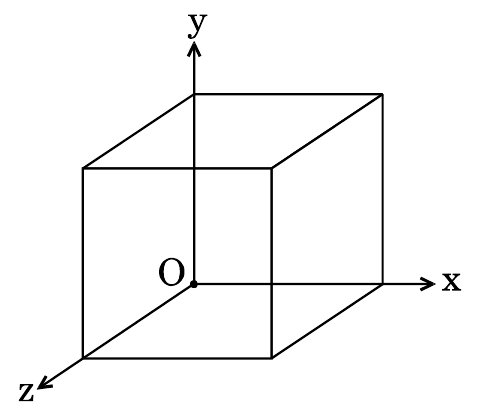
(b) A cube of side 20 cm is kept in a region as shown in the figure. An electric field exists in the region such that the potential at a point is given by V = 10x + 5, where V is in volt and x is in m. Find the (i) electric field , and (ii) total electric flux through the cube.
(a) Describe briefly the process of transferring the charge between the two plates of a parallel plate capacitor when connected to a battery. Derive an expression for the energy stored in a capacitor. (b) A parallel plate capacitor is charged by a battery to a potential difference V. It is disconnected from battery and then connected to another uncharged capacitor of the same capacitance. Calculate the ratio of the energy stored in the combination to the initial energy on the single capacitor.
(a) Distinguish, with the help of a suitable diagram, the difference in the behaviour of a conductor and a dielectric placed in an external electric field. How does polarised dielectric modify the original external field? (b) A capacitor of capacitance C is charged fully by connecting it to a battery of emf E. It is then disconnected from the battery. If the separation between the plates of the capacitor is now doubled, how will the following change? (i) charge stored by the capacitor. (ii) field strength between the plates. (iii) energy stored by the capacitor. Justify your answer in each case.
(a) Explain why, for any charge configuration, the equipotential surface through a point is normal to the electric field at that point. Draw a sketch of equipotential surfaces due to a single charge (– q), depicting the electric field lines due to the charge. (b) Obtain an expression for the work done to dissociate the system of three charges placed at the vertices of an equilateral triangle of side 'a' as shown below.
Get every solution for all chapters
- Every board question of every chapter, each fully solved the way the board gives marks
- 19 complete board papers, each followed by its solutions
- Weightage and most-asked topics for every chapter
- Instant PDF download, colour and black & white print copies
Revising the chapter first? Complete Physics Notes for Class 12 (NCERT 2026-27, CBSE Board 2027) →
What you get in the pack
- Questions from 138 CBSE papers, 2016 to 2026: every set code available
- Complete: 2262 different questions and parts from all set codes, 14 chapters and 19 full papers
- Part A: all 14 chapters, questions sorted chapter-wise and by marks
- Year-wise weightage table and most-asked topics for every chapter
- Part B: 19 full board papers, each followed by its complete solutions
- Derivations, numericals, ray and circuit diagrams worked the way the board awards marks
- Questions on topics out of the board syllabus flagged
All chapters in this pack
- PYQ Ch 1 Electric Charges and Fields
- PYQ Ch 2 Electrostatic Potential and Capacitance
- PYQ Ch 3 Current Electricity
- PYQ Ch 4 Moving Charges and Magnetism
- PYQ Ch 5 Magnetism and Matter
- PYQ Ch 6 Electromagnetic Induction
- PYQ Ch 7 Alternating Current
- PYQ Ch 8 Electromagnetic Waves
- PYQ Ch 9 Ray Optics and Optical Instruments
- PYQ Ch 10 Wave Optics
- PYQ Ch 11 Dual Nature of Radiation and Matter
- PYQ Ch 12 Atoms
- PYQ Ch 13 Nuclei
- PYQ Ch 14 Semiconductor Electronics
- Board Paper 2026 Set 55-1-1 with Solutions
- Board Paper 2026 Set 55-1-2 with Solutions
- Board Paper 2026 Set 55-1-3 with Solutions
- Board Paper 2026 Set 55-2-1 with Solutions
- Board Paper 2025 Set 55-1-1 with Solutions
- Board Paper 2025 Set 55-2-1 with Solutions
- Board Paper 2024 Set 55-1-1 with Solutions
- Board Paper 2024 Set 55-2-1 with Solutions
- Board Paper 2023 Set 55-1-1 with Solutions
- Board Paper 2023 Set 55-2-1 with Solutions
- Board Paper 2022 Term 2 Set 55-1-1 with Solutions
- Board Paper 2022 Term 2 Set 55-2-1 with Solutions
- Board Paper 2020 Set 55-1-1 with Solutions
- Board Paper 2020 Set 55-2-1 with Solutions
- Board Paper 2019 Set 55-1-1 with Solutions
- Board Paper 2019 Set 55-2-1 with Solutions
- Board Paper 2018 Set 55-1 with Solutions
- Board Paper 2017 Set 55-1 with Solutions
- Board Paper 2016 Set 55-1 with Solutions