
Wave Optics: Class 12 PYQs 2016–2026 with solutions
All 42 CBSE board questions asked from Wave Optics in 17 board papers, with the year, set and marks of each. 23 are solved free below. The Class 12 Physics PYQ Book: Solved Board Papers 2016-2026 (CBSE) has every solution, all chapters and 19 full board papers.
Subject experts: Khushbu Gupta (B.Sc., M.Sc. Physics, B.Ed.) and Vinay Wadhwani (B.Tech Electrical Engineering)



Free: NCERT solutions for Class 12 Physics →
Wave Optics: board weightage
Board weightage 2016–2026
| Year | 2016 | 2017 | 2018 | 2019 | 2020 | 2022 | 2023 | 2024 | 2025 | 2026 |
|---|---|---|---|---|---|---|---|---|---|---|
| Questions | 2 | 2 | 2 | 4 | 5 | 4 | 7 | 4 | 5 | 7 |
| Marks | 8 | 7 | 8 | 16 | 12 | 16 | 18 | 14 | 16 | 14 |
Most asked topics
42 questions from 17 papers. Repeated questions are shown once with every year they were asked.
Jump to: 1 mark2 marks3 marks5 marks
1 mark: MCQ and Assertion–Reason
The shape of the interference fringes in Young's double-slit experiment, when the distance between the slit and the screen is very large as compared to the slit-separation, is nearly
Solution
Answer: (A) straight
The fringes are strictly hyperbolic, but when the part of each hyperbola on the screen is practically a straight line, so the fringes appear as straight bright and dark bands.
Four independent waves are expressed as (i) (ii) (iii) (iv) . The interference between two of these waves is possible in
Solution
Answer: (C) (i), (iii) and (iv) only
Sustained interference needs the same frequency and a constant phase difference. Waves (i), (iii) and (iv) all have angular frequency with fixed phase differences ( and ). Wave (ii) has frequency , so it cannot interfere steadily with the others.
Assertion (A): Light added to light can produce darkness.
Reason (R): When two coherent light waves interfere, there is darkness at position of destructive interference.
Solution
Answer: (A) Both A and R are true and R is the correct explanation of A.
Where two coherent waves meet out of phase (path difference ), they cancel and give a dark fringe. This is why light added to light can give darkness.
Assertion (A): The phase difference between any two points on a wavefront is zero.
Reason (R): All points on a wavefront are at the same distance from the source and thus oscillate in the same phase.
Solution
Answer: (a) Both A and R are true and R is the correct explanation of A.
A wavefront is the locus of points in the same phase; for a point source these points are equidistant from the source, so the disturbance reaches them at the same time.
Assertion (A): In Young's double slit experiment all fringes are of equal width.
Reason (R): The fringe width depends upon wavelength of light (λ) used, distance of screen from plane of slits (D) and slits separation (d).
Fill in the blank: In Young's double slit experiment, the path difference between two interfering waves at a point on the screen is , λ being wavelength of the light used. The ________ dark fringe will lie at this point.
Fill in the blank: If one of the slits in Young's double slit experiment is fully closed, the new pattern has ________ central maximum in angular size.
2 marks: very short answer
A beam of light consisting of two wavelengths 400 nm and 600 nm is used to illuminate a single slit of width 1 mm. Find the least distance of the point from the central maximum where the dark fringes due to both wavelengths coincide on the screen placed 1.5 m from the slit.
Solution
Minima of a single slit: , at .
For coincidence : . The smallest whole numbers are , .
(Check: mm.)
In a Young's double-slit experimental set-up with slit separation 0.6 mm a beam of light consisting of two wavelengths 440 nm and 660 nm is used to obtain interference pattern on a screen kept 1.5 m in front of the slits. Find the least distance of the point from the central maximum where the bright fringes due to both the wavelengths coincide.
Solution
Bright fringes: . For coincidence : , so , .
In a Young's double-slit experiment, a beam of light consisting of two wavelengths 500 nm and 600 nm is used. The interference fringes are observed at a screen placed 1.8 m away from the plane of slits (slit separation 0.3 mm). Calculate the least distance from the central maximum where the bright fringes due to both the wavelengths coincide.
Solution
Bright fringes coincide when : , so , .
In a diffraction experiment, the slit is illuminated by light of wavelength 600 nm. The first minimum of the pattern falls at θ = 30°. Calculate the width of the slit.
Solution
Minima of single-slit diffraction: . For the first minimum, n = 1:
In a Young's double-slit experiment, two light waves, each of intensity , interfere at a point, having a path difference on the screen. Find the intensity at this point.
Solution
Phase difference .
(Equivalently .)
In a double-slit experiment, 6th dark fringe is observed at a certain point of the screen. A transparent sheet of thickness t and refractive index n is now introduced in the path of one of the two interfering waves to increase its phase by . The pattern is shifted and 8th bright fringe is observed at the same point. Find the relation for thickness t in terms of n and λ.
Solution
Path difference for the 6th dark fringe: (phase difference 11π).
Path difference for the 8th bright fringe: (phase difference 16π).
The sheet adds a path difference of :
Two waves, each of amplitude 'a' and frequency 'ω' emanating from two coherent sources of light superpose at a point. If the phase difference between the two waves is φ, obtain an expression for the resultant intensity at that point.
Solution
Let and . By superposition:
The resultant amplitude is . Intensity is proportional to amplitude squared:
Maximum for φ = 0, 2π, …; zero for φ = π, 3π, …
What is the effect on the interference pattern in Young's double-slit experiment when (i) the source slit is moved closer to the plane of the slits, and (ii) the separation between the two slits is increased? Justify your answers.
Using Huygens' principle, draw a ray diagram showing the propagation of a plane wave refracting at a plane surface separating two media. Also verify Snell's law of refraction.
Two coherent monochromatic light beams of intensities I and 4I superpose each other. Find the ratio of maximum and minimum intensities in the resulting beam.
What happens to the interference pattern when two coherent sources are (a) infinitely close, and (b) far apart from each other?
Define wavefront of a travelling wave. Using Huygens principle, obtain the law of refraction at a plane interface when light passes from a denser to rarer medium.
Draw the intensity pattern for single slit diffraction and double slit interference. Hence, state two differences between interference and diffraction patterns.
3 marks: short answer
A parallel beam of light of wavelength 600 nm is incident normally on a slit of width 0.2 mm. If the resulting diffraction pattern is observed on a screen 1 m away, find the distance of (i) first minimum, and (ii) second maximum, from the central maximum.
Solution
(i) Minima: . For n = 1:
(ii) Secondary maxima lie roughly midway between minima, at . For the second maximum, n = 2:
A plane wavefront of light of wavelength 'λ' is incident normally on a narrow slit of width 'a' and a diffraction pattern is observed on a screen at a distance 'D' from the slit. (i) Depict the intensity distribution in the pattern observed. (ii) Obtain the expression for the first maximum from the central maximum.
Solution
(i)
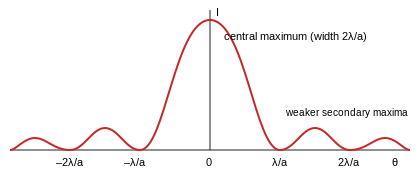
(ii) Divide the slit into three equal parts. When the path difference between the two edges is , the wavelets from two of the parts cancel each other and the third part gives some light: this is the first secondary maximum.
Its distance from the central maximum on the screen is
What is the effect on the interference fringes in Young's double slit experiment due to each of the following operations? Justify your answers. (a) The screen is moved away from the plane of the slits. (b) The separation between slits is increased. (c) The source slit is moved closer to the plane of double slit.
Solution
.
(a) D increases, so the fringe width increases (the angular separation λ/d stays the same).
(b) d increases, so the fringe width decreases; the fringes come closer together.
(c) The fringes become less sharp and may disappear: when the source slit is close, its width s subtends a larger angle, and when (S = distance of the source slit), the patterns from different parts of the source overlap. The fringe width does not change.
Define the term wavefront. Using Huygen's wave theory, verify the law of reflection.
Solution
A wavefront is the locus of all points that oscillate in the same phase.
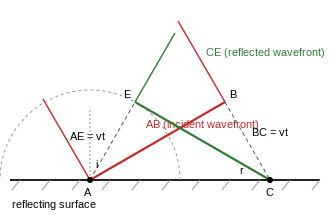
A plane wavefront AB meets the reflecting surface at A at angle i. In the time t that B takes to reach C (BC = vt), the secondary wavelet from A spreads to radius AE = vt. The tangent CE to this wavelet is the reflected wavefront, at angle r.
Right triangles ABC and AEC have the common hypotenuse AC and BC = AE, so they are congruent: i = r. The incident and reflected rays and the normal lie in one plane, which verifies the laws of reflection.
Define the term, "refractive index" of a medium. Verify Snell's law of refraction when a plane wavefront is propagating from a denser to a rarer medium.
(a) If one of two identical slits producing interference in Young's experiment is covered with glass, so that the light intensity passing through it is reduced to 50%, find the ratio of the maximum and minimum intensity of the fringe in the interference pattern. (b) What kind of fringes do you expect to observe if white light is used instead of monochromatic light?
(i) Derive Snell's law on the basis of Huygen's wave theory when light is travelling from a denser to a rarer medium. (ii) Draw the sketches to differentiate between plane wavefront and spherical wavefront.
5 marks: long answer
(a) What are coherent sources? Why they are necessary for observing stable interference pattern? Draw a graph showing the variation of intensity of light with the position on the screen in Young's double-slit experiment.
(b) Find the intensity of light at a point on the screen when two interfering waves of the same intensity have a path difference of (i) and (ii) .
Solution
(a) Two sources are coherent if they emit waves of the same frequency with a constant (or zero) phase difference.
If the sources are incoherent, the phase difference at each point changes rapidly and randomly with time, so the positions of maxima and minima keep shifting and only an average uniform intensity is seen. With coherent sources the phase difference at each point stays fixed, giving a stable interference pattern.
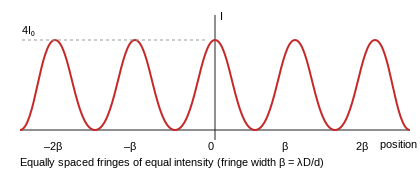
(b) For two waves of intensity : , with .
(i) : , so .
(ii) : , so .
(i) (1) What are coherent sources? Why are they necessary for observing a sustained interference pattern? (2) Lights from two independent sources are not coherent. Explain.
(ii) Two slits 0.1 mm apart are arranged 1.20 m from a screen. Light of wavelength 600 nm from a distant source is incident on the slits. (1) How far apart will adjacent bright interference fringes be on the screen? (2) Find the angular width (in degree) of the first bright fringe.
Solution
(i) (1) Two sources are coherent if they emit waves of the same frequency with a constant (zero or fixed) phase difference. A sustained pattern needs the phase difference at each point to stay constant; otherwise the bright and dark positions keep shifting and only uniform illumination is seen.
(2) In an ordinary source, light is emitted by millions of atoms independently, each for about s, with random phases. The phase of two independent sources changes randomly and independently, so their phase difference is not constant; they cannot be coherent.
(ii) (1) Fringe width:
(2) Angular width:
(i) Light consisting of two wavelengths 600 nm and 480 nm is used to obtain interference fringes in a double slit experiment. The screen is placed 1.0 m away from slits which are 1.0 nm apart. (1) Calculate the distance of the third bright fringe on the screen from the central maximum for wavelength 600 nm. (2) Find the least distance from the central maximum where the bright fringes due to both the wavelengths coincide.
(ii) (1) Draw the variation of intensity with angle of diffraction in single slit diffraction pattern. Write the expression for value of angle corresponding to zero intensity locations. (2) In what way diffraction of light waves differs from diffraction of sound waves?
Solution
(i) (1) . Taking d = 1.0 nm as printed:
(The marking scheme uses the printed value. The intended separation was clearly 1.0 mm, which gives mm.)
(2) Coincidence: : , so : the 4th bright fringe of 600 nm coincides with the 5th of 480 nm.
(With d = 1.0 mm, this is 2.4 mm.)
(ii) (1)
Zero intensity (minima) occurs at , n = ±1, ±2, …
(2) Diffraction is noticeable only when the obstacle or opening is comparable to the wavelength. Sound waves have wavelengths of about a metre, similar to doors and walls, so they bend around them easily. Light has a wavelength of about m, so its diffraction is seen only with very narrow slits or sharp edges and is not noticed in daily life.
(i) State Huygens' principle. A plane wave is incident at an angle i on a reflecting surface. Construct the corresponding reflected wavefront. Using this diagram, prove that the angle of reflection is equal to the angle of incidence.
(ii) What are the coherent sources of light? Can two independent sodium lamps act like coherent sources? Explain.
(iii) A beam of light consisting of a known wavelength 520 nm and an unknown wavelength λ, used in Young's double slit experiment produces two interference patterns such that the fourth bright fringe of unknown wavelength coincides with the fifth bright fringe of known wavelength. Find the value of λ.
Solution
(i) Huygens' principle: every point of a wavefront acts as a source of secondary wavelets that spread out in all directions with the speed of the wave; the new wavefront at a later time is the forward envelope (common tangent) of these wavelets.
A plane wavefront AB meets the surface at A at angle i. In the time t that the point B takes to reach C (BC = vt), the wavelet from A spreads to a sphere of radius AE = vt. The tangent CE from C to this wavelet is the reflected wavefront, making angle r with the surface.
In right triangles ABC and AEC: the hypotenuse AC is common and BC = AE = vt, so the triangles are congruent. Hence ∠BAC = ∠ECA, i.e. i = r.
(ii) Coherent sources emit waves of the same frequency with a constant (or zero) phase difference.
Two independent sodium lamps cannot be coherent. Light from each lamp comes from millions of atoms emitting independently in short bursts (about s) with random phases, so the phase difference between the two lamps changes randomly and rapidly. No stable interference pattern is seen.
(iii) Coincidence of bright fringes: nm.
(i) Give any two differences between the interference pattern obtained in Young's double-slit experiment and a diffraction pattern due to a single slit.
(ii) Draw an intensity distribution graph in case of a double-slit interference pattern.
(iii) In Young's double-slit experiment using monochromatic light of wavelength λ, the intensity of light at a point on the screen, where path difference is λ, is K units. Find the intensity of light at a point on the screen where the path difference is .
Solution
(i) Any two:
| Interference (double slit) | Diffraction (single slit) |
|---|---|
| Due to superposition of waves from two coherent sources. | Due to superposition of wavelets from different parts of the same wavefront. |
| Fringes are of equal width. | The central maximum is twice as wide as the other maxima. |
| All bright fringes have (nearly) the same intensity. | The intensity of the maxima falls off rapidly away from the centre. |
| Dark fringes are perfectly dark. | Minima are not perfectly dark in practice; many fringes are not visible. |
(ii)
(iii) , with .
Path difference λ: φ = 2π, .
Path difference : :
(i) (1) Write two points of difference between an interference pattern and a diffraction pattern. (2) Name any two factors on which the fringe width in a Young's double-slit experiment depends.
(ii) In Young's double-slit experiment, the two slits are separated by a distance equal to 100 times the wavelength of light that passes through the slits. Calculate: (1) the angular separation in radians between the central maximum and the adjacent maximum. (2) the distance between these two maxima on a screen 50 cm from the slits.
Solution
(i) (1) Any two:
| Interference | Diffraction (single slit) |
|---|---|
| Superposition of waves from two coherent sources. | Superposition of wavelets from different points of the same wavefront. |
| Fringes of equal width. | Central maximum twice as wide as the others. |
| Bright fringes of equal intensity. | Intensity of maxima decreases rapidly away from the centre. |
(2) Fringe width : it depends on the wavelength λ, the distance D of the screen and the separation d of the slits (any two).
(ii) (1) .
(2) .
(i) State Huygen's principle. With the help of a diagram, show how a plane wave is reflected from a surface. Hence verify the law of reflection.
(ii) A concave mirror of focal length 12 cm forms a three times magnified virtual image of an object. Find the distance of the object from the mirror.
Solution
(i) Huygens' principle: every point of a wavefront is a source of secondary wavelets that spread out in all directions with the speed of the wave; the common tangent (forward envelope) of these wavelets gives the new position of the wavefront at a later time.
A plane wavefront AB meets the surface at A at angle i. While B travels to C (BC = vt), the wavelet from A spreads to radius AE = vt. The tangent CE is the reflected wavefront, at angle r.
Triangles ABC and AEC are right-angled with the common hypotenuse AC and BC = AE, so they are congruent; hence i = r.
(ii) Virtual image: m = +3, f = –12 cm. .
The object is 8 cm in front of the mirror.
The principle of superposition is used to understand the phenomenon of interference of light waves. The principle states that at a particular point, the resultant displacement produced by a number of waves is the vector sum of the displacements produced by each wave. Light waves from two coherent sources produce interference pattern. Thomas Young devised a way to obtain two coherent sources using two identical pinholes ( and ) illuminated by a single monochromatic pinhole source S. Using these sources in his experiment known as Young's double slit experiment, Young studied the interference pattern. The pattern consists of alternate bright and dark fringes. The distance between two successive bright or dark fringes depends on the distance between and , the distance of the screen from the plane of and the wavelength of light used.
I. Consider the following waves: (i) (ii) (iii) (iv) . Which pair of the waves coming from two sources and will produce interference?
Solution
I. (B) (ii) and (iii). Sustained interference needs the same frequency and a constant phase difference: and both have angular frequency 2ω and a fixed phase difference φ.
II. (C) . Path difference λ/4 gives phase difference : .
III. (D) . Fringe width ∝ λ, and .
IV. (C) 640 nm. m.
V. (C). Angular separation does not depend on D (constant in (i)) and decreases when d increases (ii).
The British physicist Thomas Young explained the interference of light using the principle of superposition of waves. He observed the interference pattern on the screen, in his experimental set-up of Young's double slit experiment. The two slits and were illuminated by light from a slit S. The interference pattern consists of dark and bright bands of light. Such bands are called fringes. The distance between two consecutive bright and dark fringes is called fringe width.
(a) If the screen is moved closer to the plane of slits and , then the fringe width: (i) will decrease, but the intensity of bright fringe remains the same. (ii) will increase, but the intensity of bright fringe decreases. (iii) will decrease, but the intensity of bright fringe increases. (iv) and the intensity both remain the same.
(b) What will happen to the pattern on the screen, when the two slits and are replaced by two independent but identical sources? (i) The intensity of pattern will increase (ii) The intensity of pattern will decrease (iii) The number of fringes will become double (iv) No pattern will be observed on the screen
(c) Two sources of light are said to be coherent, when both emit light waves of: (i) same amplitude and have a varying phase difference. (ii) same wavelength and a constant phase difference. (iii) different wavelengths and same intensity. (iv) different wavelengths and a constant phase difference.
(d) The fringe width in a Young's double slit experiment is β. If the whole set-up is immersed in a liquid of refractive index 'μ', then the new fringe width will be: (i) β (ii) βμ (iii) (iv)
(e) The total path difference between two waves meeting at points and on the screen are and 2λ respectively. Then: (i) bright fringes are formed at both points. (ii) dark fringes are formed at both points. (iii) a bright fringe is formed at and a dark fringe is formed at . (iv) a bright fringe is formed at and a dark fringe is formed at .
(a) What is a wavefront? How does it propagate? Using Huygens' principle, explain reflection of a plane wavefront from a surface and verify the laws of reflection.
(b) A parallel beam of light of wavelength 500 nm falls on a narrow slit and the resulting diffraction pattern is obtained on a screen 1 m away. If the first minimum is formed at a distance of 2.5 mm from the centre of the screen, find the (i) width of the slit, and (ii) distance of first secondary maximum from the centre of the screen.
(a) Describe any two characteristic features which distinguish between interference and diffraction phenomena. Derive the expression for the intensity at a point of the interference pattern in Young's double slit experiment. (b) In the diffraction due to a single slit experiment, the aperture of the slit is 3 mm. If monochromatic light of wavelength 620 nm is incident normally on the slit, calculate the separation between the first order minima and the 3rd order maxima on one side of the screen. The distance between the slit and the screen is 1.5 m.
(a) Why cannot the phenomenon of interference be observed by illuminating two pin holes with two sodium lamps? (b) Two monochromatic waves having displacements and from two coherent sources interfere to produce an interference pattern. Derive the expression for the resultant intensity and obtain the conditions for constructive and destructive interference. (c) Two wavelengths of sodium light of 590 nm and 596 nm are used in turn to study the diffraction taking place at a single slit of aperture m. If the distance between the slit and the screen is 1.5 m, calculate the separation between the positions of the second maxima of diffraction pattern obtained in the two cases.
(a) Define a wavefront. Using Huygens' principle, verify the laws of reflection at a plane surface. (b) In a single slit diffraction experiment, the width of the slit is made double the original width. How does this affect the size and intensity of the central diffraction band? Explain. (c) When a tiny circular obstacle is placed in the path of light from a distant source, a bright spot is seen at the centre of the obstacle. Explain why.
(a) Define wavefront. Use Huygens' principle to verify the laws of refraction. (b) How is linearly polarised light obtained by the process of scattering of light? Find the Brewster angle for air – glass interface, when the refractive index of glass = 1.5
(a) Derive an expression for path difference in Young's double slit experiment and obtain the conditions for constructive and destructive interference at a point on the screen. (b) The intensity at the central maxima in Young's double slit experiment is . Find out the intensity at a point where the path difference is , and .
Get every solution for all chapters
- Every board question of every chapter, each fully solved the way the board gives marks
- 19 complete board papers, each followed by its solutions
- Weightage and most-asked topics for every chapter
- Instant PDF download, colour and black & white print copies
Revising the chapter first? Complete Physics Notes for Class 12 (NCERT 2026-27, CBSE Board 2027) →
What you get in the pack
- Questions from 138 CBSE papers, 2016 to 2026: every set code available
- Complete: 2262 different questions and parts from all set codes, 14 chapters and 19 full papers
- Part A: all 14 chapters, questions sorted chapter-wise and by marks
- Year-wise weightage table and most-asked topics for every chapter
- Part B: 19 full board papers, each followed by its complete solutions
- Derivations, numericals, ray and circuit diagrams worked the way the board awards marks
- Questions on topics out of the board syllabus flagged
All chapters in this pack
- PYQ Ch 1 Electric Charges and Fields
- PYQ Ch 2 Electrostatic Potential and Capacitance
- PYQ Ch 3 Current Electricity
- PYQ Ch 4 Moving Charges and Magnetism
- PYQ Ch 5 Magnetism and Matter
- PYQ Ch 6 Electromagnetic Induction
- PYQ Ch 7 Alternating Current
- PYQ Ch 8 Electromagnetic Waves
- PYQ Ch 9 Ray Optics and Optical Instruments
- PYQ Ch 10 Wave Optics
- PYQ Ch 11 Dual Nature of Radiation and Matter
- PYQ Ch 12 Atoms
- PYQ Ch 13 Nuclei
- PYQ Ch 14 Semiconductor Electronics
- Board Paper 2026 Set 55-1-1 with Solutions
- Board Paper 2026 Set 55-1-2 with Solutions
- Board Paper 2026 Set 55-1-3 with Solutions
- Board Paper 2026 Set 55-2-1 with Solutions
- Board Paper 2025 Set 55-1-1 with Solutions
- Board Paper 2025 Set 55-2-1 with Solutions
- Board Paper 2024 Set 55-1-1 with Solutions
- Board Paper 2024 Set 55-2-1 with Solutions
- Board Paper 2023 Set 55-1-1 with Solutions
- Board Paper 2023 Set 55-2-1 with Solutions
- Board Paper 2022 Term 2 Set 55-1-1 with Solutions
- Board Paper 2022 Term 2 Set 55-2-1 with Solutions
- Board Paper 2020 Set 55-1-1 with Solutions
- Board Paper 2020 Set 55-2-1 with Solutions
- Board Paper 2019 Set 55-1-1 with Solutions
- Board Paper 2019 Set 55-2-1 with Solutions
- Board Paper 2018 Set 55-1 with Solutions
- Board Paper 2017 Set 55-1 with Solutions
- Board Paper 2016 Set 55-1 with Solutions