
Atoms: Class 12 PYQs 2016–2026 with solutions
All 38 CBSE board questions asked from Atoms in 17 board papers, with the year, set and marks of each. 19 are solved free below. The Class 12 Physics PYQ Book: Solved Board Papers 2016-2026 (CBSE) has every solution, all chapters and 17 full board papers.

Free: NCERT solutions for Class 12 Physics →
Atoms: board weightage
Board weightage 2016–2026
| Year | 2016 | 2017 | 2018 | 2019 | 2020 | 2022 | 2023 | 2024 | 2025 | 2026 |
|---|---|---|---|---|---|---|---|---|---|---|
| Questions | 2 | 1 | 1 | 5 | 4 | 4 | 6 | 5 | 5 | 5 |
| Marks | 4 | 2 | 3 | 11 | 6 | 10 | 10 | 9 | 6 | 7 |
Most asked topics
38 questions from 17 papers. Repeated questions are shown once with every year they were asked.
1 mark: MCQ and Assertion–Reason
The 'distance of closest approach' of an alpha-particle is 'd' when it moves with a velocity v head-on towards the target nucleus. If the velocity of alpha particle is halved, the new 'distance of closest approach' will be
Solution
Answer: (D) 4d
At closest approach all kinetic energy becomes potential energy: , so .
Halving v makes one-fourth, so .
Assertion (A): In Bohr model of hydrogen atom, the energy levels are discrete and quantised.
Reason (R): In a hydrogen atom, the electrostatic force on the electron provides the necessary centripetal force to it to revolve around the nucleus.
Solution
Answer: (B) Both A and R are true, but R is not the correct explanation of A.
The energy levels are discrete because of Bohr's quantum condition . The electrostatic force acting as centripetal force is true, but on its own it allows any orbit; it does not explain quantisation.
In Bohr model of hydrogen atom, for large values of n, the distance between the consecutive orbits is proportional to
Solution
Answer: (B) n
, so for large n. The spacing is proportional to n.
In Bohr model of hydrogen atom, the electron makes a transition from n = 5 to n = 1 state. As a result, a photon of wavelength is emitted in the process. The wavelength of the photon emitted when an electron makes a transition from energy level n = 5 to n = 2 will be
Solution
Answer: (D)
and .
Assertion (A): The potential energy of an electron revolving in any stationary orbit in a hydrogen atom is positive.
Reason (R): The total energy of a charged particle is always positive.
Solution
Answer: (D) Both A and R are false.
The electron and the proton attract, so the potential energy is negative. The total energy of a bound electron, , is also negative.
Atomic spectral emission lines of hydrogen atom are incident on a zinc surface. The lines which can emit photoelectrons from the surface are members of
Solution
Answer: (C) Lyman series
The work function of zinc is about 4.3 eV. Lyman lines (transitions to n = 1) have energies from 10.2 eV to 13.6 eV, which exceed it. Balmer photons (at most 3.4 eV) and Paschen photons (at most 1.5 eV) are too weak.
The energy of an electron in a hydrogen atom in ground state is –13.6 eV. Its energy in an orbit corresponding to quantum number n is –0.544 eV. The value of n is
Solution
Answer: (D) 5
: , so .
Assertion (A): In Bohr model of hydrogen atom, the angular momentum of an electron in orbit is proportional to the square root of its orbit radius .
Reason (R): According to Bohr model, electron can jump to its nearest orbits only.
Solution
Answer: (C) A is true, but R is false.
and , so : A is true. The electron can jump between any two allowed orbits, not just neighbouring ones, so R is false.
The transition of electron that gives rise to the formation of the second spectral line of the Balmer series in the spectrum of hydrogen atom corresponds to
Energy levels A, B and C of an atom correspond to increasing values of energy i.e. . Let , and be the wavelengths of radiation corresponding to the transitions C to B, B to A and C to A, respectively. The correct relation between , and is
An alpha particle approaches a gold nucleus in Geiger-Marsden experiment with kinetic energy K. It momentarily stops at a distance d from the nucleus and reverses its direction. Then d is proportional to
The radius of the orbit in Bohr model of hydrogen atom is proportional to
Hydrogen atom initially in the ground state, absorbs a photon which excites it to n = 5 level. The wavelength of the photon is
A hydrogen atom makes a transition from n = 5 to n = 1 orbit. The wavelength of photon emitted is λ. The wavelength of photon emitted when it makes a transition from n = 5 to n = 2 orbit is
Which of the following statements is not correct according to Rutherford model?
Fill in the blank: According to Bohr's atomic model, the circumference of the electron orbit is always an ________ multiple of de Broglie wavelength.
2 marks: very short answer
Prove that, in Bohr model of hydrogen atom, the time period of revolution of an electron in orbit is proportional to .
Solution
…(1)
Bohr's condition gives …(2)
From (1) and (2): .
In Bohr's model , so :
(Alternatively: and , so .)
The ground state energy of hydrogen atom is –13.6 eV. What is the potential energy and kinetic energy of an electron in the third excited state?
Solution
Third excited state means n = 4. Total energy eV.
In Bohr's model, KE = –E and PE = 2E:
Kinetic energy eV; potential energy .
What is meant by ionisation energy? Write its value for hydrogen atom.
Solution
Ionisation energy is the minimum energy needed to remove an electron from the ground state of an atom to infinity (i.e. to make it free).
For hydrogen: .
Draw the graph showing the variation of the number (N) of scattered alpha particles with scattering angle (θ) in Geiger – Marsden experiment. Infer two conclusions from the graph.
Solution
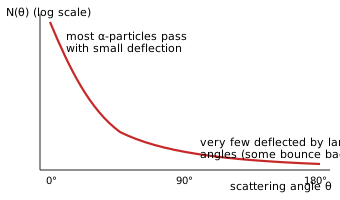
Conclusions:
1. Most α-particles pass through the foil undeflected or with very small deflections, so most of the atom is empty space.
2. A very small number are deflected through large angles (some by more than 90°, even bouncing back). So the positive charge and almost all the mass of the atom are concentrated in a tiny central region, the nucleus.
(i) Define the terms: 'impact parameter' and 'distance of closest approach' for an α-particle in Geiger-Marsden scattering experiment.
(ii) What will be the value of the impact parameter for scattering angle (I) θ = 0° and (II) θ = 180°?
Solution
(i) Impact parameter (b): the perpendicular distance of the initial velocity vector of the α-particle from the centre of the nucleus.
Distance of closest approach (): the minimum distance from the nucleus that an α-particle moving head-on reaches, where its whole kinetic energy becomes potential energy and it momentarily stops.
(ii) (I) θ = 0° (no deflection): b is very large (b → ∞).
(II) θ = 180° (head-on collision, bounces back): b = 0.
Using Bohr's atomic model, derive the expression for the radius of nth orbit of the revolving electron in a hydrogen atom.
Solution
Electrostatic attraction provides the centripetal force:
Quantisation of angular momentum: …(2)
Substituting (2) in (1):
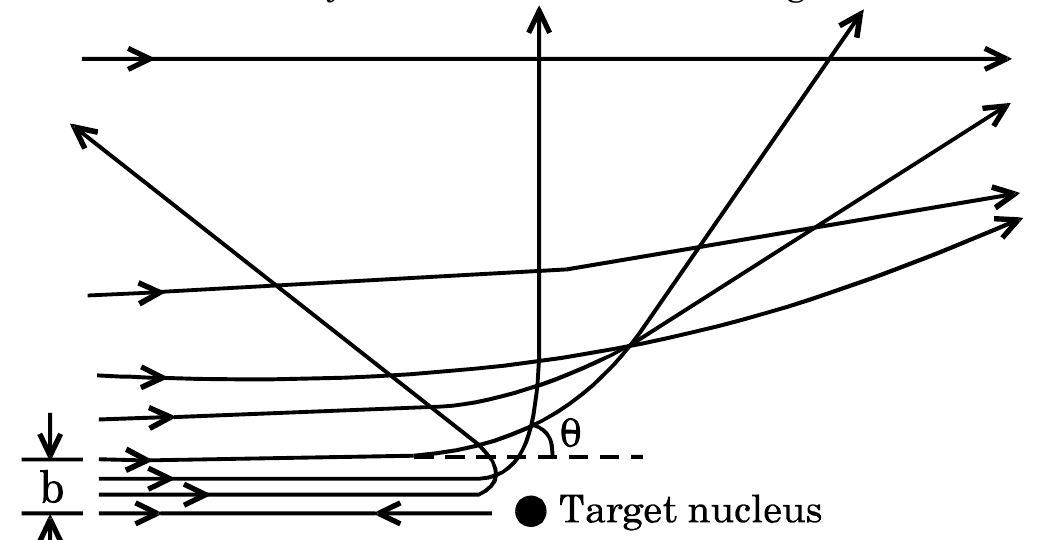
In Geiger-Marsden scattering experiment, the trajectory of α-particles in Coulomb's field of a heavy nucleus is shown in the figure. (a) What do 'b' and 'θ' represent in the figure? (b) What will be the value of 'b' for (i) θ = 0°, and (ii) θ = 180°?
Solution
(a) b is the impact parameter: the perpendicular distance of the initial velocity of the α-particle from the centre of the nucleus. θ is the scattering angle: the angle through which the α-particle is deflected.
(b) (i) θ = 0°: b is very large (infinite). (ii) θ = 180°: b = 0 (head-on collision).
State Bohr's quantization condition of angular momentum. Calculate the shortest wavelength of the Bracket series and state to which part of the electromagnetic spectrum does it belong.
Calculate the orbital period of the electron in the first excited state of hydrogen atom.
A photon emitted during the de-excitation of electron from a state n to the first excited state in a hydrogen atom, irradiates a metallic cathode of work function 2 eV, in a photo cell, with a stopping potential of 0.55 V. Obtain the value of the quantum number of the state n.
A hydrogen atom in the ground state is excited by an electron beam of 12.5 eV energy. Find out the maximum number of lines emitted by the atom from its excited state.
A 12.5 eV electron beam is used to excite a gaseous hydrogen atom at room temperature. Determine the wavelengths and the corresponding series of the lines emitted.
When is line in the emission spectrum of hydrogen atom obtained? Calculate the frequency of the photon emitted during this transition.
Calculate the wavelength of radiation emitted when electron in a hydrogen atom jumps from n = ∞ to n = 1.
3 marks: short answer
(a) State Bohr's second postulate and mention its significance.
(b) Prove that, in Bohr model of hydrogen atom as principal quantum number n becomes large, the energy levels get closer and closer.
Solution
(a) The electron revolves only in those orbits for which its angular momentum is an integral multiple of : ,
Significance: angular momentum is quantised, so only certain stable (stationary) orbits are allowed, and the electron does not radiate energy in them.
(b) eV. For consecutive levels:
For large n, eV, which decreases as n increases. So the energy levels get closer and closer.
Write the drawbacks of Rutherford's atomic model. How did Bohr remove them? Show that different orbits in Bohr's atom are not equally spaced.
Solution
Drawbacks of Rutherford's model:
1. Stability: an electron revolving in an orbit is accelerated and, by classical theory, must radiate energy continuously, so it should spiral into the nucleus and the atom would collapse.
2. Spectrum: as the electron spirals in, its frequency of revolution changes continuously, so the atom should emit a continuous spectrum; real atoms emit line spectra.
Bohr's remedy: (i) electrons revolve only in certain stationary orbits in which they do not radiate; (ii) in these orbits angular momentum is quantised, ; (iii) radiation is emitted or absorbed only when the electron jumps between orbits, with , giving discrete lines.
Spacing: . So and the gaps are , i.e. . The gap grows with n, so the orbits are not equally spaced.
Using Bohr's postulates, derive the expression for the radius of the orbit of an electron in a hydrogen atom. Also find the numerical value of Bohr's radius .
Solution
The electrostatic attraction provides the centripetal force:
Bohr's quantisation condition: …(2)
Substituting (2) in (1):
For n = 1 (Bohr radius):
Draw the energy level diagram for hydrogen atom. Mark the transitions corresponding to the series lying in the ultraviolet region, visible region and infrared region.
Solution
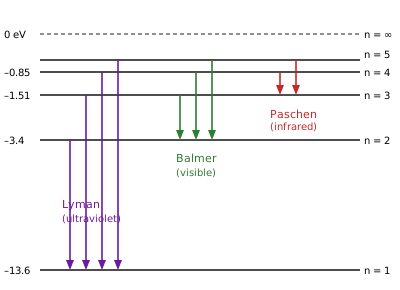
eV.
Ultraviolet: Lyman series, transitions from n = 2, 3, 4, … to n = 1.
Visible: Balmer series, transitions to n = 2.
Infrared: Paschen series, transitions to n = 3 (Brackett and Pfund series, ending on n = 4 and 5, are also infrared).
Define the term – Distance of closest approach. How will it be affected, for an α - particle, if kinetic energy of the particle is doubled?
The energy of a hydrogen atom in the first excited state is –3.4 eV. Find: (a) the radius of this orbit. (Take Bohr radius = 0.53 Å) (b) the angular momentum of the electron in the orbit. (c) the kinetic and potential energy of the electron in the orbit.
Draw a plot of α-particle scattering by a thin foil of gold to show the variation of the number of the scattered particles with scattering angle. Describe briefly how the large angle scattering explains the existence of the nucleus inside the atom. Explain with the help of impact parameter picture, how Rutherford scattering serves a powerful way to determine an upper limit on the size of the nucleus.
(a) State Bohr's postulate to define stable orbits in hydrogen atom. How does de Broglie's hypothesis explain the stability of these orbits? (b) A hydrogen atom initially in the ground state absorbs a photon which excites it to the n = 4 level. Estimate the frequency of the photon.
Get every solution for all chapters
- Every board question of every chapter, each fully solved the way the board gives marks
- 17 complete board papers, each followed by its solutions
- Weightage and most-asked topics for every chapter
- Instant PDF download, colour and black & white print copies
Revising the chapter first? Complete Physics Notes for Class 12 (NCERT 2026-27, CBSE Board 2027) →
What you get in the pack
- 10 years of CBSE Class 12 Physics board papers: 2016 to 2026 (17 papers)
- All 14 chapters and 17 board papers complete
- Part A: all 14 chapters, questions sorted chapter-wise and by marks
- Year-wise weightage table and most-asked topics for every chapter
- Part B: each full board paper followed by its complete solutions
- Derivations, numericals, ray and circuit diagrams worked the way the board awards marks
- Questions on deleted topics flagged; only the current syllabus in Part A
All chapters in this pack
- PYQ Ch 1 Electric Charges and Fields
- PYQ Ch 2 Electrostatic Potential and Capacitance
- PYQ Ch 3 Current Electricity
- PYQ Ch 4 Moving Charges and Magnetism
- PYQ Ch 5 Magnetism and Matter
- PYQ Ch 6 Electromagnetic Induction
- PYQ Ch 7 Alternating Current
- PYQ Ch 8 Electromagnetic Waves
- PYQ Ch 9 Ray Optics and Optical Instruments
- PYQ Ch 10 Wave Optics
- PYQ Ch 11 Dual Nature of Radiation and Matter
- PYQ Ch 12 Atoms
- PYQ Ch 13 Nuclei
- PYQ Ch 14 Semiconductor Electronics
- Board Paper 2026 Set 55-1-1 with Solutions
- Board Paper 2026 Set 55-2-1 with Solutions
- Board Paper 2025 Set 55-1-1 with Solutions
- Board Paper 2025 Set 55-2-1 with Solutions
- Board Paper 2024 Set 55-1-1 with Solutions
- Board Paper 2024 Set 55-2-1 with Solutions
- Board Paper 2023 Set 55-1-1 with Solutions
- Board Paper 2023 Set 55-2-1 with Solutions
- Board Paper 2022 Term 2 Set 55-1-1 with Solutions
- Board Paper 2022 Term 2 Set 55-2-1 with Solutions
- Board Paper 2020 Set 55-1-1 with Solutions
- Board Paper 2020 Set 55-2-1 with Solutions
- Board Paper 2019 Set 55-1-1 with Solutions
- Board Paper 2019 Set 55-2-1 with Solutions
- Board Paper 2018 Set 55-1 with Solutions
- Board Paper 2017 Set 55-1 with Solutions
- Board Paper 2016 Set 55-1 with Solutions