
Electromagnetic Induction: Class 12 PYQs 2016–2026 with solutions
All 26 CBSE board questions asked from Electromagnetic Induction in 14 board papers, with the year, set and marks of each. 14 are solved free below. The Class 12 Physics PYQ Book: Solved Board Papers 2016-2026 (CBSE) has every solution, all chapters and 19 full board papers.
Subject experts: Khushbu Gupta (B.Sc., M.Sc. Physics, B.Ed.) and Vinay Wadhwani (B.Tech Electrical Engineering)



Free: NCERT solutions for Class 12 Physics →
Electromagnetic Induction: board weightage
Board weightage 2016–2026
| Year | 2016 | 2017 | 2018 | 2019 | 2020 | 2022 | 2023 | 2024 | 2025 | 2026 |
|---|---|---|---|---|---|---|---|---|---|---|
| Questions | 1 | 3 | – | 2 | 3 | – | 4 | 4 | 5 | 4 |
| Marks | 5 | 7 | – | 8 | 3 | – | 13 | 6 | 7 | 10 |
Most asked topics
26 questions from 14 papers. Repeated questions are shown once with every year they were asked.
Jump to: 1 mark3 marks4 marks5 marks
1 mark: MCQ and Assertion–Reason
The magnetic flux (in Wb) linked with a coil is related to time t (in s) as . The SI units of A and B are respectively
Solution
Answer: (C) Wb s⁻², Wb s⁻¹
Each term must be in Wb: in Wb, so A is in Wb s⁻²; in Wb, so B is in Wb s⁻¹.
A magnet held vertically, with its north pole down is dropped along the axis of a closed solenoid placed vertically on a table. If the observer looks down from the top,
Solution
Answer: (A) anticlockwise
By Lenz's law the upper end of the solenoid must become a north pole to repel the approaching north pole. A face looks like a north pole when the current in it, seen from that side, is anticlockwise.
A coil has 100 turns, each of area 0.05 m² and total resistance 1.5 Ω. It is inserted at an instant in a magnetic field of 90 mT, with its axis parallel to the field. The charge induced in the coil at that instant is
Solution
Answer: (B) 0.30 C
Induced charge C. (It depends only on the change of flux, not on how fast it changes.)
You are required to design an air-filled solenoid of inductance 0.016 H having a length 0.81 m and radius 0.02 m. The number of turns in the solenoid should be
Solution
Answer: (B) 2866
, so
.
Assertion (A): It is difficult to move a magnet into a coil of large number of turns when the circuit of the coil is closed.
Reason (R): The direction of induced current in a coil with its circuit closed, due to motion of a magnet, is such that it opposes the cause.
Solution
Answer: (A) Both A and R are true and R is the correct explanation of A.
The induced current makes the coil's face repel the approaching magnet (Lenz's law), so work must be done against this force; with more turns the induced current and the opposing force are larger.
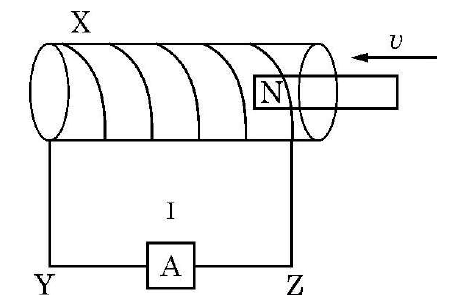
In the figure X is a coil wound over a hollow wooden pipe. A permanent magnet is pushed at a constant speed v from the right into the pipe and it comes out at the left end of the pipe. During the entry and the exit of the magnet, the current in the wire YZ will be from
Solution
Answer: (B) Z to Y and then Y to Z
By Lenz's law, while the N pole enters, the right end of the coil becomes a north pole (to repel it); for the winding shown this current flows Z → Y in the external wire. When the magnet leaves from the left end, the coil must attract it back, so the induced current reverses: Y → Z.
Assertion (A): The mutual inductance between two coils is maximum when the coils are wound on each other.
Reason (R): The flux linkage between two coils is maximum when they are wound on each other.
Solution
Answer: (A) Both A and R are true and R is the correct explanation of A.
. Winding one coil over the other makes almost all the flux of one link the other, so the flux linkage and hence M are maximum.
A circular coil of radius 10 cm is placed in a magnetic field mT such that the outward unit vector normal to the surface of the coil is . The magnetic flux linked with the coil is
Assertion (A): Lenz's law is a consequence of the law of conservation of energy.
Reason (R): There is no power loss in an ideal inductor.
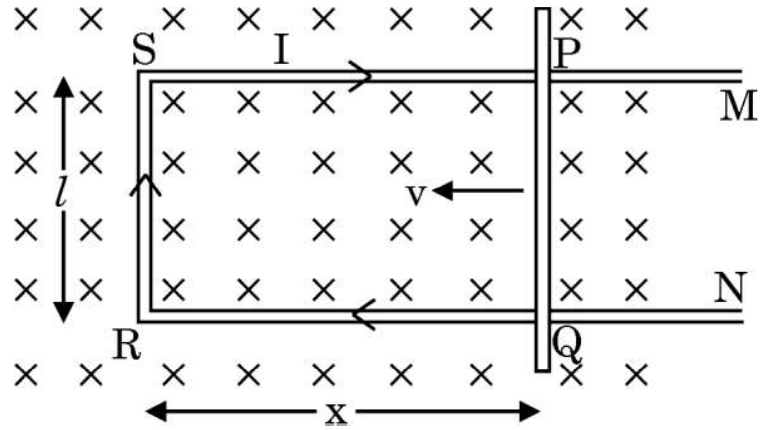
Figure shows a rectangular conductor PSRQ in which movable arm PQ has a resistance 'r' and resistance of PSRQ is negligible. The magnitude of emf induced when PQ is moved with a velocity does not depend on
Fill in the blank: The number of turns of a solenoid are doubled without changing its length and area of cross-section. The self-inductance of the solenoid will become ________ times.
A conducting rod of length l is kept parallel to a uniform magnetic field . It is moved along the magnetic field with a velocity . What is the value of emf induced in the conductor?
Draw the graph showing variation of the value of the induced emf as a function of rate of change of current flowing through an ideal inductor.
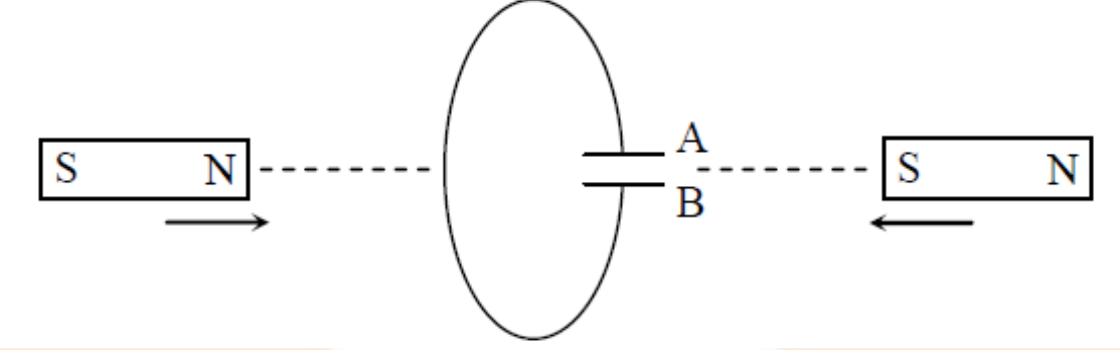
Predict the polarity of the capacitor in the situation described below:
3 marks: short answer
(i) Define mutual inductance of a pair of coils. Write its SI unit.
(ii) A long solenoid of radius R and length L has n turns per unit length. A circular loop of radius is placed inside at the centre of the solenoid such that its axis coincides with the axis of the solenoid. Obtain the mutual inductance of the solenoid and the loop.
Solution
(i) The mutual inductance of two coils is the magnetic flux linked with one coil per unit current in the other: (equivalently, the emf induced in one coil per unit rate of change of current in the other). SI unit: henry (H) = Wb A⁻¹.
(ii) A current I in the solenoid gives a uniform field inside: .
Flux through the loop (area , entirely inside): .
(a) Show that the energy required to build up the current I in a coil of inductance L is .
(b) Considering the case of magnetic field produced by air-filled current carrying solenoid, show that the magnetic energy density of a magnetic field B is .
Solution
(a) While the current is growing, the self-induced emf opposes it. The source must do work against it at the rate
Total work to raise the current from 0 to I:
This is stored as magnetic energy in the coil.
(b) For a long solenoid of length l, cross-section A and n turns per unit length: and , so .
The field occupies the volume , so the energy per unit volume is
A 100-turn coil of radius 1.6 cm and resistance 5.0 Ω is co-axial with a solenoid of 250 turns/cm and radius 1.8 cm. The solenoid current drops from 1.5 A to zero in 25 ms. Calculate the current induced in the coil in this duration. (Take π² = 10)
Solution
The coil (radius 1.6 cm) lies within the solenoid's cross-section, so the flux through each turn is with per cm m⁻¹ and m.
Using : H per turn.
A long solenoid of radius r consists of n turns per unit length. A current flows in the solenoid. A coil of N turns is wound tightly around it near its centre. What is: (a) the induced emf in the coil? (b) the mutual inductance between the solenoid and the coil?
Solution
Field inside the solenoid: . The coil is wound tightly, so its area is and the flux linkage is
(a)
(b)
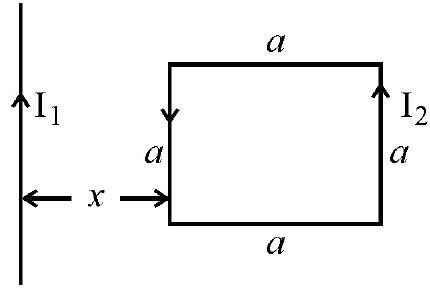
(a) Define mutual inductance and write its S.I. unit. (b) A square loop of side 'a' carrying a current is kept at distance x from an infinitely long straight wire carrying a current as shown in the figure. Obtain the expression for the resultant force acting on the loop.
Define mutual inductance between a pair of coils. Derive an expression for the mutual inductance of two long coaxial solenoids of same length wound one over the other.
Define self-inductance of a coil. Obtain the expression for the energy stored in an inductor L connected across a source of emf.
4 marks: case-based / source-based
Consider the experimental set up shown in the figure. This jumping ring experiment is an outstanding demonstration of some simple laws of Physics. A conducting non-magnetic ring is placed over the vertical core of a solenoid. When current is passed through the solenoid, the ring is thrown off.
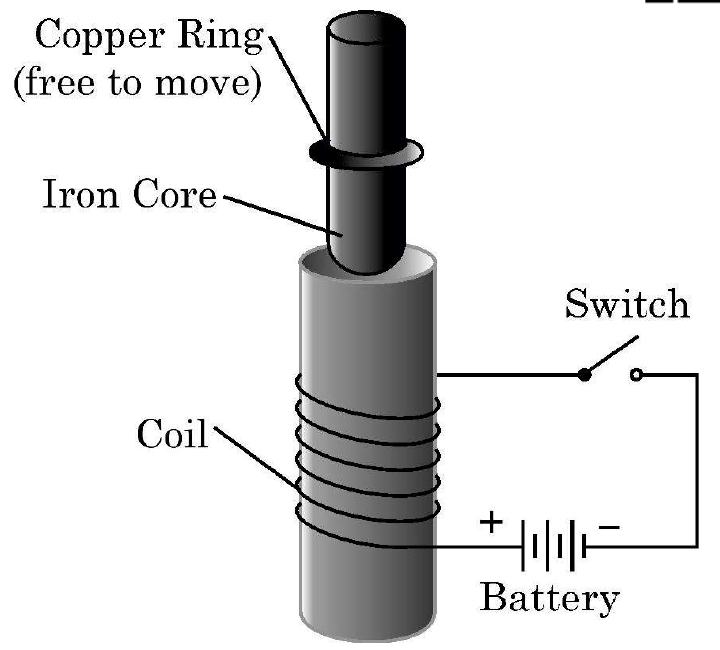
(i) Explain the reason of jumping of the ring when the switch is closed in the circuit.
(ii) What will happen if the terminals of the battery are reversed and the switch is closed? Explain.
(iii) Explain the two laws that help us understand this phenomenon.
Solution
(i) When the switch is closed, the current in the coil grows and the magnetic flux through the ring increases rapidly. An emf and current are induced in the ring. By Lenz's law this current opposes the increase in flux, so the ring behaves like a magnet with like poles facing the coil, and it is repelled, so it jumps up.
(ii) The ring still jumps. Reversing the battery reverses the coil's field, but the flux through the ring still increases when the switch is closed; the induced current reverses too, so the force is again repulsive.
(iii) Faraday's law: the emf induced in a circuit equals the rate of change of magnetic flux through it, .
Lenz's law: the induced current flows in a direction that opposes the change in flux that produces it.
5 marks: long answer
(a) State Faraday's law of electromagnetic induction.
(b) Derive an expression for the self-inductance of an air-filled long solenoid of length l and cross-sectional area A having N turns.
(c) A conducting rod of length 50 cm, with one end pivoted, is rotated with angular speed of 60 rpm in a uniform magnetic field of 4.0 mT directed perpendicular to the plane of rotation of rod. Find the emf induced in the rod.
Solution
(a) The magnitude of the emf induced in a circuit equals the time rate of change of magnetic flux through it: (for N turns, ). The negative sign shows the induced emf opposes the change (Lenz's law).
(b) Turns per unit length . A current I gives a field inside the solenoid
Total flux linkage: .
Since :
(c) rpm rev/s rad/s; m; T.
(i) Define coefficient of self-induction. Obtain an expression for self-inductance of a long solenoid of length l, area of cross-section A having N turns.
(ii) Calculate the self-inductance of a coil using the following data obtained when an AC source of frequency Hz and a DC source is applied across the coil.
| AC source | DC source | ||||
|---|---|---|---|---|---|
| S.No. | V (volts) | I (A) | S.No. | V (volts) | I (A) |
| 1 | 3.0 | 0.5 | 1 | 4.0 | 1.0 |
| 2 | 6.0 | 1.0 | 2 | 6.0 | 1.5 |
| 3 | 9.0 | 1.5 | 3 | 8.0 | 2.0 |
Solution
(i) The coefficient of self-induction (self-inductance) L of a coil is the magnetic flux linked with it per unit current in it: . Equivalently, it is the emf induced in the coil when the current changes at 1 A s⁻¹: . Unit: henry.
Field inside the solenoid: . Flux linkage: .
(ii) DC data: (from every row). AC data: .
rad s⁻¹.
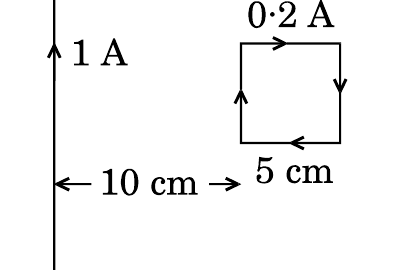
(a) Derive the expression for the magnetic energy stored in an inductor when a current I develops in it. Hence, obtain the expression for the magnetic energy density. (b) A square loop of sides 5 cm carrying a current of 0.2 A in the clockwise direction is placed at a distance of 10 cm from an infinitely long wire carrying a current of 1 A as shown. Calculate (i) the resultant magnetic force, and (ii) the torque, if any, acting on the loop.
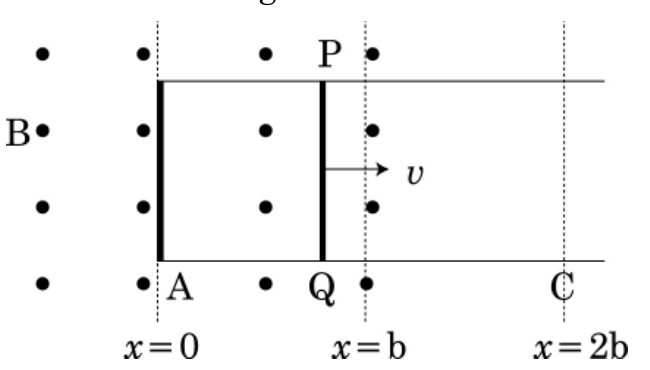
(a) When a bar magnet is pushed towards (or away) from the coil connected to a galvanometer, the pointer in the galvanometer deflects. Identify the phenomenon causing this deflection and write the factors on which the amount and direction of the deflection depends. State the laws describing this phenomenon. (b) Sketch the change in flux, emf and force when a conducting rod PQ of resistance R and length l moves freely to and fro between A and C with speed v on a rectangular conductor placed in uniform magnetic field as shown in the figure.
Get every solution for all chapters
- Every board question of every chapter, each fully solved the way the board gives marks
- 19 complete board papers, each followed by its solutions
- Weightage and most-asked topics for every chapter
- Instant PDF download, colour and black & white print copies
Revising the chapter first? Complete Physics Notes for Class 12 (NCERT 2026-27, CBSE Board 2027) →
What you get in the pack
- Questions from 138 CBSE papers, 2016 to 2026: every set code available
- Complete: 2262 different questions and parts from all set codes, 14 chapters and 19 full papers
- Part A: all 14 chapters, questions sorted chapter-wise and by marks
- Year-wise weightage table and most-asked topics for every chapter
- Part B: 19 full board papers, each followed by its complete solutions
- Derivations, numericals, ray and circuit diagrams worked the way the board awards marks
- Questions on topics out of the board syllabus flagged
All chapters in this pack
- PYQ Ch 1 Electric Charges and Fields
- PYQ Ch 2 Electrostatic Potential and Capacitance
- PYQ Ch 3 Current Electricity
- PYQ Ch 4 Moving Charges and Magnetism
- PYQ Ch 5 Magnetism and Matter
- PYQ Ch 6 Electromagnetic Induction
- PYQ Ch 7 Alternating Current
- PYQ Ch 8 Electromagnetic Waves
- PYQ Ch 9 Ray Optics and Optical Instruments
- PYQ Ch 10 Wave Optics
- PYQ Ch 11 Dual Nature of Radiation and Matter
- PYQ Ch 12 Atoms
- PYQ Ch 13 Nuclei
- PYQ Ch 14 Semiconductor Electronics
- Board Paper 2026 Set 55-1-1 with Solutions
- Board Paper 2026 Set 55-1-2 with Solutions
- Board Paper 2026 Set 55-1-3 with Solutions
- Board Paper 2026 Set 55-2-1 with Solutions
- Board Paper 2025 Set 55-1-1 with Solutions
- Board Paper 2025 Set 55-2-1 with Solutions
- Board Paper 2024 Set 55-1-1 with Solutions
- Board Paper 2024 Set 55-2-1 with Solutions
- Board Paper 2023 Set 55-1-1 with Solutions
- Board Paper 2023 Set 55-2-1 with Solutions
- Board Paper 2022 Term 2 Set 55-1-1 with Solutions
- Board Paper 2022 Term 2 Set 55-2-1 with Solutions
- Board Paper 2020 Set 55-1-1 with Solutions
- Board Paper 2020 Set 55-2-1 with Solutions
- Board Paper 2019 Set 55-1-1 with Solutions
- Board Paper 2019 Set 55-2-1 with Solutions
- Board Paper 2018 Set 55-1 with Solutions
- Board Paper 2017 Set 55-1 with Solutions
- Board Paper 2016 Set 55-1 with Solutions