
Moving Charges and Magnetism: Class 12 PYQs 2016–2026 with solutions
All 55 CBSE board questions asked from Moving Charges and Magnetism in 15 board papers, with the year, set and marks of each. 30 are solved free below. The Class 12 Physics PYQ Book: Solved Board Papers 2016-2026 (CBSE) has every solution, all chapters and 19 full board papers.
Subject experts: Khushbu Gupta (B.Sc., M.Sc. Physics, B.Ed.) and Vinay Wadhwani (B.Tech Electrical Engineering)



Free: NCERT solutions for Class 12 Physics →
Moving Charges and Magnetism: board weightage
Board weightage 2016–2026
| Year | 2016 | 2017 | 2018 | 2019 | 2020 | 2022 | 2023 | 2024 | 2025 | 2026 |
|---|---|---|---|---|---|---|---|---|---|---|
| Questions | 3 | 2 | 1 | 5 | 9 | – | 7 | 11 | 10 | 7 |
| Marks | 8 | 5 | 1 | 12 | 27 | – | 20 | 25 | 32 | 15 |
Most asked topics
55 questions from 15 papers. Repeated questions are shown once with every year they were asked.
Jump to: 1 mark2 marks3 marks4 marks5 marks
1 mark: MCQ and Assertion–Reason
A long straight wire of circular cross-section (radius a) carries a steady current I. The current is uniformly distributed across this cross-section. The magnitude of the magnetic field produced at a point at a distance from the axis of the wire will be
Solution
Answer: (C)
Inside the wire , Ampere's law with the enclosed current gives . At :
A straight long wire lying along y-axis, carries a current of 1 A along –y direction. The magnetic field due to the conductor at a point (50 cm, 0, 0) will point along
Solution
Answer: (A) z-axis
is along . Here is along and (from the wire to the point) is along : . So points along .
A galvanometer of resistance 27 Ω is converted into an ammeter of range (0 – 10 mA) using a resistance of 3 Ω. The galvanometer will show full scale deflection for a current of about
Solution
Answer: (C) 1 mA
The shunt is in parallel, so : , giving and mA.
A 1 cm segment of a wire lying along x-axis carries current of 0.5 A along +x direction. A magnetic field is switched on, in the region. The force acting on the segment is
Solution
Answer: (B) μN
Using and :
Assertion (A): The deflection in a galvanometer is directly proportional to the current passing through it.
Reason (R): The coil of a galvanometer is suspended in a uniform radial magnetic field.
Solution
Answer: (A) Both A and R are true and R is the correct explanation of A.
In a radial field the plane of the coil is always parallel to B, so the deflecting torque is at all positions. Balancing with the spring torque gives , so .
A 1 cm straight segment of a conductor carrying 1 A current in x direction lies symmetrically at origin of Cartesian coordinate system. The magnetic field due to this segment at point (1 m, 1 m, 0) is
Solution
Answer: (C) T
Biot–Savart law: , with m, , m.
.
A loop carrying a current I clockwise is placed in x – y plane, in a uniform magnetic field directed along z-axis. The tendency of the loop will be to
Solution
Answer: (C) shrink
A clockwise current (seen from +z) has its magnetic moment along –z, opposite to . The force on every element then points towards the centre of the loop, so the loop tends to shrink. (The net force is zero, so it does not move as a whole.)
A 10 cm long wire lies along y-axis. It carries a current of 1.0 A in positive y-direction. A magnetic field exists in the region. The force on the wire is
Solution
Answer: (B)
and , so N.
A galvanometer of resistance G Ω is converted into an ammeter of range 0 to I A. If the current through the galvanometer is 0.1% of I A, the resistance of the ammeter is
Solution
Answer: (B) Ω
. Shunt: .
(Directly: the ammeter's voltage is , so .)
Assertion (A): Two long parallel wires, freely suspended and connected in series to a battery, move apart.
Reason (R): Two wires carrying current in opposite directions repel each other.
Solution
Answer: (A) Both A and R are true and R is the correct explanation of A.
In series the current goes along one wire and returns along the other, so the currents are antiparallel, and antiparallel currents repel.
A wire of length 4.4 m is bent round in the shape of a circular loop and carries a current of 1.0 A. The magnetic moment of the loop will be
Assertion (A): An electron and a proton enter with the same momentum in a magnetic field such that . Then both describe a circular path of the same radius.
Reason (R): The radius of the circular path described by the charged particle (charge q, mass m) moving in the magnetic field is given by .
Beams of electrons and protons move parallel to each other in the same direction. They
A long straight wire of radius 'a' carries a steady current 'I'. The current is uniformly distributed across its area of cross-section. The ratio of magnitude of magnetic field at and at distance 2a is
The magnetic dipole moment of a current carrying coil does not depend upon
An electron is released from rest in a region of uniform electric and magnetic fields acting parallel to each other. The electron will
A proton is accelerated through a potential difference V, subjected to a uniform magnetic field acting normal to the velocity of the proton. If the potential difference is doubled, how will the radius of the circular path described by the proton in the magnetic field change?
A proton and an electron travelling along parallel paths enter a region of uniform magnetic field, acting perpendicular to their paths. Which of them will move in a circular path with higher frequency?
What can be the cause of helical motion of a charged particle?
2 marks: very short answer
A wire of length L is bent round into (i) a square coil having N turns and (ii) a circular coil having N turns. The coil in both cases is free to turn about a vertical axis coinciding with the plane of the coil, in a uniform, horizontal magnetic field and carry the same currents. Find the ratio of the maximum value of the torque acting on the square coil to that on the circular coil.
Solution
Maximum torque , so .
Square: perimeter of one turn , so and .
Circle: , so and .
Ratio .
An alpha particle is projected with velocity into a region in which magnetic field exists. Calculate the acceleration of the particle in the region. , and are unit vectors along x, y and z axis respectively and charge to mass ratio for alpha particle is C/kg.
Solution
, so .
(, .)
Briefly explain why and how a galvanometer is converted into an ammeter.
Solution
Why: a galvanometer is very sensitive and gives full-scale deflection for a very small current (μA–mA), and its coil has an appreciable resistance. Connected in series directly, it would be damaged by a large current and would also change the current being measured.
How: a small resistance S (shunt) is connected in parallel with the galvanometer. Most of the current passes through the shunt, and only goes through the coil:
The ammeter so formed has a very low resistance, .
Two long straight parallel wires A and B separated by a distance d, carry equal current I flowing in same direction as shown in the figure. (a) Find the magnetic field at a point P situated between them at a distance x from one wire. (b) Show graphically the variation of the magnetic field with distance x for 0 < x < d.
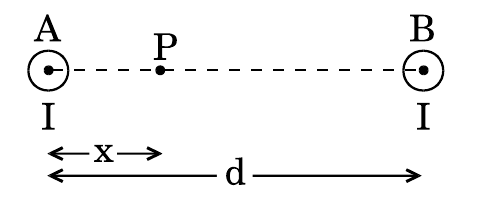
Solution
(a) Field due to A at P: ; due to B: . Between two wires with currents in the same direction these fields are opposite:
(b)
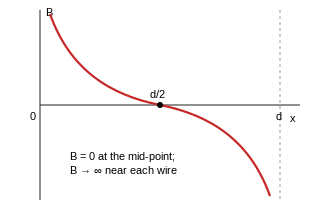
B is zero at , and changes direction on either side of the midpoint.
An ammeter of resistance 0.8 Ω can measure a current up to 1.0 A. Find the value of shunt resistance required to convert this ammeter to measure a current up to 5.0 A.
An α-particle and a proton of the same kinetic energy are in turn allowed to pass through a magnetic field , acting normal to the direction of motion of the particles. Calculate the ratio of radii of the circular paths described by them.
Find the condition under which the charged particles moving with different speeds in the presence of electric and magnetic field vectors can be used to select charged particles of a particular speed.
3 marks: short answer
Two long straight parallel conductors A and B carrying steady currents and in the same direction are separated by a distance d. Deduce the expressions for the force acting on length L of conductor B due to conductor A and show it in figure. Write the expression for the force acting on length L of conductor A due to conductor B and show that it follows Newton's third law.
Solution
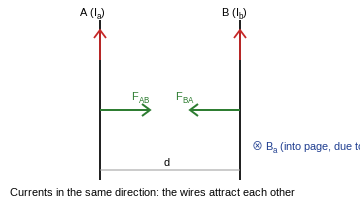
Field of A at the position of B: , perpendicular to B (into the page in the figure).
Force on length L of B: , of magnitude
directed towards A (attraction).
Similarly, the field of B at A is , and the force on length L of A is
directed towards B.
The two forces are equal in magnitude and opposite in direction, , as Newton's third law requires.
Derive an expression for the magnetic field B, due to a circular coil of N turns, each of radius r carrying current I, at a distance 'x' from the centre along its axis.
Solution
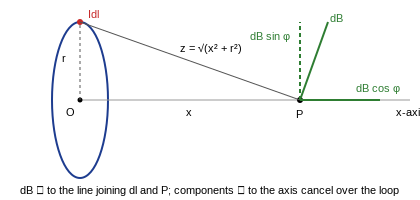
Take a current element on the loop. Its distance from P is , and . By the Biot–Savart law:
is perpendicular to the line joining the element and P. Its component perpendicular to the axis () is cancelled by the element on the opposite side. The components along the axis add:
For N turns:
(At the centre, x = 0: .)
Using Biot-Savart law, derive expression for the magnetic field due to a circular current carrying loop at a point on its axis and hence at its centre.
Solution
Take a current element on the loop of radius r. Its distance from P (at x on the axis) is , and is perpendicular to the line joining it to P. By the Biot–Savart law:
The components of perpendicular to the axis cancel for diametrically opposite elements. The components along the axis add:
(For N turns multiply by N.)
At the centre, x = 0:
In a region of a uniform electric field , a negatively charged particle is moving with a constant velocity near a long straight conductor coinciding with XX′ axis and carrying current I towards –X axis. The particle remains at a distance d from the conductor. (i) Draw diagram showing direction of electric and magnetic fields. (ii) What are the various forces acting on the charged particle? (iii) Find the value of in terms of E, d and I.
Solution
(i)
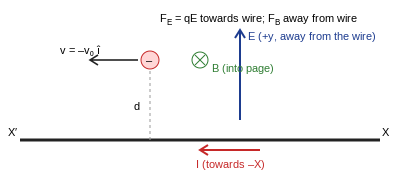
Taking the particle at distance d above the wire (along +y): the wire's field there is into the page (). The magnetic force on the negative charge then points away from the wire, so must point away from the wire (+y), making the electric force on the negative charge point towards the wire.
(ii) Two forces act: the electric force and the magnetic force . They are equal and opposite, so the particle moves with constant velocity.
(iii) :
Two infinitely long conductors kept along XX′ and YY′ axes are carrying current and along –X axis and –Y axis respectively. Find the magnitude and direction of the net magnetic field produced at point P(X, Y).
Solution
Wire along the x-axis (current along –x), P at distance Y from it: (since ).
Wire along the y-axis (current along –y), P at distance X from it: (since ).
The net field is along the z-axis, perpendicular to the plane of the two wires: along +z if , otherwise along –z.
A proton with kinetic energy J moving horizontally from north to south, enters a uniform magnetic field B of 2.0 mT directed eastward. Calculate: (a) the speed of the proton (b) the magnitude of acceleration of the proton (c) the radius of the path traced by the proton [Take (q/m) for proton = C/kg]
Solution
(a) kg.
(b) , so and
(c)
Two long, straight, parallel conductors carry steady currents in opposite directions. Explain the nature of the force of interaction between them. Obtain an expression for the magnitude of the force between the two conductors. Hence define one ampere.
Solution
Each wire lies in the magnetic field of the other. With opposite currents, the force on each wire points away from the other, so the wires repel each other.
Field of wire a at wire b (distance d): , perpendicular to b.
Force on length L of b: , and the force per unit length is
(The figure shows the attractive case of parallel currents; with opposite currents the forces reverse and become repulsive, with the same magnitude.)
One ampere is the steady current which, flowing in each of two very long, straight, parallel conductors of negligible cross-section placed 1 m apart in vacuum, produces a force of N per metre of length between them.
Obtain an expression for the torque acting on a current carrying loop in a uniform magnetic field . Draw the necessary diagram.
Solution
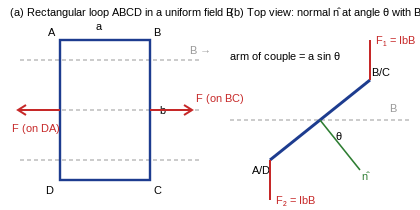
Take a rectangular loop ABCD (sides a and b, current I) whose normal makes angle θ with ; the sides of length b are perpendicular to .
The forces on the sides of length a are equal, opposite and collinear, so they cancel.
The forces on the sides of length b are each, equal and opposite but along different lines, forming a couple. The perpendicular distance between them is :
With the magnetic moment :
(a) Write an expression of magnetic moment associated with a current (I) carrying circular coil of radius r having N turns.
(b) Consider the above mentioned coil placed in YZ plane with its centre at the origin. Derive expression for the value of magnetic field due to it at point (x, 0, 0).
(a) Define current sensitivity of a galvanometer. Write its expression.
(b) A galvanometer has resistance G and shows full scale deflection for current . (i) How can it be converted into an ammeter to measure current up to ? (ii) What is the effective resistance of this ammeter?
(a) Derive the expression for the torque acting on a current carrying loop placed in a magnetic field. (b) Explain the significance of a radial magnetic field when a current carrying coil is kept in it.
(a) Derive, with the help of a diagram, the expression for the magnetic field inside a very long solenoid having n turns per unit length carrying a current I. (b) How is a toroid different from a solenoid?
Prove that the magnetic moment of the electron revolving around a nucleus in an orbit of radius r with orbital speed v is equal to evr/2. Hence using Bohr's postulate of quantization of angular momentum, deduce the expression for the magnetic moment of hydrogen atom in the ground state.
(a) State Biot – Savart law and express this law in the vector form. (b) Two identical circular coils, P and Q each of radius R, carrying currents 1 A and A respectively, are placed concentrically and perpendicular to each other lying in the XY and YZ planes. Find the magnitude and direction of the net magnetic field at the centre of the coils.
State Ampere's circuital law. Use this law to find magnetic field due to straight infinite current carrying wire. How are the magnetic field lines different from the electrostatic field lines?
4 marks: case-based / source-based
A galvanometer is used to detect or/and measure small currents in an electrical circuit. It essentially works on the fact that a current-carrying coil experiences a deflecting torque when placed in a magnetic field. This deflection in the coil can be measured and it is related to the current flowing in the coil, the number of turns in the coil, area of the coil and the magnetic field. A hair spring attached to the coil provides a counter torque and helps in measuring the deflection. A galvanometer can be converted to an ammeter or a voltmeter of desired range by using suitable resistances.
(I) The torque on the coil remains constant irrespective of the coil's orientation during rotation due to
A galvanometer coil has a resistance of 15 Ω and the meter shows full scale deflection for a current of 3 mA. The value of resistance required to convert it into a voltmeter of range (0 – 12 V) is
Solution
(I) (B) radial magnetic field. In a radial field the plane of the coil is always parallel to , so and at every position.
(II) (A) increasing number of turns of the coil (answer as per the CBSE marking scheme). Current sensitivity increases with N.
(III) (D) 0.25 N m. N m.
OR (B) 3985 Ω. , in series.
(IV) (C) 0.01 Ω in parallel. Shunt , connected in parallel.
Briefly explain various ways to increase the strength of magnetic field produced by a given solenoid.
Solution
inside a long solenoid. It can be increased by:
1. increasing the current I through it;
2. increasing the number of turns per unit length n (winding more closely);
3. inserting a soft-iron (ferromagnetic) core, which has a very large relative permeability .
Seema's uncle was advised by his doctor to have an MRI (Magnetic Resonance Imaging) scan of his brain. Her uncle felt it to be expensive and wanted to postpone it. When Seema learnt about this, she took the help of her family and also approached the doctor, who also offered a substantial discount. She then convinced her uncle to undergo the test to enable the doctor to know the condition of his brain. The information thus obtained greatly helped the doctor to treat him properly.
(a) What according to you are the values displayed by Seema, her family and the doctor? (b) What could be the possible reason for MRI test to be so expensive? (c) Assuming that MRI test was performed using a magnetic field of 0.1 T, find the minimum and maximum values of the force that the magnetic field could exert on a proton (charge = C) moving with a speed of m/s.
5 marks: long answer
(i) A proton moving with velocity in a non-uniform magnetic field traces a path as shown in the figure. The path followed by the proton is always in the plane of the paper. What is the direction of the magnetic field in the region near points P, Q and R? What can you say about relative magnitude of magnetic fields at these points?
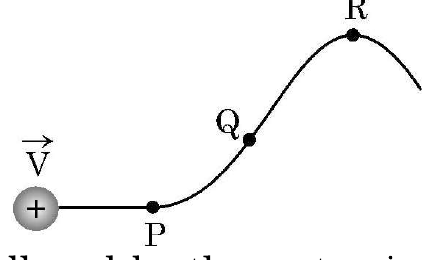
(ii) A current carrying circular loop of area A produces a magnetic field B at its centre. Show that the magnetic moment of the loop is .
Solution
(i) The force on the proton is , towards the centre of curvature of its path.
Near P and Q the path bends upward (force upward while moving to the right), so is into the plane of the paper.
Near R the path bends downward (force downward), so is out of the plane of the paper.
Radius of the path , so (the speed stays constant). The path is most sharply curved at R and least curved near Q (where it is almost straight), so .
(ii) At the centre , so . With , .
(i) Derive an expression for the torque acting on a rectangular current loop suspended in a uniform magnetic field.
(ii) A charged particle is moving in a circular path with velocity in a uniform magnetic field . It is made to pass through a sheet of lead and as a consequence, it looses one half of its kinetic energy without change in its direction. How will (1) the radius of its path (2) its time period of revolution change?
Solution
(i)
Let the loop ABCD (sides a and b, current I) be in a uniform field , with its normal at angle θ to ; the sides of length b are perpendicular to .
The forces on the sides of length a are equal and opposite along the same line, so they cancel.
The forces on the two sides of length b are , equal and opposite but along different lines, forming a couple.
The perpendicular distance between them is , so
In vector form, with :
(For N turns, .)
(ii) (1) , so . With : . The radius decreases by a factor .
(2) does not depend on speed or kinetic energy, so the time period does not change.
(i) What is the source of force acting on a current-carrying conductor placed in a magnetic field? Obtain the expression for force acting between two long straight parallel conductors carrying steady currents and hence define 'ampere'.
(ii) A point charge q is moving with velocity in a uniform magnetic field . Find the work done by the magnetic force on the charge.
(iii) Explain the necessary conditions in which the trajectory of a charged particle is helical in a uniform magnetic field.
Solution
(i) The force arises from the Lorentz force on the moving charges (drifting electrons) in the conductor; it is the interaction of the conductor's own field with the external field.
Two long parallel conductors a and b, distance d apart, carry currents and . The field of a at b is , perpendicular to b. Force on length L of b:
towards a (attractive for parallel currents, repulsive for antiparallel). Force per unit length: .
Ampere: one ampere is the steady current which, maintained in each of two very long, straight, parallel conductors of negligible cross-section placed 1 m apart in vacuum, produces a force of N per metre of length on each conductor.
(ii) is always perpendicular to , so : the work done by the magnetic force is zero (the speed and kinetic energy do not change).
(iii) The path is a helix when the velocity makes an angle θ with other than 0° or 90°. The component (perpendicular to B) makes the particle go round in a circle, while the component (along B) is unaffected and carries it forward uniformly; together they give a helix of pitch .
(i) A current carrying loop can be considered as a magnetic dipole placed along its axis. Explain.
(ii) Obtain the relation for magnetic dipole moment of current carrying coil. Give the direction of .
(iii) A current carrying coil is placed in an external uniform magnetic field. The coil is free to turn in the magnetic field. What is the net force acting on the coil? Obtain the orientation of the coil in stable equilibrium. Show that in this orientation the flux of the total field (field produced by the loop + external field) through the coil is maximum.
Solution
(i) The field lines of a current loop are like those of a bar magnet: one face acts as a north pole and the other as a south pole. Far away on its axis the field is , exactly the form of a dipole's axial field. So a current loop behaves as a magnetic dipole along its axis.
(ii) On the axis, far away: . Comparing with the dipole field gives . For N turns:
Direction: along the area vector, perpendicular to the plane of the coil, given by the right-hand thumb rule (curl the fingers along the current; the thumb points along ).
(iii) In a uniform field the forces on opposite sides of the coil cancel, so the net force is zero (there may be a torque ).
Potential energy . It is minimum at θ = 0, so the coil is in stable equilibrium when is parallel to (the plane of the coil perpendicular to B).
In this orientation the coil's own field at its centre is along , i.e. in the same direction as the external field, and both are normal to the plane of the coil. The total field through the coil is therefore , and the flux has its maximum possible value.
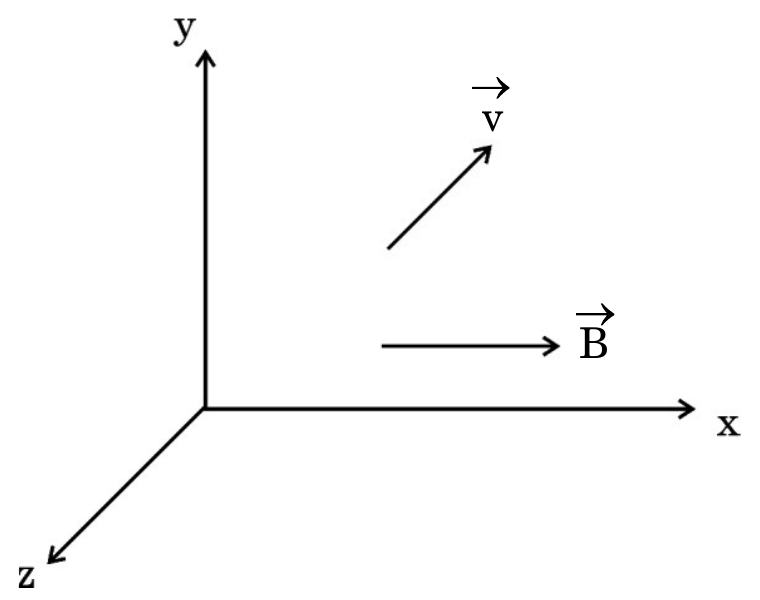
(i) A particle of mass m and charge q is moving with a velocity in a magnetic field as shown in the figure. Show that it follows a helical path. Hence, obtain its frequency of revolution.
(ii) In a hydrogen atom, the electron moves in an orbit of radius 2 Å making revolutions per second. Find the magnetic moment associated with the orbital motion of the electron.
Solution
(i) makes an angle θ with (along x). Resolve it: along and perpendicular to it.
The force depends only on and is perpendicular to both and . It makes the particle move in a circle in the plane perpendicular to :
There is no force along , so stays constant and the circle drifts uniformly along . The combination of circular motion and uniform motion along the axis is a helix.
Period , so the frequency of revolution is
(pitch ).
(ii) Current due to the orbiting electron: A.
Area: m².
(i) What is current sensitivity of a galvanometer? Show how the current sensitivity of a galvanometer may be increased. "Increasing the current sensitivity of a galvanometer may not necessarily increase its voltage sensitivity." Explain.
(ii) A moving coil galvanometer has a resistance 15 Ω and takes 20 mA to produce full scale deflection. How can this galvanometer be converted into a voltmeter of range 0 to 100 V?
Solution
(i) Current sensitivity is the deflection per unit current: .
In equilibrium the deflecting torque balances the restoring torque: , so
It can be increased by increasing the number of turns N, the area A of the coil or the field B (strong magnet), or by using a suspension with a smaller torsion constant k.
Voltage sensitivity is . If the current sensitivity is increased by doubling N, the length of wire and hence the resistance R of the coil also roughly double, so the voltage sensitivity stays nearly the same. So increasing current sensitivity need not increase voltage sensitivity.
(ii) Connect a high resistance R in series with the galvanometer, so that 100 V drives the full-scale current:
(i) State Biot-Savart's law for the magnetic field due to a current carrying element. Use this law to obtain an expression for the magnetic field at the centre of a circular loop of radius 'a' and carrying a current 'I'. Draw the magnetic field lines for a current loop indicating the direction of magnetic field.
(ii) An electron is revolving around the nucleus in a circular orbit with a speed of m s⁻¹. If the radius of the orbit is m, find the current constituted by the revolving electron in the orbit.
(i) Derive an expression for the force acting on a current carrying straight conductor kept in a magnetic field. State the rule which is used to find the direction of this force. Give the condition under which this force is (1) maximum, and (2) minimum.
(ii) Two long parallel straight wires A and B are 2.5 cm apart in air. They carry 5.0 A and 2.5 A currents respectively in opposite directions. Calculate the magnitude of the force exerted by wire A on a 10 cm length of wire B.
(a) Derive the expression for the torque acting on the rectangular current carrying coil of a galvanometer. Why is the magnetic field made radial?
(b) An α-particle is accelerated through a potential difference of 10 kV and moves along x-axis. It enters in a region of uniform magnetic field T acting along y-axis. Find the radius of its path. (Take mass of α-particle = kg)
(a) A circular loop of radius R carries a current I. Obtain an expression for the magnetic field at a point on its axis at a distance x from its centre.
(b) A conducting rod of length 2 m is placed on a horizontal table in north-south direction. It carries a current of 5 A from south to north. Find the direction and magnitude of the magnetic force acting on the rod. Given that the Earth's magnetic field at the place is T and angle of dip is .
(a) Obtain the expression for the deflecting torque acting on the current carrying rectangular coil of a galvanometer in a uniform magnetic field. Why is a radial magnetic field employed in the moving coil galvanometer?
(b) Particles of mass kg and charge C are accelerated in a cyclotron of dee radius 40 cm. It employs a magnetic field 0.4 T. Find the kinetic energy (in MeV) of the particle beam imparted by the accelerator.
Get every solution for all chapters
- Every board question of every chapter, each fully solved the way the board gives marks
- 19 complete board papers, each followed by its solutions
- Weightage and most-asked topics for every chapter
- Instant PDF download, colour and black & white print copies
Revising the chapter first? Complete Physics Notes for Class 12 (NCERT 2026-27, CBSE Board 2027) →
What you get in the pack
- Questions from 138 CBSE papers, 2016 to 2026: every set code available
- Complete: 2262 different questions and parts from all set codes, 14 chapters and 19 full papers
- Part A: all 14 chapters, questions sorted chapter-wise and by marks
- Year-wise weightage table and most-asked topics for every chapter
- Part B: 19 full board papers, each followed by its complete solutions
- Derivations, numericals, ray and circuit diagrams worked the way the board awards marks
- Questions on topics out of the board syllabus flagged
All chapters in this pack
- PYQ Ch 1 Electric Charges and Fields
- PYQ Ch 2 Electrostatic Potential and Capacitance
- PYQ Ch 3 Current Electricity
- PYQ Ch 4 Moving Charges and Magnetism
- PYQ Ch 5 Magnetism and Matter
- PYQ Ch 6 Electromagnetic Induction
- PYQ Ch 7 Alternating Current
- PYQ Ch 8 Electromagnetic Waves
- PYQ Ch 9 Ray Optics and Optical Instruments
- PYQ Ch 10 Wave Optics
- PYQ Ch 11 Dual Nature of Radiation and Matter
- PYQ Ch 12 Atoms
- PYQ Ch 13 Nuclei
- PYQ Ch 14 Semiconductor Electronics
- Board Paper 2026 Set 55-1-1 with Solutions
- Board Paper 2026 Set 55-1-2 with Solutions
- Board Paper 2026 Set 55-1-3 with Solutions
- Board Paper 2026 Set 55-2-1 with Solutions
- Board Paper 2025 Set 55-1-1 with Solutions
- Board Paper 2025 Set 55-2-1 with Solutions
- Board Paper 2024 Set 55-1-1 with Solutions
- Board Paper 2024 Set 55-2-1 with Solutions
- Board Paper 2023 Set 55-1-1 with Solutions
- Board Paper 2023 Set 55-2-1 with Solutions
- Board Paper 2022 Term 2 Set 55-1-1 with Solutions
- Board Paper 2022 Term 2 Set 55-2-1 with Solutions
- Board Paper 2020 Set 55-1-1 with Solutions
- Board Paper 2020 Set 55-2-1 with Solutions
- Board Paper 2019 Set 55-1-1 with Solutions
- Board Paper 2019 Set 55-2-1 with Solutions
- Board Paper 2018 Set 55-1 with Solutions
- Board Paper 2017 Set 55-1 with Solutions
- Board Paper 2016 Set 55-1 with Solutions