
Dual Nature of Radiation and Matter: Class 12 PYQs 2016–2026 with solutions
All 45 CBSE board questions asked from Dual Nature of Radiation and Matter in 17 board papers, with the year, set and marks of each. 23 are solved free below. The Class 12 Physics PYQ Book: Solved Board Papers 2016-2026 (CBSE) has every solution, all chapters and 19 full board papers.
Subject experts: Khushbu Gupta (B.Sc., M.Sc. Physics, B.Ed.) and Vinay Wadhwani (B.Tech Electrical Engineering)



Free: NCERT solutions for Class 12 Physics →
Dual Nature of Radiation and Matter: board weightage
Board weightage 2016–2026
| Year | 2016 | 2017 | 2018 | 2019 | 2020 | 2022 | 2023 | 2024 | 2025 | 2026 |
|---|---|---|---|---|---|---|---|---|---|---|
| Questions | 2 | 2 | 2 | 5 | 7 | 4 | 5 | 7 | 5 | 6 |
| Marks | 5 | 4 | 3 | 8 | 10 | 10 | 13 | 10 | 11 | 11 |
Most asked topics
45 questions from 17 papers. Repeated questions are shown once with every year they were asked.
Jump to: 1 mark2 marks3 marks4 marks
1 mark: MCQ and Assertion–Reason
Assertion (A): If accelerated electrons are passed through a narrow slit, a diffraction pattern is observed.
Reason (R): Electrons behave as both particles and waves.
Solution
Answer: (A) Both A and R are true and R is the correct explanation of A.
Moving electrons have a de Broglie wavelength . This wave nature makes them diffract at a narrow slit (as in the Davisson–Germer experiment), so R explains A.
The maximum kinetic energy of the electrons emitted from a photo sensitive surface depends on
Solution
Answer: (D) Both and
: it depends on the frequency and the work function, not on the intensity.
Assertion (A): On increasing the intensity of incident light of frequency on a photosensitive surface, the photocurrent increases.
Reason (R): The stopping potential for a photosensitive surface increases with increase of frequency of incident light.
Solution
Answer: (B) Both A and R are true, but R is not the correct explanation of A.
More intensity means more photons per second, so more electrons are emitted and the photocurrent rises (A is true). R is also true (), but it concerns frequency, not intensity, so it does not explain A.
The stopping potential measured in a photoelectric experiment for a metal surface is plotted against frequency ν of the incident radiation. Let m be the slope of the straight line so obtained. Then the value of charge of an electron is given by (h is the Planck's constant.)
Solution
Answer: (C)
. Slope , so .
Let , and be the wavelengths associated with an electron, a proton and a deuteron, all moving with the same speed. Then the correct relation between them is
Solution
Answer: (B)
; at the same speed . Since , .
Two beams, A and B whose photon energies are 3.3 eV and 11.3 eV respectively, illuminate a metallic surface (work function 2.3 eV) successively. The ratio of maximum speed of electrons emitted due to beam A to that due to beam B is
Solution
Answer: (C)
eV, eV. Since : .
The waves associated with a moving electron and a moving proton have the same wavelength λ. It implies that they have the same
Solution
Answer: (A) momentum
, so the same λ means the same momentum p.
Assertion (A): In photoelectric effect, the kinetic energy of the emitted photoelectrons increases with increase in the intensity of the incident light.
Reason (R): Photoelectric current depends on the wavelength of the incident light.
Solution
Answer: (D) Both A and R are false.
Maximum KE depends on frequency, not on intensity (), so A is false. The photoelectric current depends on the intensity (number of photons), not on the wavelength (above threshold), so R is also false.
The work function for a photosensitive surface is 3.315 eV. The cut-off wavelength for photoemission of electrons from this surface is
Solution
Answer: (C) 375 nm
Assertion (A): Photoelectric current increases with an increase in intensity of incident radiation, for a given frequency of incident radiation and the accelerating potential.
Reason (R): Increase in the intensity of incident radiation results in an increase in the number of photoelectrons emitted per second and hence an increase in the photocurrent.
Solution
Answer: (A) Both A and R are true and R is the correct explanation of A.
More intense light means more photons per second, so more electrons are emitted per second and the current is larger.
Assertion (A): Photoelectric effect demonstrates the particle nature of light.
Reason (R): Photoelectric current is proportional to intensity of incident radiation for frequencies more than the threshold frequency.
Solution
Answer: (b) Both A and R are true, but R is not the correct explanation of A.
The particle nature is shown by the existence of a threshold frequency, instantaneous emission and depending on frequency (photons of energy hν). The proportionality of current to intensity is true but does not by itself prove the particle nature.
Which one of the following metals does not exhibit emission of electrons from its surface when irradiated by visible light?
Photons of energies 1 eV and 2 eV are successively incident on a metallic surface of work function 0.5 eV. The ratio of kinetic energy of most energetic photoelectrons in the two cases will be
A proton and an electron have equal speeds. Find the ratio of de Broglie wavelengths associated with them.
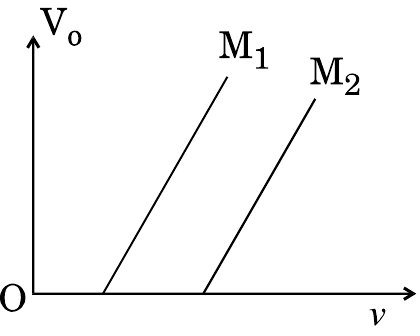
The variation of the stopping potential () with the frequency (ν) of the light incident on two different photosensitive surfaces and is shown in the figure. Identify the surface which has greater value of the work function.
What is the wavelength of a photon of energy J?
Define the term 'threshold frequency' in photoelectric emission.
Define the term "threshold frequency", in the context of photoelectric emission.
Define the term "Intensity" in photon picture of electromagnetic radiation.
Draw graphs showing variation of photoelectric current with applied voltage for two incident radiations of equal frequency and different intensities. Mark the graph for the radiation of higher intensity.
Name the phenomenon which shows the quantum nature of electromagnetic radiation.
2 marks: very short answer
In a photoelectric experiment, the emitter plate is irradiated with radiation of 200 nm. The photocurrent becomes zero when the collector plate potential is V. Calculate the work function (in eV) of the emitter.
Solution
Einstein's equation: , so .
Stopping potential V, so eV.
Find ratio of the de Broglie wavelength and associated respectively with an alpha particle and a proton, (i) if they are moving with the same kinetic energy. (ii) just after they are accelerated through the same potential difference.
Solution
, , .
(i) ; with the same K:
(ii) , so ; with the same V:
A light of wavelength 400 nm is incident on metal surface whose work function is J. Calculate the speed of the fastest photoelectrons emitted.
Solution
Consider a neutron (mass m) of kinetic energy E and a photon of the same energy. Let and be the de Broglie wavelength of neutron and the wavelength of photon respectively. Obtain an expression for .
Solution
Neutron: , so .
Photon: , so .
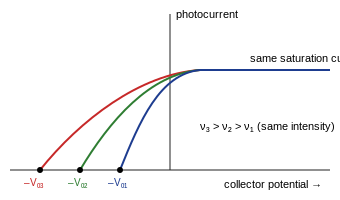
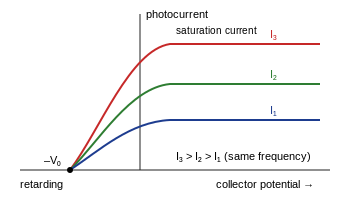
Plot suitable graphs to show the variation of photoelectric current with the collector plate potential for the incident radiation of (i) the same intensity but different frequencies , and (ii) the same frequency but different intensities , and
Solution
(i) Same intensity, different frequencies: the saturation current is the same, but the stopping potential is larger for higher frequency.
(ii) Same frequency, different intensities: the stopping potential is the same, but the saturation current is larger for higher intensity.
Photoelectric emission occurs when a surface is irradiated with the radiation of frequency (i) , and (ii) . The maximum kinetic energy of the electrons emitted in the two cases are K and 2K respectively. Obtain the expression for the threshold frequency for the surface.
Solution
Einstein's equation :
…(1) and …(2).
Multiplying (1) by 2 and equating with (2):
(a) Write two main observations of photoelectric effect experiment which could only be explained by Einstein's photoelectric equation. (b) Draw a graph showing variation of photocurrent with the anode potential of a photocell.
Why is wave theory of electromagnetic radiation not able to explain photo electric effect? How does photon picture resolve this problem?
Plot a graph showing variation of de Broglie wavelength (λ) associated with a charged particle of mass m, versus , where V is the potential difference through which the particle is accelerated. How does this graph give us the information regarding the magnitude of the charge of the particle?
A photon and a proton have the same de-Broglie wavelength λ. Prove that the energy of the photon is times the kinetic energy of the proton.
If light of wavelength 412.5 nm is incident on each of the metals given below, which ones will show photoelectric emission and why? Na 1.92 eV, K 2.15 eV, Ca 3.20 eV, Mo 4.17 eV
A proton and an α particle are accelerated through the same potential difference. Which one of the two has (i) greater de-Broglie wavelength, and (ii) less kinetic energy? Justify your answer.
3 marks: short answer
Answer the following giving reason: (a) All the photo electrons do not eject with the same kinetic energy when monochromatic light is incident on a metal surface. (b) The saturation current in case (a) is different for different intensity. (c) If one goes on increasing the wavelength of light incident on a metal surface, keeping its intensity constant, emission of photo electrons stop at a certain wavelength for this metal.
Solution
(a) Each photon gives the same energy , but electrons are bound with different energies: those below the surface lose energy in collisions before escaping. Only the least tightly bound electrons at the surface come out with the maximum kinetic energy ; the others come out with less.
(b) The intensity measures the number of photons falling per second. Each photon ejects at most one electron, so more intense light ejects more electrons per second, and the saturation current is proportional to the intensity.
(c) Photon energy decreases as λ increases. When λ exceeds the threshold wavelength , a photon has less energy than the work function, so no electron is emitted, however intense the light.
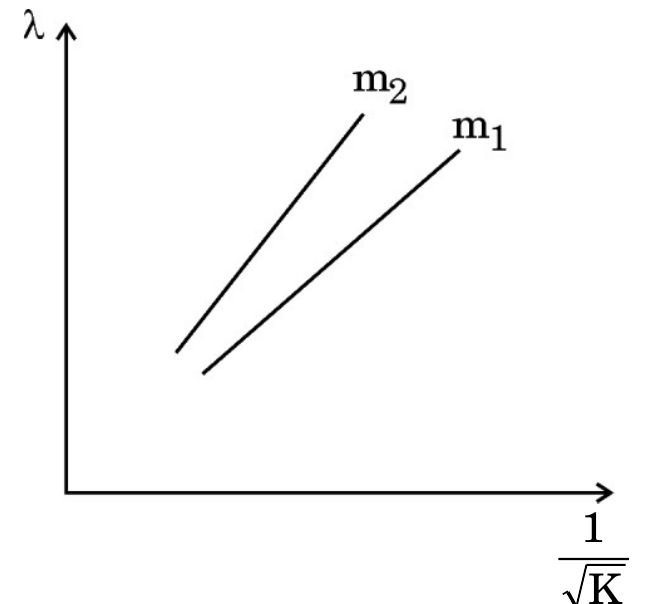
de Broglie wavelength λ as a function of , for two particles of masses and are shown in the figure. Here, K is the energy of the moving particles. (a) What does the slope of a line represent? (b) Which of the two particles is heavier? (c) Is this graph also valid for a photon? Justify your answer in each case.
Solution
: a straight line through the origin.
(a) The slope is ; it is inversely proportional to .
(b) The line for has the smaller slope, so is heavier.
(c) No. For a photon , so λ is proportional to , not to (a photon has no rest mass, and ).
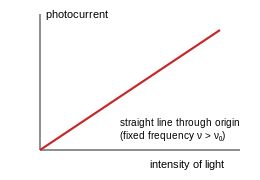
How does Einstein's photoelectric equation explain the emission of electrons from a metal surface? Explain briefly. Plot the variation of photocurrent with: (a) collector plate potential for different intensity of incident radiation, and (b) intensity of incident radiation.
Solution
Light consists of photons of energy hν. A photon gives all its energy to one electron. Part of it (, the work function) is used to free the electron from the metal, and the rest appears as kinetic energy:
So emission occurs only if (ν above the threshold frequency ), it is instantaneous, and depends on frequency, not on intensity. Intensity decides only the number of photons, hence the number of electrons emitted.
(a)
(b)
Photoelectrons are emitted from a metal surface when illuminated with UV light of wavelength 330 nm. The minimum amount of energy required to emit the electrons from the surface is J. Calculate: (i) the energy of the incident radiation, and (ii) the kinetic energy of the photoelectron.
Solution
(i)
(ii)
Find the ratio of the de Broglie wavelengths associated with an alpha particle and a proton, if both (a) have the same speeds, (b) have the same kinetic energy, (c) are accelerated through the same potential difference.
The maximum kinetic energy of the photoelectrons emitted is doubled when the wavelength of light incident on the photosensitive surface changes from to . Deduce expressions for the threshold wavelength and work function for the metal surface in terms of and .
Using photon picture of light, show how Einstein's photoelectric equation can be established. Write two features of photoelectric effect which cannot be explained by wave theory.
State two important properties of photon which are used to write Einstein's photoelectric equation. Define (i) stopping potential and (ii) threshold frequency, using Einstein's equation and drawing necessary plot between relevant quantities.
4 marks: case-based / source-based
A researcher performs an experiment on photo-electric effect using two metals A and B with unknown work functions. She illuminates the surfaces of A and B with monochromatic radiation of various frequencies and records the value of corresponding stopping potentials . The graph shows the variation of stopping potential with the frequency of incident radiation for metals A and B.
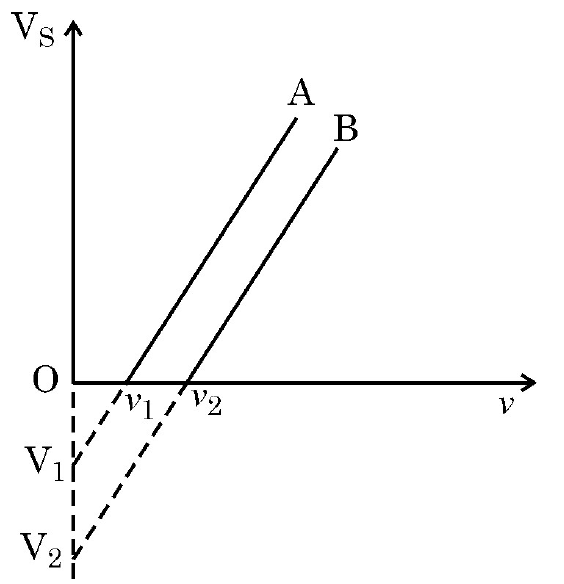
(I) From the graph, the work functions of A and B are (h is Planck's constant and e value of charge on an electron)
Let m be the slope of the graph line for metal B. If e is the value of electron charge, then Planck's constant 'h' is given by
Solution
(I) (C) and . The intercepts on the -axis are the threshold frequencies, and .
(II) (A) greater for metal A because it has a smaller work function. ; for the same , the smaller (metal A) gives the larger .
(III) (D) The slope does not depend on intensity, and the threshold frequency does not change; higher intensity means more photons, so more electrons are emitted per second.
(IV) (C) 2/5. ; ; .
OR (A) me. , so the slope and .
When a photon of suitable frequency is incident on a metal surface, photoelectron is emitted from it. If the frequency is below a threshold frequency for the surface, no photoelectron is emitted. For a photon of frequency , the kinetic energy of the emitted photoelectrons is . The photocurrent can be stopped by applying a potential called 'stopping potential' on the anode. Thus maximum kinetic energy of photoelectrons . The experimental graph between and ν for a metal is shown in figure. This is a straight line of slope m.
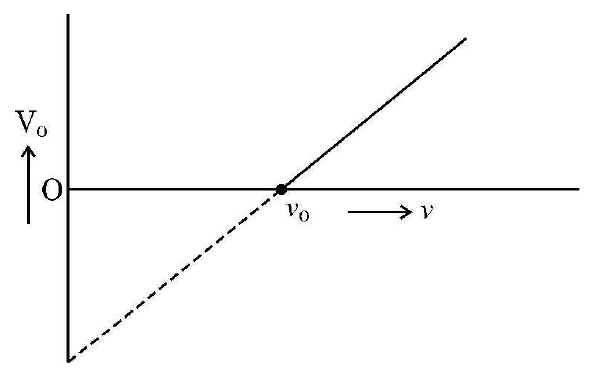
(i) The straight line graphs obtained for two metals
When the wavelength of a photon is doubled, how many times its wave number and frequency become, respectively?
Solution
(i) (B) parallel to each other. : the slope is the same for every metal; only the intercept changes.
(ii) (C) me. , so .
(iii) The intercepts are on the ν-axis and on the -axis. No option gives the negative sign, so CBSE awarded the mark to every student who attempted this part.
OR (B) , . Wave number and frequency both become half when λ is doubled.
(iv) (D) 13.3 μm. m μm.
Figure shows the variation of photoelectric current measured in a photo cell circuit as a function of the potential difference between the plates of the photo cell when light beams A, B, C and D of different wavelengths are incident on the photo cell. Examine the given figure and answer the following questions:
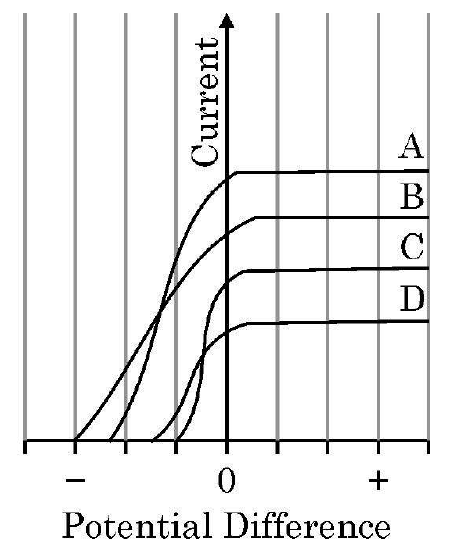
(i) Which light beam has the highest frequency and why?
(ii) Which light beam has the longest wavelength and why?
(iii) Which light beam ejects photoelectrons with maximum momentum and why?
What is the effect on threshold frequency and stopping potential on increasing the frequency of incident beam of light? Justify your answer.
Get every solution for all chapters
- Every board question of every chapter, each fully solved the way the board gives marks
- 19 complete board papers, each followed by its solutions
- Weightage and most-asked topics for every chapter
- Instant PDF download, colour and black & white print copies
Revising the chapter first? Complete Physics Notes for Class 12 (NCERT 2026-27, CBSE Board 2027) →
What you get in the pack
- Questions from 138 CBSE papers, 2016 to 2026: every set code available
- Complete: 2262 different questions and parts from all set codes, 14 chapters and 19 full papers
- Part A: all 14 chapters, questions sorted chapter-wise and by marks
- Year-wise weightage table and most-asked topics for every chapter
- Part B: 19 full board papers, each followed by its complete solutions
- Derivations, numericals, ray and circuit diagrams worked the way the board awards marks
- Questions on topics out of the board syllabus flagged
All chapters in this pack
- PYQ Ch 1 Electric Charges and Fields
- PYQ Ch 2 Electrostatic Potential and Capacitance
- PYQ Ch 3 Current Electricity
- PYQ Ch 4 Moving Charges and Magnetism
- PYQ Ch 5 Magnetism and Matter
- PYQ Ch 6 Electromagnetic Induction
- PYQ Ch 7 Alternating Current
- PYQ Ch 8 Electromagnetic Waves
- PYQ Ch 9 Ray Optics and Optical Instruments
- PYQ Ch 10 Wave Optics
- PYQ Ch 11 Dual Nature of Radiation and Matter
- PYQ Ch 12 Atoms
- PYQ Ch 13 Nuclei
- PYQ Ch 14 Semiconductor Electronics
- Board Paper 2026 Set 55-1-1 with Solutions
- Board Paper 2026 Set 55-1-2 with Solutions
- Board Paper 2026 Set 55-1-3 with Solutions
- Board Paper 2026 Set 55-2-1 with Solutions
- Board Paper 2025 Set 55-1-1 with Solutions
- Board Paper 2025 Set 55-2-1 with Solutions
- Board Paper 2024 Set 55-1-1 with Solutions
- Board Paper 2024 Set 55-2-1 with Solutions
- Board Paper 2023 Set 55-1-1 with Solutions
- Board Paper 2023 Set 55-2-1 with Solutions
- Board Paper 2022 Term 2 Set 55-1-1 with Solutions
- Board Paper 2022 Term 2 Set 55-2-1 with Solutions
- Board Paper 2020 Set 55-1-1 with Solutions
- Board Paper 2020 Set 55-2-1 with Solutions
- Board Paper 2019 Set 55-1-1 with Solutions
- Board Paper 2019 Set 55-2-1 with Solutions
- Board Paper 2018 Set 55-1 with Solutions
- Board Paper 2017 Set 55-1 with Solutions
- Board Paper 2016 Set 55-1 with Solutions