
Electric Charges and Fields: Class 12 PYQs 2016–2026 with solutions
All 31 CBSE board questions asked from Electric Charges and Fields in 14 board papers, with the year, set and marks of each. 16 are solved free below. The Class 12 Physics PYQ Book: Solved Board Papers 2016-2026 (CBSE) has every solution, all chapters and 19 full board papers.
Subject experts: Khushbu Gupta (B.Sc., M.Sc. Physics, B.Ed.) and Vinay Wadhwani (B.Tech Electrical Engineering)



Free: NCERT solutions for Class 12 Physics →
Electric Charges and Fields: board weightage
Board weightage 2016–2026
| Year | 2016 | 2017 | 2018 | 2019 | 2020 | 2022 | 2023 | 2024 | 2025 | 2026 |
|---|---|---|---|---|---|---|---|---|---|---|
| Questions | 1 | 2 | 2 | 4 | 5 | – | 5 | 5 | 4 | 3 |
| Marks | 3 | 10 | 10 | 12 | 15 | – | 17 | 15 | 8 | 11 |
Most asked topics
31 questions from 14 papers. Repeated questions are shown once with every year they were asked.
1 mark: MCQ and Assertion–Reason
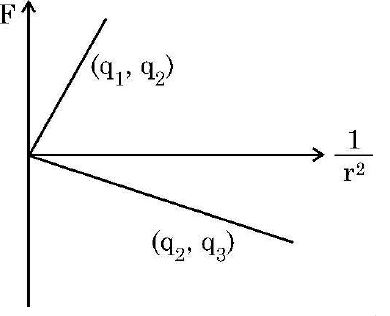
Figure shows variation of Coulomb force (F) acting between two point charges with , r being the separation between the two charges and . If is positive and least in magnitude, then the magnitudes of , and are such that
Solution
Answer: (A)
, so on an F– graph the slope is . The line is steeper (larger magnitude of slope) than the line, so , i.e. . With the least: .
(The signs also tell us is positive, since F is repulsive, and is negative, since F is attractive.)
Two charges –q each are placed at the vertices A and B of an equilateral triangle ABC. If M is the mid-point of AB, the net electric field at C will point along
Solution
Answer: (D) CM
The field of a negative charge points towards it, so at C the fields point along CA and CB, with equal magnitudes. Their components parallel to AB cancel, and the components along the bisector add. The resultant points from C towards M, i.e. along CM.
Which one of the following statements is correct? Electric field due to static charges is
Solution
Answer: (A)
The work done by an electrostatic field around any closed path is zero, so the field is conservative. Its lines start on positive charges and end on negative charges, so they never form closed loops.
A thin plastic rod is bent into a circular ring of radius R. It is uniformly charged with charge density λ. The magnitude of the electric field at its centre is
Solution
Answer: (B) Zero
For every small element of the ring there is an identical element diametrically opposite. Their fields at the centre are equal and opposite, so the net field at the centre is zero.
Two charged particles P and Q, having the same charge but different masses and , start from rest and travel equal distances in a uniform electric field in time and respectively. Neglecting the effect of gravity, the ratio is
Solution
Answer: (C)
and, from rest, , so (same q, E and s).
A point charge situated at a distance 'r' from a short electric dipole on its axis, experiences a force . If the distance of the charge is '2r', the force on the charge will be
The magnitude of the electric field due to a point charge object at a distance of 4.0 m is 9 N/C. From the same charged object the electric field of magnitude, 16 N/C will be at a distance of
If the net electric flux through a closed surface is zero, then we can infer
Fill in the blank: If the electric flux entering and leaving a closed surface in air are and respectively, the net electric charge enclosed within the surface is ________.
Draw the pattern of electric field lines, when a point charge – Q is kept near an uncharged conducting plate.
3 marks: short answer
(a) Using Gauss's law, deduce an expression for electric field at a point due to a uniformly charged infinite plane thin sheet.
(b) Two large thin plane sheets, each having surface charge density , are held close and parallel to each other in air. What is the net electric field at a point (i) inside and (ii) outside, the sheets?
Solution
(a) Take a cylindrical Gaussian surface of end-area A, cutting the sheet perpendicularly.
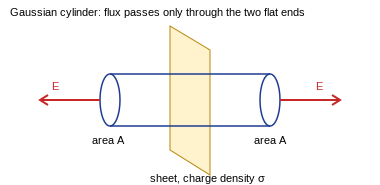
By symmetry is normal to the sheet. There is no flux through the curved surface; through each flat end the flux is EA.
Total flux ; charge enclosed . Gauss's law:
directed away from the sheet if ; it does not depend on distance.
(b) Each sheet gives .
(i) Inside: the two fields are opposite, so .
(ii) Outside: the fields add, so , directed away from the sheets.
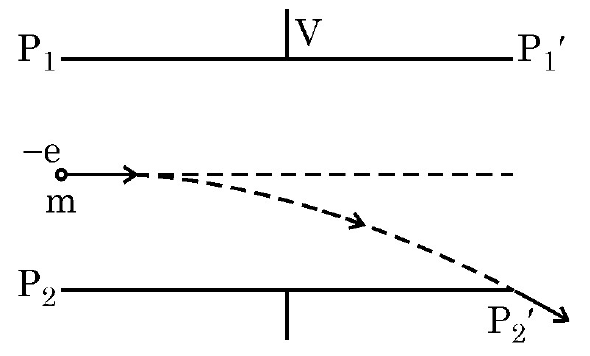
Figure shows a narrow beam of electrons entering with a velocity of m/s, symmetrically through the space between two parallel horizontal plates and kept 2 cm apart. If each plate is 3 cm long, calculate the potential difference V applied between the plates so that the beam just strikes the end .
Solution
Field between plates ; acceleration of the electron (towards the positive plate).
Time to cross the plates: .
To just strike the end, the deflection must be cm:
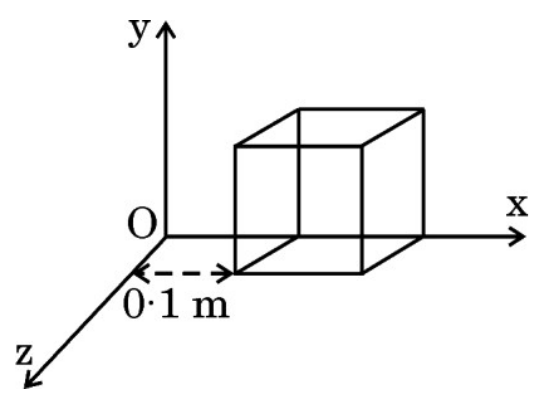
A cube of side 0.1 m is placed, as shown in the figure, in a region where electric field exists. Here x is in meters and E in N C⁻¹. Calculate: (a) the flux passing through the cube, and (b) the charge within the cube.
Solution
(a) is along x, so only the two faces perpendicular to x carry flux. Area of each face m². The cube lies from x = 0.1 m to x = 0.2 m.
Left face (x = 0.1 m, area vector along –x): N m² C⁻¹.
Right face (x = 0.2 m, area vector along +x): N m² C⁻¹.
(b) Gauss's law: .
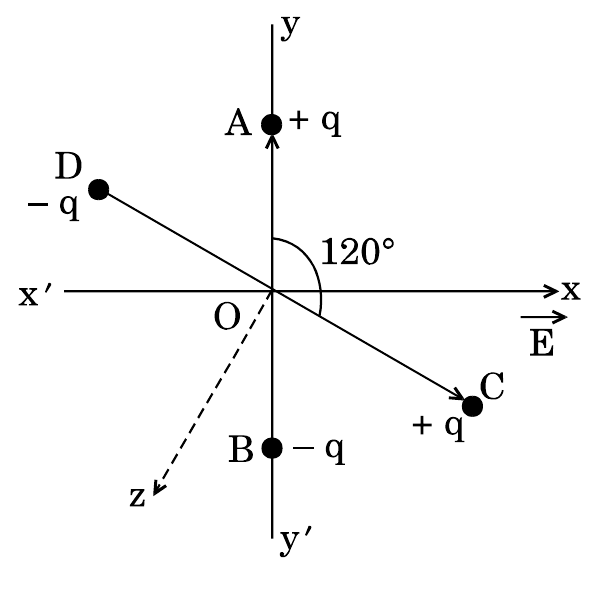
Two small identical electric dipoles AB and CD, each of dipole moment are kept at an angle of 120° to each other in an external electric field pointing along the x-axis as shown in the figure. Find the (a) dipole moment of the arrangement, and (b) magnitude and direction of the net torque acting on it.
Solution
(a) (B → A) points along +y; (D → C) points at 120° from it, i.e. 30° below the x-axis. The resultant of two equal vectors at 120° has magnitude
along the bisector, i.e. at 60° to each, which is 30° above the x-axis.
(b) .
: with at 30° above +x and along +x, the torque points along the –z direction; it tends to rotate the arrangement clockwise (towards ).
Two large charged plane sheets of charge densities σ and –2σ C/m² are arranged vertically with a separation of d between them. Deduce expressions for the electric field at points (i) to the left of the first sheet, (ii) to the right of the second sheet, and (iii) between the two sheets.
A spherical conducting shell of inner radius and outer radius has a charge Q. (a) A charge q is placed at the centre of the shell. Find out the surface charge density on the inner and outer surfaces of the shell. (b) Is the electric field inside a cavity (with no charge) zero; independent of the fact whether the shell is spherical or not? Explain.
Find the electric field intensity due to a uniformly charged spherical shell at a point (i) outside the shell and (ii) inside the shell. Plot the graph of electric field with distance from the centre of the shell.
5 marks: long answer
(a) An electric dipole consists of two point charges q and –q separated by a distance 2a. Derive an expression for the electric field due to this dipole at a point distant r from the centre of the dipole on the equatorial plane. Write the expression for the electric field at a far off point, i.e. .
(b) A dipole is placed in x-y plane such that charges q and –q are located at and respectively. There exists an electric field N/C in the region. Calculate the force and torque experienced by the dipole.
Solution
(a)
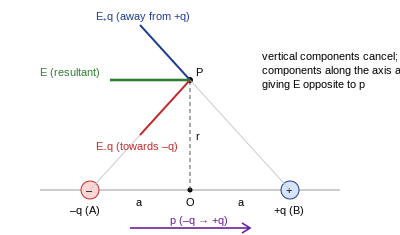
P is on the perpendicular bisector at distance r from the centre O. Distance of P from each charge , so
Their components perpendicular to the axis cancel. The components parallel to the axis add, both pointing from +q towards –q (opposite to ). If is the angle each field makes with the axis, :
With :
For a far-off point :
(b) The field is uniform, so the forces on +q and –q are and : net force .
Dipole moment (from –q to +q): . Torque:
(the dipole lies along the field, so it is in equilibrium).
(i) What is difference between an open surface and a closed surface? Draw elementary surface vector for a spherical surface S.
(ii) Define electric flux through a surface. Give the significance of a Gaussian surface. A charge outside a Gaussian surface does not contribute to total electric flux through the surface. Why?
(iii) A small spherical shell has point charges μC, μC and μC inside it. This shell is enclosed by another big spherical shell . A point charge Q is placed in between the two surfaces and . If the electric flux through the surface is four times the flux through surface , find charge Q.
Solution
(i) An open surface (like a disc or a hemisphere) has a boundary and does not enclose a volume; a closed surface (like a sphere) encloses a volume and has no boundary. For a closed surface, the area vector of every small element points along the outward normal: on a sphere, radially outward from the centre.
(ii) Electric flux through a surface is (for a uniform field ): a measure of the number of field lines crossing the surface. Its SI unit is N m² C⁻¹.
A Gaussian surface is a closed surface, chosen to fit the symmetry, through which the flux is ; it makes the field easy to calculate.
A charge outside the surface contributes nothing because every field line from it that enters the surface also leaves it, so its inward and outward flux cancel.
(iii) Charge inside : μC, so .
Charge inside : μC, so .
(i) Derive an expression for potential energy of an electric dipole in an external uniform electric field . When is the potential energy of the dipole (1) maximum, and (2) minimum?
(ii) An electric dipole consists of point charges –1.0 pC and +1.0 pC located at (0, 0) and (3 mm, 4 mm) respectively in x – y plane. An electric field is switched on in the region. Find the torque acting on the dipole.
Solution
(i) A dipole at angle θ with experiences a torque that tends to align it with the field. Work done in rotating it slowly from to against this torque:
This work is stored as potential energy. Taking at :
(1) Maximum, , when θ = 180° ( antiparallel to , unstable equilibrium).
(2) Minimum, , when θ = 0° ( parallel to , stable equilibrium).
(ii) points from –q to +q: C m C m.
(magnitude N m, along –z).
(i) State Gauss's Law in electrostatics. Apply this to obtain the electric field at a point near a uniformly charged infinite plane sheet.
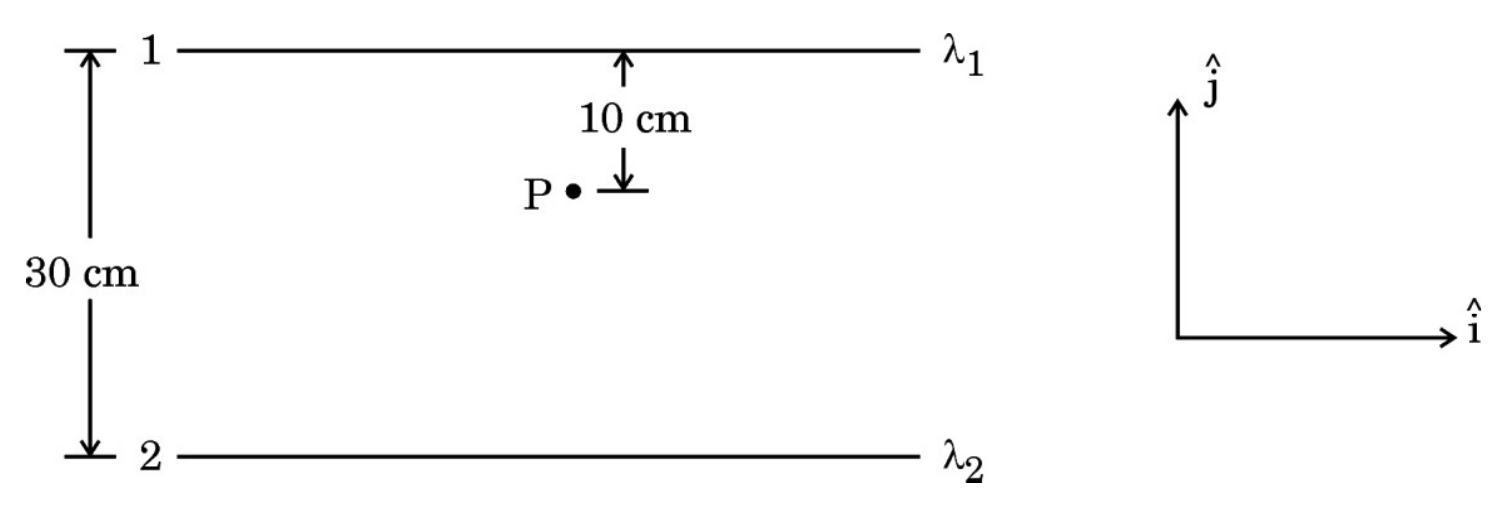
(ii) Two long straight wires 1 and 2 are kept as shown in the figure. The linear charge density of the two wires are = 10 μC/m and = –20 μC/m. Find the net force experienced by an electron held at point P.
Solution
(i) Gauss's law: the total electric flux through any closed surface equals times the net charge enclosed by it: .
Take a cylinder of end-area A crossing the sheet (surface charge density σ). By symmetry is normal to the sheet: no flux through the curved surface, flux EA through each end. Total flux ; charge enclosed :
directed away from the sheet (for σ > 0), independent of distance.
(ii) Field of a long line charge: .
P is 10 cm below wire 1 and 20 cm above wire 2.
Wire 1 (positive): N/C, away from wire 1, i.e. along .
Wire 2 (negative): N/C, towards wire 2, i.e. along .
Net field: N/C.
Force on the electron (charge –e):
(towards wire 1).
(i) State Coulomb's law in electrostatics and write it in vector form, for two charges.
(ii) 'Gauss's law is based on the inverse-square dependence on distance contained in the Coulomb's law.' Explain.
(iii) Two charges A (charge q) and B (charge 2q) are located at points (0, 0) and (a, a) respectively. Let and be the unit vectors along x-axis and y-axis respectively. Find the force exerted by A on B, in terms of and .
Solution
(i) The force between two point charges is directly proportional to the product of the charges and inversely proportional to the square of the distance between them, and acts along the line joining them:
where is the force on due to and is the unit vector from to .
(ii) For a point charge q at the centre of a sphere of radius r, and the area is , so the flux does not depend on r. This is so only because E falls as while the area grows as . If the force law were any other power of r, the flux through a closed surface would depend on its size, and Gauss's law would not hold.
(iii) , , .
(repulsive, along AB produced).
(i) Derive an expression for the electric field at a point on the equatorial plane of an electric dipole consisting of charges q and – q separated by a distance 2a.
(ii) The distance of a far off point on the equatorial plane of an electric dipole is halved. How will the electric field be affected for the dipole?
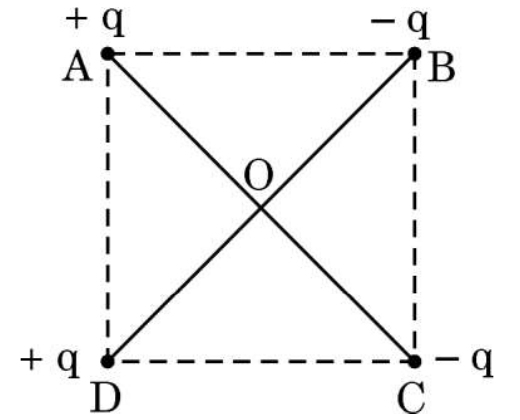
(iii) Two identical electric dipoles are placed along the diagonals of a square ABCD of side m as shown in the figure. Obtain the magnitude and direction of the net electric field at the centre (O) of the square.
Solution
(i)
The point P is at distance r from the centre on the perpendicular bisector; each charge is at distance :
The components perpendicular to the axis cancel; the components along the axis add, pointing from +q towards –q:
(ii) For a far point ; halving r makes the field 8 times.
(iii) The diagonal of the square is m, so each charge is 1 m from O. Each charge produces a field of magnitude at O.
Dipole A(+q)–C(–q): both fields point from A towards C, total along AC.
Dipole D(+q)–B(–q): both fields point from D towards B, total along DB.
AC and DB are perpendicular, and their bisector is parallel to DC (AB). Each makes 45° with it, so the components perpendicular to DC cancel:
directed parallel to DC (from the AD side towards the BC side).
(i) Use Gauss' law to obtain an expression for the electric field due to an infinitely long thin straight wire with uniform linear charge density λ.
(ii) An infinitely long positively charged straight wire has a linear charge density λ. An electron is revolving in a circle with a constant speed v such that the wire passes through the centre, and is perpendicular to the plane, of the circle. Find the kinetic energy of the electron in terms of magnitudes of its charge and linear charge density λ on the wire.
(iii) Draw a graph of kinetic energy as a function of linear charge density λ.
Solution
(i)
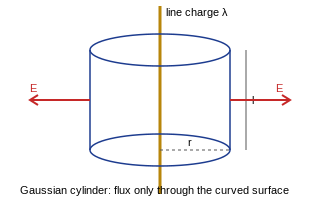
Take a coaxial cylinder of radius r and length l as the Gaussian surface. By symmetry is radial and has the same magnitude on the curved surface. The flux through the flat ends is zero ( there).
Flux ; charge enclosed :
directed radially outward for λ > 0.
(ii) The electrostatic attraction provides the centripetal force:
(independent of the radius of the orbit).
(iii) K ∝ λ: a straight line through the origin (slope ).
(a) Using Gauss law, derive expression for electric field due to a spherical shell of uniform charge distribution σ and radius R at a point lying at a distance x from the centre of shell, such that (i) 0 < x < R, and (ii) x > R.
(b) An electric field is uniform and acts along + x direction in the region of positive x. It is also uniform with the same magnitude but acts in – x direction in the region of negative x. The value of the field is E = 200 N/C for x > 0 and E = – 200 N/C for x < 0. A right circular cylinder of length 20 cm and radius 5 cm has its centre at the origin and its axis along the x-axis so that one flat face is at x = + 10 cm and the other is at x = – 10 cm. Find: (i) The net outward flux through the cylinder. (ii) The net charge present inside the cylinder.
(a) Use Gauss's law to show that due to a uniformly charged spherical shell of radius R, the electric field at any point situated outside the shell at a distance r from its centre is equal to the electric field at the same point, when the entire charge on the shell were concentrated at its centre. Also plot the graph showing the variation of electric field with r, for r ≤ R and r ≥ R.
(b) Two point charges of + 1 μC and + 4 μC are kept 30 cm apart. How far from the + 1 μC charge on the line joining the two charges, will the net electric field be zero?
(a) Derive an expression for the electric field at any point on the equatorial line of an electric dipole. (b) Two identical point charges, q each, are kept 2m apart in air. A third point charge Q of unknown magnitude and sign is placed on the line joining the charges such that the system remains in equilibrium. Find the position and nature of Q.
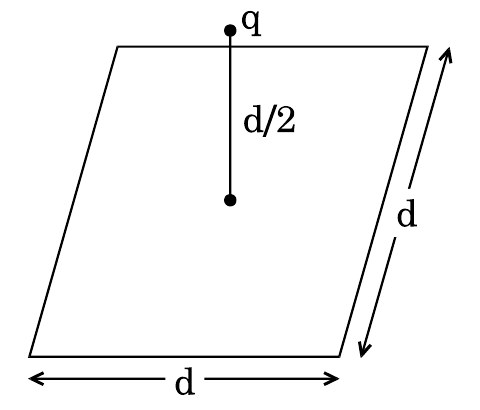
(a) Define electric flux. Is it a scalar or a vector quantity? A point charge q is at a distance of d/2 directly above the centre of a square of side d, as shown in the figure. Use Gauss' law to obtain the expression for the electric flux through the square. (b) If the point charge is now moved to a distance 'd' from the centre of the square and the side of the square is doubled, explain how the electric flux will be affected.
(a) Use Gauss' law to derive the expression for the electric field due to a straight uniformly charged infinite line of charge density λ C/m. (b) Draw a graph to show the variation of E with perpendicular distance r from the line of charge. (c) Find the work done in bringing a charge q from perpendicular distance to .
(a) Derive an expression for the electric field E due to a dipole of length '2a' at a point distant r from the centre of the dipole on the axial line. (b) Draw a graph of E versus r for r >> a. (c) If this dipole were kept in a uniform external electric field , diagrammatically represent the position of the dipole in stable and unstable equilibrium and write the expressions for the torque acting on the dipole in both the cases.
(a) Use Gauss's theorem to find the electric field due to a uniformly charged infinitely large plane thin sheet with surface charge density σ. (b) An infinitely large thin plane sheet has a uniform surface charge density +σ. Obtain the expression for the amount of work done in bringing a point charge q from infinity to a point, distance r, in front of the charged plane sheet.
Get every solution for all chapters
- Every board question of every chapter, each fully solved the way the board gives marks
- 19 complete board papers, each followed by its solutions
- Weightage and most-asked topics for every chapter
- Instant PDF download, colour and black & white print copies
Revising the chapter first? Complete Physics Notes for Class 12 (NCERT 2026-27, CBSE Board 2027) →
What you get in the pack
- Questions from 138 CBSE papers, 2016 to 2026: every set code available
- Complete: 2262 different questions and parts from all set codes, 14 chapters and 19 full papers
- Part A: all 14 chapters, questions sorted chapter-wise and by marks
- Year-wise weightage table and most-asked topics for every chapter
- Part B: 19 full board papers, each followed by its complete solutions
- Derivations, numericals, ray and circuit diagrams worked the way the board awards marks
- Questions on topics out of the board syllabus flagged
All chapters in this pack
- PYQ Ch 1 Electric Charges and Fields
- PYQ Ch 2 Electrostatic Potential and Capacitance
- PYQ Ch 3 Current Electricity
- PYQ Ch 4 Moving Charges and Magnetism
- PYQ Ch 5 Magnetism and Matter
- PYQ Ch 6 Electromagnetic Induction
- PYQ Ch 7 Alternating Current
- PYQ Ch 8 Electromagnetic Waves
- PYQ Ch 9 Ray Optics and Optical Instruments
- PYQ Ch 10 Wave Optics
- PYQ Ch 11 Dual Nature of Radiation and Matter
- PYQ Ch 12 Atoms
- PYQ Ch 13 Nuclei
- PYQ Ch 14 Semiconductor Electronics
- Board Paper 2026 Set 55-1-1 with Solutions
- Board Paper 2026 Set 55-1-2 with Solutions
- Board Paper 2026 Set 55-1-3 with Solutions
- Board Paper 2026 Set 55-2-1 with Solutions
- Board Paper 2025 Set 55-1-1 with Solutions
- Board Paper 2025 Set 55-2-1 with Solutions
- Board Paper 2024 Set 55-1-1 with Solutions
- Board Paper 2024 Set 55-2-1 with Solutions
- Board Paper 2023 Set 55-1-1 with Solutions
- Board Paper 2023 Set 55-2-1 with Solutions
- Board Paper 2022 Term 2 Set 55-1-1 with Solutions
- Board Paper 2022 Term 2 Set 55-2-1 with Solutions
- Board Paper 2020 Set 55-1-1 with Solutions
- Board Paper 2020 Set 55-2-1 with Solutions
- Board Paper 2019 Set 55-1-1 with Solutions
- Board Paper 2019 Set 55-2-1 with Solutions
- Board Paper 2018 Set 55-1 with Solutions
- Board Paper 2017 Set 55-1 with Solutions
- Board Paper 2016 Set 55-1 with Solutions