
Biotechnology: Principles and Processes: Class 12 PYQs 2016–2026 with solutions
All 47 CBSE board questions asked from Biotechnology: Principles and Processes in 17 board papers, with the year, set and marks of each. 25 are solved free below. The Class 12 Biology PYQ Book: Solved Board Papers 2016-2026 (CBSE) has every solution, all chapters and 19 full board papers.
Subject experts: Divya Harwani (B.Sc. Biotechnology, M.Sc. Biotechnology) and Jayant Sharma (B.Sc., B.Ed.)



Free: NCERT solutions for Class 12 Biology →
Biotechnology: Principles and Processes: board weightage
Board weightage 2016–2026
| Year | 2016 | 2017 | 2018 | 2019 | 2020 | 2022 | 2023 | 2024 | 2025 | 2026 |
|---|---|---|---|---|---|---|---|---|---|---|
| Questions | 2 | 2 | 2 | 5 | 3 | 4 | 8 | 8 | 5 | 8 |
| Marks | 6 | 6 | 6 | 12 | 9 | 16 | 17 | 18 | 15 | 15 |
Most asked topics
47 questions from 17 papers. Repeated questions are shown once with every year they were asked.
Jump to: 1 mark2 marks3 marks4 marks5 marks
1 mark: MCQ and Assertion–Reason
Match Column-I with Column-II and choose the correct option :
| Column-I | Column-II |
|---|---|
| a. Biolistic gun | i. Bacterial cell |
| b. Chitinase | ii. Tumour inducing |
| c. Ti | iii. Animal cell |
| d. Ca++ | iv. Fungal cell |
| v. Plant cell |
Solution
Answer: (C) a – v, b – iv, c – ii, d – i
A biolistic (gene) gun shoots DNA-coated gold or tungsten particles into plant cells. Chitinase breaks the fungal cell wall. The Ti plasmid is the tumour-inducing plasmid of Agrobacterium. Divalent Ca2+ ions make bacterial cells competent to take up DNA.
Which of the following statements about plasmids is incorrect ?
Solution
Answer: (B)
Plasmids replicate autonomously, independent of the chromosomal DNA, because each has its own origin of replication (ori).
Which of the following is used to visualize DNA bands under UV light after gel electrophoresis ?
Solution
Answer: (C) Ethidium Bromide
DNA stained with ethidium bromide shows bright orange bands under UV light.
Assertion (A) : DNA Ligase is used to join DNA fragments.
Reason (R) : It catalyses the formation of glycosidic bonds between nucleotides.
Solution
Answer: (C) A is true but R is false.
DNA ligase joins fragments by forming phosphodiester bonds between adjacent nucleotides. Glycosidic bonds link a base to its sugar within a nucleotide.
Isolation of DNA from a fungal cell can be achieved by using :
Solution
Answer: (B) Chitinase
The fungal cell wall is made of chitin. (Lysozyme is used for bacteria, cellulase for plant cells.)
Restriction Endonuclease Hind II always cuts DNA molecules at a particular point by recognising a specific sequence of :
Solution
Answer: (A) Six base pairs
Hind II, the first restriction endonuclease to be isolated, recognises a specific six base-pair sequence (its recognition sequence).
Assertion (A) : Agrobacterium tumefaciens is a pathogen of several monocot plants.
Reason (R) : It is able to deliver a piece of DNA known as T-DNA to transform normal plant cells into a tumor.
Which one of the following is not a feature of plasmids ?
Assertion (A) : Specific enzymes are used to degrade the cell wall in organisms to isolate the DNA from the cell.
Reason (R) : Fungal cell wall is degraded by the enzyme cellulase.
Given below are two columns. In Column I is the list of four enzymes and in Column II is the list of functions of the given enzymes. Which one of the following options shows the enzymes matched with their respective functions correctly ?
| Column I (Enzyme) | Column II (Function) |
|---|---|
| P. DNA Ligase | i. Removes nucleotides from ends of DNA |
| Q. Restriction exonuclease | ii. Extends primer on a DNA template |
| R. Taq polymerase | iii. Joins the DNA fragments |
| S. Restriction endonuclease | iv. Cuts DNA at a specific position |
The organism used in construction of the first artificial recombinant DNA by Cohen and Boyer in 1972 was :
The given schematic illustration shows three steps 'P', 'Q' and 'R' of the polymerase chain reaction.
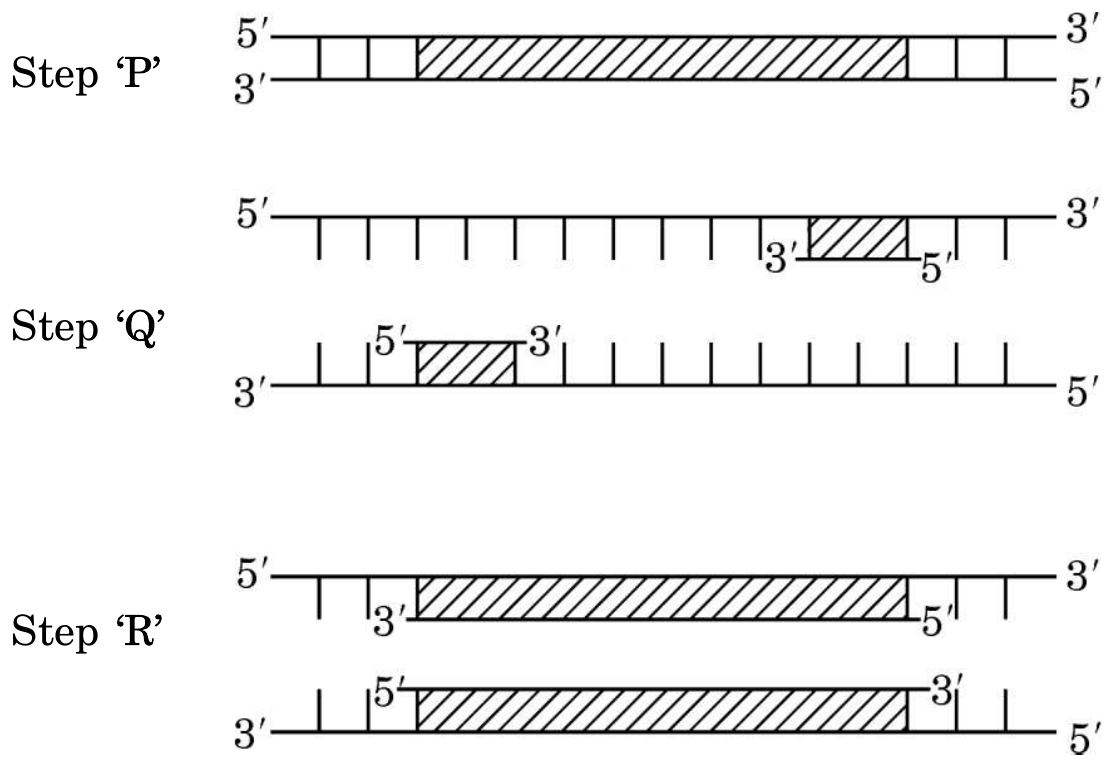
Which of the following statements are correct with reference to the illustration given above ?
(i) Step 'P' is showing denaturation at low temperature.
(ii) Step 'Q' is a denaturation of DNA strand at high temperature, followed by annealing.
(iii) Step 'R' is an extension of DNA in presence of thermostable DNA polymerase.
(iv) Step 'Q' is extension with two sets of primers.
2 marks: very short answer
Study the sequence of bases in a DNA molecule that is shown below and answer the questions.
5' – GAATTC – 3'
3' – CTTAAG – 5'
(a) What are such sequences called ? Name the enzyme used that recognises such nucleotide sequences.
(b) How do these enzymes function ?
Solution
(a) Palindromic nucleotide sequences: they read the same on both strands when read in the same direction (5' → 3'). The enzyme is a restriction endonuclease, EcoRI.
(b) The restriction endonuclease scans the DNA, binds to its specific palindromic recognition sequence and cuts each strand at a specific point between the same two bases (EcoRI cuts between G and A). The cuts are a little away from the centre of the palindrome, so single-stranded overhangs called sticky ends are left on each strand.
How do scientists use microinjection and gene gun in biotechnology ?
Solution
• Microinjection: recombinant DNA is injected directly into the nucleus of an animal cell with a fine micro-needle.
• Gene gun (biolistics): plant cells are bombarded with high-velocity micro-particles of gold or tungsten coated with DNA.
Both are ways of putting the foreign (recombinant) DNA into host cells.
The basic scheme of the essential steps involved in the process of recombinant DNA technology is summarized below in the form of a flow diagram.
Step-1: Vector DNA (cut using Restriction Enzyme EcoR I) + Alien DNA (cut using Restriction Enzyme EcoR I) → Enzyme A
Step-2: Recombinant DNA molecule
Step-3: Transfer of recombinant DNA molecule in E. coli (Host)
Step-4: Replication of recombinant DNA molecule in E. coli
(a) Name the enzyme used in Step-1 to join the cut plasmid and alien DNA.
(b) State the technical term used for Step-3.
(c) Justify the use of same Restriction Enzyme EcoR I to cut both the vector DNA and the alien DNA.
Solution
(a) Enzyme A is DNA ligase.
(b) Transformation (introducing rDNA into a competent host cell).
(c) The same enzyme leaves the same, complementary sticky ends on both the vector and the alien DNA. These sticky ends pair by hydrogen bonds, and ligase then seals them. With different enzymes the ends would not match.
The basic scheme of the essential steps involved in the process of recombinant DNA technology is summarised below in the form of a flow diagram.
Step-1: Plasmid DNA (cut using Restriction Enzyme EcoR I) + Foreign DNA (cut using Restriction Enzyme EcoR I) → DNA ligase
Step-2: Recombinant DNA molecule
Step-3: Transfer of recombinant DNA molecule to the host cell
Step-4: Replication of recombinant DNA molecule in the host cell
(a) Name the specific enzyme that might have been used to make the multiple copies of foreign DNA before undergoing Step-1 of the process.
(b) How does the use of restriction enzyme EcoR I in Step-1 facilitate the action of DNA ligase to form the recombinant DNA molecule ? Explain.
(c) Name the most commonly used host in the above process.
Solution
(a) Taq polymerase (thermostable DNA polymerase used in PCR).
(b) EcoRI cuts both the plasmid and the foreign DNA at the same palindromic site, leaving complementary single-stranded overhangs called sticky ends. These ends form hydrogen bonds with their complementary partners, holding the two pieces together. DNA ligase then seals the backbone.
(c) Escherichia coli.
Write the role of 'ori' and restriction site in the cloning vector pBR322.
Solution
• ori (origin of replication): the sequence where replication starts. Any piece of DNA linked to it can replicate in the host cell. It also controls the copy number of the linked DNA.
• Restriction site: a recognition site for a restriction enzyme (e.g. BamHI, EcoRI, PstI in pBR322) where the vector is cut and the alien (foreign) DNA is ligated. Having a single recognition site for an enzyme avoids cutting the vector into many pieces.
(i) Identify and name the structures 'A' and 'B' marked in the image given below :
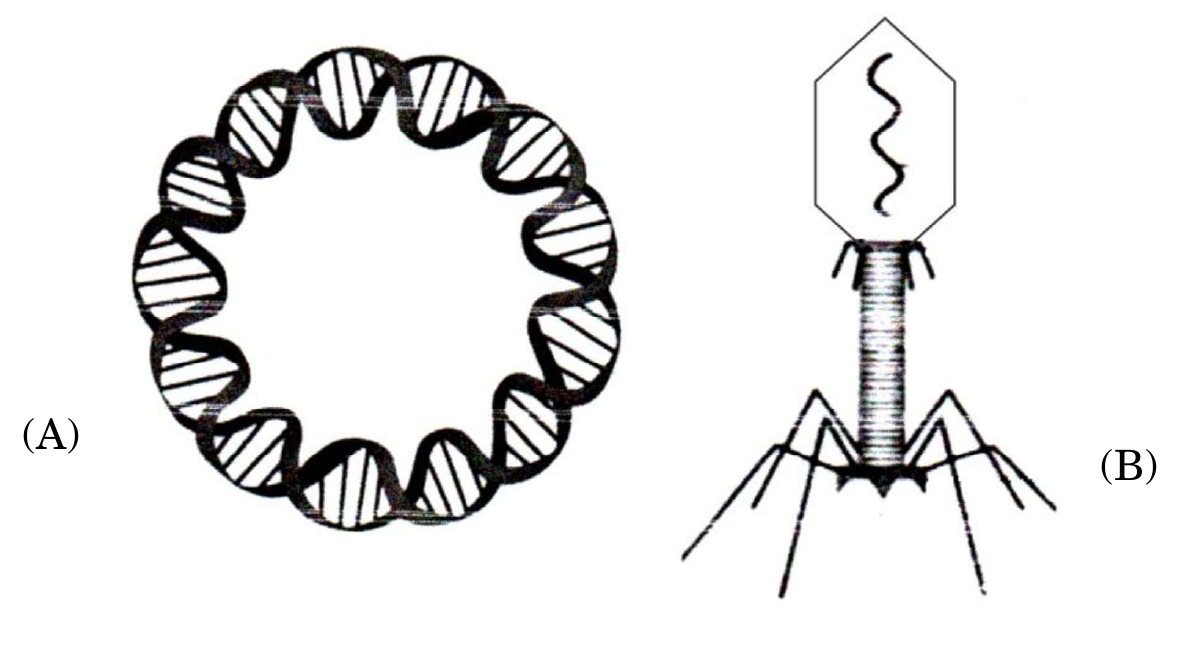
(ii) State their importance in various biotechnology experiments.
Solution
(i) A – plasmid (circular extra-chromosomal DNA); B – bacteriophage.
(ii) Both are used as cloning vectors to carry a foreign gene into host cells. They can replicate inside bacterial cells independently of the chromosomal DNA, and they are present in high copy numbers, so the linked gene of interest is multiplied too.
Explain the process by which a bacterial cell can be made 'competent' to take up foreign DNA from its surroundings, using divalent cations and temperature treatment.
'Insertional inactivation' is a method to detect recombinant DNA. Explain the method.
How are DNA fragments visualised during gel-electrophoresis ? What is elution ?
What is 'Ori' ? State its importance during cloning of a vector.
Explain the importance of 'selectable marker', with the help of a suitable example.
3 marks: short answer
Observe the given picture carefully. A mixture of DNA with fragments ranging from 100 base pairs to 1800 base pairs were separated by electrophoresis on agarose gel with the following arrangement :
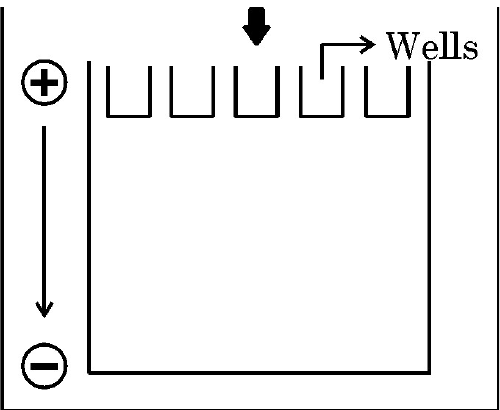
(a) What result will be obtained in staining with ethidium bromide ? Explain with reasons.
(b) The above setup was modified as shown below and a band with 100 base pairs was obtained at X.
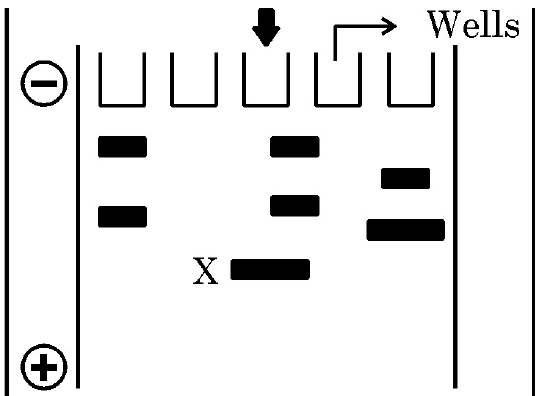
What changes were made to the previous design to get a band at 'X'. Why did the band appear at 'X' ?
Solution
(a) No bands will be seen in the gel. DNA is negatively charged and moves towards the anode (+). Here the wells are at the anode end, so the DNA does not move through the gel towards the cathode and no fragments are separated.
(b) The electrodes were interchanged: the wells are now at the cathode (–) end and the anode (+) is at the far end.
Agarose acts as a sieve, so fragments separate by size. The smallest fragment moves fastest and farthest towards the anode. So the 100 bp fragment, the smallest in the mixture, forms the band at X.
(i) Explain the convention for naming EcoRI.
(ii) With the help of an illustration only, show the action of EcoRI on a DNA Polynucleotide.
Solution
(i) EcoRI comes from Escherichia coli RY 13.
• E – the genus, Escherichia
• co – the species, coli
• R – the strain, RY 13
• I – the order in which the enzyme was isolated from that strain (the first)
(ii) EcoRI recognises 5'–GAATTC–3' and cuts between G and A on both strands, leaving sticky ends:
| 5'– G↓AATTC –3' 3'– CTTAA↑G –5' | → EcoRI → | 5'– G AATTC –3' 3'– CTTAA G –5' (sticky ends: single-stranded AATT overhangs) |
With the help of a schematic diagram only, show in three steps, the formation of recombinant DNA by the action of restriction endonuclease – EcoRI and DNA ligase.
Solution

With the advent of sophisticated techniques of genetic engineering, we can now readily purify and isolate DNA. Name and explain the different steps involved in the separation and isolation of DNA fragments once cut by restriction endonucleases.
Solution
The technique is agarose gel electrophoresis.
• The DNA fragments are negatively charged, so in an electric field they move towards the anode through the agarose gel.
• The gel acts as a sieve: the fragments separate according to their size, and the smaller fragments move farther.
• The separated DNA is stained with ethidium bromide and seen as bright orange bands under UV light.
• The desired bands are cut out of the agarose gel and the DNA is extracted from the gel piece. This step is called elution. The purified DNA is used to make recombinant DNA.
Causative agents of HIV-AIDS and COVID-19 belong to the same group of viruses. To diagnose and amplify the genetic material for further study of COVID-19 virus, 'RT-PCR' test is carried out.
(a) What does 'RT-PCR' stand for ?
(b) Explain the various steps of PCR technique.
Solution
(a) Reverse Transcription – Polymerase Chain Reaction (also used for real-time PCR). The viral RNA is first copied into DNA by reverse transcriptase, and the DNA is then amplified.
(b) Each PCR cycle has three steps, repeated many times:
• Denaturation: the double-stranded DNA is heated (about 94 °C), so the two strands separate.
• Annealing: two sets of primers (small synthetic oligonucleotides) bind to the complementary regions at the 3' ends of the template strands.
• Extension: a thermostable DNA polymerase (Taq polymerase, from Thermus aquaticus) extends the primers using the nucleotides provided.
Repeating the cycle about 30 times amplifies the DNA segment about a billion times.
Explain the three steps carried out in the formation of recombinant DNA using the enzyme EcoRI.
Solution
1. EcoRI cuts both the vector DNA and the foreign DNA (gene of interest) at the palindromic site 5'–GAATTC–3' / 3'–CTTAAG–5', between the bases G and A.
2. This leaves single-stranded overhanging stretches, sticky ends, on each strand.
3. The complementary sticky ends of the vector and the foreign DNA pair up, and DNA ligase joins them to form the recombinant DNA.
Name any two natural cloning vectors. Give reasons that make them act as cloning vectors. Write the two characteristics the engineered vectors are made to possess.
Solution
Natural cloning vectors: plasmids and bacteriophages.
Why they act as vectors: they can replicate within bacterial cells independently of the chromosomal DNA, and they have a high copy number in the cell.
Engineered vectors are made to possess: (1) features for easy linking of foreign DNA (cloning/restriction sites, ori); (2) selectable markers that help in selecting recombinants from non-recombinants.
(a) Identify steps A and B in a cycle of Polymerase Chain Reaction given below.
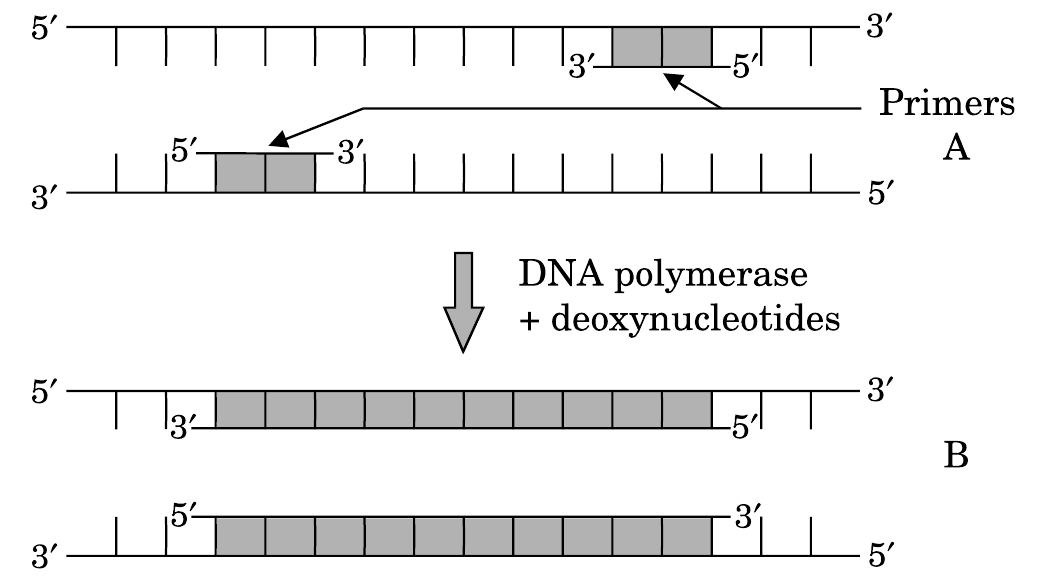
(b) State the specific characteristic feature of the enzyme in carrying step B.
Solution
(a) A – annealing (primers bind to the complementary regions of the separated strands); B – extension.
(b) The enzyme, Taq polymerase (from Thermus aquaticus), is thermostable: it remains active at the high temperatures used for denaturation.
Name the most commonly used bioreactor in biotechnology labs. Mention the most essential components this bioreactor must have so as to provide the optimum conditions to the culture medium, resulting in production of large volume of desired product.
(a) Why should a bacterium be made 'competent' ?
(b) Explain the role of 'microinjection' and 'gene gun' in biotechnology.
(a) How has the development of bioreactor helped in biotechnology ?
(b) Name the most commonly used bioreactor and describe its working.
Explain the roles of the following with the help of an example each in recombinant DNA technology: (a) Restriction Enzymes (b) Plasmids
(a) Explain the significance of palindromic nucleotide sequence in the formation of recombinant DNA.
(b) Write the use of restriction endonuclease in the above process.
Describe the roles of heat, primers and the bacterium Thermus aquaticus in the process of PCR.
(a) Name the selectable markers in the cloning vector pBR322 ? Mention the role they play.
(b) Why is the coding sequence of an enzyme (β-galactosidase) a preferred selectable marker in comparison to the ones named above ?
(a) Why must a cell be made 'competent' in biotechnology experiments ? How does calcium ion help in doing so ?
(b) State the role of 'biolistic gun' in biotechnology experiments.
4 marks: case-based / source-based
Gene manipulation is a fast emerging science. It started with the development of recombinant DNA molecules. This technology which mostly involves cutting and pasting of desired DNA fragments is based on two most important discoveries in bacteria – presence of plasmid and restriction endonucleases. The science of r-DNA technology took birth when Cohen and Boyer (1973) were able to produce a piece of gene containing foreign DNA introduced into plasmid of E.coli.
(a) Name one core technique of biotechnology that alters the genetic material. (1)
(b) What is a plasmid ? Mention its importance in biotechnology. (2)
(c) Which gene was isolated by Cohen and Boyer and from which bacteria ? (1)
OR
(c) How is the action of exonuclease different from that of endonuclease ? (1)
Solution
(a) Genetic engineering (recombinant DNA technology).
(b) A plasmid is an autonomously replicating, circular, extra-chromosomal DNA of bacteria. It is used as a vector to carry a foreign gene into a host cell, where the gene is multiplied along with the plasmid (cloning).
(c) An antibiotic-resistance gene, isolated from a native plasmid of Salmonella typhimurium.
OR (c) An exonuclease removes nucleotides from the ends of a DNA strand. An endonuclease cuts at specific positions within the DNA strand.
Study the diagram given below that shows the steps involved in the procedure of selecting transformed bacteria and answer the questions that follow :
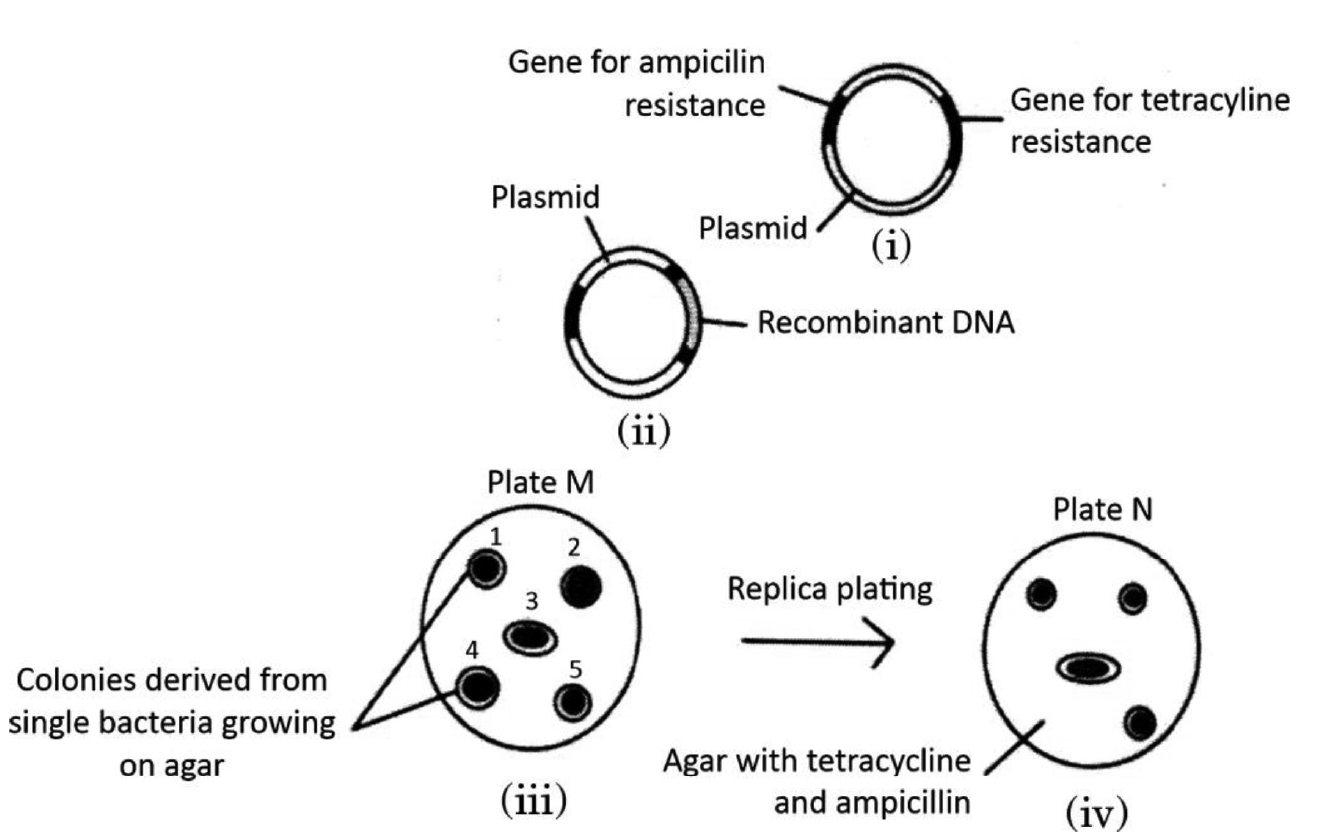
(a) Identify the colony that has got transformed. Justify your answer. (1)
(b) What are the sites in a plasmid called where ampicillin and tetracycline resistance genes are inserted ? State their role in genetic engineering. (2)
(c) Name two enzymes playing an important role in genetic engineering. (1)
OR
(c) State the role of β-galactosidase in insertional inactivation. (1)
Solution
(a) Colony 4. It grows on plate M but does not appear on replica plate N, which has tetracycline and ampicillin. Its plasmid carries the foreign DNA inserted in the tetracycline-resistance gene, so it has lost tetracycline resistance (it still has ampicillin resistance). So colony 4 contains the recombinant plasmid.
(b) The genes for ampicillin and tetracycline resistance are selectable markers, and the sites in them where foreign DNA is ligated are recognition (restriction) sites, e.g. BamHI in the tetracycline-resistance gene of pBR322. Role: they help to identify and eliminate non-transformants and to select transformants. Insertion of foreign DNA into one marker inactivates it (insertional inactivation), which lets us tell recombinants from non-recombinants.
(c) Any two: restriction endonuclease, DNA ligase, DNA polymerase (Taq polymerase).
OR (c) The β-galactosidase (lacZ) gene works as a marker. If the foreign DNA is inserted in its coding sequence, the enzyme is not made, and the colonies stay colourless on a chromogenic substrate. Non-recombinants make the enzyme and give blue colonies. So recombinant colonies are picked out by colour.
5 marks: long answer
Explain the amplification of gene of interest using the technique of Polymerase chain reaction (PCR).
Solution
PCR makes many copies of a gene (DNA) of interest in vitro. It needs the DNA template, two sets of primers, deoxynucleotides and a thermostable DNA polymerase. Each cycle has three steps:
1. Denaturation: the double-stranded DNA is heated to a high temperature (about 94 °C), breaking the hydrogen bonds so that the two strands separate.
2. Annealing: the mixture is cooled. Two sets of primers (small chemically synthesised oligonucleotides complementary to the region of DNA) bind to the 3' ends of the template strands.
3. Extension: the enzyme extends the primers using the nucleotides provided and the genomic DNA as template. The enzyme is Taq polymerase, a thermostable DNA polymerase from the bacterium Thermus aquaticus, which stays active at the high temperature of denaturation.
The cycle is repeated about 30 times, and the DNA segment is amplified about a billion times. The amplified fragment can then be ligated with a vector for cloning.
Describe the structure and working of a sparged stirred-tank bioreactor.
Solution
A bioreactor is a large vessel (100–1000 litres) in which raw materials are converted biologically into specific products. It provides optimal conditions for the desired product: temperature, pH, substrate, salts, vitamins and oxygen.
Structure: a stirred-tank reactor is usually cylindrical, or has a curved base to help mix the contents. It has:
• an agitator (stirrer) driven by a motor;
• a sparger at the bottom, through which sterile air is bubbled;
• an oxygen delivery system, a foam control system, a temperature control system and a pH control system;
• inlets for acid/base and the culture medium, and sampling ports to withdraw small volumes of culture periodically.
Working: the stirrer mixes the contents evenly and makes oxygen available throughout the reactor. In a sparged reactor, air is bubbled in as small bubbles, which greatly increases the area for oxygen transfer. The control systems keep the conditions optimal while the cells grow and make the product.
(i) Why should a cell be made competent to take up an alien DNA ? How can a bacterial cell be made competent using calcium ions ? Explain.
(ii) (1) State the importance of gel electrophoresis in biotechnology. (2) Explain the principle on which this technique works. (3) Mention why ethidium bromide is used in this technique.
Solution
(i) DNA is a hydrophilic molecule and cannot pass through cell membranes, so the cell must be made competent to take it up.
The bacterial cells are treated with a specific concentration of a divalent cation such as calcium. This increases the efficiency with which DNA enters the bacterium through pores in its cell wall. The cells are then incubated with the rDNA on ice, given a brief heat shock (42 °C), and put back on ice, which lets the bacteria take up the rDNA.
(ii) (1) It separates DNA fragments, e.g. after restriction digestion, so that the desired fragment can be isolated (elution) and used.
(2) DNA fragments are negatively charged, so in an electric field they move towards the anode through an agarose gel matrix. The gel acts as a sieve, so the fragments separate by size: the smaller the fragment, the farther it moves.
(3) Ethidium bromide stains the DNA, which can then be seen as bright orange bands under UV light.
Answer the following questions with respect to recombinant DNA technology :
(i) Why is plasmid considered to be an important tool in rDNA technology ? From where can plasmids be isolated ? (Any two sources)
(ii) Explain the role of 'ori' and selectable marker in a cloning vector.
(iii) "r-DNA technology cannot proceed without restriction endonuclease." Justify.
Development of recombinant DNA technology has opened gates to many breakthroughs in the fields of medicine and agriculture. This has enabled scientists to isolate, sequence and manipulate individual genes obtained from diverse living or dead cells. Given below is a diagram showing the basic steps involved in genetically modifying an organism.
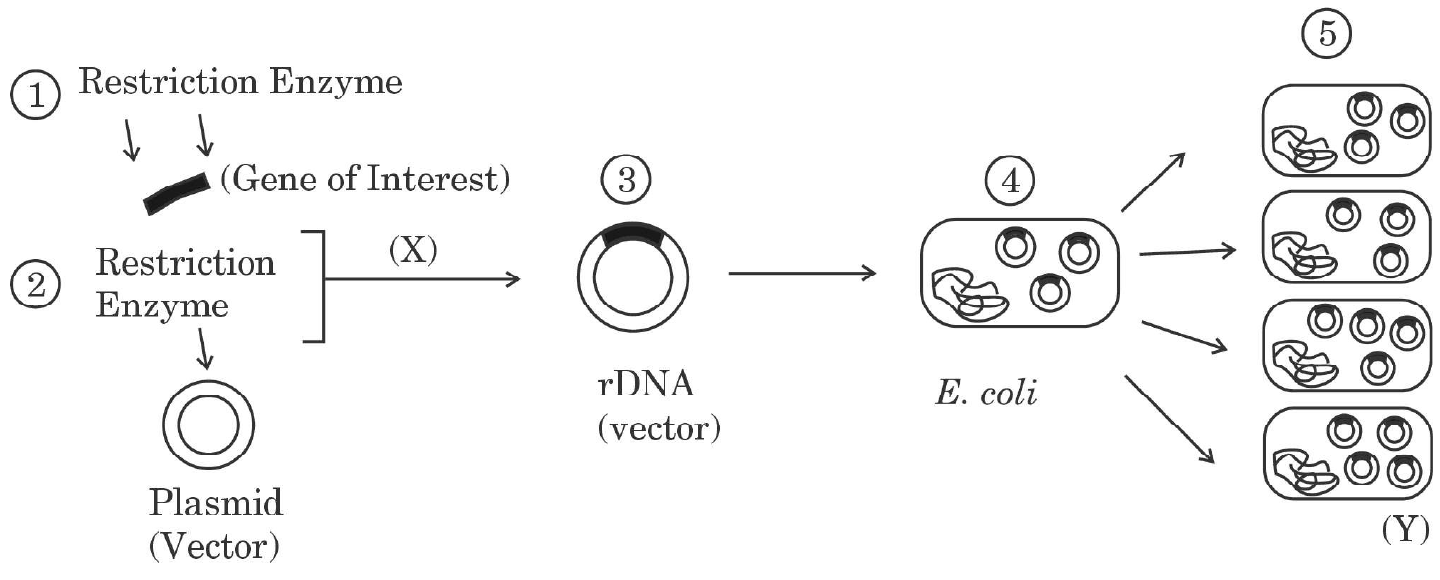
(i) Are two different types of restriction endonucleases used, one to cut the vector DNA and another to cut the desired DNA to be cloned ? Support your answer, giving reason.
(ii) Which enzyme is used at step (X) to integrate the foreign DNA with the vector DNA ?
(iii) What is the term used for step (Y) showing multiple copies of the foreign DNA being formed in transformed E. coli ?
(iv) Draw a diagram of E. coli cloning vector pBR322 to show the following : (I) Any one restriction endonuclease site in tetracycline resistance gene (II) Any one restriction endonuclease site in ampicillin resistance gene (III) 'ori' site
(v) What does "rop" code for in plasmid pBR322 ?
Gene of interest/alien gene is introduced by a cloning vector into a host cell to bring about a desired phenotypic expression in a host cell. The cloning vectors used are plasmid and bacteriophages. Biotechnologists in their labs, for desired results engineered specialised cloning vectors. One such vector is pBR322. Study the diagram carefully and answer the questions that follow.
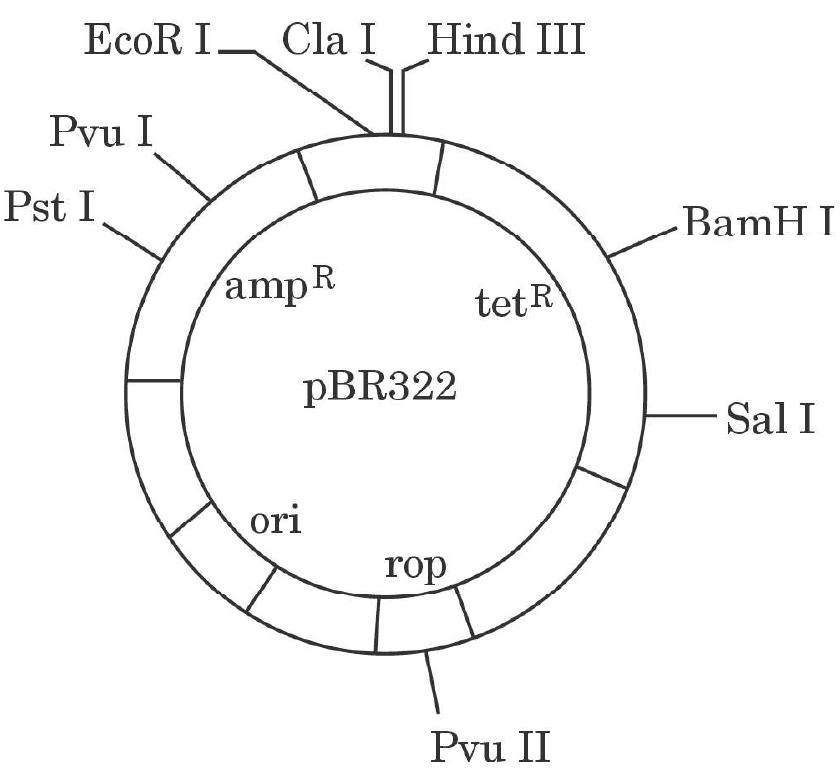
(i) What do 'EcoR I', 'BamH I' and 'Hind III' represent ? State their functions.
(ii) Identify the gene you would select for the role of a selectable marker in pBR322. Explain why.
(iii) Write the property/characteristic of plasmid and bacteriophage that makes them efficient cloning vectors.
(iv) Biotechnologists always insert 'ori' gene in their engineered cloning vector. Justify the statement.
(v) Will the experiment be successful if the alien DNA is ligated at Hind III restriction site ? Give reason in support of your answer.
Get every solution for all chapters
- Every board question of every chapter, each fully solved the way the board gives marks
- 19 complete board papers, each followed by its solutions
- Weightage and most-asked topics for every chapter
- Instant PDF download, colour and black & white print copies
Revising the chapter first? Complete Biology Notes for Class 12 (NCERT 2026-27, CBSE Board 2027) →
What you get in the pack
- Questions from 122 CBSE papers, 2016 to 2026: every set code available
- Complete: 2114 different questions and parts from all set codes, 13 chapters and 19 full papers
- Part A: all 13 chapters, questions sorted chapter-wise and by marks
- Year-wise weightage table and most-asked topics for every chapter
- Part B: 19 full board papers, each followed by its complete solutions
- Labelled diagrams, Punnett squares, crosses and flow charts drawn in full
- Questions on topics out of the board syllabus flagged
All chapters in this pack
- PYQ Ch 1 Sexual Reproduction in Flowering Plants
- PYQ Ch 2 Human Reproduction
- PYQ Ch 3 Reproductive Health
- PYQ Ch 4 Principles of Inheritance and Variation
- PYQ Ch 5 Molecular Basis of Inheritance
- PYQ Ch 6 Evolution
- PYQ Ch 7 Human Health and Disease
- PYQ Ch 8 Microbes in Human Welfare
- PYQ Ch 9 Biotechnology: Principles and Processes
- PYQ Ch 10 Biotechnology and its Applications
- PYQ Ch 11 Organisms and Populations
- PYQ Ch 12 Ecosystem
- PYQ Ch 13 Biodiversity and Conservation
- Board Paper 2026 Set 57-1-1 with Solutions
- Board Paper 2026 Set 57-1-2 with Solutions
- Board Paper 2026 Set 57-1-3 with Solutions
- Board Paper 2026 Set 57-2-1 with Solutions
- Board Paper 2025 Set 57-4-1 with Solutions
- Board Paper 2025 Set 57-5-1 with Solutions
- Board Paper 2024 Set 57-1-1 with Solutions
- Board Paper 2024 Set 57-2-1 with Solutions
- Board Paper 2023 Set 57-1-1 with Solutions
- Board Paper 2023 Set 57-3-1 with Solutions
- Board Paper 2022 Term 2 Set 57-2-1 with Solutions
- Board Paper 2022 Term 2 Set 57-4-1 with Solutions
- Board Paper 2020 Set 57-1-1 with Solutions
- Board Paper 2020 Set 57-2-1 with Solutions
- Board Paper 2019 Set 57-2-1 with Solutions
- Board Paper 2019 Set 57-3-1 with Solutions
- Board Paper 2018 Set 57-1 with Solutions
- Board Paper 2017 Set 57-1 with Solutions
- Board Paper 2016 Set 57-1 with Solutions