
Principles of Inheritance and Variation: Class 12 PYQs 2016–2026 with solutions
All 52 CBSE board questions asked from Principles of Inheritance and Variation in 15 board papers, with the year, set and marks of each. 28 are solved free below. The Class 12 Biology PYQ Book: Solved Board Papers 2016-2026 (CBSE) has every solution, all chapters and 19 full board papers.
Subject experts: Divya Harwani (B.Sc. Biotechnology, M.Sc. Biotechnology) and Jayant Sharma (B.Sc., B.Ed.)


Free: NCERT solutions for Class 12 Biology →
Principles of Inheritance and Variation: board weightage
Board weightage 2016–2026
| Year | 2016 | 2017 | 2018 | 2019 | 2020 | 2022 | 2023 | 2024 | 2025 | 2026 |
|---|---|---|---|---|---|---|---|---|---|---|
| Questions | 2 | 2 | 2 | 7 | 5 | – | 8 | 9 | 9 | 8 |
| Marks | 4 | 4 | 8 | 20 | 14 | – | 21 | 22 | 15 | 21 |
Most asked topics
52 questions from 15 papers. Repeated questions are shown once with every year they were asked.
Jump to: 1 mark2 marks3 marks4 marks5 marks
1 mark: MCQ and Assertion–Reason
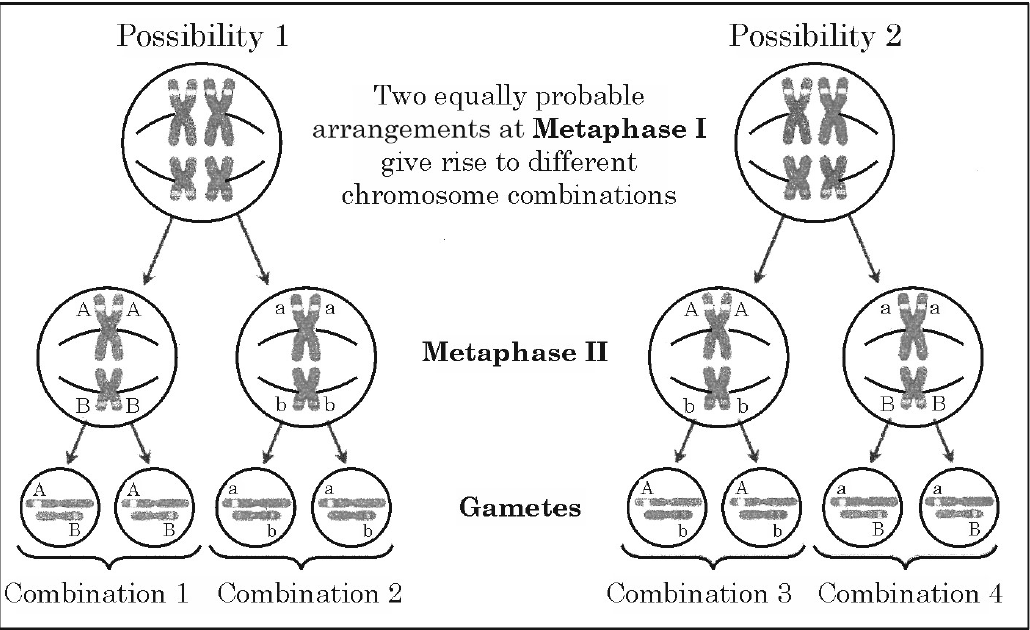
In the following figure, two ways of pairing of two homologous pairs of chromosomes are shown. Which of the following phenomena is expressed ?
Solution
Answer: (B) Independent assortment of genes
The two homologous pairs line up independently of each other at metaphase I. This gives four equally likely gene combinations in the gametes (AB, ab, Ab, aB), which is Mendel's law of independent assortment.
In a dihybrid cross, 2400 individuals are produced in F2 generation. Approximately how many will be phenotypically similar to parents ?
Solution
Answer: (B) 1500
In the F2 ratio 9 : 3 : 3 : 1, the parental phenotypes are the 9 (both dominant) and the 1 (both recessive) classes, so .
In the given pedigree chart, a cross between a normal couple resulted in a son who was haemophilic and a normal daughter. In course of time, when the daughter was married to a normal man, to their surprise the grandson was also haemophilic.
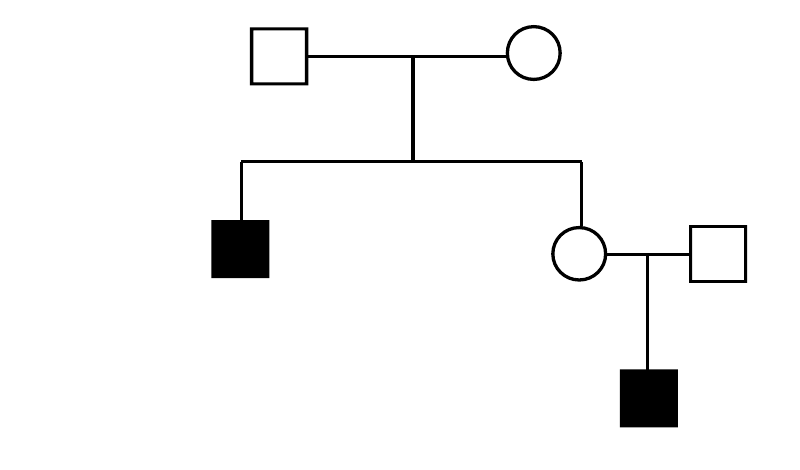
Choose the option that indicates the correct inheritance of trait in the above pedigree chart :
Solution
Answer: (D) Sex-linked recessive trait
Only males are affected, and they get the trait through normal carrier mothers (XhX). This is the criss-cross pattern of an X-linked recessive gene, as in haemophilia.
In a pea plant (Pisum sativum) inflated pod shape is dominant over constricted pod shape. The expected ratio of phenotypes of the offspring in a cross between both the parents with heterozygous inflated pod shape will be :
Solution
Answer: (D) 3 : 1
Ii × Ii → 1 II : 2 Ii : 1 ii, i.e. 3 inflated : 1 constricted.
Assertion (A) : ABO blood grouping in humans is an example of multiple allelism.
Reason (R) : More than two genes in a population govern the same character in ABO blood grouping in humans.
Solution
Answer: (C) A is true but R is false.
A single gene (I) with three alleles (IA, IB, i) controls the ABO blood group. Multiple allelism means more than two alleles of one gene, not more than two genes.
Which of the following is not an example of aneuploidy ?
Solution
Answer: (C) Phenylketonuria
PKU is a Mendelian (autosomal recessive) disorder caused by a gene mutation. The other three involve a gain or loss of a chromosome (XO, trisomy 21, XXY).
During a monohybrid cross involving a tall pea plant with a dwarf pea plant, the offspring populations were tall and dwarf in equal ratio. Find out the genotype of parent pea plants.
Solution
Answer: (A) Tt × tt
Tt × tt gives 1 Tt (tall) : 1 tt (dwarf). This is the test cross ratio.
Assertion (A) : Gene pairs present on the same chromosome may be tightly linked or loosely linked.
Reason (R) : Frequency of recombination between gene pairs on different chromosomes as a measure of the distance between the chromosomes.
Solution
Answer: (C) A is true but R is false.
Sturtevant used the frequency of recombination between gene pairs on the same chromosome as a measure of the distance between the genes, to map their positions.
Select the incorrect match from the following :
| Human Karyotype | Characters | |
|---|---|---|
| (A) | 45 + XX | Broad palm with characteristic palm crease |
| (B) | 44 + XXY | Overall feminine development |
| (C) | 44 + XO | Sterile females as ovaries are rudimentary |
| (D) | 44 + XY | Normal male |
Solution
Answer: (B)
44 + XXY is Klinefelter's syndrome, a male with some feminine features (gynaecomastia) who is sterile. "Overall feminine development" is not correct for it, so (B) is the wrong match. 45 + XX is Down's syndrome (broad palm with palm crease), and 44 + XO is Turner's syndrome.
Assertion (A) : Linked genes do not show dihybrid F2 ratio 9 : 3 : 3 : 1.
Reason (R) : Linked genes do not undergo independent assortment.
Solution
Answer: (A) Both A and R are true and R is the correct explanation of A.
Genes on the same chromosome tend to be inherited together. Parental combinations are therefore much more frequent than recombinants, and the 9 : 3 : 3 : 1 ratio is not obtained.
Match the items in Column I with those in Column II and select the correctly matched option from those given below :
| Column I (Cross) | Column II (Phenotypic Ratio) |
|---|---|
| 1. Mendelian monohybrid | (i) 1 : 2 : 1 (F2) |
| 2. Mendelian dihybrid | (ii) 1 : 1 |
| 3. Incomplete dominance | (iii) 3 : 1 (F2) |
| 4. Test cross (monohybrid) | (iv) 9 : 3 : 3 : 1 (F2) |
A woman with normal vision has a colour blind father. She marries a man with normal vision. The percentage chance of their progeny being colour blind is :
Which one of the following processes results in the production of recombinants in future generations ?
(i) Mutation
(ii) Independent assortment during meiosis I
(iii) Independent assortment during meiosis II
(iv) Crossing over of bivalents
Assertion (A) : Birds like pigeon have heterogametic females whereas the males are homogametic.
Reason (R) : In pigeons, females have Z and W sex chromosomes whereas males have ZZ sex chromosomes.
Choose the set of sex determining chromosomes that indicates the correct sex of the respective organism.
Assertion (A) : In humans the genotype with all the dominant alleles (AABBCC) will have the darkest skin colour.
Reason (R) : In a polygenic trait, phenotype reflects the contribution of each allele.
Name a human genetic disorder due to the following : (a) An additional X-chromosome in a male (b) Deletion of one X-chromosome in a female
State what does aneuploidy lead to.
Name the type of cross that would help to find the genotype of a pea plant bearing violet flowers.
A male honeybee has 16 chromosomes whereas its female has 32 chromosomes. Give one reason.
2 marks: very short answer
Analyse the following two cases of sex determination in different organisms :
Case I : Males have (XO) sex chromosomes and females have two copies of same sex chromosome (XX).
Case II : Females have two different sex chromosomes (ZW) and males have two copies of same sex chromosome (ZZ).
Identify the type of heterogamety in each case, giving one example of each.
Solution
Case I: male heterogamety (the male makes two kinds of sperm, with and without X). Example: grasshopper (many insects).
Case II: female heterogamety (the female makes two kinds of eggs, Z and W). Example: birds (hen).
The diagram below shows the sequence of amino acids in part of haemoglobin molecule.
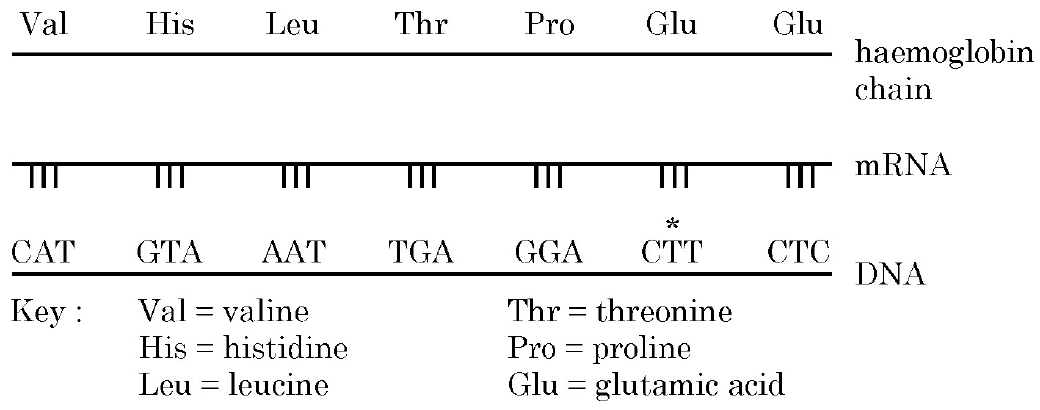
(i) If the base T* is substituted with A, in 'CTT' of DNA strand how would it affect the haemoglobin chain ?
(ii) Name the condition and the effects associated with the above substitution.
Solution
(i) The DNA strand shown is the template. CTT is transcribed into the mRNA codon GAA (glutamic acid). If T* becomes A, the triplet becomes CAT and the codon becomes GUA (valine). So glutamic acid at the sixth position of the β-globin chain is replaced by valine.
(ii) The condition is sickle-cell anaemia. Under low oxygen tension the mutant haemoglobin polymerises. The RBCs change from biconcave discs to elongated sickle shapes, and their oxygen-carrying capacity falls.
Although Haemophilia and sickle cell anemia are two blood related Mendelian disorders, yet, they differ in their pattern of inheritance. State any two differences.
Solution
| Haemophilia | Sickle-cell anaemia |
|---|---|
| Sex-linked (X-linked) recessive disorder | Autosomal recessive disorder |
| More males than females are affected | Males and females are affected equally |
| An unaffected carrier female passes the disease to some of her sons | Passed on when both parents are carriers (heterozygous) |
What is aneuploidy ? Name a chromosomal disorder in humans caused due to (a) gain of an autosome, and (b) loss of a sex chromosome in females.
Differentiate between Turner's syndrome and Down's syndrome.
3 marks: short answer
(a) What is pedigree analysis ? Mention its importance in human genetics. (2 pts.)
(b) Analyse the following pedigree and write the (i) Pattern of inheritance. (ii) Give one example of disease showing such an inheritance pattern.
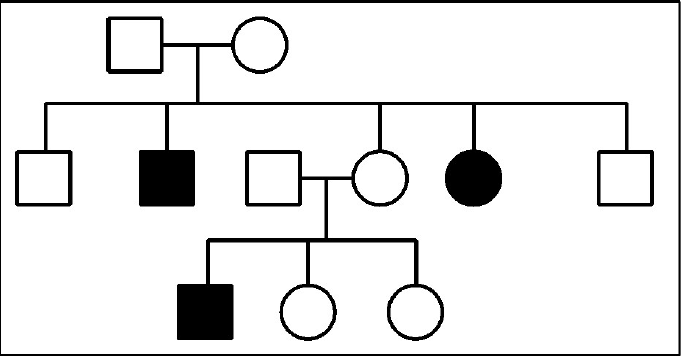
Solution
(a) Pedigree analysis is the study of how a trait is inherited over several generations of a family, using a family tree drawn with standard symbols.
Importance: controlled crosses are not possible in humans, so it is used to trace the inheritance of a trait, abnormality or disease. It also helps to predict the chance of a genetic disorder in future generations (genetic counselling).
(b) (i) Autosomal recessive. Two unaffected parents have affected children, so the trait is recessive. An affected daughter has an unaffected father, which rules out X-linked recessive inheritance.
(ii) Sickle-cell anaemia (or thalassemia, phenylketonuria).
(a) Give the scientific name of the organism used by Morgan to study sex-linked traits.
(b) Write any four reasons why this organism made it an ideal experimental model.
Solution
(a) Drosophila melanogaster (fruit fly).
(b) Any four:
• It can be grown on a simple synthetic medium in the laboratory.
• It completes its life cycle in about two weeks.
• A single mating produces a large number of progeny flies.
• Males and females are clearly differentiated and easy to tell apart.
• It has many types of hereditary variations that can be seen with low-power microscopes.
Gregor Mendel conducted hybridisation experiments in garden pea for seven years and proposed the law of inheritance.
(a) Why was he successful in his hybridisation experiments ? Give two reasons.
(b) State the law of independent assortment as proposed by Mendel after his dihybrid crosses.
Solution
(a) Any two:
• He chose true-breeding pea varieties with clear contrasting traits (e.g. tall/dwarf).
• He worked on one or two characters at a time.
• He did artificial pollination (self and cross) carefully.
• He used large samples, which made his data statistically reliable.
• He confirmed his results over several generations.
(b) Law of independent assortment: when two pairs of traits are combined in a hybrid, the segregation of one pair of characters is independent of the other pair of characters.
During a medical investigation, an infant was found to possess an extra copy of chromosome no. 21. Identify the disorder the child is suffering from. Describe the symptoms the child is likely to develop later in life.
Solution
The disorder is Down's syndrome (trisomy 21, described by Langdon Down in 1866).
Symptoms (any two): short stature with a small round head; furrowed tongue and partially open mouth; broad palm with a characteristic palm crease; retarded physical, psychomotor and mental development.
| Genotype | RBC | Phenotype |
|---|---|---|
| IAIA | (antigen A) | A |
| IAi | (antigen A) | A |
| IBIB | (antigen B) | B |
| IBi | (antigen B) | B |
| IAIB | (antigens A and B) | AB |
| ii | (no antigen) | O |
Study the diagram above and answer the following questions :
(a) How many alleles are involved in blood grouping ?
(b) A person having 'AB' blood group has both dominant alleles. What is this inheritance type called ?
(c) A man with 'A' blood group marries a woman with 'B' blood group. Can they have a child with 'O' blood group ? Explain with the help of a cross.
Solution
(a) Three alleles: IA, IB and i.
(b) Co-dominance (both IA and IB express their own antigens).
(c) Yes, if both parents are heterozygous.
Man IAi (A) × Woman IBi (B)
Gametes: IA, i and IB, i
| IB | i | |
|---|---|---|
| IA | IAIB (AB) | IAi (A) |
| i | IBi (B) | ii (O) |
There is a 1/4 chance of a child with blood group O (ii).
In a family, the father, the daughter and the son are colour blind, whereas the mother has normal vision. Do you think the son and the daughter have inherited the disease from their father ? Work out a cross to justify your answer.
Solution
No, not both. Colour blindness is X-linked recessive (Xc). The son got the gene from his mother, and the daughter got one gene from each parent. The mother must be a carrier (normal vision but heterozygous).
Mother XcX (carrier, normal) × Father XcY (colour blind)
| Xc (father) | Y (father) | |
|---|---|---|
| Xc (mother) | XcXc colour-blind daughter | XcY colour-blind son |
| X (mother) | XcX carrier daughter (normal) | XY normal son |
A son always receives his X from the mother; the father gives him only Y. So the son's colour blindness comes from the mother. The colour-blind daughter received Xc from the father and Xc from the mother.
(i) Write the karyotype and the genetic disorder of an individual who has developed from a zygote formed from an 'XX' egg fertilised by a 'Y' sperm.
(ii) Mention any two symptoms of this genetic disorder.
(iii) Write the possible reason that leads to the formation of this 'XX' egg.
Solution
(i) Karyotype 44 + XXY (47, XXY). Disorder: Klinefelter's syndrome.
(ii) Any two: overall masculine development with some feminine features; gynaecomastia (development of breasts); sterility.
(iii) Non-disjunction: the X chromosomes (or chromatids) fail to separate during meiosis in the mother (oogenesis), so the egg gets both X chromosomes.
Study the given pedigree chart and answer the questions that follow.
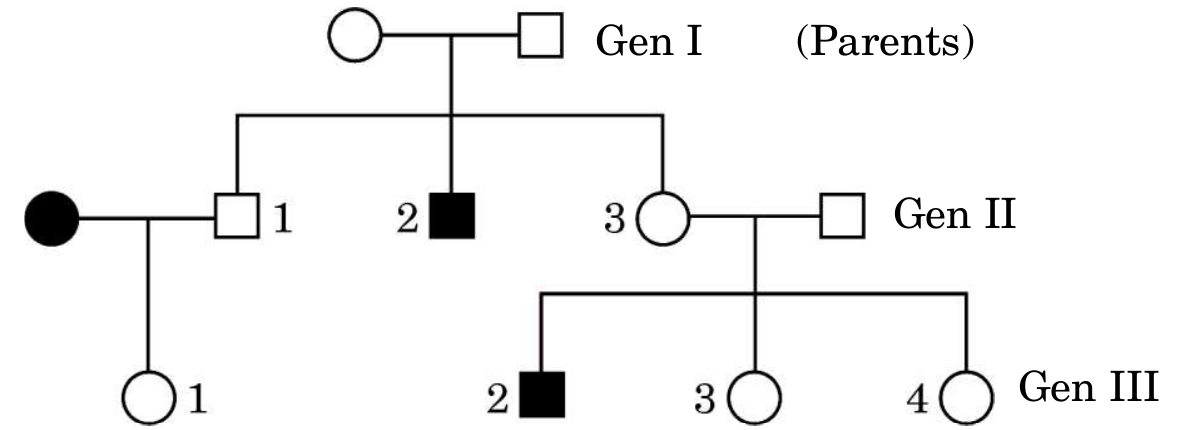
(a) Is the trait given in the chart dominant or recessive ? Give reason in support of your answer.
(b) Is this trait autosomal or sex-linked ? Give reason in support of your answer.
(c) Write the possible genotypes of the children numbers '1' and '3' of the second generation.
Solution
(a) Recessive. Both parents in generation I are unaffected, yet the trait appears in their son (II-2). So both parents carry the recessive allele without showing it.
(b) Sex-linked (X-linked) recessive. Only males are affected through unaffected mothers (II-2 and III-2, son of the unaffected daughter II-3), which is the criss-cross pattern of X-linked inheritance. (The marking scheme also accepts "autosomal" with the reason that males and females can both get it.)
(c) X-linked: child 1 (normal son) = XAY; child 3 (normal daughter who has an affected son) = XAXa (carrier).
If autosomal: child 1 = AA or Aa; child 3 = Aa.
Generally it is observed that human males suffer from hemophilia more than human females, who rarely suffer from it. Explain giving reasons.
Solution
• Haemophilia is an X-linked recessive disorder.
• A male has only one X chromosome (XY), so a single recessive allele (XhY) makes him haemophilic. A heterozygous carrier female (XhX) transmits the disease to half of her sons.
• A female is affected only if she is homozygous (XhXh). For this, her mother must be at least a carrier and her father must be haemophilic. Such fathers rarely survive to reproductive age, so haemophilic females are very rare.
F1 progeny of pea plant bearing violet flowers and snapdragon plant bearing red flowers were selfed to produce their respective F2 progeny. Compare the phenotypes, the genotypes and the pattern of inheritance of their respective F2 progeny.
The cytological observations made in a number of insects led to the development of the concept of genetic/chromosomal basis of sex-determination mechanism. Honey bee is an interesting example to study the mechanism of sex-determination. Study the schematic cross between the male and the female honey bees given below and answer the questions that follow :
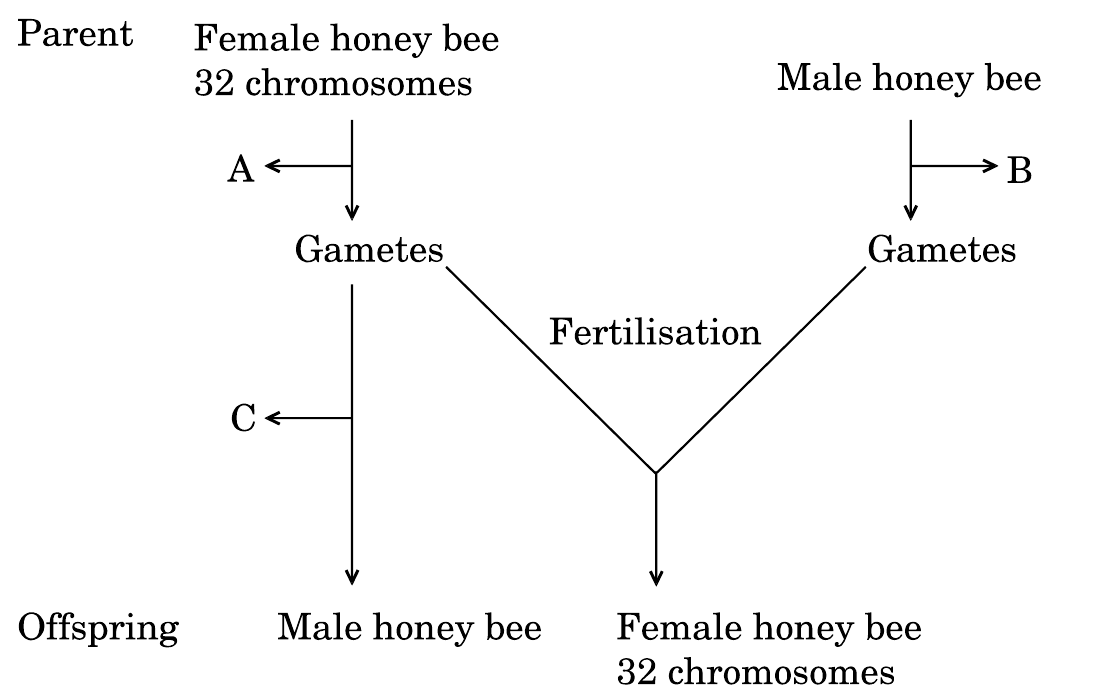
(a) Identify the cell divisions 'A' and 'B' that lead to gamete formation in female and male honey bees respectively.
(b) Name the process 'C' that leads to the development of male honey bee (drone).
A normal couple has their first child, who is haemophilic. Work out a cross to show how it is possible. State the possibility of the normal and the haemophilic children, along with their sexes, that can be born to them.
(a) How does mutation occur ?
(b) Differentiate between point mutation and frameshift mutation.
What is heterogamety ? Explain the mechanism of sex determination in Drosophila.
Explain the mechanism of 'sex determination' in birds. How does it differ from that of human beings ?
Both Haemophilia and Thalassemia are blood related disorders in humans. Write their causes and the difference between the two. Name the category of genetic disorder they both come under.
What is a test cross ? How can it decipher the heterozygosity of a plant ?
4 marks: case-based / source-based
A student performed some crosses in plants and represented the result in the form of bar graphs as shown below. Each graph displays the phenotypic proportion of the progeny. Study the graphs and answer the questions :
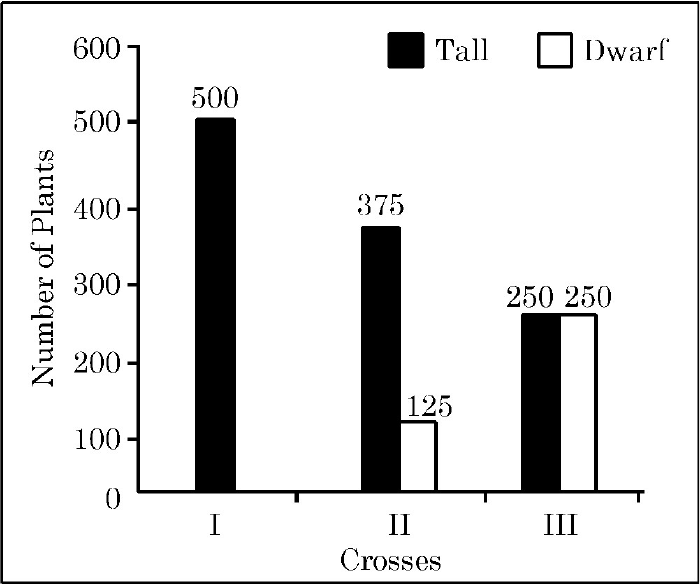
(a) What can you infer about the genotype of parents in crosses I and II ? (1)
OR
(a) Which genetic cross is represented by these crosses ? (1)
(b) Looking at bar graph of cross III, identify the type of cross performed and its importance in genetics. (2)
(c) What conclusion can you draw from the results of bar graphs of crosses I and II ? Name the genetic principle illustrated. (1)
Solution
(a) Cross I (all 500 tall): at least one parent is homozygous tall, TT × TT or TT × tt (or TT × Tt).
Cross II (375 tall : 125 dwarf = 3 : 1): both parents are heterozygous, Tt × Tt.
OR (a) Monohybrid crosses (one character, plant height, is studied).
(b) Cross III gives 250 tall : 250 dwarf = 1 : 1, so it is a test cross (Tt × tt).
Importance: crossing an organism showing the dominant phenotype with the recessive parent tells whether its genotype is homozygous (TT, all tall) or heterozygous (Tt, 1 : 1).
(c) Tall is dominant over dwarf: in cross I dwarf does not appear, and in cross II it reappears only in a quarter of the progeny. The principle is the law of dominance.
The following pedigree chart shows the inheritance of a genetic disorder up to three generations of a family. Observe the chart and answer the questions that follow.
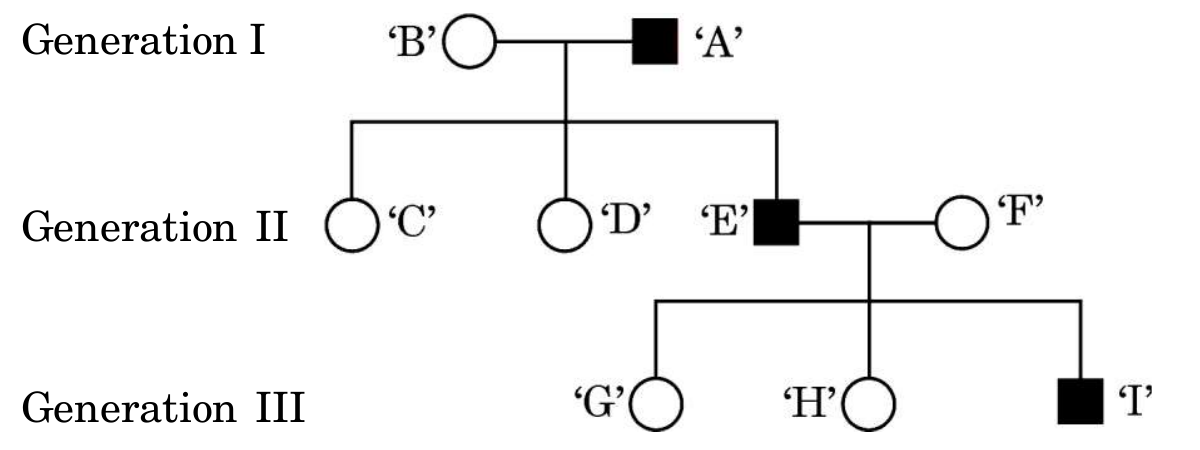
(i) Is the disease sex-linked or autosomal as per the chart ? Give reasons in support of your answer. (1)
(ii) Is it a recessive or a dominant disorder ? (1)
(iii) Write the genotypes of the individuals 'C', 'D' and 'H'. (1)
(iv) (a) If the female 'D' marries a normal man, what will be the probability of their daughter being a sufferer of this disease ? (1)
OR
(iv) (b) If the mother 'B' is a carrier of the disease, what will be the probability of their daughter being a sufferer of this disease ? (1)
Solution
(i) Sex-linked (X-linked). Only males are affected, and males have only one X chromosome, so a single recessive allele on it is expressed.
(ii) Recessive.
(iii) C – XcX; D – XcX; H – XcX (all carrier daughters of affected fathers; c = affected allele).
(iv) (a) D (XcX) × normal man (XY): daughters are XX or XcX, all normal. Probability of an affected daughter = 0%.
OR (iv) (b) B (XcX, carrier) × A (XcY, affected): daughters are XcXc (affected) or XcX (carrier). Probability of an affected daughter = 50%.
5 marks: long answer
In a particular cattle, the coat colour red and white are controlled by single pair of alleles. A calf that receives allele for red coat from mother and allele for white coat from father shows equal number of red and white hairs on its coat.
(i) Is this an example of Co-dominance or incomplete dominance. Give a reason for your answer.
(ii) With the help of a genetic cross upto F2 generation, explain what will be the consequent phenotype of calf when (1) Red is dominant over white, (2) Red is incompletely dominant.
Solution
(i) Co-dominance. Both alleles express themselves fully and separately in the hybrid: it has distinct red hairs and white hairs (roan). There is no blending into an intermediate colour.
(ii) (1) Red dominant over white (R = red, r = white):
P: RR (red) × rr (white); gametes R and r
F1: all Rr – red coat
F1 × F1: Rr × Rr
| R | r | |
|---|---|---|
| R | RR red | Rr red |
| r | Rr red | rr white |
F2 phenotypic ratio 3 red : 1 white (genotypic ratio 1 RR : 2 Rr : 1 rr). The calf (Rr) would be red.
(2) Red incompletely dominant:
P: RR (red) × rr (white)
F1: all Rr – an intermediate colour (pink, a blend of red and white)
F1 × F1: Rr × Rr
| R | r | |
|---|---|---|
| R | RR red | Rr pink |
| r | Rr pink | rr white |
F2 phenotypic ratio = genotypic ratio = 1 red : 2 intermediate (pink) : 1 white. The calf (Rr) would have an intermediate colour.
A tall pea plant bearing violet flowers with unknown genotype is given. Find the genotype by working out different crosses only by selfing the plants. Write the genotypic and phenotypic ratios of each cross shown by you.
Solution
A tall, violet-flowered plant can have any of four genotypes: TTVV, TtVV, TTVv, TtVv. Selfing each gives a different result:
Case I: TTVV × TTVV → all TTVV. Phenotype: all tall violet. Genotypic ratio: all TTVV.
Case II: TtVV × TtVV (gametes TV, tV)
| TV | tV | |
|---|---|---|
| TV | TTVV tall violet | TtVV tall violet |
| tV | TtVV tall violet | ttVV dwarf violet |
Phenotypic ratio 3 tall violet : 1 dwarf violet; genotypic ratio 1 TTVV : 2 TtVV : 1 ttVV.
Case III: TTVv × TTVv (gametes TV, Tv)
| TV | Tv | |
|---|---|---|
| TV | TTVV tall violet | TTVv tall violet |
| Tv | TTVv tall violet | TTvv tall white |
Phenotypic ratio 3 tall violet : 1 tall white; genotypic ratio 1 TTVV : 2 TTVv : 1 TTvv.
Case IV: TtVv × TtVv (gametes TV, Tv, tV, tv)
| TV | Tv | tV | tv | |
|---|---|---|---|---|
| TV | TTVV | TTVv | TtVV | TtVv |
| Tv | TTVv | TTvv | TtVv | Ttvv |
| tV | TtVV | TtVv | ttVV | ttVv |
| tv | TtVv | Ttvv | ttVv | ttvv |
Phenotypic ratio 9 tall violet : 3 tall white : 3 dwarf violet : 1 dwarf white.
Genotypic ratio 1 TTVV : 2 TTVv : 2 TtVV : 4 TtVv : 1 TTvv : 2 Ttvv : 1 ttVV : 2 ttVv : 1 ttvv.
So, if selfing gives all tall violet the plant is TTVV; if 3 : 1 with dwarfs it is TtVV; if 3 : 1 with whites it is TTVv; if 9 : 3 : 3 : 1 it is TtVv.
(i) Compare the pattern of inheritance of flower colour in garden pea plant (violet/white) with snapdragon plant (red/white) on the basis of the following : (1) F1 phenotypic expression; (2) expected phenotypic and genotypic expression of F2 generation; (3) the conclusion you reached at the end of the comparison made.
(ii) List any two characteristics of pattern of inheritance of human blood group ABO.
Solution
(i)
| Garden pea (violet × white) | Snapdragon (red × white) | |
|---|---|---|
| (1) F1 | All violet (Vv) | All pink (Rr) |
| (2) F2 phenotype | 3 violet : 1 white | 1 red : 2 pink : 1 white |
| F2 genotype | 1 VV : 2 Vv : 1 vv | 1 RR : 2 Rr : 1 rr |
| (3) Conclusion | Violet is completely dominant over white (law of dominance); phenotypic and genotypic ratios differ | Incomplete dominance: the heterozygote is intermediate; phenotypic and genotypic ratios are the same |
(ii) Any two: it shows multiple allelism (three alleles, IA, IB, i, of one gene); IA and IB are co-dominant (blood group AB); IA and IB are completely dominant over i.
(i) A true breeding tall pea plant with round seeds is crossed with a recessive dwarf pea plant having wrinkled seeds. Work out the cross up to F2 generation giving the phenotypic ratios of F1 and F2 generation respectively.
(ii) State the Mendelian principle that can be derived only with the help of such a cross.
Solution
(i) P: TTRR (tall, round) × ttrr (dwarf, wrinkled); gametes TR and tr.
F1: all TtRr – tall, round (phenotypic ratio 1 : 0, all tall round).
F1 × F1: TtRr × TtRr; each makes four kinds of gametes: TR, Tr, tR, tr.
| TR | Tr | tR | tr | |
|---|---|---|---|---|
| TR | TTRR | TTRr | TtRR | TtRr |
| Tr | TTRr | TTrr | TtRr | Ttrr |
| tR | TtRR | TtRr | ttRR | ttRr |
| tr | TtRr | Ttrr | ttRr | ttrr |
F2 phenotypic ratio: 9 tall round : 3 tall wrinkled : 3 dwarf round : 1 dwarf wrinkled.
(ii) Law of independent assortment: when two pairs of traits are combined in a hybrid, segregation of one pair of characters is independent of the other pair of characters.
A homozygous tall pea plant with green seeds is crossed with a homozygous dwarf pea plant with yellow seeds.
(i) Write the possible phenotype and genotype of F1 generation.
(ii) State the laws of Mendel that are proved true by the F1 generation.
(iii) Mention the F2 phenotypic ratio along with their possible phenotypes.
(iv) Write the genotypes of the male and female gametes produced by F1 progeny.
Mendel crossed a homozygous pea plant having yellow and round seeds with another pea plant bearing green and wrinkled seeds. He found that in some of the F2 population new combination of parental characters were observed. How will you explain the appearance of a new combination of parental characters in F2-offsprings ? Support your answer with the help of Punnett square.
(a) How would you find out whether a given tall garden pea plant is homozygous or heterozygous ? Substantiate your answer with the help of Punnett squares.
(b) Given below are the F2-phenotypic ratios of two independently carried monohybrid crosses : (i) 1:2:1 (ii) 3:1. Mention what does each ratio suggest.
(a) Write the scientific name of the organism Thomas Hunt Morgan and his colleagues worked with for their experiments. Explain the correlation between linkage and recombination with respect to genes as studied by them.
(b) How did Sturtevant explain gene mapping while working with Morgan ?
Get every solution for all chapters
- Every board question of every chapter, each fully solved the way the board gives marks
- 19 complete board papers, each followed by its solutions
- Weightage and most-asked topics for every chapter
- Instant PDF download, colour and black & white print copies
Revising the chapter first? Complete Biology Notes for Class 12 (NCERT 2026-27, CBSE Board 2027) →
What you get in the pack
- Questions from 122 CBSE papers, 2016 to 2026: every set code available
- Complete: 2114 different questions and parts from all set codes, 13 chapters and 19 full papers
- Part A: all 13 chapters, questions sorted chapter-wise and by marks
- Year-wise weightage table and most-asked topics for every chapter
- Part B: 19 full board papers, each followed by its complete solutions
- Labelled diagrams, Punnett squares, crosses and flow charts drawn in full
- Questions on topics out of the board syllabus flagged
All chapters in this pack
- PYQ Ch 1 Sexual Reproduction in Flowering Plants
- PYQ Ch 2 Human Reproduction
- PYQ Ch 3 Reproductive Health
- PYQ Ch 4 Principles of Inheritance and Variation
- PYQ Ch 5 Molecular Basis of Inheritance
- PYQ Ch 6 Evolution
- PYQ Ch 7 Human Health and Disease
- PYQ Ch 8 Microbes in Human Welfare
- PYQ Ch 9 Biotechnology: Principles and Processes
- PYQ Ch 10 Biotechnology and its Applications
- PYQ Ch 11 Organisms and Populations
- PYQ Ch 12 Ecosystem
- PYQ Ch 13 Biodiversity and Conservation
- Board Paper 2026 Set 57-1-1 with Solutions
- Board Paper 2026 Set 57-1-2 with Solutions
- Board Paper 2026 Set 57-1-3 with Solutions
- Board Paper 2026 Set 57-2-1 with Solutions
- Board Paper 2025 Set 57-4-1 with Solutions
- Board Paper 2025 Set 57-5-1 with Solutions
- Board Paper 2024 Set 57-1-1 with Solutions
- Board Paper 2024 Set 57-2-1 with Solutions
- Board Paper 2023 Set 57-1-1 with Solutions
- Board Paper 2023 Set 57-3-1 with Solutions
- Board Paper 2022 Term 2 Set 57-2-1 with Solutions
- Board Paper 2022 Term 2 Set 57-4-1 with Solutions
- Board Paper 2020 Set 57-1-1 with Solutions
- Board Paper 2020 Set 57-2-1 with Solutions
- Board Paper 2019 Set 57-2-1 with Solutions
- Board Paper 2019 Set 57-3-1 with Solutions
- Board Paper 2018 Set 57-1 with Solutions
- Board Paper 2017 Set 57-1 with Solutions
- Board Paper 2016 Set 57-1 with Solutions