
Ecosystem: Class 12 PYQs 2016–2026 with solutions
All 22 CBSE board questions asked from Ecosystem in 14 board papers, with the year, set and marks of each. 12 are solved free below. The Class 12 Biology PYQ Book: Solved Board Papers 2016-2026 (CBSE) has every solution, all chapters and 19 full board papers.
Subject experts: Divya Harwani (B.Sc. Biotechnology, M.Sc. Biotechnology) and Jayant Sharma (B.Sc., B.Ed.)



Free: NCERT solutions for Class 12 Biology →
Ecosystem: board weightage
Board weightage 2016–2026
| Year | 2016 | 2017 | 2018 | 2019 | 2020 | 2022 | 2023 | 2024 | 2025 | 2026 |
|---|---|---|---|---|---|---|---|---|---|---|
| Questions | 1 | 2 | 1 | 4 | 1 | – | 2 | 4 | 2 | 5 |
| Marks | 5 | 8 | 5 | 13 | 3 | – | 4 | 6 | 4 | 9 |
Most asked topics
22 questions from 14 papers. Repeated questions are shown once with every year they were asked.
Jump to: 1 mark2 marks3 marks4 marks5 marks
1 mark: MCQ and Assertion–Reason
In an ecosystem, different species occupy different levels and vertical distribution is called
Solution
Answer: (A) Stratification
For example, in a forest, trees occupy the top layer, shrubs the second and herbs and grasses the bottom layers.
Assertion (A) : In terrestrial ecosystem much larger fraction of energy flows through grazing food chain.
Reason (R) : Grazing food chain may be connected to Detritus food chain at some levels.
Solution
Answer: (D) A is false but R is true.
In terrestrial ecosystems a much larger fraction of energy flows through the detritus food chain. The two chains are linked, because dead organisms of the grazing chain become detritus.
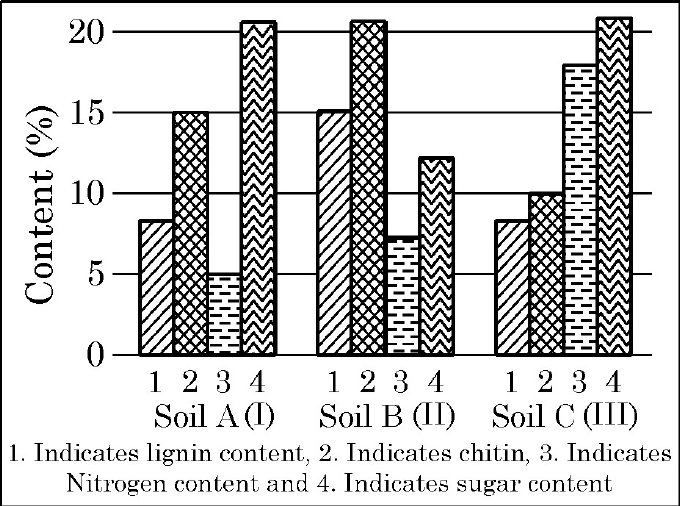
Observe the contents 1, 2, 3 and 4 of soil samples I, II and III shown in the graph. If the temperature and moisture of all soil samples are identical, which soil sample(s) will show faster decomposition ?
Solution
Answer: (C) Soil Sample III
Decomposition is slower when detritus is rich in lignin and chitin and faster when it is rich in nitrogen and water-soluble substances such as sugars. Soil III has low lignin (8%) and chitin (10%) but the highest nitrogen (18%) and sugar (20%).
The rate of formation of new organic matter by consumers, and the biomass available for consumption of herbivores as well as decomposers are referred to as :
The pyramid of biomass in sea is generally inverted because in sea :
2 marks: very short answer
Given below is a pyramid found in an ecosystem, where each bar represents the standing crop available in the trophic level.
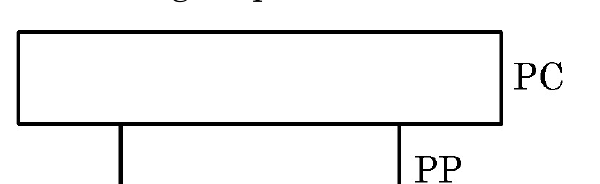
(i) Identify the kind of pyramid and with the help of an example explain the conditions where this kind of pyramid is possible in nature.
(ii) Write any two limitations of ecological pyramids.
Solution
(i) It is an inverted pyramid of biomass: the primary consumers (PC) have a larger standing crop than the producers (PP). It is seen in the sea, where a small standing crop of phytoplankton supports a large standing crop of zooplankton or fish. The phytoplankton reproduce very fast, so their small biomass at any moment can feed a larger consumer biomass.
(ii) Any two:
• They do not account for a species that belongs to two or more trophic levels.
• They assume a simple food chain and cannot show a food web.
• Saprophytes (decomposers) are not shown, though they play a vital role.
Correctly depict (also indicate the trophic level) and describe the ecological pyramid of biomass in sea with 40 standing crop of phytoplankton supporting 90 standing crop of zooplankton which further supports 120 small fishes.
Solution
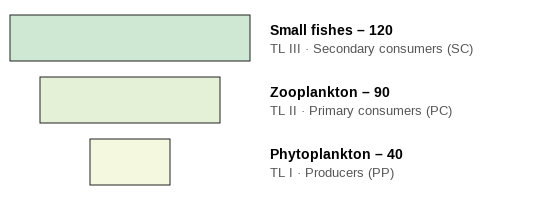
This is an inverted pyramid of biomass. The biomass (standing crop) of producers is smallest at the base and increases at each higher trophic level. It is found in the sea because phytoplankton reproduce very fast. A small standing crop at any moment can support a larger biomass of consumers.
Correctly depict (also indicate the trophic level) and describe the ecological pyramid of number with 32 birds dependent on 20 insects feeding on one banyan tree.
Solution
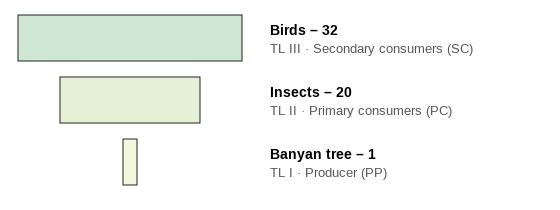
It is an inverted pyramid of number. A single large producer, the banyan tree, supports 20 insects (herbivores), which in turn support 32 birds. So the number of individuals increases from the producer level upwards.
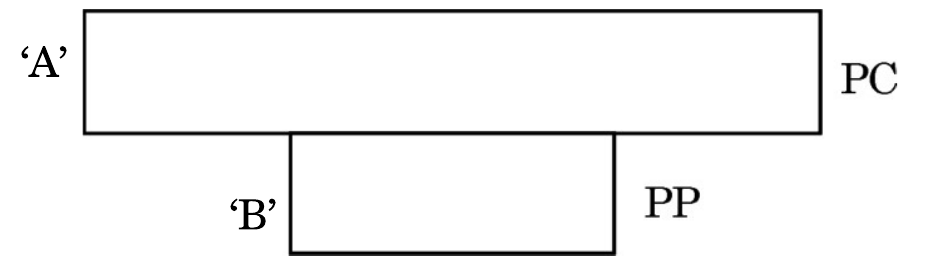
Study the diagram of a pyramid of biomass given below. Name the two standing crops that could be occupying level 'A' and level 'B' in it. Name this type of pyramid and the ecosystem in which it is found.
Solution
A – zooplankton (primary consumers); B – phytoplankton (producers).
It is an inverted pyramid of biomass, found in the sea (aquatic ecosystem). The small standing crop of fast-multiplying phytoplankton supports a larger standing crop of zooplankton.
How is the rate of decomposition affected by the nature of detritus and temperature ?
Ecological pyramids give important information about the ecological system, but do have some limitations. List any two limitations of ecological pyramids.
Given below is a food web that involves nine organisms.
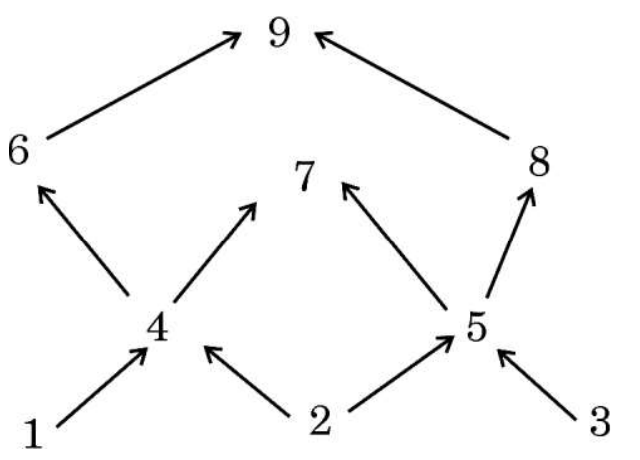
(a) Identify two producers and two carnivores shown in the food web.
(b) Is it possible to make an ecological pyramid depicting this food web ? Give reason in support of your answer.
Justify the statement, "Pyramid of energy is always upright, and can never be inverted."
3 marks: short answer
(a) Name an ideal pyramid existing in an ecosystem. Construct it up to its three trophic levels along with their names.
(b) The sun provides 1,000,000 J of sunlight (solar energy) to an ecosystem. Write the amount of energy that is available to the first and third trophic levels, respectively.
Solution
(a) The pyramid of energy is the ideal pyramid. It is always upright, because energy is lost as heat at every step.
| TL III – Secondary consumers (carnivores): 100 J |
| TL II – Primary consumers (herbivores): 1,000 J |
| TL I – Producers (plants): 10,000 J |
| Sunlight: 1,000,000 J |
(b) Plants capture about 1% of the sunlight, so the first trophic level gets 1% of 1,000,000 J = 10,000 J. By the 10 per cent law, the second level gets 1,000 J, and the third trophic level gets 100 J.
(a) What is the primary productivity of an ecosystem and how is it expressed ?
(b) Explain what does the equation given below show : NPP = GPP — R
Solution
(a) Primary productivity is the rate of biomass production (organic matter) by plants during photosynthesis, per unit area over a time period. It is expressed as weight (g m–2 yr–1) or energy (kcal m–2 yr–1).
(b) The equation shows that net primary productivity (NPP) is the gross primary productivity (GPP, total rate of production of organic matter) minus the respiration losses (R) of the plants. NPP is the biomass available for consumption by heterotrophs (herbivores and decomposers).
(a) Name the type of detritus that decomposes faster. List any two factors that enhance the rate of decomposition.
(b) Write the different steps taken in humification and mineralisation during the process of decomposition.
Describe the inter-relationship between productivity, gross primary productivity and net productivity.
4 marks: case-based / source-based
Below is shown a pond that represents a self-sustaining natural ecosystem with both biotic and abiotic components interacting in a balanced food web.
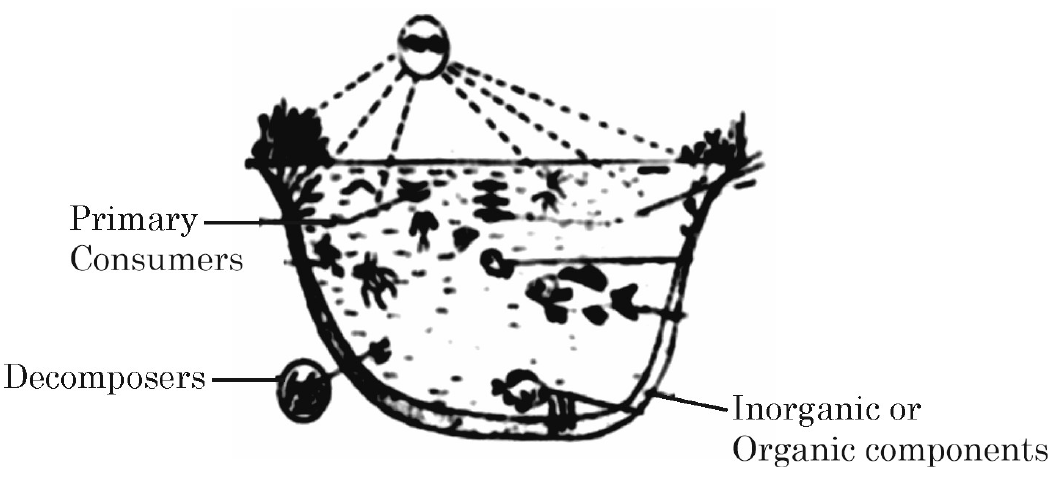
Based on the diagram, answer the questions :
(a) Mention two abiotic components of a pond ecosystem. (1)
(b) Differentiate between the roles of producers and decomposers in such an ecosystem. (2)
(c) Draw a simple food chain operating in such an ecosystem and label each trophic level. (1)
OR
(c) Why is transfer of energy not 100% efficient between trophic levels ? (1)
Solution
(a) Any two: water, the soil deposit at the bottom, sunlight, temperature, dissolved inorganic and organic substances.
(b)
| Producers | Decomposers |
|---|---|
| Phytoplankton, algae and floating, submerged and marginal plants | Fungi, bacteria and flagellates, especially on the pond bottom |
| Make organic food from inorganic materials using sunlight (photosynthesis) | Break down dead organic matter into simple inorganic substances, which are released for reuse |
(c) Phytoplankton (producer, 1st trophic level) → Zooplankton (primary consumer, 2nd trophic level) → Small fish (secondary consumer, 3rd trophic level)
OR (c) At each trophic level, most of the energy is used in respiration and lost as heat, and some is lost in undigested and dead matter. Only about 10% of the energy is passed to the next level (10 per cent law).
5 marks: long answer
(a) What does an ecological pyramid represent ? State any two limitations that these pyramids have.
(b) Describe an inverted pyramid of biomass with the help of an example.
Solution
(a) An ecological pyramid represents the relationship between organisms at different trophic levels in terms of number, biomass or energy. The base is the producers and the apex is the top carnivores.
Limitations (any two): it does not take into account the same species belonging to two or more trophic levels; it assumes a simple food chain, which almost never exists in nature, and does not accommodate a food web; saprophytes are given no place, even though they play a vital role.
(b) The pyramid of biomass in the sea is generally inverted: the biomass of fishes is far greater than that of phytoplankton. The phytoplankton multiply very fast, so their small standing crop at any moment supports a much larger standing crop of consumers.
(a) What is a trophic level in an ecosystem ? What is 'standing crop' with reference to it ?
(b) Explain the role of the 'first trophic level' in an ecosystem.
(c) How is the detritus food chain connected with the grazing food chain in a natural ecosystem ?
Solution
(a) A trophic level is the specific place of an organism in a food chain, based on its source of nutrition or food (producer, primary consumer, etc.).
Standing crop is the mass of living material (biomass) at a trophic level at a particular time, measured as biomass or number per unit area.
(b) The first trophic level is formed by the producers (autotrophs, green plants). They trap solar energy and convert it into food (chemical energy) by photosynthesis. All other organisms depend on them directly or indirectly for food and energy.
(c) The two chains are connected: some organisms of the detritus food chain (DFC) are prey to animals of the grazing food chain (GFC); and the dead remains of GFC organisms become detritus, which is decomposed by the organisms of the DFC into simple inorganic substances.
(a) What is an ecological pyramid? Compare the pyramids of energy, biomass and numbers.
(b) Write any two limitations of ecological pyramids.
(a) Taking an example of a small pond, explain how the four components of an ecosystem function as a unit.
(b) Name the type of food chain that exists in a pond.
Get every solution for all chapters
- Every board question of every chapter, each fully solved the way the board gives marks
- 19 complete board papers, each followed by its solutions
- Weightage and most-asked topics for every chapter
- Instant PDF download, colour and black & white print copies
Revising the chapter first? Complete Biology Notes for Class 12 (NCERT 2026-27, CBSE Board 2027) →
What you get in the pack
- Questions from 122 CBSE papers, 2016 to 2026: every set code available
- Complete: 2114 different questions and parts from all set codes, 13 chapters and 19 full papers
- Part A: all 13 chapters, questions sorted chapter-wise and by marks
- Year-wise weightage table and most-asked topics for every chapter
- Part B: 19 full board papers, each followed by its complete solutions
- Labelled diagrams, Punnett squares, crosses and flow charts drawn in full
- Questions on topics out of the board syllabus flagged
All chapters in this pack
- PYQ Ch 1 Sexual Reproduction in Flowering Plants
- PYQ Ch 2 Human Reproduction
- PYQ Ch 3 Reproductive Health
- PYQ Ch 4 Principles of Inheritance and Variation
- PYQ Ch 5 Molecular Basis of Inheritance
- PYQ Ch 6 Evolution
- PYQ Ch 7 Human Health and Disease
- PYQ Ch 8 Microbes in Human Welfare
- PYQ Ch 9 Biotechnology: Principles and Processes
- PYQ Ch 10 Biotechnology and its Applications
- PYQ Ch 11 Organisms and Populations
- PYQ Ch 12 Ecosystem
- PYQ Ch 13 Biodiversity and Conservation
- Board Paper 2026 Set 57-1-1 with Solutions
- Board Paper 2026 Set 57-1-2 with Solutions
- Board Paper 2026 Set 57-1-3 with Solutions
- Board Paper 2026 Set 57-2-1 with Solutions
- Board Paper 2025 Set 57-4-1 with Solutions
- Board Paper 2025 Set 57-5-1 with Solutions
- Board Paper 2024 Set 57-1-1 with Solutions
- Board Paper 2024 Set 57-2-1 with Solutions
- Board Paper 2023 Set 57-1-1 with Solutions
- Board Paper 2023 Set 57-3-1 with Solutions
- Board Paper 2022 Term 2 Set 57-2-1 with Solutions
- Board Paper 2022 Term 2 Set 57-4-1 with Solutions
- Board Paper 2020 Set 57-1-1 with Solutions
- Board Paper 2020 Set 57-2-1 with Solutions
- Board Paper 2019 Set 57-2-1 with Solutions
- Board Paper 2019 Set 57-3-1 with Solutions
- Board Paper 2018 Set 57-1 with Solutions
- Board Paper 2017 Set 57-1 with Solutions
- Board Paper 2016 Set 57-1 with Solutions