
Molecular Basis of Inheritance: Class 12 PYQs 2016–2026 with solutions
All 63 CBSE board questions asked from Molecular Basis of Inheritance in 15 board papers, with the year, set and marks of each. 32 are solved free below. The Class 12 Biology PYQ Book: Solved Board Papers 2016-2026 (CBSE) has every solution, all chapters and 19 full board papers.
Subject experts: Divya Harwani (B.Sc. Biotechnology, M.Sc. Biotechnology) and Jayant Sharma (B.Sc., B.Ed.)



Free: NCERT solutions for Class 12 Biology →
Molecular Basis of Inheritance: board weightage
Board weightage 2016–2026
| Year | 2016 | 2017 | 2018 | 2019 | 2020 | 2022 | 2023 | 2024 | 2025 | 2026 |
|---|---|---|---|---|---|---|---|---|---|---|
| Questions | 4 | 4 | 4 | 7 | 6 | – | 9 | 10 | 11 | 8 |
| Marks | 15 | 15 | 11 | 20 | 20 | – | 24 | 24 | 15 | 24 |
Most asked topics
63 questions from 15 papers. Repeated questions are shown once with every year they were asked.
Jump to: 1 mark2 marks3 marks4 marks5 marks
1 mark: MCQ and Assertion–Reason
To separate repetitive DNA from bulk genomic DNA, which of the following method is used ?
Solution
Answer: (D) Density Gradient Centrifugation
In density gradient centrifugation, the bulk DNA forms a major peak. The repetitive (satellite) DNA has a different base composition, so it forms small separate peaks.
A bacterium having radioactive thymidine in its DNA is allowed to multiply in a medium having non-radioactive thymidine for two generations. What percentage of bacteria will have radioactive thymidine in its DNA ?
Solution
Answer: (B) 50
Replication is semi-conservative. After the 1st generation, both daughter bacteria have one labelled strand. After the 2nd generation there are 4 bacteria: 2 still carry a labelled strand and 2 are fully unlabelled. So 2/4 = 50%.
In its extended 'beads-on-string' form of chromatin, the 'beads' in the string represent :
Solution
Answer: (C) Nucleosomes
Each nucleosome is a histone octamer with about 200 bp of DNA wrapped around it. The nucleosomes are the "beads", and the linker DNA between them is the "string".
The substrate used during DNA replication by the enzyme DNA-dependent DNA polymerase is :
Solution
Answer: (B) Deoxyribonucleoside triphosphate
dNTPs (dATP, dGTP, dCTP, dTTP) act as substrates and also provide energy for polymerisation from their two terminal phosphates.
Use the given information to select the amino acid attached to the 3' end of tRNA during the process of translation, if the coding strand of the structural gene being transcribed has the nucleotide sequence TAC.
Codons for the amino acids : AUC – Isoleucine; AUG – Methionine; UAC – Tyrosine; GUA – Valine
Solution
Answer: (C) Tyrosine
The mRNA has the same sequence as the coding strand, with U for T: codon UAC = tyrosine. The tRNA with anticodon AUG brings tyrosine, carried at its 3' end.
The correct depiction of the experiment performed by Matthew Meselson and Franklin Stahl to prove that DNA replicates semi-conservatively on separation of DNA by centrifugation after 40 minutes is :
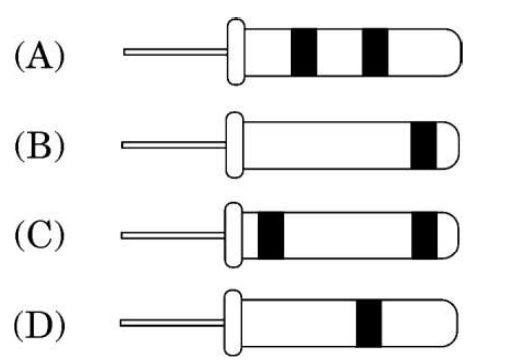
Solution
Answer: (A)
E. coli divides every 20 minutes, so 40 minutes means two generations in 14N medium. Half the DNA is hybrid (15N/14N, intermediate density) and half is light (14N/14N). So there are two bands, one hybrid and one light.
The histone core in a nucleosome of chromatin thread is a/an :
Solution
Answer: (D) octamer
Two molecules each of the histones H2A, H2B, H3 and H4 form the octamer, and about 200 bp of DNA wrap around it.
During the process of transcription, after binding to a promoter, RNA polymerase catalyses and makes the bases in the template strand of DNA available for base pairing, with the bases of :
Solution
Answer: (D) Ribonucleoside triphosphate
RNA polymerase uses ribonucleoside triphosphates (ATP, GTP, CTP, UTP) as substrates and pairs them with the template bases.
What would happen if a gene encoding a polypeptide of 50 amino acids, 25th Codon (UAU) is mutated to "UAA" ?
Solution
Answer: (C) 24 amino acids
UAA is a stop codon. Translation stops at the 25th codon, so only the first 24 amino acids are joined.
The correct depiction of the centrifugation step of the experiment conducted by Alfred Hershey and Martha Chase on using radioactive labelled phages to prove that DNA is the genetic material is :
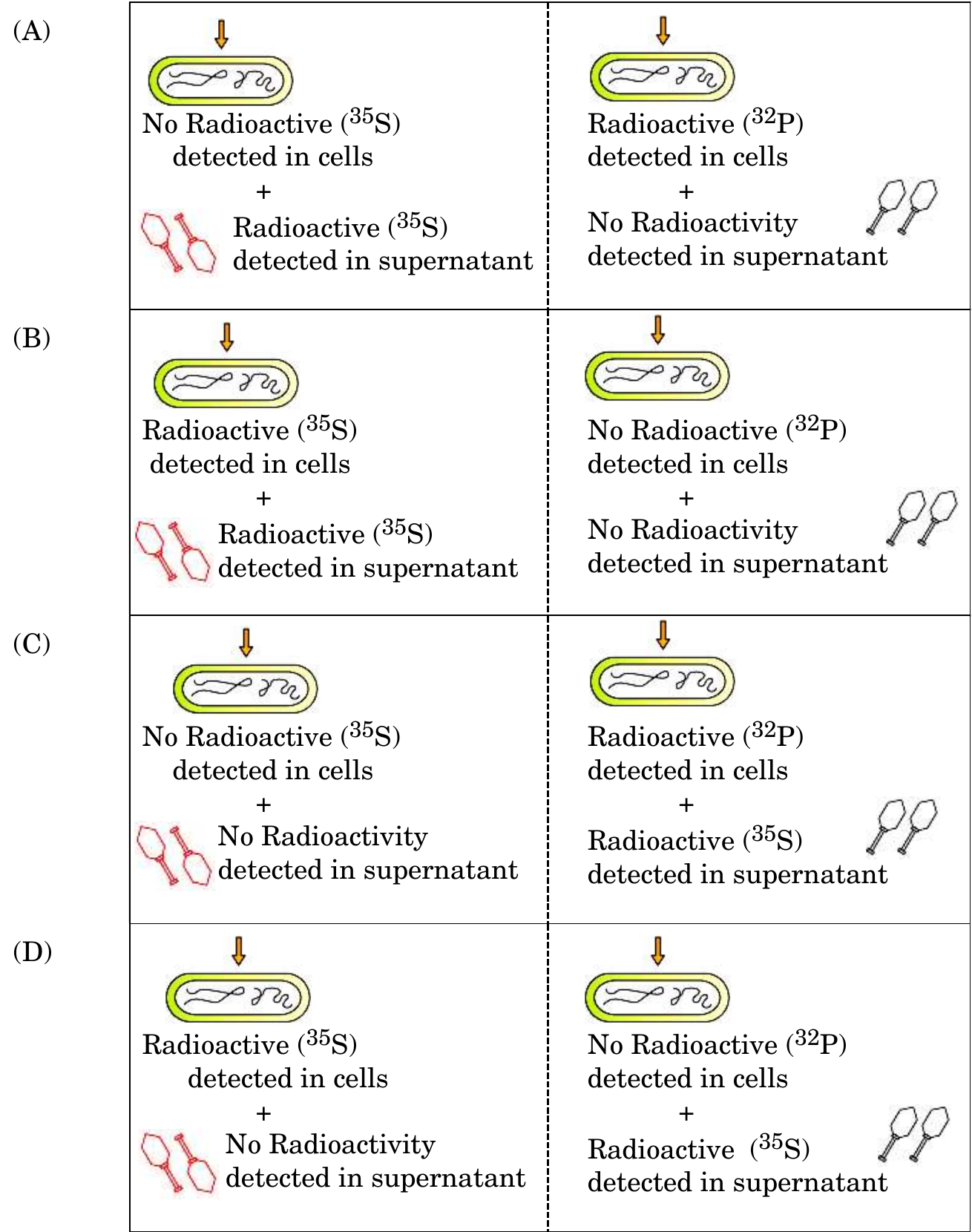
Solution
Answer: (A)
35S labels the protein coat. The coat stays outside the bacteria, comes off in blending and stays in the supernatant, so the cells show no 35S.
32P labels the DNA. The DNA enters the bacteria, so the cells (pellet) are radioactive and the supernatant is not. Hence DNA, not protein, is the genetic material.
You know that there are twenty different types of naturally occurring amino acids and four different types of bases in the DNA. A combination of 3 such bases code for a specific amino acid. If instead there are 96 different amino acids and 12 different bases in the DNA, then the minimum number of combination of bases required to form a codon is :
Solution
Answer: (C) 2
With 12 bases, a codon of n bases gives 12n combinations. A 1-base codon gives only 12 combinations, which is fewer than 96. A 2-base codon gives 122 = 144 ≥ 96, so 2 bases are enough.
The type of bond represented by the dotted line '– – – – –' in a schematic polynucleotide chain is :
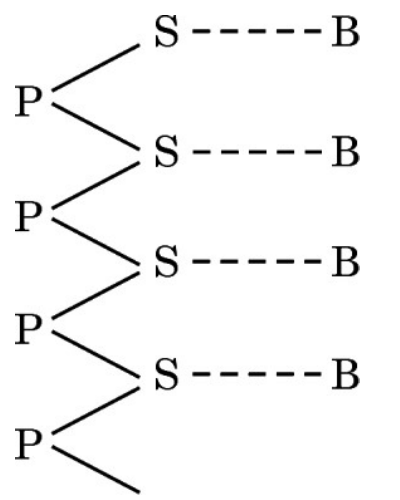
In the double helical structure of DNA molecule, the strands are :
In a 'transcription unit', the 'terminator' is located towards the :
Assertion (A) : RNA is unstable and can mutate at a faster rate.
Reason (R) : The presence of 2' – OH group in every nucleotide of RNA makes it labile and easily degradable.
Identify the region 'X', the factor 'Y' and the enzyme 'Z' involved in the process of transcription in prokaryote as shown in the schematic representation given below.
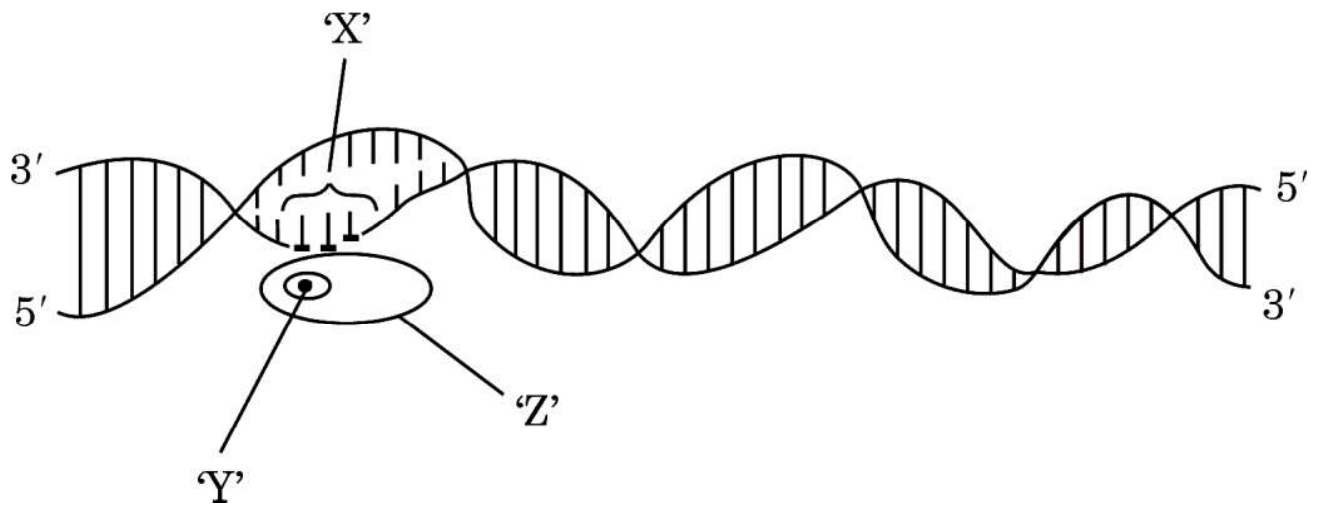
| Region 'X' | Factor 'Y' | Enzyme 'Z' | |
|---|---|---|---|
| (a) | Terminator | Sigma (σ) | RNA polymerase |
| (b) | Promoter | Rho (ρ) | RNA polymerase |
| (c) | Promoter | Sigma (σ) | RNA polymerase |
| (d) | Promoter | Sigma (σ) | DNA polymerase |
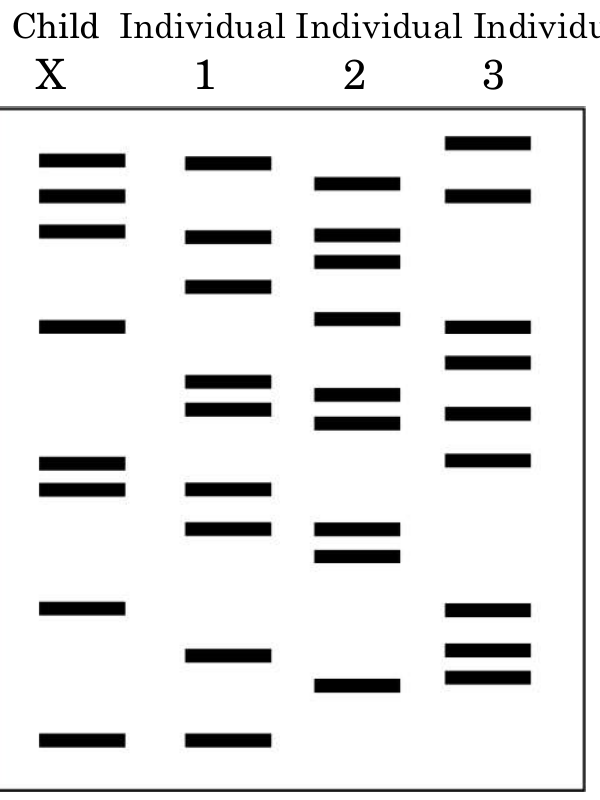
Study the DNA profiles obtained as a result of DNA fingerprinting of a child 'X' and three individuals 1, 2 and 3. Which one of the following options shows the possible parents of the child 'X' ?
Given below is a list of steps Meselson and Stahl carried out in their experiment to prove that DNA replication is semi-conservative. Select the option that gives the correct sequence of steps followed by them.
(i) Bacteria transferred to a N14 medium and sampled every 20 minutes.
(ii) All bacteria contain hybrid DNA (N14 DNA and N15 DNA).
(iii) Bacteria grown in N15 medium for many generations.
(iv) All bacteria contain N15 DNA.
(v) Bacteria contain either all N14 DNA or all hybrid DNA.
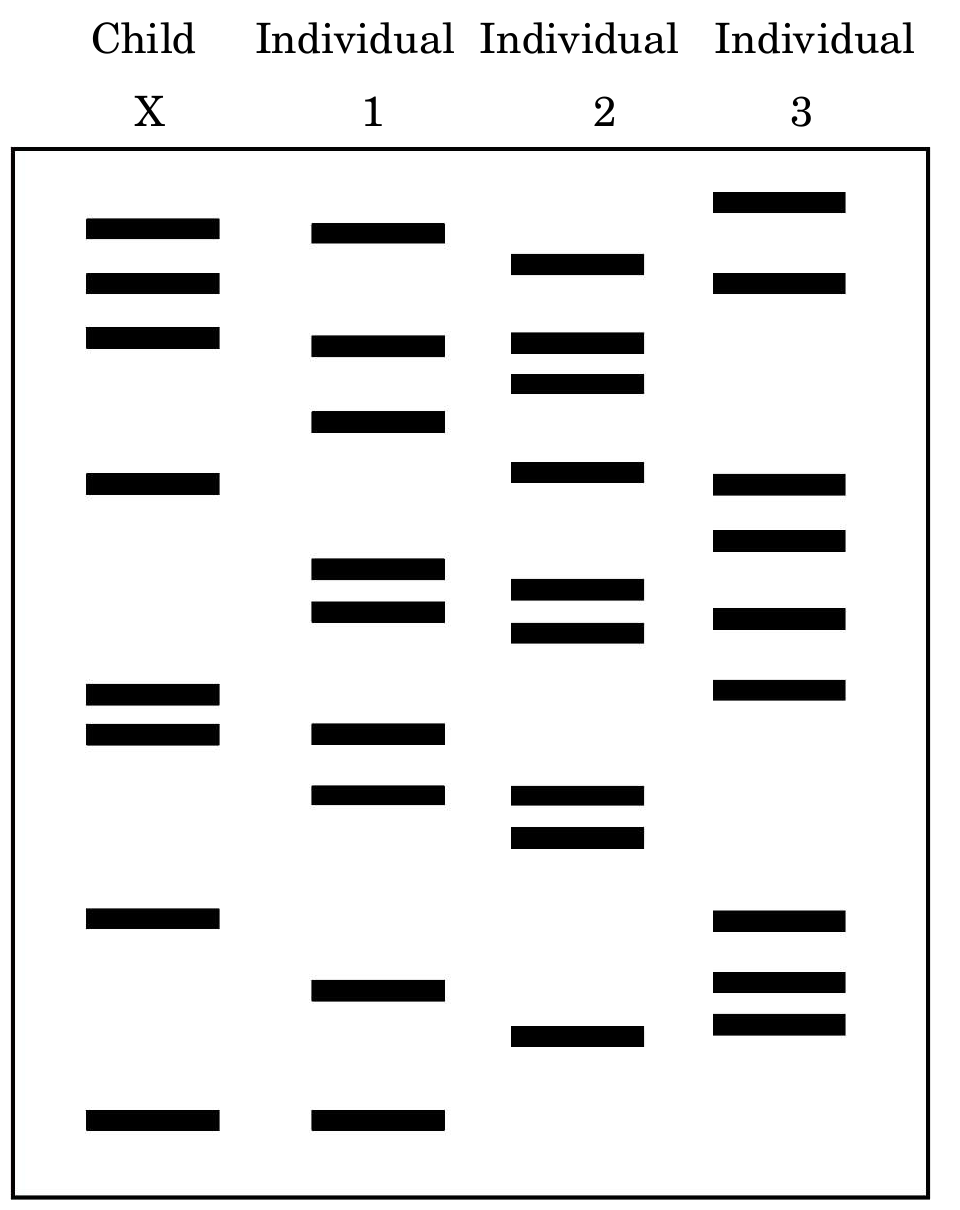
DNA profiles of the child and three individuals 1, 2 and 3 who claim to be the parents of the child are given below. Select the option that shows the correct actual parent/parents of the child.
Meselson and Stahl carried out centrifugation in CsCl2 density gradient to separate :
Differentiate between a DNA and a RNA nucleotide.
Write the dual purpose served by Deoxyribonucleoside triphosphates in polymerisation.
2 marks: very short answer
(i) Differentiate between a DNA and RNA nucleotide.
(ii) Name the two types of bonds present within a single nucleotide.
Solution
(i)
| DNA nucleotide | RNA nucleotide |
|---|---|
| Sugar is deoxyribose | Sugar is ribose |
| Base is A, G, C or thymine | Base is A, G, C or uracil |
(ii) N-glycosidic linkage (between the nitrogen base and the 1' C of the pentose sugar) and phosphoester linkage (between the phosphate and the 5' OH of the sugar).
DNA is considered a more stable genetic material than RNA. Justify this statement with suitable reasons.
Solution
Any two:
• DNA is double-stranded, with two complementary strands, which makes it more stable. RNA is single-stranded.
• The 2'-OH group on every ribose of RNA is reactive and makes RNA labile and easily degraded. DNA has no 2'-OH, so it is chemically less reactive.
• DNA has thymine instead of uracil (5-methyl uracil), which gives it extra stability.
• Being stable, DNA mutates at a slower rate.
Assume that the given mRNA (start site is not depicted) is theoretically translated in two reading frames.
(a) Translation starting from the first nucleotide (Reading frame 1)
(b) Translation starting from the second nucleotide (Reading frame 2)
Frame 1: 5' – CUCGCUUGCCGAUCAAGGGUUA – 3'
Frame 2: 5' – GUGGCACUCAGUCCUUAAUGGCG – 3'
How many amino acids will be specified in case (a) and case (b) on translation ? Justify your answer.
Solution
The genetic code is a triplet, read continuously without commas. Leftover bases that do not make a full triplet are not translated.
(a) Reading from the 1st nucleotide: CUC GCU UGC CGA UCA AGG GUU | A → 7 complete codons and no stop codon: 7 amino acids (22 bases = 7 × 3 + 1).
(b) Reading from the 2nd nucleotide: G | UGG CAC UCA GUC CUU AAU GGC | G → 7 complete codons and no stop codon: 7 amino acids.
Given below are the diagrammatic representations of the replicating fork of DNA in E. coli. Study the diagrams and answer the questions that follow.
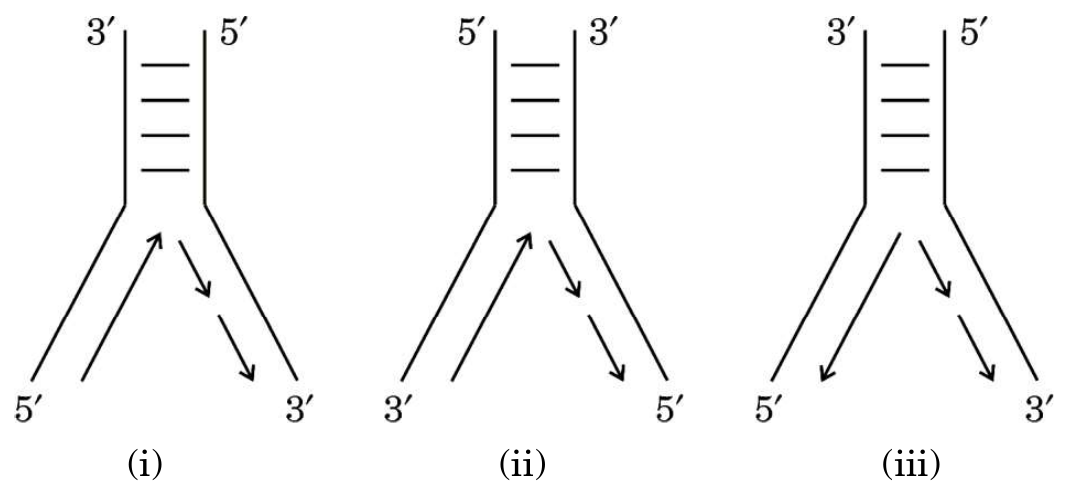
(a) Which one of the three diagrams (i), (ii) or (iii) is the correct representation of the replicating fork of DNA replication ? Explain your answer.
(b) Name the enzyme used in E. coli to join the newly synthesised fragments of DNA.
Solution
(a) Diagram (ii) is correct.
DNA-dependent DNA polymerase catalyses polymerisation only in the 5' → 3' direction. So on the template with polarity 3' → 5', replication is continuous (leading strand). On the template with polarity 5' → 3', it is discontinuous (lagging strand, Okazaki fragments). Diagram (ii) shows one continuous and one discontinuous strand in the right directions.
(b) DNA ligase joins the discontinuously synthesised fragments.
Given below is one of the strands of a DNA segment :
TACGTACGTACGTACG
(a) Write its complementary strand.
(b) Write a possible RNA strand that can be transcribed from the above DNA molecule formed.
Solution
Taking the given strand as 3'–TACGTACGTACGTACG–5':
(a) Complementary strand (A pairs with T, G with C, antiparallel): 5'–ATGCATGCATGCATGC–3'
(b) Using the given strand as the template, the RNA has the same sequence as the complementary strand with U in place of T: 5'–AUGCAUGCAUGCAUGC–3'
State a functional difference between the following codons: (a) AUG and UAA (b) Specific and Degenerate
A segment of DNA molecule comprises of 546 nucleotides. How many cytosine nucleotides would be present in it if the number of adenine nucleotides is 96 ?
Although a prokaryotic cell has no defined nucleus, yet DNA is not scattered throughout the cell. Explain.
Differentiate between the genetic codes given below: (a) Unambiguous and Universal (b) Degenerate and Initiator
Following are the features of genetic codes. What does each one indicate ? Stop codon; Unambiguous codon; Degenerate codon; Universal codon.
3 marks: short answer
(a) What is a genetic code ?
(b) Why did scientists feel the need to propose a genetic code ?
(c) Genetic code is said to be 'Universal'. Why ?
Solution
(a) The genetic code is the set of triplets of nitrogen bases (codons) on mRNA that decide the sequence of amino acids in a protein.
(b) Genetic information is a sequence of only 4 bases in nucleic acids, while proteins are made of 20 amino acids. A code was needed to relate the two, to show how a change in nucleic acid causes a change in the amino acids of a protein. Only a triplet code (4³ = 64 combinations) can specify 20 amino acids.
(c) The code is nearly the same in all organisms. A codon codes for the same amino acid from bacteria to humans (e.g. UUU = phenylalanine). There are a few exceptions in mitochondria and some protozoans.
Study the given below single strand of deoxyribonucleic acid depicted in the form of a "stick" diagram with 5' – 3' end directionality, sugars as vertical lines and bases as single letter abbreviations and answer the questions that follow.
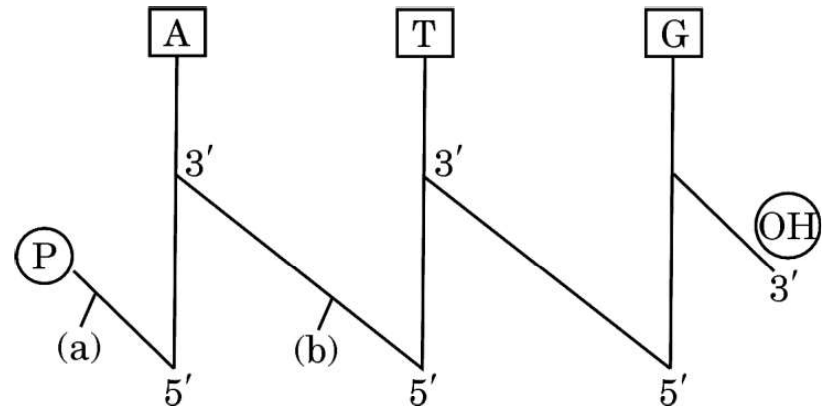
(a) Name the covalent bonds depicted as (a) and (b) in the form of slanting lines in the diagram.
(b) How many purines are present in the given "stick" diagram ?
(c) Draw the chemical structure of the given polynucleotide chain of DNA.
Solution
(a) (a) is a phosphoester bond (phosphate to the 5' C of the sugar). (b) is a 3'–5' phosphodiester bond (linking the 3' C of one sugar to the 5' C of the next through a phosphate).
(b) Two purines: adenine (A) and guanine (G). T is a pyrimidine.
(c) 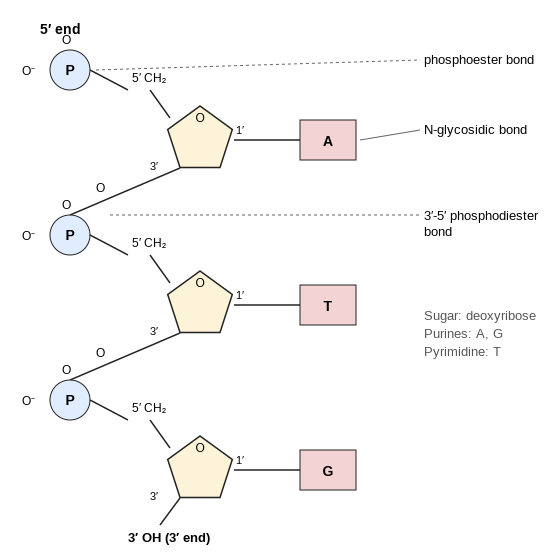
(a) Name and write two characteristics of the type of DNA that forms the basis of DNA fingerprinting technique.
(b) Mention any two applications of this technique.
Solution
(a) Repetitive DNA (satellite DNA, VNTRs). Characteristics (any two):
• It does not code for any protein.
• It forms a large portion of the human genome.
• It shows a high degree of polymorphism (variable number of tandem repeats differs from person to person), which makes it the basis of DNA fingerprinting.
(b) Any two: forensic applications (identifying criminals); paternity testing; determining population and genetic diversities; studying evolution; tracing the path of hereditary diseases.
In case of any dispute, a very small sample of tissue or even a drop of blood can help us to determine the paternity of a child. Provide a scientific explanation to substantiate the statement.
Solution
This is done by DNA fingerprinting.
• Every person's DNA has repetitive sequences (satellite DNA, VNTRs) that show a high degree of polymorphism, so the pattern is unique to each person.
• These polymorphisms are inheritable: a child gets half its pattern from the mother and half from the father.
• Steps: DNA is isolated from the small sample and amplified by PCR → digested by restriction enzymes → fragments separated by gel electrophoresis → blotted onto a membrane (Southern blotting) → hybridised with a labelled VNTR probe → detected by autoradiography.
• The bands of the child are compared with those of the alleged father. Every band of the child not found in the mother must match a band of the true father.
(a) Explain the process by which amino acid gets attached to the tRNA molecule during translation process.
(b) How does the translation process get terminated ?
(c) Expand 'UTR'. Where are they located ?
Solution
(a) Amino acids are first activated in the presence of ATP. Each is then linked to its cognate tRNA (the tRNA with the matching anticodon). This is called charging of tRNA (aminoacylation of tRNA).
(b) When the ribosome reaches a stop codon (UAA, UAG or UGA), a release factor binds to it. This terminates translation and releases the complete polypeptide from the ribosome.
(c) UTR = untranslated region. UTRs are present at both the 5' end (before the start codon) and the 3' end (after the stop codon) of the mRNA. They are needed for efficient translation.
(i) How many types of RNA polymerases are there in a eukaryote cell ? Mention which one of them transcribes hnRNA.
(ii) Write the changes that hnRNA undergoes before it leaves the nucleus as mRNA.
Solution
(i) Three types (RNA polymerase I, II and III). RNA polymerase II transcribes the precursor of mRNA, the hnRNA.
(ii) • Splicing: the introns are removed and the exons are joined in a definite order.
• Capping: an unusual nucleotide, methyl guanosine triphosphate, is added at the 5' end.
• Tailing: about 200–300 adenylate residues are added at the 3' end, independently of any template.
The fully processed hnRNA, now mRNA, is transported out of the nucleus for translation.
The length of DNA in any cell is far greater than the dimension of its nucleus. Explain how this enormous DNA is packaged in a eukaryotic cell.
Solution
• In eukaryotes there is a set of positively charged, basic proteins called histones, rich in the basic amino acids lysine and arginine.
• The positively charged histones are organised into a unit of eight molecules (histone octamer).
• The negatively charged DNA wraps around the histone octamer, forming a structure called the nucleosome. A typical nucleosome contains about 200 bp of DNA helix.
• Nucleosomes are the repeating units of chromatin, which appears like "beads on a string" under the electron microscope.
• The chromatin is further coiled and condensed at metaphase to form chromosomes. Packaging at higher levels needs additional non-histone chromosomal (NHC) proteins.
"Use of heavy isotope of nitrogen by Meselson and Stahl demonstrated semi-conservative mode of replication of a DNA molecule." Explain how did they arrive at this conclusion.
Explain the mechanism of translation that occurs in the ribosomes in a prokaryote.
Write any six salient features of the human genome as drawn from the human genome project.
Explain the process of making heterogeneous nuclear RNA (hnRNA) into a fully functional mRNA in eukaryotes. Where does this process occur in the cell ?
(a) Expand VNTR and describe its role in DNA fingerprinting.
(b) List any two applications of DNA fingerprinting technique.
(a) List the two methodologies which were involved in human genome project. Mention how they were used.
(b) Expand 'YAC' and mention what it was used for.
(a) What do 'Y' and 'B' stand for in 'YAC' and 'BAC' used in Human Genome Project (HGP). Mention their role in the project.
(b) Write the percentage of the total human genome that codes for proteins and the percentage of discovered genes whose functions are known as observed during HGP.
(c) Expand 'SNPs' identified by scientists in HGP.
4 marks: case-based / source-based
Gene expresses itself in a cell system as a protein/enzyme. How does an expression of gene occur in a cell system and when does it need to occur, and how the gene expression is regulated in a prokaryote cell system was studied by the combined efforts of Jacque Monod, the biochemist and Francois Jacob, the geneticist. For their work on lactose metabolism in E. coli and introducing the concept of "lac operon" they were awarded the Nobel Prize in 1965.
(a) Why is lac operon said to be a transcriptionally regulated system ? (1)
(b) It is said that "the lac operon has to be operational at a very low level in the bacterial cell all the time." Justify. (½)
(c) Why is the regulator gene in lac operon marked as 'i' gene ? (½)
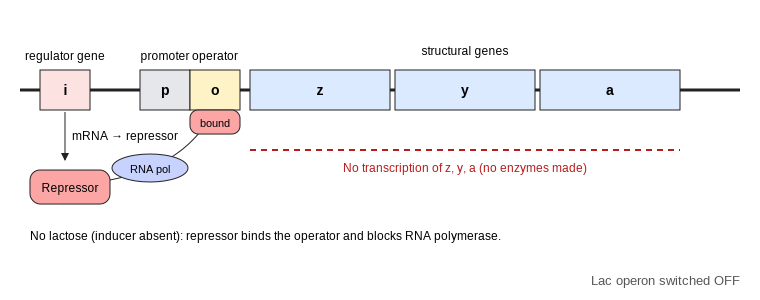
(d) Draw a schematic diagram of lac operon in absence of inducer in the culture medium of the bacteria. (2)
OR
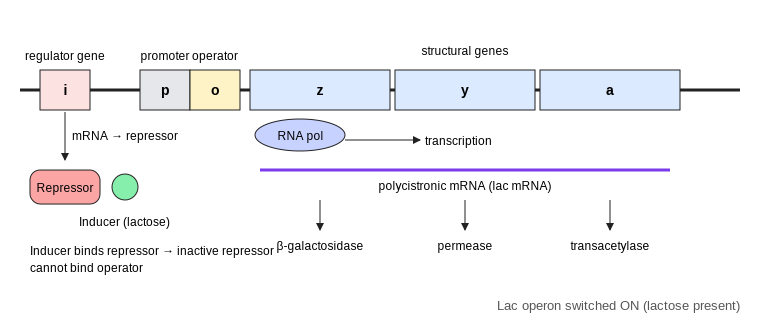
(d) Draw a schematic diagram of lac operon in the presence of inducer in the culture medium of the bacteria. (2)
Solution
(a) It is regulated at the level of transcription (initiation). In the absence of lactose, the repressor binds to the operator and stops RNA polymerase from transcribing the operon. In the presence of lactose, the repressor cannot bind, and RNA polymerase transcribes the structural genes.
(b) Lactose cannot enter the cell without permease, which is coded by the y gene of the operon itself. So a very low level of expression must always be present, to make a little permease that lets lactose in to switch the operon on.
(c) The letter "i" comes from the word inhibitor. The i gene codes for the repressor protein, which binds to the operator and switches the operon off.
(d) Absence of inducer (switched off):
OR (d) Presence of inducer (switched on):
5 marks: long answer
(i) Watson and Crick's discovery of double helical structure was based on which two findings. Also mention the name of the scientists associated with these findings.
(ii) Write down the salient features of double helix structure of DNA (any three points).
Solution
(i) • The X-ray diffraction data of DNA produced by Maurice Wilkins and Rosalind Franklin.
• Chargaff's rules (Erwin Chargaff): in double-stranded DNA, A = T and G ≡ C, so the ratios A/T and G/C are constant and equal to one.
(ii) Any three:
• DNA is made of two polynucleotide chains. Sugar and phosphate form the backbone and the bases project inwards.
• The two chains have antiparallel polarity (5'→3' and 3'→5').
• The bases of the two strands pair through hydrogen bonds: A with T (two H-bonds) and G with C (three H-bonds). A purine always pairs with a pyrimidine, so the distance between the strands stays uniform.
• The two chains are coiled in a right-handed helix. The pitch is 3.4 nm with about 10 bp per turn, so adjacent base pairs are about 0.34 nm apart.
• The plane of one base pair stacks over the other, which adds to the stability of the helix.
Given below is a stretch of DNA showing the coding strand of structural gene of transcription unit.
5' - ATG ACC GTA TTT TCT GTA GTG CCC GTA CTT CAG GCA TTA 3'
(i) Write the corresponding template strand and m-RNA strand that will be transcribed along with its polarity.
(ii) If GUA of transcribed mRNA is an intron, then depict the sequence involved in formation of mRNA / mature / processed hnRNA strand : (1) In a bacterium (2) In humans
(iii) How many amino acids the resulting polypeptide will have after the process of translation in humans ?
Solution
(i) Template strand: 3' – TAC TGG CAT AAA AGA CAT CAC GGG CAT GAA GTC CGT AAT – 5'
mRNA (same as the coding strand, with U for T): 5' – AUG ACC GUA UUU UCU GUA GUG CCC GUA CUU CAG GCA UUA – 3'
(ii) (1) In a bacterium, genes are not split and there is no splicing; the mRNA is used as it is:
5' – AUG ACC GUA UUU UCU GUA GUG CCC GUA CUU CAG GCA UUA – 3'
(2) In humans, the hnRNA is spliced (the three GUA introns are removed), capped (methyl guanosine triphosphate at the 5' end) and tailed (poly-A at the 3' end):
5' – mGppp – AUG ACC UUU UCU GUG CCC CUU CAG GCA UUA – AAAA…(poly A tail) – 3'
(iii) The mature mRNA has 10 codons (AUG … UUA), so the polypeptide has 10 amino acids.
Observe the segment of mRNA given below and answers the questions given below :
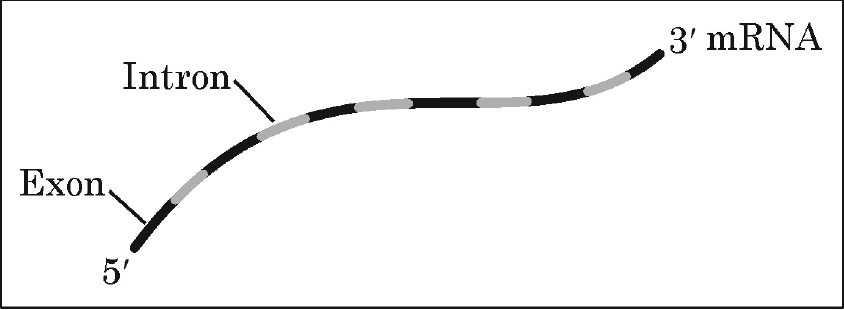
(i) Explain and illustrate the steps involved to make fully processed hn RNA.
(ii) Gene encoding RNA polymerase I and RNA polymerase III have been affected by mutation. Explain its impact on the synthesis of polypeptide giving reasons.
Solution
(i) The primary transcript (hnRNA) contains both exons and introns. It is processed in three steps:
• Splicing: the introns (non-coding sequences) are removed and the exons (coding sequences) are joined together.
• Capping: an unusual nucleotide, methyl guanosine triphosphate, is added to the 5' end.
• Tailing: about 200–300 adenylate residues (poly-A tail) are added to the 3' end, independently of any template.
5' – [Exon]–[Intron]–[Exon]–[Intron]–[Exon] – 3' (hnRNA)
→ splicing → 5' – Exon–Exon–Exon – 3'
→ capping and tailing → 5' mGppp – Exon–Exon–Exon – AAAA…A 3' (mature mRNA)
(ii) No polypeptide will be made.
• RNA polymerase I transcribes rRNAs (28S, 18S, 5.8S). rRNAs form the ribosomes and play structural and catalytic roles in translation (the 23S rRNA is the ribozyme that forms peptide bonds).
• RNA polymerase III transcribes tRNA (and 5S rRNA, snRNA). tRNA is the adaptor molecule that brings amino acids to the ribosome.
Without ribosomes and tRNA, translation cannot happen even though RNA polymerase II still makes the mRNA.
Stability, as one of the properties of genetic material, was very evident in one of the very early experiments in genetics. Name the scientist and describe his experiment. State the conclusion he arrived at.
Solution
The scientist is Frederick Griffith (1928). He used two strains of Streptococcus pneumoniae:
• S strain – smooth (has a polysaccharide mucous coat), virulent
• R strain – rough (no coat), non-virulent
Experiment, injecting into mice:
1. S strain → mice die
2. R strain → mice live
3. S strain (heat-killed) → mice live
4. S strain (heat-killed) + R strain (live) → mice die, and live S bacteria are recovered from the dead mice
Conclusion:
• The R-strain bacteria had been transformed by the heat-killed S-strain bacteria.
• Some "transforming principle", transferred from the heat-killed S strain, enabled the R strain to make a smooth polysaccharide coat and become virulent. This must be due to transfer of the genetic material.
• Heat killed the bacteria but did not destroy the properties of the genetic material, which shows its stability. (Its biochemical nature was later shown to be DNA by Avery, MacLeod and McCarty.)
(i) Draw a schematic, self-explanatory labelled diagram of lac operon in switched on condition.
(ii) Why is regulation of lac operon referred to as negative regulation ?
Solution
(i)
When lactose (the inducer) is present, it binds to the repressor made by the i gene and inactivates it. The repressor cannot bind to the operator, so RNA polymerase transcribes the structural genes z, y and a into a polycistronic mRNA. This makes β-galactosidase, permease and transacetylase.
(ii) The regulation is negative because the repressor protein, when it binds to the operator, switches off (prevents) transcription. The operon is expressed only when the repressor is removed by the inducer.
Meselson and Stahl carried out an experiment to prove the nature of DNA replication. Recall the experiment and answer the following questions.
(i) Which two types of nitrogen were used by them in their experiment and why ?
(ii) Why did they take samples of E. coli at definite time intervals for their observation ?
(iii) State the role of caesium chloride density gradient in their experiment.
(iv) Write the conclusions they arrived at.
Solution
(i) Heavy nitrogen, 15N (as 15NH4Cl), and normal nitrogen, 14N. E. coli grown in 15N for many generations had heavy DNA. It was then shifted to 14N, so new strands were light. The two nitrogens made heavy and light DNA, which could be told apart by density.
(ii) E. coli divides every 20 minutes. Taking samples at definite intervals (20 min, 40 min, …) showed the DNA after each generation, revealing how the DNA was replicated.
(iii) CsCl density gradient centrifugation separates DNA molecules by their density: heavy (15N/15N), hybrid (15N/14N) and light (14N/14N) DNA form bands at different positions.
(iv) After one generation (20 min), all DNA was hybrid (intermediate density). After two generations (40 min), there were equal amounts of hybrid and light DNA. So DNA replicates semi-conservatively: each new molecule has one old (parental) strand and one new strand.
Protein synthesis requires the services of all three types of RNAs, namely t-RNA, m-RNA and r-RNA. Explain the role of each of them during the process of protein synthesis in prokaryotes.
Solution
• mRNA (messenger RNA): acts as the template for protein synthesis. It carries the genetic information as codons. It has the start codon AUG to begin translation and a stop codon (UAA, UAG or UGA) to end it, and untranslated regions (UTRs) at both ends for efficient translation.
• tRNA (transfer RNA): the adaptor molecule. It reads the code through its anticodon loop and carries a specific amino acid at its amino-acid acceptor end (after charging). It brings the specific amino acid to the ribosome. A special initiator tRNA starts translation.
• rRNA (ribosomal RNA): forms the ribosomes with proteins and plays structural and catalytic roles. The large subunit has two sites for binding tRNAs carrying amino acids, close enough for peptide bond formation. When the small subunit meets the mRNA, translation begins. The 23S rRNA acts as a ribozyme, catalysing the formation of peptide bonds.
Describe the experiment carried out by Hershey and Chase. Write the conclusion they arrived at.
Solution
In 1952, Alfred Hershey and Martha Chase worked with bacteriophages (viruses that infect bacteria):
• They grew some viruses on a medium containing radioactive phosphorus (32P) and some on a medium containing radioactive sulphur (35S).
• Viruses grown on 32P had radioactive DNA (DNA has phosphorus, protein does not). Viruses grown on 35S had radioactive protein (protein has sulphur, DNA does not).
• The radioactive phages were allowed to attach to (infect) E. coli bacteria.
• As the infection proceeded, the virus coats were removed from the bacteria by agitating them in a blender.
• The virus particles were separated from the bacteria by centrifugation.
• Bacteria infected with viruses having radioactive DNA were radioactive, showing that DNA had entered the bacteria.
• Bacteria infected with viruses having radioactive protein were not radioactive: the protein did not enter the bacteria, and the radioactivity stayed in the supernatant.
Conclusion: DNA is the genetic material that passes from the virus to the bacteria.
Explain the expression of lac operon genes in E. coli growing in lactose containing culture medium.
Name the types of cells and the process by which hnRNA is formed. Describe the processing mechanism it undergoes before it becomes functional.
(a) Why did Hershey and Chase use radioactive 32P and 35S in their experiments ? Explain.
(b) Following the experiments conducted by them, write what conclusion did they arrive at and how.
(a) State the 'Central dogma' as proposed by Francis Crick. Are there any exceptions to it ? Support your answer with a reason and an example.
(b) Explain how the biochemical characterisation (nature) of 'Transforming Principle' was determined, which was not defined from Griffith's experiments.
(a) Describe the structure and function of a t-RNA molecule. Why is it referred to as an adapter molecule?
(b) Explain the process of splicing of hn-RNA in a eukaryotic cell.
Write the different components of a lac-operon in E. coli. Explain its expression while in an 'open' state.
Describe Meselson and Stahl's experiment that was carried in 1958 on E. coli. Write the conclusion they arrived at after the experiment.
(a) Describe the process of transcription in bacteria.
(b) Explain the processing the hnRNA needs to undergo before becoming functional mRNA in eukaryotes.
Get every solution for all chapters
- Every board question of every chapter, each fully solved the way the board gives marks
- 19 complete board papers, each followed by its solutions
- Weightage and most-asked topics for every chapter
- Instant PDF download, colour and black & white print copies
Revising the chapter first? Complete Biology Notes for Class 12 (NCERT 2026-27, CBSE Board 2027) →
What you get in the pack
- Questions from 122 CBSE papers, 2016 to 2026: every set code available
- Complete: 2114 different questions and parts from all set codes, 13 chapters and 19 full papers
- Part A: all 13 chapters, questions sorted chapter-wise and by marks
- Year-wise weightage table and most-asked topics for every chapter
- Part B: 19 full board papers, each followed by its complete solutions
- Labelled diagrams, Punnett squares, crosses and flow charts drawn in full
- Questions on topics out of the board syllabus flagged
All chapters in this pack
- PYQ Ch 1 Sexual Reproduction in Flowering Plants
- PYQ Ch 2 Human Reproduction
- PYQ Ch 3 Reproductive Health
- PYQ Ch 4 Principles of Inheritance and Variation
- PYQ Ch 5 Molecular Basis of Inheritance
- PYQ Ch 6 Evolution
- PYQ Ch 7 Human Health and Disease
- PYQ Ch 8 Microbes in Human Welfare
- PYQ Ch 9 Biotechnology: Principles and Processes
- PYQ Ch 10 Biotechnology and its Applications
- PYQ Ch 11 Organisms and Populations
- PYQ Ch 12 Ecosystem
- PYQ Ch 13 Biodiversity and Conservation
- Board Paper 2026 Set 57-1-1 with Solutions
- Board Paper 2026 Set 57-1-2 with Solutions
- Board Paper 2026 Set 57-1-3 with Solutions
- Board Paper 2026 Set 57-2-1 with Solutions
- Board Paper 2025 Set 57-4-1 with Solutions
- Board Paper 2025 Set 57-5-1 with Solutions
- Board Paper 2024 Set 57-1-1 with Solutions
- Board Paper 2024 Set 57-2-1 with Solutions
- Board Paper 2023 Set 57-1-1 with Solutions
- Board Paper 2023 Set 57-3-1 with Solutions
- Board Paper 2022 Term 2 Set 57-2-1 with Solutions
- Board Paper 2022 Term 2 Set 57-4-1 with Solutions
- Board Paper 2020 Set 57-1-1 with Solutions
- Board Paper 2020 Set 57-2-1 with Solutions
- Board Paper 2019 Set 57-2-1 with Solutions
- Board Paper 2019 Set 57-3-1 with Solutions
- Board Paper 2018 Set 57-1 with Solutions
- Board Paper 2017 Set 57-1 with Solutions
- Board Paper 2016 Set 57-1 with Solutions