
Microbes in Human Welfare: Class 12 PYQs 2016–2026 with solutions
All 39 CBSE board questions asked from Microbes in Human Welfare in 17 board papers, with the year, set and marks of each. 21 are solved free below. The Class 12 Biology PYQ Book: Solved Board Papers 2016-2026 (CBSE) has every solution, all chapters and 19 full board papers.
Subject experts: Divya Harwani (B.Sc. Biotechnology, M.Sc. Biotechnology) and Jayant Sharma (B.Sc., B.Ed.)



Free: NCERT solutions for Class 12 Biology →
Microbes in Human Welfare: board weightage
Board weightage 2016–2026
| Year | 2016 | 2017 | 2018 | 2019 | 2020 | 2022 | 2023 | 2024 | 2025 | 2026 |
|---|---|---|---|---|---|---|---|---|---|---|
| Questions | 2 | 2 | 2 | 4 | 6 | 6 | 3 | 4 | 5 | 5 |
| Marks | 5 | 5 | 5 | 14 | 12 | 12 | 6 | 9 | 9 | 14 |
Most asked topics
39 questions from 17 papers. Repeated questions are shown once with every year they were asked.
Jump to: 1 mark2 marks3 marks5 marks
1 mark: MCQ and Assertion–Reason
Assertion (A) : Flocs are masses of bacteria associated with fungal filaments in secondary treatment of sewage.
Reason (R) : Flocs help in digestion of solid waste by anaerobic respiration.
Solution
Answer: (C) A is true but R is false.
Flocs grow in the aeration tank, where air is pumped in. They consume the organic matter by aerobic respiration and so lower the BOD. Anaerobic digestion happens later, in the sludge digester.
Assertion (A) : Microbes are used for commercial production of alcohol and beverages.
Reason (R) : Yeast converts glucose into ethanol and carbon dioxide during fermentation.
Solution
Answer: (A) Both A and R are true and R is the correct explanation of A.
Brewer's yeast, Saccharomyces cerevisiae, ferments malted cereals and fruit juices to make ethanol, as in wine, beer, whisky, brandy and rum.
Bioactive molecule Cyclosporin A used for human welfare is derived from :
Solution
Answer: (C) Trichoderma polysporum
Cyclosporin A is used as an immunosuppressive agent in organ-transplant patients. (Monascus gives statins, Aspergillus citric acid, Propionibacterium the holes in Swiss cheese.)
Large scale industrial production of Butyric acid for human welfare is done using the microbe :
Solution
Answer: (C) Clostridium sp.
Clostridium butylicum makes butyric acid. (Aspergillus niger makes citric acid.)
Assertion (A) : Biogas plants are more often built in rural areas.
Reason (R) : The excreta or gobar of cattle is rich in Methanobacterium.
Solution
Answer: (A) Both A and R are true and R is the correct explanation of A.
Cattle dung (gobar), available in plenty in villages, contains methanogens such as Methanobacterium (from the cattle rumen), which produce methane-rich biogas.
Lactobacillus that sets milk into curd is categorised as :
Solution
Answer: (D) Heterotrophic bacteria
Lactobacillus (LAB) obtains food from milk and converts lactose into lactic acid. It does not make its own food.
Which one of the following pairs is not correctly matched ?
Identify the fungus that ripens the famous 'Roquefort' cheese :
The microbes commonly used in kitchens are
The bioactive molecule used as an immunosuppressive agent during organ transplant is
Write the scientific name of the organism Alexander Fleming worked on and discovered the first antibiotic. Was the organism he worked on a fungus or a bacterium ?
2 marks: very short answer
After significant reduction of BOD during secondary treatment of sewage, what further processes are carried out ? Mention any one important outcome of these processes.
Solution
• The effluent from the aeration tank is passed into a settling tank, where the bacterial flocs settle down. This sediment is called activated sludge.
• A small part of the activated sludge is pumped back into the aeration tank to serve as inoculum.
• The major part is pumped into large tanks called anaerobic sludge digesters. There, anaerobic bacteria digest the bacteria and fungi of the sludge and produce gases such as methane, hydrogen sulphide and CO2 (biogas).
Outcome (any one): the biogas can be used as a source of energy. The treated effluent is clean enough to be released into rivers and streams.
Why do organic farmers not recommend complete eradication of insect pests ? Explain giving reason.
Solution
Organic farmers hold that complete eradication of pests is not only impossible but also undesirable. Without pests, the beneficial predatory and parasitic insects that depend on them for food or as hosts would not survive. Their key belief is that biodiversity furthers health: a more diverse landscape is a more sustainable ecosystem. So they keep pests at manageable levels through natural checks and balances (biological control).
(a) Write the first step the primary effluent undergoes when it enters the secondary treatment plant and state the purpose.
(b) What is the level of B.O.D indicative of in the secondary treatment plant ? Mention its significance.
Solution
(a) The primary effluent is passed into large aeration tanks, where it is constantly agitated mechanically and air is pumped in. Purpose: to allow vigorous growth of useful aerobic microbes into flocs (bacteria associated with fungal filaments), which consume the organic matter and reduce the BOD.
(b) BOD indicates the amount of organic matter present in the water, i.e. its polluting potential: the greater the BOD, the more polluting the water. The sewage is treated in the aeration tank until the BOD is reduced significantly.
"Curd is easier to digest by humans than milk." Justify, giving two suitable reasons.
Solution
• The lactic acid bacteria (LAB, e.g. Lactobacillus) in curd produce acids that coagulate the milk.
• They also partially digest the milk proteins, so curd is easier to digest. (LAB also increase vitamin B12 and check disease-causing microbes in the stomach.)
Study the given diagrams of Biogas plants – 'A' and 'B' and answer the questions that follow :
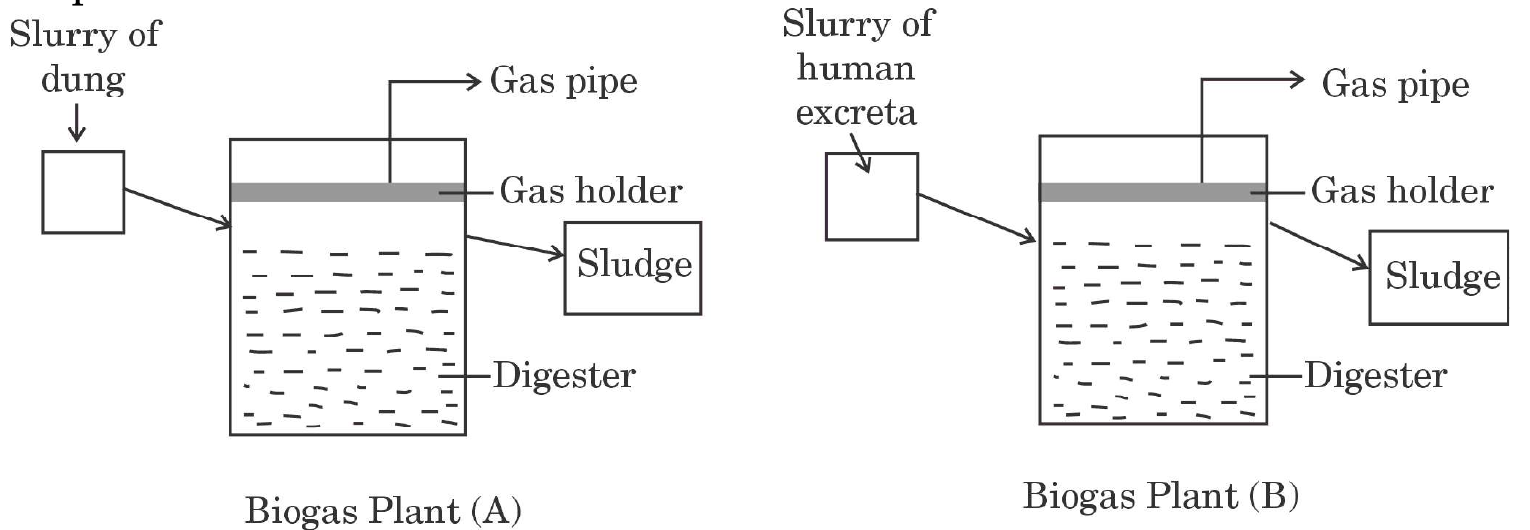
Which one of the two biogas plants can be used for generating gas fuel and electricity and why ? Give suitable reasons in support of your answer.
Solution
Biogas plant A (fed with a slurry of cattle dung, gobar).
Cattle dung is rich in methanogens (e.g. Methanobacterium) from the rumen of cattle. They grow anaerobically on the cellulosic material and produce large amounts of methane along with CO2 and H2. The methane-rich biogas can be used for cooking and lighting (and electricity).
Mention the common bacterium found in the anaerobic sludge during sewage treatment and also in the rumen of cattle. How is this bacterium commercially useful ?
Solution
Methanobacterium (methanogens).
It is used commercially to produce biogas (gobar gas), mainly methane, from cattle dung and sludge. Biogas is used for cooking and lighting.
Name the effective biocontrol agents of several plant pathogens belonging to group of viruses. Also write about the ways they support the environment.
Solution
Baculoviruses, mostly of the genus Nucleopolyhedrovirus.
Ways they help (any two): they are species-specific with narrow-spectrum insecticidal action; they have no negative impact on plants, mammals, birds, fish or even non-target insects; this helps conserve beneficial insects, so they are ideal for IPM, especially in ecologically sensitive areas.
Some of the microbes used as biofertilizers are prokaryotes. Name the taxonomic group they come under. With the help of an example, mention how they act as biofertilizers.
Different species belonging to genus Trichoderma are useful to humans as well as to plants. Justify their roles by giving one instance of each.
Name the genus of baculovirus that acts as a biological control agent in spite of being a pathogen. Justify by giving three reasons that make it an excellent candidate for the job.
"Micro-organisms play an important role for the biological treatment of sewage." Justify.
Your advice is sought to improve the nitrogen content of the soil to be used for cultivation of a non-leguminous terrestrial crop.
(a) Recommend two microbes that can enrich the soil with nitrogen.
(b) Why do leguminous crops not require such enrichment of the soil ?
Name the microbes that help production of the following products commercially: (a) Statin (b) Citric acid (c) Penicillin (d) Butyric acid
Name a genus of baculovirus. Why are they considered good biocontrol agents ?
3 marks: short answer
Explain the biological treatment of primary effluent when passed into the large aeration tanks in a sewage treatment plant (STP).
Solution
• The primary effluent is passed into large aeration tanks, where it is constantly agitated mechanically and air is pumped into it.
• This allows vigorous growth of useful aerobic microbes into flocs (masses of bacteria associated with fungal filaments, forming mesh-like structures).
• While growing, these microbes consume the major part of the organic matter in the effluent.
• This significantly reduces the BOD (biochemical oxygen demand) of the effluent. The sewage is treated until the BOD is reduced.
(a) Write the full form of BOD.
(b) Define BOD. Explain how it is a measure of the organic matter present in the water body.
Solution
(a) Biochemical Oxygen Demand.
(b) BOD is the amount of oxygen that would be consumed if all the organic matter in one litre of water were oxidised by bacteria.
Microbes use oxygen to break down organic matter, so the more organic matter there is, the more oxygen is consumed. Hence the greater the BOD of waste water, the more organic matter it has and the greater its polluting potential. The sewage is treated until the BOD is reduced.
Treatment of wastewater is done in a sewage treatment plant to make it less polluting. Explain the following with reference to this treatment process : (a) Primary sludge (b) Activated sludge (c) Anaerobic sludge digesters
Solution
(a) Primary sludge: during primary (physical) treatment, floating debris is removed by sequential filtration, and grit (soil and small pebbles) by sedimentation. All the solids that settle form the primary sludge; the supernatant is the primary effluent.
(b) Activated sludge: in secondary (biological) treatment, the primary effluent is aerated so that aerobic microbes grow as flocs and consume the organic matter, reducing the BOD. The effluent is then passed to a settling tank, where the bacterial flocs settle as a sediment called activated sludge. A small part is pumped back into the aeration tank as inoculum.
(c) Anaerobic sludge digesters: large tanks into which the major part of the activated sludge is pumped. Anaerobic bacteria digest the bacteria and fungi in the sludge and produce a mixture of methane, hydrogen sulphide and CO2 (biogas).
Explain the changes that milk undergoes when suitable starter/inoculum is added to it. How does the end product formed prove to be beneficial for human health ?
Solution
• A small amount of curd added to fresh milk as inoculum (starter) contains millions of Lactobacillus and other lactic acid bacteria (LAB).
• At a suitable warm temperature, the LAB multiply and convert milk into curd.
• They produce acids (lactic acid) that coagulate and partially digest the milk proteins.
Benefits: curd has improved nutritional quality because of increased vitamin B12, and in our stomach LAB check disease-causing microbes.
The release of municipal wastewater and industrial waste into our natural water bodies is causing disastrous effect to the aquatic life. Explain the biological treatment that should be given to it before releasing into the natural water bodies.
Solution
• The primary effluent is passed into large aeration tanks, where it is constantly agitated mechanically and air is pumped into it.
• This allows vigorous growth of useful aerobic microbes into flocs (masses of bacteria associated with fungal filaments).
• These microbes consume the major part of the organic matter in the effluent, so the BOD is reduced significantly.
• The effluent is then passed into a settling tank, where the flocs sediment. This sediment is the activated sludge.
• A small part of the activated sludge is pumped back into the aeration tank as the inoculum.
• The remaining major part is pumped into large tanks, the anaerobic sludge digesters. There, anaerobic bacteria digest the bacteria and fungi in the sludge and produce methane, hydrogen sulphide and CO2 (biogas). The treated effluent can then be released into rivers and streams.
Describe the steps that are followed during secondary treatment of sewage.
(a) Organic farmers prefer biological control of diseases and pests to the use of chemicals for the same purpose. Justify.
(b) Give an example of a bacterium, a fungus and an insect that are used as biocontrol agents.
Secondary treatment of the sewage is also called Biological treatment. Justify this statement and explain the process.
(a) How do organic farmers control pests ? Give two examples.
(b) State the difference in their approach from that of conventional pest control methods.
5 marks: long answer
(i) What are bio-fertilizers ?
(ii) Name the different types of microorganisms used as bio-fertilizers in organic farming and explain how each contributes to soil fertility.
(iii) Write two advantages of using bio-fertilizers over chemical fertilizers.
Solution
(i) Biofertilisers are organisms that enrich the nutrient quality of the soil. The main sources are bacteria, fungi and cyanobacteria.
(ii) • Bacteria: Rhizobium forms root nodules on leguminous plants and fixes atmospheric nitrogen into organic forms used by the plant. Azospirillum and Azotobacter are free-living in the soil and also fix atmospheric nitrogen.
• Fungi: fungi of the genus Glomus form mycorrhiza with plant roots. The fungus absorbs phosphorus from the soil and passes it to the plant. Such plants also resist root-borne pathogens, tolerate salinity and drought, and grow better overall.
• Cyanobacteria: autotrophic microbes such as Anabaena, Nostoc and Oscillatoria fix atmospheric nitrogen. They are important biofertilisers in paddy fields and also add organic matter to the soil.
(iii) Any two: they do not pollute the soil or ground water; they are cheap and renewable; they conserve beneficial soil microbes; they do not harm human health. Chemical fertilisers do the opposite.
(i) Why are microbes considered effective biocontrol agents in sustainable agriculture ?
(ii) Explain the role of the following as biocontrol agents naming the pests or diseases they help to control : (1) A Bacterium (2) A Fungus (3) Virus
Solution
(i) They greatly reduce the use of toxic chemicals and pesticides that pollute the environment. Pests are not wiped out but kept at manageable levels by natural checks and balances. Many are species-specific and do not harm plants, mammals, birds, fish or non-target insects.
(ii) (1) Bacterium – Bacillus thuringiensis (Bt): controls butterfly caterpillars. Dried Bt spores are mixed with water and sprayed on plants (e.g. brassicas, fruit trees). Larvae eat the spores, the toxin is released in their gut, and the larvae are killed. Bt cry genes are also put into plants (Bt cotton).
(2) Fungus – Trichoderma: a free-living fungus common in root ecosystems. It is an effective biocontrol agent against several plant pathogens.
(3) Virus – baculoviruses (genus Nucleopolyhedrovirus): attack insects and other arthropods. They are species-specific with narrow-spectrum insecticidal action, and have no negative effect on non-target organisms. This makes them ideal for integrated pest management, especially in ecologically sensitive areas.
Large quantities of sewage are generated every day in cities as well as in towns and are treated in Sewage Treatment Plants (STPs) to make them less polluting. Given below is the flow diagram of stages of STP.
Primary effluent passed into large aeration tanks → Effluent passed into settling tanks to form sediment
(i) (1) Why is primary effluent passed into large aeration tanks ? (2) What is the sediment formed, referred to as ? Mention its significance. (3) Explain the final step in the settling tank before the treated effluent is released into water bodies.
(ii) Name any two organisms commonly used as biofertilisers, belonging to different kingdoms. Write how each one acts as a biofertiliser.
Solution
(i) (1) In the aeration tanks, the effluent is agitated and air is pumped in. This allows vigorous growth of useful aerobic microbes into flocs (bacteria with fungal filaments). These consume the major part of the organic matter and so reduce the BOD.
(2) The sediment of bacterial flocs is called activated sludge. A small part of it is pumped back into the aeration tank to serve as the inoculum. The rest goes to anaerobic sludge digesters, where it is digested and biogas is produced.
(3) Once the BOD is sufficiently reduced, the effluent is passed into the settling tank, where the bacterial flocs are allowed to sediment (forming activated sludge). The clear effluent above is released into natural water bodies such as rivers and streams.
(ii) Any two from different kingdoms:
• Rhizobium (bacterium, Monera): lives symbiotically in the root nodules of leguminous plants and fixes atmospheric nitrogen into organic forms used by the plant.
• Glomus (fungus): forms mycorrhiza with the roots of higher plants. It absorbs phosphorus from the soil and passes it to the plant.
• Cyanobacteria (Anabaena, Nostoc, Oscillatoria, Monera) fix atmospheric nitrogen and add organic matter to soil, especially in paddy fields.
Describe the process of secondary treatment given to municipal waste water (sewage) before it can be released into fresh waterbodies. Mention another benefit provided by this process.
Explain the interrelationship between organic farming and biofertilizers, with the help of any three suitable examples.
Get every solution for all chapters
- Every board question of every chapter, each fully solved the way the board gives marks
- 19 complete board papers, each followed by its solutions
- Weightage and most-asked topics for every chapter
- Instant PDF download, colour and black & white print copies
Revising the chapter first? Complete Biology Notes for Class 12 (NCERT 2026-27, CBSE Board 2027) →
What you get in the pack
- Questions from 122 CBSE papers, 2016 to 2026: every set code available
- Complete: 2114 different questions and parts from all set codes, 13 chapters and 19 full papers
- Part A: all 13 chapters, questions sorted chapter-wise and by marks
- Year-wise weightage table and most-asked topics for every chapter
- Part B: 19 full board papers, each followed by its complete solutions
- Labelled diagrams, Punnett squares, crosses and flow charts drawn in full
- Questions on topics out of the board syllabus flagged
All chapters in this pack
- PYQ Ch 1 Sexual Reproduction in Flowering Plants
- PYQ Ch 2 Human Reproduction
- PYQ Ch 3 Reproductive Health
- PYQ Ch 4 Principles of Inheritance and Variation
- PYQ Ch 5 Molecular Basis of Inheritance
- PYQ Ch 6 Evolution
- PYQ Ch 7 Human Health and Disease
- PYQ Ch 8 Microbes in Human Welfare
- PYQ Ch 9 Biotechnology: Principles and Processes
- PYQ Ch 10 Biotechnology and its Applications
- PYQ Ch 11 Organisms and Populations
- PYQ Ch 12 Ecosystem
- PYQ Ch 13 Biodiversity and Conservation
- Board Paper 2026 Set 57-1-1 with Solutions
- Board Paper 2026 Set 57-1-2 with Solutions
- Board Paper 2026 Set 57-1-3 with Solutions
- Board Paper 2026 Set 57-2-1 with Solutions
- Board Paper 2025 Set 57-4-1 with Solutions
- Board Paper 2025 Set 57-5-1 with Solutions
- Board Paper 2024 Set 57-1-1 with Solutions
- Board Paper 2024 Set 57-2-1 with Solutions
- Board Paper 2023 Set 57-1-1 with Solutions
- Board Paper 2023 Set 57-3-1 with Solutions
- Board Paper 2022 Term 2 Set 57-2-1 with Solutions
- Board Paper 2022 Term 2 Set 57-4-1 with Solutions
- Board Paper 2020 Set 57-1-1 with Solutions
- Board Paper 2020 Set 57-2-1 with Solutions
- Board Paper 2019 Set 57-2-1 with Solutions
- Board Paper 2019 Set 57-3-1 with Solutions
- Board Paper 2018 Set 57-1 with Solutions
- Board Paper 2017 Set 57-1 with Solutions
- Board Paper 2016 Set 57-1 with Solutions