
Evolution: Class 12 PYQs 2016–2026 with solutions
All 35 CBSE board questions asked from Evolution in 15 board papers, with the year, set and marks of each. 20 are solved free below. The Class 12 Biology PYQ Book: Solved Board Papers 2016-2026 (CBSE) has every solution, all chapters and 19 full board papers.
Subject experts: Divya Harwani (B.Sc. Biotechnology, M.Sc. Biotechnology) and Jayant Sharma (B.Sc., B.Ed.)



Free: NCERT solutions for Class 12 Biology →
Evolution: board weightage
Board weightage 2016–2026
| Year | 2016 | 2017 | 2018 | 2019 | 2020 | 2022 | 2023 | 2024 | 2025 | 2026 |
|---|---|---|---|---|---|---|---|---|---|---|
| Questions | 2 | 2 | 3 | 5 | 5 | – | 5 | 4 | 4 | 5 |
| Marks | 4 | 4 | 6 | 13 | 13 | – | 9 | 7 | 10 | 9 |
Most asked topics
35 questions from 15 papers. Repeated questions are shown once with every year they were asked.
Jump to: 1 mark2 marks3 marks4 marks5 marks
1 mark: MCQ and Assertion–Reason
The idea of use and disuse of organs for evolution of organism was proposed by
Solution
Answer: (D) Lamarck
Lamarck said that organs that are used develop and those not used degenerate, and that these acquired changes are inherited (e.g. the giraffe's long neck).
Assertion (A) : The population of melanized moths increased in industrial areas after Industrial Revolution.
Reason (R) : In Industrial environment lichen covered trees were replaced by soot-covered trees offering better camouflage to dark coloured moths.
Solution
Answer: (A) Both A and R are true and R is the correct explanation of A.
On soot-darkened bark, dark moths were hidden from predatory birds and white moths were picked off. Natural selection therefore increased the number of melanised moths.
What conclusion can be drawn if the forelimbs of an aquatic animal and a terrestrial animal have similar anatomical structure ?
Solution
Answer: (B) Share common ancestors
Forelimbs of a whale and a cheetah have the same basic bone plan but different functions. They are homologous organs, which shows divergent evolution from a common ancestor.
About 15 mya during human evolution, the primates which used to walk like gorillas and chimpanzees were :
Solution
Answer: (B) Dryopithecus and Ramapithecus
They were hairy and walked like gorillas and chimpanzees. Ramapithecus was more man-like, and Dryopithecus more ape-like.
Which of the following combinations is a correct example of convergent evolution in Australian marsupials and Placental mammals ?
| Australian Marsupials | Placental Mammals | |
|---|---|---|
| (A) | Lemur | Spotted cuscus |
| (B) | Tasmanian tiger cat | Anteater |
| (C) | Bobcat | Lemur |
| (D) | Numbat | Anteater |
Solution
Answer: (D) Numbat – Anteater
The numbat (marsupial anteater) and the placental anteater look alike because they live alike. Other correct pairs are spotted cuscus–lemur and Tasmanian tiger cat–bobcat.
Which one of the following statements is not true ?
Solution
Answer: (D)
Homologous structures result from divergent evolution. Analogous structures are the result of convergent evolution.
A population is in genetic equilibrium/Hardy-Weinberg equilibrium for a gene with 2 alleles (dominant allele is 'A' and recessive allele 'a'). If the frequency of allele 'A' is 0·6, then the frequency of genotype 'Aa' is :
Solution
Answer: (C) 0·48
p = 0.6, so q = 1 − 0.6 = 0.4. Frequency of Aa = 2pq = 2 × 0.6 × 0.4 = 0.48.
Select the option that gives the correct description of the process of Natural Selection with respect to the length of the neck of giraffe.
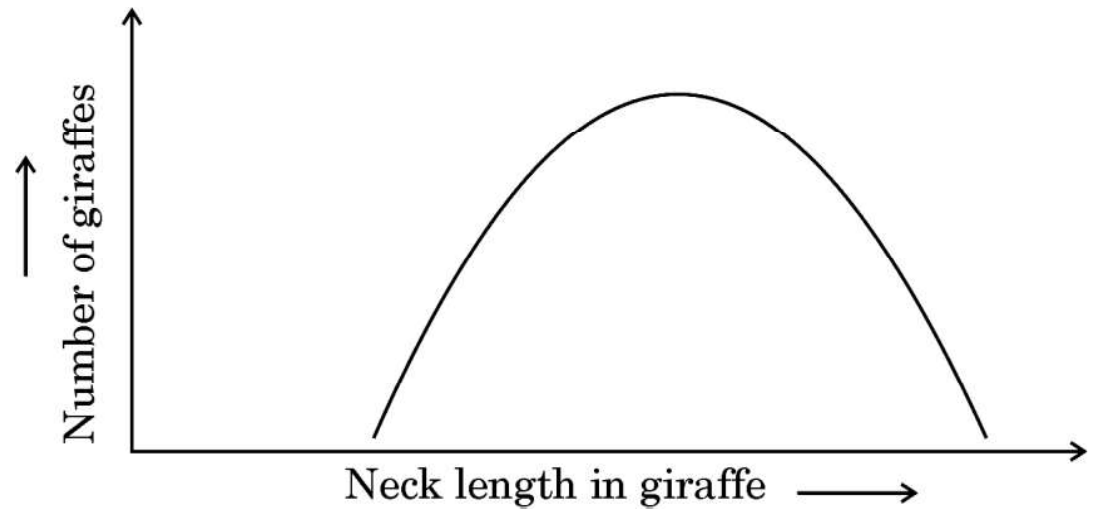
Solution
Answer: (d) (the marking scheme also accepts (c))
The graph shows a bell curve with most giraffes at the medium neck length, which is how stabilising selection is drawn. (Over evolutionary time, the increase in giraffe neck length is described as directional selection, hence (c) was also accepted.)
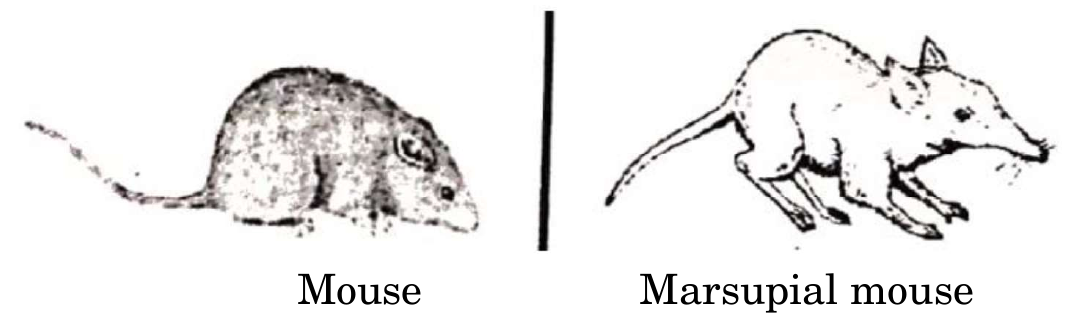
Identify the option that gives the correct type of evolution exhibited by the two animals shown, living in the same habitat in Australia.
Assertion (A) : The number of white winged moths decreased drastically after industrialisation in England.
Reason (R) : Effects of industrialisation were more marked in rural areas of England.
The theory of evolution supported by the experiment conducted by Louis Pasteur is
Mention one example each from plants and animals exhibiting divergent evolution.
What is 'Saltation' according to de Vries ?
Write the names of the following : (a) A 15 mya primate that was ape-like (b) A 2 mya primate that lived in East African grasslands
State two postulates of Oparin and Haldane with reference to origin of life.
Write the probable differences in eating habits of Homo habilis and Homo erectus.
2 marks: very short answer
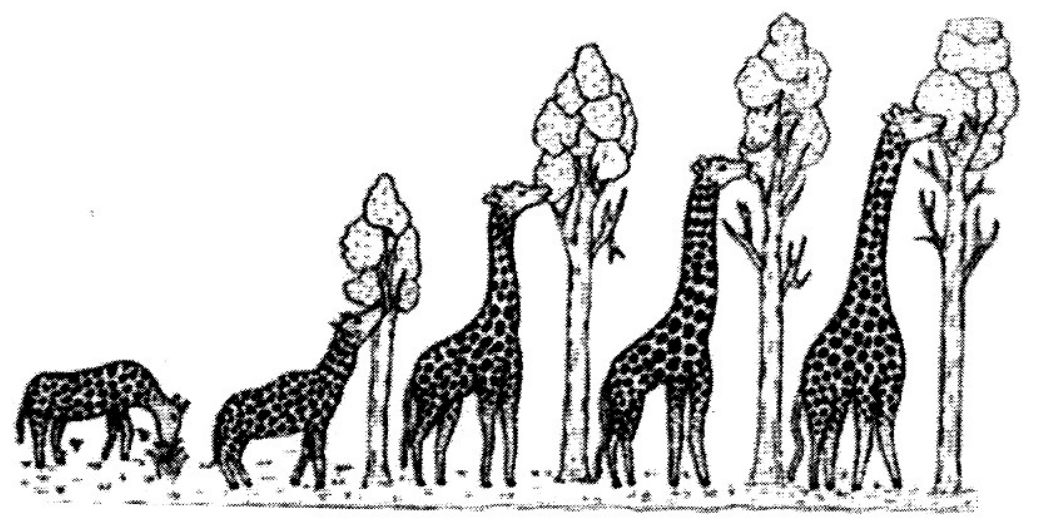
Observe the picture given below. Name the naturalist and write the explanation given by him that evolution of life forms had occurred on the basis of this example.
Solution
The naturalist is Lamarck. He said that evolution of life forms was driven by the use and disuse of organs.
Example: ancestors of giraffes, trying to forage leaves on tall trees, had to adapt by stretching and elongating their necks. They passed on this acquired character (elongated neck) to their succeeding generations, and over the years all giraffes came to have long necks. (Inheritance of acquired characters.)
Wings of birds and wings of butterflies contribute to locomotion. Explain the type of evolution such organs are a result of.
Solution
The wings of birds and of butterflies are not anatomically similar, but they perform the same function (flight). They are analogous organs.
They are the result of convergent evolution: different groups living in similar habitats were selected for similar adaptive features (wings) for the same function.
(a) Identify any two marsupials from the list given below : (i) Lemur (ii) Spotted cuscus (iii) Flying phalanger (iv) Bobcat (v) Tasmanian wolf (vi) Mole
(b) "Australian marsupials exhibit adaptive radiation." Justify the statement.
With the help of an algebraic equation, how did Hardy-Weinberg explain that in a given population the frequency of occurrence of alleles of a gene is supposed to remain the same through generations ?
3 marks: short answer
(a) How is Hardy-Weinberg expression () derived ?
(b) List any two factors that disturb the genetic equilibrium.
Solution
(a) In a population, the frequencies of the alleles of a gene stay constant across generations, and their sum is 1. Let alleles A and a have frequencies p and q, so p + q = 1.
The chance that allele A is present on both homologous chromosomes of a diploid individual is p × p = p², the frequency of AA. Similarly aa = q², and Aa = 2pq (A from the father and a from the mother, or the reverse).
So .
(b) Any two: gene migration (gene flow), genetic drift, mutation, genetic recombination, natural selection.
S.L. Miller conducted an experiment in 1953 to simulate the conditions of early earth in a laboratory setup. Answer the following questions based on the experiment :
(a) What was the aim of his experiment ?
(b) Name the gases used and the source of energy.
Solution
(a) To show that the first organic molecules could form spontaneously from inorganic ones, so that life was preceded by chemical evolution (testing the Oparin–Haldane hypothesis). He obtained amino acids.
(b) Gases: CH4, H2, NH3 and water vapour, in a closed flask at 800 °C.
Energy source: electric discharge (sparks).
(a) Explain the significance of the experiment carried out by S.L. Miller. Name the scientists whose hypothesis prompted him to carry out this experiment.
(b) How does meteorite analysis favour this hypothesis ?
Solution
(a) In 1953, Miller created early-earth conditions on a laboratory scale: a closed flask containing CH4, H2, NH3 and water vapour at 800 °C, with electric discharge as the energy source. He observed the formation of amino acids. This supported the theory that the first organic molecules formed from inorganic molecules, so life was preceded by chemical evolution.
The hypothesis was that of Oparin (Russia) and Haldane (England).
(b) Analysis of meteorite content revealed similar organic compounds, showing that similar processes are occurring elsewhere in space.
(a) Name the two primate ancestors of the present day humans, who existed approximately about 15 million years ago.
(b) According to geological records, when and where did Australopithecines live ?
(c) Give two differences between Homo habilis and Homo erectus.
Solution
(a) Dryopithecus and Ramapithecus.
(b) About 2 million years ago, in the East African grasslands.
(c)
| Homo habilis | Homo erectus |
|---|---|
| Brain capacity 650–800 cc | Brain capacity about 900 cc |
| Probably did not eat meat | Probably ate meat |
| About 2 million years ago | About 1.5 million years ago |
(a) Darwin's theory of Natural Selection is widely accepted but some limitations have been identified by modern biologists. Mention the limitations identified.
(b) Name and state the most accepted theory of evolution in modern times.
(c) Mention any two ways the limitations identified in Darwin's theory of evolution are explained in modern biology.
Solution
(a) Darwin could not explain how variations arise and how they are inherited.
(b) The synthetic (modern) theory of evolution: origin of species is based on the interaction of genetic variation and natural selection (variation from mutation and recombination, plus gene flow, genetic drift, natural selection and isolation).
(c) Any two: mutations (Hugo de Vries; large, sudden variations); recombination during meiosis (crossing over); hybridisation; sexual reproduction.
Study the diagrammatic representation of S.L. Miller's experiment given below and answer the questions that follow :
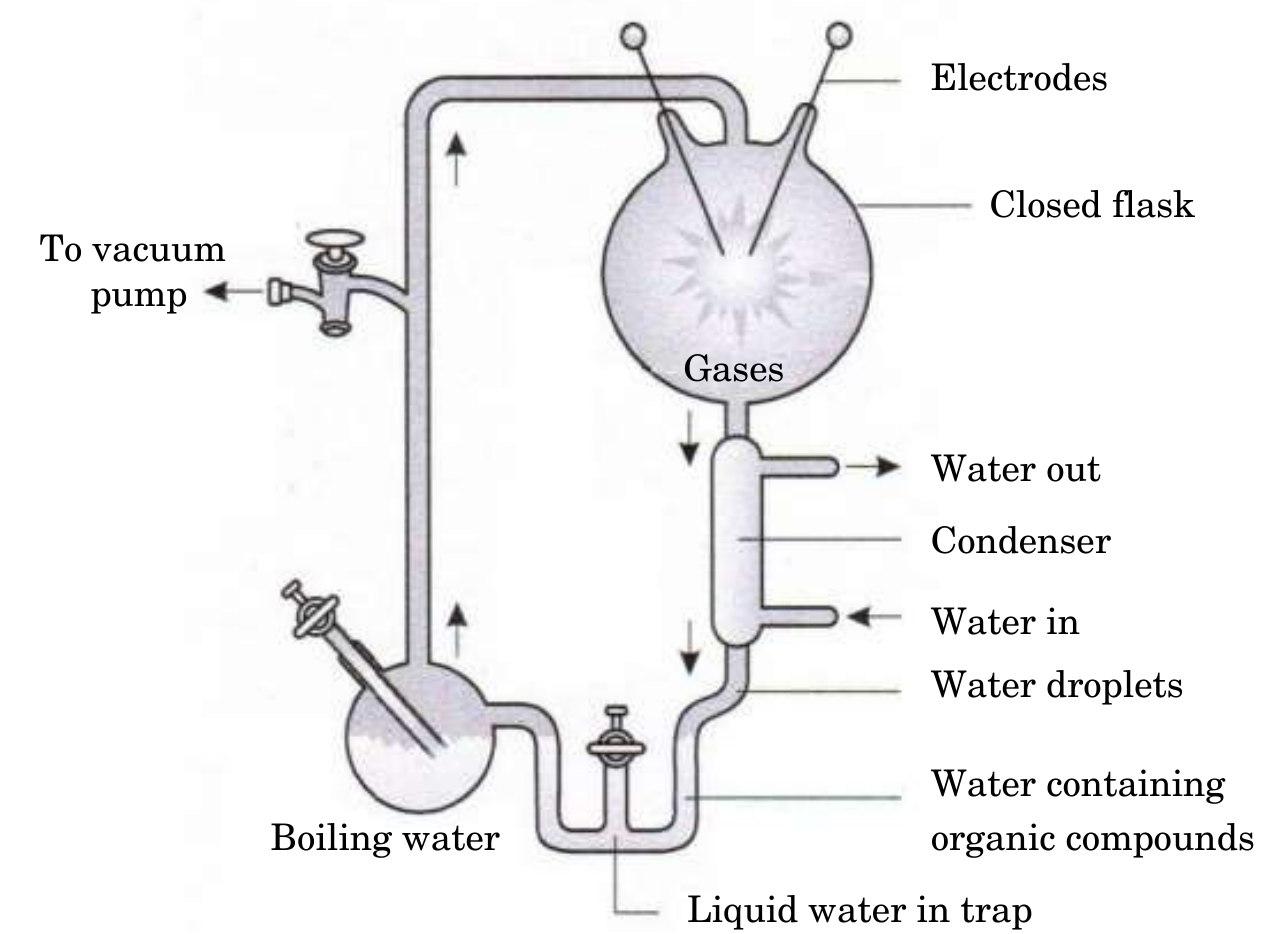
(a) How did S.L. Miller create the conditions which existed before the origin of any life on Earth ?
(b) Name the organic compound formed and collected at the end of his experiment.
(c) Mention the kind of evolution his experiment supports.
Solution
(a) The early earth had high temperatures, volcanic storms and a reducing atmosphere of CH4, NH3, etc. Miller created these conditions in a closed flask containing CH4, H2, NH3 and water vapour at 800 °C, with electric discharge from electrodes as the energy source.
(b) Amino acids.
(c) Chemical evolution (the origin of the first organic molecules from inorganic ones).
According to Darwinian theory of natural selection the rate of appearance of new forms is linked to the life-cycle or the life-span of an organism. Explain with the help of an example.
"Appearance of melanised moths post-industrialisation in England is a classic example of evolution by natural selection." Explain.
(a) Differentiate between analogous and homologous structures.
(b) Select and write analogous structures from the list given below : (i) Wings of butterfly and birds (ii) Vertebrate hearts (iii) Tendrils of bougainvillea and cucurbita (iv) Tubers of sweet potato and potato
Write the characteristics of Ramapithecus, Dryopithecus and Neanderthal man.
Differentiate between homology and analogy. Give one example of each.
4 marks: case-based / source-based
The most convincing evidence to trace evolutionary relationships between humans and different groups of animals come from the basic similarities seen at the molecular level. Study the table given below that depicts the number of amino acid differences between the haemoglobin polypeptide of few animals with that of humans and answer the questions that follow.
| S.No. | Animal | No. of amino acid differences in haemoglobin with that of humans |
|---|---|---|
| 1. | Macaque | 08 |
| 2. | Dog | 32 |
| 3. | Bird | 45 |
| 4. | Frog | 67 |
| 5. | Lamprey | 125 |
(a) To which category of evolution (Divergent or Convergent) do the following evolutionary relationships belong to : (i) Humans and Macaque (ii) Humans and Frog (1)
(b) What do the biochemical similarities in haemoglobin suggest about the evolutionary relationship between humans, frog and lamprey ? (1)
(c) (i) Which one of the two – lampreys' or macaques' evolution is more closely related to humans and why ? (2)
OR
(c) (ii) Which one of the two – frogs' or dogs' evolution is more closely related to humans and why ? (2)
Solution
(a) (i) Humans and macaque: divergent evolution. (ii) Humans and frog: divergent evolution. (Both pairs have the same haemoglobin, inherited from a common ancestor and modified.)
(b) Similar haemoglobin in all of them suggests a common ancestry. The differences grew as the lines diverged.
(c) (i) The macaque. Its haemoglobin differs from human haemoglobin by only 8 amino acids, against 125 for the lamprey. Fewer differences mean a more recent common ancestor.
OR (c) (ii) The dog. Its haemoglobin differs from human haemoglobin by 32 amino acids, against 67 for the frog, so it shares more biochemical similarity with humans.
Highly conserved proteins such as Haemoglobin and Cytochrome-C provide the best biochemical evidences to trace evolutionary relationships between different groups. Cytochrome-C is formed of 104 amino acids. Cytochrome-C is the respiratory pigment present in all eukaryotic cells. It has evolved at a constant rate during evolution. In chimpanzees and humans, Cytochrome-C genes are identical. The given data shows the evolution of the Cytochrome-C gene in different mammals from kangaroos, cows, rodents to humans :
| Groups | Nucleotide substitution in the gene of Cytochrome-C | Millions of years ago |
|---|---|---|
| Human/Kangaroo | 100 | 125 mya |
| Human/Cow | 75 | 120 mya |
| Human/Rodent | 60 | 75 mya |
(a) Select the correct option for the time of separation of two groups and the number of nucleotide substitutions in the gene of Cytochrome-C : (i) Lesser – Greater (ii) Greater – Lesser (iii) Greater – Greater (1)
(b) What do you infer about the type of evolution (convergent or divergent) for the given pair of groups and why ? (i) Human and Kangaroo (ii) Human and Rodent (1)
(c) (i) Define convergent evolution. (2)
OR
(c) (ii) Define divergent evolution. (2)
Solution
(a) (iii) Greater – Greater: the earlier two groups separated, the more nucleotide substitutions have built up (Human/Kangaroo: 125 mya, 100 substitutions; Human/Rodent: 75 mya, 60).
(b) (i) and (ii) are both divergent evolution. Both pairs have the same respiratory pigment, cytochrome c, inherited from a common ancestor and changed gradually over time.
(c) (i) Convergent evolution: different structures, not of common origin, evolve for the same function and so look similar (analogous organs), e.g. wings of a butterfly and of a bird; Australian marsupials and placental mammals that look alike.
OR (c) (ii) Divergent evolution: the same basic structure, inherited from a common ancestor, develops along different directions as adaptations to different needs (homologous organs), e.g. forelimbs of whale, bat, cheetah and human.
5 marks: long answer
(a) Describe the observations made on collection of white winged moths and dark winged moths in England between the years 1850 and 1920. What did these observations lead to ?
(b) How is the use of herbicides, pesticides and antibiotics by humans for various purposes, comparable with the observations made on moths in the above question ? What is this type of phenomenon called ?
Solution
(a) • Collections made before industrialisation (around 1850) had more white-winged moths than dark-winged ones. Collections made after industrialisation (around 1920) had more dark-winged (melanised) moths.
• Before industrialisation, tree trunks were covered with light-coloured lichens. White moths were camouflaged against them, while dark moths were picked out by predators.
• After industrialisation, the tree trunks became dark with industrial smoke and soot (and lichens died). Now the white moths were picked out by predators and the dark moths survived.
• These observations showed that the organisms better adapted to the environment survive and increase in number, i.e. natural selection.
(b) Excessive use of herbicides, pesticides and antibiotics has similarly selected resistant varieties of weeds, pests and microbes, in a much shorter time scale (months or years, not centuries).
This is evolution by anthropogenic action (human-caused natural selection).
Describe S.L. Miller's experiment. Comment on the observations he made and his contribution towards the origin of life on Earth.
Solution
• In 1953, Miller created conditions like those on the early earth on a laboratory scale: high temperature (800 °C), high-energy radiation and a reducing atmosphere.
• He used a closed flask containing CH4, H2, NH3 and water vapour, and created an electric discharge through it with electrodes.
• Water was boiled in another flask to circulate vapour, and a condenser cooled the gases so that water with any compounds formed collected in a trap.
Observations: after about a week, amino acids were formed. (Others later found sugars, nitrogen bases, pigments and fats.)
Contribution: the experiment supported the Oparin–Haldane hypothesis that the first organic molecules formed from inorganic ones, i.e. chemical evolution, and that the first form of life arose slowly through evolutionary forces from non-living molecules.
Get every solution for all chapters
- Every board question of every chapter, each fully solved the way the board gives marks
- 19 complete board papers, each followed by its solutions
- Weightage and most-asked topics for every chapter
- Instant PDF download, colour and black & white print copies
Revising the chapter first? Complete Biology Notes for Class 12 (NCERT 2026-27, CBSE Board 2027) →
What you get in the pack
- Questions from 122 CBSE papers, 2016 to 2026: every set code available
- Complete: 2114 different questions and parts from all set codes, 13 chapters and 19 full papers
- Part A: all 13 chapters, questions sorted chapter-wise and by marks
- Year-wise weightage table and most-asked topics for every chapter
- Part B: 19 full board papers, each followed by its complete solutions
- Labelled diagrams, Punnett squares, crosses and flow charts drawn in full
- Questions on topics out of the board syllabus flagged
All chapters in this pack
- PYQ Ch 1 Sexual Reproduction in Flowering Plants
- PYQ Ch 2 Human Reproduction
- PYQ Ch 3 Reproductive Health
- PYQ Ch 4 Principles of Inheritance and Variation
- PYQ Ch 5 Molecular Basis of Inheritance
- PYQ Ch 6 Evolution
- PYQ Ch 7 Human Health and Disease
- PYQ Ch 8 Microbes in Human Welfare
- PYQ Ch 9 Biotechnology: Principles and Processes
- PYQ Ch 10 Biotechnology and its Applications
- PYQ Ch 11 Organisms and Populations
- PYQ Ch 12 Ecosystem
- PYQ Ch 13 Biodiversity and Conservation
- Board Paper 2026 Set 57-1-1 with Solutions
- Board Paper 2026 Set 57-1-2 with Solutions
- Board Paper 2026 Set 57-1-3 with Solutions
- Board Paper 2026 Set 57-2-1 with Solutions
- Board Paper 2025 Set 57-4-1 with Solutions
- Board Paper 2025 Set 57-5-1 with Solutions
- Board Paper 2024 Set 57-1-1 with Solutions
- Board Paper 2024 Set 57-2-1 with Solutions
- Board Paper 2023 Set 57-1-1 with Solutions
- Board Paper 2023 Set 57-3-1 with Solutions
- Board Paper 2022 Term 2 Set 57-2-1 with Solutions
- Board Paper 2022 Term 2 Set 57-4-1 with Solutions
- Board Paper 2020 Set 57-1-1 with Solutions
- Board Paper 2020 Set 57-2-1 with Solutions
- Board Paper 2019 Set 57-2-1 with Solutions
- Board Paper 2019 Set 57-3-1 with Solutions
- Board Paper 2018 Set 57-1 with Solutions
- Board Paper 2017 Set 57-1 with Solutions
- Board Paper 2016 Set 57-1 with Solutions