
Reproductive Health: Class 12 PYQs 2016–2026 with solutions
All 26 CBSE board questions asked from Reproductive Health in 14 board papers, with the year, set and marks of each. 15 are solved free below. The Class 12 Biology PYQ Book: Solved Board Papers 2016-2026 (CBSE) has every solution, all chapters and 19 full board papers.
Subject experts: Divya Harwani (B.Sc. Biotechnology, M.Sc. Biotechnology) and Jayant Sharma (B.Sc., B.Ed.)



Free: NCERT solutions for Class 12 Biology →
Reproductive Health: board weightage
Board weightage 2016–2026
| Year | 2016 | 2017 | 2018 | 2019 | 2020 | 2022 | 2023 | 2024 | 2025 | 2026 |
|---|---|---|---|---|---|---|---|---|---|---|
| Questions | 2 | 1 | – | 2 | 2 | – | 4 | 6 | 6 | 3 |
| Marks | 7 | 4 | – | 4 | 10 | – | 8 | 12 | 10 | 9 |
Most asked topics
26 questions from 14 papers. Repeated questions are shown once with every year they were asked.
Jump to: 1 mark2 marks3 marks4 marks5 marks
1 mark: MCQ and Assertion–Reason
How many of the following features are related to Nirodh – a popular brand of condoms ?
(i) Prevention of sexually transmitted infections.
(ii) Phagocytosis of sperms.
(iii) Male contraceptive device.
(iv) Acts as chemical barrier.
(v) Physiological changes in cervical mucus.
Solution
Answer: (B) (i) and (iii)
Nirodh is a condom for males. It is a physical (not chemical) barrier, and it also protects against STIs. Phagocytosis of sperms is caused by IUDs, and changes in cervical mucus by hormonal methods.
Assertion (A) : 'Saheli', an oral contraceptive inhibits ovulation and increases phagocytosis of sperms.
Reason (R) : It is a non-steroidal preparation.
Solution
Answer: (D) A is false but R is true.
Saheli is a once-a-week non-steroidal pill. Increasing phagocytosis of sperms in the uterus is how IUDs work, not oral pills.
Assertion (A) : Cu-T, Cu-7 and LNG-20 are the most widely used copper-releasing IUDs.
Reason (R) : Cu-ions in IUDs effectively suppress sperm motility and the fertilising capacity of sperms.
Solution
Answer: (D) A is false but R is true.
LNG-20 is a hormone-releasing IUD. The copper-releasing IUDs are CuT, Cu7 and Multiload 375.
The periodic abstinence by a couple for family planning should be from :
Solution
Answer: (C) Day 10 to 17
Ovulation is expected around day 14, so days 10 to 17 are the fertile period, when the chance of fertilisation is very high.
Assertion (A) : The laws of our country permit legal adoption and it is as yet, one of the best methods for childless couples looking for parenthood.
Reason (R) : Emotional, religious and social factors are no deterrents to the legal adoption of orphaned and destitute children in India.
Given below are two columns. In Column I the names of four contraceptive devices are given and in Column II the modes of action of the contraceptives are given. Select the option where the contraceptive devices are correctly matched with their respective modes of action.
| Column I (Contraceptive devices) | Column II (Modes of action) |
|---|---|
| P. Lippes loop | i. Inhibition of ovulation |
| Q. Multiload 375 | ii. Phagocytosis of sperms in uterus |
| R. Subcutaneous Norplant | iii. Causes thickening of cervical mucous |
| S. Saheli | iv. Makes cervix hostile to sperms |
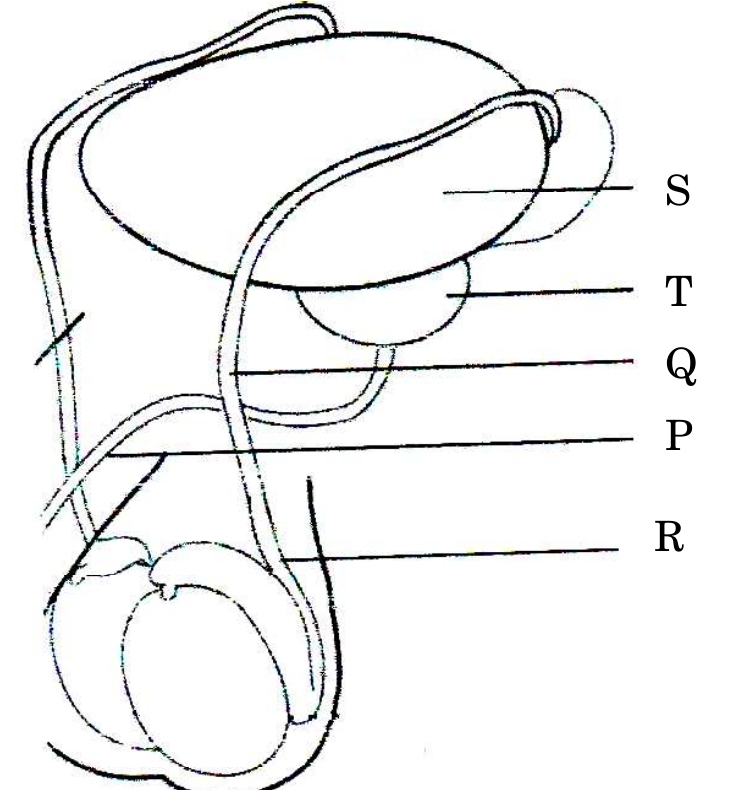
A human male decides to adopt a surgical method for contraception. Identify the point in the diagram where a cut would be made and tied.
Give one reason to justify statutory ban on amniocentesis.
2 marks: very short answer
Explain what is meant by the term MTP. What was the main reason to legalize MTP by the Government of India ?
Solution
MTP (medical termination of pregnancy) is the intentional or voluntary termination of pregnancy before full term (induced abortion).
India legalised MTP in 1971 with strict conditions, to stop its misuse (e.g. female foeticide) and illegal abortions. MTP is needed to end unwanted pregnancies due to casual unprotected intercourse, failure of the contraceptive used, or rape. It is also needed when continuing the pregnancy would be harmful or fatal to the mother, the foetus or both.
Name any two STIs which might occur in a human female. State its two early symptoms.
Solution
STIs (any two): gonorrhoea, syphilis, genital herpes, chlamydiasis, genital warts, trichomoniasis, hepatitis-B, HIV (AIDS).
Early symptoms (any two): itching, fluid discharge, slight pain, swellings in the genital region.
Explain what is meant by the term amniocentesis. How is this technique misused in India ?
Solution
Amniocentesis is a foetal sex-determination and disorder test. Some of the amniotic fluid of the developing foetus is taken out, and the foetal cells and dissolved substances in it are analysed for chromosomal and genetic disorders.
Misuse: it is used to find the sex of the foetus, and a female foetus is then aborted (female foeticide). That is why there is a statutory ban on its use for sex determination.
Name any two VDs which might occur in a human female. State any two complications in a female if it is left untreated.
Write the basic steps followed in the Assisted Reproductive Technologies (ART) programme to help childless couples. Why is it also known as test tube baby programme ?
Name any two copper releasing intra-uterine devices. State two reasons that make them effective contraceptives.
3 marks: short answer
Study the diagram given below :
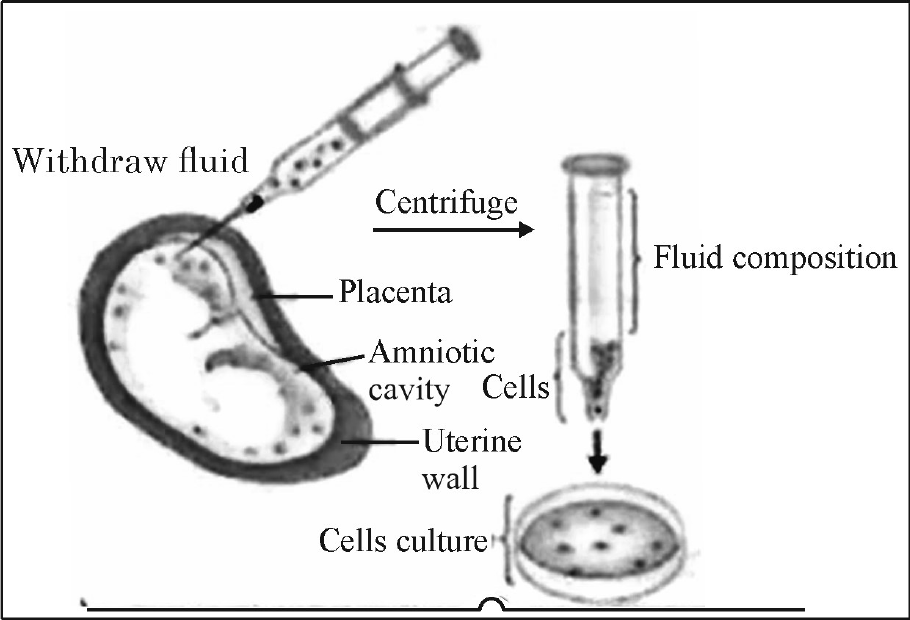
(a) Name and explain the procedure shown in the diagram. Mention one of its advantage and one disadvantage.
(b) How is 'Saheli' different from other oral pills in terms of its composition and advantage ?
Solution
(a) Amniocentesis. Some amniotic fluid around the developing foetus is withdrawn with a needle. The foetal cells and dissolved substances in it are then analysed (after centrifuging and culturing the cells).
Advantage: it detects genetic disorders such as Down's syndrome, haemophilia or sickle-cell anaemia, and tells whether the foetus will survive.
Disadvantage: it is misused to find the sex of the foetus, which can lead to female foeticide (so it is banned for sex determination).
(b) Saheli is a non-steroidal pill (other pills contain steroid hormones, progestogens or progestogen–estrogen). It is taken once a week, has very few side effects and high contraceptive value.
Explain the mode of action of contraceptive pills taken by human females. Mention the schedule to be followed for effective outcome.
Solution
• Oral pills contain small doses of progestogens or a progestogen–estrogen combination.
• They inhibit ovulation and implantation, and alter the quality of cervical mucus to prevent or retard the entry of sperms.
• Schedule: the pills are taken daily for 21 days, starting within the first five days of the menstrual cycle. After a gap of 7 days (during which menstruation occurs), they are repeated in the same pattern as long as the female wants to prevent conception.
(a) Why is "in vitro fertilization (IVF)" so named ? State its importance.
(b) Distinguish between GIFT and ZIFT.
Solution
(a) In IVF, fertilisation takes place outside the body ("in vitro" means "in glass"), in the laboratory, under conditions similar to those in the body.
Importance: it helps infertile couples to have children (parenthood) when natural fertilisation is not possible.
(b)
| GIFT | ZIFT |
|---|---|
| Gamete intra-fallopian transfer | Zygote intra-fallopian transfer |
| An ovum collected from a donor is transferred into the fallopian tube of a female who cannot produce one but can provide suitable conditions for fertilisation | A zygote or early embryo (up to 8 blastomeres), formed by IVF, is transferred into the fallopian tube |
| Fertilisation happens inside the body (in vivo) | Fertilisation happens outside the body (in vitro) |
(i) Expand the abbreviations given below, used for different modes of assisted reproductive technologies : (1) ZIFT (2) ICSI (3) IUT (4) GIFT
(ii) Which one of them cannot be considered as a procedure of IVF ? Give reasons in support of your answer.
Solution
(i) (1) ZIFT – Zygote Intra-Fallopian Transfer; (2) ICSI – Intra-Cytoplasmic Sperm Injection; (3) IUT – Intra-Uterine Transfer; (4) GIFT – Gamete Intra-Fallopian Transfer.
(ii) GIFT. In GIFT, the ovum (gamete) itself is transferred into the fallopian tube, so fertilisation takes place inside the body (in vivo). In IVF, fertilisation happens outside the body.
Expand and explain the following techniques used in the 'Test Tube Baby' programme : (a) GIFT (b) ZIFT (c) IUI
(a) Name and explain the mode of action of any two types of IUDs.
(b) List the advantages of using 'Saheli' as a contraceptive.
(a) Mention the problems that are taken care of by Reproduction and Child Health Care programme.
(b) What is amniocentesis and why there is a statutory ban on it ?
4 marks: case-based / source-based
It is commonly observed that parents feel embarrassed to discuss freely with their adolescent children about sexuality and reproduction. The result of this parental inhibition is that the children go astray sometimes.
(a) Explain the reasons that you feel are behind such embarrassment amongst some parents to freely discuss such issues with their growing children.
(b) By taking one example of a local plant and animal, how would you help these parents to overcome such inhibitions about reproduction and sexuality ?
Solution
(a) Reasons (any two): social taboos and conservative attitudes that treat sex as an embarrassing subject; lack of proper scientific knowledge among parents; fear that talking about it will encourage children to experiment; generation gap and lack of friendly communication. As a result, children get wrong or misleading information from peers and the media.
(b) Reproduction is a natural biological process common to all living beings. Parents can explain it through familiar examples:
• Plant: a flower such as a mustard or hibiscus flower has male parts (stamens) and female parts (pistil). Pollen reaches the stigma and fertilises the egg, and the ovary becomes a fruit with seeds.
• Animal: in a cow or a hen, the male and female mate, and the young develop inside the mother (calf) or in an egg (chick).
Using such examples, parents can talk about changes during adolescence, reproductive health, STIs and contraception in a scientific and friendly way, so children get correct information and make responsible choices.
A large number of married couples the world over are childless. It is shocking to know that in India the female partner is often blamed for the couple being childless.
(a) Why in your opinion the female partner is often blamed for such situations in India ? Mention any two values that you as a biology student can promote to check this social evil.
(b) State any two reasons responsible for the cause of infertility.
(c) Suggest a technique that can help the couple to have a child where the problem is with the male partner.
Solution
(a) Reasons: a male-dominated social mindset, inequality of the sexes, and lack of awareness that infertility can be due to either partner.
Values (any two): spreading awareness that infertility can be due to abnormalities in either the male or the female; mutual respect between partners and seeking help from medical experts instead of quacks; not believing in superstitions and myths.
(b) Any two: physical (abnormalities of the reproductive system), congenital, immunological or psychological causes (also diseases, drugs).
(c) ICSI (intracytoplasmic sperm injection), artificial insemination (AI) or intra-uterine insemination (IUI): semen from the husband or a donor is introduced artificially into the vagina or uterus, used when the male cannot inseminate or has a very low sperm count.
5 marks: long answer
(i) Case studies of some couples are given below. They were not able to have kids even though the parents were not taking any precautions. They also do not wish to adopt a child or take the help of donors. Study these cases and suggest an appropriate Assisted Reproductive Technology that could help them.
Case I – Female – Normal Reports; Male – Normal sperms but no connection between epididymis and vas deferens.
Case II – Female – Normal eggs but Fallopian tube blocked. Male – Normal sperms. Male reports are normal.
Case III – Female – Normal Reports. Male – Low sperm count with less motility.
(ii) Copper releasing intrauterine devices are very effective and popular contraceptive devices. Name any two copper releasing IUDs. Write two reasons that make them effective contraceptives.
Solution
(i) Case I: the sperms cannot reach the ejaculate, so sperms are collected from the epididymis and used in IVF followed by embryo transfer (ZIFT/IUT) (or artificial insemination, IUI).
Case II: the eggs cannot reach the site of fertilisation, so IVF followed by intra-uterine transfer (IUT) of the embryo (with more than 8 blastomeres) into the uterus.
Case III: ICSI (intracytoplasmic sperm injection: a sperm is injected directly into the ovum), or artificial insemination (IUI) using the husband's semen collected and concentrated.
(ii) Copper-releasing IUDs: CuT, Cu7, Multiload 375 (any two).
Why effective:
• They increase phagocytosis of sperms within the uterus.
• The Cu ions released suppress sperm motility and the fertilising capacity of sperms.
(a) IVF is a very popular method these days that is helping childless couples to bear a child. Describe the different steps that are carried out in this technique.
(b) Would you consider Gamete Intrafallopian Transfer (GIFT) as an IVF ? Give a reason in support of your answer.
Solution
(a) • Ova from the wife or a donor (female) and sperms from the husband or a donor (male) are collected.
• They are induced to form a zygote under simulated conditions in the laboratory (in vitro fertilisation).
• The zygote or early embryo (up to 8 blastomeres) is transferred into the fallopian tube: ZIFT (zygote intra-fallopian transfer).
• Embryos with more than 8 blastomeres are transferred into the uterus: IUT (intra-uterine transfer), to complete further development.
• (Embryos formed by in vivo fertilisation in a female can also be transferred to assist women who cannot conceive.)
(b) No. In GIFT, the ovum is transferred into the fallopian tube of a female who cannot produce ova but can provide suitable conditions for fertilisation. Fertilisation takes place inside the female body (in vivo), not in vitro.
(a) IUDs are said to be effective contraceptives. Name any two commonly used IUDs and write the mode of their actions.
(b) When is sterilisation advised to married couples ? How is it carried out in a human male and a female, respectively?
Get every solution for all chapters
- Every board question of every chapter, each fully solved the way the board gives marks
- 19 complete board papers, each followed by its solutions
- Weightage and most-asked topics for every chapter
- Instant PDF download, colour and black & white print copies
Revising the chapter first? Complete Biology Notes for Class 12 (NCERT 2026-27, CBSE Board 2027) →
What you get in the pack
- Questions from 122 CBSE papers, 2016 to 2026: every set code available
- Complete: 2114 different questions and parts from all set codes, 13 chapters and 19 full papers
- Part A: all 13 chapters, questions sorted chapter-wise and by marks
- Year-wise weightage table and most-asked topics for every chapter
- Part B: 19 full board papers, each followed by its complete solutions
- Labelled diagrams, Punnett squares, crosses and flow charts drawn in full
- Questions on topics out of the board syllabus flagged
All chapters in this pack
- PYQ Ch 1 Sexual Reproduction in Flowering Plants
- PYQ Ch 2 Human Reproduction
- PYQ Ch 3 Reproductive Health
- PYQ Ch 4 Principles of Inheritance and Variation
- PYQ Ch 5 Molecular Basis of Inheritance
- PYQ Ch 6 Evolution
- PYQ Ch 7 Human Health and Disease
- PYQ Ch 8 Microbes in Human Welfare
- PYQ Ch 9 Biotechnology: Principles and Processes
- PYQ Ch 10 Biotechnology and its Applications
- PYQ Ch 11 Organisms and Populations
- PYQ Ch 12 Ecosystem
- PYQ Ch 13 Biodiversity and Conservation
- Board Paper 2026 Set 57-1-1 with Solutions
- Board Paper 2026 Set 57-1-2 with Solutions
- Board Paper 2026 Set 57-1-3 with Solutions
- Board Paper 2026 Set 57-2-1 with Solutions
- Board Paper 2025 Set 57-4-1 with Solutions
- Board Paper 2025 Set 57-5-1 with Solutions
- Board Paper 2024 Set 57-1-1 with Solutions
- Board Paper 2024 Set 57-2-1 with Solutions
- Board Paper 2023 Set 57-1-1 with Solutions
- Board Paper 2023 Set 57-3-1 with Solutions
- Board Paper 2022 Term 2 Set 57-2-1 with Solutions
- Board Paper 2022 Term 2 Set 57-4-1 with Solutions
- Board Paper 2020 Set 57-1-1 with Solutions
- Board Paper 2020 Set 57-2-1 with Solutions
- Board Paper 2019 Set 57-2-1 with Solutions
- Board Paper 2019 Set 57-3-1 with Solutions
- Board Paper 2018 Set 57-1 with Solutions
- Board Paper 2017 Set 57-1 with Solutions
- Board Paper 2016 Set 57-1 with Solutions