
Human Reproduction: Class 12 PYQs 2016–2026 with solutions
All 35 CBSE board questions asked from Human Reproduction in 15 board papers, with the year, set and marks of each. 19 are solved free below. The Class 12 Biology PYQ Book: Solved Board Papers 2016-2026 (CBSE) has every solution, all chapters and 19 full board papers.
Subject experts: Divya Harwani (B.Sc. Biotechnology, M.Sc. Biotechnology) and Jayant Sharma (B.Sc., B.Ed.)



Free: NCERT solutions for Class 12 Biology →
Human Reproduction: board weightage
Board weightage 2016–2026
| Year | 2016 | 2017 | 2018 | 2019 | 2020 | 2022 | 2023 | 2024 | 2025 | 2026 |
|---|---|---|---|---|---|---|---|---|---|---|
| Questions | 1 | 1 | 2 | 3 | 4 | – | 6 | 5 | 6 | 7 |
| Marks | 5 | 5 | 8 | 11 | 15 | – | 17 | 16 | 18 | 18 |
Most asked topics
35 questions from 15 papers. Repeated questions are shown once with every year they were asked.
Jump to: 1 mark2 marks3 marks4 marks5 marks
1 mark: MCQ and Assertion–Reason
Select the option that shows correct statements :
(i) Corpus luteum secretes progesterone.
(ii) Only FSH attains a peak level in middle of cycle.
(iii) LH surge induces rupture of graafian follicle.
(iv) Luteal phase of menstrual cycle is also called proliferative phase.
Solution
Answer: (B) (i) and (iii) are correct.
(ii) is wrong: both LH and FSH peak in mid-cycle. (iv) is wrong: the follicular phase is the proliferative phase, while the luteal phase is the secretory phase.
Which connective tissue connects ovary to pelvic wall and uterus ?
Solution
Answer: (B) Ligaments
Each ovary is held to the pelvic wall and uterus by ligaments.
Given below are a few statements with reference to the accessory ducts of the human male reproductive system :
(i) The seminiferous tubules of the testes open into rete testis then into the vas deferens.
(ii) The vasa efferentia leave the testes and open into the epididymis.
(iii) The epididymis leads to vas deferens that ascends into the abdomen.
(iv) The vas deferens receives a duct from the prostrate gland and opens into the urethra as ejaculatory duct.
(v) The urethra originates from the urinary bladder and extends through the penis to its external opening, urethral meatus.
Choose the option with all true statements from the given options :
Solution
Answer: (B) (ii), (iii), (v)
(i) is wrong: the seminiferous tubules open into the vasa efferentia through the rete testis. (iv) is wrong: the vas deferens receives a duct from the seminal vesicle, not the prostate.
Given below are few statements with reference to the uterus in the female reproductive system :
(i) The myometrium exhibits strong contractions during the delivery of the baby.
(ii) The uterus opens into the cervix through a narrow opening called vagina.
(iii) The cavity of the cervix and the vagina forms the birth canal.
(iv) The outermost layer of uterus is a thin membranous perimetrium.
(v) The uterus is supported by tendons attached to the pelvic wall.
Choose the option with all true statements from the given options :
Solution
Answer: (D) (i), (iii) and (iv)
(ii) is wrong: the uterus opens into the vagina through a narrow cervix. (v) is wrong: the uterus is supported by ligaments, not tendons.
Which one of the following hormones is secreted by the human placenta that helps in the maintenance of pregnancy ?
In humans, the secondary oocyte completes meiotic division when :
In which one of the following options does the endocrine gland correctly match with its hormonal secretion and its function ?
| Endocrine Gland | Hormone | Function | |
|---|---|---|---|
| (a) | Sertoli cells | Testosterone | Development of secondary sexual characteristics |
| (b) | Placenta | Estrogen | Initiates secretion of milk |
| (c) | Leydig cells | Androgen | Initiates the production of sperms |
| (d) | Ovary | FSH | Stimulates follicular development |
Which of the following options correctly matches the name of the hormone to its site of production in the human body ?
| Name of the Hormone | Site of Production |
|---|---|
| P. Oxytocin | i. Placenta |
| Q. Relaxin | ii. Corpus Luteum |
| R. hCG | iii. Pituitary Gland |
| S. Progesterone | iv. Ovaries |
2 marks: very short answer
Identify the stage of follicle where primary oocyte undergoes first meiotic division. Also mention the products of this division.
Solution
The primary oocyte completes its first meiotic division inside the tertiary follicle (as it matures into the Graafian follicle).
The products are a large haploid secondary oocyte and a tiny first polar body.
(i) Name the organ that forms a connection between foetus and the uterus of a pregnant human female.
(ii) How does it support both nutrition and hormonal regulation ?
Solution
(i) The placenta.
(ii) Nutrition: chorionic villi and uterine tissue interdigitate, so oxygen and nutrients pass from the mother's blood to the embryo, and CO2 and wastes pass back. The umbilical cord carries them to and from the embryo.
Hormonal regulation: the placenta is also an endocrine tissue. It produces hCG, hPL, estrogens and progestogens, which maintain the pregnancy.
Give reasons for :
(i) All copulations do not lead to pregnancy.
(ii) Meiosis I in spermatogenesis and oogenesis are markedly different.
Solution
(i) Fertilisation happens only if the ovum and the sperms reach the ampullary region at the same time. That is why not all copulations lead to fertilisation and pregnancy. (Other causes: no ovulation, low sperm count, use of contraceptives.)
(ii)
| Meiosis I in spermatogenesis | Meiosis I in oogenesis |
|---|---|
| Starts at puberty | Starts in the foetal stage and stays suspended (prophase I) until puberty |
| Equal division: two equal secondary spermatocytes | Unequal division: a large secondary oocyte and a tiny first polar body |
The diagram given below shows a developmental stage of human embryo. Answer the following questions with reference to it :
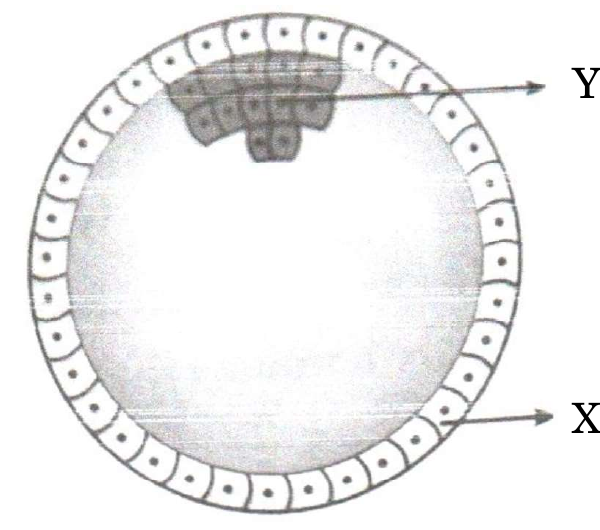
(a) Identify and name the human embryonic stage shown.
(b) Mention its exact location in the normal pregnancy of a woman.
(c) Write one function of each of the two parts labelled 'X' and 'Y'.
List the three hormones produced in women only during pregnancy. What happens to the levels of estrogen and progesterone during pregnancy ?
3 marks: short answer
Explain the process of formation of placenta in a human female after the implantation of the blastocyst in the endometrium of the uterus.
Solution
• After implantation, finger-like projections called chorionic villi appear on the trophoblast.
• The villi are surrounded by uterine tissue and maternal blood.
• The chorionic villi and the uterine tissue become interdigitated with each other.
• Together they form the placenta, a structural and functional unit between the developing embryo (foetus) and the maternal body.
• The placenta is connected to the embryo by the umbilical cord. It supplies oxygen and nutrients, removes CO2 and wastes, and also acts as an endocrine tissue (hCG, hPL, estrogens, progestogens).
Explain the neuroendocrine mechanism involved in the process of parturition in a human female leading to the expulsion of the baby out of the uterus through the birth canal.
Solution
• Parturition is induced by a complex neuroendocrine mechanism.
• The signals for parturition come from the fully developed foetus and the placenta. They induce mild uterine contractions called the foetal ejection reflex.
• This triggers the release of oxytocin from the maternal pituitary.
• Oxytocin acts on the uterine muscles and causes stronger uterine contractions, which in turn stimulate further secretion of oxytocin.
• This stimulatory reflex between uterine contraction and oxytocin secretion continues, giving stronger and stronger contractions.
• This leads to the expulsion of the baby out of the uterus through the birth canal. Soon after, the placenta is also expelled.
Given below is a diagrammatic sectional view of a seminiferous tubule.
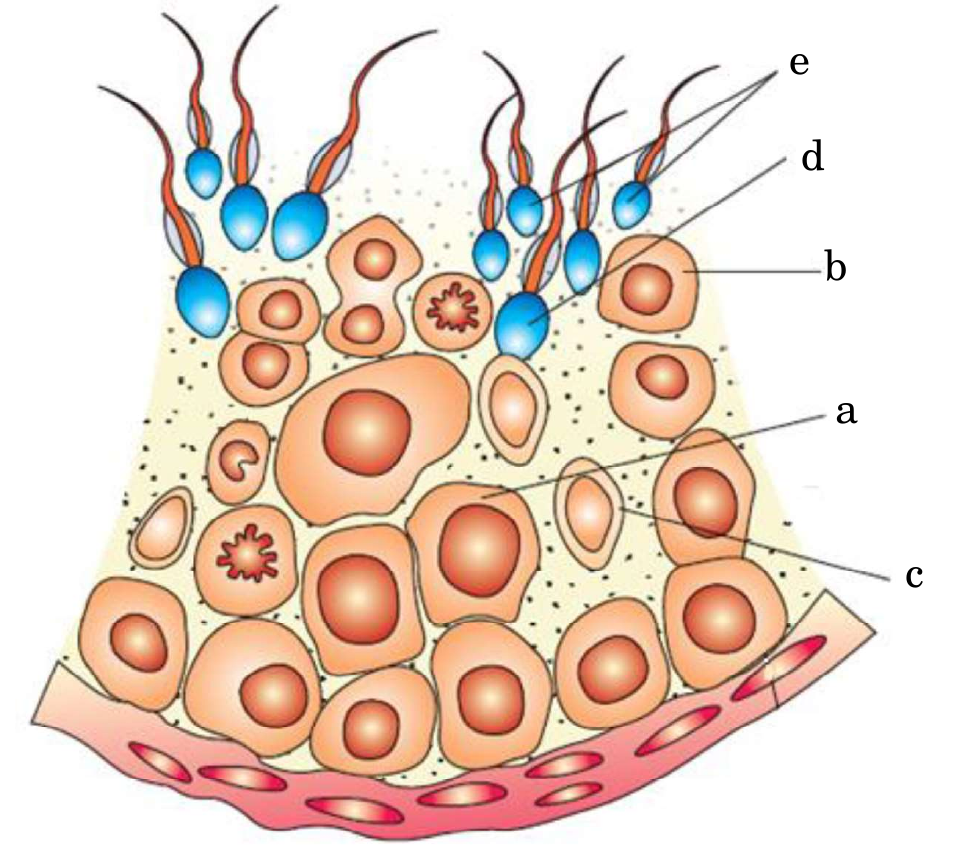
State the developmental process of : (a) (i) 'b' from 'a'. (ii) 'e' from 'd'. (iii) 'd' from 'b'.
(b) Identify 'a', 'b' and 'c'.
Solution
(a) (i) b (secondary spermatocyte) forms from a (primary spermatocyte) by the first meiotic division (meiosis I).
(ii) e (sperm) forms from d (spermatid) by spermiogenesis (differentiation).
(iii) d (spermatid) forms from b (secondary spermatocyte) by the second meiotic division (meiosis II).
(b) a – primary spermatocyte; b – secondary spermatocyte; c – Sertoli cell.
Study the given diagram : A is an embryonic stage that gets transformed into B, which in turn gets implanted in the endometrium in human females.
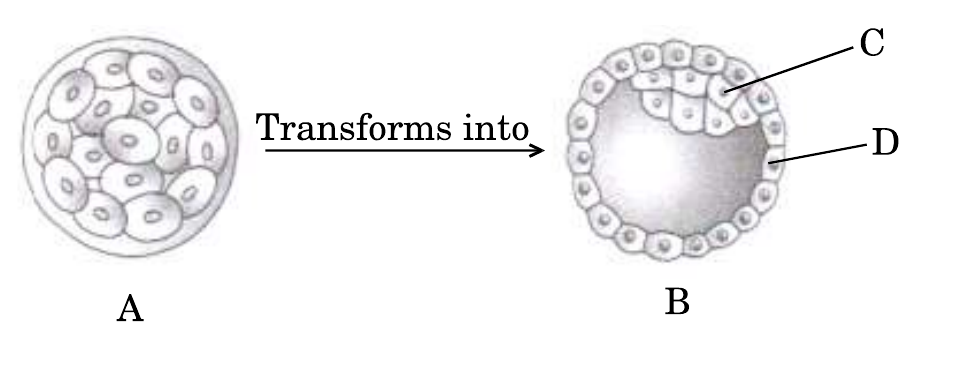
(a) Identify A, B and its parts C and D.
(b) State the fate of C and D in the course of embryonic development in humans.
Solution
(a) A – morula; B – blastocyst; C – inner cell mass (stem cells); D – trophoblast.
(b) C (inner cell mass) differentiates into the embryo, forming the three germ layers (ectoderm, mesoderm, endoderm). D (trophoblast) attaches to the endometrium for implantation, and forms the chorionic villi, which help form the placenta.
Construct a flow chart exhibiting sequential events of oogenesis.
Draw a diagrammatic sectional view of a seminiferous tubule (enlarged) in humans and label its parts.
Draw a diagram of a mature human sperm. Label any three parts and write their functions.
4 marks: case-based / source-based
Spermatogenesis is an important primary sex characteristic in humans and all other vertebrates. The process is coordinated and controlled under the influence of hormones. It starts with the onset of puberty in humans and thereafter continues. The primordial cells within the embryonic testis which differentiate into spermatogonia are the precursors of the sperms. These are located at the outer walls of the seminiferous tubules where the process of spermatogenesis proceeds.
(a) State the site of action of FSH in the testes and describe its action thereafter. (2)
OR
(a) Describe the role of LH in the process of spermatogenesis. (2)
(b) Name the cells and their products which undergo : (i) Mitosis and Differentiation (ii) Meiosis I and Meiosis II during the process of spermatogenesis. (1)
(c) Name the accessory ducts that the sperms travel through from seminiferous tubules to reach the epididymis. (1)
Solution
(a) FSH acts on the Sertoli cells of the seminiferous tubules. It stimulates the secretion of some factors that help in spermiogenesis (the change of spermatids into sperms).
OR (a) LH acts on the Leydig cells (interstitial cells). It stimulates the synthesis and secretion of androgens, which in turn stimulate spermatogenesis.
(b) (i) Spermatogonia (2n) → by mitosis and differentiation → primary spermatocytes (2n).
(ii) Primary spermatocyte → meiosis I → two secondary spermatocytes (n) → meiosis II → four spermatids (n).
(c) Rete testis and vasa efferentia.
5 marks: long answer
Trace the events from fertilization till implantation of blastocyst in human female. Also mention the site where fertilization takes place.
Solution
Site: the ampullary region of the fallopian tube (ampullary–isthmic junction).
1. A sperm contacts the zona pellucida of the secondary oocyte. This changes the membrane, which blocks the entry of other sperms.
2. Entry of the sperm makes the secondary oocyte complete meiosis II, giving a haploid ovum (ootid) and a second polar body.
3. The haploid nuclei of the sperm and the ovum fuse to form a diploid zygote.
4. The zygote divides by mitosis (cleavage) while moving through the isthmus of the oviduct towards the uterus, forming 2, 4, 8, 16 daughter cells called blastomeres.
5. The embryo with 8 to 16 blastomeres is the morula.
6. The morula keeps dividing and becomes the blastocyst. Its blastomeres are arranged into an outer layer, the trophoblast, and an inner cell mass.
7. The trophoblast layer attaches to the endometrium; the inner cell mass later forms the embryo.
8. The uterine cells then divide rapidly and cover the blastocyst, which becomes embedded in the endometrium. This is implantation, and it leads to pregnancy.
(i) Explain menstrual phase in the menstrual cycle of human female.
(ii) Why is follicular phase also called proliferative phase ?
(iii) Explain the events that occur in Graafian follicle at the time of ovulation and thereafter.
(iv) Draw a Graafian follicle and label – Antrum and secondary oocyte.
Solution
(i) Menstrual phase: if the released ovum is not fertilised, the endometrial lining of the uterus and its blood vessels break down. They form a liquid that comes out through the vagina. The flow lasts for 3–5 days.
(ii) In the follicular phase, the endometrium of the uterus regenerates by proliferation under the influence of estrogens from the growing follicles, hence the name proliferative phase.
(iii) In mid-cycle (about day 14), the LH surge makes the Graafian follicle rupture and release the secondary oocyte (ovulation). After ovulation, the remaining part of the follicle changes into the corpus luteum. The corpus luteum secretes large amounts of progesterone, which maintains the endometrium.
(iv) 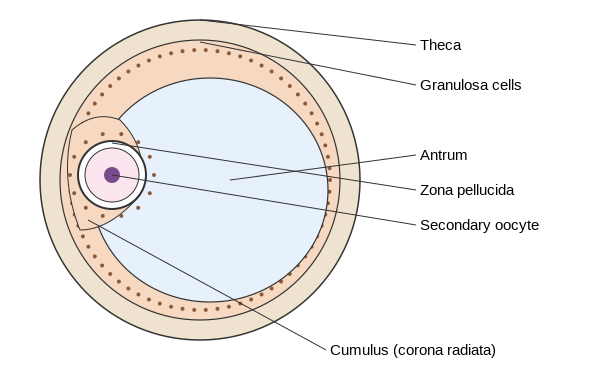
(i) Explain the structure of testicular lobules in human male reproductive system. Name the two types of cells present in the seminiferous tubules and state their role.
(ii) Describe the role of hypothalamic hormone GnRH in spermatogenesis.
Solution
(i) Each testis has about 250 compartments called testicular lobules. Each lobule contains one to three highly coiled seminiferous tubules, in which sperms are produced.
The tubules are lined by two types of cells:
• Male germ cells (spermatogonia): they undergo meiotic divisions, finally leading to sperm formation.
• Sertoli cells: they provide nutrition to the germ cells.
(The interstitial spaces outside the tubules have Leydig cells, which secrete androgens.)
(ii) Spermatogenesis starts at puberty because of a rise in GnRH secreted by the hypothalamus. GnRH acts on the anterior pituitary and stimulates secretion of two gonadotropins:
• LH acts on the Leydig cells and stimulates synthesis and secretion of androgens, which stimulate spermatogenesis.
• FSH acts on the Sertoli cells and stimulates secretion of factors that help in spermiogenesis.
(i) Name and explain the structural organisation of the male sex accessory ducts in the human male reproductive system.
(ii) Describe the role of gonadotropin FSH in the regulation of spermatogenesis.
Solution
(i) The male sex accessory ducts are the rete testis, vasa efferentia, epididymis and vas deferens.
• Rete testis: the seminiferous tubules of the testis open into the vasa efferentia through the rete testis.
• Vasa efferentia: they leave the testis and open into the epididymis.
• Epididymis: it lies along the posterior surface of each testis and leads to the vas deferens.
• Vas deferens: it ascends into the abdomen and loops over the urinary bladder. It receives a duct from the seminal vesicle and opens into the urethra as the ejaculatory duct.
These ducts store and transport the sperms from the testis to the outside through the urethra.
(ii) FSH (from the anterior pituitary, under GnRH control) acts on the Sertoli cells. It stimulates secretion of some factors that help in spermiogenesis, the change of spermatids into sperms (a part of spermatogenesis).
(i) Draw a diagrammatic sectional view of ovary of human female and label the following : (1) Blood vessels (2) Primary follicle (3) Tertiary follicle (4) Ovum
(ii) At which stage of life are primary follicles formed in a human female ?
(iii) Explain the events (both hormonal and structural) that occur at the time of ovulation till the onset of the next menstrual cycle.
Solution
(i) 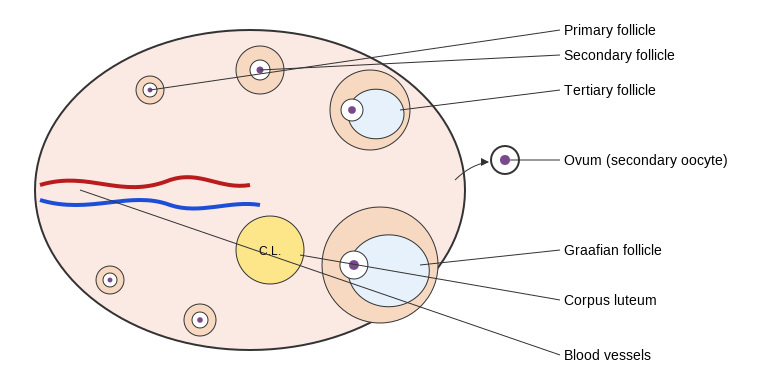
(ii) During the embryonic (foetal) stage. Oogenesis starts then, and the primary oocytes get surrounded by granulosa cells to form primary follicles.
(iii) • In mid-cycle, both LH and FSH reach a peak. The rapid secretion of LH to its maximum is the LH surge.
• The LH surge induces rupture of the Graafian follicle and release of the secondary oocyte (ovulation, about day 14).
• The ovulatory phase is followed by the luteal phase, in which the remaining parts of the Graafian follicle change into the corpus luteum.
• The corpus luteum secretes large amounts of progesterone, which maintains the endometrium for implantation.
• If fertilisation does not occur, the corpus luteum degenerates. Progesterone falls, the endometrium disintegrates, and menstruation marks a new cycle.
(i) Mention the site where fertilisation of the ovum occurs in a human female. Explain the process of fertilization and mention how polyspermy is prevented.
(ii) Name the embryonic stage that gets implanted in the uterus. Explain the process of implantation in a human female.
Solution
(i) Site: the ampullary region (ampullary–isthmic junction) of the fallopian tube.
• A sperm comes in contact with the zona pellucida of the ovum. The secretions of the acrosome help the sperm to enter the cytoplasm of the ovum.
• This induces the secondary oocyte to complete meiosis II, forming the haploid ovum (ootid) and a second polar body.
• The haploid nuclei of the sperm and the ovum fuse to form the diploid zygote.
Polyspermy: contact of the sperm with the zona pellucida induces changes in the membrane that block the entry of additional sperms.
(ii) The blastocyst is implanted.
• Its outer layer, the trophoblast, gets attached to the endometrium; the inner cell mass differentiates into the embryo.
• After attachment, the uterine cells divide rapidly and cover the blastocyst, so it becomes embedded in the endometrium of the uterus. This is implantation, and it leads to pregnancy.
Observe the diagram given below showing the menstrual cycle of a normal human female and answer the questions that follow :
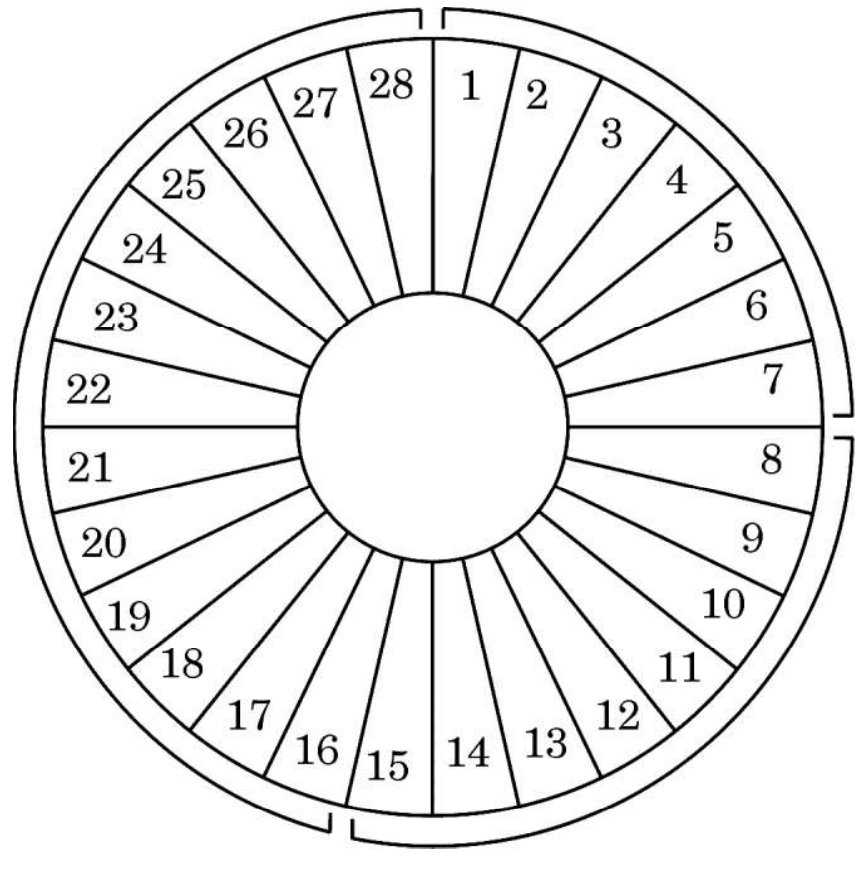
(i) What are the suitable technical terms used for the following ? (1) Days 1 – 7 (2) Days 8 – 12 (3) Days 16 – 28 (4) Days 13 – 15
(ii) Explain the role of ovarian and pituitary hormones during the following time periods : (1) Days 8 – 12 (2) Days 13 – 15 (3) Days 16 – 28
Solution
(i) (1) Days 1–7: menstrual phase (menses). (2) Days 8–12: follicular (proliferative) phase. (3) Days 16–28: luteal (secretory) phase. (4) Days 13–15: ovulatory phase (ovulation about day 14).
(ii)
| Days | Pituitary hormones | Ovarian hormones |
|---|---|---|
| 8–12 | LH and FSH rise gradually and stimulate follicular development and secretion of estrogens by the growing follicles | Estrogens cause regeneration (proliferation) of the endometrium |
| 13–15 | LH and FSH peak; the LH surge causes rupture of the Graafian follicle and release of the ovum (ovulation) | Estrogen is at its peak; the endometrium keeps thickening |
| 16–28 | LH maintains the corpus luteum | The corpus luteum secretes large amounts of progesterone, which maintains the endometrium for implantation. If there is no fertilisation, the corpus luteum degenerates, progesterone falls and menstruation starts. |
Given below is a diagrammatic representation of a human ovum.
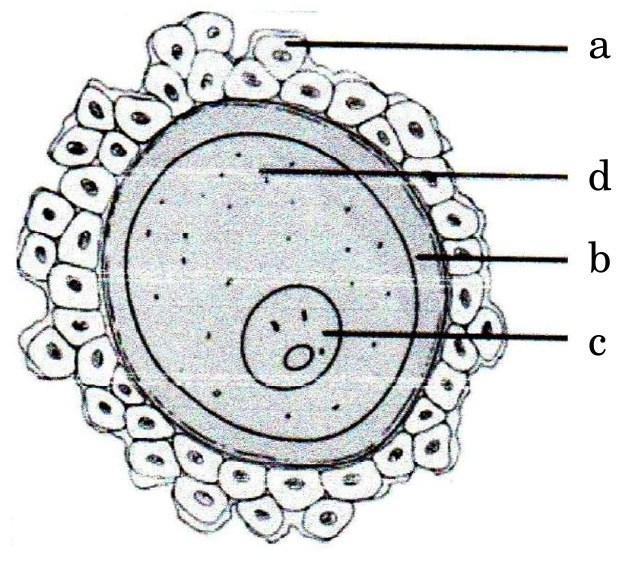
(i) Identify the parts 'a', 'b' and 'c'.
(ii) This ovum is released from the ovary with incomplete meiotic division. When, where and how is the meiotic division completed ?
(iii) How does an ovum ensure the entry of a single sperm during fertilisation ?
(a) Draw a sectional view of a human ovary and label primary follicle, tertiary follicle, Graafian follicle and corpus luteum in it.
(b) Name the gonadotropins and explain their role in oogenesis and the release of ova.
(a) Draw the sectional view of a seminiferous tubule of human. Label its any six parts.
(b) Name the pituitary hormones involved in the process of spermatogenesis. State their functions.
(a) Mention the events that, lead to the development of placenta during pregnancy in human females.
(b) Explain the role of placenta during pregnancy including its action as an endocrine organ.
(a) Explain menstrual cycle in human females.
(b) How can the scientific understanding of the menstrual cycle of human females help as a contraceptive measure ?
(a) Explain the following phases in the menstrual cycle of a human female: (i) Menstrual phase (ii) Follicular phase (iii) Luteal phase
(b) A proper understanding of menstrual cycle can help immensely in family planning. Do you agree with the statement? Provide reasons for your answer.
(a) Explain the menstrual phase in a human female. State the levels of ovarian and pituitary hormones during this phase.
(b) Why is follicular phase in the menstrual cycle also referred as proliferative phase ? Explain.
(c) Explain the events that occur in a graafian follicle at the time of ovulation and thereafter.
(d) Draw a graafian follicle and label antrum and secondary oocyte.
Get every solution for all chapters
- Every board question of every chapter, each fully solved the way the board gives marks
- 19 complete board papers, each followed by its solutions
- Weightage and most-asked topics for every chapter
- Instant PDF download, colour and black & white print copies
Revising the chapter first? Complete Biology Notes for Class 12 (NCERT 2026-27, CBSE Board 2027) →
What you get in the pack
- Questions from 122 CBSE papers, 2016 to 2026: every set code available
- Complete: 2114 different questions and parts from all set codes, 13 chapters and 19 full papers
- Part A: all 13 chapters, questions sorted chapter-wise and by marks
- Year-wise weightage table and most-asked topics for every chapter
- Part B: 19 full board papers, each followed by its complete solutions
- Labelled diagrams, Punnett squares, crosses and flow charts drawn in full
- Questions on topics out of the board syllabus flagged
All chapters in this pack
- PYQ Ch 1 Sexual Reproduction in Flowering Plants
- PYQ Ch 2 Human Reproduction
- PYQ Ch 3 Reproductive Health
- PYQ Ch 4 Principles of Inheritance and Variation
- PYQ Ch 5 Molecular Basis of Inheritance
- PYQ Ch 6 Evolution
- PYQ Ch 7 Human Health and Disease
- PYQ Ch 8 Microbes in Human Welfare
- PYQ Ch 9 Biotechnology: Principles and Processes
- PYQ Ch 10 Biotechnology and its Applications
- PYQ Ch 11 Organisms and Populations
- PYQ Ch 12 Ecosystem
- PYQ Ch 13 Biodiversity and Conservation
- Board Paper 2026 Set 57-1-1 with Solutions
- Board Paper 2026 Set 57-1-2 with Solutions
- Board Paper 2026 Set 57-1-3 with Solutions
- Board Paper 2026 Set 57-2-1 with Solutions
- Board Paper 2025 Set 57-4-1 with Solutions
- Board Paper 2025 Set 57-5-1 with Solutions
- Board Paper 2024 Set 57-1-1 with Solutions
- Board Paper 2024 Set 57-2-1 with Solutions
- Board Paper 2023 Set 57-1-1 with Solutions
- Board Paper 2023 Set 57-3-1 with Solutions
- Board Paper 2022 Term 2 Set 57-2-1 with Solutions
- Board Paper 2022 Term 2 Set 57-4-1 with Solutions
- Board Paper 2020 Set 57-1-1 with Solutions
- Board Paper 2020 Set 57-2-1 with Solutions
- Board Paper 2019 Set 57-2-1 with Solutions
- Board Paper 2019 Set 57-3-1 with Solutions
- Board Paper 2018 Set 57-1 with Solutions
- Board Paper 2017 Set 57-1 with Solutions
- Board Paper 2016 Set 57-1 with Solutions