
Biodiversity and Conservation: Class 12 PYQs 2016–2026 with solutions
All 31 CBSE board questions asked from Biodiversity and Conservation in 16 board papers, with the year, set and marks of each. 17 are solved free below. The Class 12 Biology PYQ Book: Solved Board Papers 2016-2026 (CBSE) has every solution, all chapters and 19 full board papers.
Subject experts: Divya Harwani (B.Sc. Biotechnology, M.Sc. Biotechnology) and Jayant Sharma (B.Sc., B.Ed.)



Free: NCERT solutions for Class 12 Biology →
Biodiversity and Conservation: board weightage
Board weightage 2016–2026
| Year | 2016 | 2017 | 2018 | 2019 | 2020 | 2022 | 2023 | 2024 | 2025 | 2026 |
|---|---|---|---|---|---|---|---|---|---|---|
| Questions | 1 | 1 | 1 | 2 | 2 | 7 | 4 | 3 | 4 | 6 |
| Marks | 2 | 2 | 3 | 5 | 8 | 20 | 9 | 8 | 16 | 8 |
Most asked topics
31 questions from 16 papers. Repeated questions are shown once with every year they were asked.
Jump to: 1 mark2 marks3 marks4 marks5 marks
1 mark: MCQ and Assertion–Reason
Select the mismatched pair :
Solution
Answer: (B)
India has more than 50,000 genetically different strains of rice, not fewer than 1000.
Which of the following sacred groves is found in Meghalaya ?
Solution
Answer: (A) Jaintia hills
The Khasi and Jaintia hills are in Meghalaya. Bastar, Chanda and Sarguja are in Madhya Pradesh and Chhattisgarh.
Select the correct option :
Solution
Answer: (A)
Biodiversity increases from the poles to the equator, so the tropics are richer than temperate areas. The other figures are swapped: Colombia has about 1400 bird species, New York about 105, and India more than 1200.
Assertion (A) : IUCN Red List helps in identifying and protecting endangered species worldwide.
Reason (R) : The list includes the species facing risk of extinction.
Assertion (A) : Loss of biodiversity can occur due to overexploitation of resources.
Reason (R) : Introduction of Clarias gariepinus in Indian rivers has led to a decline in native Indian fishes.
Human settlement often leads to habitat loss which leads to fragmentation, forming smaller patches of habitats. Select the statements that describe how a small patch differs from a large patch of the same habitat.
(i) Invasive species will never be seen here.
(ii) Population of large animals decreases.
(iii) Biodiversity decreases.
(iv) Competition from surrounding habitats increases.
2 marks: very short answer
In an ecosystem there was loss of biodiversity due to some project in that area.
(i) How will biodiversity be affected ? (2 points)
(ii) List two major causes of loss of biodiversity.
Solution
(i) Any two: plant production declines; the ecosystem's resistance to disturbances such as drought falls; variability increases in ecosystem processes such as plant productivity, water use and pest and disease cycles.
(ii) Any two of the "evil quartet": habitat loss and fragmentation, over-exploitation, alien species invasions, co-extinctions.
What factors contribute to the Amazonian rain forests in South America being the most biodiverse regions on Earth ?
Solution
Any two:
• Tropical regions have remained relatively undisturbed for millions of years, giving a long time for species diversification.
• The environment is less seasonal, relatively constant and predictable, which promotes niche specialisation.
• More solar energy is available, so productivity is higher, which supports greater diversity.
India is the seventh largest country in the world in terms of total land area including land and water. Write the value of the land area of our country (in terms of percentage) of the world. Mention then, what makes India one of the 12 mega diversity countries of the world.
Solution
India has only 2.4% of the world's land area.
Yet its share of the global species diversity is an impressive 8.1%. This high species richness (around 45,000 plant and twice as many animal species recorded), helped by its varied habitats and largely tropical location, makes India one of the 12 megadiversity countries.
Illustrate with the help of an example how introduction of an alien species turns invasive and causes decline of an indigenous species.
Solution
When an alien species is introduced, it may have no natural predators in the new area and may out-compete native species, so it turns invasive.
Example: the Nile perch introduced into Lake Victoria in East Africa eventually led to the extinction of an ecologically unique assemblage of more than 200 species of cichlid fish in the lake.
(Other examples: the African catfish Clarias gariepinus, introduced for aquaculture, threatens the indigenous catfishes of Indian rivers; Parthenium, Lantana and water hyacinth have harmed native species.)
Study the given graphs (X) and (Y) depicting the annual variation in solar radiation on Earth from January to December and answer the undermentioned questions.
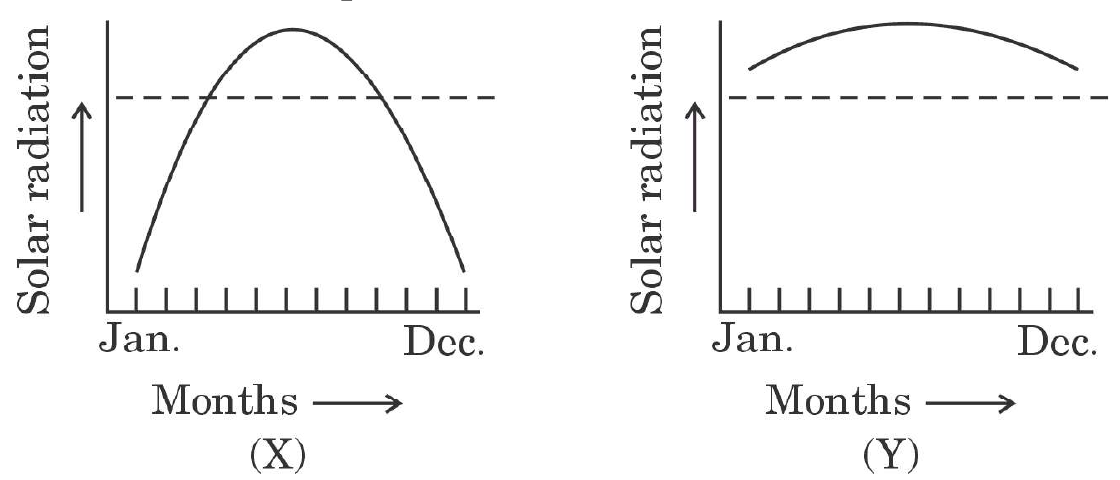
(i) Identify the graph that depicts (I) tropical region, and (II) temperate region, respectively.
(ii) Which of the two regions, (X) or (Y), will show high biological diversity and why ? Give two reasons.
State 'two' observations made by German naturalist, Alexender von Humboldt during his extensive explorations in South American jungles.
Suggest two practices giving one example of each that help protect rare or threatened species.
Why are sacred groves highly protected ?
3 marks: short answer
According to a recent wildlife report, the biggest threat to the tiger's survival in Mudumalai Tiger Reserve (MTR) was found to be a small, beautiful flower, Lantana camara, a tropical American shrub, that invaded 40% of India's tiger range. Tamil Nadu department's Lantana weed eradication drive helped to restore the dying MTR thereby also reducing human-wildlife conflicts. MTR is home to 25 species of grasses and legumes.
Answer the given questions based on the information given above.
(a) Explain how did the removal of Lantana help in restoring the dying Mudumalai Tiger Reserve.
(b) Why is the invasion of Lantana camara a cause of concern in MTR.
Solution
(a) Removing Lantana let the native grasses and legumes grow again. This increased the food for herbivores such as deer and gaur, so their numbers rose. More prey restored the tiger population, and tigers no longer had to stray into villages, which reduced human–wildlife conflict.
(b) Lantana is an alien invasive species. It spreads fast and does not let other plants grow around it, so it displaces the native grasses and legumes. Herbivore numbers fall, and so do the tigers that feed on them. Alien invasions are one of the "evil quartet" causes of biodiversity loss.
Explain how the loss of habitat and fragmentation drives plants and animals to extinction with the help of an example of habitat loss in the Tropical Rain Forest. Also write the effect of fragmentation of a habitat on the population decline.
Solution
• Habitat loss is the most important cause of extinction of plants and animals: when their home is destroyed, they lose food, shelter and breeding sites.
• Example: tropical rain forests once covered 14% of the earth's land surface and now cover no more than 6%. The Amazon rain forest ("lungs of the planet"), home to millions of species, is being cut and cleared to grow soya beans or to make grasslands for raising beef cattle. This threatens the survival of many species.
• Fragmentation: when large habitats are broken up into small fragments, mammals and birds that need large territories, and animals with migratory habits, are badly affected. This leads to population declines and extinction.
Given below is a pie chart representing global diversity of vertebrates.
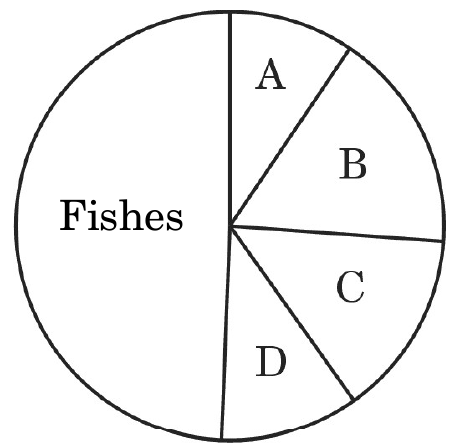
(a) Redraw the pie chart identifying the groups A, B, C and D in their respective positions.
(b) Mention two examples of recently extinct animals.
Solution
(a) Besides fishes, the vertebrate groups are birds, reptiles, amphibians and mammals. Their sizes run from birds (largest of the four) and reptiles (only a little smaller) to amphibians and then mammals (smallest). So the two larger segments are B – birds and C – reptiles, and the two smaller ones are A – mammals and D – amphibians. Redraw the chart with these labels (fishes still the largest, close to half of all vertebrates).
(b) Any two: dodo (Mauritius), quagga (Africa), thylacine (Australia), Steller's sea cow (Russia), three subspecies of tiger (Bali, Javan, Caspian).
"Some species in an ecosystem exert greater influence in driving major ecosystem services than others." How did Paul Ehrlich explain this concept in his 'rivet popper hypothesis' ?
Solution
• Ehrlich compared an ecosystem to an airplane, with all its parts joined together by thousands of rivets. The rivets are the species.
• If every passenger travelling in it pops a rivet to take home (a species becomes extinct), it may not affect flight safety (proper functioning of the ecosystem) at first.
• But as more and more rivets are removed, the plane becomes dangerously weak over time.
• Which rivet is removed also matters: losing rivets on the wings (key species that drive major ecosystem functions) is a more serious threat to flight safety than losing a few rivets on the seats or windows inside.
(i) How has the introduction of Nile Perch into Lake Victoria in East Africa had a devastating effect on the indigenous species in the lake ?
(ii) Name two invasive weed species which have posed a threat to the existence of our native species.
Solution
(i) The Nile perch, introduced into Lake Victoria, eventually led to the extinction of an ecologically unique assemblage of more than 200 species of cichlid fish in the lake.
(ii) Any two: carrot grass (Parthenium), Lantana, water hyacinth (Eichhornia).
Given below is a picture of a natural large habitat that is being continuously broken into smaller patches. This process is continuing, increasing and expanding over time due to human impact, thereby posing a great risk to the existence of species in the habitat.
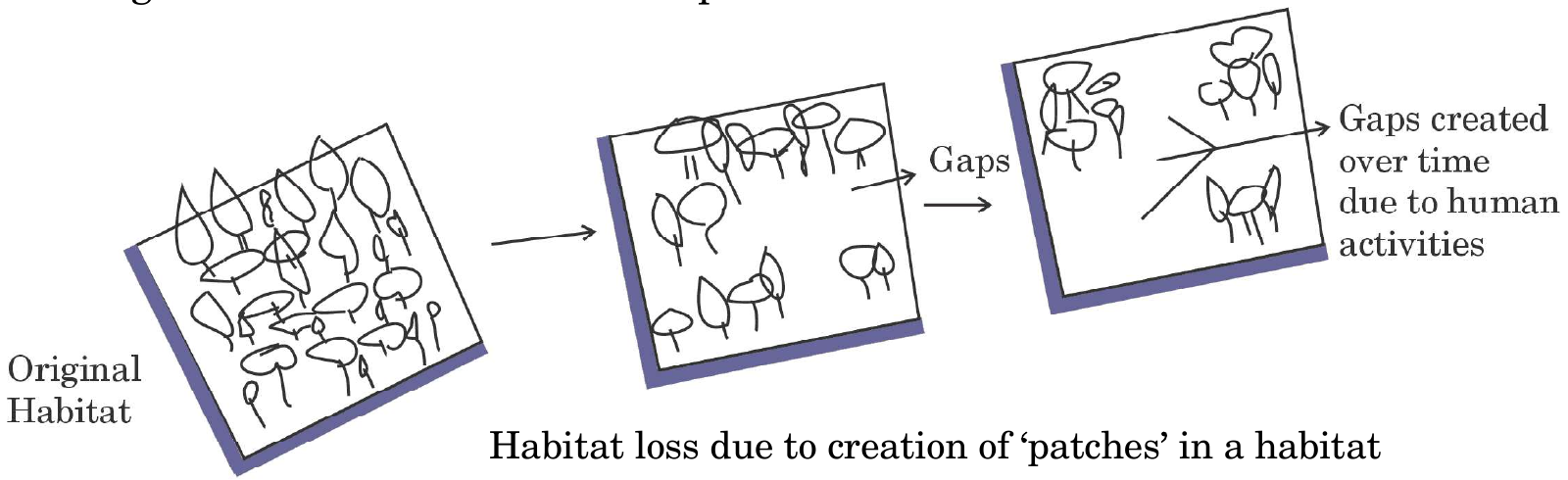
(a) Do you agree with the above statement ? Give two suitable reasons in support of your answer.
(b) Write the ecological term used for such patches formed in an original habitat.
Solution
(a) Yes.
• When large habitats are broken into small fragments, mammals and birds that need large territories, and animals with migratory habits, are badly affected, so their populations decline.
• Habitat loss and fragmentation are the most important cause of extinction of plants and animals (e.g. the Amazon rain forest cleared for soya beans and cattle).
(b) Fragments (habitat fragmentation).
The graph given below shows species-area relationship of a certain region.
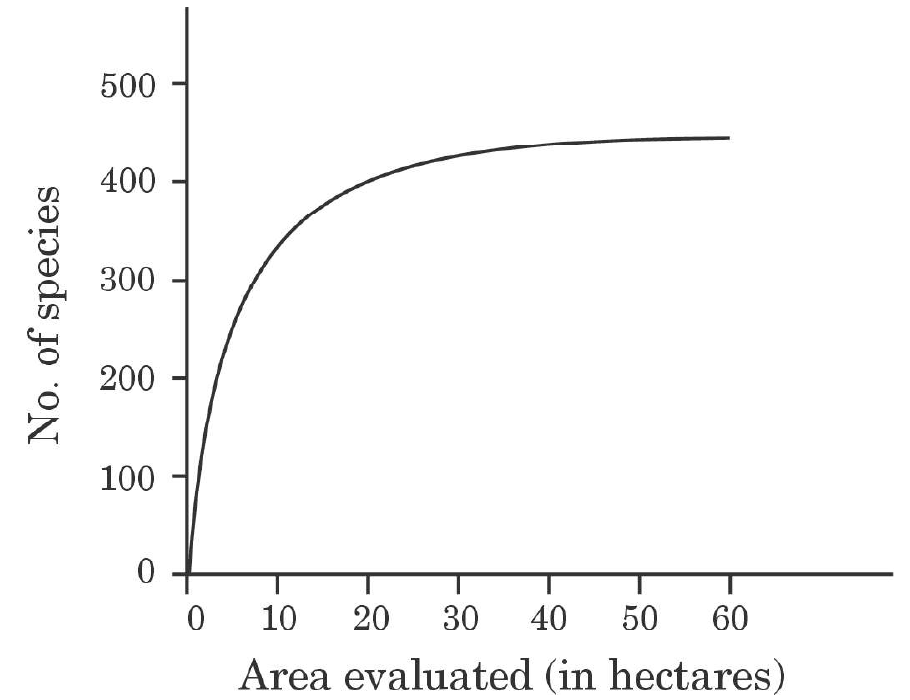
(i) Study the graph and explain what it represents.
(ii) After a while, a small area was taken for constructing a road which divided the region into two. Write the impact this construction would have on species richness of the region.
How did Dr. David Tilman relate experimentally, the stability of a community and its species richness ? Explain.
What are the consequences of loss of biodiversity in a region ? Explain.
Alien species invasion has been a threat to biodiversity. Justify with the help of a suitable example. List any other three causes responsible for such a loss.
Analyse the effects of 'Alien species invasion' on the biodiversity of a given area. Provide two examples.
(a) "India has greater ecosystem diversity than Norway." Do you agree with the statement ? Give reasons in support of your answer.
(b) Write the difference between genetic biodiversity and species biodiversity that exists at all the levels of biological organisation.
4 marks: case-based / source-based
Isn't it incredible that India's land area is only 2·4 per cent of the world's total land area whereas its share of the global species diversity is an impressive 8·1 per cent ! However, in these estimates of species, prokaryotes do not figure anywhere. Biologists are always keen on collecting data with respect to species diversity observed in different regions of the world. The data collected based on the survey conducted for species richness of groups of mammals in three different regions of the world is shown in the bar graph given below :
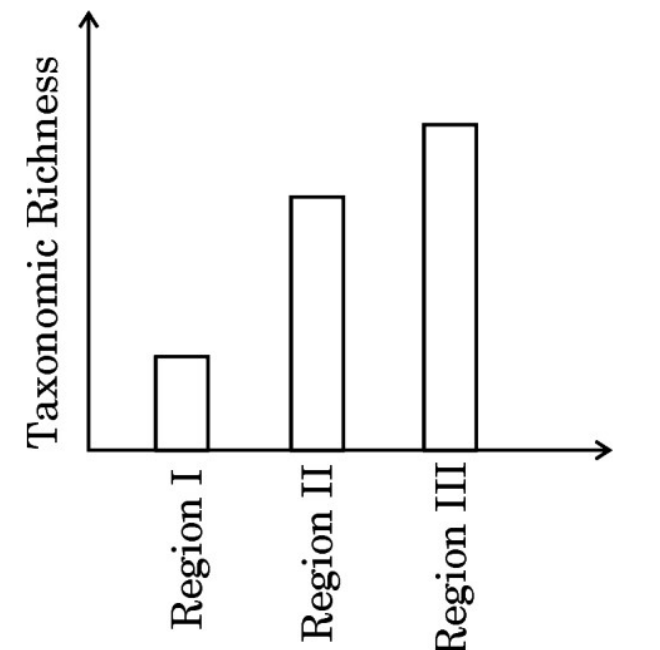
(a) Why is the species richness maximum in Region III in the bar graph ? (1)
OR
(a) Why is the species richness minimum in Region I in the bar graph ? (1)
(b) Plants and animals do not have uniform diversity in the world but show rather uneven distribution. Mention what this kind of diversity is referred to as. (1)
(c) Why is it that prokaryotes do not have an estimated number of their species diversity as seen in plants and animals ? Explain. (2)
Solution
(a) Region III is a tropical region. Tropical latitudes have remained relatively undisturbed for millions of years, so they had a long evolutionary time for species diversification. Their environment is less seasonal, more constant and predictable. More solar energy is available, giving higher productivity and so higher diversity.
OR (a) Region I is a temperate (high-latitude) region. It was subjected to frequent glaciations in the past, so it had less evolutionary time for diversification. Its environment is more seasonal and less predictable. It receives less solar energy, so productivity and diversity are lower.
(b) Latitudinal gradient in diversity: species diversity decreases as we move away from the equator towards the poles.
(c) Conventional taxonomic methods are not suitable for identifying microbial species, and many species are simply not culturable under laboratory conditions. Their diversity cannot be estimated by the usual methods, even though it may run into millions (biochemical and molecular methods are needed).
Study the diagrammatic representation given below of the Earth with regions marked 'A' and 'B' respectively. Answer the questions that follow.
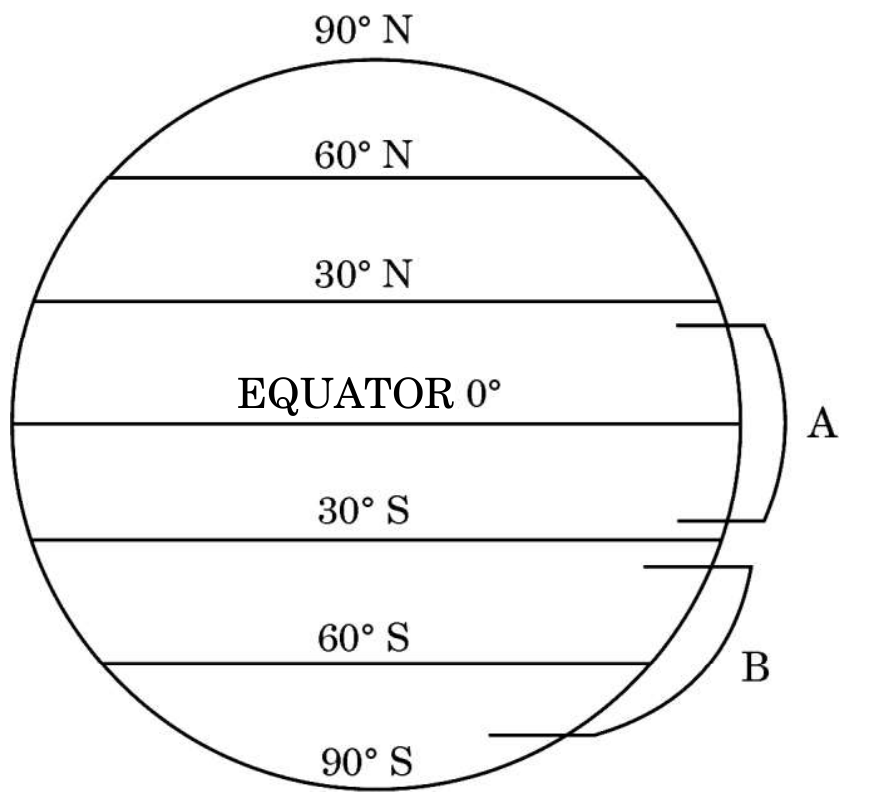
(a) Write the observations made regarding the species diversity when moving from region 'A' to region 'B'. Give two reasons also. (3)
(b) Stating the reason, mention the approximate number of bird species recorded in India. (1)
OR
(b) Name the region in the world that records the greatest biodiversity and mention why. (1)
Solution
(a) Species diversity decreases as we move from region A (the tropics, 23.5° N to 23.5° S) to region B (towards the pole). Reasons (any two):
• The tropics have remained relatively undisturbed for millions of years, giving a long evolutionary time for species diversification. Temperate regions faced frequent glaciations.
• Tropical environments are less seasonal and more constant and predictable, which promotes niche specialisation.
• More solar energy is available in the tropics, so productivity and diversity are higher.
(b) India has more than 1200 species of birds, because most of the Indian land mass lies in the tropical latitudes.
OR (b) The Amazonian rain forest in South America has the greatest biodiversity, mainly because it lies in the tropical region and has stayed undisturbed for a long time.
5 marks: long answer
(i) Explain the Species-Area relationship within a natural forest and also predict the nature of graph when species richness is plotted against the area for a wide variety of taxa.
(ii) Depict the graphical relationship between species richness and area.
(iii) Give the equation of the Species-Area relationship for a wide variety of taxa on a logarithmic scale.
Solution
(i) Alexander von Humboldt observed that within a region, species richness increases with the explored area, but only up to a limit. For a wide variety of taxa (angiosperms, birds, bats, freshwater fishes), the plot of species richness against area is a rectangular hyperbola. On a log–log scale the relationship is a straight line.
(ii) 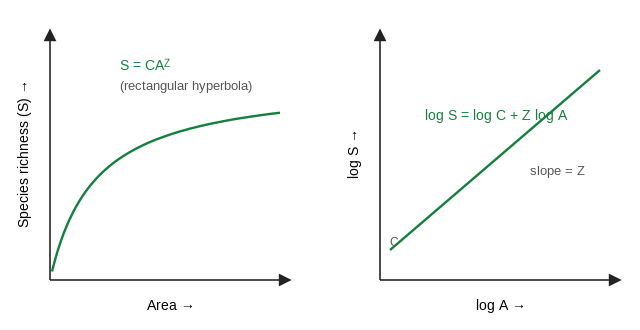
(iii) , i.e. on a logarithmic scale:
where S = species richness, A = area, Z = slope of the line (regression coefficient), C = Y-intercept. Z usually lies between 0.1 and 0.2. For very large areas such as whole continents, it is steeper (0.6 to 1.2).
(i) Explain the conclusion drawn by Alexander von Humboldt during his extensive explorations in the wilderness of South American jungles.
(ii) Give the equation of the Species-Area relationship.
(iii) Draw a graphical representation of the relation between species richness and area for a wide variety of taxa such as birds, bats, etc.
Solution
(i) Humboldt observed that within a region, species richness increased with increasing explored area, but only up to a limit. For a wide variety of taxa (angiosperms, birds, bats, freshwater fishes), this relationship is a rectangular hyperbola.
(ii) , or on a log scale , where S = species richness, A = area, Z = slope of the line (regression coefficient), C = Y-intercept. Z is usually 0.1–0.2, and 0.6–1.2 for very large areas such as continents.
(iii)
There is a great concern all over the world to conserve biodiversity for maintaining ecological balance in nature. Explain giving three reasons. Write different ways that have helped in increasing tiger population in our country.
Get every solution for all chapters
- Every board question of every chapter, each fully solved the way the board gives marks
- 19 complete board papers, each followed by its solutions
- Weightage and most-asked topics for every chapter
- Instant PDF download, colour and black & white print copies
Revising the chapter first? Complete Biology Notes for Class 12 (NCERT 2026-27, CBSE Board 2027) →
What you get in the pack
- Questions from 122 CBSE papers, 2016 to 2026: every set code available
- Complete: 2114 different questions and parts from all set codes, 13 chapters and 19 full papers
- Part A: all 13 chapters, questions sorted chapter-wise and by marks
- Year-wise weightage table and most-asked topics for every chapter
- Part B: 19 full board papers, each followed by its complete solutions
- Labelled diagrams, Punnett squares, crosses and flow charts drawn in full
- Questions on topics out of the board syllabus flagged
All chapters in this pack
- PYQ Ch 1 Sexual Reproduction in Flowering Plants
- PYQ Ch 2 Human Reproduction
- PYQ Ch 3 Reproductive Health
- PYQ Ch 4 Principles of Inheritance and Variation
- PYQ Ch 5 Molecular Basis of Inheritance
- PYQ Ch 6 Evolution
- PYQ Ch 7 Human Health and Disease
- PYQ Ch 8 Microbes in Human Welfare
- PYQ Ch 9 Biotechnology: Principles and Processes
- PYQ Ch 10 Biotechnology and its Applications
- PYQ Ch 11 Organisms and Populations
- PYQ Ch 12 Ecosystem
- PYQ Ch 13 Biodiversity and Conservation
- Board Paper 2026 Set 57-1-1 with Solutions
- Board Paper 2026 Set 57-1-2 with Solutions
- Board Paper 2026 Set 57-1-3 with Solutions
- Board Paper 2026 Set 57-2-1 with Solutions
- Board Paper 2025 Set 57-4-1 with Solutions
- Board Paper 2025 Set 57-5-1 with Solutions
- Board Paper 2024 Set 57-1-1 with Solutions
- Board Paper 2024 Set 57-2-1 with Solutions
- Board Paper 2023 Set 57-1-1 with Solutions
- Board Paper 2023 Set 57-3-1 with Solutions
- Board Paper 2022 Term 2 Set 57-2-1 with Solutions
- Board Paper 2022 Term 2 Set 57-4-1 with Solutions
- Board Paper 2020 Set 57-1-1 with Solutions
- Board Paper 2020 Set 57-2-1 with Solutions
- Board Paper 2019 Set 57-2-1 with Solutions
- Board Paper 2019 Set 57-3-1 with Solutions
- Board Paper 2018 Set 57-1 with Solutions
- Board Paper 2017 Set 57-1 with Solutions
- Board Paper 2016 Set 57-1 with Solutions